In recent years, major infectious diseases, such as SARS (severe acute respiratory syndrome), H1N1 influenza, and H7N9 influenza, have frequently occurred, resulting in many infections and deaths, economic losses, and even widespread panic on a worldwide scale.Reference Fan, Gao and Ding 1 - Reference Watanabe, Watanabe and Maher 4 When an epidemic occurs, the primary consideration is how to build a field hospital to diagnosis and treat disease and prevent its spread.
In January 2013, an epidemic outbreak of adenovirus occurred in China with many suspected patients. To prevent adenovirus transmission during transport and treatment of patients with suspected infection, a field hospital for diagnostic screening and treatment was set up to provide assistance. This article describes the experiences of the rescue team at the field hospital during the response to an adenovirus outbreak.
DEPLOYABLE, RAPID-ASSEMBLY SHELTER HOSPITAL
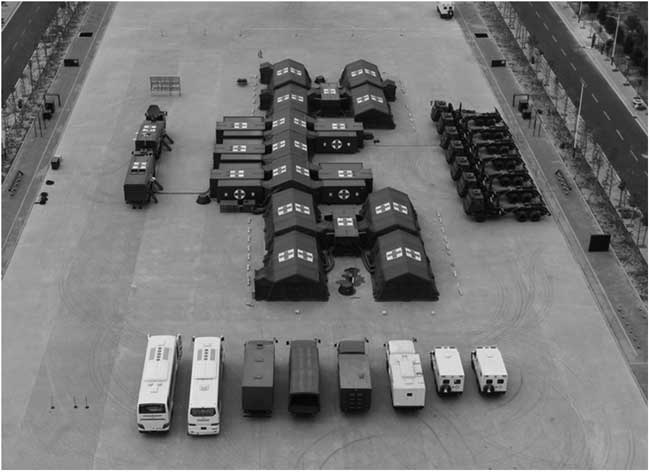
In 2012, a set of shelter hospitals was developed to provide medical rescue to Chinese domestic citizens in the event of natural disasters and public emergencies.Reference Lu, Fan and Fan 5 - Reference Ding, Hou and Fan 9 The shelter hospital is a self-contained field hospital complete with 4 units: a leadership unit, a medical rescue unit, a medical technology unit, and a logistics support unit (Figure 1). Each unit is composed of multiple shelters that can be loaded and unloaded by an automated device and transported by vehicle (Table 1).
The Shelter Hospital.

Composition of Each UnitFootnote a

a Abbreviations: CT, computed tomography; ICU, intensive care unit.
Multiple resources have been developed for the shelter hospital, including a national search and rescue team, which was established in 2001 and had responded to provide aid in a series of disasters, such as the super earthquake that struck Haiti in 2010.Reference Hou and Fan 10 - Reference Cao, Hou and Fan 13 The team is highly specialized and is capable of establishing a fully capable, freestanding field hospital anywhere.
CREATING A FIELD HOSPITAL
In January 2013, an epidemic outbreak of adenovirus occurred in China. More than 3000 patients with suspected adenovirus infection were in urgent need of screening. The patients with suspected infection were not permitted in the surrounding area hospitals for further examination, because adenovirus spreads easily and could infect healthy people. In such a climate, a prearranged plan is rapidly launched, according to the “Regulations on the Management of the Shelter Hospital,” which were developed as an emergency rescue response. The shelter hospital and the rescue team were sent to the area of infection to implement medical service.
Predeployment Preparation
The major purpose of the mission was rapid screening, isolation, and evacuation of patients. Before leaving for the mission, the team was informed that there would be a large number of suspected patients who would need to be ruled out for having adenovirus infection. Thus, the rescue team must anticipate what equipment would be needed. On the basis of the characteristics of the adenovirus infection and discussions among the team members about the equipment required to provide the best patient care, the needed equipment was determined modularly. The equipment included a medical command vehicle, a computed tomography (CT) shelter, an X-ray shelter, a special laboratory shelter, an oxygen and electricity supply vehicle, epidemic prevention and protection equipment, and personal gear.
PCR testing can be used to determine whether patients are infected with adenovirus. However, there is only one PCR testing device in the special laboratory shelter, which means the team could not complete a rapid screening mission in a short time. Thus, we tried to make a preliminary judgment according to the patients’ symptoms in their lungs. The CT scanner and X-ray apparatus had screening functions, and all patients were randomized to screening by either the CT scanner or the X-ray apparatus. When patients with suspected infection were transported to the base hospital, PCR was performed to make a final confirmation.
The rescue team assembled up to 59 members (ordinarily, approximately 30 members are prepared for a sudden deployment) , the vast majority of whom were medical personnel comprising doctors, nurses, pharmacists, paramedics, physician’s assistants, emergency medical technicians, X-ray technicians, respiratory therapists, and logistical personnel.
Hospital Setup
The shelter hospital and the rescue team arrived at the infection area on January 15, and the shelters were set up within 1 hour.
CT Shelter
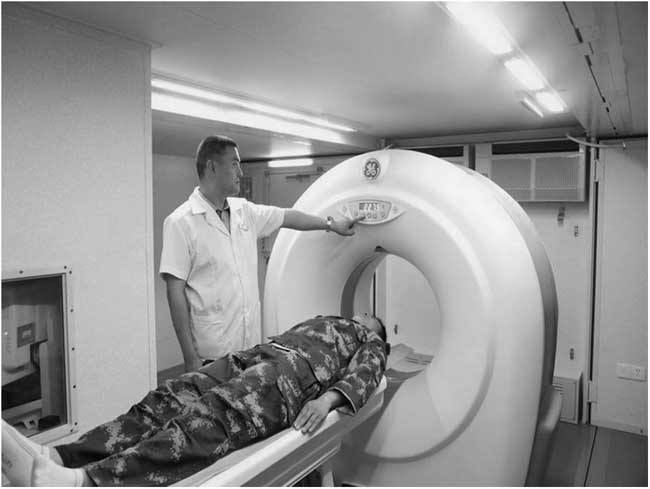
A turnover plate-type structure was used in the CT shelter design to expand the shelter’s internal space, and a Brivo CT325 CT scanner system (General Electric Medical Group, China) was installed in the interior of the shelter (Figure 2). The lungs of the patients with suspected infection were scanned to confirm that they were infected. The images acquired by the CT scanner system were reconstructed and transferred to a database via shared networking, and doctors in the shelter hospital could easily access the images by using a communication device.
The Interior of the Computed Tomography Shelter.

X-ray Shelter
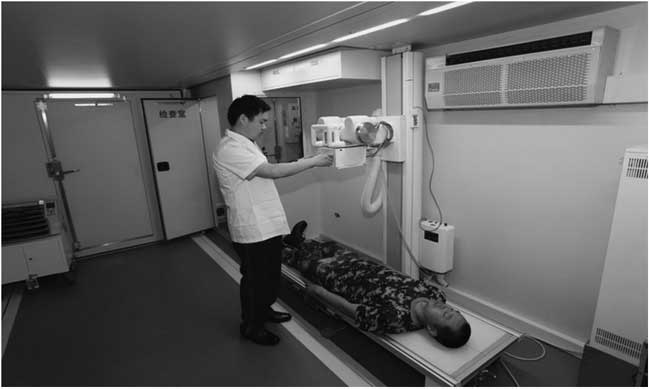
This shelter had the same structure as the CT shelter and was equipped with an on-board DR image diagnosis system, a mobile DR image diagnosis system, an image processing transmission system, and other medical devices (Figure 3) that could be applied to perform X-ray examinations and to diagnose suspected patients.
The Interior of the X-Ray Shelter.

Special Laboratory Shelter
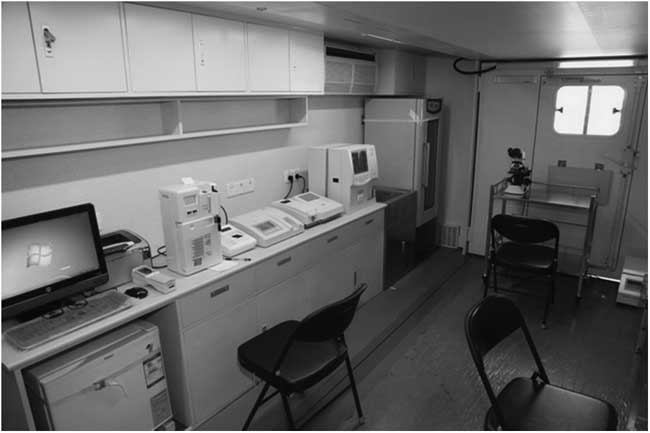
This shelter was configured with many medical devices, including a digital color ultrasound machine, an electrocardiograph machine, a biochemical analyzer machine, a blood gas analyzer machine, an urine analyzer machine, an electrolyte analyzer machine, and a coagulation analyzer machine (Figure 4), which could be used to perform blood, blood biochemistry, bacteria, ultrasound, and electrocardiograph examinations.
The Interior of the Special Laboratory Shelter.

Oxygen and Electricity Supply Vehicle
Electrical power was provided by generators installed in the vehicle. The output power of the generator was 200 kW, which was used to fulfill the following electrical demands: interior and exterior field lighting, medical device operations, and other facilities, such as air conditioning.
Medical Command Vehicle
This vehicle provided a medical command and information system support platform, which could be used to monitor field operations, for communications, for remote consultations, and for synchronous transmission of audio and video. To realize the above functions, the following information devices were integrated: History Information System (HIS), Laboratory Information System (LIS), Picture Archiving and Communication Systems (PACS), Voice over Internet Protocols (VoIP), and International Maritime Satellite Telephone.
CHALLENGES WITH INFECTION TREATMENT
Treatment Mode
An innovative new mode of treating adenovirus infection, “field screening, observation in temporary wards, and transportation to base hospital,” was presented and applied, and significant success was achieved. During field screening, suspected patients were sent to the shelter hospital to undergo a series of medical inspections and doctors diagnosed patients on the basis of the inspection results. Observation in a temporary ward involved placing patients suspected of having adenovirus in a temporary ward for observation while waiting for further medical results. Transportation to the base hospital involved transporting critical patients to the base hospital for further comprehensive treatment. This process allowed the patients to obtain early diagnosis and treatment while effectively preventing the omission of critical patients.
Schedule
The shelter hospital was open 24 hours a day, and all medical devices were in continuous working condition. Rescue team members were assigned 12-hour shifts; however, the majority of team members often worked much longer shifts because of the large number of patients.
Experience
Because of the large number of patients with suspected infection who needed to be screened in such a short time, we observed the shadows in their lungs to make a preliminary judgment as to whether they were infected. We did not have enough time or enough facilities to scrutinize every patient, because about 1000 suspected patients needed to be inspected. If PCR examination had been performed for every suspected patient, some patients may have died or spread the disease to others. If we screened their lungs and saw some shadows, the infection was basically confirmed. Meanwhile, we would also check whether the patient had persistent high fever, cough, throat bleeding, dyspnea, and other symptoms, which contributed to the diagnosis of adenovirus infection.
Patients with suspected infection were not assigned to a specific classification of imaging modalities. Because both the CT scanner and the X-ray apparatus could be used for screening, all patients were randomized to screening by either CT or X-ray. When patients with suspected infection were transported to the base hospital, PCR was performed to make a final confirmation of infection.
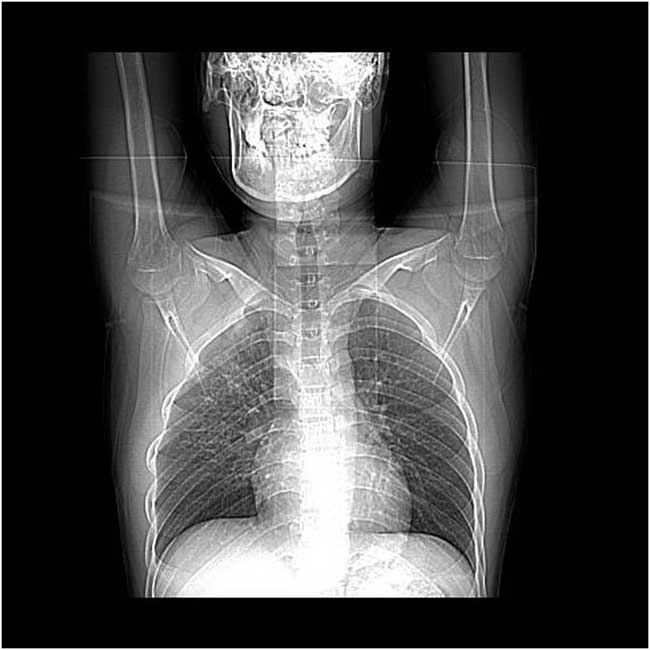
Figure 5 presents the results of a chest scan of a patient infected with adenovirus. The scan clearly shows a white, root-like shadow in the patient’s lungs, which is an obvious symptom of adenovirus infection. We made the initial determination of whether the patients were infected with adenovirus on the basis of these symptoms. Some other symptoms were also presented, like persistent high fever, cough, throat bleeding, and dyspnea; however, infiltrates were the main basis for diagnosis.
The Result of a Chest Scan of a Patient Infected With Adenovirus.

In terms of irradiation dose, the chest CT radiation dose is between 5000 and 7000 µSv, which is nearly 10 times higher than the radiation from a regular chest X-ray. But we were faced with a deadly virus, and it was only through the use of this method that we could screen the most people in the shortest period of time to ensure that patients did not die due to adenovirus.
If the suspected patients were ill, the risk of contamination of the equipment would increase. However, each team member wore positive-pressure biological protective clothing (type: HZ-ZYF-01, for military use), which is primarily suitable for those who come in contact or may come in contact with highly pathogenic microorganisms. The filters in this personal protective equipment can filter highly pathogenic microorganisms, and the filtration efficiency of 0.3-μm biological particulate aerosol is not less than 99.99%, which meets Chinese national standards (GB 2626-2006 KN100).
Two workers were infected with adenovirus. One was an emergency physician working in the quarantine area, and the other was a coordination commander in the CT shelter. Both were identified as infected in the late stage of the entire operation, and they were immediately transported to the base hospital for treatment. After 2 months of treatment, they were cured. They most likely got infected through direct contact with patients. Because we had reached the end of the action, they may not have paid attention to protection and may have had some contact with suspected patients.
From January 15 to February 6, a total of 850 people underwent CT examinations, 1142 people underwent X-ray examinations, blood specimens from 989 people were assayed, 165 people underwent observation, and 327 people were transported to the base hospital.
All patients who were infected by adenovirus were treated properly, and no deaths occurred. The infected patients were first isolated in the quarantine area. The range of treatment include anti-infection, symptomatic treatment, supportive treatment, and other comprehensive measures. Ribavirin was used to treat adenovirus though intravenous or intramuscular injection. If patients had a secondary infection, such as Staphylococcus aureus or Escherichia coli, penicillin and cephalosporin and aminobenzylpenicillin, respectively, were applied to control infection. Chlorpromazine and promethazine were used as sedative, antispasmodic, and antiasthmatic drugs. Digitalis was used to control heart failure. For patients with severe symptoms, adrenal cortex hormone therapy was applied for temporary treatment. The above treatment was the initial treatment, and most of the infected patients were transported to the base hospital to get further therapy. After emergency measures were implemented, the spread of the adenovirus was eventually controlled.
Patient Isolation
A special isolation ward for patients and health care workers was designated to isolate and treat individuals who were infected with adenovirus. The ward was composed of 2 negative-pressure isolation rooms and a risk zone. Patients were confined to the contamination room and were separated from health care workers by the risk zone, where the decontamination facilities and personal protective equipment were placed. These effective isolation measures played a significant role in containing the disease by quarantining patients and isolating infectious individuals before the patients were transported to the base hospital.
Staff Mental Health
The medical staff was prepared for a long quarantine period, hard work, and cramped living conditions. Thus, despite these stressors, the group identity engendered an esprit de corps and developed a built-in support system.
Many positive measures were implemented to relieve mental pressures. For instance, (1) expert lectures were convened and knowledge on adenovirus infection and protection was disseminated to the team. Experts in the lectures answered questions about the harm and protection of adenovirus, which enabled the team to understand the situation and not experience worry, anxiety, fear, and other emotions. (2) The situation of the team’s work and the status of the epidemic was communicated to the team every day, so that each team member had an understanding about the situation, which enabled emotional stability. (3) A psychological questionnaire designed to evaluate rescue members’ emotions was administered to team members to understand the difficulties and problems they encountered in their lives. (4) Two psychologists were sent for psychological counseling of team members. Team members who felt that they were under excessive stress were allowed to meet with a psychologist and underwent private therapy as needed. (5) Certain spiritual and material rewards were given.
DISCUSSION
In the aftermath of the epidemic outbreak of adenovirus, a rapid-assembly shelter hospital staffed with a rescue team of 59 health care workers was deployed to aid in rescue and response. In the epidemic prevention process, a new treatment mode of adenovirus infection, “field screening, observation in temporary wards, and transportation to base hospital,” was applied. This treatment mode made it easier for health care workers to determine each patient’s current status and how to address it. Thus, patients were diagnosed and treated easier. For 22 days, more than 3000 patients with suspected infection underwent initial medical diagnoses; no patient died from adenovirus infection. The spread of the epidemic was prevented, and unnecessary public panic was avoided.
The location of the adenovirus outbreak was less than 200 km away from the shelter hospital site; therefore, all personnel and equipment were transported by military off-road vehicles in 1 day. Owing to funding constraints, we can only develop road transportation methods, and all devices are placed or directly installed in the vehicles to reach the destination in the shortest time period. However, for long-distance transportation, road transportation methods will cost valuable time, which is not conducive to emergency rescue. Because of the government’s focus on disaster medicine in 2015, increased funding will be available to support our efforts, and we intend to develop air transportation methods and equipment in the future to reduce transportation time.
As a prehospital diagnosis and treatment section, the shelter hospital has significance for improving the ability to treat infectious diseases and prevent their spread. First, a shelter hospital can be applied for prehospital diagnosis and patient identification, which will reduce the workload of hospital diagnosis and treatment. Second, the shelter hospital strengthens the decontamination function in order to realize early control of the source of infection and cut off the means of transmission to prevent the spread of infectious disease in the hospital.
Because the spread of infectious diseases occurs quickly, an appropriate prearranged action plan is necessary. Our prearranged plan was developed by the government, according to the current law in China, and it included a series of rescue plans for infectious diseases, natural disasters, accidental disasters, and other emergencies. The advantages of having a prearranged plan were obvious. The rescue team can respond in the shortest period of time, and patients can receive timely and reasonable treatments. However, there were still some defects, the most obvious of which was a lack of detail. Because it is impossible for the government designer to anticipate all details, the rescue team had to improvise, perhaps not always effectively.
More CNB (chemical, nuclear, biological) protective equipment should be equipped and CNB incident rescue training should be strengthened . In recent years, there have been more and more CNB incidents. Because we cannot predict what kind of situation we will face the next time, we must prepare in advance. More equipment and strengthened training can guarantee success.
In summary, the shelter hospital is a deployable, rapid-assembly field hospital that can provide an environment in which to diagnose and treat infectious diseases. In the prevention of this epidemic, an infectious disease screening and treatment module was established, which made a tremendous contribution to controlling the spread of adenovirus. The treatment mode and the primary operation methods are worthy of detailed study and careful research to provide knowledge for the future prevention and treatment of infectious diseases.
Acknowledgment
This study was supported by the National Key Technology Research and Development Program of the Ministry of Science and Technology of China (2014BAK05B01), the Research Fund for the Doctoral Program of Logistic University of Chinese People’s Armed Police Force (PAPF) of China (WHB201413), and the Tianjin application foundation and advanced technology research project (14JCQC12600).