In mid-twentieth-century Japan, it seemed as if the body had fallen apart. In the decades leading up to the 1950s, bodies were burned, fractured, and obliterated from air raids, military service, and atomic bombs. More than 1.7 million soldiers died at war; 500,000 died in fire bombings, and a further 15 million were homeless (Orbaugh Reference Orbaugh2007, 29). By the end of the Asia-Pacific War, the notion that the Japanese state could competently control its citizens’ bodies no longer made sense in the face of such fleshy fragility (Igarashi Reference Igarashi2000, 5). For instance, male intellectuals such as nikutai bungaku (flesh literature) writers and champions of “decadence” began to question the very purpose of the body (Slaymaker Reference Slaymaker2004, 21). Social order and bodily order seemingly were “not set, and it felt possible to change the world” (Jesty Reference Jesty2018, 33).
However, these perceptions did not match an ongoing experience of control. In nikutai bungaku, female characters’ bodies were vessels for male liberation (Slaymaker Reference Slaymaker2004, 14). Moreover, beyond literature, preexisting controls placed on bodies intensified with control from the United States (Marotti Reference Marotti2013, 5). This article deals with the tension between the concept of bodily freedom and the actuality of external control.
Dance, in which bodies are vital, played an especially significant role in this debate, particularly in Noh and butoh. In Noh, a dance form that dates to the fourteenth century, women could suddenly perform. Meanwhile, butoh, an entirely new genre of dance, was being developed. Noh dancer Tsumura Kimiko and butoh dancer Motofuji Akiko were at the forefront of these changes. They used dance to determine how and why bodies mattered in postwar Japan. Their answer to why bodies mattered diverged from the false dichotomy of nikutai bungaku writers: that the body could only be disciplined either by a large-scale institution (as it had been during the war) or by individuals (in their construction of a radically free postwar era). Tsumura and Motofuji created another view, which acknowledged the persistence of large-scale mechanisms of control from the early twentieth century and the hypocrisies of the new nikutai perspective. They saw the importance of the physical body, as nikutai's champions did, but extended that importance to every body, regardless of gender, age, or shape.
Tsumura and Motofuji used dance to agitate some of the rifts, double standards, and problems they encountered. One such rift was the gap they perceived between the ever-growing consumer-oriented city and their view of a “natural” world. The second was a problem of representation: bodies that were not aesthetically pleasing or functional were pushed out of sight. I argue that observing these issues led Tsumura and Motofuji to emphasize the importance of all physical bodies, including many that had been pushed to the margins of 1950s Japan. The movement they created critiqued the social structures that pushed these bodies out of sight, and provided an alternative framing for them than those espoused by nikutai bungaku writers and other artists and intellectuals at the time.
Method
Onstage performance is a medium to exact critique and protest as well as a platform to conserve the memories and identities of those who do not usually have a social voice (Taylor Reference Taylor2003, xviii). Tsumura and Motofuji used this platform extensively. Moreover, their ideas of movement seeped into their everyday life and writings. Thus, my approach is to capture their ideas of the body through records of performance alongside daily life. I examine photographs, posters, and scripts of performances alongside an analysis of where dancers chose to dance and how they moved beyond the studio. Through an analysis of the limited images we have available, other materials surrounding those images, and a knowledge of the life experiences of these women, I hope to present a view of Tsumura's and Motofuji's ideas of “body.”
Butoh and Noh: Why View Them Together?
In 1948, Tsumura was one of the first women to become a professional Noh performer. She founded the Ryokusen-kai Noh troupe and led it until her death in 1975 (Teele, Teele, and Teele Reference Teele, Teele and Teele1993, 211). Noh, which combines dance, chanting, and narrative, is listed by UNESCO as an Intangible Cultural Heritage of Humanity (Wolz Reference Wolz1975, 26). Before 1948, wealthy women could train as amateur Noh dancers, but their lesson fees funded professional male performers rather than their own careers (Madhavan Reference Madhavan2017, 30). Tsumura's entry marked changes to which bodies could perform Noh publicly.
Meanwhile, Motofuji and her fellow dancers tried to change the purpose of dance. They created butoh, which novelist Mishima Yukio (Reference Mishima, Baird and Candelario2018, 52–53) saw as surprising because of “the way the sudden movements of the body, or the sudden shouts did not correspond to any of our everyday expectations and instead continually and exquisitely betrayed our purposive consciousness. . . . It appears that these people are seriously celebrating the fearful nightmare of the modern.” Butoh “exquisitely” betrayed the audience's preconceptions. Butoh dancers consciously tried to distort the aesthetics of other dance forms, creating movements that disturbed, rather than pleased, audiences. This became a coherent butoh aesthetic: slow movements, exaggerated expressions, mixing everyday movement into performance, and a costume of white paint (Harada Reference Harada2004, 1).
On the surface, Noh and butoh seem so disparate that they have never been analyzed together before. Noh can be seen as a fixed form, a feature of a constructed Japanese national identity; even in export, it remains “Japanese.” Conversely, butoh has become relevant to all bodies, everywhere, but particularly in Europe and America. However, seeing butoh and Noh together in the mid-twentieth century, we can move away from seeing Noh teleologically and butoh as “universal.” We do not see Noh as immutable and butoh as in flux. Instead, both are part of a story of changes to the idea of “body” and their repercussions on individual lives, particularly women's. The similarities between the ideas of Tsumura and Motofuji, which I outline next, show that some mid-twentieth-century Noh and butoh dancers thought similarly—particularly focusing on the centrality of bodies, and particularly marginalized bodies. By bringing butoh and Noh into conversation with one another, we can see these changes to the ideas of the body were part of a broader change to cultural productions and individual life—how people moved, where they were visible, and their views of sexuality. The changes to the ideas about the body were not specific to a certain dance form or art style, but were part of a broader reaction to changes that individuals experienced during this time.
Butoh, Noh, and Dance as History
We rarely read the stories of the history of the body and dance together. From the perspective of historians, dance and performance scholarship is often unrelated to history—the things that happen in training halls and onstage are not related to their surroundings (KuroDalaiJee 2010, 40). Works of history tend not to see dance as a central topic, though many scholars of Japan discuss bodies and the forces that disciplined them (Dower Reference Dower1999; Orbaugh Reference Orbaugh2007; Slaymaker Reference Slaymaker2004). Looking at the dancers in my study, I will show that they used dance to explore and rethink the purpose of the body and should be included in this narrative. Meanwhile, dance scholarship sees dance as a mirror of its context—it reflects what we already know (from the historians) is happening. Dance scholarship often focuses on aesthetics or key figures. Sondra Fraleigh's (Reference Fraleigh2016) work explains the importance of consciousness and nature in butoh, which I demonstrate came from Motofuji. Meanwhile, Noh scholars writing in both Japanese and English, such as Kanamori Atsuko (Reference Kanamori1994), Ito Maki (Reference Ito2005), and Maruki Yasutaka (Reference Maruki2013) profile Tsumura because of her role as one of the few established female Noh performers in living memory. These works of scholarship allow us to learn about figures and concepts, but they do not always explore their surrounding context. The historians miss the dance, and the dancers miss the history. In looking at the interplay between work and context, I argue that dance can go beyond mirroring context. Instead, it can act as a window into that context, something that can be opened and climbed through, helping us understand historical developments, particularly those about the body.
Several works have attempted to integrate dance and history, such as Bruce Baird's (Reference Baird2012) study of butoh and Katrina Moore's (Reference Moore2014) study of amateur Noh dancers. Still others situate dancers within broader artistic, cultural, and political movements. Takashi Morishita (Reference Morishita2014, 11–12) and Miryam Sas (Reference Sas2011, 132) map the network of associations between Hijikata Tatsumi and artists from other avant-garde. KuroDalaiJee (2010, 19–20) situates butoh within the category of “anti-art” performance artists, who shared some artistic sensibilities and can be understood by analyzing their works alongside cultural and political change. These works integrate dance into history by illustrating connections between art, their artists, and other individuals or phenomena within a particular historical moment.
However, much dance historiography, even as it traces networks of collaborators, emphasizes the role of a single individual. A key example is the cultivation of a “Hijikata myth” in butoh scholarship. Many works imply that Hijikata alone established butoh, with titles such as Hijikata: Revolt of the Body, and many refer to butoh as “Hijikata Tatsumi's butoh” (KuroDalaiJee 2010, 461). Motofuji herself somewhat engendered this myth, establishing memorials for Hijikata after his death and helping create the Hijikata Tatsumi Butoh Archive (Ashikawa Reference Ashikawa2018, 8). As a result, historiography and the realms beyond regard butoh as Hijikata's, obscuring the role of other dancers who were vital to this process. Hiromi Harada (Reference Harada2004, 8), for instance, describes Motofuji, who made essential contributions to butoh concepts, as a “dancer from the foundation period” rather than a “founder.” One of the aims of this article is to rethink the origins of butoh, joining scholars such as Vangeline (2020) and Katherine Mezur (Reference Mezur, Mezur and Wilcox2020), who recently highlighted the presence of women in butoh's development. I will apply their stance to the development of both butoh and Noh in the postwar period, challenging the “Hijikata myth” in butoh, while also showing that Tsumura was a pioneer of Noh not just because she was able to appear onstage, but also because of the way she developed Noh according to a conception of body that she shared with Motofuji. As Rebecca Copeland (Reference Copeland, Hein and Jennison2010, 59) points out, women were making art in a world “saturated with a masculine imperative”; I would like to show that women were operating within it.
Scholars of fine art, film, and performance art also use art as a way of understanding mid-twentieth-century Japan. For instance, Catherine Eubanks (Reference Eubanks2019, 5) analyzes the development of art over time to suggest that there was not a sudden break in ideas and living conditions from wartime to the postwar era. I will demonstrate later that the experiences of my historical actors confirm this analysis, for their bodies continued to be subject to the same kinds of framing and control from the wartime period into the postwar era. William Marotti (Reference Marotti2013), Justin Jesty (Reference Jesty2018), and Jessica Nakamura (Reference Nakamura2018) also look at this period to consider art as a mode of social engagement, seeing the postwar era as a period when specific cultural developments by a handful of avant-garde groups drove social change. They consider the many ways in which 1950s art could be read as social critique or direct action (Marotti Reference Marotti2013, 2). I build on these ideas by considering artistic lifestyle and daily practice to be as significant as the content of the work these dancers produced.
Another way in which my work departs from existing scholarship is in exploring butoh and Noh together as examples of movement. Butoh is often framed in art history work by the context of the postwar avant-garde, not in the context of other movements, and Noh is often seen as a stand-alone artform. Sas (Reference Sas2011, xi) observes how postwar questions of language and the “actual” were transposed onto the body with the rise of more corporeal performing arts. By focusing on corporeality and dance and joining butoh and Noh together, I am able to shift the approach of the historiography in order to pay attention to another aspect of what was at stake—one's body, and what one could do with it.
Kokutai and Nikutai
When Tsumura and Motofuji were working, there was a shift from rhetoric around the word kokutai, meaning “national body,” toward nikutai, meaning “flesh body” (Slaymaker Reference Slaymaker2004, 8, 11). In the early twentieth century, the state disciplined bodies for colonial expansion and war, in the Foucauldian sense that “basic biological features become the object of a political strategy of power” (Foucault Reference Foucault and Macey2003, 1–4). Individual bodies formed the skeletal and muscular systems that mobilized militarist Japan—all bodies were considered part of a single goal. Some examples of this kind of discipline include tokkōtai, the “suicide pilots” who were told to use their bodies inside planes as weapons; the ryōsai kenbo (“Good Wife, Wise Mother”) rhetoric that encouraged women to enlarge Japan's national body by having many children who would grow up to serve the state; and the ianfu (comfort women) system of sexual slavery, in which women—often from Japanese colonies—were imprisoned and raped by soldiers as part of a system intended to maintain military morale. Wartime institutions thus repurposed bodies to serve their interests.
Afterward, the kokutai idea of the body seemed untenable. Losing the war led to simultaneous despondence and relief, the concomitant effect of which was felt in individual bodies. Many mistrusted the institutions that had allowed this destruction, such as nikutai bungaku writer Tamura Taijirō, who wrote,
We now believe in nothing but our own bodies. Only the body is real. The body's weariness, the body's desires, the body's anger, the body's intoxications, the body's confusion, the body's fatigue. (Slaymaker Reference Slaymaker2004, 7)
Tamura Taijirō and other nikutai bungaku writers such as Noma Hiroshi and Sakaguchi Ango presented an alternative use for the body: to find individual truth. They eschewed abstract spiritual values in favor of the “carnal physicality” of nikutai, as a way to find freedom and truth through this bodily liberation (Slaymaker Reference Slaymaker2004, 9, 15). The decades following the war thus became an “age of nikutai,” in which embodiment was a way to escape domination (KuroDalaiJee 2010, 461).
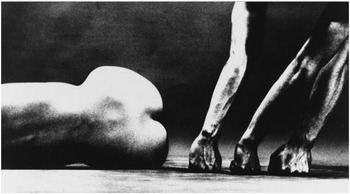
The popularity of nikutai and carnality went beyond these writers. It influenced other writers such as Mishima and photographers such as Eikoh Hosoe, whose photograph Otoko to onna (Man and woman, 1961) emphasized the physical attraction between two bodies, as seen in the image of Motofuji and her husband (figure 1).
Motofuji and Hijikata in Otoko to onna. Used with permission from the estate of Eikoh Hosoe.

These nikutai artistic developments also spilled over into kasutori culture, in which sexual expression was no longer curtailed (Dower Reference Dower1999, 107). Products of kasutori culture include nikutai bungaku, kasutori zasshi (kasutori magazines), and the emergence of striptease (Dower Reference Dower1999, 150). A group of scholars in Japan who collected a variety of images and writings of the occupation show that stripping gained popularity in Japan from 1946 (Yamamoto Reference Yamamoto2009, 10). Actor Ozawa Shōichi reflected that it allowed “we whose homes had been destroyed by air raids and who lived day and night in shelters—to have a taste of freedom” (Dumont and Manigot Reference Dumont and Manigot2016, 6). The proliferation of the female nude was not confined to the striptease; postcensorship nudity began to proliferate in various “anti-art” performances at this time (KuroDalaiJee 2010, 462).
These developments provided some opportunities for women. In 1939, Tsumura (Reference Tsumura1987, 49) “begged to know why Noh was the only traditional art form that had not yet allowed women.” It was not until 1948, alongside the shift toward nikutai ideology, that women could perform as professional Noh artists. Motofuji was also able to make a career as a dancer in this climate. Butoh dancers used the endemic sexualization of bodies to earn money—for instance, dancing nude in nightclubs (Barber Reference Barber2007, 20). Dancing for financial gain was an area in which dance and the everyday overlapped: dance was both income and art for Motofuji. Previously, the idea that a woman's body was dangerous in its capacity to seduce barred women from performing, but in the 1950s, this danger was idealized and pushed into public view in theaters, cabarets, and clubs. Suddenly, women who wanted to perform could make a viable living doing so.
However, these opportunities could be restrictive. Liberation of the body as nikutai meant objectifying an idealized female body. For instance, Motofuji (Reference Motofuji1990, 130) reflected that “the members [of her cabaret group] were me and seven men. Because there was only one woman, we were disliked by the cabarets and clubs, and so decided to welcome more women members.” There was less demand for a dancing male body than a female one. Thus, the most successful way to fund a dance career was to possess a body deemed female, and to display it nude.
There was a further paradox between nikutai rhetoric and the reality that living conditions, and overarching structures of control, remained the same from wartime to peacetime (Eubanks Reference Eubanks2019, 5). Marotti (Reference Marotti2013, 5) explores the persistence of kokutai in the postwar period, showing how Japan's emperor, kokutai incarnate, was not implicated in the postwar Tokyo Trial. The survival of the emperor indicated the persistence of kokutai, something that in 1946 angered protesters who waved signs saying “kokutai has been preserved” (Marotti Reference Marotti2013, 47). Despite the image of liberation, there was actually a continuation, and even an extra layer, of large-scale governance—kokutai—following the war.
Sex work also remained directed by a national body. The Japanese government established the Recreation and Amusement Association, which sent female sex workers to American GI districts as welcome gifts (Kramm Reference Kramm2017, 5). Many recruited women were outcasts: sex workers or poor women (Broinowski Reference Broinowski2016, 50). They were used as a protective “barrier” or “safety valve” to stop US men from accessing middle-class Japanese women, so as to protect the chastity of the nation (Kramm Reference Kramm2017, 5). These women were thus a disposable limb of kokutai, sacrificed to protect women who were part of productive families. Thus, the bodies of sex workers remained directed, at least in part, by a larger authority.
Meanwhile, the bodily conditions for many did not change in the immediate postwar period. Food and shelter—things needed for bodily survival—were scarce during the war, and remained so after. Although the perceived liberation of the body within nikutai culture allowed new ways of working for women, it came with both persistent and new limitations on gendering and the body. Tsumura and Motofuji contended with conflicting ideas: first, that everyone was now enormously free; and second, that many were still hungry, still homeless, and still subject to the same type of ruling authority.
Body over Mind
Tsumura's and Motofuji's ideas departed from the dominant kokutai-to-nikutai narrative. They did, however, share the idea at the core of nikutai, that “only the body is real,” that only through the physical body can one experience the world. Tsumura's and Motofuji's views and actions show that they helped craft a way of moving that used the physicality of the body as a basis. Because of the centrality of the body, both dancers saw the need to “empty out” the body of any occupying thoughts (Broinowski Reference Broinowski2016, 12). This philosophy relied on a mind-body distinction that cherished body over mind. Though the distinction between a thinking mind and a moving body is a construction, and not the only philosophy of consciousness at play in the twentieth century, many mid-twentieth-century Japanese artists postulated that a person comprised a thinking part and a moving part. As we saw in Tamura Taijirō's essays, in early twentieth-century Japan (and many other times and places), “thought,” or the mind, was given precedence. The mind thinks and disciplines the body. The body, meanwhile, is a collection of wants that distract from thinking. Dancers of the 1950s maintained that mind and body were separate but inverted the value placed upon them. The body was the important thing; the mind got in the way. The explicit aim of Tsumura and Motofuji was to forget the sense of self they located in the mind, and thus the body could move in new ways. Ashikawa Yoko, a widely known female butoh dancer, described this process in her essay “A Room with a View of a Grave”:
Memory, recollection, and the unconscious belong to the class of things gathered and made, while the ideas that belong to the body can travel to any depth or distance, to the farthest extremes of light and dark. If one can return again and again from where one has gone, if one can know the route of going and returning, one can be reborn at will from the edge of darkness. (SU-EN Reference Baird and Candelario2018, 212)
What Ashikawa discusses here, first, is the difficulty of an individual reaching their body; individuals must take a journey and return from it. The way that an individual mind sees its connected body comes with layers of bias that stops one from seeing the body clearly. Ashikawa also undermines the potency of thought—“memory, recollection, and the unconscious”—types of thinking that she views as fleeting and unreliable. These are contrasted with the ideas that belong to the body, which can “travel to any depth or distance.” She describes a process of reaching inside the body and tracing the journey it takes to get inside and come back. This is something that can only be done if ideas of aesthetic beauty, and of thought (memory, recollection, one's unconscious), are abandoned. This annihilation of the self is the way to find new ways of moving and to get at knowledge of the body, which had been subverted during the war.
Both Tsumura and Motofuji foregrounded the importance of the body. Motofuji described several instances when dancers slipped into a state in which they were “forgetting themselves.” One example is when Motofuji first “discovered” Ashikawa Yoko, a student who apparently had never danced before. When Ashikawa said that she wanted to dance, Motofuji danced with her. Ashikawa was “dancing and losing herself in it” and looked as if she did not know when she was going to stop (Motofuji Reference Motofuji1990, 165). It was as though the movements took over their bodies and moved them. From this encounter, and the excitement that she sensed in Ashikawa's movement, Motofuji saw Ashikawa's potential (Motofuji Reference Motofuji1990, 165). Moving without consciousness of direction allows individuals to find another sense of reality and could lead them to create something.
Tsumura also saw the need to move as an unconscious body when she “became” different characters. She forgot her own “self,” and the way that her body usually moved, to move as if she were something else:
When I dance, there should not be any part of myself recognized as if I am performing some conventional form. Transcending the form and forgetting everything including my arms and legs or any thought of how I am perceived, I become true to myself and able to dance. (Tsumura Reference Tsumura1987, 36)
Her characters expressed the importance of the flesh body and of the desire to suspend a sense of self to gain knowledge and understanding. A priest in her play Fumigara (1950), for example, tells the protagonist and the audience that “if one is to achieve enlightenment in the flesh it is through leaning that suffering is what it is because it is experienced physically” (Teele, Teele, and Teele Reference Teele, Teele and Teele1993, 215). Enlightenment here is not framed as enlightenment of thought, but of the flesh body itself, and physical experience is the only way to achieve this. Moreover, the protagonist, whom Tsumura herself danced, cries out: “Indeed, in truth that is just what I pray for! To give up the self!” (Teele, Teele, and Teele Reference Teele, Teele and Teele1993, 215). Tsumura's personal reflections, and her own choreographies and plays, emphasize the importance of physical experience, and of abandoning a sense of “self” in favor of this.
Moreover, when Tsumura performed Ataka in 1939, she did so in ordinary clothes after the costume donor refused to give her the costumes at the last minute (Tsumura Reference Tsumura1987, 49). She used her movements alone, on an unornamented, ordinarily clothed body, to tell the story. It seems she had to empty out her own character from herself and move completely as if she were another person, beyond merely dressing up as them and wearing a mask to represent them. In her movements, she fully embraced the idea of self-annihilation to better her art.
We can get an idea of what this kind of self-annihilated body looks like from images of the two dancers. In photographs, it is perhaps more within the domain of the photographer than the photographic subject to frame the scene. However, dancers are performers, and these dancers conveyed the centrality of the body so much that their photographers may have felt compelled to capture it. For instance, Motofuji was captured by avant-garde photographer Eikoh Hosoe for his work Sōseiki: Wakaki hi no Geijutsukatachi (Portraits: Artists’ Younger Days, Reference Hosoe2012). In this piece, he sought to capture postwar artists in the moments they were working. His photographs of Motofuji show her as a choreographer and teacher, rather than a performer, in contrast with other artists whom he photographed performing onstage or in their studios. In one image, Motofuji seems to be thrusting (in the present-continuous tense, very much in motion) her thumb in one direction, instructing her students to lift their legs (Hosoe Reference Hosoe2012, 90). The photo was taken to make her appear in the midst of motion, and the focus seems to be on particular body parts—her thumb, the dancer's legs. Hosoe portrays Motofuji as focused on the body, as part of the formative process that led to producing dance, rather than showing the polished final product of her performing onstage.
Meanwhile, several images of Tsumura survive, mostly of her in performance. In one image, she performs with Ryokusen-kai (Maruki Reference Maruki2013, 168). As with Motofuji's image, it seems that Tsumura is in the midst of motion: her feet seem to be performing suriashi, a sliding walk essential to Noh movement. She also seems to be in motion compared with the men sitting in stillness behind her, and she takes a powerful stance, arms and feet both spread wide. Her movement, elevation, and stance draw attention to her, a body that had been marginalized in this art form until relatively recently. Thus, this photograph shows us the centrality of the physical body in Tsumura's concept of body, as well as her desire to bring attention to the marginalized, which I will elaborate next.
Self-annihilation can only be achieved through movement, so Tsumura and Motofuji used dance to emphasize the importance of the physical body, by trying to remove all traces of a thinking mind. The importance of body in how these dancers moved created a platform for their dances to critique their circumstances and suggested ways to improve them.
The City
In postwar Japan, Tsumura and Motofuji observed many problems that the idea of nikutai could not solve. One of these was the rift between new, “liberated” spaces such as cabarets and the rise of consumer lifestyles, although they were compounded into one urban landscape.
Motofuji experienced these problems firsthand. Her family home was firebombed in 1943, and she was one of the many girls mobilized to work in munitions factories as part of the war effort; the destruction created a “whirlpool of chaos” (Motofuji Reference Motofuji1990, 27–30). The places she lived allowed her to explore what she saw as the “darker” side of humanity, a dark side that flourished in her increasingly urbanized world:
If you get off at Koganecho station there is a small river flowing, called Kobu; even at noon it is dark on both sides, and shops are lined up on the slopes. The Kobu river emits a horrible smell, and the houses are like brothels. . . .
When dawn broke, we noticed a strange atmosphere around us. This apartment, that was so quiet when we moved in, shone like a light-trap and was boisterously noisy when dawn broke. This apartment was for gay people and prostitutes. . . . I began to hate being alone at night. A sobbing began in our neighbours’ room. It continued for ages and eventually stopped, and with it our long day also ended. (Motofuji Reference Motofuji1990, 86–88)
She drew attention to the griminess of the city. Urbanization had taken place in Japan for centuries, and in the 1950s, this ongoing growth was coupled with material consumption. City environments, where acquiring things became an important marker of social status, facilitated this (Yoshimi Reference Yoshimi2003, 433). In the late 1950s, many households were able to consume electronic products and enter the “middle class” (Papp Reference Papp2012, 201). Consumption increased and daily life became, supposedly, depoliticized—with individuals drawn into fulfilling their own extraneously manufactured desires (Marotti Reference Marotti2013, 3). One of the electronic objects that became widely available was the television, a gadget that could capture the total attention of viewers—a precursor to our social-media-dominated existence today. Motofuji's husband, Hijikata, summarized the problem with this, decrying “the Japanese in front of their televisions who skip over reality in a short circuit of the structure of the world” (Sas Reference Sas2011, 166). Consumption was increasing, and it had a numbing effect, diminishing individual bodily experiences of their surroundings. Moreover, the improvements to standards of living which this consumption supposedly provided were “built on ill-gotten spoils of war”—encouraged by the determination of the Supreme Commander for the Allied Powers (SCAP) to bring its interpretation of democracy to a defeated Japan (Eckersall Reference Eckersall2006, 74). Thus, a gap continued to widen between the veneration of cities and a consumer lifestyle, and the problems—poverty, bodily numbness, the people funding urban growth, and the sadness associated with all of this—that Motofuji saw within them.
These problems inspired ankoku butoh, the “dance of utter darkness” that she developed to critique this world. Often, the creation of ankoku butoh is attributed directly to Hijikata. However, Motofuji was vital in developing concepts core to ankoku butoh. First, she influenced the movement style of butoh in certain ways. For example, her influence as a classically trained dancer can also be seen in the 1959 Donald Richie film Gisei, which Motofuji starred in. Here, balletic movements blend with jarring, sharp movements as the dancers move sometimes synchronously, sometimes at the same time, but with movements exploding in different directions.
Moreover, Motofuji's ideas of nature came to underpin the ideas of butoh. Dances would portray illicit relationships, such as in Kinjiki (1959), or images of starvation, as in Hijikata Tatsumi to Nihonjin: Nikutai no Hanran (1969), using what KuroDalaiJee (2010, 461) describes as the impossibilities and grotesqueness of nikutai to show the dark sides of human nature. The word ankoku held great importance in early butoh (Harada Reference Harada2004, 1–2). However, more than displaying darkness, Motofuji wanted to present an alternative to this world. To do so, she used a focus upon the body to construct a “natural” world that could be a solution to frantic urbanization. It was through the body that one related to the world, and the ideas within butoh aimed to unravel the discipline placed upon individual bodies. They tried to disconnect the body from being a part of this society and used images from the natural world to do this. Butoh dancers thus saw butoh as a “‘body revolution’ where we take back our body and get rid of society's way of thinking” (Giannschi and Stewart Reference Giannschi and Stewart2006, 330). They used dance as a means to shape their everyday lives as a way to overcome “society's way of thinking.” For instance, dancers who joined the butoh group often moved to Asbestos Hall. They trained, ate, and slept in the same space, entirely blending their everyday lives into dance as a way to reinvent their own lifestyles (Coker Reference Coker2015, 82). Tsumura used a similar method to teach students, such as her protégé Tsumura Reijiro, who lived in her house and trained intensively with her before qualifying as a professional Noh dancer (Tsumura Reference Tsumura2008, 24).
These lifestyle changes were inspired by “nature.” Another butoh founder said that butoh dancers “resonate with animals, insects, and the spectacle of place in their own way, as also with happenings in nature” (Giannschi and Stewart Reference Giannschi and Stewart2006, 330). Butoh dancers thus tried to create a connection between their movements, lifestyle, and nature. “Nature” was a space created as an antithesis to societal constructs and to unlearn the learned behaviors of being human. It is “a foundational presence in butoh, an anchor of continuity as the butoh world continually expands and transforms” (Fraleigh Reference Fraleigh2016, 62). As well as its use in performance, Motofuji outlined moments when nature became important to butoh and placed herself as indispensable in all of them, blending her everyday life, intertwined with nature, with dance. One moment occurred when she lived in Hibiya Park. The choice of Hibiya Park was significant, as it carried resonances of protest and prostitution that Motofuji may have drawn upon. Beginning around 1946, when SCAP abolished licensed prostitution in Japan, Hibiya Park became the workplace for many unlicensed sex workers (Kramm Reference Kramm2017, 3). Moreover, Hibiya Park was a site of protest in the early twentieth century—against, for instance, the Treaty of Portsmouth and authority in 1905. These protesters inside the park were actively idle, consciously not being productive (Gordon Reference Gordon2011, 3, 9). Butoh's movements often share this purpose, being unproductive and even incomprehensible. Dwelling in Hibiya Park in the 1950s, and writing about it, made Motofuji important in creating the resonances between protest, illegality, and butoh that scholars and dancers observe today.
When going to wash each morning, Motofuji observed, “The bamboo at the edges (of the pool of water) bent gracefully, and (from this) we were made to discover new ways of moving. We were surrounded by this ‘nature-teacher’ and lived like this for a few months” (Motofuji Reference Motofuji1990, 70). Here, the use of “we” (watashitachi) indicates this was a revelation experienced by both herself and Hijikata, something shared. The root of this new way of moving comes from “natural” things: bamboo, the lake that they washed in. Motofuji translates the movement of the bamboo into human movement. The bamboo bends gracefully and seeing this sparks a way for human bodies to move, too, like a stalk of bamboo. This observation fits directly with the later veneration of “nature” within the butoh world and implies that the moment of its conception was during an intimate experience, that of washing, together. Motofuji thus inserts herself into the butoh narrative by explaining how nature came to be important, and how only she could know this because only she was present at this moment of physical intimacy with Hijikata. She explains how the focus on nature came about, and she was important to generating this focus. The way of life which made sense to her involved taking the human body and placing it within her construction of nature. This action meant that nature is important to butoh decades later.
Paradoxes of Visibility
A second issue that both dancers engaged with is visibility. Tsumura and Motofuji rejected the nikutai conception of body and attempted value-free emphasis on the importance of the body. Their framework addressed problems of visibility, using their work to bring to light sufferers of tuberculosis and leprosy, and the social stigma toward female sexuality.
First, Motofuji emphasized the ill treatment of leprosy sufferers in Japan. From 1907, the Leprosy Prevention Law forced homeless sufferers into sanatoriums; in 1931, all sufferers were placed there. Motofuji intervened in their situation in 1950, when she purchased a dance studio:
I left to find a training room, jumping for joy.
Whilst I was strolling through Meguro, I came across some wooden nameplates saying Kouzensha and Ihaien. I wondered what Ihaien was . . . ? It was a treatment centre for Hansen's disease. . . .
From what I hear, it seems that at the end of the Meiji era Ihaien was a 1500 tsubo plot of land which was maintained as a private Hansen's Disease hospital, and housed 10 patients. They were probably temporarily distracted from their loneliness with newspapers and such. . . . From the perspective of the Ihaien patients, it not nothing but a piece of paper. If I do not create opposition to this problem, I will not be able to emphasise with them and will not be able to judge their loneliness.
At that moment, passing through Meguro in the middle of the night, it seemed as though I was walking with the dejected patients.
And it seems that all the residents had a blind eye turned to them. I wonder, with what feeling did the patients speak to themselves about their own bodies, that were about to collapse—their own out-of-shape bodies, their noses, fingers, legs, hands, their falling-out hair . . . ?
And from the outside world, they only received prejudices like: “but they got compensation, didn't they?” They had to endure this tragedy from inside the hospital, cut off from the outside world, until the day of the Great Kanto Earthquake.
I remembered empathizing, “where are the innermost feelings of the Ihaien patients?” And in order to make the most of the gift my father had given me to dance, I decided to establish the Tsuda Modern Dance School on this soil, and first bought the plot of land, then built the rehearsal room. (Motofuji Reference Motofuji1990, 39–41)
In this recollection, Motofuji brought attention to this other kind of body and recognized the discrimination that it faced. More than recognizing it, she made an intervention into this issue, making the abandoned hospital the space that dancers of the Tsuda Modern Dance School, and later Asbestos Hall, would live and dance in. By buying the land that used to be a private leprosy sanatorium, and then dancing in that space, she continued to remember and empathize with those whose bodies were hidden and limited. She paid meticulous attention to the way the physical reality of these bodies shaped their experience. She did not think about how the patients must have felt, but tried to imagine the feeling of “their noses, fingers, legs, hands, their falling-out hair.” Her way of empathizing was through the body. She thought about the state that a body would be in if it were suffering from Hansen's disease, not what it would be like, but how her imagination could transform her own sense of self into experiencing what those patients had experienced. She brought attention to these marginalized bodies through movement, against the way that both kokutai and nikutai ideas of the body shunned them. This sensitivity would later be taken up in now famous butoh performances, such as Natsu no Arashi (1973), but its origins were with Motofuji and her choice of butoh site (Innami Reference Innami2021, 7).
Sufferers of another kind of sickness, tuberculosis, were subject to both stigma and glamorization. It is a disease that makes the body both pure and desirable at once; sufferers of tuberculosis were both angelicized and eroticized in works of art and literature (Sontag Reference Sontag1978, 12–20). Until the 1950s, tuberculosis was generally considered a death sentence; sufferers would lie about their condition to avoid being sent to sanatoriums, where they were not expected to recover. In Tsumura's case, as a sufferer of tuberculosis, the disease prevented her from performing between 1950 and 1968, and she also lost several siblings to the disease (Kanamori Reference Kanamori1994, 67). However, the way that she used her illness was to slip out of sight and create. Her approach to stillness contrasted with Motofuji's, showing that placing emphasis on the physical body could be carried out in a multitude of ways, and could diverge and contradict. We can see this in their attitudes to movement and stillness. Motofuji often focused on always moving. She observed the movements of small birds during her commute, noticing how they were always in motion if one looked closely (Motofuji Reference Motofuji1990, 51). She applied this attitude to her dance, and also to her lifestyle, moving homes many times while she was an active dancer (Motofuji Reference Motofuji1990, 146). Tsumura, by contrast, took moments of stillness and used them to generate new dances and movements. Though she could not practice or perform Noh dance in this period, she found other ways to contribute to the art form. She wrote several New Noh Plays (Noh works written in the twentieth century) between 1950 and 1952 and a total of ten by the 1970s (Ito Reference Ito2005, 214). This was rare in Noh, where the canon was fixed until the twentieth century (Yokata Reference Yokata, Maree and Satoh2012, 429). Though several authors penned New Noh Plays, the success and continued performance of Tsumura's plays was exceptional, indicating that she used her position as a peripheral body to bring about change in the seemingly unchanging Noh world (Yokata Reference Yokata, Maree and Satoh2012, 429). Tsumura and Motofuji illuminated bodies that were, sometimes against their will, pushed out of sight and used the stigma against these types of bodies to generate creativity.
One problem with the nikutai view was that certain bodies remained invisible. Another, which persisted from before the 1950s, was a sexual double standard. This was a moral code that permitted sexual freedom and promiscuity for men but frowned upon women who did the same. While men were rarely blamed for heteronormative sexual promiscuity, women who had multiple sexual partners, and/or those who were sex workers, faced much societal stigma. The postwar treatment of panpan is evidence of this. Panpan were sex workers, usually women, who serviced the US military and were able to earn a generous income and have some autonomy in their work (Sanders Reference Sanders2010, 416). However, their high visibility, and a shifting perception of sex work as a social evil as SCAP deregulated brothels, often meant that panpan became victims of abuse, while their customers came to no such harm (Sanders Reference Sanders2010, 416). Meanwhile, the blame for the spread of diseases among the brothels was placed entirely on sex workers (Kramm Reference Kramm2017, 106). Men were not frowned upon for visiting sex workers, yet the women they visited were shamed for their line of work.
This concept of blameless male desire and female shame existed beyond the parameters of sex work and long before the postwar period. It bled into the structures of relationships, wherein women who were sexually promiscuous were expected to feel shame. The concept was also articulated and reinforced within all kinds of cultural productions. In Noh plays, including those performed well into the twentieth century, sexual shame often became physically embodied by the central female character. A female protagonist would age, and her body would wither because of her past romantic escapades. One key example is the story of Sotoba Komachi, written by Zeami Motokiyo, considered the founder of Noh. The original play follows the story of the semimythical Heian poet Ono no Komachi—semimythical in that the poet certainly existed, but the majority of information about her is speculative (Teele, Teele, and Teele Reference Teele, Teele and Teele1993, xi). Many stories surrounding her concern either her beauty or her love affairs, the latter being a trend that Sotoba Komachi uses to explore female shame. In Sotoba Komachi, her past affair with Commander Fukakusa causes her body to decay: “these locks which were so lovely / now stick to my skin, like ink / from which the colour has run” (Teele, Teele, and Teele Reference Teele, Teele and Teele1993, 191). Reflecting on her past affairs, she sings, “Memories come which make me feel / ashamed to be in the light of the waning moon” (191). She achieves no redemption—she is possessed by Fukakusa, and this drives her insane (191). In such plays, shame is the key emotion for the central female character, and this shame causes suffering (Yamanaka Reference Yamanaka, Watson and Yamanaka2015, 60). The shame was expressed physically; Komachi's body aged, and this aging is linked to her shame-filled memories. Thus, the female body needed hiding because it revealed too much about the past of its inhabitant.
Tsumura created her own version of this story, named Fumigara (which Rebecca Teele translates as Love Letters and Gerry Yokata as Letters to the Void) (Yokata Reference Yokata2005). She wrote this play in 1950 and performed as Ono no Komachi several years later, after recovering from tuberculosis (Teele, Teele, and Teele Reference Teele, Teele and Teele1993, 211). Fumigara echoes the plot of Satoba Komachi, showing her knowledge of canonical Noh works. Moreover, because she was a skilled enough performer to dance and perform the work, she showed that she both possessed the body, and body of knowledge, to become important in the Noh world.
Her story alters the ending of the trope of shame and bodily decay, in doing so calling out the double standard that she observed in these stories and her surroundings. For instance, just as the color had run from the body of Sotoba Komachi's Ono no Komachi, in Tsumura's Fumigara, she says “even my body / as I tread through the shadows, / had begun to fade” (Teele, Teele, and Teele Reference Teele, Teele and Teele1993, 214). She also says,
Komachi feels embarrassment toward her memories, and this is shown on her body. She also explicitly points out her feelings of shame, stating that she is “pressed by the boulder of adultery” and she cannot abandon her sufferings (Teele, Teele, and Teele Reference Teele, Teele and Teele1993, 218). These sufferings are framed as sins, yet rather than descending into madness because of them, she overcomes them and is forgiven for them, reframing them as simply memories rather than transgressions. The many love letters she has received are destroyed, and with them, all feelings of shame and resentment. She is no longer as other Komachis were, and she returns home (Teele, Teele, and Teele Reference Teele, Teele and Teele1993, 219–20). According to Gerry Yokata (Reference Yokata2005), with this ending, Tsumura clarifies that the “Buddhist idea that suffering is caused by attachment, by the desire to dominate, to control, to possess, but that this is not to be confused with the idea that passion and sexual desire are wrong.” More than clarifying the Buddhist concept, I see Tsumura's play as speaking to broader societal problems of this double standard—the male ghosts who haunt her are also shown to suffer but are ultimately released. Moreover, it was Tsumura herself who performed the role of Komachi in Fumigara, meaning it was not just her script that was an instrument to subvert. She created the play, among others, from a state of stillness when suffering with tuberculosis. She was then able to enact those feelings through her own body. Moreover, Tsumura was sensitive to the knowledge that each dancer's body reacts differently to the works she created. Tsumura and her protégé, Tsumura Reijiro, adjusted Tsumura's original 1950 work for a later performance (Tsumura Reference Tsumura2008, 28). Her idea that the body is central extended into seeing each individual body as different and that movement and speech should be adjusted accordingly. Her experience of bodily marginalization gave her the space to create something to challenge these ideas; her later unmarginalized body was able to perform to shed light on this aspect of marginalization of those women considered promiscuous.
Tsumura and Motofuji both addressed the issue of which bodies could be visible in postwar Japan. Through paying attention to those bodies which were unfairly marked out or concealed by their actions, and sometimes giving their stories a different ending, they used their view of the body as a way to address hierarchies of gender and ability in postwar society.
Conclusion
What has been framed as a jarring transition from bodies directed by kokutai to those free under the jurisdiction of nikutai was not the only way that bodies were thought of and used in 1950s Japan, nor was it the reality many lived. The change in real conditions was not sudden; what changed was that some attempted to confront the gap between conditions in a new way. Tsumura Kimiko and Motofuji Akiko show that the nikutai liberation, which seemed to serve mainly male-directed ends, was not the only way that bodies were rethought. Awareness of the body's centrality remained vital to Tsumura's and Motofuji's conceptions of body, yet instead of stressing sexualized images of female bodies, they stressed the importance of every body, even those seen as undesirable or unproductive in their social order.
We can see these ideas of the body—its centrality, its ability to empty, and its ability to draw attention to inequality—in Motofuji's Leda Santai (Three phases of Leda, 1963) and Emiri no Bara (Roses for Emily, 1960). Emiri no Bara was based on a William Faulkner short story about an ostracized woman in a small town and how the townsfolk are not sure how to communicate with her. Placing this story at the center of the dance immediately brings a peripheral body to the center of the story. Meanwhile, Leda Santai was inspired by the Greek myth of Leda and brought attention to one of the many women marginalized or objectified in art and mythology. Leda was a Spartan queen whom the god Zeus had sex with in the form of a bird, and on the same day, Leda's husband also had sex with her. She gave birth to four children because of this—two from each man—but her story ends after she gives birth to those children. Motofuji chose to bring Leda's body to the centre of her dance, communicating the splitting of her body between two men by painting half of her body white, and half of it pink. In her dance, putting her body on stage in such a striking way called attention to a story of a body which was forgotten once it had been used as an object of male pleasure, and then a vessel of motherhood.
Meanwhile, the poster advertising Leda echoed Tsumura's and Motofuji's ideas of emptying the body. On the poster, Motofuji's name appeared next to the word gata, meaning “shape” or “form,” while the other dancers in the piece were yarite, meaning “doers,” “performers,” or “agents” (Motofuji Reference Motofuji1990, 117). Motofuji, who choreographed and directed the piece, was responsible for the form of the dance, shaping the bodies of the doers. From this perspective, dancing bodies were empty objects that could embody any form. In Motofuji's recollection of this performance, she described how “my spine, chest, and I” were dancing (Motofuji Reference Motofuji1990, 115). Here, it seems it was the physical aspects of the body that were part of the dance, and that Motofuji was aware of which parts of her physical body were dancing. Looking at recollections and posters of Leda santai illustrates how the importance of the physical body, empty of self, was used to shed light on a marginalized figure.
The impact of Tsumura and Motofuji's interpretations of the role of the body shared many unexpected parallels, but this impact diverged. Both paid attention to marginalized bodies, but in dissimilar contexts. Tsumura's work made an intervention into a centuries-old movement institution, rewriting the ending to an age-old story of sexual double standards. Contrastingly, Motofuji trained in another highly regulated style of dance—ballet—but instead of finding an interception into this, she helped invent an entirely new style of dance that could, in her view, better address the problems of peripheral bodies she observed. Their take on the centrality of the body, in spite of the difference in their approach, allowed these women to develop and alter the dance styles they practiced. A nonhierarchical view of the body allowed Motofuji and Tsumura to address inequalities faced by marginalized bodies through their dance. In creating these dances, both women exercised agency that has been forgotten in an obsession with male genius figures in the dance world.
Finally, and most importantly, their ideas of the body allowed them to subtly intercept and comment upon some of the aspects of postwar Japan that they observed and did not quite agree with. These include the unequal treatment of bodies that were non-male and disabled, and the growing disparity between visions of a material urban society and the problems that occurred within cities. Observing and critiquing them, Tsumura and Motofuji presented alternative ideas about how to live outside of these problems, and also tried to overcome the inequalities they observed. Their developments to Noh and butoh can be seen as a kind of resistance, but even more than fighting against the ideas of body they disagreed with, they completely remade them.
Author Bio
Alice Baldock is a DPhil researcher and dancer based at the University of Oxford. Her research focuses on the history of postwar Japan, particularly how intellectual views on the concept of body changed during this period for different people. Her focus is primarily on butoh and Noh dancers, with interests ranging from a performance art usually considered to be part of Japan's “traditional” culture to its avant-garde cousin. The historical actor-dancers she discusses are usual absent from our historical narrative. Partly due to her long-standing involvement in the dance world, and partly due to belief that when researching any kind of movement, it is also essential to move yourself, she is also a student of some genres of dance and a teacher of others.