1. The tablet
1.1. The oldest cuneiform artifact of the Musée d'Art et d'Histoire (MAH), Geneva, Switzerland, is a hitherto unpublished tablet (MAH 16070) previously in the possession of Genevan Assyriologist Alfred Boissier (Deonna Reference Deonna1939: 31).
(The seven somewhat more recent ED IIIb tablets in the MAH collection were published over 70 years ago by Edmond Sollberger (1948)). The museum catalog states the provenance of our tablet as Fāra, presumably on the basis of Boissier's lost personal catalog. Boissier's acquisition of the tablet is undocumented.
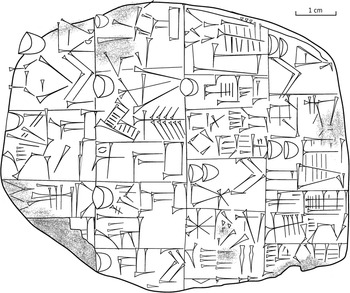
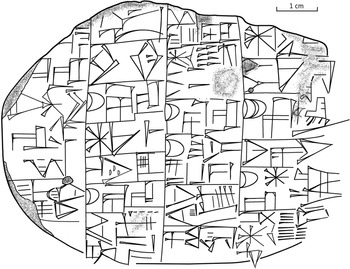
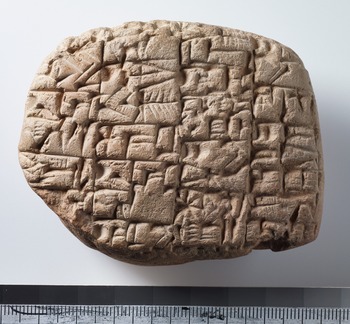
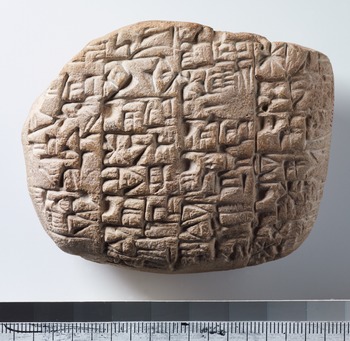
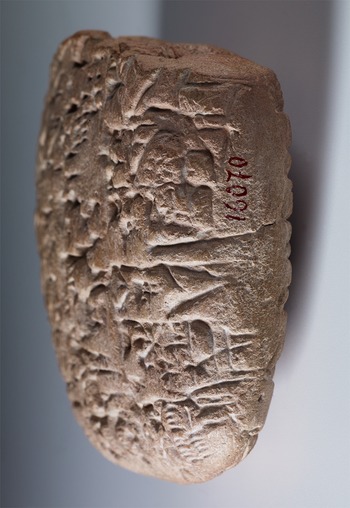
1.2. An image was captured by the Cuneiform Digital Library Initiative (CDLI),Footnote 1 record P424011, in 2011. The tablet is 7.7 cm wide by 6.2 cm high by 2.3 cm thick. The obverse of the tablet was sketched at the MAH over several weeks in early 2014 and collated afresh in early 2015. At the time, as shown by the original CDLI image, the reverse was almost completely covered by a sandy layer that seemed to have been baked onto the tablet. In 2017 a skilled conservator at the MAH found that the high salt content of the gangue rendered it friable in the presence of water, and succeeded in revealing the previously hidden text. Figure 1 is a hand copy of the tablet in its current state, Figure 2 presents recent photos.
MAH 16070 obverse. Hand copy by E. Clevenstine.

MAH 16070 reverse. Hand copy by E. Clevenstine.

MAH 16070 obverse © Musées d'art et d'histoire, Ville de Genève, photographer: Bettina Jacot-Descombes

MAH 16070 reverse © Musées d'art et d'histoire, Ville de Genève, photographer: Bettina Jacot-Descombes

MAH 16070 right edge © Musées d'art et d'histoire, Ville de Genève, photographer: Bettina Jacot-Descombes

2. Format and palaeography
2.1. One edge of the tablet, corresponding to the end of the obverse and the beginning of the reverse, is missing
The corners have been somewhat abraded. The object has the “pillow” shape, a rounded quadrilateral tapering to the edges in cross-section, that one sees in many of the administrative tablets excavated at Fāra and Tell Abū Ṣalābīḫ (photos visible via CDLI), but seems to be thicker and more crudely made than many; the broken edge shows voids in the tablet that may have caused breakage during baking.Footnote 2 The scribe may have passed a finger along the edge of the tablet after inscribing the last case, distorting the ruling at the bottom and partially effacing the signs nearest the edge.
2.2. The ductus is typical of texts of known Fāra provenance, as can be seen, e.g., in the forms of GI (o ii 2) and ZI (o iii 1, o iv 4, r ii 6’, r iii 7). The text seems carelessly written, which may indicate that we are dealing with a draft document.
2.3. At least one row of cases is missing at the bottom of the obverse and at the top of the reverse. Case r iv 1’ probably extended to the top of the tablet if – as one would expect – it included all the items/products noted in preceding cases.
3. The Text
Obv.

4. Objects or commodities
The nature of some items seems to be clear. ĝir2 ku3-sig17 (o ii 2) is unambiguously a “gold dagger”. Banšur “table(s)” (r ii 4’, r iii 3’, r iii 6’) can be found also on another Fāra tablet (SF 9, P010576). On the other hand, the “copper statue” of r i 5’ seems to be unique; doubly unique, if we may say so, is its characterization as a “divine copper statue” (alan diĝir uruda). G. Visicato (apud Pomponio - Visicato 1996: 3) lists one Fāra tablet registering ku3 “silver” (CT 50, 5), one tablet registering ku3 “silver” and uruda “copper” (CT 50, 4), and 11 tablets registering uruda “copper”: CT 50, 6; NTSŠ 207 (no uruda!), 280; TSŠ 90, 260, 834 (uruda not preserved, cdli restores siki); WF 137, 147 (“KIB” and nig2-a2 uruda), 148, 149, 151. Additional witnesses for copper allotments were published in Steible - Yıldız 1996 (Š 1006) and 2003 (Š 756). Lapis: Š 742, Š 745 (Steible - Yıldız 2000 and 2001/02). – WF 150 metal objects for gods.
o i 1, o iii 4: GU2.GU.RU in o i 1 is perhaps the same as RU.GU in o iii 4, the co-occurence of a longer and a shorter (abbreviated?) form can be compared to za-ḫa-da (o i 2) and ḫa-da in (o ii 1, o ii 4). The additional GU2 in o i 1 is hardly the weight measure gun2 “talent”. The term GU.RU (or RU.GU) resists interpretation, the correct order of the signs unclear. One finds GU.RU as an apparent occupational title in SF 48 o ii 6 (P010633), but in our text we have to do with something countable. A possible further attestation is this object is WF 152 r i 4: n? GU? RU URUDA.
o i 2, o ii 1 and o ii 4: All three cases most probably name the same object, namely za-ha-da “an axe” (perhaps borrowed from Akk. ṣaḫātu reborrowed as zaḫatû), which constitutes a good pendant to ĝir2 “dagger” in o ii 2. Note that in o ii 1 and o ii 4, an empty space is left where ZA is expected. Perhaps the scribe's apparent difficulty with the first ZA led him to hesitate in completing the other two cases.
o i 4: The remaining wedges in this damaged case are consistent with URUDA, but we cannot know what copper object may have been indicated.
o ii 2: ĝir2 ku3-sig17 “gold dagger”. The “offering list” WF 152 (P011111) includes a dagger of unspecified material, but no other item found on our tablet.
o ii 5: RU … uruda is another copper object, whose designation cannot be restored. Cf. perhaps WF 152 r i 4: 1? GU? RU URUDA.
o iii 2: The exact meaning/purpose of dub uruda “copper tablet” is unclear. The only other possible occurrence is CT 50, 8 o i 5: 3: uruda dub A?.KUR. Other copper objects attested in Fāra are: ba (TSŠ 44 i 2: 2 ba uruda), AGA-sal (TSŠ 60 ii 4), gir2-sal (WF 151 iii 3: 2/3 uruda (ma-na) gir2-sal), LAK610 and a2-ĝar2 (WF 147 passim).
o iv 3: The first sign after the number is almost certainly ĜEŠ not GANA2: the lower horizontal wedge does not protrude on the left-hand side, which would constitute a distinctive feature of GANA2. There are some vertical strokes below and perhaps also within the sign (apart from scratches) which either are traces of a deleted sign (ŠIM?) or belong to the ŠIM below. ĜEŠ.ŠIM here is a countable object, perhaps a piece of aromatic wood.
r i 3’: After GIŠGAL there are two signs which seem to form a compound with GIŠGAL. The first could be ME or IGI, the second is EN. According to the context the signs designate a countable object. To our knowledge no compounds of GIŠGAL with ME and/or EN are attested. The only other instance in Fāra texts where GIŠGAL and EN co-occur is WF 58 i 8: EN MUNUS GI[ŠGAL]. WF 58 is a lexical text which starts with a group of words (and names?) containing GIŠGAL. In the present context, a possible solution is to read 2 silig(GIŠGAL×IGI!) “2 silig-axes”. In this case EN would be a qualification of silig, either en “of the en-priest” or (less likely) uru16 “exalted”.
r i 5’: ALAN denoting an actual statue has not been recognized in any previously published Fāra document. This may be the earliest attestation of a statue that is made of metal and represents a deity. Otherwise, the sign ALAN occurs as an element of several ED personal names (cf. Krebernik Reference Krebernik, Streck and Weninger2002: 41 note 240 and Lecompte Reference Lecompte2013: 166-170): a-alan, a-alan-abzu, alan-abzu, alan-šita (Š 97 iii 3, see Krebernik/Steible/Yıldız 2014: 331 and Figs. 1a, b), alan-zi, ama-alam-gi, BIL3(PA4.NE)-alan (“Blau Obelisk” BM 86261 [P005995], see Krebernik Reference Krebernik, Renn and Schemmel2019: 45), lugal-alan, [munus?]-alan, munus-alan-ak. The basic meaning of alam (> Akk. lānu) is most probably “shape, image”, but in our case we can only be dealing with a concrete object, i.e. a “statue” made of copper.
r ii 4’, r iii 3’, r iii 6’: banšur “table(s)” may be modest objects, but fine wood was prized and the archaeological record shows that furniture could be richly decorated, so they do not seem to be out of place.
r ii 4’: The reading and meaning of ŠEN.ĜEŠ.NE are uncertain. The speculative translation “brazier” is inspired by the ideas of šen “(copper) vessel”, NE “fire” (izi) or “burn” (bil2), and the known GEŠ.GIBIL “brazier”. The expression is perhaps to be analysed as šen ĝeš bil2 “copper vessel (for) burning (aromatic) wood”.
r iv 1’: The penultimate case, whose beginning is not preserved, is disproportionally large. It contains the designations of at least three objects mentioned in different previous sections. No numbers are present. In spite of the lack of numbers in its preserved part, the case seems to present a kind of summary.
5. Persons
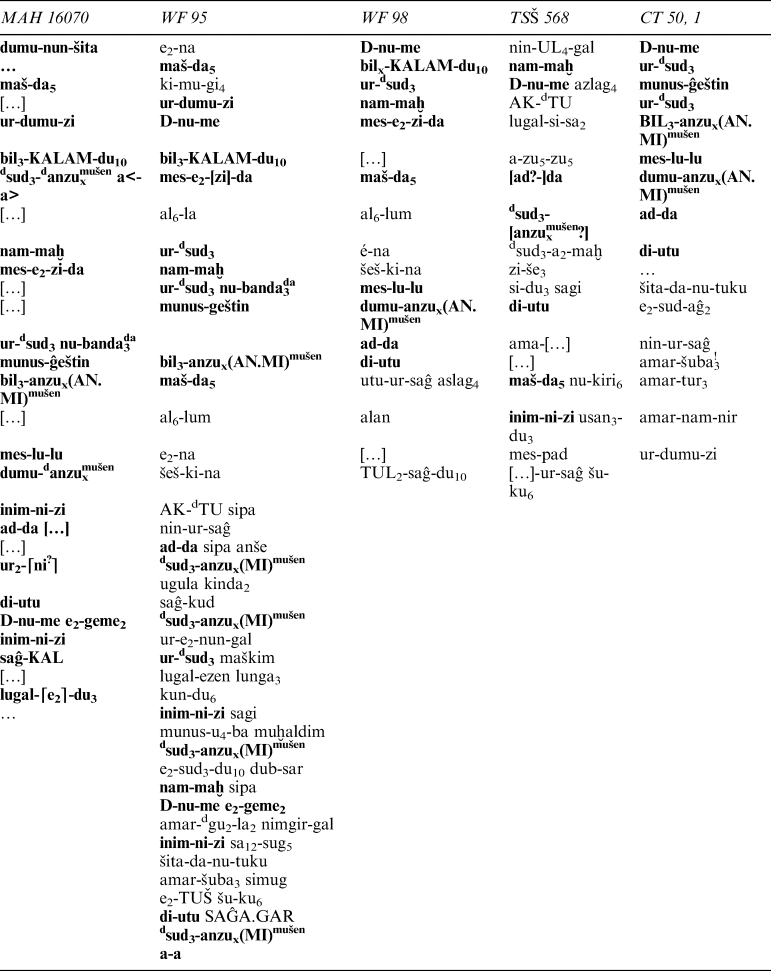
Most of the personal names on our tablet are also found clustered on WF 95 (VAT 09117, P011052), WF 98 (VAT 12455, P011055), TSŠ 568 (Š 568), and CT 50, 1 (BM 21014), see Table 1. The ‘Fundjournal’ of the DOG excavation indicates the same findspot, XVIIc, for WF 95, WF 98 and TSŠ 568.Footnote 3 Names not occurring on these tablets appear elsewhere in the Šuruppak documents published by Deimel (Reference Deimel1924), Jestin (Reference Jestin1937, Reference Jestin1957), Pomponio (1994), and Martin et al. (Reference Martin, Pomponio, Visicato and Westenholz2001). In addition to the tabulated collocations, note that Dumu-nun-šita appears with Ur-Dumuzi, dSud3-Anzu, Nam-mah, Ad-da and DIĜIR-nu-me in WF 67 (P011024). In contrast to the onomastic parallelism of our tablet and those from the excavations of the Deutsche Orient-Gesellschaft (DOG), there is little overlap with the proper names in tablets from the University of Pennsylvania excavations published by Kramer (Reference Kramer1932) and Martin et al. (Reference Martin, Pomponio, Visicato and Westenholz2001).
Personal names in selected Fāra tablets. Personal names found in multiple tablets in boldface

According to a hypothesis advanced by Edzard (Reference Edzard and Lipiński1979: 164-166) the order in which individuals were named in economic tablets reflected their position in the Šuruppak hierarchy. Furthermore, when one name (PN2) was named immediately after another (PN1), it indicated a dependency of PN1 on PN2, see Pomponio Reference Pomponio1983: 144, and 1987: xviii. In our text, two consecutive PNs occur in o iii 5 (dsud3-anzux(MI)mušen a<-a>), r ii 6’-7’, (inim-ni-zi ad-da) and r ii 6’-7’ (inim-ni-zi saĝ-KAL). One person is specified by profession: ur-dsud3 nu-banda3da (r i 1’-2’).
Comments on individual names
o i 3: For dumu-nun-šita see Steible - Yıldız 2003: 591: “dumu×<-nun>-šita / (d)PA (Š. 756 i 6 - ii 1 = WF 148 ii 1-2) muss eine hohe Position innegehabt haben, wird er doch in Š 745 iii 1-3 mit ‘1 Talent (= ca. 30 kg.) Lapislazuli’ (= 1 za-gin3 gu2) ausgestattet. Diese Vermutung wird gestützt durch den inzwischen in größerem Umfang rekonstruierten Text (TS)Š 567 vi’ (= Rs. i) 2-7, wo er in Verbindung mit hohen Amtsträgern genannt ist, und zwar in der Abfolge šubur / mu6-sub3 / šuš3 / enku / dumu×nun-šita / dPA.” Interestingly, the name occurs also on an ED seal from Mari.Footnote 4
o iii 3: Marchesi (2004: 190-191), has convincingly argued that the sign KALAM in BIL3-KALAM-dug3 should be read as uĝ3, but for practical reasons we have retained the transliteration KALAM of the original publications.
o iii 5: On first glance, the frequent name Sud-Anzu seems to imply here an unusual spelling of Anzu as aMImušen.Footnote 5 However, the case as better analyzed as dsud3-anzux(MI)mušen a<-a> in light of WF 76 o ix 2-3, WF 78 r v 3-4, and WF 95 r iii 2-3, where dsud3-anzux(MI)mušen is followed by the PN (?) a-a (PN?). Note also that the short spelling MImušen for Anzu regularly occurs in combination with dsud3, apparently in order to avoid the doubling of AN.
o iv 2: In the search for occurrences of the name Nam-maḫ, we noticed that the name indexed as Maḫ-ḫu by Deimel (Reference Deimel1924) and Visicato (Reference Visicato1997) occurs only once in published texts (WF 66, VAT 12748, P011023, obv. i 5) and that the CDLI image of WF 66 shows damage that leaves open the possibility that there were originally two vertical strokes on the “neck” of the ḪU sign, two strokes that we see in the MAH tablet. Furthermore, the effacement of most of the small strokes of NAM on our tablet and on TSŠ 100: rev. i 3 raises the possibility that the name on VAT 12748 is also Nam-maḫ.
o iv 3: It cannot be decided if the expression ša3 e2-gal “(in/of the) interior of the palace” refers only to the preceding PN mes-e2-zi-da or to the preceding section. In any case, mes-e2-zi-da was an important functionary in Fāra, see Steible – Yıldız (2003: 589-590)
r ii 5’, r iii 8’: Whereas the name Inim-(a)ni-zi in r ii 5’ is unqualified, it is followed by saĝ-KAL in r iii 8’. The former is found in five ED IIIa records in CDLI, one of which, WF 77 (P011044), is an administrative text in which Pomponio (Reference Pomponio1987: 210) took saĝ-KAL to be a personal name.Footnote 6 SAG-ĜURUŠ occurs in lexical list TSŠ 46 (P010717) as the name of a wild animal. The fact that sa12(SAG)-sug5 “land recorder” is found after KA-ni-zi in WF 41 (P010998) obv. vi 6-7 and WF 95 (P011052) rev. ii 2-3 exerts a strong temptation to see the same term here, but although the sign SUG5(LAK666/786) can vary in form the leftmost sign in our r iii 8’ seems to be truly KALAG(LAK709).
r iii 1’: ED PNs containing the element UR2 are an-ur2-še3, ur2-mud, ur2-ni, and ur2-TAR. The traces of the sign above UR2 can best be reconciled with ŠE3.
r iii 2’: Although the two signs appear in the order UD-DI, as in most of the documents in which they occur together, the consensus reading, given the occasional presence of a divine determinative, is di-(d)utu, see the discussion in Steinkeller (Reference Steinkeller2015).
r iv 2’: The right-hand sign below LUGAL is almost certainly DU3. It is crossed from above by a wedge of LUGAL which makes it look a little bit like a NI. The left-hand sign can be SA or E2. If we take the vertical of DU3 as belonging exclusively to DU3 then it is SA. If we assume that the vertical is at the same time the final wedge of the sign to the left then we can read that sign as E2. As there is no space for another sign, the reading lugal-⸢e2⸣-ni!-[še3] (PN) can be excluded. A PN lugal-sa-du3 (comparable with lugal-sa-par3) is possible but not attested elsewhere. Therefore we propose the reading lugal ⸢e2⸣ du3, which would indicate the occasion of the transaction.
6. Buildings/Institutions
Our texts names 2 buildings or institutions: e2-gal “palace” (o iv 5) and e2-geme2 “handmaids’ house” (r iii 4’-5’).
A cdli search yielded 9 attestations of the term e2-gal in administrative texts from Fara, among them 4 with the combination ša3 e2-gal: CT 50, 6 o ii 3, TSŠ 554 o i 2 (ša3 e2-gal), TSŠ 780 o i 2 (ša3 e2-gal), WF 35 r i 6, WF 64 r ii 3, WF 66 r vi 6 (ša3 e2-gal), WF 95 o ii 4, WF 139 o ii 4, WF 104 r iv 2 ([ša3 e2-gal]). This institution is also witnessed by several personal names such as the frequent ur-e2-gal and divine names such as dnin-e2-gal (SF 1 i 21).
On the existence of an e2-geme2, see RlA 10, s.v. “Paläste A.I.” (Sallaberger 2005). This institution is attested in 15 Fāra tablets: NTSŠ 165 r vi 4, TSŠ 1 r iv 8, TSŠ 78 o ii 9 and o iii 2, TSŠ 181 o iii 7 (uncertain), TSŠ 308 o ii’ 7’, TSŠ 614 o iii 5, WF 7 r iv 3, WF 25 r i 16 and r vi 5, WF 27 o iv 5, WF 68 r i 5, WF 69 r i 8, WF 95 r i 9, WVDOG 143, 36 r ii 3, WVDOG 143, 68 r i 3 and r ii 3, WVDOG 143, 157 o i 2. Occupations linked to it are: dub-sar “scribe” (TSŠ 1, WF 7), engar “farmer” (NTSŠ 165, WF 25), šu-ku6 “fisher” (WF 68, WF 69), and ugula “supervisor” (TSŠ 78).
The final line most probably contains the signs LUGAL, E2, and DU3. Due to their uncertain sequence and the possibility of defective spellings they can be interpreted in several ways: (1) lugal e2-du3 “(for) the owner of the ‘built house (plot)’”, (2) e2-du3 lugal “(for) the ‘built house (plot)’ of the king“, (3) e2 lugal du3 lugal “(for) building the king's house”. The most plausible interpretation is perhaps (3): e2 lugal(=ak) du3(=a/de3) “(for the) building of the king's house” because e2 lugal “house of the king” occurs on five other Fāra tablets.Footnote 7 They show that at least three occupations were associated with it: i3-du8 “doorkeeper”Footnote 8, na-gada “herdsman”Footnote 9, and sa12-sug5 “land recorder”Footnote 10. Furthermore TSŠ 247 o ii 3 records the delivery of a large amount (213 gur) of grain to the e2-lugal. In TSŠ 765, e2-lugal appears in parallel with e2-gu4 “cattle house” and gu4-si-gur of uncertain meaning. Of these five tablets, 3 can be traced back to the same findspot, “nördl. von XVh” according to the DOG “Fundjournal”. The findspots of the two remaining tablets can no longer be determined.
7. The object of the tablet
The tablet is indexed as a sale contract in the CDLI database, but the characteristic words and structure of such a document (Krecher Reference Krecher1973: 153-154; Gelb et al. Reference Gelb, Steinkeller and Whiting1991: 203-204; Cavigneaux 2020 with further references) are missing.
Martin et al. (2001: xxvi-xxvii) note important differences in form and content between the tablets excavated by the DOG and by the American expedition of 1931, which covered different areas of the site. The constellation of names present in the unprovenanced MAH 16070 clearly shows that it comes from the same archive or institutional context as the systematically excavated WF 95 and similar tablets (see Pomponio Reference Pomponio1983: 129, and table 3 below). According to Martin (1975: 179, and 1988: 97-99), DOG's trench XVIIc-d yielded 99 tablets of which 22 can be identified; among them 11 are records of livestock, rations and metal given to various people wheras the remaining are the famous “guruš muster lists” including WF 95. She proposed on the basis of the content of the tablets that this was the site of a powerful public institution.
As already stated above, the final line (r iv 2’) is likely to be read e2 lugal du3, which would indicate the occasion or purpose of the document. This would imply that the listed objects were received or presented by the named persons when the “house of the king” was rebuilt or restored, perhaps in the course of a celebration. It must be stressed, however, that this interpretation is far from certain. We therefore refrain from further speculation on the identity of the “king” and the building.