INTRODUCTION
Ecological theory suggests that the frequency of specialization increases with decreased latitude such that tropical specialists are more diverse than their temperate counterparts (i.e. ‘latitude niche-breadth hypothesis’). If the processes that affect the relationship between species diversity and specialization are independent of latitude per se, then the diet breadth or host spectrum of specialists should be narrower in speciose communities than in low-diversity ones of comparable latitude (i.e. ‘diversity niche-breadth hypothesis’). This corollary gives rise to two testable predictions: monophagy should be more prevalent and herbivore–algal connectance (the proportion of actual interactions that occur relative to the number of possible ones) should be lower in species-rich regions than species-poor ones.
Several different ecological mechanisms could contribute to narrow niche breadth in tropical or other species-rich communities. The most commonly cited mechanisms are intense interspecific competition among herbivores for host plants and/or intense predation selecting for low host-switching by herbivores. Resource diversification in different regions may also strongly influence consumer abundance and interaction strength though this mechanism has been less well explored. For example, the green alga Codium Stackhouse has a centre of species radiation in the temperate north-western Pacific whereas Caulerpa J.V. Lamouroux is most diverse in the tropical Indo-Pacific region. The diversity niche-breadth hypothesis would predict that recognized hotspots of green algal diversity would support highly stenophagous consumers and a high frequency of monophagy.
Ecological and evolutionary issues regarding specialization have been extensively explored for terrestrial species (Novotny et al., Reference Novotny, Basset, Miller, Drozd and Cizek2002; Vázquez & Stevens, Reference Vázquez and Stevens2004; Dyer et al., Reference Dyer, Singer, Lill, Stireman, Gentry, Marquis, Ricklefs, Greeney, Wagner, Morais, Diniz, Kursar and Coley2007). Geographical variations in biodiversity, specialization and niche diversification have been investigated, using the interaction web approach (Olesen & Jordano, Reference Olesen and Jordano2002) with two important parameters:
network size: M = AP (such that A = number of animal species; P = number of plant species); and
connectance: C = 100 (I/M) (such that I = number of actual interactions; M = number of possible interactions).
The network size, a measure of species richness, indicates the maximum number of observable interactions within the community of interest whereas the connectance among the species is expressed as the percentage of the possible interactions that are actually established. Species-rich communities would presumably have larger networks (M) than low-diversity ones. With high niche-diversification and specialization (habitat and/or food), connectance values should be low.
Complementary information on and approaches for elucidating the biogeographical patterns of marine specialization are meagre (but see Poore et al., Reference Poore, Hill and Sotka2007). The majority of marine specialist herbivores are sacoglossan gastropods although many of the ampithoid amphipods are stenophagous as well (Poore et al., Reference Poore, Hill and Sotka2007). The sea slugs are typically small, suctorial herbivores with numerous ecological, physiological and morphological adaptations associated with their host specificity (e.g. Jensen, Reference Jensen1989, Reference Jensen1993a, Reference Jensenb, Reference Jensen and Mortonc, Reference Jensen1994). Although the majority of sacoglossans associate with several orders of green algae, at least 17 species of sacoglossans in three different families feed on red algae (Trowbridge et al., in press). Other sacoglossan diets such as diatoms, seagrasses and opisthobranch eggs are also well recognized.
The response of sacoglossans to regional and biogeographical variation in host-plant diversity and in overall community diversity is unknown. In high-diversity or speciose systems, two different patterns could occur. On one hand, herbivores may exhibit extreme specialization with narrow diet spectrum or host range; monophagy would be more frequent than in low-diversity communities. On the other hand, high-diversity or speciose communities have low species’ dominance (e.g. little propensity for monospecific beds of hosts) so low host-plant availability may lead to broader diet spectra.
Our objective in this preliminary investigation was to investigate marine specialist herbivores on highly speciose temperate north-western Pacific seaweeds: (1) to compare the associations to the ecological analogues in other geographical regions; and (2) to evaluate whether the Asian herbivores are comparatively monophagous or polyphagous among the numerous potential hosts. Understanding such herbivore responses is crucial to predict how grazers will respond to algal host additions (accidental or intentional introductions) or deletions (local extinction of host species due to habitat destruction or degradation). Both of these community-level changes have occurred in coastal systems particularly with coenocytic green algae and ceramialean red algae (e.g. Clark, Reference Clark1994; Trowbridge & Todd, Reference Trowbridge and Todd2001; Trowbridge, Reference Trowbridge2004, Reference Trowbridge, Critchley, Ohno and Largo2006).
MATERIALS AND METHODS
Study system
The central sacoglossan of this study was the small limapontiid Placida sp. (sensu Baba, Reference Baba1986). As described by Trowbridge et al. (Reference Trowbridge, Hirano and Hirano2008b), the common species on Japanese Codium was originally described as Hermaea dendritica (Alder & Hancock, 1843) and then as Placida dendritica (Alder & Hancock, 1843). The Japanese species was separated from the European one and renamed Placida babai Marcus, 1982. Baba (Reference Baba1986) subsequently redescribed the local species and rejected the name P. dendritica for the Japanese specimens. Because Baba did not reassign the name P. babai, nor did he assign a new name, this well described but unnamed species is referred to as Placida sp. (sensu Baba, Reference Baba1986) herein. Preliminary genetic information (e.g. Walsh & Trowbridge, Reference Walsh and Trowbridge2001 and unpublished data) indicated high differentiation in mitochrondrial sequences between north-eastern and north-western Pacific as well as North Atlantic populations, supporting the interpretation that Placida dendritica is a complex of sibling species. Significant variation in external and internal anatomy has been described (Baba, Reference Baba1986; Hirano et al., Reference Hirano, Hirano and Trowbridge2006a, Reference Hirano, Hirano and Trowbridgeb) and additional taxonomic work is ongoing.
The Asian species is widely distributed around Japan (Hirano et al., Reference Hirano, Hirano and Trowbridge2006a, Reference Hirano, Hirano and Trowbridgeb; Shimadu, Reference Shimadu2004; Shimadu et al., Reference Shimadu, Hirano, Trowbridge and Hirano2006; Trowbridge et al., Reference Trowbridge, Hirano and Hirano2008b) and has been recorded from Peter the Great Bay in the Sea of Japan (Adrianov & Kussakin, Reference Adrianov and Kussakin1998). Algal hosts include the green macroalgae Codium Stackhouse, Bryopsis J.V. Lamouroux, Derbesia Solier and Pedobesia MacRaild & Womersely (Baba & Hamatani, Reference Baba and Hamatani1952; Baba, Reference Baba1959; Bleakney, Reference Bleakney1989; Trowbridge et al., Reference Trowbridge, Hirano and Hirano2008b and unpublished data). On Pacific shores of Honshu, Placida sp. shared some algal hosts with other sacoglossan species, especially the two common species Elysia trisinuata Baba, 1949 and E. setoensis Hamatani, 1968 (Trowbridge et al., Reference Trowbridge, Hirano and Hirano2008b), and less commonly with Stiliger ornatus Ehrenberg, 1828, Stiliger aureomarginatus Jensen, Reference Jensen1993, Elysia atroviridis Baba, 1955, and an undescribed species of Placida Trinchese, 1876. Although the species have different phenologies and host-preferences, they did periodically coexist on the same algal thallus.
Study region
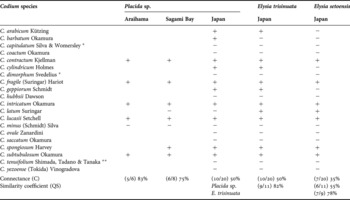
This investigation was based at the Misaki Marine Biological Station (MMBS), University of Tokyo, on the Miura Peninsula on the Pacific coast of Honshu. MMBS is on the eastern shore of Sagami Bay, near the northern limit of many warm-temperate to subtropical species (MMBS website, 2007). To determine algal host associations of sacoglossans, field surveys were made of all the Codium spp. (Table 1) during periodic spring and summer visits (2000–2004). The per cent of thalli attacked by slugs and the number of slugs per attacked thallus were recorded for the intertidal encrusting C. lucasii Setchell and upright, branching C. fragile (Suringar) Hariot ssp. fragile (sensu Provan et al., Reference Provan, Booth, Todd, Beatty and Maggs2007) on the rocky shores at Araihama (35°9.4′ N 139°36.7′ E); these Codium spp. inhabited rocky shores at or below the level of the abundant brown alga Sargassum fusiforme (Harvey) Setchell. In April and May 2000, subtidal thalli of C. fragile and C. subtubulosum Okamura were collected from Moroiso Bay (35°9.7′ N 139°36.7′ E) to document slug associations; algae were attached to ropes suspended in the seawater from surface floats. Supplementary information on sacoglossan associations with C. lucasii, C. fragile, C. contractum Kjellman, C. intricatum Okamura, C. latum Suringar and C. spongiosum Harvey was collected at several other locations on the Izu Peninsula (west side of Sagami Bay) (see Trowbridge et al., Reference Trowbridge, Hirano and Hirano2008b).
Interaction web connectance (fraction of observed interactions relative to possible ones) and Sørensen's similarity coefficient (QS) for Placida sp. and two coexisting Elysia spp. Algal names based on Yoshida (Reference Yoshida1998), Chang et al. (Reference Chang, Dai and Chang2002) and Yoshida et al. (Reference Yoshida, Shimada, Yoshinaga and Nakajima2005).

*, first reported for Japan by Yoshida et al. (Reference Yoshida, Shimada, Yoshinaga and Nakajima2005); **, species described by Shimada et al. (2007a); blank cells, no personal observation or published report of Codium spp.; −, no personal observation or published report of sacoglossans on Codium.
Interaction web analysis
The number of sacoglossan and Codium species was determined from the literature to calculate regional and biogeographical variations in network size of sacoglossan–Codium associations. While the network size indicates the maximum number of potential interactions within the community of interest, the connectance among the species was determined observationally and experimentally. The possible sacoglossan–Codium interactions that were actually realized were determined by: (1) shore surveys of available Codium hosts and (2) laboratory experiments (described below). Finally, pairwise similarity analyses were calculated to compare host similarity between Placida sp. and two coexisting sacoglossans, Elysia trisinuata and E. setoensis. The Sørensen's similarity coefficient (QS) was used:

such that C = number of species shared by two sacoglossan species while A and B represent the number of host species of each sacoglossan. Data for Placida sp. were derived from the present study; records of host use for E. trisinuata and E. setoensis were collected simultaneously to the present study but were published separately (Trowbridge et al., Reference Trowbridge, Hirano and Hirano2008b).
Feeding preference experiments
Laboratory experiments were conducted to evaluate if many of the possible interactions were ecologically demonstrated. Pairwise-choice feeding experiments were conducted by placing individual slugs in small containers (~0.5 l) with seawater and a pairwise-choice of algae (source alga and a non-source alga). The number of slugs on each alga was counted periodically over a 1–2 day period. The categorical data at the end of each experiment were analysed, using log likelihood goodness-of-fit tests or Fisher's exact tests (depending on sample size) (Zar, Reference Zar1984).
In May 2000 and July 2001, a series of pairwise-choice experiments were conducted with Placida sp. The algal choices included: (1) Codium fragile versus C. lucasii, C. intricatum, C. subtubulosum, and C. minus (Schmidt) Silva; (2) C. fragile versus Bryopsis spp.; and (3) C. fragile versus the filamentous, septate algae Chaetomorpha crassa (C. Agardh) Kützing and Cladophora wrightiana Harvey. Experiments were conducted with old versus young fronds of C. fragile as choices to determine if preference rankings of Placida sp. could be altered by the physiological and/or ontogenetic condition of algae. In most cases, the host sources from which slugs were collected were C. fragile or C. lucasii. Reciprocal experiments were not logistically feasible during this preliminary study.
All experiments, except one, were conducted at MMBS with slugs and algae from the adjacent shore, Araihama. The exception was a feeding experiment conducted in July 2001 at the Oshoro Marine Laboratory, Hokkaido University; specimens of Placida sp. were collected from shallow subtidal Bryopsis spp. growing on the east shore of Oshoro Bay and C. fragile was collected from just outside the mouth of the bay (43°12.7′ N 140°51.4′ E). Eight slugs were collected from Bryopsis and offered a pairwise choice of Bryopsis versus Codium.
Interspecific interactions
In high-diversity systems, interspecific competition among herbivores for resources has been considered to be a major factor contributing to trophic specialization. The local coexistence of sacoglossans on Codium hosts prompted the question of whether competition occurred among sacoglossans and, if so, whether it was interference or exploitative competition. To address this issue, the frequency of interspecific sacoglossan coexistence on Codium fragile on the shore was quantified in July 2001, from August to November 2003 and from February to September 2004. In 2001, a complete census of C. fragile on the shore was made at Araihama. In 2003 and 2004, 20 thalli of C. fragile were surveyed each month (or fewer when the seasonal alga was first emerging or declining on the shore); data were combined for different months. The frequency of coexistence of the sacoglossans was summarized separately by year.
Two experiments were conducted to determine whether competition for algal food and/or interspecific interactions (either attraction or aversion) may be occurring. First, in May 2000, single individuals of Placida sp. were placed in containers with seawater and small pieces of Codium lucasii. To half of the containers, one intact spawn mass of the sacoglossan Elysia trisinuata was added (carefully detached from substrata and placed in experimental container on the alga); to the other half of the containers, no spawn mass was added (negative control); there were 15 replicates per treatment. For 2 days the location of Placida sp. specimens was recorded as on the algae (typically feeding and producing visible damage) or off the algae; if Placida had an aversion response to E. trisinuata eggs, Placida should be more frequent on algae in the control than the experimental treatment.
Next, single individuals of Placida sp. were placed in containers with seawater and small pieces of Codium lucasii. To half of the containers, a large adult Elysia trisinuata was added (coexistence treatment); to the other half, no Elysia were added (negative control); there were 13 replicates per treatment. For 2 days the positions of Placida and Elysia were monitored. If sacoglossans were competing and/or avoiding each other, fewer slugs should be on the algae in the coexistence treatment than in the control treatment. If sacoglossans were facilitating each other, more slugs should be on the algae in the coexistence treatment than in the control. Finally, if interspecific interactions were neutral, similar numbers of slugs should be on algae in the two treatments. The categorical data were analysed with log likelihood goodness-of-fit tests (Zar, Reference Zar1984).
RESULTS
Network size
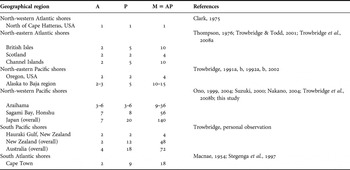
The calculated size of sacoglossan–Codium networks (M) varied by two orders of magnitude worldwide (Table 2). The highest estimates were on Japanese shores where there is an extraordinary diversity of Codium (20 spp.) and sacoglossan specialists that consume Codium (7 species) with a network size of 140. During our study, six Codium species (P) were found at Araihama and eight in and around Sagami Bay (Table 1). Three sacoglossan species (A) were commonly found on Codium in Sagami Bay: Placida sp., Elysia trisinuata and E. setoensis. Three other described Codium-specialists (Stiliger ornatus, S. aureomarginatus and Elysia atroviridis) and an undescribed species of Placida were recorded at Araihama and/or Sagami Bay. Network size, thus, varied from 36 (6A × 6P) to 56 (7A × 8P) possible, pairwise interactions at the local to regional level.
Geographical comparison of network sizes (M) of sacoglossan–Codium host assemblages.

A, number of sacoglossan species that consume Codium; P, number of Codium species (or subspecies of C. fragile).
Host use
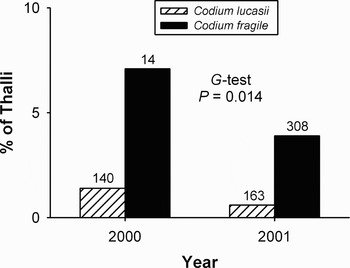
During the 2000 and 2001 surveys, Placida sp. was recorded on several intertidal and shallow subtidal green algal hosts. The frequency of slug occurence was low on the abundant hosts Codium fragile and C. lucasii: <10% of thalli (Figure 1). Significantly more thalli of C. fragile were attacked than of C. lucasii (log likelihood goodness-of-fit test, G = 6.01, 1 df, P = 0.014). Placida sp. was not found on the sparsely distributed C. minus during this study but a few individuals (N = 7) and many egg masses were found on the subtidal C. subtubulosum on ropes. Placida sp. was also recorded as present on C. contractum, C. intricatum, and C. spongiosum but not on the large, frond-like C. latum on the Izu Peninsula. In this study, Placida sp. at Araihama had a host range of six species, of which five associations have been observed on the shore (C = 83%); in Sagami Bay, 6 of 8 potential associations (75%) have been observed. At least 50% of Codium spp. are used as hosts by Placida sp. within Japan.
Frequency of occurrence of Placida sp. on Codium fragile and C. lucasii surveyed in April–May 2000 and July 2001 at Araihama, Miura Peninsula, Honshu. Sample sizes indicate the number of thalli examined during each survey period for sacoglossans.

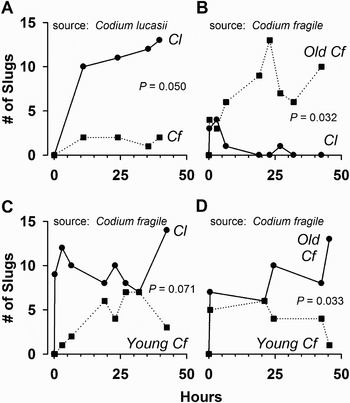
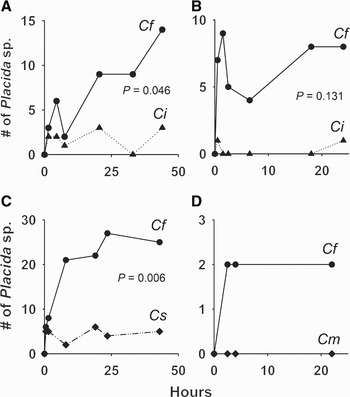
In pairwise-choice experiments conducted with Placida sp., most slugs preferred the algal host species from which they were collected (i.e. source alga) (Figures 2–3). However, these host preferences could be changed depending on the physiological condition of the algae. Young, vigorous growth of C. fragile was rarely attacked by slugs on the shore. For example, occupied thalli of C. fragile were significantly longer (Student's t-test, t = 2.8, N = 37, P < 0.001) with wider branches (t = 2.7, N = 37, P = 0.010) than sympatric thalli not occupied by slugs. In feeding experiments, slugs from C. fragile would select C. lucasii (the alternate host) when the only source alga was young fronds (Figure 2B, C). In a pairwise experiment with young versus old C. fragile, Placida sp. individuals were significantly more frequent on old fronds than young ones (Fisher's exact test, P = 0.033, Figure 2D).
Pairwise-choice feeding experiments with Placida sp. conducted in May 2000. The algal source of sacoglossans is indicated. P values are based on log likelihood goodness-of-fit tests. Algal species are abbreviated: Cl, Codium lucasii; Cf, C. fragile.

Pairwise-choice feeding experiments with Placida sp. The algal source of sacoglossans was C. fragile. P values are based on log likelihood goodness-of-fit tests or Fisher's exact tests. Algal species are abbreviated: Cf, Codium fragile; Ci, C. intricatum; Cs, C. subtubulosum; Cm, C. minus. The two panels show trials with the same algal choices but conducted in different years (A: May 2000; B: July 2001).

If the alternate (non-source) choice were a congeneric host (e.g. C. intricatum or C. subtubulosum), slugs usually explored and, in many cases, fed on the alga (Figures 2, 3A–C); the exception was with C. minus (Figure 3D) although the small sample size (N = 2) due to limited algal availability makes us cautious about extrapolation. Also, Placida sp. would not switch from C. fragile to the host Bryopsis spp. (Chi-Square test, χ2 = 20.0, P < 0.001) or vice versa (Fisher's exact test, P = 0.077, N = 8) during short-term experiments. When Placida sp. was offered presumed non-host algal genera, few slugs even explored the non-source algae. For example, Placida sp. would not switch between Codium fragile and the filamentous algae Cladophora wrightiana and Chaetomorpha crassa (Fisher's exact test, P = 0.006 and P = 0.002, respectively).
Interspecific interactions
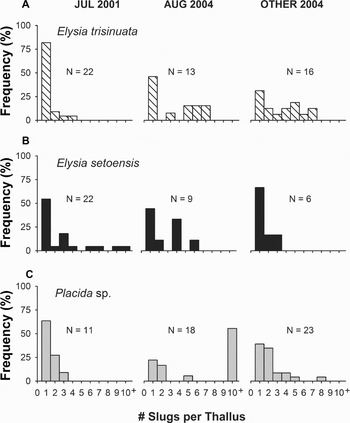
The majority of attacked algal hosts (50–80%) on the Araihama shore in July 2001 were inhabited by single individuals of sacoglossans. The maximum abundance of Placida sp. was three conspecifics per algal thallus (Figure 4C). Elysia setoensis occurred with up to 10 slugs per host (Figure 4B) but this was a transient feature. When there were multiple conspecific slugs per algal host (or thallus), the slugs were rarely observed in close proximity to one another. There was no visual evidence of intraspecific congregations on algal hosts in July 2001 (Figure 4) or other surveys conducted during four summers (2000–2003); furthermore, slugs generally did not congregate on Codium in the laboratory.
Frequency with which three common sacoglossan species occurred alone versus in sympatry with conspecifics on algal hosts at Araihama, Sagami Bay. Data were collected in July 2001 and February–September 2004. Sample sizes indicate the number of thalli attacked by sacoglossans.

In 2004, however, sacoglossan densities were generally higher than in 2001. In August, there was a high density of Placida sp. with up to 47 juveniles per thallus (note the Figure 4C graph is truncated at 10+). This right-skewed distribution was markedly different from the rest of 2004 when the frequency of coexistence was markedly left-skewed (Figure 4C). A comparable pulse of juveniles was seen for Elysia trisinuata in August 2004 and it persisted in September with up to 7 slugs per thallus.
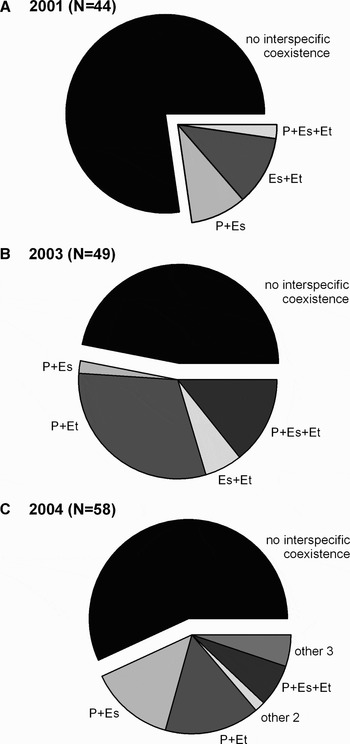
In July 2001, 10 cases were observed of interspecific coexistence out of 44 thalli of Codium fragile inhabited by sacoglossans (Figure 5A). There was one case with all three species present (Placida sp., Elysia trisinuata and E. setoensis), five with the two Elysia species together and four with Placida sp. and E. setoensis together. In 2003, there were 26 cases of coexistence out of 49 thalli attacked (Figure 5B). Most cases involved Placida sp. with E. trisinuata or with both Elysia spp. In 2004, 25 cases were recorded of interspecific coexistence out of 58 attacked thalli (Figure 5C). Most cases involved Placida sp. coexisting with one of both Elysia spp. However, there were four cases of additional sacoglossan species coexisting on the same thallus. In no case of local coexistence (i.e. slugs on the same algal thallus) was there any evidence of the different species being in close proximity. Furthermore, all the slugs were distributed widely across each algal thallus, and algal hosts were not a limiting resource. No microhabitat preferences of any of the slug species were noted on the shore or in the laboratory.
Frequency of interspecific coexistence of sacoglossans on Codium fragile at Araihama, Sagami Bay. Data were collected in July 2001, August–November 2003 and February–September 2004, respectively. Sacoglossans are abbreviated as follows: P, Placida; Et, Elysia trisinuata; Es, Elysia setoensis. ‘Other 2’ denotes Elysia trisinuata and unidentified Placida. ‘Other 3’ denotes the following 3 situations: (i) E. trisinuata, Stiliger ornatus and Placida sp.; (ii) E. trisinuata, S. ornatus and an unidentified Placida; and (iii) Placida sp. (sensu Baba, Reference Baba1986), E. trisinuata, and Elysia ornata (Swainson, 1840). Sample sizes indicate the number of thalli attacked by sacoglossans.

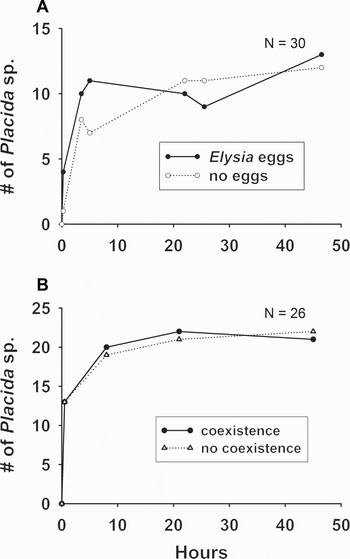
In the first interspecific interaction experiment, similar numbers of Placida sp. were on Codium lucasii in the two treatments (presence or absence of eggs of Elysia trisinuata, Fisher's exact test, P = 1.00) (Figure 6A); the presence of spawn masses (or even recently hatched veliger larvae) of the larger sacoglossan E. trisinuata did not influence the frequency of Placida sp. attacking hosts. In the second experiment, the presence or absence of E. trisinuata also did not influence the frequency of Placida sp. on algae (Fisher's exact test, P = 1.00, Figure 6B).
Interspecific interaction experiments conducted in July 2001. (A) Placida sp. in the presence or absence of egg masses of the sacoglossan Elysia trisinuata; (B) Placida sp. in the presence or absence of an adult Elysia trisinuata. Sample sizes indicate the number of replicate slugs.

DISCUSSION
The Codium–sacoglossan networks were substantially larger on north-western Pacific shores than in any other geographical region (Table 2). Furthermore, if all the sacoglossans that feed on Codium also consume Bryopsis and/or Derbesia (as many Codium-feeders worldwide do: Thompson, Reference Thompson1976; Bleakney, Reference Bleakney1989; Trowbridge, Reference Trowbridge1991a, Reference Trowbridgeb, Reference Trowbridge1992a, Reference Trowbridgeb, Reference Trowbridge1995, Reference Trowbridge2002; Trowbridge et al., Reference Trowbridge, Little, Stirling and Farnham2008a, Reference Trowbridge, Hirano and Hiranob), the networks would be considerably larger. For example, there are 20 Codium, 10 Bryopsis and 4 described Derbesia spp. in Japan (Yoshida, Reference Yoshida1998; Chang et al., Reference Chang, Dai and Chang2002; Yoshida et al., Reference Yoshida, Shimada, Yoshinaga and Nakajima2005): 34 potential hosts. At the other extreme, in the British Isles there are 5 Codium, 2 Bryopsis and 2 described Derbesia spp. (Brodie et al., Reference Brodie, Maggs and John2007): 9 potential hosts. Thus, Japanese shores have many more hosts and potential interactions than other temperate shores, regardless of whether just Codium or alternate host genera are considered within the network.
Placida sp. and other Codium-feeding sacoglossans in Japan are clearly not monophagous (Trowbridge et al., Reference Trowbridge, Hirano and Hirano2008b and this study). A comparison of host use results (Table 1) indicates a high overlap of host-species use in three sacoglossan species (Sørensen's similarity coefficients for pairwise species comparisons: QS = 55–82%). There was no obvious relationship between algal morphological features (e.g. utricle diameter, utricle volume, wall thickness, thallus shape, etc.) and sacoglossan association (or lack thereof). The paucity of monophagy and the low niche differentiation are ecologically important results of this study.
The sacoglossans Elysia trisinuata and E. setoensis had web connectance values of 67% at Araihama; thus, locally, the three common species have a mean connectance of 72%. At the national level, connectance values were lower (mean = 45%, Table 1). On Oregon shores, Placida dendritica exhibits 100% connectance and Elysia hedgpethi, 75% connectance (Trowbridge, unpublished data). In the British Isles, P. dendritica and Elysia viridis (Montagu, 1804) have 100% connectance with Codium hosts (Trowbridge, unpublished data). In the Hauraki Gulf, north-eastern New Zealand, the two sacoglossan feeders exhibit 100% connectance (Trowbridge, unpublished data). There are no published examples of sacoglossan connectance per se; the estimates above are extracted from various papers or unpublished data of the first author. There is no evidence in Japan or elsewhere of niche partitioning among sympatric sacoglossans that feed on Codium.
The apparent decline in connectance with increased spatial scale within Japan (Table 1) may reflect the extent of research rather than real patterns. Given the paucity of information about Codium hubbsii Dawson, C. saccatum Okamura, C. ovale Zanardini and C. yezoense (Tokida) Vinogradova, future studies may well show values higher than those recorded here. This will undoubtedly be true for C. dimorphum Svedelius and C. capitulatum Silva & Womersley (only recently being recognized in Japan by Shimada et al., Reference Shimada, Ebata, Horiguchi, Kurihara and Tanaka2007b) and C. tenuifolium Shimada et al. (in Shimada et al., Reference Shimada, Tadano and Tanaka2007a). There are published reports of sacoglossans associated with C. dimorphum in the southern hemisphere but not with C. capitulatum (reviewed by Trowbridge, Reference Trowbridge1995).
The interaction strength of an association may be estimated by the relative frequency of occurrence (Olesen & Jordano, Reference Olesen and Jordano2002). Although such information is generally lacking for sacoglossans, our preliminary information is most complete for sacoglossans attacking Codium fragile. In late spring to early summer, the frequency of sacoglossan attack is low: <10% in 2000 and 2001 (Figure 1) and <25% in 2004 (Shimadu et al., unpublished data). In mid to late summer, the frequency of attack is higher: 50–100% in 2004 (Shimadu et al., unpublished data). Other hosts have lower frequencies of attack although there is considerable spatial–temporal variation. On European and Oregon shores, there are several cases of high rates of sacoglossan attack and others of low rates (e.g. Trowbridge, Reference Trowbridge1992a, Reference Trowbridgeb, Reference Trowbridge1995, Reference Trowbridge2004; Trowbridge et al., Reference Trowbridge, Little, Stirling and Farnham2008a); in several cases, the frequency of attack is influenced by oceanographic conditions (sea loughs/lochs, tidal rapids and downwelling events) and consequent larval supply, not by the onshore host communities (Trowbridge et al., Reference Trowbridge, Little, Stirling and Farnham2008a and unpublished data).
The capacity of these marine specialists to modify their diets to congeneric hosts would enable the slugs to survive if their initial hosts were no longer available (due to host mortality, slug dislodgment, habitat destruction, or other factors). Placida sp. from C. lucasii had the capacity to feed on C. fragile and vice versa. At least some individuals are able to feed on C. intricatum and C. subtubulosum although few are associated with either alga on the shore at our sites. Trowbridge (Reference Trowbridge1991a) demonstrated that initial preferences after 1–2 days are often indicative of subsequent performance (survival and growth) for a small, short-lived slug Placida dendritica in Oregon. Yet, some individuals from the low-quality Codium spp. can switch to the high-quality ephemeral Bryopsis hosts (Trowbridge, Reference Trowbridge1991a). Some species such as the larger, longer-lived Elysia viridis may learn to feed on novel hosts although not all individuals have the capacity to change (Jensen, Reference Jensen1989; Trowbridge & Todd, Reference Trowbridge and Todd2001). The presence of functional kleptoplasty may enable E. viridis and many other sacoglossans to tolerate starvation for extended periods while ‘learning’ to feed on unfamiliar hosts. Short-lived sacoglossans lacking functional kleptoplasty may be more limited in their capacity to change host species; this topic clearly merits further future investigation, particularly the role of sacoglossan constraints and algal physiological status.
In many suctorial herbivores (e.g. homopteran insects and sacoglossans), conspecifics congregate and facilitate each others’ survival and growth on structurally challenging hosts (Clark, Reference Clark1975; Trowbridge, Reference Trowbridge1991b; Jensen, Reference Jensen, Walker and Wells1999). Intraspecific feeding aggregations or congregations of Codium-feeding slugs are not ubiquitous. Japanese slugs were distributed widely across each algal thallus, and algal hosts were not a limiting resource. No microhabitat preferences of any of the slug species were noted on the shore or in the laboratory. Thus, there was no direct or indirect evidence indicative of interspecific competition, niche partitioning or a limiting resource in Japan. There is no evidence of highly differentiated, trophic niches of these specialists on high-diversity or speciose shores.
ACKNOWLEDGEMENTS
This study was generously supported by the Sagami Bay Biodiversity Project (2001–2003) of MMBS, the Women-In-Science Collaboration (WISC) funds from AAAS/NSF (2002 & 2003) and the Japanese Society for the Promotion of Science (JSPS) Grant-in-Aid for Scientific Research C-15570073 (2003–2006). We thank Y. Shimadu, K. Sudo and K. Kumagai for their valuable assistance in the field and laboratory; M. Morisawa (MMBS director) for his extensive logistical support; M. Sekimoto and M. Sekifuji for valuable collection assistance in the field; and K. Sayashi for her kind logistical assistance during all our visits. We also thank K. Shinta for his valuable assistance collecting specimens in Oshoro Bay, Hokkaido and T. Kitayama (National Science Museum) provided valuable phycological assistance, particularly with newly recognized Codium spp. on Japanese shores. This paper was significantly improved by comments from Colin Little, Kathe Jensen and two anonymous referees. We complied with ethical standards in the treatment of invertebrates, adhering to the pertinent Japanese collection and maintenance guidelines.