Introduction
Promoting the sustainable exploitation of fishes requires a thorough understanding of species biology and their interactions with fisheries. Stock assessments for fish are generally undertaken for defined stock units, which may be based on either management units or, preferably, biological stock units. The latter constitutes discrete populations that are self-reproducing, show biological integrity over time, and with the population displaying similar life-history parameters and responses to exploitation (Begg & Waldman, Reference Begg and Waldman1999; Pawson & Ellis, Reference Pawson and Ellis2005).
The International Council for the Exploration of the Sea (ICES) provides advice on the stock status for a range of North-east Atlantic fish stocks across specified geographic units that are usually defined according to ICES Subareas and/or Divisions (with international fishery data typically collated at such spatial scales). Whilst ICES Divisions have a broad similarity to the biogeographic provinces described by various authors (Dinter, Reference Dinter2001) and form suitable boundaries for some fish stocks, these boundaries may not be appropriate for all stocks. Interspecific differences in distribution patterns, movements and fishing pressures can complicate data collection, stock assessments and management efforts (Frisk et al., Reference Frisk, Miller, Martell and Sosebee2008; Goethel et al., Reference Goethel, Quinn and Cadrin2011). Assessing the appropriateness of current stock units used in ICES’ advisory process is, therefore, fundamental to conducting robust stock assessments and ensuring that management measures apply over appropriate geographic areas (Pawson & Jennings, Reference Pawson and Jennings1996). Indeed, mismatches between the spatial scale of management areas and biological stock units could impede accurate stock assessments and effective fisheries management, and subsequently threaten sustainability goals, species conservation and fisheries profitability (Kerr et al., Reference Kerr, Hintzen, Cadrin, Clausen, Dickey-Collas, Goethel, Hatfield, Kritzer and Nash2017).
Identifying biologically discrete fish stocks can be problematic, and holistic and multidisciplinary approaches to provide more accurate definitions of stock structure are especially challenging (Pawson & Jennings, Reference Pawson and Jennings1996; Begg & Waldman, Reference Begg and Waldman1999). Consequently, few multidisciplinary studies have applied a range of approaches to inform on stock units of marine fish (Abaunza et al., Reference Abaunza, Murta, Campbell, Cimmaruta, Comesana, Dahle, Gallo, Santamaría, Gordo, Iversen and MacKenzie2008; Im et al., Reference Im, Jo, Ji, Myoung and Kim2017). Many studies on stock units have been focused on individual methods, such as species distribution and relative abundance (Pawson & Ellis, Reference Pawson and Ellis2005), molecular genetics (Carvalho & Hauser, Reference Carvalho and Hauser1994), morphometric discrimination (Cadrin, Reference Cadrin2000), life-history parameters (Begg et al., Reference Begg, Hare and Sheehan1999), parasites (McVicar, Reference McVicar1977; Lester, Reference Lester1990; MacKenzie & Abaunza, Reference MacKenzie and Abaunza1998; Irigoitia et al., Reference Irigoitia, Incorvaia and Timi2017), contaminant and microchemistry analysis (Campana et al., Reference Campana, Chouinard, Hanson, Frechet and Brattey2000) and tagging experiments (Walker et al., Reference Walker, Howlett and Millner1997). While such approaches may support inferences on stock structure, tagging data can provide some of the more robust evidence on the spatial extents of movements and connectivity across the biogeographic range of the species, thereby informing on stock units (Pawson & Jennings, Reference Pawson and Jennings1996). However, this method is dependent on the likelihood of marked fish being recaptured throughout their stock range, and recapture information being reported.
The use of conventional (non-electronic) mark identification tags has been applied widely for studying fish movements (Kohler & Turner, Reference Kohler and Turner2001; Burt et al., Reference Burt, Goldsmith and Armstrong2006). While advances in electronic tagging technologies in recent decades have greatly improved our understanding of fine-scale movements and behaviour, these tags are more expensive and, accordingly, have typically been deployed in smaller sample sizes (Arnold & Dewar, Reference Arnold, Dewar, Sibert and Nielsen2001; Hammerschlag et al., Reference Hammerschlag, Gallagher and Lazarre2011). Furthermore, inferences on broad movement patterns made from conventional tagging studies have often been confirmed in subsequent electronic tagging studies (Bolle et al., Reference Bolle, Hunter, Rijnsdorp, Pastoors, Metcalfe and Reynolds2005; Righton et al., Reference Righton, Quayle, Hetherington and Burt2007). Conventional tagging studies may, therefore, provide broader overviews of longer-term movements, potentially based on a much larger sample size, and help delineate appropriate stock units.
Skates (Rajidae) are an important commercial component for many demersal fisheries in European waters and have been of increased management interest in recent years due to life-history characteristics that make them potentially vulnerable to over-exploitation (Frisk et al., Reference Frisk, Miller and Dulvy2005). In the Atlantic waters of the European Union, skates are managed under the quota system (ICES, 2018), with a Total Allowable Catch (TAC) set for the order Rajiformes for five management areas: (i) North Sea (Union waters of Division 2.a and Subarea 4); (ii) Skagerrak (Division 3.a); (iii) eastern Channel (Division 7.d); (iv) Celtic Seas ecoregion (Subareas 6–7, excluding Division 7.d); and (v) Biscay-Iberian waters (Subareas 8–9).
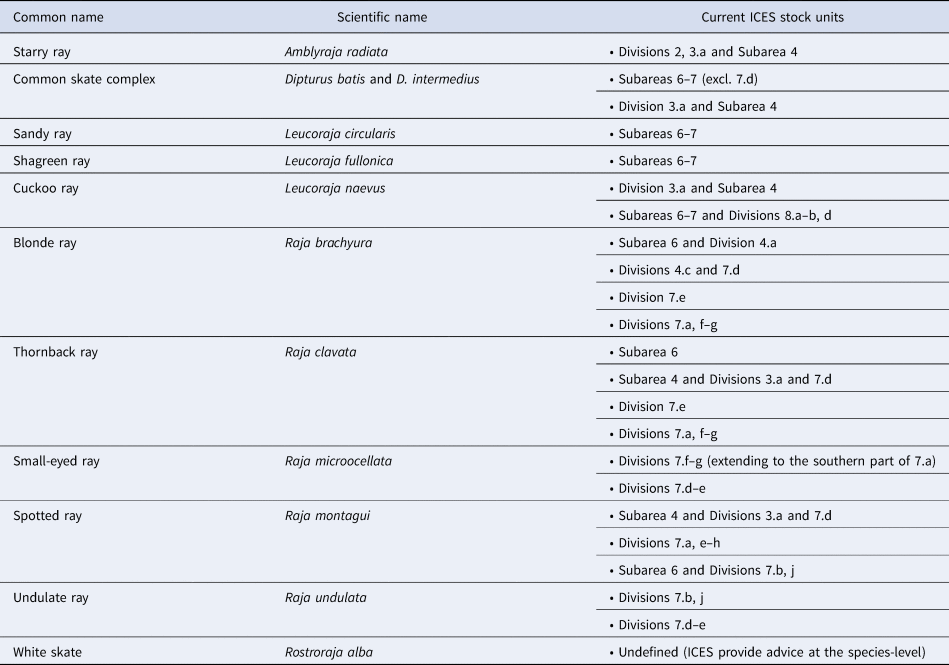
Under the reformed Common Fisheries Policy (CFP), member states are encouraged to take a more regional approach to fisheries management and to minimize impacts on marine biodiversity (European Union, 2013), and there have been recent discussions as to the most effective ways of managing fisheries for skates (STECF, 2017), including whether quota management would be best applied at the level of regional species-complex, genus, species or stock. Whilst ICES provide advice for a range of nominal skate stocks (ICES, 2018; Table 1), some skate stocks straddle different management areas, and the various stock units are not fully defined for some species. Consequently, there is a fundamental need to re-appraise the spatial movements and connectivity of skate populations.
Current ICES stock units for skates (Rajidae) around the British Isles

Note: The stock units used by ICES do not cover the full spatial distributions for some of the species.
In the present study, 50 years of conventional tagging data for eight commercially important skate species around the British Isles were analysed in order to (1) examine the distances travelled by the various species, (2) estimate the degree of connectivity between ICES Divisions, (3) identify whether the stock units currently used by ICES are appropriate, and (4) identify those species and areas for which data are lacking, or limited, and where further tagging studies could usefully be undertaken.
Methods
Tagging studies
Fish tagging has been conducted by CEFAS since the early 1900s, with records for skate and ray tagging dating back to the 1950s (Burt et al., Reference Burt, Goldsmith and Armstrong2006). These studies were undertaken initially to help understand their movements and growth. Given the landing obligation under the reformed CFP (EU, 2013), recent tagging studies have also been used to understand the discard survival of commercially caught fish.
In total, 22,424 individual batoids were tagged between 1959 and 2016. These included nominal records of sandy ray Leucoraja circularis (Couch, 1838) (N = 29) being tagged from outside their expected distribution range, and these records were excluded from further analysis.
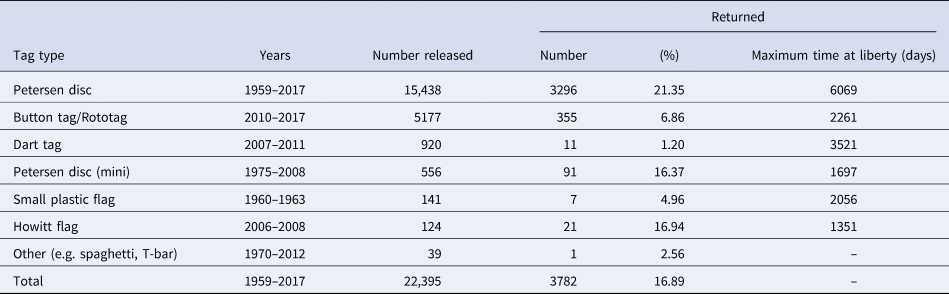
Ten different types of conventional tags were deployed on skates, including Petersen discs and button, dart, spaghetti and T-bar tags (Table 2). Petersen discs were the preferred choice for skates (used for 69% of releases) given their good retention rates and low biofouling.
Number of batoids released (and recaptured) by tag type

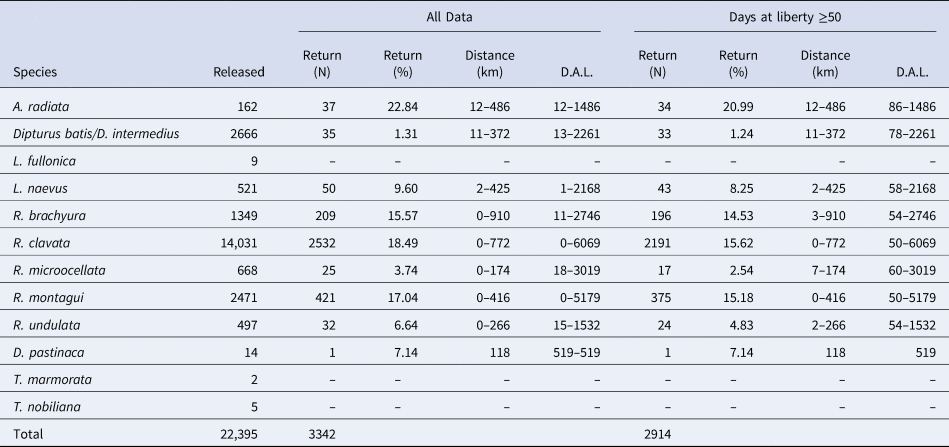
Thirteen batoid species (Table 3) were tagged during this time, including species of commercial importance (e.g. thornback ray Raja clavata L., 1758) and conservation interest (e.g. common blue skate Dipturus batis L., 1758).
Summary of tag return information (% returned, distance travelled and days at liberty (D.A.L.)) for skates and D. pastinaca, where return locations were provided to at least the resolution of ICES Rectangle

Data shown for all returns and for those that were ≥50 D.A.L. See legend of Table 4 for potential identification issues.
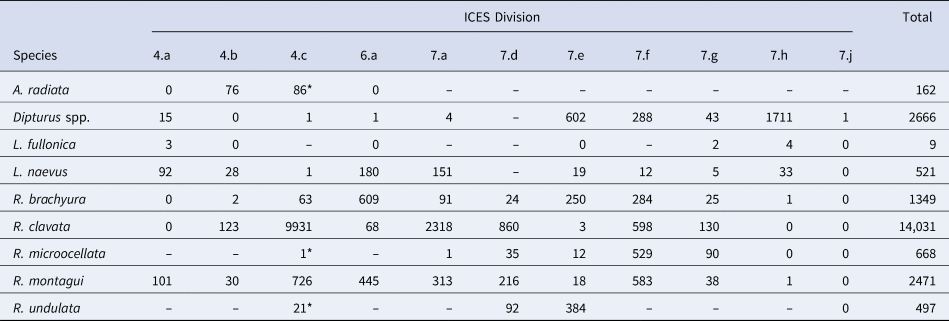
Numbers of skates tagged by ICES Division. Records of potential misidentifications are denoted *. ‘0’ = where no tagging of a species has been undertaken in that part of their geographic range; ‘–' = where a species is not considered to occur in meaningful numbers for tagging studies

Most tagging was undertaken from 1959–1976 (33.9% of databased releases) and since 2000 (56.8%), with lower numbers tagged from the mid-1970s to 2000. Studies in the early part of the time-series were conducted as part of biological investigations of skates (Holden, Reference Holden1972), with studies since 2000 involving a combination of dedicated tagging studies (e.g. Ellis et al., Reference Ellis, Burt, Grilli, McCully Phillips, Catchpole and Maxwell2018) and opportunistic tagging during fishery-independent trawl surveys.
Raja clavata, the most commercially important skate in the UK, had the largest number of tags released (N = 14,031), primarily through dedicated tagging studies (e.g. Ellis et al., Reference Ellis, Burt, Grilli, McCully Phillips, Catchpole and Maxwell2018), and as a result of their abundance and broad distribution. Both spotted ray Raja montagui Fowler, 1910 (N = 2471) and blonde ray Raja brachyura Lafont, 1873 (N = 1349) also had large sample sizes. Data were more limited for species with more restricted distributions or lower commercial value, for example the smaller-bodied starry ray Amblyraja radiata (Donovan, 1808) had just 162 releases, with 86 of the historical records considered questionable, due to the geographic location of the releases (Division 4.c).
Tag returns were supplied by commercial fishers, staff at ports and markets, or from beachcombers who discovered tags washed ashore once shed from the body of the fish. The tags could be returned either on their own or with the carcass (assuming the species was not subject to management restrictions) for a financial reward. Data on the recapture position or recovery of the tag are requested, along with biological information such as species, length and sex, to verify the entry and to potentially provide additional data relating to growth.
Tagging data
Tagging data, including release and return information (dates and locations), biological information (length and sex) and tag type, were collated for all batoids held in the CEFAS Tagged Fish Database (Burt et al., Reference Burt, Goldsmith and Armstrong2006). Recapture information for reported tags had varying degrees of resolution (in terms of positional information, capture date, fish size), depending on the data provider. Where precise recapture coordinates were not reported, locational information was given as the centre point of the estimated ICES Rectangle (e.g. based on port and fishing grounds of the vessel). Where tags were reported for a general region, capture locations were assigned to the relevant ICES Division and not assigned coordinate information for spatial analyses.
Spatial analyses of movement patterns were constrained to individuals that were recaptured after ≥50 days at liberty (DAL), to allow sufficient time for movements away from the release position. To assess movements, great-circle distances (straight-line distances ignoring land and accounting for the curvature of the earth) were calculated using the haversine formula:
 $$a = \; {\rm si}{\rm n}^2\left( {\displaystyle{{\Delta {\rm \varphi}} \over 2}} \right) + {\rm cos}\varphi _1\cdot {\rm cos}\varphi _2\; \cdot \; {\rm si}{\rm n}^2\left( {\displaystyle{{\Delta \lambda} \over 2}} \right)$$
 $$c = 2\; \cdot a{\rm tan}2\; \left( {\sqrt a, \; \sqrt {\lpar {1-a} \rpar }} \right)\; $$
 $$d = R\; \cdot c$$
where φ is latitude (radians), λ is longitude (radians) and R is the earth's radius (6378.145 km).
To quantify movements between ICES Divisions, the proportion of returns from each ICES Division was calculated for the corresponding ICES Division in which the species was released. For mapping purposes, only individuals with known return locations (either precise coordinates or the centre of ICES Rectangles) were plotted. These data were then used to determine the validity of the stock units currently considered by ICES.
Results
Overall tagging results
Of the 22,395 batoids considered (comprising 22,374 skates and 21 other batoids), tags were returned from 3782 (16.89%) individuals. Of these, 3342 tags (88.4%) had either precise coordinates (latitude and longitude) or centre points of ICES Rectangle (Table 3), with this increasing to 3406 (90.1%) that had locational information to at least ICES Division.
For individuals where recapture information was available to at least ICES Rectangle and those that were at liberty for ≥50 days (N = 2914), A. radiata had the highest return rate (21.0%), whilst R. brachyura, R. clavata and R. montagui all had similar return rates (14.5, 15.6 and 15.2%, respectively; Table 3).
Skates were tagged and released in all months, with the majority (~70%) in May to October, and ~30% released from November to April. In terms of recaptures (≥50 DAL), skates were returned in all months of the year, with most returned in February, May, June and September. Given the duration of the time-series, it was not possible to examine the recapture information in relation to fishing effort. However, given the continental shelf habitat of the species in question, it is unlikely that tagged skates had moved beyond the geographic range of European fishing fleets.
The furthest straight-line distance travelled by any individual was for a R. brachyura (910 km), while a tagged R. clavata had the longest time at liberty (6069 days or 16.6 years; Table 3). Of the 12 species of batoid tagged around the British Isles, spatial analyses were constrained to those skate taxa for which ICES provide advice (Table 1), comprising Amblyraja radiata, Leucoraja spp., Raja spp. and the common skate complex (D. batis and flapper skate Dipturus intermedius (Parnell, 1837)).
The spatial coverage of tagging studies was non-uniform, with larger numbers of skates (and broader range of species) tagged and released in the southern North Sea (Division 4.c), Irish Sea (Division 7.a) and Bristol Channel (Division 7.f; Table 4). Smaller sample sizes were available for the northern North Sea (Division 4.a), western English Channel (Division 7.e) and north-west Scotland (Division 6.a).
Raja clavata
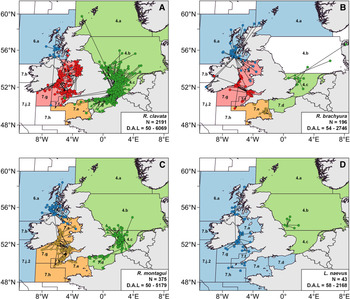
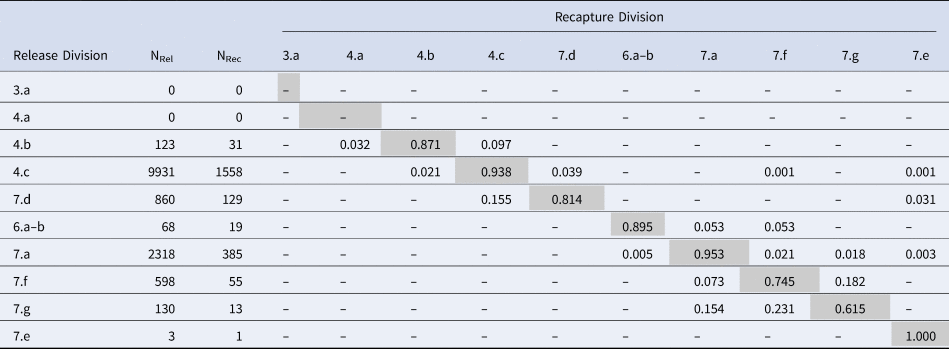
Of the 14,031 R. clavata tagged, 2191 (15.6%) tags at liberty for ≥50 days were returned with appropriate locational information (i.e. exact coordinates or ICES Rectangle). Most R. clavata were tagged and released in Division 4.c (70.8%; Table 4). Overall, 99.5% of returned tags were from within the defined stock unit of release (Table 5), although some more extensive movements between stock units and management areas were recorded (Figure 1), including from the North Sea stock area to the stock areas for Division 7.e (N = 5) and Divisions 7.a, f–g (N = 2). There were also some movements of R. clavata from Divisions 7.a, f–g northwards into Subarea 6 (N = 2), and southward movements from Subarea 6 to Divisions 7.a, f–g (N = 2).
Tag releases (triangles), returns (circles) and straight-line distances (lines) for (A) R. clavata (N = 2 191), (B) R. brachyura (N = 196), (C) R. montagui (N = 375) and (D) L. naevus (N = 43) at liberty for ≥50 days (D.A.L.). Different colours indicate ICES stock units.

Exchange of Raja clavata (≥50 D.A.L.; N = 2191) between ICES Divisions, showing the original release Division, the total number released (NRel), the number recaptured (NRec; see Table 3), and the proportion of these recaptured in each ICES Division

Grey cells indicate where the Division of release and recapture were the same, and boxes indicate the current stock units.
Raja brachyura
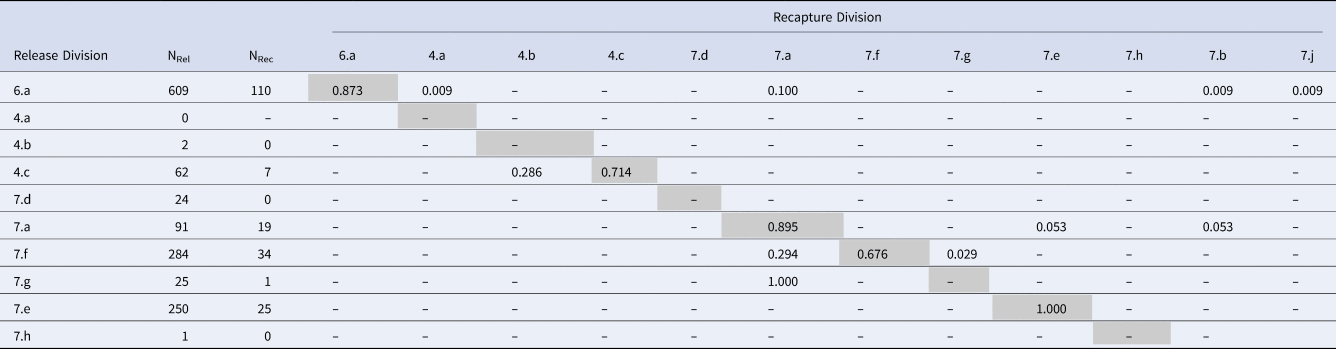
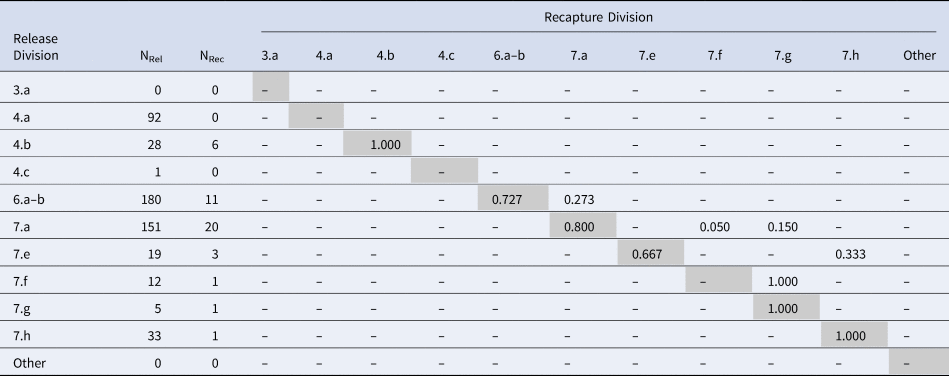
In total, 1349 R. brachyura were tagged and released across nine ICES Divisions. Tags were returned from 196 individuals and 10 ICES Divisions (Figure 1). The current ICES stock units broadly encompassed the observed movements of this species, with 91.8% of tag returns from within the stock unit released (Table 6). There was some exchange between stock units, with R. brachyura tagged in Division 6.a moving southwards into Divisions 7.a, f–g (N = 11), and from Divisions 7.a, f–g into Division 7.e (N = 1). There were instances of individuals being caught outside current ICES stock units, with R. brachyura tagged in Division 6.a being recaptured in Divisions 7.b (N = 1) and 7.j (N = 1), and three specimens tagged in Division 4.c moved north into Division 4.b.
Exchange of Raja brachyura (≥50 D.A.L.; N = 196) between ICES Divisions. See Table 5 for further details

Raja montagui
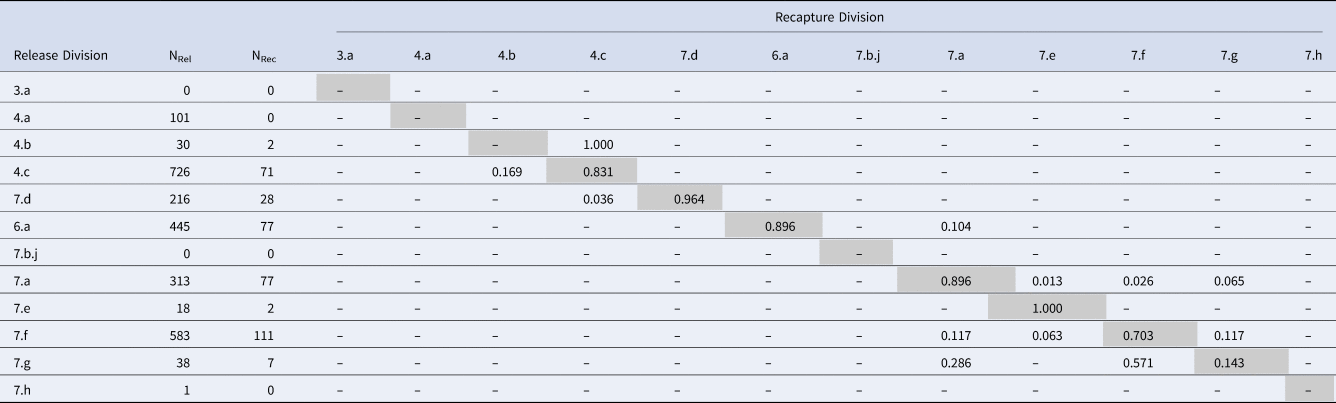
Of the 2471 R. montagui tagged across 10 ICES Divisions, 375 (15.2%) were returned from eight Divisions. Overall, 97.9% of tags were returned from within the stock unit of release (Figure 1). The only observed movements between stock units for R. montagui were individuals (N = 8) tagged and released in Division 6.a moving southwards into Division 7.a (Table 7).
Exchange of Raja montagui (≥50 D.A.L.; N = 375) between ICES Divisions. See Table 5 for further details

Leucoraja naevus
A total of 521 cuckoo ray Leucoraja naevus (Müller & Henle, 1841) were tagged and released from nine ICES Divisions, of which 43 tags were returned and reported from seven ICES Divisions (Figure 1; Table 8). Movements were only ever to the same region of release or to an adjacent ICES Division. The low return rate (8.25%) for this species limited the inferences about movements between ICES Divisions and stock units. There were no recorded movements between the current stock units, although only limited tagging was undertaken close to the border between Divisions 4.a and 6.a.
Exchange of Leucoraja naevus (≥50 D.A.L.; N = 43) between ICES Divisions. See Table 5 for further details. No data available for ‘Other’ parts of the stock range (Divisions 7.b–c, j–k and 8.a.b.d)

Other skate species
For the remaining species, tag releases and/or returns were too low to reliably inform on stock units. Of the 162 A. radiata released in Divisions 4.b and 4.c, the 34 tags returned with appropriate recapture information were all from within the stock unit.
There were limited returns for small-eyed ray Raja microocellata Montagu, 1818 with recapture information (2.54%), despite relatively large numbers being tagged (N = 668) across five ICES Divisions. Of those tags returned, there was no evidence to suggest movement between stock units, with all tags returned from the stock unit of release.
For undulate ray Raja undulata Lacepède 1802, only 24 tags were returned with known locations from the 497 individuals tagged and released. Most R. undulata moved east-west between Divisions 7.e and 7.d, with a single individual recaptured in Division 7.f (outside the defined stock areas for this species). Large numbers of Dipturus spp. were tagged and released (N = 2666), and all returns (N = 35) were within the release area (Divisions 7.e–h).
Discussion
Historical tagging studies
A range of tagging studies have been conducted on skates in northern European seas. Among the earliest studies, Fulton (Reference Fulton1893), using numbered brass discs attached to the tails of fish by black silk cord, tagged and released various skate species (R. clavata, Dipturus spp. and A. radiata) off north-west Scotland in the late 1880s. Later, in the early 1930s, Steven (Reference Steven1936) used vulcanized rubber tags to undertake studies on the movements and growth of juvenile R. clavata from the coastal waters of south-west England. Both these studies recorded limited movements of tagged skates, although the numbers tagged, restricted tagging locations and limited times-at-liberty restricted the interpretation of stock units.
The utility of tagging studies
The use of mark-recapture data to distinguish stocks has some advantages, but also well documented limitations (Pawson & Jennings, Reference Pawson and Jennings1996; Pawson & Ellis, Reference Pawson and Ellis2005). Tag returns are dependent on the recovery and reporting of tags by fishers, port staff or the public. Whilst reward programmes encourage the return of tags and recapture information, some fishers may not engage in such programmes. Furthermore, there should be a good overlap between fisheries and the species' distribution, to ensure that recaptures rates are not spatially biased.
The genus Raja comprises the main skate species exploited by commercial fisheries on the inner continental shelf around the British Isles, and were the more extensive data used in the present study (Table 3). Raja clavata, R. brachyura and R. montagui all had return rates >15%, thereby supporting more robust inferences regarding their movements.
The species analysed in the present study have the capacity to undertake long-distance movements, with the maximum individual straight-line distances travelled by R. clavata and R. brachyura being 772 and 910 km, respectively. Due to the nature of mark-recapture data, these calculated distances are minimum estimates and probably underestimate the actual distances moved. It is also unclear if these individuals returned to the areas of release within the time at liberty, or would return at some later point.
Whilst the high proportion of recaptures that occurred close (<50 km) to the original release positions indicates high affinities to these regions, these may not necessarily reflect restricted spatial movements over the lifetime of the individual. Several species of batoid are known to exhibit philopatric (repeated-return migrations) behaviours (Flowers et al., Reference Flowers, Ajemian, Bassos-Hull, Feldheim, Hueter, Papastamatiou and Chapman2016), which may not be reflected using conventional mark-recapture data (Hunter et al., Reference Hunter, Buckley, Stewart and Metcalfe2005). An increasing number of studies have used electronic data storage tags (DSTs) to collect continuous data on the finer-scale movements of batoids between release and recapture positions, which can help resolve this ambiguity. Using DSTs, Hunter et al. (Reference Hunter, Buckley, Stewart and Metcalfe2005) found that R. clavata undertook seasonal migrations that were not apparent from conventional tagging data. Electronic tagging of big skate Beringraja binoculata in the eastern Pacific demonstrated the distances inferred from conventional tagging studies underestimated the distances travelled and number of management boundaries crossed (Farrugia et al., Reference Farrugia, Goldman, Tribuzio and Seitz2016), but also demonstrated that a proportion of the population probably had high site fidelity, similar to that observed for flapper skate Dipturus intermedius in Scottish waters (Wearmouth & Sims, Reference Wearmouth and Sims2009; as D. batis; Neat et al., Reference Neat, Pinto, Burrett, Cowie, Travis, Thorburn, Gibb and Wright2015).
More recently, Humphries et al. (Reference Humphries, Simpson, Wearmouth and Sims2016) reported that the 92% of skates (four species combined) tagged with electronic tags were returned <30 km from the release point in the western English Channel. This study reported that the distances travelled (release to recapture point) and times at liberty were 4.2–38.2 km and 9–685 days (R. brachyura; N = 12); 0–20.1 km and 0–1052 days (R. clavata; N = 43); 0–64.0 km and 1–403 days (R. microocellata; N = 24) and 1.1–32.1 km and 38–654 days (R. montagui; N = 10). Hence, the presence of larger-scale movements (>100 km) observed in the current study highlights that some skates (individuals and/or species) may move greater distances than generally realized, and deployments of longer-term electronic tags could help refine our understanding of skate movements.
Over the 58 years of tagging experiments, a total of 10 different tag types were used (Table 2), although most data related to Petersen discs. Whilst the return rates of the different tag types varied, a finding noted in other tagging studies (Pawson et al., Reference Pawson, Pickett and Kelley1987), the tagging studies examined here were not designed to determine differences between tag types. Differences in tag retention rates (tag shedding) and tagging-related mortality (both of which might be influenced by the experience of the tagger), as well as impacts on fish health and behaviour, susceptibility to biofouling and visibility to fishers and public may all impact the likelihood of a tag being returned. For example, the use of dart tags on commercial skates (N = 920; mostly in the Bristol Channel) resulted in returns of only 11 (1.2%). This suggests that either the tags used have a high shedding rate, or that fishers in the area were not returning tags. Previous studies have shown tag shedding from spaghetti tags to be higher than for T-bar tags (Timmons & Howell, Reference Timmons and Howell1995), especially when anchored in the dorsal musculature as opposed to the basal cartilage (Xiao et al., Reference Xiao, Brown, Walker and Punt1999). The present study indicated that Petersen discs (and mini Petersen discs) yielded relatively good return rates, with (all data combined) 21.1% and 13.9% returned. Despite the increased handling times in attaching Petersen discs, these data confirm that these tags are suitable for tagging skates.
Raja clavata
Over the study period, R. clavata accounted for 62.65% of the total tag releases (Table 3), with many of these originating from work in the Outer Thames (Division 4.c; Ellis et al., Reference Ellis, Burt, Grilli, McCully Phillips, Catchpole and Maxwell2018), an important area for the North Sea-eastern Channel stock (Walker et al., Reference Walker, Howlett and Millner1997; ICES, 2018). Whilst these tagging data broadly supported the current ICES stock unit, with over 99% of returned fish from within the stock distribution, data were limited for the northern North Sea (Division 4.a). Whilst there was exchange of R. clavata within Divisions 4.b–c and 7.d, there was only a single instance of a recapture in the northern North Sea (Division 4.a) and no evidence of movements to the Skagerrak (Division 3.a). Hence, further studies to gauge the movements of R. clavata from these Divisions are required.
Most R. clavata tagged in the Irish Sea (Division 7.a) and Bristol Channel (7.f) also remained in the stock area, with only occasional recaptures from elsewhere. The numbers of R. clavata released in other nominal stock units (e.g. Subarea 6 and Division 7.e) were limited, although the southward movement of some individuals from 6.a to 7.a and 7.f was noted.
The available data had no releases from west of Ireland (Divisions 7.b, 7.j, an area for which the stock units of R. clavata are yet to be defined). Mark-recapture studies on recreationally caught R. clavata tagged in Broadhaven Bay (western Ireland; 71 released; 8 (11.3%) recaptured) reported movements of less than 45 nm (= 83 km; Fitzmaurice, Reference Fitzmaurice1974).
The inferences of relatively limited dispersal observed in the present study supported the findings of previous studies. For example, Steven (Reference Steven1936) found that 61% of the 202 recaptured R. clavata tagged off Plymouth were recaptured in the same general position as their release, despite being at liberty for a range of 12–1357 days. However, several R. clavata travelled distances >100 km in the present study (Table 3), indicating that this species can move greater distances and move between stock units (and management areas). Genetic studies have provided limited evidence of stock differentiation in R. clavata around the British Isles (Chevolot et al., Reference Chevolot, Ellis, Hoarau, Rijnsdorp, Stam and Olsen2006), suggesting that there is a degree of mixing between adjacent stocks, which the larger distances recorded here would support. More recent genetic studies have demonstrated a degree of genetic mixing of R. clavata in the North-east Atlantic, suggesting that genetic approaches may not always be suitable for assessing finer-scale demographic connectivity and dispersal patterns in this species (Marandel et al., Reference Marandel, Lorance, Andrello, Charrier, Le Cam, Lehuta and Trenkel2017). The occasional movements of R. clavata tagged in 6.a, 7.a, 7.d and 4.c into different stock units indicates that a small proportion of the stock undertake larger-scale movements, which is consistent with the findings from genetic studies.
Overall, the current ICES stock units for this species appeared to agree with tagging data, but to what extent movements into other stock units may represent regular migrations or occasional, transient movements remains unclear. Interestingly, of the 12 individual R. clavata that travelled greater than 400 km, 11 were female, suggesting there may be potential differences in dispersion between the sexes of this species. Whilst sex-biased dispersal has been reported in a range of elasmobranchs (Pardini et al., Reference Pardini, Jones, Noble, Kreiser, Malcolm, Bruce, Stevens, Cliff, Scholl, Francis and Duffy2001; Portnoy et al., Reference Portnoy, Puritz, Hollenbeck, Gelsleichter, Chapman and Gold2015), it typically involves more wide-ranging movements of males, and so further studies on sex-biased dispersal could usefully be undertaken for rajids.
Of additional interest was one male R. clavata that was tagged at 64 cm and remained at liberty for 6069 days (16.6 years, reported length at recapture = 90 cm) – a time longer than the maximum ages of 8–15 observed by various authors (Gallagher et al., Reference Gallagher, Nolan and Jeal2005; Serra-Pereira et al., Reference Serra-Pereira, Figueiredo, Farias, Moura and Gordo2008; Kadri et al., Reference Kadri, Marouani, Saïdi, Bradai, Bouaïn and Morize2014).
Raja brachyura
Most returned R. brachyura tags (91.84%) were also from within the ICES stock unit of their release, suggesting current stock units are broadly correct. However, there appeared to be a relatively important movement from Division 6.a southwards into the 7a.f–g stock unit which, although based on low numbers, was a relatively high proportion (10% of recaptures of R. brachyura tagged in 6.a were recaptured in 7.a). In contrast, there was no evidence of a corresponding northward movement from 7.a.f–g to 6.a (Figure 1). Of the 11 R. brachyura tagged and released in Division 6.a that were subsequently recaptured in 7.a, six were recaptured in March–April, which could possibly relate to moving to spawning grounds, although more detailed investigations on the seasonality of migrations are required.
ICES currently advise on R. brachyura in the northern North Sea (part of a nominal Subarea 6 and Division 4.a stock) and southern North Sea (part of a nominal stock in Divisions 4.c and 7.d), which is supported by the reported distribution pattern from trawl surveys in the North Sea (Ellis et al., Reference Ellis, Heessen, McCully Phillips, Heessen, Daan and Ellis2015). The present study indicated that R. brachyura tagged in the southern North Sea also moved into the central North Sea (Division 4.b), suggesting that this stock may extend further north than currently assumed.
Available data from the western Channel (Division 7.e) indicated a resident population of R. brachyura. This supports an earlier study conducted around the island of Jersey, which reported a maximum distance travelled of 61 km, and with most returned tags coming from areas close to their initial tag and release position (Ellis et al., Reference Ellis, Morel, Burt and Bossy2011).
Once again, larger-scale movements of this species were also observed and 61% of those fish that moved greater than 100 km were female, including the individual that travelled 910 km.
Raja montagui
Overall, 97.9% of recaptured R. montagui (with known return locations), were from within the stock unit that they were released from, suggesting movements between units to be limited. The only observed movements between stock units was a southward connection between 6.a and 7.a, as noted previously for both R. clavata and R. brachyura. However, whilst mixing within the 7.a.e–h stock was evident, there was no evidence to indicate movements from Subarea 6 to Divisions 7.b.j. Similarly, whilst there was mixing within part of the North Sea stock range, there was no evidence of movements from the southern North Sea and eastern Channel to either the northern North Sea or Skagerrak. Whilst this may suggest that the current stock units for this species are too broad, it is noted that there were very few tags returned from Division 4.a, and it is possible that fishers in this area have not returned tags. Previous analyses using a subset of these data (Walker et al., Reference Walker, Howlett and Millner1997) suggested that there were separate stocks of R. montagui in the North Sea and eastern English Channel stock. Whilst none of the R. montagui released in 4.c moved into 7.d, some individuals (3.6%) tagged in 7.d did move into 4.c, indicating a degree of connectivity.
Leucoraja naevus
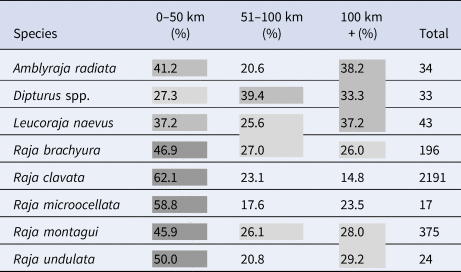
While the spatial coverage of tag releases for L. naevus was relatively good, there were only 50 recaptures, of which only 43 had both geographic recapture information and had been at liberty ≥50 days. Whilst there was no evidence to suggest that L. naevus moved between stock units, further tagging studies across their distributional range are required to better assess the effectiveness of current stock units, especially in relation to potential connectivity between Divisions 6.a and 4.a. As seen in other skates, a southward movement from Division 6.a into 7.a was observed. Leucoraja naevus is widespread along the continental shelf of north-west Europe, and it is currently assumed that the stock extends from north-west Scotland (Subarea 6) to the Bay of Biscay (Divisions 8.a–b, d). The available tagging data did not provide any evidence to corroborate movements across this extensive stock unit (e.g. there were no reported recaptures from the Bay of Biscay). However, the maximum distance travelled was 425 km and a relatively high proportion of recaptures were from distances of >100 km (Table 9).
Summary of distances travelled by main skate species of the British Isles. Shade of the box is reflective of percentage

Other skate species
There were fewer tag returns from R. microocellata and R. undulata (corresponding return rates were 2.54% and 4.83%, respectively). Similar to species discussed previously, fish that had been at liberty for ≥50 days were generally recaptured from the same ICES Division as their release, even when times at liberty were in excess of four years, suggesting both these species have more restricted distributions and potentially greater site fidelity. While no movements between stock units were observed for R. microocellata, one tagged R. undulata moved from Division 7.e to 7.f (days at liberty = 206; maximum distance travelled = 246 km). The low return rates observed in R. microocellata may in part be due to the high proportion of dart tags deployed on this species (see above).
Whilst few A. radiata were tagged and released, the corresponding return rate was relatively high (20.99%), and there were no recorded movements out of the North Sea. Tagging studies on A. radiata off Newfoundland reported that most individuals moved <60 nm (=111 km) over periods of up to 16 years (Templeman, Reference Templeman1984). Whilst the latter study found that 13% of individuals travelled >100 nm (=185 km), indicating this species is capable of longer-distance movements, A. radiata in the North-western Atlantic are larger-bodied than the North Sea population and may be more capable of travelling larger distances.
Are ICES’ current stock units appropriate?
Compiling over 50 years of conventional tagging data from skates around the British Isles has provided strong evidence to suggest that current ICES stock units for these species (Table 1) broadly encompass the observed dispersal patterns. Overall, for skates at liberty for ≥50 days, most were returned from areas <50 km from their release positions (59.0%; Table 9), and most recaptures were from the current stock units used by ICES.
Areas of high tidal dynamics and high seabed sheer stress are known to be suboptimal habitats for some skates (e.g. Maxwell et al., Reference Maxwell, Stelzenmüller, Eastwood and Rogers2009; Martin et al., Reference Martin, Vaz, Ellis, Lauria, Coppin and Carpentier2012), and such sites include the North Channel (separating Divisions 6.a and 7.a) and the narrows (separating 7.d and 7.e). The North Channel is an area of both high tidal dynamics and deeper water (e.g. Robinson, Reference Robinson1979; Howarth, Reference Howarth1982) and fish stocks off north-western Scotland and the Irish Sea are often considered to be separate. However, southward movements from the south-eastern part of Division 6.a into 7.a, presumably involving movements through the North Channel, were observed for several skate species, with comparatively fewer northward movements. Habitat mapping of this region suggests there is a mix of sandy bottoms connecting the two regions (Aldridge & Davies, Reference Aldridge and Davies1993), potentially providing habitat corridors for those skate species that favour these sediment types, and the southward water movements along the Irish side may facilitate the southward movements of skates from 6.a into 7.a. Future work could usefully use electronic tagging of skates in this region to further improve our understanding of finer scale movements between 6.a and 7.a to better gauge the appropriateness of the North Channel as a stock boundary.
The stock units used by ICES sometimes straddle both the North Sea and Skagerrak (e.g. L. naevus, R. clavata and R. montagui). There were, however, no returns of any of these species from the Skagerrak (Division 3.a) from tagging studies elsewhere in Subarea 4. Furthermore, the distributions of both R. montagui and L. naevus do not appear to extend into the Skagerrak (Ellis et al., Reference Ellis, Heessen, McCully Phillips, Heessen, Daan and Ellis2015). Consequently, the stock units of these species could usefully be reconsidered.
Whist there were considerable data for R. clavata, R. brachyura and R. montagui in several areas, comparable data were limited for other parts of their range. Such data gaps could be addressed by targeted tagging efforts for R. clavata in 7.e., R. brachyura in 4.c and 7.d, and R. montagui from 4.a–b and 7.e, g–h. Those species with limited recapture data (e.g. A. radiata, L. fullonica, L. naevus, R. microocellata and R. undulata) would also benefit from continued conventional tagging, potentially with dedicated programmes to ensure appropriate sample sizes can be tagged. Future tagging work would also benefit from increased efforts off north-western Scotland (6.a), northern and central North Sea (4.a–b), western Ireland (7.b, j) and western Channel (7.e), as such information would also inform any future reappraisal of stock units.
Whilst tagging can provide important information on stock units, and other aspects of the ecology of the species, more dedicated and holistic studies on stock identity, including tagging, genetic and parasitological studies, as well as spatial variation in life-history parameters (Begg & Waldman, Reference Begg and Waldman1999; Pawson & Ellis, Reference Pawson and Ellis2005; Abaunza et al., Reference Abaunza, Murta, Campbell, Cimmaruta, Comesana, Dahle, Gallo, Santamaría, Gordo, Iversen and MacKenzie2008) may also help further refine the relevant stock units.
Acknowledgements
We thank the many scientists, past and present, for their assistance with the various tagging projects undertaken by the laboratory, and the anonymous reviewers for their constructive comments.
Financial support
This research has benefitted from the support of the UK's Department for Environment, Food and Rural Affairs.