Introduction
Modern cochlear implants with continuously improving hardware, speech processors and atraumatic surgical techniques are a miraculous solution for treating severe sensorineural hearing loss. Because conventional cochlear implants have quite noticeable external hardware, users have demanded a cochlear implant system that does not stigmatise their disability. Although the fully implantable cochlear implant concept is not exactly new, it has not gained widespread use because of technical difficulties with rechargeable batteries, high-fidelity microphones, over-complicated surgical procedures and concerns about safety.Reference Cohen1
A fully implantable cochlear implant needs to have energy and sound data transfer modalities, often with backups. Although the power supply or energy consumption of a fully implantable cochlear implant system is not the primary focus of this study, it could be said that the unavailability of a small, reliable rechargeable battery with enough capacityReference Liang, Zhao, Yuan, Chen, Zhang and Huang2 and a long lifetime or an effective energy harvesting system has been problematic. Regardless of the technology, the low energy requirement is always critical.
The sound source of a fully implantable cochlear implant could be an implanted subcutaneous microphone,Reference Briggs, Eder, Seligman, Cowan, Plant and Dalton3,Reference Zenner, Leysieffer, Maassen, Lehner, Lenarz and Baumann4 a piezoelectric vibration sensor located on the ossicles,Reference Barbara, Filippi, Covelli, Volpini and Monini5 tympanic membraneReference İlik, Koyuncuoğlu, Uluşan, Chamanian, Işık and Şardan-Sukas6 or under the basilar membrane,Reference Liu, Zhu, Liu, Zhang, Liu and Zhai7 or could even use electrocochleography.Reference Riggs, Hiss, Skidmore, Varadarajan, Mattingly and Moberly8 Although an external microphone that is wirelessly linked to a cochlear implant system without any external unit, as proposed in this study, cannot be classified as a fully implantable cochlear implant, a similar ‘hidden operation’ is still possible. The processing power of a modern smart device is more than enough to perform any digital sound data process almost instantly.
The simplicity and flexibility of using the microphone of a smart device and gathering the processed sound data through a wireless link, such as BluetoothTM, are very appealing. Furthermore, a readily available smart device connection would dramatically enhance the user experience, making software upgrades practical and remote control of the device possible. The drawback of a Bluetooth connection is the higher energy consumption of the implanted unit. Therefore, an energy-efficient way of transmitting sound data as an alternative would be necessary. For this purpose, we proposed a ‘hidden external unit’ with an in-the-canal hearing aid form and a transtympanic optical data transfer system. The hidden external unit would gather sound signals with its in-the-canal microphone. This would enable the resonance of the outer ear to give more natural hearing. The processed sound data would then be transmitted with a wide-angle infrared source. The hidden cochlear implant would receive those signals with its optical receiver. A tiny (sub-millimetre9) optical receiver would be neatly embedded in the polymeric sheath of the electrode carrier, a few milimeters proximal to the round window insertion marker. Therefore, it would be positioned in the middle ear, facing the tympanic membrane in line of sight of the transmitter. So, the form factor and the implantation of the hidden cochlear implant would be almost identical to conventional cochlear implants.
This study aimed to present the fresh frozen cadaver implantation results of the hidden cochlear implant proof of the concept prototype and compare it with the state-of-the-art fully implantable cochlear implant concept.
Materials and methods
The experimental setup used Bluetooth low energy technology. ESP32SoC modules (Espressif Systems, Shanghai, China) were used both as the transmitter and the receiver. The transmitter module was implanted in a sub-periosteal pocket with a retro-auricular incision where a cochlear implant body would normally be placed (Figure 1). A DP832 power supply (Rigol, Suzhou, China) was used to monitor the power consumption. Transmitted and received data were continuously recorded. The average delay between the transmitted–received signals and the power consumption was calculated at 1 m. All electronic devices and wireless connections that might interfere with the results had been turned off.
Image of the general layout during the interference received signal strength indicator test. The Bluetooth low energy transmitter was implanted in the implant bed. It was connected to a computer with a flat cable. Four other wireless devices operating at the 2.4 GHz band were positioned at the corners of a 75-cm square to cause interference. The receiver was at the 1 m distance approximately at the position of the camera.

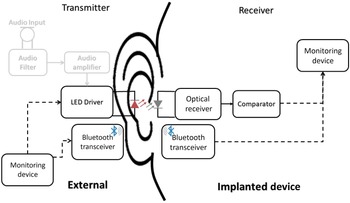
Received signal strength indicator tests were performed with NRF Connect android application (Nordic Semiconductor, Trondheim, Norway) running on a Galaxy M31 smartphone (Samsung, Suwon-si, South Korea) and X509JB laptop computer (Asus, Taipei, Taiwan). Multiple (n = 10 ± 2) decibel milliwatt readings were taken at each test. The schematic representation of the Bluetooth low energy data transmission system is given in Figure 2. For the distance received signal strength indicator tests, the distance between the devices was gradually increased with a clear line of sight until a reliable connection could not be established.
Schematic representation of the proposed Bluetooth low energy and transtympanic optical data transmission systems for the hidden cochlear implant concept. Transtympanic data transmission was performed with digital communication. Please note that the grey boxes were not active during the experiment. LED = light-emitting diode

Obstacle and interference received signal strength indicator tests were performed at 1 m. The signal strength from the opposite side of the cadaveric head, through 8 layers of cotton-polyester blend surgical cloth (4.45 mm in total), through a 31-mm thick living tissue (palm of a hand), and through grounded and non-grounded 70-micron thick copper-clad laminate (Pyralux® AP, DuPont, Wilmington, USA), was measured. The interference test setup, which had the head in the centre and four interfering devices with Bluetooth connections at the corners of a square with 75-cm long edges, was designed according to the literature (Figure 1).Reference Cantón Paterna, Calveras Augé, Paradells Aspas and Pérez Bullones10
The transtympanic optical data transfer system had two components: an external transmitter and an implanted receiver. The transmitter had a high-speed infrared light-emitting diode (LED; VSMB10940, Vishay, USA). Digital signals were chosen to make the signal amplitude (light intensity) irrelevant during the transmission because digital signals are either ‘0’ or ‘1’. The combination of infrared light and digital signals for the transtympanic data transmission was hypothesised to make the system less susceptible to misalignments, cerumen, effusion and so on. The receiver module had an off-the-shelf optical receiver (BPW34fs, Osram, Munich, Germany) with the dimensions of 5.4 × 4.3 × 3.2 mm and a comparator (LM311, Texas Instruments, Dallas, USA). The schematic representation of the system is given in Figure 2.
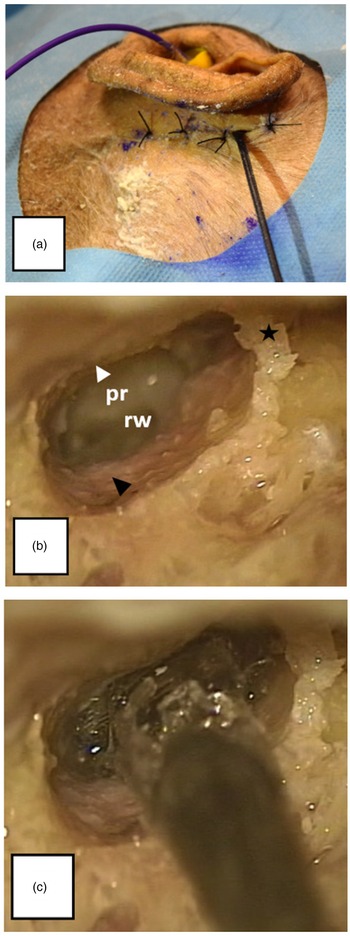
In the experimental setup, the infrared transmitter (940 nm wavelength) LED was wired to a waterproof cable, embedded in silicone, passed through a modified earplug and facing the tympanic membrane. Similarly, the infrared optical receiver was also wired to a waterproof cable and embedded in silicone. The optical receiver was passed through the posterior tympanotomy to be located on the promontorium, facing the tympanic membrane. A conventional, post-auricular, trans-mastoidal cochlear implantation technique and standard surgical pieces of equipment were used. Anatomical landmarks were meticulously preserved (Figure 3). Other components of the transmitter and receiver were left resting on the bench. Digital data transmission, power consumption and transtympanic optical data transfer with obstacles were tested. Transtympanic optical data transfer tests were conducted with data transfer rates of 1 Mbit/s and 250 Kbit/s.
(a) The transtympanic optical data transmission test layout. The optical transmitter was wired to a waterproof cable (blue), embedded in silicone, passed through a modified ear plug (yellow) and facing the tympanic membrane. Similarly, the optical receiver was also wired to a waterproof cable (black) and embedded in silicone. The optical receiver was passed through a retro-auricular incision, mastoidectomy cavity and posterior tympanotomy, similar to the conventional cochlear implantation technique and located on the promontorium, facing the tympanic membrane. (b) Anatomical landmarks such as ear canal, facial nerve (black arrowhead), chorda tympani nerve, tympanic membrane (white arrowhead), incudal buttress (asterisk), ossicles, round window (rw) niche and promontorium (pr) were meticulously preserved. (c) The optical receiver in the middle ear through the posterior tympanotomy.

For the transtympanic optical data transfer test, both the LED driver of the transmitter and the comparator of the receiver were connected to an oscilloscope to monitor the system performance. Both the transmitter and the receiver modules were powered by a DP832 power supply. Voltage, current and the power consumption of the modules were recorded for 1 minute during the transtympanic optical data transfer test to calculate average power consumption. The transtympanic optical data transfer tests with obstacles were designed to test the system performance in suboptimal conditions, simulating real-life use. For this purpose, water filling or some disc-shaped (diameter = 6 mm) obstacles on the intact tympanic membrane were used to simulate cerumen, effusion and foreign materials. A 0.4-mm polydimethylsiloxane, 0.1-mm polyvinyl alcohol, 0.4-mm black cardboard, 1.5-mm polylactic acid and a 0.4-mm thermoplastic polyurethane disc were tested as obstacles.
Results
Fresh frozen cadaver had 7-mm-thick soft tissue covering the implantation pocket. The Bluetooth low energy system used a 91 mA current on average during both active transmitting and receiving. The current consumption decreased as low as 5 μA during the sleep cycles. The average power consumption was 310 mW. The power consumption was only 16.5 μW during the sleep cycles. The average delay between sent and recovered data packs was 1.39 ms (± 0.064).
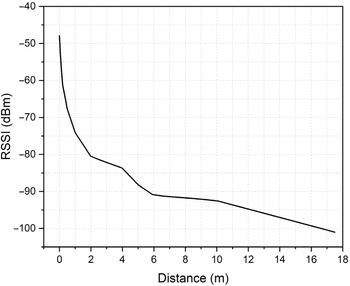
The received signal strength at zero distance in the open air was −26 dBm. This value dropped to −47 dBm when the transmitter was implanted subcutaneously. The signal strength decreased exponentially with increasing distance (Figure 4). A reliable connection could be established up to 17.5 m. As expected, the signal strength decreased with various obstacles that were put between the implanted transmitter and the receiver except for the copper-clad laminate, which increased the signal strength by 1.52 dBm. Once the same copper-clad laminate was grounded, it caused a 4.25 dBm weakening. The presence of the head between the transmitter and the receiver modules (head shadow effect) caused a remarkable 10.71 dBm decrease in the signal strength. The palm of the author's hand, as an obstacle, caused a 9.85 dBm drop in the signal strength. Interference of other wireless devices operating at 2.4 GHz affected the signal strength considerably, decreasing the signal strength by 8.3 dBm. Eight layers of cloth representing thick headwear caused only a 4.3 dBm decrease in the signal strength. The results of the obstacle and interference received signal strength indicator tests are summarised in Table 1. The expected Bluetooth low energy ranges with the tested obstacle and interference variables are summarised in Table 1.
Graph showing change of signal strength with distance. The Bluetooth low energy module transmitter was implanted in the implant bed, and the distance of the receiver was gradually increased with a clear line of sight. A connection could be established up to 17.5 m. RSSI = received signal strength indicator

Measured signal strengths at 1 m with various obstacles or interference

The maximum estimated ranges were calculated according to the distance received signal strength indicator (RSSI) and obstacle or interference RSSI test results
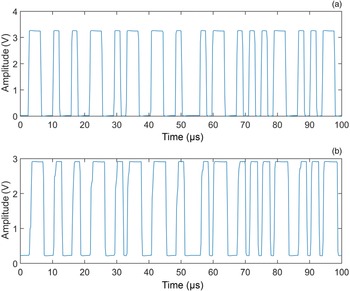
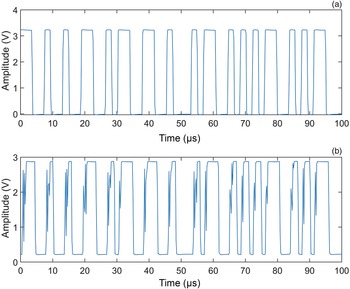
Transtympanic optical data transfer tests showed impressive data transfer rates exceeding 1Mbit/s with 99.22 per cent overall bit accuracy. The average delay between the sent and received data packs was 800 ns (Figure 5). During transtympanic optical data transfer tests, the average power consumption was 35 mW for the transmitter module and 41 mW for the receiving module. Because low energy consumption was not the aim, the infrared LED of the transmitter operated at its peak power (29.7 mW) throughout the experiment. The majority of the receiver module's energy consumption was because of the operational amplifier, which used 24.75 mW. The infrared receiver used only 231 μW.
It could be seen that 5 bytes of (a) transmitted data were (b) received without major distortion during the transtympanic optical digital data transmission test. The average delay between the sent and received data was 800 ns. Please note that the amplitude of the square signal was always the same, representing a digital signal.

During the transtympanic optical data transfer test with obstacles, a 0.4-mm-thick black cardboard obstacle gave the best result (99.65 per cent; Figure 6), which was as good as the transtympanic optical data transfer test result without any obstacle. Although small amounts of water were present because of the melting of the cadaver throughout the experiment, filling the ear canal with water decreased the correlation ratio by more than 12 per cent (correlation ratio, 87.58 per cent). The lowest correlation ratio was with the 0.4-mm-thick thermoplastic polyurethane disc (correlation ratio, 61.02 per cent). Lower transtympanic optical data transfer rates dramatically increased accuracy, and more than 99 per cent accuracy was reached with all of the obstacles with a 250 Kbit/s transtympanic optical data transfer rate. The thicknesses, the absorbance co-efficients of the obstacles and accuracy figures with 1 Mbit/s and 250 Kbit/s rates are summarised in Table 2.
It could be seen that the (a) transmitted data was (b) received with some minor distortion during the transtympanic optical digital data transmission test while 0.4-mm thick black cardboard was on the tympanic membrane as an obstacle. The presence of the obstacle increased the rise time but did not affect the decoded signal. The average delay between the sent and recovered data was 1 μs.

Correlation ratios of transmitted and received signals during the digital data transmission test with obstacles

The optical absorbance capabilities of the obstacles were negligible at 940 nm. Absorbance co-efficients were taken from the literature. Please note that at a 250 Kbit/s transfer rate, correlation ratios were dramatically increased
Discussion
In a fully implantable cochlear implant, implanted electronics, such as microchips, batteries, microphones and communication modules, inevitably increase the risk of a device failure. Therefore, many fully implantable cochlear implant concepts, like Envoy Medical Acclaim® often implement or hypothesise a connector11 to enable hardware upgradeability and overcome reliability issues.Reference Cohen1 Hidden use cochlear implants would also have a connector to be located in the mastoid cavity to allow easier device replacement without touching the electrode array.
Fully implantable cochlear implant concepts often have backup strategies to overcome reliability concerns. For example, the Med-ElTM Mi2000 totally implantable cochlear implant device retains a receiving antenna and magnet for charging and as a backup, similar to a conventional cochlear implant.12 This conservative approach enables the fully implantable cochlear implant system simply to be used as a conventional cochlear implant if needed. Since inductive charging is more forgiving to misalignments and interrupted charging is not a problem with modern rechargeable batteries, the only remaining function of a magnet in a fully implantable cochlear implant system would be holding the charger or backup external unit in place. We do not believe this insurance pays off against the benefits of a magnet-free design. In the magnet-free hidden cochlear implant concept, the function of the receiving antenna would be power transmission, and the data transmission would be taken care of by the Bluetooth low energy and transtympanic optical data transfer systems. The magnetic resonance imaging compatibility of a magnet-free cochlear implant would be revolutionary.
The requirements of data and power transmission systems are usually conflicting. Conventional cochlear implants have to compromise one for the sake of the other. If data transmission was not required, optimising a wireless power transmission system would be much easier. An inductive charging system running at its resonance frequency with a narrow bandwidth could have a much higher efficiencyReference Zhou, Liu and Huang13 than conventional cochlear implants, which have around 40 per cent power transfer efficiency.Reference Zeng, Rebscher, Harrison, Sun and Feng14
Each sound sensor modality for fully implantable cochlear implant has its distinct pros and cons. A subcutaneous microphone could be a straightforward solution but may suffer from attenuation and distortion of the signal because of headwear, movements and chewing.Reference Cohen1,Reference Briggs, Eder, Seligman, Cowan, Plant and Dalton3,Reference Zenner, Leysieffer, Maassen, Lehner, Lenarz and Baumann4 Piezoelectric vibration sensors may require delicate implantation surgery and be fragile.Reference Barbara, Filippi, Covelli, Volpini and Monini5 A sensor array in contact with the tympanic membrane might have the risk of being exposed.Reference Cohen1,15 An electrocochleography-based sound sensor conceptReference Riggs, Hiss, Skidmore, Varadarajan, Mattingly and Moberly8 seems interesting but may only be useful in patients with residual hearing, enough hair cell function and who are electroacoustic-stimulation candidates.
The potential benefits of a visual user interface and high-speed internet connection through a smart device cannot be emphasised enough. Therefore, we consider a wireless connection ability crucial for a modern cochlear implant. Bluetooth low energy was the preferred wireless technology for the hidden cochlear implant because of its lower energy consumption, higher range and shorter connection latency. A central bluetooth low energy device may connect to multiple peripherals at once. This enables an implanted unit to be controlled or monitored from one device and receive sound data from one of the multiple sources. According to the product datasheet, the maximum throughput of Bluetooth low energy communication between ESP32Soc modules can reach 700 Kbit/s.16 Bluetooth low energy also uses 128-bit encryption for safety. Despite these advantages, Bluetooth low energy uses too much energy during active transmission and receiving, especially under interference. In our experiment, because the focus of this study was not power efficiency, we used commercial off-the-shelf Bluetooth low energy modules with the default signal strength (0 dBm). The average power consumption was 310 mW during active transmission or receiving, which decreased 18 200 times during the deep sleep cycles.
Within a power-efficiency oriented integrated chip, a Bluetooth low energy core with its peripherals would realistically consume 9–15 mW.17 That would still be too high for a practical cochlear implant to last a full day. For this reason, the transtympanic optical data transfer concept was hypothesised in the hidden cochlear implant to maximise battery life.
The implanted module had a respectable 17.5 m range through the 7-mm soft tissue of the fresh frozen cadaver (Figure 4). The effects of the obstacles and interference were tested to give an idea of real-world conditions. Eight layers of a thick fabric simulating heavy headwear caused a slight decrease in the range. Interference almost halved the range to 8.75 m. Placing the head or the palm between the transmitter and the receiver created noticeable effects, but even in those cases, the range was more than 5 m, which would be enough. Conductor materials even had a positive effect unless grounded (Table 1). These results showed that the Bluetooth low energy range would not be a significant problem for an implanted cochlear implant.
The transtympanic optical data transfer concept is not new. It had been considered among the suitable technologies when the first transcutaneous multichannel cochlear implant concepts emerged. White advocated a cochlear implant concept that had a transtympanic optical link for wideband data transfer and a separate induction link for energy transfer.Reference Merzenich, Schindler and Sooy18 Unfortunately, this concept has never been further developed. Modern rechargeable battery technology, Bluetooth, advanced electronics and the inclusion of a connector could open a second chapter for transtympanic optical data transfer.
Transtympanic optical data transfer could considerably decrease the battery consumption of the implanted unit by letting the Bluetooth low energy module sleep most of the time. With the transtympanic optical data transfer managing the routine sound data transfer, the Bluetooth low energy usage could be reduced to the initial transtympanic optical data transfer calibration step and data-logging with regular intervals, which may be as sparse as once an hour. This usage would not have a noticeable impact on the battery. But since Bluetooth low energy enabled two-way communication, it would still be needed for the concept.
An analogue transtympanic optical data transfer system could work in ideal conditions, where the receiver and the transmitter were face to face without any obstacles. But the real-life conditions are far from the ‘ideal’. There would always be misalignments, movement and obstacles, such as cerumen or effusion. These changes would affect the received light intensity (signal amplitude), therefore distorting analogue data. In order to make the hidden cochlear implant immune to such variations, we preferred digital signal transmission and chose infrared light because of its deeper penetration.Reference Avci, Gupta, Sadasivam, Vecchio, Pam and Pam19
One of the main objectives of the experiment was to reach the highest possible transtympanic optical data transfer rate. A 1Mbit/second data transfer rate could be achieved in optimal conditions. That rate was almost three times the compact disc quality sound, more than most conventional cochlear implantsReference Zeng, Rebscher, Harrison, Sun and Feng14 and comparable to Bluetooth low energy.16 Such a high rate would be unnecessary for a hidden cochlear implant. Therefore, we decreased the transfer rate to enable longer pulse widths. At the 250 Kbit/s rate, which would be more than enough, the effect of optical scattering was reduced to a minimum, and accuracy increased dramatically (Table 2).
Conventional cochlear implant communication uses a radio frequency link, which is not digital and has low noise and interference immunity. Because exact accuracy figures have not been shared publicly (vague terms like ‘high accuracy’ are used),Reference Zeng, Rebscher, Harrison, Sun and Feng14 it can be estimated to be on the high end of the spectrum of 87.8 to 96.0 per cent as given for a different radio frequency communication application.Reference Jin, Wu, Chen, Chen, Wen and Kao20
Considering the 99.21 per cent correlation ratio of the transtympanic optical data transfer test with the 1Mbit/s rate, our results were very satisfactory for a proof of the concept study. Transtympanic optical data transfer tests with obstacles proved that transtympanic optical data transfer could also be accomplished without a clear line of sight. Even with the thickest obstacle (1.5-mm-thick polylactic acid disc), which would be unlikely in a real-life scenario, 99 per cent accuracy could be reached.
Infrared light of 940 nm has low absorbance co-efficients with many polymeric substances.Reference Buti, Pullano, Papa, Nygårds, Ludvigsen and Wadum21–Reference Moghaddam, Martin, Halley and Fredericks27 For example, polydimethylsiloxane, a potential polymer to cover the infrared receiver, has a negligible absorption co-efficient.Reference Cai, Neyer, Kuckuk and Heise22 Water has an absorption co-efficient of 0.7/m.Reference Prahl28 This means a water cover of 5 mm would absorb approximately 3.5 per cent of the light and transmit the rest. Therefore, we believe that optical scattering played a more significant role with the tested material thicknesses. This was supported by the increased accuracy with increased pulse widths.
• Bluetooth low energy technology is a viable option for implanted units especially if a connector is implemented to allow replacement and technology upgrades
• Transtympanic optical data transmission is an effective and applicable concept with an excellent low-power potential
• Hidden use cochlear implants are an innovative cochlear implant concept that incorporates Bluetooth low energy and transtympanic optical data transfer technologies
Since the power consumption of the implanted unit was important, it was worth noting that the infrared receiver only drew 70 μA. That low consumption could give an idea about the potential of the technology. Nevertheless, our study was not designed to achieve the lowest possible power consumption. All the electronic components used, such as the Bluetooth low energy module, operational amplifier, comparator, LED, receiver detector, and so on were off-the-shelf products. Therefore their consumption could not be decreased according to the specific needs of the hidden cochlear implant. Still, transtympanic optical data transfer consumed noticeably lower power (41 mW) than the Bluetooth low energy module (310 mW). It is known that energy consumption could be decreased up to one-thousandth of the current level with an integrated chip design.Reference Sarpeshkar, Salthouse, Sit, Baker, Zhak and Lu29,Reference Yigit, Ulusan, Koc, Yuksel, Chamanian and Kulah30
Tissue heating could be discussed as a potential risk of an infrared emitter. But the power efficient LED technology and the deep penetration of infrared reduces the risk of a harmful local heating. Although full power of the transmitter was used because decreasing the infrared radiation was not an aim of this study, we did not notice an increased tissue defrosting or heating. A 450 mW infrared laser, which is more than 10 times stronger than our setup, has been used as a therapeutic alternative in chronic tinnitus with no patient discomfort.Reference Dejakum, Piegger, Plewka, Gunkel, Thumfart and Kudaibergenova31 Furthermore, in the hidden cochlear implant concept, the implanted unit would be able to communicate with the hidden external unit through the Bluetooth low energy module and give feedback about the signal strength and any possible misalignments during initial calibration. This could decrease energy consumption by reducing any unnecessary light intensity and minimising tissue heating.
Conclusion
In the future, the potential of the hidden cochlear implant concept should be further explored with an application-specific integrated chip design and custom transmitters and receivers. Various signal modulation approaches should be tested to further improve the accuracy in suboptimal conditions while decreasing the power consumption.
Using off-the-shelf electronics was a major limitation of this study. This prevented accurate inferences on the accuracy, delay and especially power consumption. Because a custom-designed integrated chip would significantly improve these elements, our results could be accepted as benchmarks for, hopefully, much better future results. Another shortcoming of the study was implanting in non-living tissue. It could be said that blood flow and motion would disturb the results. Although precautions were taken, these should be tested further once an integrated chip prototype is developed and implanted in an animal model.
Competing interests
Some of the authors (OE, DG, LS) have a patent on a cochlear implant system with a connector (PCT/TR2020/050419). This patent has not been linked to any financial interest.