




No CrossRef data available.
Article contents
Paths to phonemic awareness in Japanese: Evidence from a training study
Published online by Cambridge University Press: 03 May 2005
Abstract
Although phonemic awareness does not usually develop outside the acquisition of alphabetic reading, nonnegligible phoneme manipulation abilities have been reported in Japanese fourth graders who knew only the kana, nonalphabetic, writing system. The present contribution explored whether some characteristics of this system may facilitate phonemic awareness in Japanese children. In two distinct training studies, the pre- and posttest phonemic awareness abilities of three groups were compared, one trained with explicit reference to some organizational aspects of the kana matrix, one trained without such reference, and one control. Training was effective in both studies, especially when displaying explicit reference to the kana system. Some features of this system thus seem helpful in drawing Japanese children's attention to phonemic constituents.
Information
- Type
- Articles
- Information
- Copyright
- © 2005 Cambridge University Press
Many studies carried out with preliterate children or illiterate adults have shown that phonemic awareness, that is, the ability to consciously represent and manipulate phonemes, does not arise outside of the acquisition of reading and spelling. Both preliterate children (e.g., Liberman, Shankweiler, Fischer, & Carter, 1974; Zhurova, 1973) and Western adults who were never taught to read and write (Adrián, Alegria, & Morais, 1995; Lukatela, Carello, Shankweiler, & Liberman, 1995; Morais, Bertelson, Cary, & Alegria, 1986; Morais, Cary, Alegria, & Bertelson, 1979; Scliar–Cabral, Morais, Nepomuceno, & Kolinsky, 1997) are largely unable to delete, reverse, or count the phonemes of an expression. Furthermore, phonemic awareness seems to be promoted by alphabetic literacy only, that is, by writing systems that represent spoken language with units that roughly correspond to phonemes, called graphemes. Indeed, literate adults who do not read alphabetic characters (e.g., Chinese) also display poor phonemic manipulation abilities (e.g., de Gelder, Vroomen, & Bertelson, 1993; Read, Zhang, Nie, & Ding, 1986).
In light of these results, one may expect that phonographic systems that represent phonological units other than phonemes differentially impact on metaphonological representations. Japanese is an interesting language because its kana writing system represents phonological structure at the level of the mora (although it is often described as a syllabary).
The mora is a subsyllabic rhythmic unit that can be larger than the phoneme and serves the purpose of measuring syllabic weight (Hayes, 1989; Hyman, 1985). Consonant–vowel (CV) syllables containing a short vowel (i.e., light syllables) count as one mora, CV syllables containing a long vowel count as two moras, and each coda consonant counts as an extra mora.
1In Japanese, only two consonants are permissible at the coda position of a CVC syllable, namely, the nasal hatsu-on /N/, and sokuon /Q/ (the first member of a geminate cluster).

); [to:ri]
2We will transcribe vowel length with the sign (:), according to the convention of the International Phonetic Alphabet.

); and a word like [sinbun] (newspaper) includes four moras, because each nasal consonant (the hatsu-on /N/) counts as one mora (si-N-bu-N; Shibatani, 1990), and is represented with four kanas (

). These examples make it obvious that moras do not always correspond to syllables.
The written counterparts of moras consist of two sets of kana phonograms that stand in a perfect one–one correspondence to each other, namely hiragana and katakana, which are told to children at school with a reference table called gojuuon-zu (see Figure 1). The traditional Japanese writing system also includes ideograms of Chinese origin, the kanji. These characters usually transcribe lexical morphemes such as nouns as well as verbal and adjectival roots. Hiragana represent grammatical morphemes and function words; katakana transcribe loan words as well as onomatopoeia. In everyday life, all three types of characters are usually combined in the same text. In addition, the Roman alphabet, Roma-ji, which transcribes each kana character into an alphabetic sequence, is widely used for international communication (essentially for proper nouns) and for operating computerized word processors.

The standard hiragana characters of modern Japanese, or gojuuon-zu table. Phonemic transcriptions are added below each kana.
These characteristics of the Japanese writing and phonological system promote the mora as an important metaphonological unit (e.g., Sugito, 1989), as suggested by various cultural and social activities such as traditional Japanese poetry (see, e.g., Fujimura, 1966, p. 49) and word games like the sakasa-kotoba or “reversed words” game (see Nakamura, Kolinsky, Spagnoletti, & Morais, 1998) and shiritori (see Cutler & Otake, 2002). Experimental studies have shown that the concept of mora is subsequent to the acquisition of kana literacy (e.g., Inagaki, Hatano, & Otake, 2000; Muto, 1987). Moreover, Japanese first graders excel at manipulating (counting or deleting) moras but, contrary to American first graders, they are unaware of phonemes (Mann, 1986; Spagnoletti, Morais, Alegria, & Dominicy, 1989). The mora remains the most prominent metaphonological unit, even for Japanese-native adults who know both the Japanese system and a Western alphabetic writing system (Nakamura et al., 1998).
However, Mann (1986) reported results that seem at odds with the notion that phonemic awareness is promoted only by alphabetic writing systems. She observed that, although Japanese first graders could count and delete moras but not phonemes, most of the examined fourth graders were able to manipulate both syllables and phonemes, even if they had not yet been introduced to any alphabetic writing system. In addition, the children's performances in the phoneme counting and phoneme deletion tasks were significantly related to kana reading level, but not to age.
Mann (1986) formulated several suggestions in attempting to account for the fact that some of the examined Japanese fourth graders had developed phonemic representations despite being literate in a writing system that does not represent phonemes in any direct way. For example, she hypothesized that the ability to manipulate phonemes may atrophy unless maintained by appropriate reading experience. However, there seems to be no critical period for the acquisition of phoneme awareness (Morais & Kolinsky, 2001). Indeed, ex-illiterates, namely, control people of the same socioeconomic background as illiterates, but alphabetized at adult ages, are far better than illiterates at manipulating phonemes (e.g., Morais et al., 1979). Furthermore, enhanced phonemic awareness is observed after training in phoneme deletion, both in preliterate kindergarteners (Content, Kolinsky, Morais, & Bertelson, 1986) and in illiterate adults (Morais, Content, Bertelson, Cary, & Kolinsky, 1988).
Another suggestion from Mann (1986) was that experience with the kana system promotes phonemic awareness, owing to the fact that it is a phonological orthography, as opposed to the Chinese logographic system. Spagnoletti et al. (1989) and Nakamura et al. (1998) further highlighted four characteristics of this system and/or of the way it is taught at school, which might elicit a certain level of phonemic awareness in Japanese children.
First, some of the kanas represent phonological units corresponding to phonemes. This is the case for the vowel characters (right column, top, Figure 1) as well as for the character

, called hatsu-on (leftmost character, top, Figure 1).
3Contrary to the nasal phoneme appearing at the onset of the /na/ /ni/ /nu/ /ne/ /no/ series of characters, hatsu-on represents an isolated nasal consonant and can only be found at the end of a syllable or before another consonant or a glide (Kuroda, 1979). Still other characters do not represent phonemes, instead marking lengthened vowels (the /R/ tyoo'on) or the doubling of subsequent consonants (the /Q/ sokuon, or hatsu-on before /n/).
Second, in reference tables represented in schoolbooks, the kana characters are arranged in a systematic way. As illustrated in Figure 1, all the kanas appearing in the same column share the consonant, and all the kanas appearing in the same row share the vowel. In addition, children are taught this table according to a canonical order of recitation, that is, from top to bottom and from right to left (/a i u e o/, /ka ki ku ke ko/, etc.; see top, Figure 1). This way of memorizing is further encouraged by the fact that all characters including the same vowel share the same color. Great importance is thus given to this ordering, which is found, for instance, in dictionaries, exactly as Western dictionaries are built up according to the alphabet.
Third, some kanas include diacritics that systematically distinguish between voiced and voiceless consonants. Indeed, the kanas starting with a voiced consonant (called dakuon; see Figure 1) are formed with the kanas starting with their voiceless counterpart (called seion) to which the diacritic mark {″} is added
4Except for nasal consonants, which are spontaneously voiced.

, /gu/, is the voiced counterpart of

, /ku/). Similarly, the kanas starting with the voiceless labial plosive /p/ (called handakuon) are represented with the seions of the /h/ column and the diacritic mark {°}. Thus, the seion

(/ha/) yields the handakuon

(/pa/) and the dakuon

(/ba/). Diacritic marks are taught by reference to the seions. For example, children are taught that the character corresponding to /pa/ is the one for /ha/ with the addition of the diacritic {°}, and that the character corresponding to /ba/ is the one for /ha/ adding the diacritic {″}.
Fourth, some kana digraphs, called yoo'ons, contrast to simple kanas (chokuon, top, Figure 1) in that they result from the combination of two (diphonemic) seions. The initial part of a yoo'on is the full-sized transcription of a syllable ending with /i/, and the final portion is the reduced transcription of a syllable beginning with /j/. For example, the yoon

(/kja/) results from the combination of the seions

(/ki/) and

(/ja/), and the yoo'on

([∫a]) results from the combination of the seions

([∫i]) and
(/ja/). These characters respectively contain three and two phonemes, instead of four.
These features of the kana system may draw the reader–writer's attention toward phonemic constituents, and may thus account for the fact that some phonemic awareness seems to develop in Japanese nonalphabetized children, as suggested by Mann's (1986) results. Evidence relating phonemic awareness to the acquisition of the yoo'ons was reported by Endo (1991). She observed positive relationships between preschoolers' performance at reading as well as composing yoo'ons, and their performance at associating two syllables sharing their final vowels. In addition, performance was better for yoo'ons than for other items. These results should however be considered with caution. Indeed, illiterate adults who consistently fail at stringent tests of phonemic awareness such as consonant deletion or phoneme reversal are nevertheless successful in phoneme classification (or detection) tasks (Cary, 1988; Scliar–Cabral et al., 1997). Most tests of phoneme classification do not require segmentation abilities or phonemic manipulation, since they may be performed by appreciation of holistic similarity between sequences (see discussions in Morais & Kolinsky, 2003; Morais, Kolinsky, Alegria, & Scliar–Cabral, 1998). Consistent with this view, no significant advantage for yoo'ons was observed in a more rigorous test of phoneme counting (Spagnoletti et al., 1989).
In the present study, we directly tested the hypothesis that some characteristics of the kana writing system afford young Japanese readers with cues to phonemes. To this aim, we explicitly trained them to pay attention to these characteristics and examined their pre- and posttest performances in tasks that require explicit levels of phonemic awareness, namely phoneme counting and phoneme deletion.
During the training phase separating the pre- and posttest, two experimental groups of children were provided with oral classification exercises aimed at drawing their attention toward three characteristics of the kana matrix that may elicit phonemic awareness (as described above), namely, table organization into columns, diacritic marks, and yoo'ons.5
Reference to hatsu-on, which by representing an isolated nasal consonant might also draw attention to phonemes, was not used because its pronunciation varies highly, depending on the following segment (Kuroda, 1979).
Because strictly oral training enhances phonemic awareness even in children with a nonalphabetic reading background (e.g., Chinese; Cheung, 1999), we expected that both experimental groups, but not the control group, would improve at posttest. Nevertheless, if part of this improvement were related to the characteristics of the Japanese written system, it would be stronger in the E+ group than in the E− group.
In addition, the stimuli presented in the pre- and posttests were created so that their number of phonemes never matched their number of moras or kanas. This controlled design is based on previous observations showing that Japanese children (Mann, 1986; Spagnoletti et al., 1989) and adults (Nakamura et al., 1998) often spontaneously resort to the kana table when performing phonemic awareness tasks. For example, in Spagnoletti et al.'s study, items in which the number of phonemes and kanas (and moras) matched were nearly always tapped correctly, while items for which there was no such match were nearly always tapped incorrectly, and most responses corresponded to the number of kanas (and moras) in these items. In Mann's study, some children acknowledged having used an orthographically based “trick” in the phoneme counting task, consisting of tapping the number of kanas needed to spell a given stimulus and then adding one tap. Accordingly, the items for which this “kana + 1” strategy yielded the correct response induced better performances than the items for which such a strategy did not lead to the correct answer.
Four types of items were selected for the present study, that is, CV items (e.g., /mi/) with two phonemes, one mora and one kana; CVCV items (e.g., /pani/) with four phonemes, two moras and two kanas; VCV items (e.g., /amo/) with three phonemes, two moras and two kanas; and CjV items (yoons) with three phonemes, one mora and two kanas (e.g., /pjo/). These structures allowed us to examine the extent to which the kana + 1 strategy would be used. Indeed, if participants adopt a phoneme counting trick such as adding one to each kana or mora, they would be able to answer correctly to CVs and perhaps to CVCVs (if they add one to each constituting kana), but not to VCVs or yoo'ons. The yoo'ons also allowed us to check whether there is a facilitative effect of these structures on phoneme counting (cf. Endo, 1991), as well as to examine whether children would resort to moras or kanas (or both) when applying strategies, because such items contain one mora but two kanas.
Two distinct training studies were conducted to examine the hypothesis that some characteristics of the kana writing system afford Japanese children with cues to phonemic awareness. The first study (Study 1), involving Japanese monolinguals schooled in Tokyo, was characterized by highly constrained testing conditions. This study thus had some methodological weaknesses, which were addressed in the second study (Study 2). In particular, the setting of Study 2 allowed us to increase both the sample size (from 23 to 48 children) and the number of items presented in the experimental tasks (from 31 to 63) as well as in the training (from 96 to 144). In addition, the period of time separating pre- and posttest was considerably lengthened (from 5 to 82 days, on average), thus minimizing possible ephemeral effects of the training. In order to meet these requirements, however, we were forced to run Study 2 in an extraterritorial Japanese school6
Following the school staff's wish for anonymity, the testing site will not be revealed.
METHOD
Participants
Participants in Study 1 were living in Tokyo. Selection was based on age (5 years minimum) and performance in a kana reading test (see below). The sample included 23 children (9 girls), aged 6 years, 9 months (6;9) on average (5;2–7;10); 10 were preschoolers at Kitamachi-Kichijoji, and the others were first graders from several schools.
Participants in Study 2 were selected from a sample of 92 first or second graders attending an extraterritorial Japanese school, in which the educational program is identical to that in Japan. Based on a questionnaire given to the parents, 44 children who had previously attended a primary Western school,7
Note that, as is the case in Japan, the academic year of the Japanese school where children were tested begins in April. Many parents prefer to put their children in a Western school at the beginning of the Western academic year (September), waiting for the beginning of the Japanese school year.
Because they were living in a French-speaking community, the children were offered 45-min French lessons three times a week, but these lessons only concerned oral French and did not include any reference to the alphabetic writing system.
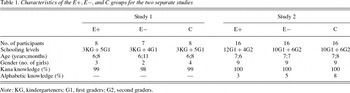
In both studies, assignment of the children to the groups (E+, E−, or C) took into account the following criteria: (a) schooling level, (b) age, (c) gender, (d) knowledge of the kana and the alphabetic systems (the tests are detailed below), and (e) global performance at pretest (see the Results section). Table 1 summarizes the descriptive statistics related to the four first variables, separately for the three groups and for the two studies.

Knowledge of the kana system was evaluated with a reading test of either isolated characters (Study 1) or short sentences (Study 2), which included seions, dakuons, handakuons, and yoo'ons. As presented in Table 1, this task induced ceiling effects in both studies, thus showing that the participating children mastered the kana table perfectly.
Such knowledge logically extended to the phonological counterparts of kanas, that is, moras. Indeed, tasks involving mora (syllable) counting or deletion induced high performances in the participants of Study 1 (on average, 72 and 99.5% of correct responses, respectively), in line with previous studies (Mann, 1986; Spagnoletti et al., 1989). Because all these children could easily count and delete moras, these tasks were no longer presented to the (older) participants of Study 2.
Knowledge of the alphabetic system was examined in Study 1 by presenting the pseudoword /ba/ written alphabetically both in upper- and lowercase. None of the children were able to read either of these two items, which is not surprising given that they had never been exposed to any alphabetic system and had not yet learned Roma-ji.
In Study 2, knowledge of the alphabetic system was examined with three tests. The first included 10 frequent disyllabic words selected on the basis of BRULEX frequencies (Content, Mousty, & Radeau, 1990). In the second, the words from the first test were translated into Japanese and presented in Roma-ji, in a different order as in the first test. Children were then presented with a list of 10 disyllabic pseudowords. Each test was terminated after three consecutive errors. The mean reading performance was extremely poor, with 1.2% of correct responses for French words, 8.1% for Japanese words written alphabetically, and 7.3% for pseudowords. Only seven children displayed a nonnull performance (two in the E+ group, one in the E− group, four in the C group), and only one of these children (in the E− group) could read half of the French words.
Materials and procedure
Each child participated in four sessions: the pretest, the first and second part of the training phase, and the posttest. The period of time separating training and posttest was considerably longer in Study 2 than in Study 1 (on average, 60 vs. 2 days).
A Japanese-native female speaker (the second author) pronounced the instructions and stimuli presented in the four sessions. All tasks were presented as word games, and, in order to motivate the children, their participation was rewarded with drawings.
The choice of both the procedure and materials for the several experimental and training tasks was based on a previous pilot study conducted with nine Japanese children who were living outside of Japan but were exposed solely to the kana writing system.
Pre- and posttests
Each participant was individually pretested and posttested in a quiet room during single sessions of 20–30 min. These evaluations included several tasks aimed at examining phoneme counting and phoneme deletion performances.
PHONEME COUNTING
This test included 20 items in Study 1 (4 CVs, 8 CVCVs, 4 VCVs, 4 yoo'ons) and 33 items in Study 2 (12 CVs, 12 CVCVs, 3 VCVs, 6 yoo'ons).
In both studies, the test was introduced with two examples, one monophonemic (/a/) and one diphonemic (/so/), for which the experimenter indicated the number of phonemes by handclaps. The children were then free to adopt the same response mode, or not, in order to “count the number of sounds” that they heard. They were then asked to perform the counting task on the two example items. The correct response was provided and explained in case of error. The test stimuli were then presented in two blocks, the first including the VCVs randomly mixed with CVs and CVCVs, the second including yoo'ons randomly mixed with CVCVs. In this, as well as in all the other experimental and training tasks, most of the stimuli were pseudowords, and all were presented as “words that do not exist in Japanese.”
PHONEME DELETION
This test included 11 items in Study 1 (8 CVCVs, 3 yoo'ons) and 30 items in Study 2 (12 CVs, 12 CVCVs, 6 yoo'ons). The inclusion of CVs in Study 2 was aimed at discouraging children to delete kanas or moras (a common error for the CVCVs in Study 1), because for these items such deletions are impossible.
The phoneme deletion task was presented as a puppet game modeled after Content et al. (1986). Children were told that one puppet spoke an unknown language and that the other was learning by repeating only the final part of what the first puppet had just said. They were then required to delete the initial consonant of the sequences. The test started with an example (/teku/–/eku/) and a training trial (/piku/–/iku/) for which corrective feedback was provided in case of error.
Training phase
In Study 1, the training phase included two sessions of approximately 15 min each, during which the children were trained individually at school or at the home of the second author. In Study 2, it included two sessions of approximately 35 min each, during which the children were trained in small groups (of four) at school.
In each training session, the children performed specific activities with the experimenter, depending on their group assignment.
C GROUP
The children of the C group did not receive any training involving phonological manipulations. They listened to stories read by the experimenter, and had to answer questions regarding these stories and any connection with personal experiences.
E GROUP WITH ORAL TRAINING (E−)
The children of the E− group were asked to perform three classification tasks in which they were required to put cards into one of two boxes according to a criterion, different for each task. The classification criteria were designed to draw children's attention to three phonological characteristics that systematically distinguish groups of kana, and that were hypothesized to promote phonemic awareness.
In the yoo'on training task, the children were asked to observe the experimenter's mouth while she pronounced /i/, and then required either to draw (Study 1) or to examine (Study 2)9
Because the drawings made by the children who participated in Study 1 were consistent, they were directly provided to the children in Study 2. For the yoo'on training task, the drawing associated with the items containing /i/ represented the horizontal elongation of the mouth; for the diacritic training task, the drawing representing the voiced consonant represented a vertical serrated line illustrating the vibration of the vocal cords, whereas the one associated with the voiceless consonant represented a vertical straight line.
In order to facilitate the children's understanding of the classification rule, four additional CV sequences (e.g., /mi/, /ko/) were given as examples in both studies. Also, the stimuli were presented as cartoonlike characters' names, and the characters were drawn on cards, which were placed on the response boxes.
In the column training task, the children were presented with two animal drawings, called /momo/ and /nono/, which were placed on the two response boxes. They were then asked to discriminate bimoraic disyllables beginning with /m/ from those beginning with /n/. The task was again presented like a game in which friends had similar names (“Is /nana/ the friend of /momo/ or of /nono/?”) and was illustrated with one trial. Study 1 included 24 trials (12 CVCVs beginning with /m/ and 12 beginning with /n/). Study 2 included 48 trials (24 stimuli of each type).
In the diacritic training task, the children were first asked to touch their larynx while pronouncing /p/ and /b/. They were then asked either to draw what they had experienced (Study 1), or to examine drawings (Study 2) of a vertical serrate line (for /b/) or straight line (for /p/). The drawings were then placed on the response boxes, and the children were asked to put the names starting with a vibration into the corresponding box and those that did not into the other box. Study 1 included 44 items (22 beginning with a voiced consonant, 22 with a voiceless one). Study 2 included 48 trials (12 with /b/, 12 with /g/, 12 with /p/, 12 with /k/). In both studies, the stimuli were monomoraic monosyllables.
Each of the three classification tasks (yoo'on, column, diacritic) was split across the two training sessions, with half of the items being presented in each. Within task, the stimuli were presented in quasirandom order, with the constraint that no more than three items corresponding to the same response category would appear successively.
None of the items presented in any of the training tasks were presented in the pre- and posttest tasks evaluating phoneme counting and deletion performances.
E GROUP WITH COMBINED TRAINING (E+)
The children of the E+ group were asked to perform exactly the same three classification tasks as the children of the E− group. However, at the end of each trial, their attention was drawn to the relationship between the phonological sequences to be classified and the structure of the kana matrix.10
Contrary to Figure 1, this table did not include any phonemic transcription.
More specifically, in the {yoo'on training task}, the children were required to write down the name of the cartoonlike characters, and their attention was drawn to the distinction between the CVCV sequences that included /i/ as first vowel (e.g., /piju/) and corresponded to simple kana, and the CjV sequences (e.g., /pju/) that corresponded to yoo'ons. When writing, they were asked to put the yoo'ons in one column and the chokuons in another.
In the column training task, the experimenter helped the children to localize the first kana of the pseudoword in the kana table, and progressively drew their attention to the fact that each set of items (starting with /m/ vs. with /n/) systematically corresponded to either the fifth or the seventh column of the seion table.
In the diacritic training task, the experimenter helped the children to localize the kana corresponding to the stimulus sequence in the table, which drew their attention to the fact that each set corresponded either to a seion (for sequences beginning with /k/ and /s/), a dakuon (for sequences beginning with /g/ and /z/), that is, a kana with the {″} diacritic mark, or a handakuon (for those beginning with /p/), that is, a kana with the {°} diacritic mark.
RESULTS AND DISCUSSION
In each of the two studies (S1 and S2), separate analyses of variance (ANOVAs) by subjects (F1) and by items (F2) were conducted on the correct responses observed in the phoneme counting and phoneme deletion tasks. For both tasks, only phoneme-based responses were considered as correct.
Phoneme counting
In both studies, the ANOVAs performed on the percentages of correct responses considered test period (pre- vs. posttest) and item type (CVs, CVCVs, VCVs, and yoo'ons) as within-subjects factors, and the groups (E+ vs. E− vs. C). The ANOVAs show significant effects of item type, S1: F1 (3, 60) = 12.42, p<.0001, F2 (3, 16)=18.48, p<.0001; S2: F1 (3, 135)=8.52, p<.0001, F2 (3, 29)=63.44, p<.0001; and test period, S1: F1 (1, 20)=15.66, p<.001, F2 (1, 16)=26.57, p<.0001; S2: F1 (1, 45)=5.52, p<.05, F2 (1, 29)=73.11, p<.0001, but inconsistent effects of group, S1: F1<1, F2 (2, 32)=10.79, p<.001; S2: F1<1, F2 (2, 58)=29.42, p<.0001.
Higher scores were observed for the CVs (on average, 51% correct in S1, 38.5% correct in S2) than for all other types of items (in both studies, all F1 significant at least at p < .05; in the item analyses, all Scheffé tests significant at least at p=.01).11
Further reported Scheffé tests all concern contrasts made in the item analyses.
In principle, this strategy could be applied to the CVCVs by adding one to each of the two kanas (or moras) of the stimuli. This was clearly not the case, since these items actually led to the poorest performance in both studies (S1: 19%; S2: 16%). The VCVs and yoo'ons, for which no such kana + 1 strategy is applicable, induced an intermediate level of performance (S1: 30 and 25%; S2: 26 and 29%, respectively) and did not differ from each other (in both studies, F1<1; all Scheffé tests with p>.1). Performance was better with these two types of items than with the CVCVs in Study 2 (both F1 significant at least at p<.05; Scheffé test with at least p<.01). This difference did not come out significantly in Study 1, probably because this study included fewer items and participants than Study 2. Indeed, the percentages of correct responses were very similar in both studies.
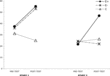
More importantly, in both studies the ANOVAs also show a highly significant interaction between group and test period, S1: F1 (2, 20)=9.96, p=.001, F2 (2, 32)=30.9, p<.0001; S2: F1 (2, 45)=5.74, p<.01, F2 (2, 58)=109.48, p<.0001. The decomposition of these interactions, illustrated in Figure 2, was preceded by separate analyses of the pretest scores, in order to check whether the groups differed before training. This was not the case (in both studies, F1 and F2 [les ] 1).

The percentage of correct responses in phoneme counting for the three separate groups (E+, E−, C) and the two studies.
In both studies, performance improved significantly from pre- to posttest in the E+ group, S1: F1 (1, 7)=9.18, p<.05, F2 (1, 32)=51.63, p<.0001; S2: F1 (1, 15)=14.31, p<.01, F2 (1, 58)=319.01, p<.0001, but not in the C group, S1: F1 and F2<1; S2: F1<1, F2 (1, 58)=2.45, p>.1. In Study 1, the performance of the E− group also improved significantly, F1 (1, 6)=44.33, p<.001, F2 (1, 38)=54.37, p<.0001; this was not the case in Study 2, F1<1, F2 (1, 58)=2.75, p=.1.
The observed improvements varied somewhat as a function of item type, although the Group × Test Period × Item Type interaction is significant only in the item analysis, S1: F1 (6, 60)=1.15, p>.1, F2 (6, 32)=4.47, p<.01; S2: F1<1, F2 (6, 58)=7.18, p<.0001. Possible reasons for such discrepancy between the analyses by participants and by items could be that phonemic awareness tasks tend to induce extreme patterns of performance, hence maximizing between-participants variability and minimizing between-items variability. Such statistically inconsistent differences that are only significant in the analyses by items should be considered with caution because they cannot be generalized across participants. Although further statistically inconsistent results will be reported and analyzed in the results of the present studies for sake of clarity and completeness, the conclusions that will be drawn from the results will be based only on statistically consistent differences.
The decomposition of the significant interactions observed by items between group, test period, and item type show slight differences between the two studies. They will therefore be detailed below.
In Study 1, the Group × Test Period interaction is significant only for the VCVs, F2 (2, 6)=7.91, p<.05, and the CVCVs, F2 (2, 14)=64.07, p<.0001; CVs, F2 (2, 6)=4.49, p=.06; yoo'ons, F2 (2, 6)=2.94, p>.1. For the VCVs, performance significantly improves from pre- to posttest in the E+ and E− groups, F2 (1, 6)=11.26 and 14.7, respectively, p[les ].01 in both cases, but not in the C group, F2 (1, 6)=1.58, p>.1. Moreover, the improvement is similar in the two experimental groups (F2<1). For the most difficult CVCV items, the performance improves significantly in both experimental groups, F2 (1, 6)=184.71 and 45.61 for E+ and E−, respectively, p<.0001 in both cases, but the improvement is stronger in the E+ group, F2 (1, 6)=23.38, p<.001, and no improvement is observed in the C group.
In Study 2, the test period by group interaction is significant for all materials, CVs: F2 (2, 22)=103.46, p<.0001; CVCVs: F2 (2, 22)=93.49, p<.0001; CVCs: F2 (2, 4)=25.56, p<.01; and yoo'ons: F2 (2, 10)=10.61, p<.01. The E+ group benefited from training for all item types, CVs: F2 (1, 22)=307.13, p<.0001; CVCVs: F2 (1, 22)=281.56, p<.0001; VCVs: F2 (1, 4)=94.39, p<.001; and yoo'ons: F2 (1, 10)=13.3, p<.01. Conversely, the E− group showed slightly lower scores at post- than at pretest for both yoo'ons and CVs, no improvement for CVCVs (F2<1), and only a trend toward an improvement for VCVs, F2 (1, 4)=5.9, p=.07. The gain observed in the E+ group for these items was significant, F2 (1, 4)= 26.55, p<.01. Finally, the C group also improved for CVs, F2 (1, 22)=17.12, p<.001, but to a lesser extent than the E+ group, F2 (1, 22)=89.61, p<.0001, and did not improve for the other item types (in all cases, F2<1).
In summary, the results observed in the phoneme counting task show, in both studies, that the training was effective, especially for the E+ group. Indeed, only the E+ group showed significant improvements that were consistent across participants and items in both studies. Thus, children trained with visual resort to the kana matrix seem to improve more than those provided only with oral training.
These positive effects of training should not conceal the fact that posttest performance remained poor in all groups. If we exclude the CVs, for which a simple kana + 1 strategy can be used, the average posttest performance of the E+ group was 38% in Study 1 (improvement of +17%) and 40% in Study 2 (improvement of +21%). This is probably related to the fact that the children paid attention to moras or kanas, and performed the task by reference to these units, rather than to phonemes.
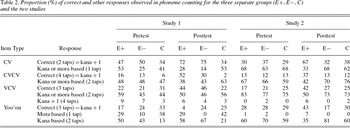
The analysis of their response types is consistent with this view. Indeed, as can be seen in Table 2, the proportions of responses based on moras and/or kanas12
In Study 1, one yoo'on item that presented a match between its number of phonemes and moras or kanas (/∫u/) was discarded from these analyses.

Two aspects of these data are worth discussing. First, if children resorted to a kana + 1 strategy in processing the CV items, such a strategy was not applied to the more complex CVCV items. Rather, in both studies, and at both pre- and posttest, all groups tended to count the number of moras (or kanas) in these items. Second, the analysis of the response types produced on the yoo'ons supports the view that the children resorted to an orthographic, kana-based strategy, in addition to mora counting. As a matter of fact, for yoo'ons that are represented by two kanas but correspond to one mora (e.g., /kja/), erroneous “2” responses were on average more frequent than erroneous “1” responses, averaging over the three groups in Study 1: 42 versus 25% of the responses, respectively, χ2 (1)=5.26, p<.05, in Study 2: 61 versus 2% of the responses, respectively, χ2 (1)=323.1, p<.0001. Thus, the most common error to these yoo'ons consisted in reporting the number of kanas rather than the number of moras.
It is interesting that the evolution of the pattern of responses shows that the tendency to count kanas (or moras) decreased substantially in the E+ group of Study 2 (on average, −29% from pre- to posttest), but not in any other group, S1: −9% in E+, +3% in E−, +12% in C; S2: +4% in E−, +2% in C. Thus, the more intensive training provided to the E+ group induced not only a performance improvement, but also a tendency to rely on phonology, rather than on orthography.
In conclusion, the analyses of response types shows that, although the training was effective in the experimental groups in enhancing the children's sensitivity to phonemic constituents, it did not eliminate reliance on Japanese representational units (moras and/or kanas). This tendency was particularly marked for the most complex items (CVCVs and yoo'ons). The analyses of the response types given to the yoo'ons further suggest that the children resorted to orthographic (kana-based) strategies, not only to mora counting.
Phoneme deletion
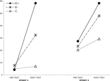
For both studies, the ANOVAs conducted on the percentages of correct responses took into account test period (pre- vs. posttest) and item type (Study 1: CVCVs and yoo'ons; Study 2: CVs, CVCVs, and yoo'ons) as within-subjects factors, as well as the groups (E+ vs. E− vs. C). Both sets of analyses show significant group effects in the items analyses, S1: F1 (2, 20)=3.2, p=.06, F2 (2, 18)=103.09, p<.0001; S2: F1 (2, 45)=3.81, p<.05, F2 (2, 54)=94.21, p<.0001, and significant effects of test period, S1: F1 (1, 20)=15.87, p<.001, F2 (1, 9)=180.71, p<.0001; S2: F1 (1, 45)=39.01, p<.0001, F2 (1, 27)=1114.93, p<.0001. The interactions between these two factors, illustrated in Figure 3, are also significant, S1: F1 (2, 20)=5.19, p=.01, F2 (2, 18)=116.31, p<.0001; S2: F1 (2, 45)=3.56, p<.05, F2 (2, 54)=65.96, p<.0001.

The percentage of correct responses in phoneme deletion for the three separate groups (E+, E−, C) and the two studies.
Separate analyses on the pretest scores showed no consistent difference between groups before training, S1: F1<1, F2 (2, 18)=3.35, p=.06; S2: F1<1, F2 (2, 54)=16.03, p<.0001. The statistically inconsistent difference observed in Study 2 could be related to the difficulty of the phoneme deletion task as well as to the fact that a few children of each group considered in this study displayed restricted alphabetical knowledge. Therefore, we will adopt the same conservative position as for the counting task, and consider only statistically consistent differences that can be generalized across both participants and items when discussing the present results.
Decomposition of the group by test period interactions show that in both studies the improvement of the E+ group is significant, S1: F1 (1, 7)=11.06, p=.01, F2 (1, 18)=495, p<.0001; S2: F1 (1, 15)=30.57, p<.001, F2 (1, 54)=493.84, p<.0001. The improvement observed in the E− group is consistently significant only in Study 2, F1 (1, 15)=11.83, p<.05, F2 (1, 54)=317.71, p<.0001; S1: F1 (1, 6)=4.33, p=.08, F2 (1, 18)=84.06, p<.0001, and thus cannot be generalized. Two-by-two comparisons also show that, although in both studies fewer children benefited from training in the E− group than in the E+ group (S1: 57 vs. 75% of the children, S2: 75 vs. 90% of the children, respectively), the difference in improvement across the two experimental groups is significant only in the analyses by items, S1: F1 (1, 13)=2.03, p>.1, F2 (1, 28)=85.55, p<.0001; S2: F1<1, F2 (1, 54)=9.66, p<.01.
For the C group, an unexpected difference is observed between the two studies, that is, this group does not improve at all in Study 1, F1 and F2<1, but shows a significant improvement in the analysis by items in Study 2, F1 (1, 15)=3.37, p<.1, F2 (1, 54)=42.02, p<.0001. This difference across studies could be related to the longer period of time separating post- from pretest in Study 2 and/or to the possible exposure of Study 2's children to alphabetical materials between the two evaluations. Nevertheless, the improvement observed in the C group of Study 2 is significantly less important than the one observed in the E+ group of this study, both by participants and by items, F1 (1, 30)=8.64, p<.01, F2 (1, 54)=123.88, p<.0001.
Because Study 2 included material not considered in Study 1 (CVs), the main effects and interactions involving item type will be presented separately for the two studies.
In Study 1, although yoo'ons tended to succeed better than CVCVs (23 vs. 15% correct, respectively), item type does not affect performance consistently, F1 (1, 20)=1.6, p>.1, F2 (2, 12)=32.27, p<.0001, and does not interact with group, F1 and F2<1, or test period, F1 (1, 20)=3.2, p<.1, F2<1; Item Type × Group × Test Period interaction, F1 and F2<1.
On the contrary, in Study 2, there is a significant effect of item type, F1 (2, 90)=41.95, F2 (2, 27)=187.97, p<.0001, in both cases. Scores were higher for CVs (on average, 55% correct) than for both yoo'ons (on average, 41%), F1 (1, 90)=7.44, p<.01, Scheffé test, p<.001, and CVCVs (on average, 8%), F1 (1, 90)=79.87, p<.0001, Scheffé test, p<.0001. Moreover, yoo'ons induced better performance than CVCVs, F1 (1, 90)=38.54, p<.0001, Scheffé test, p<.0001.
In Study 2, there is also an inconsistent interaction between group, test period, and item type, F1 (4, 90)=1.46, p>.1, F2 (4, 54)=14.92, p<.0001. The decomposition of this interaction shows that the Group × Test Period interaction is significant for all materials, CVs: F2 (2, 22)=54.28; CVCVs: F2 (2, 22)=32.72; yoo'ons: F2 (2, 10)=14.03, p<.0001 in all cases, but the contrast between experimental and control groups is slightly more pronounced for yoo'ons than for CVs and CVCVs. Indeed, for yoo'ons, only the experimental groups improved their performance from pre- to posttest, F2 (1, 10)=23.85, and 63.5 for the E+ and E− groups, respectively, p<.0001 in both cases, which was not true for the C group (F<1). For the CVs and the CVCVs, all groups benefited from training, including the C group: for CVs: F2 (1, 22)=475.94, 156.22, and 52.88, for CVCVs: F2 (1, 22)=307.76, 106.17, and 40.21 for the E+, E−, and C groups, respectively, all ps<.0001. Yet, even for CVs and CVCVs, the improvement from pre- to posttest is stronger in both the E+ and E− groups than in the C group: for CVs: F2 (1, 22)=105.76, p<.0001, F2 (1, 22)=13.66, p=.001; for CVCVs: F2 (1, 22)=62.74, p<.0001, F2 (1, 22)=7.856, p=.01, respectively. Moreover, the improvement is stronger in the E+ than in the E− group for CVs and CVCVs, F2 (1, 22) = 43.41 and 26.2, respectively, p<.0001$ in both cases, but not for yoo'ons.
To summarize, in both studies, the combined auditory and table-based training helped the children of the E+ group to improve their performance from pre- to posttest (on average, from 16 to 58%), and the strictly auditory training also helped the children of the E− group, although less robustly and less consistently (on average, from 16 to 40%). For some types of items the C group also showed inconsistent improvements in Study 2, but not in Study 1. In any case, the training effects observed in Study 2 cannot be accounted for by these factors, because in that study the E+ group robustly outperformed the C group at posttest.
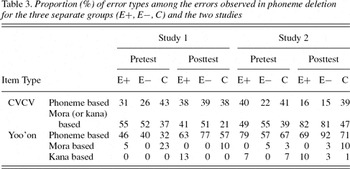
Nevertheless, the analysis of the errors produced on the deletion task reveals the children's difficulties with phonemic manipulations. As presented in Table 3, in both studies the longest and most complex items (CVCV) induced a strong tendency to manipulate (i.e., to delete, add, reverse, or substitute) moras (or kanas) rather than phonemes. This tendency was observed across all groups and studies.13
Such a tendency is also observed in Study 2 for the CVs, which are not represented in the table because they induced very similar results as the CVCVs and because they were not presented in Study 1.

In Study 1, the kana or mora-based responses to CVCVs tended to decrease at posttest in the E+ group (−14%), but not in the E− group (+1%). However, at posttest only the E+ group showed an increase of kana-based errors for yoo'ons14
Such errors consisted of answering, for example, /ija/ in trying to delete the first unitof /kja/ (
), a character represented with the kanas for /ki/ (
) and /ja/ (
).
In Study 2, for CVCVs, both experimental groups showed a large increase of kana- or mora-based errors at posttest (+33 and +26% for the E+ and E− groups, respectively). Hence, the inclusion of CV items in Study 2, for which kana or mora deletion was impossible, did not discourage children to delete kanas or moras in more difficult items such as CVCVs, much to the contrary. The children relied heavily on kana (moras) to perform the task, even after training, as they did for phoneme counting (see Table 2).
GENERAL DISCUSSION
The main objective of the present work was to explore the potentially facilitatory effects of some characteristics of the Japanese kana writing system on the development of phonemic awareness in young Japanese readers. In two separate studies, the phoneme counting and phoneme deletion abilities of three groups of children were compared in pre- and posttests. During the training period separating the two evaluations, one experimental group (E+) received classification exercises systematically associated to three characteristics of the kana matrix hypothesized to elicit phonemic awareness (yoo'ons structure, kana table organization and diacritic marks), while the other experimental group (E−) received the same exercises without explicit reference to the writing system.
In both studies, the results of the posttests showed that the training was effective at enhancing children's phoneme counting and deletion performances. The similarity of the findings observed across both studies rules out the possibility that the training effects observed in Study 2 resulted from these participants' partial bilingualism or possible exposure to alphabetical materials. Indeed, the Japanese children examined in Study 1 had no lexical competencies in any foreign language and no notion of any alphabetical system. Taken together, the two studies were thus successful in showing that a relatively short training (30–60 min) on some organizational characteristics of the kana writing system has a positive impact on young Japanese readers' performance in rigorous phonemic awareness tasks. Our results thus support Spagnoletti et al.'s (1989) suggestion that such characteristics of the kana table may facilite the emergence of some form of phonemic awareness. This in turn may explain why Mann (1986) observed some phonemic manipulation abilities in Japanese fourth graders who had not yet been introduced to alphabetic writing.
In the present studies, part of the improvement seemed to have stemmed from the visual training on the characteristics of the Japanese kana written system. Indeed, the experimental group presented with a visual support during training (E+) was the only group to show a consistent improvement across participants and items in both studies.
Nevertheless, in each study, the children of the experimental group presented with only oral exercises (E−) also displayed some improvement from pre- to posttest, which suggests that they also benefited from the training. Part of this benefit was probably induced by reliance on the kana matrix, since, in comparison to the E+ groups, the E− groups showed similar effects of item types and similar patterns of errors, suggesting some reliance on kana-based strategies.
What exactly induced such orthographic strategies remains unclear. The fact that the oral exercises presented to the children of the E− group insisted on phonetic differences corresponding to the written peculiarities of the kana system might have been sufficient to elicit resort to these written characteristics. Alternatively, the children of the E− groups may have spontaneously resorted to the kana matrix. Spontaneous resort to the kana table when performing phonemic awareness tasks is reported in studies conducted on Japanese children (Mann, 1986; Spagnoletti et al., 1989) and adults (Nakamura et al., 1998). Probably the best example of this strategy is described in Nakamura et al., who observed that a majority of Japanese adults spontaneously imagined the table and interchanged kana cells of two different columns of the same row, when required to perform phoneme reversal. Hence, further studies should be conducted to determine whether it is possible to provide training that discourages the use of mental representations of kanas in metaphonological tasks, for example, by taxing visual memory with a secondary task.
In addition, studies involving delayed posttests should be conducted in order to examine the long-term effects that the training of some characteristics of the Japanese writing system may have on phonemic awareness. In the present work, the fact that the training effects were not more important in Study 1 than in Study 2, although the period of time separating the training from the posttest was much shorter in Study 1 (on average, 2 days) than in Study 2 (on average, 60 days), suggests that the training effects were robust.
In any case, the positive training effects observed in both studies should not conceal the fact that performance achieved after training remained rather poor in all experimental groups. Indeed, even the more intensive training of Study 2 did not allow the children to reach a very high posttest performance in phoneme counting and deletion. Moreover, the training did not reduce their tendency to rely on the representational units of Japanese, namely moras and kanas, whenever possible.
This poor performance may be related to intrinsic limitations of our design. As a matter of fact, even in Study 2 we used a relatively short training that included a small number of trials and that capitalized only on a few of the characteristics that may elicit phonemic awareness in Japanese. Some of these characteristics may be less critical for the development of phonemic awareness than suggested before. For example, confirming observations made by Spagnoletti et al. (1989), we observed that the yoo'ons, which were systematically used in the training, did not induce systematic facilitation in rigorous tests of phonemic awareness (counting and deletion) as they did in phoneme classification (Endo, 1991). Nevertheless, we cannot discard the possibility that training on yoo'ons was effective, because there is no way to untangle the relative effects of the three trained characteristics of the kana system. This issue should be addressed in further studies.
Future work should also compare these effects to the ones induced by other characteristics of the Japanese writing systems. For example, Spagnoletti et al. (1989) suggested that the way in which the katakana writing system assigns a spelling to words of foreign origin might also positively influence phonemic awareness. Indeed, the Japanese phonology does not allow consonantal clusters at syllable onsets; moreover, even some simple CV syllables like [di] do not exist in that language. Assigning a spelling to words like /disko/ (“disco”) requires manipulations at the phonemic level. For example, the syllable [di] is transcribed with two katakana characters, the first (written in full size) standing for /de/ and the second (reduced) for the vowel /i/. Because in this case /de/ + /i/ has to be pronounced [di], this may lead the Japanese child to conceive that the written form of [di] includes the phoneme /d/. Increasing familiarity with such katakana manipulations may also account for improvements in phonemic awareness, since the katakana system is introduced at the end of the first grade.
The poor performance achieved by the children of the experimental groups after training may reflect another limitation, not specific to our design but rather to the nature of the representational system used in the training (which did not involve symbols representing phonemes) and to the nature of the training itself (which did not involve any phonemic manipulations but rather exercises aimed at drawing children's attention toward some organizational aspects of the kana table). Both the quantitative and the qualitative observations reported in the present contribution suggest that the indirect route to phonemic awareness is laborious. As such, our results would be consistent with the observation that alphabetized Western children schooled in a setting where the code is not explicitly taught (whole-word methods) perform dramatically worse in phonemic awareness tasks than children instructed with phonic methods (e.g., Alegria & Morais, 1991; Ehri, Nunes, Willows, Schuster, Yaghoub–Zadeh & Shanahan, 2001; for a meta-analysis see NICHHD, 2000). In other words, analyzing speech into phonemic segments seems to be as difficult when merely confronted with the few cues afforded by a nonalphabetic phonographic writing system as when instructed in an alphabet without explicit instruction of the alphabetic principle.
Nevertheless, because the training administered in the present study did induce significant amelioration of performance in phonemic awareness tasks, our results may have important implications for the alphabetization of Japanese-native students. In particular, they may help in developing teaching methods that capitalize on the most efficient cues to phonemic awareness of the Japanese system, and therefore facilitate subsequent alphabetic reading acquisition in these children. Resorting to the characteristics of the kana table (which is taught at home before the beginning of formal instruction) when introducing an alphabetic system may help young Japanese children building phonemic representations.
Studies examining this possibility would be particularly relevant within the recent educational reforms undertaken by Japan (and other countries) to introduce the learning of a second language characterized by an alphabetic system (English) in the first grade of formal schooling. Also, the development of computerized word processors favoring the use of the Roma-ji and English alphabets increases the need for Japanese children to develop phonemic representations, which will allow the successful development of reading and writing skills within such systems.
ACKNOWLEDGEMENTS
Many thanks to Miyoko Nakamura, as well as to Usha Goswami and four anonymous reviewers, for very helpful comments on former versions of the manuscript. We also express our deepest gratitude to the staff and children of the schools. Preparation of the manuscript was supported by a Spencer Foundation postdoctoral fellowship of the National Academy of Education to the first author.
References
Adrián J. A.,
Alegria J., &
Morais J.
1995.
Metaphonological abilities of Spanish illiterate adults.
International Journal of Psychology,
30,
329–
353.Google Scholar
Alegria J., &
Morais J.
1991.
Segmental analysis and reading acquisition.
In L. Rieben &
C. A. Perfetti (Eds.),
Learning to read: Basic research and its implications.
Hillsdale, NJ:
Erlbaum.
Bus A. G., &
van IJzendoorn M. H.
1999.
Phonological awareness and early reading: A meta-analysis of experimental training studies.
Journal of Educational Psychology,
91,
403–
414.Google Scholar
Cary L.
1988.
A análise explícita das unidades da fala nos adultos não-alphabetizados.
Unpublished doctoral dissertation,
University of Lisbon.
Cheung H.
1999.
Improving phonological awareness and word reading in a later learned alphabetic script.
Cognition,
70,
1–
26.Google Scholar
Content A.,
Kolinsky R.,
Morais J., &
Bertelson P.
1986.
Phonetic segmentation in prereaders: Effect of corrective information.
Journal of Experimental Child Psychology,
42,
49–
72.Google Scholar
Content A.,
Mousty P., &
Radeau M.
1990.
Brulex. Une base de données lexicales informatisées pour le français écrit et parlé.
L'année Psychologique,
90,
551–
566.Google Scholar
Cutler A., &
Otake T.
2002.
Rhythmic categories in spoken-word recognition.
Journal of Memory and Language,
46,
296–
322.Google Scholar
de Gelder B.,
Vroomen J., &
Bertelson P.
1993.
The effects of alphabetic reading competence on language representation in bilingual Chinese subjects.
Psychological Research,
55,
315–
321.Google Scholar
Dunn L. M., &
Dunn L. M.
1997.
Peabody Picture Vocabulary Scale (3rd ed.).
Circle Pines, MN:
American Guidance Service.
Dunn L. M.,
Thiérault–Whalen C. M., &
Dunn L. M.
1993.
Echelle de Vocabulaire en Images Peabody.
Toronto:
Psycan.
Ehri L. C.,
Nunes S. R.,
Willows D. M.,
Schuster B. V.,
Yaghoub–Zadeh Z., &
Shanahan T.
2001.
Phonemic awareness instruction helps children learn to read: Evidence from the National Reading Panel's meta-analysis.
Reading Research Quarterly,
36,
250–
287.Google Scholar
Endo M.
1991.
Nihonjin yoji no in no kanjusei to yoon hyokiho no shutoku [Phonological sensitivity and acquisition of yoon transcription of Japanese preschool children].
Japanese Journal of Educational Psychology,
39,
448–
454.
(For this and all subsequent references in Japanese, see Miyoko Nakamura or second author's translation.)Google Scholar
Goetry V.
2002.
Etude longitudinale comparative du développement des compétences métaphono- logiques et orthographiques d'enfants bilingues scolarisés en langue seconde.
Unpublished doctoral dissertation,
Université Libre de Bruxelles.
Hayes B.
1989.
Compensatory lengthening in moraic phonology.
Linguistic Inquiry,
20,
253–
306.Google Scholar
Hyman L.
1985.
A theory of phonological weight.
Dordrecht:
Foris.
Inagaki K.,
Hatano G., &
Otake T.
2000.
The effect of kana literacy acquisition on the speech segmentation unit used by Japanese young children.
Journal of Experimental Child Psychology,
75,
70–
91.Google Scholar
Kuroda S. Y.
1979.
Generative grammatical studies in the Japanese language.
New York:
Garland.
Liberman I. Y.,
Shankweiler D.,
Fischer M. F., &
Carter B.
1974.
Explicit syllable and phoneme segmentation in the young child.
Journal of Experimental Child Psychology,
18,
201–
212.Google Scholar
Lukatela K.,
Carello C.,
Shankweiler D., &
Liberman I. Y.
1995.
Phonological awareness in illiterates: Observations from Serbo-Croatian.
Applied Psycholinguistics,
16,
463–
487.Google Scholar
Mann V.
1986.
Phonological awareness: The role of reading experience.
Cognition,
24,
65–
92.Google Scholar
Morais J.,
Bertelson P.,
Cary L., &
Alegria J.
1986.
Literacy training and speech segmentation.
Cognition,
24,
45–
64.Google Scholar
Morais J.,
Cary L.,
Alegria J., &
Bertelson P.
1979.
Does awareness of speech as a sequence of phones arise spontaneously?
Cognition,
7,
323–
331.Google Scholar
Morais J.,
Content A.,
Bertelson P.,
Cary L., &
Kolinsky R.
1988.
Is there a critical period for the acquisition of segmental analysis?
Cognitive Neuropsychology,
5,
347–
352.Google Scholar
Morais J., &
Kolinsky R.
2001.
The literate mind and the universal human mind.
In E. Dupoux (Ed.),
Language, brain and cognitive development: Essays in honor of Jacques Mehler
(pp. 463–
480).
Cambridge, MA:
MIT Press.
Morais J., &
Kolinsky R.
2003.
The linguistic consequences of literacy.
In P. Bryant &
T. Nunes (Eds.),
The handbook of literacy.
Dordrecht:
Kluwer.
Morais J.,
Kolinsky R.,
Alegria J., &
Scliar–Cabral L.
1998.
Alphabetic literacy and psychological structures.
Letras de Hoje,
33,
61–
79.Google Scholar
Muto T.
1987.
Relationship between kana character reading and verbal game playing in Japanese young children.
Paper presented at the 9th Biennial Meetings of the International Society for the Study of Behavioral Development, Tokyo.
Nakamura M.,
Kolinsky R.,
Spagnoletti C., &
Morais J.
1998.
Phonemic awareness in alphabetically literate Japanese adults: The influence of the first acquired writing system.
Cahiers de Psychologie Cognitive/Current Psychology of Cognition,
17,
417–
450.Google Scholar
National Institute of Child Health and Human Development.
2000.
Report of the National Reading Panel. Teaching children to read: An evidence-based assessment of the scientific research literature on reading and its implications for reading instruction: Reports of the subgroups
(NIH Publication No. 00-4754).
Washington, DC:
US Government Printing Office.
Read C.,
Zhang Y.,
Nie H., &
Ding B.
1986.
The ability to manipulate speech sounds depends on knowing alphabetic writing.
Cognition,
24,
31–
44.Google Scholar
Scliar–Cabral L.,
Morais J.,
Nepomuceno L., &
Kolinsky R.
1997.
The awareness of phonemes: So close—so far away.
International Journal of Psycholinguistics,
13,
211–
240.Google Scholar
Shibatani M.
1990.
The languages of Japan.
Cambridge:
Cambridge University Press.
Spagnoletti C.,
Morais J.,
Alegria J., &
Dominicy M.
1989.
Metaphonological abilities of Japanese Children.
Reading and Writing,
2,
221–
244.Google Scholar
Sugito M.
1989.
Onsetsu ka haku ka [Syllable or mora?]: Choon, hatsuon, sokuon.
In M. Sugito (Ed.),
Koza nihongo to nihongo kyoiku: Dai 2-kan. Nihongo no onsei, on-in (jo) [Japanese language and its education: Vol. 2, Speech sounds and phonological issues of Japanese language]
(pp. 154–
177).
Tokyo:
Meiji-shoin.
Zhurova L. Y.
1973.
The development of analysis of words into their sounds by preschool children.
In C. A. Ferguson &
D. I. Slobin (Eds.),
Studies of child language development
(pp. 141–
154).
New York:
Holt, Rinehart & Winston.
Characteristics of the E+, E−, and C groups for the two separate studies
The percentage of correct responses in phoneme counting for the three separate groups (E+, E−, C) and the two studies.
Proportion (%) of correct and other responses observed in phoneme counting for the three separate groups (E+, E−, C) and the two studies
The percentage of correct responses in phoneme deletion for the three separate groups (E+, E−, C) and the two studies.
Proportion (%) of error types among the errors observed in phoneme deletion for the three separate groups (E+, E−, C) and the two studies
 You have
Access
- 11
- Cited by