1. Introduction
The Gaia survey provides rich kinematic data on stars, ushering in a new era in stellar dynamics. Using these data, numerous stellar streams have been identified across various systems, including young star-forming regions (Kounkel and Covey Reference Kounkel and Covey2019; Jerabkova et al. Reference Jerabkova, Boffin, Beccari and Anderson2019; Beccari et al. Reference Beccari, Boffin and Jerabkova2020; Meingast et al. Reference Meingast, Alves and Fürnkranz2019), open clusters (Jerabkova et al. Reference Jerabkova, Boffin, Beccari, de Marchi, de Bruijne and Prusti2021; Meingast et al. Reference Meingast, Alves and Rottensteiner2021; Kos Reference Kos2024; Risbud et al. Reference Risbud, Jadhav and Kroupa2025), and globular clusters (GCs) (Ibata et al. Reference Ibata, Malhan, Tenachi, Ardern-Arentsen, Bellazzini, Bianchini, Bonifacio, Caffau, Diakogiannis, Errani, Famaey, Ferrone, Martin, di Matteo, Monari, Renaud, Starkenburg, Thomas, Viswanathan and Yuan2024; Bonaca and Price-Whelan Reference Bonaca and Price-Whelan2025). These streams offer new opportunities to investigate the dynamical evolution of their progenitor stellar systems.
Among these systems, star clusters are gravitationally bound groups whose members form in the same environment, making them ideal laboratories for studying star formation and evolution. However, as collisional systems, their global properties, such as density profiles, stellar mass functions, and binary characteristics, are substantially altered by dynamical processes including two-body relaxation, mass segregation, binary formation and evolution, and tidal evaporation. Consequently, present-day observations do not reflect their initial states. This is especially true after significant stellar escape or the evolution of massive stars into dark remnants, which makes it challenging to infer the initial conditions of the clusters.
In contrast, stellar streams originating from star clusters are so diffuse that collisional effects are negligible. Their global properties (e.g., mass function, binary properties) therefore remain unchanged and reflect the state at the time stars escape into the stream. This suggests that different regions of a stream preserve stellar properties from different stages of dynamical evolution, helping to constrain the initial conditions of star clusters.
Achieving this requires self-consistent models of both clusters and their streams. Although such studies are still limited, advances in numerical tools and computational resources now make it feasible to build these models for open clusters and GCs (e.g. Küpper et al. Reference Küpper, MacLeod and Heggie2008; Renaud et al. Reference Renaud, Gieles and Boily2011; Dinnbier and Kroupa Reference Dinnbier and Kroupa2020; Wan et al. Reference Wan, Oliver, Baumgardt, Lewis, Gieles, Hénault-Brunet, de Boer, Balbinot, Da Costa and Mackey2021; Wan et al. Reference Wan, Arnold, Oliver, Lewis, Baumgardt, Gieles, Hénault-Brunet, de Boer, Balbinot, Da Costa, Mackey, Erkal, Ferguson, Kuzma, Pancino, Peñarrubia, Sanna, Sollima, van der Marel and Watkins2023; Jerabkova et al. Reference Jerabkova, Boffin, Beccari, de Marchi, de Bruijne and Prusti2021; Gieles et al. Reference Gieles, Erkal, Antonini, Balbinot and Peñarrubia2021; Webb and Bovy Reference Webb and Bovy2020; Webb and Bovy Reference Webb and Bovy2022; Boffin et al. Reference Boffin, Jerabkova, Beccari and Wang2022; Wang and Jerabkova Reference Wang and Jerabkova2021; Wang et al. Reference Wang, Gieles, Baumgardt, Li, Pang and Tang2024; Thomas et al. Reference Thomas, Famaey, Monari, Laporte, Ibata, de Laverny, Hill and Boily2023; Arnold and Baumgardt Reference Arnold and Baumgardt2025).
The petar code (Wang et al. Reference Wang, Iwasawa, Nitadori and Makino2020a) is an N-body code designed for star-by-star simulations of star clusters including their streams. It integrates the parallel particle framework fdps (Iwasawa et al. Reference Iwasawa, Tanikawa, Hosono, Nitadori, Muranushi and Makino2016; Iwasawa et al. Reference Iwasawa, Namekata, Nitadori, Nomura, Wang, Tsubouchi and Makino2020), the accurate binary-interaction module sdar (Wang et al. Reference Wang, Nitadori and Makino2020b) based on slowdown algorithmic regularization, updated single and binary stellar evolution (sse, bse) (Hurley et al. Reference Hurley, Pols and Tout2000; Hurley et al. Reference Hurley, Tout and Pols2002; Banerjee et al. Reference Banerjee, Belczynski, Fryer, Berczik, Hurley, Spurzem and Wang2020), as well as mobse (Giacobbo et al. Reference Giacobbo, Mapelli and Spera2018), bseemp (Tanikawa et al. Reference Tanikawa, Yoshida, Kinugawa, Takahashi and Umeda2020), and the galactic tidal field package galpy (Bovy Reference Bovy2015). Ongoing updates to petar include the implementation of the stellar and binary evolution code SEVN (Iorio et al. Reference Iorio, Mapelli, Costa, Spera, Escobar, Sgalletta, Trani, Korb, Santoliquido, Dall’Amico, Gaspari and Bressan2023) and the galactic potential library agama (Vasiliev Reference Vasiliev2019). Using petar, Wang and Jerabkova (Reference Wang and Jerabkova2021) and Wang et al. (Reference Wang, Gieles, Baumgardt, Li, Pang and Tang2024) built star-by-star models of the Hyades open cluster and the globular cluster Palomar 5. Here, we summarize those results and examine how the initial mass function (IMF), black holes (BHs), and binaries shape the evolution of Hyades and Palomar 5.
2. Influence of randomly sampling IMF on survival of open clusters
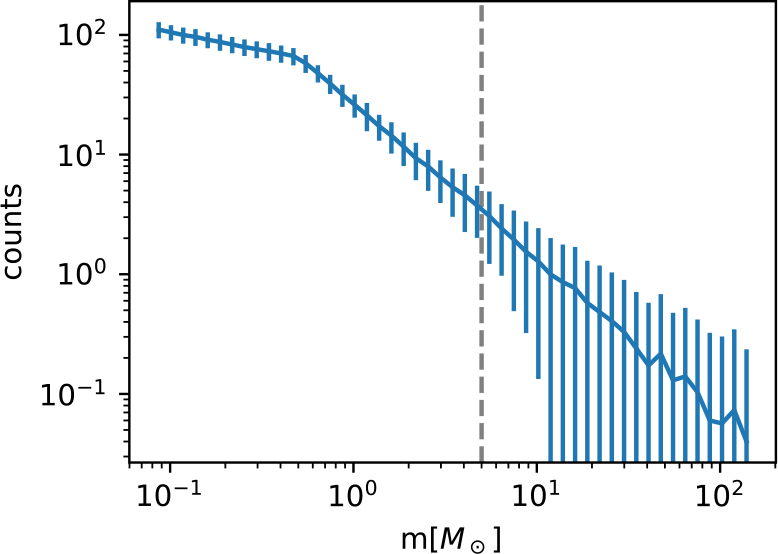
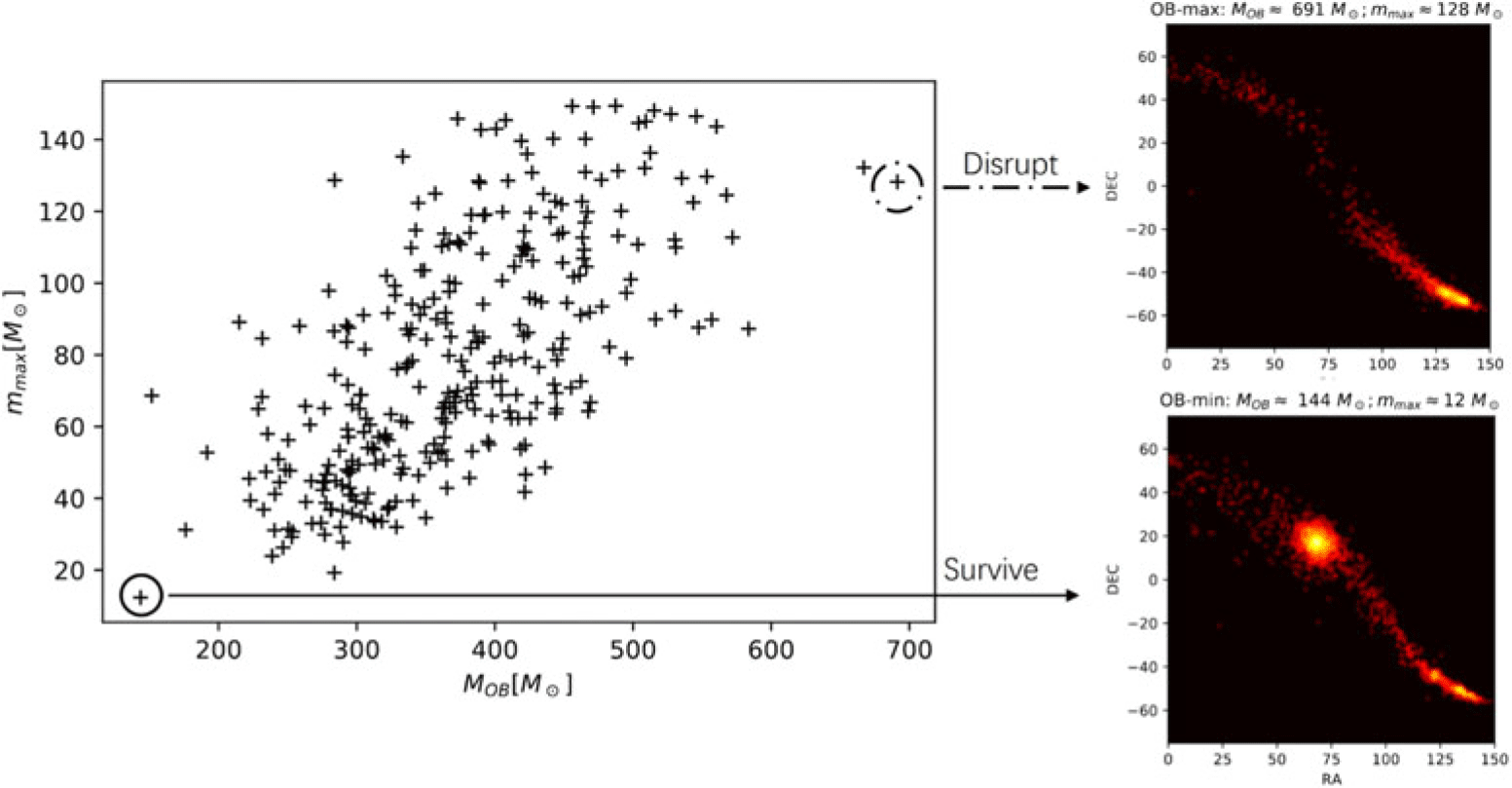
Using the convergent point (CP) method with Gaia data, Jerabkova et al. (Reference Jerabkova, Boffin, Beccari, de Marchi, de Bruijne and Prusti2021) discovered 800 pc-long tidal tails around the Hyades, demonstrating that the CP method efficiently detects extended tails independent of the assumed Galactic potential. In follow-up work, Wang and Jerabkova (Reference Wang and Jerabkova2021) used N-body simulations to constrain the Hyades’ initial conditions and showed that the underlying IMF physics–whether star formation is purely stochastic or self-regulated–critically affects the tidal disruption and survival of low-mass, Hyades-like clusters. As illustrated in Figure 1, randomly sampling the Kroupa (Reference Kroupa2001) IMF to a total mass of about
 $800\,M_\odot$
over 300 realizations yields large variations in the number of OB stars (
 $\gt5\,M_\odot$
), even though the mean matches the IMF expectation. Consequently, both the maximum stellar mass
 $m_{\mathrm{max}}$
and the total OB-star mass
 $M_{\mathrm{OB}}$
vary substantially (Figure 2).
Mean and standard deviation of star counts from 300 random samples of the Kroupa (Reference Kroupa2001) IMF with total mass
 $M \approx 800\,M_\odot$
.

Left: Maximum mass
 $m_{\mathrm{max}}$
versus total OB-star mass (
 $\gt5\,M_\odot$
)
 $M_{\mathrm{OB}}$
from IMF sampling of Figure 1. Right: RA-Dec contour maps of star clusters and tidal streams from two simulations with the same initial
 $r_{\mathrm{h}}=2$
pc and
 $M=800\,M_\odot$
, showing the cases with maximum and minimum
 $M_{\mathrm{OB}}$
, respectively. Figures adapted from Wang and Jerabkova (Reference Wang and Jerabkova2021).

Wang and Jerabkova (Reference Wang and Jerabkova2021) simulated Hyades-like clusters with petar for each IMF realization up to 648 Myr, adopting identical initial conditions: a Plummer density profile, half-mass radius
 $r_{\mathrm{h}}=2$
pc, virial equilibrium, no primordial binaries, and the Galactic potential using MWPotential2014 (Bovy Reference Bovy2015). The outcomes differ markedly with
 $m_{\mathrm{max}}$
and
 $M_{\mathrm{OB}}$
: the largest
 $M_{\mathrm{OB}}$
leads to complete disruption leaving only streams, whereas the smallest
 $M_{\mathrm{OB}}$
yields a surviving open cluster akin to the Hyades.
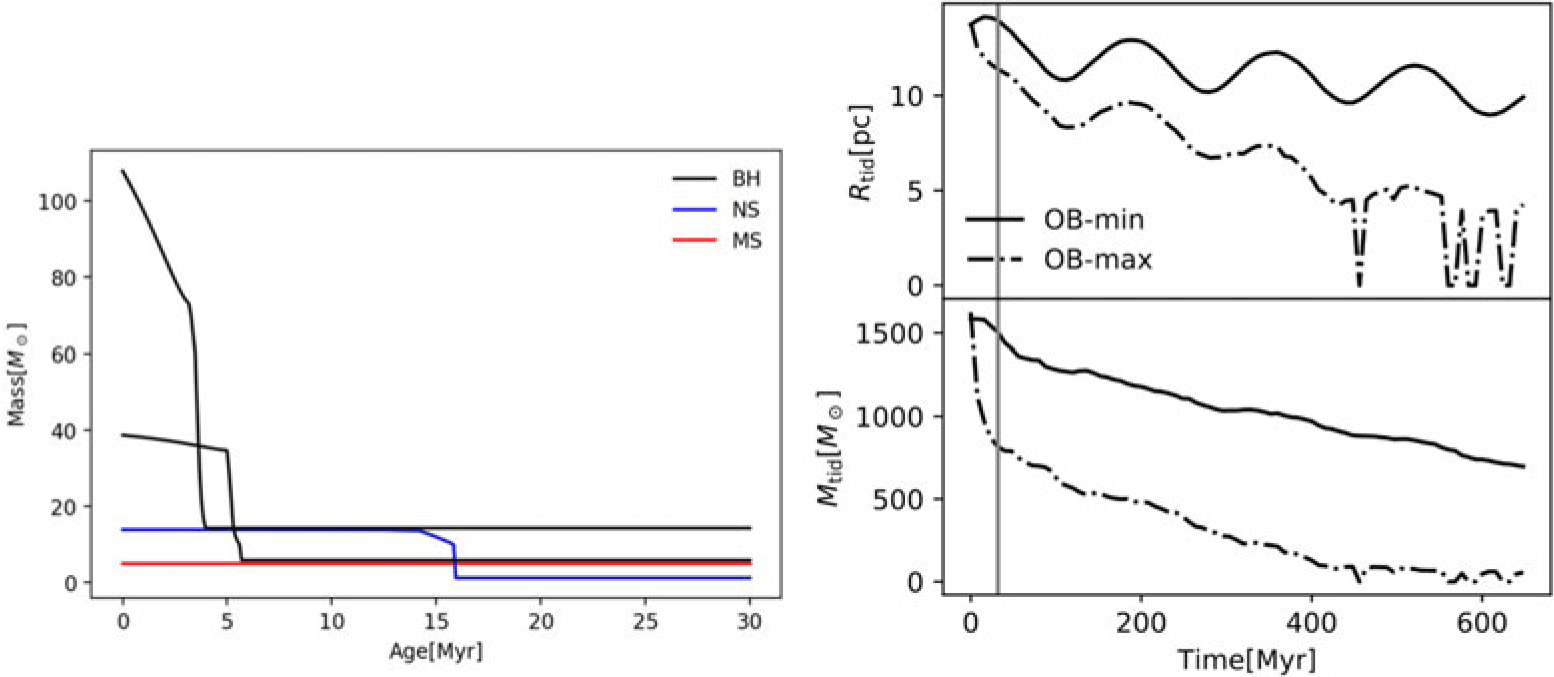
We identify two mechanisms that drive the large differences in cluster evolution. First, stellar-wind mass loss from OB stars–most pronounced in the first 30 Myr–removes substantial mass (Figure 3). OB stars shed mass and evolve into neutron stars or BHs, while low-mass stars lose comparatively little. A larger
 $M_{\mathrm{OB}}$
, therefore, induces a greater cluster mass loss, rapidly reducing the tidal radius
 $r_{\mathrm{tid}}$
and total mass
 $M_{\mathrm{tid}}$
. The cluster then experiences stronger tidal disruption and cannot survive to 600 Myr.
Left: Mass evolution during the first 30 Myr for different types of solar-metallicity stars using sse code. Right: Evolution of the tidal radius
 $r_{\mathrm{tid}}$
and total mass
 $M_{\mathrm{tid}}$
for the simulations in Figure 2, adapted from Figure 5 of Wang and Jerabkova (Reference Wang and Jerabkova2021).

Figure 3 Long description
Panel A: A line graph shows the mass evolution of different types of solar-metallicity stars over the first 30 million years. The x-axis represents age in million years (Myr), and the y-axis represents mass in solar masses (M☉). Three lines are plotted: one for black holes (BH) in black, one for neutron stars (NS) in blue, and one for main-sequence stars (MS) in red. The mass of black holes decreases sharply initially and then stabilizes, while the mass of neutron stars and main-sequence stars remains relatively constant. Panel B: Two line graphs show the evolution of the tidal radius and total mass for simulations. The top graph has the x-axis representing time in million years (Myr) and the y-axis representing tidal radius in parsecs (pc). Two lines are plotted: one for the minimum tidal radius (OB-min) in solid black and one for the maximum tidal radius (OB-max) in dashed black. The bottom graph has the x-axis representing time in million years (Myr) and the y-axis representing total mass in solar masses (M☉). Two lines are plotted: one for the minimum total mass in solid black and one for the maximum total mass in dashed black. Both the tidal radius and total mass show a decreasing trend over time.
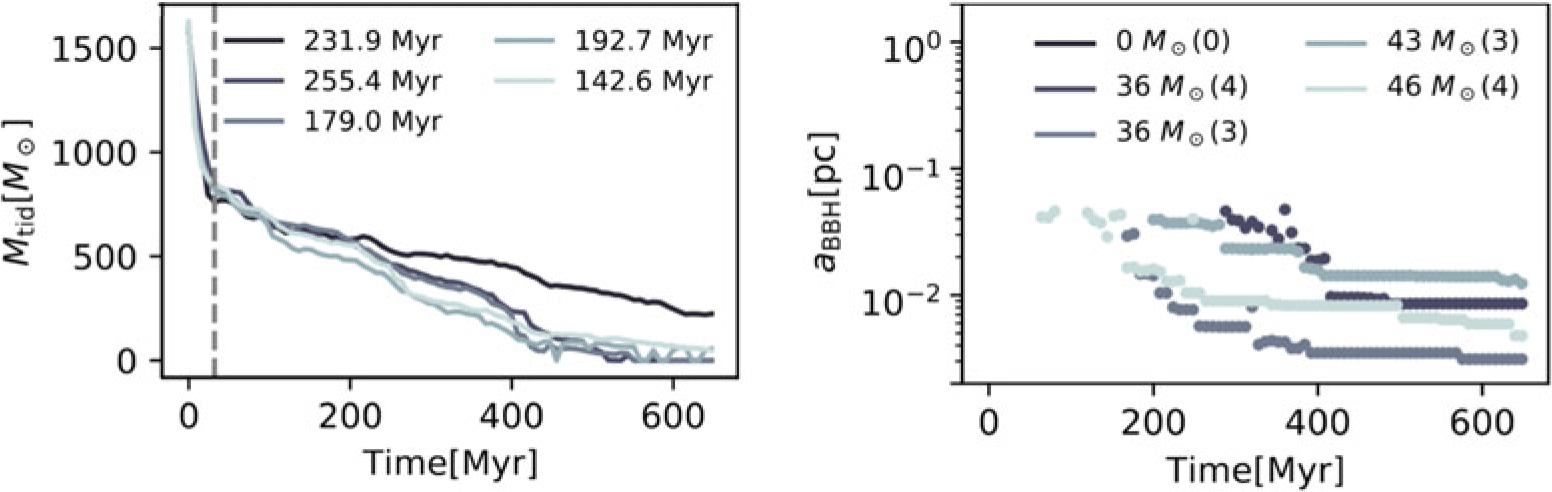
Second, BHs formed from massive OB stars alter the long-term dynamics. Figure 4 compares five simulations with similar
 $M_{\mathrm{tid}}$
and
 $r_{\mathrm{h}}$
at 30 Myr, minimizing the effect of early wind mass loss, yet their subsequent evolution diverges. The surviving model does not contain BHs, whereas the others retain 3–4 BHs. These BHs form binary black holes (BBHs) that act as energetic heating sources: as their semi-major axes
 $a_{\mathrm{BBH}}$
shrink, repeated interactions eject surrounding stars. The resulting lower-density clusters are more vulnerable to tidal forces and disrupt earlier.
Left: Mass evolution for five models with similar
 $r_{\mathrm{h}}$
and
 $M_{\mathrm{tid}}$
at 30 Myr. Right: corresponding evolution of binary BH semi-major axes
 $a_{\mathrm{BBH}}$
. Figures adapted from Figure 7 of Wang and Jerabkova (Reference Wang and Jerabkova2021).

The findings of Wang and Jerabkova (Reference Wang and Jerabkova2021) show that massive OB stars strongly influence the long-term evolution of low-mass clusters like the Hyades, complicating efforts to constrain their initial conditions. However, tidal streams preserve the history of tidal disruption and provide additional data, such as star counts, that could potentially enable better constraints (Figure 8 in Wang and Jerabkova Reference Wang and Jerabkova2021), worth further study.
3. Influence of black holes and primordial binary on globular cluster Palomar 5
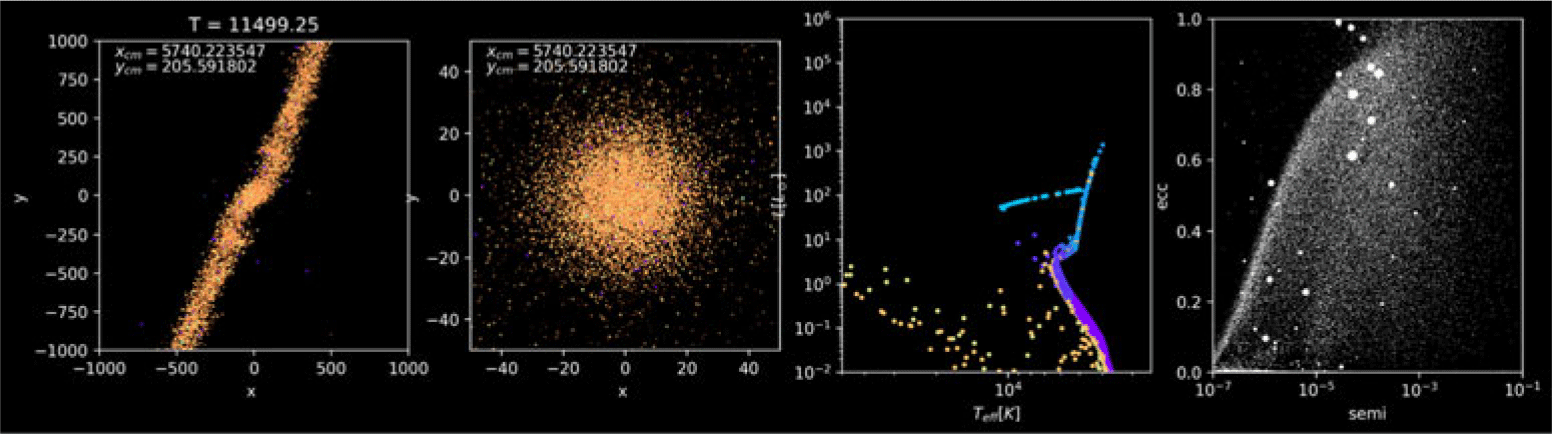
Palomar 5 is notable for its extended tidal tails, indicating strong tidal mass loss. It also has unusually low density and an extended core compared to other GCs. Using N-body simulations, Gieles et al. (Reference Gieles, Erkal, Antonini, Balbinot and Peñarrubia2021) showed that reproducing the observed density profile requires either a large BH population that heats the core or an initially looser cluster; current observations cannot distinguish these scenarios. Wang et al. (Reference Wang, Gieles, Baumgardt, Li, Pang and Tang2024) extended this with N-body simulations with and without BHs and primordial binaries, examining observable binary features and mass functions. Figure 5 presents a Bin-BH model at Palomar 5’s age, showing the tidal stream, resolved stellar populations and binary properties.
Snapshot of projected positions in the x–y (galactic disk) plane, HR diagram, and binary semi-major axis-eccentricity distributions for Palomar 5 simulations with BHs and primordial binaries at
 $\approx 11.5$
Gyr. Data from Wang et al. (Reference Wang, Gieles, Baumgardt, Li, Pang and Tang2024).

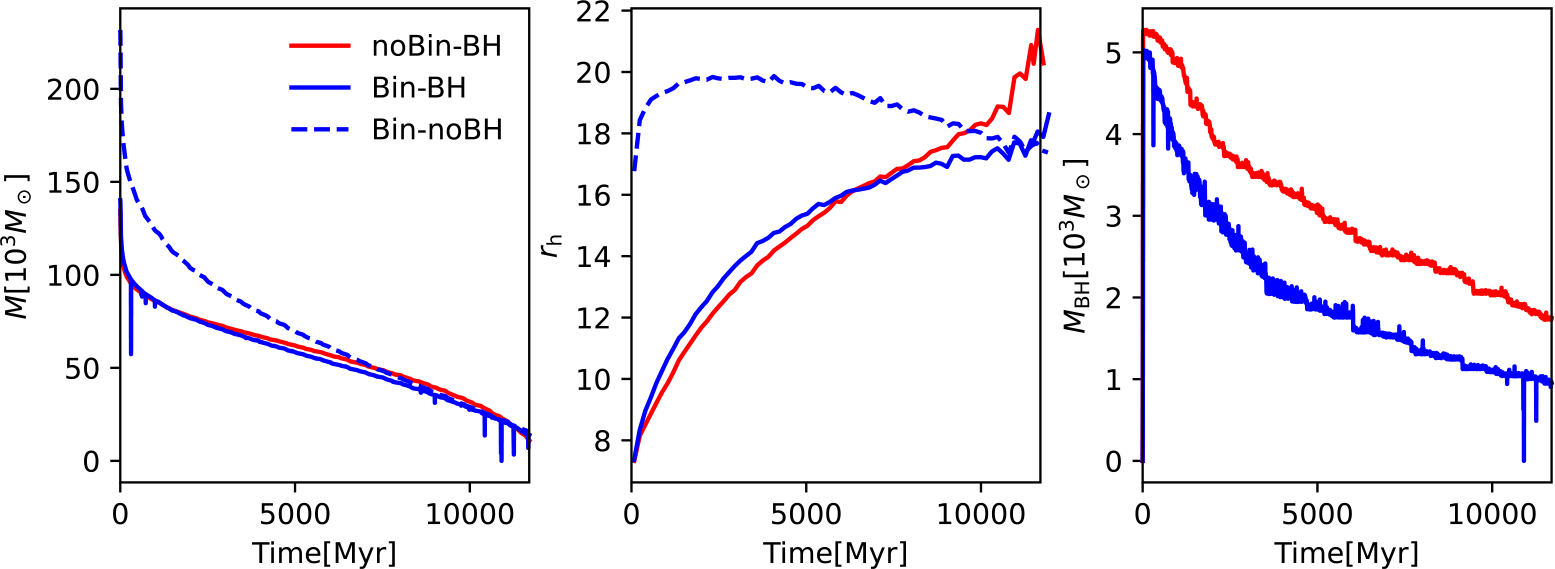
Compared with the presence of BHs, the existence of primordial binaries has a much weaker impact on cluster structural evolution (Figure 6). To reach the same final M and
 $r_{\mathrm{h}}$
, BH-free models (Bin-noBH) require much larger initial mass and
 $r_{\mathrm{h}}$
than BH models (Bin-BH and noBin-BH). Among BH models, the M and
 $r_{\mathrm{h}}$
evolutions are similar with or without binaries, except that the total BH mass
 $M_{\mathrm{BH}}$
is lower when binaries are present because early OB-binary mergers reduce BH progenitors.
Evolution of M,
 $r_{\mathrm{h}}$
, and total BH mass
 $M_{\mathrm{BH}}$
across three Palomar models, comparing binaries vs. no binaries (Bin/noBin) and BHs vs. no BHs (BH/noBH). Data is from Wang et al. (Reference Wang, Gieles, Baumgardt, Li, Pang and Tang2024).

Figure 6 Long description
Panel A: A line graph shows the evolution of mass (M) in units of 10^3 solar masses (M☉) over time in millions of years (Myr). Three lines represent different models: noBin-BH (red), Bin-BH (blue), and Bin-noBH (blue dashed). Mass decreases over time in all models. Panel B: A line graph depicts the evolution of half-mass radius (r_h) in parsecs (pc) over time in Myr. The same three models are represented by the same color scheme. The half-mass radius increases over time, with the Bin-noBH model showing the highest values. Panel C: A line graph illustrates the evolution of total black hole mass (M_BH) in units of 10^3 solar masses (M☉) over time in Myr. The noBin-BH model (red) shows a gradual decrease, while the Bin-BH model (blue) shows a more rapid decline.
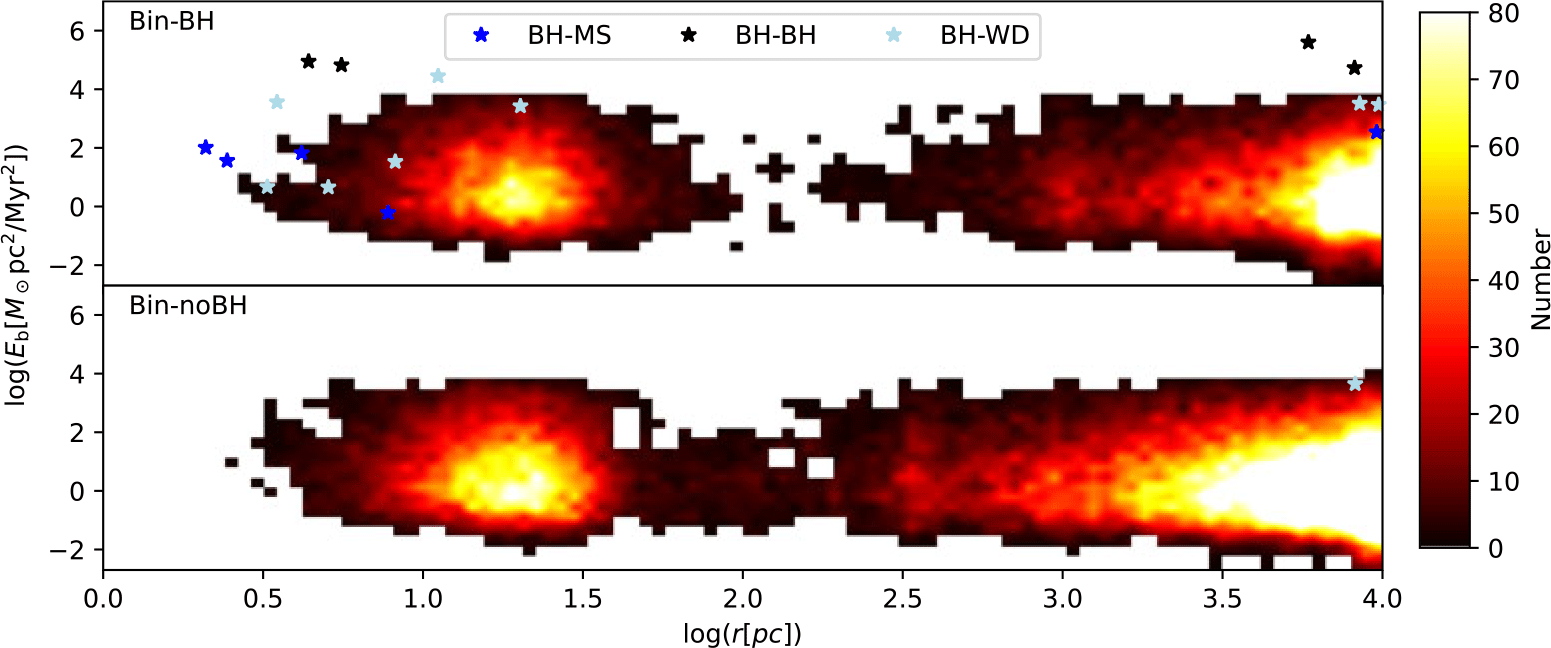
Different evolutionary histories in models with and without BHs lead to a distinct binary evolution. In the denser, BH-heated systems, the hard-soft boundary is smaller, increasing binary disruption and altering the period distribution. Figure 7 shows the number-density map of binary binding energy
 $E_{\mathrm{b}}$
versus cluster-centric distance r. Binaries within 100 pc lie inside the cluster; those beyond are in the tidal streams.
Number-density map of binary binding energy versus cluster-centric distance for Palomar 5 simulations, comparing models with primordial binaries with and without BHs. In BH models, BH-MS, BH-BH, and BH-WD binaries are marked with stars. Figure adapted from Figure 8 in Wang et al. (Reference Wang, Gieles, Baumgardt, Li, Pang and Tang2024).

Figure 7 Long description
Panel A: A heat map titled Bin-BH showing the number density of binary binding energy versus cluster-centric distance. The x-axis is labeled log(r[pc]) and the y-axis is labeled log(E_b[M_sun pc^2/Myr^2]). The color scale ranges from black to yellow, indicating increasing number density. Stars mark BH-MS, BH-BH, and BH-WD binaries. Panel B: A heat map titled Bin-noBH with the same axes and color scale as Panel A, but without the star markers.
The two models show no clear difference in the
 $E_{\mathrm{b}}$
distribution, although the Bin-BH case has a lower binary fraction and includes several binaries containing BH. Binaries with BH and main sequence stars (BH-MS) could be identified via multi-epoch radial-velocity measurements, providing potential evidence for BHs in Palomar 5.
A large fraction of binaries have escaped through the tidal stream, exhibiting a wider
 $E_{\mathrm{b}}$
distribution than cluster-bound binaries. As shown by Wang et al. (Reference Wang, Gieles, Baumgardt, Li, Pang and Tang2024), the distant tidal tails should host a higher binary fraction because escaped binaries experience fewer encounters, allowing wide systems to survive—unlike the inside of clusters. This trend can help link halo and GC binary populations and constrain the initial wide-binary properties in GCs.
4. Conclusion
Studies of the Hyades and Palomar 5 show that massive stars with high mass loss–the progenitors of BHs–can strongly shape the long-term evolution of both low-mass open clusters and globular clusters. This influence complicates inferring initial cluster conditions from present-day observations. Tidal streams, which record stars’ escape histories, offer additional constraints. Future work should explore the dynamical relationship between the cluster and the stream, including the roles of gas expulsion and rotation in stream formation and evolution (e.g., Dinnbier and Kroupa Reference Dinnbier and Kroupa2020), and how time-dependent Galactic potentials (bar, spiral arms) interact with the dynamics of the internal cluster to shape streams.
 M≈800M⊙
 mmax
 >5M⊙
 MOB
 rh=2
 M=800M⊙
 MOB
 rtid
 Mtid
 rh
 Mtid
 aBBH
 ≈11.5
 rh
 MBH