Introduction
Hidden hunger is a type of malnutrition associated with micronutrients deficiency. The World Health Organization (WHO) reports that more than two billion people worldwide have ‘hidden hunger’, and the principal micronutrients related to this condition are iron, zinc, vitamin A, iodine, and folic acid.Reference Schibba, Ogden and Smith1,Reference Freeland-Graves, Sachdev, Binderberger and Sosanya2 Zinc is a vital micronutrient involved in cell division, physical growth, and immune system function. This micronutrient is involved in more than 300 metalloenzymes, influences more than two thousand transcription factors, and participates in the regulation and expression of hundreds of genes.Reference Chasapis, Ntoupa, Spiliopoulou and Stefanidou3,Reference de Benoist, Darnton-Hill, Davidsson, Fontaine and Hotz4 Mild zinc deficiency can be associated with impaired immune response and cell replication, increasing the susceptibility to infectious and impairing children’s growth. The moderate and severe deficiency is called acrodermatitis enteropathica, whose manifestations are irritability, alopecia, diarrhea, and stunting.Reference Chasapis, Ntoupa, Spiliopoulou and Stefanidou3-Reference Gupta, Brazier and Lowe5
A meta-analysis that used zinc serum levels (<65 μg/dL), stunting prevalence, and dietary zinc intake inadequacy as markers of zinc deficiency found an alarming deficiency percentage (>20% of the population under five years old) in 23 of the 25 countries assessed.Reference Gupta, Brazier and Lowe5 Zinc deficiency is a public health problem in low- and middle-income countries.Reference Chasapis, Ntoupa, Spiliopoulou and Stefanidou3 The zinc serum levels alone are not a good marker of mild zinc deficiency.Reference de Benoist, Darnton-Hill, Davidsson, Fontaine and Hotz4 Zinc supplementation in infants younger than 6 months old, and from 6 to 12 months old was related to a slight improvement in linear growth and lower prevalence of the diarrheal disease, respectively.Reference Lassi, Kurji and Oliveira6,Reference Mayo-Wilson, Junior and Imdad7
Preterm newborns are at risk for zinc deficiency due to lower reserves, accelerated postnatal growth, immature gastrointestinal tract, diseases developed during hospitalization, and lower dietary intake of this micronutrient in postnatal follow-up.Reference Terrin, Berni-Canani and Di Chiara8,Reference Gulani, Bhatnagar and Sachdev9 During hospitalization, preterm newborns receive zinc through parenteral and enteral nutrition. Breast milk is the principal source for enteral nutrition in preterm newborns. The use of human milk in preterm infant is associated with a reduced risk of necrotizing enterocolitis, sepsis, and better indicators of long-term neuropsychomotor development.Reference Altobelli, Angeletti, Verrotti and Petrocelli10 However, the amount of zinc in breast milk varies considerably and decreases with lactation time, which may be insufficient to meet the needs of preterm newborns who may require human milk fortification.Reference Bhatia11
This observation was well documented in several studies, that is, there is a physiological drop in breast milk zinc concentrations with progressing lactation that occurs regardless of maternal zinc status, diet, and supplementation.Reference Aumeistere, Ciproviča, Zavadska, Bavrins and Borisova12 Foods which are source of zinc such as beef, eggs, and fish should be included in the complementary feeding from the sixth month of life. Plant-based foods such as pulses and grain products are also a good source of zinc, but they contain phytates, which decrease its bioavailability. Previous studies show that the introduction of food sources of animal origin occurs later, between 8 and 12 months, which increases the risk of zinc deficiency at this stage.Reference Kostecka, Jackowska and Kostecka13 Specifically, concerning infants born prematurely, a group that is even more vulnerable to zinc deficiency, there are few studies available that assess in more detail the composition of the complementary feeding and the repercussions in short- and long-term outcomes in this population.
Few studies have evaluated the zinc-related nutritional status in moderately and extremely preterm infants after hospital discharge.Reference Harris, Gardner, Podany, Kelleher and Doheny14-Reference Mathur and Agarwal20 This study aimed to compare serum and erythrocyte zinc levels in a group of preterm and full-term infants after 9 months of age and related the zinc levels to dietary intake and anthropometric indicators in both groups.
Method
Study design
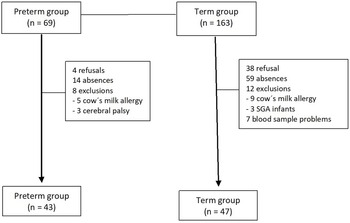
A cross-sectional study was carried out from 2018 to 2019 with 43 preterm infants (preterm group, gestational age from 24 to 33 weeks), with chronological age 9 to 24 months, at the follow-up clinic of the Hospital Municipal Universitário de São Bernardo do Campo, São Paulo, Brazil. The comparison group consisted of 47 healthy full-term infants (term group), adequate for gestational age and weighing more than 2,500 grams, of the same age, in follow-up at the Primary Health Care of the same city.
The Hospital adopts the Kangaroo Method and is a Baby-Friendly Hospital. About 14% of births are preterm, and the breastfeeding rate for preterm infants at hospital discharge is 82%. Preterm newborns with gestational age <34 weeks or birth weight <1,500 grams are followed at the outpatient clinic up to 6 years of age by a multidisciplinary team. The follow-up happens in parallel to that performed by the Primary Care Health. For all preterm newborns were prescribed daily supplementation of vitamin D (400 IU) and iron (2–4 mg/kg of body weight) after hospital discharge up to 2 years of age. None of the infants received zinc supplementation.
Infants with severe malformations (heart and central nervous system defects), genetic syndromes, cerebral palsy, oxygen-dependent children at evaluation, those who did not feed exclusively orally, who had intolerances and food allergies, who were unable to provide telephone contact or missed at the day of data collected, and whose family refused to participate were excluded from the sample (Fig 1).
Sample inclusion flowchart.

The Research Ethics Committee of Universidade Federal de São Paulo approved the study (N° 2.937.127), and all methods were performed following the Declaration of Helsinki. The children’s legal guardians signed the informed consent form after the interview and explanation by the researchers regarding the study’s steps and procedures.
Collected data
General information
Information on the socioeconomic status, household income, mother’s education level, and maternal health during pregnancy were collected. Data collected from medical records were weight, length, head circumference, gestational age, and Apgar score at birth. The gestational age was calculated according to the date of the last menstruation. If this information was not available, we used the first-trimester ultrasound and, finally, the clinical evaluation of the newborn (New Ballard Score).Reference Ballard, Khoury, Wedig, Wang, Eilers-Walsman and Lipp21 Fenton’s referenceReference Fenton and Kim22 was adopted to classify the newborns into small (SGA), adequate (AGA), and large (LGA) for gestational age when the birth weight for gestational age was below the 10th percentile, from the 10th to the 90th, and above the 90th, respectively.
Anthropometry
At the time of evaluation, anthropometric measurements were performed by an experienced dietician at clinical evaluation. Weight was measured on a digital scale graduated in grams, length with a measuring board graduated in millimeters, and head and arm circumference with an inextensible measuring tape.23 The infants were unclothed and without diapers during all procedures.
The anthropometric measures were used to calculate the indicators z-scores of body mass index (BMIZ), length/age (LAZ), and head circumference/age (HCAZ) through the WHO Anthro v.3.2.2. The cutoff points employed to classify anthropometric indicators were proposed by the World Health Organization.Reference de Onis, Garza, Victora, Onyango, Frongillo and Martines24 The corrected age of 40 weeks was used to calculate anthropometric indicators for preterm infants.
Dietary intake
Three 24-hour recalls were collected over a 2-week period by a trained nutritionist. Three, two, and one 24-hour recalls were available in 24 (26.7%), 16 (17.7%), and 45 (50%) infants included in the study. Preterm infants had lower number of 24-hour recall responses when compared to the control group (two or three responses: preterm group 32.6% vs. term group 57.4%, p = 0.021).
Dietary recalls were analyzed using DietWin® program, which uses the food composition tables proposed by the United States Department of Agriculture25 and the Brazilian Food Composition Table.26 Consumption of milk and infant formula was excluded from the calculation of main meals (solid foods). The frequency of breast feedings per day (times in 24 hours) was recorded. The main meals were defined as solid foods consumed at lunch and dinner per the traditional Brazilian eating habits, in general, rice, beans, meats, poultry, fish, and vegetables.27 The dietary intake of energy, protein, zinc, and iron in main meals, infant formula, and cow´s milk was showed separately between preterm and full-term groups, stratified into breastfed and non-breastfed infants because was not possible to measure the volume of breast milk consumed in breastfed children.
Additional dietary data collected included the age of onset and sequence of introduction of complementary foods, breastfeeding practices and duration, and use of infant formula and whole cow’s milk.
Laboratory tests
The blood samples (8 mL) were collected with 3 hours of fasting in the morning. The blood sample was divided into tubes for collecting metals (Trace EDTA BD Ref. 368381), dry tube, and EDTA tube. The material was immediately transported to the Clinical Analysis Laboratory, where the sample preparation, laboratory analysis, and storage were performed. Samples that were not analyzed immediately were stored in a freezer at –80 °C.
The blood count was performed with the multi-parameter automated hematology analyzer (Cell-Dyn Ruby) using the Multi-Angle Polarized Scatter Separation technology and laser flow cytometry. Anemia was defined by the level of hemoglobin (Hb) below 11 g/dL.28 The ultrasensitive C-reactive protein (us-CRP) was measured [human CRP (C-reactive protein) ELISA Kit, FineTest® Wuhan Fine Biotech].
Serum and erythrocyte zinc levels were determined by the inductively coupled plasma mass spectrometry method (ICP-MS). Red cell lysis was performed with phosphate buffer. The reference values adopted for serum and erythrocyte zinc were 65 μg/dLReference de Benoist, Darnton-Hill, Davidsson, Fontaine and Hotz4 and 40 μg/g hemoglobin (µg/gHb),Reference Hotz, Peerson and Brown29 respectively.
Statistical analysis
The analyses were performed in the statistical package SPSS 25.0 (IBM®). Categorical variables were presented as absolute numbers and percentages and compared with the Chi-square test. The distribution of continuous variables was assessed using the Shapiro–Wilk test, histograms, and Kurtosis values. The variables with normal distribution were presented as mean±standard deviation and compared by the Student’s t-test for independent variables. Variables with non-normal distribution were presented as medians and interquartile ranges (p25–p75) and compared with the Mann–Whitney test.
The linear regression method was employed for the multivariate analysis. The variables were included in the model after the analysis of multicollinearity and interpretation of “Tolerance” and “Variance inflation factor” (VIF) values. The serum and erythrocyte zinc were used as dependent variables. The independent variables without collinearity, which showed a statistically significant difference between the preterm and full-term groups, and the ones with clinical relevance were included in this analysis. A significance level of 5% was adopted in all analyses.
Employing α-bidirectional = 0.05 and β = 0.20 allowed the included sample (45 infants per group) to detect a difference of 10 µg/dL of serum zinc between the groups (standardized magnitude of the effect of 0.6). For this calculation, we used data from the paper published by Cho et al., 2019,Reference Cho, Kim and Yang17 which found a mean and standard deviation in serum zinc levels of 81.4 ± 18.7 µg/dL in a group of preterm infants.
Results
Table 1 shows the general characteristics of population studied. In the preterm group, 24 (55.8%) of the infants were male, the mean birth weight, gestational age, and corrected age were 1,245 ± 381.7 grams, 29.9 ± 2.3 weeks, and 14.3 ± 6.4 months, respectively. There was no difference between the groups in the socioeconomic variables studied, such as household income and maternal education.
General characteristics of infants evaluated

GA, gestational age; SGA, small for gestational age; BF, Breastfeeding; BMI, Body Mass Index; SD, standard deviation.
*Significance level of the Chi-square.
§Student’s t-test.
||||Mann–Whitney tests.
The duration of total breastfeeding was lower [7.0 months (3.0; 9.2) vs. 11.3 months (6.0; 16.4); p = 0.003] and the age of introduction of solid foods was earlier [7.0 months (6.3; 8.0) vs. 6.0 months (5.0; 6.0), p < 0.001] in infants of preterm group compared to the full-term group, using chronological age (Table 1).
At the time of evaluation, the anthropometric indicators showed lower mean values, and we observed a lower percentage of breastfed infants (18.6% vs. 53.2%; p = 0.001) in the preterm group compared to the full-term group (Table 1).
There was no statistically significant difference between the preterm and full-term group in the serum zinc (94.0 ± 23.4 µg/dL vs. 90.3 ± 18.0 µg/dL; p = 0.450) and erythrocyte zinc levels (119.4 ± 23.8 µg/gHb vs. 112.7 ± 23.1 µg/gHb; p = 0.307) (Table 2). There was no difference in the dietary intake of zinc, iron, energy, and protein between the groups (Table 3).
Comparison of laboratory variables between preterm and full-term group

*Significance level of the Student’s t-test.
§Mann–Whitney.
||||Chi-Square tests.
Dietary intake in preterm and full-term infants stratified by breastfed or not breastfeeding

Significance level of the Mann–Whitney test between preterm group vs. term group (p > 0.05).
In the linear regression, the variables associated with higher serum zinc concentrations were breastfeeding at evaluation (β = 20.11 µg/dL, 95% CI 9.62–30.60, p < 0.001) and time of introduction of solid foods (β = 6.6 µg/dL, 95% CI 5.3–11.4, p < 0.001). Breastfeeding was also associated with higher erythrocyte zinc levels at evaluation (β = 18.8 µg/dL, 95% CI 3.7–33.8, p = 0.015) (Table 4).
Multivariate analysis assessing factors associated with the levels of serum and erythrocyte zinc in infants

Discussion
Serum zinc deficiency occurred in less than 5% of infants born prematurely and was not associated with thinness/malnutrition and short stature. There are no well-defined cutoffs for serum and erythrocyte zinc levels in term and preterm infants, and these measurements by themselves could not be sensitive enough to act as a biological marker for zinc deficiency, especially for subclinical zinc deficiency. A study with 27,801 individuals aged between 6 months and 74 years showed that values below 65 µg/dL (2.5th percentile) of serum zinc could be low for children under ten years of age.Reference Hotz, Peerson and Brown29 However, the authors did not propose specific cutoffs for infants, nor did they relate these inappropriate values to relevant clinical outcomes.
Preterm newborns have lower serum zinc levels than term infants in the first months of life, and in this group, zinc supplementation during hospitalization is associated with reduced mortality, improved weight gain, and linear growth up to two years of age.Reference Harris, Gardner, Podany, Kelleher and Doheny14,Reference Terrin, Berni-Canani and Passariello15,Reference Hotz, Peerson and Brown29 Studies that evaluated serum zinc levels and the effects of supplementation in clinical outcomes such as growthReference Mayo-Wilson, Junior and Imdad7,Reference Wauben, Gibson and Atkinson18,Reference Díaz-Gómez, Doménech, Barroso, Castells, Cortabarria and Jiménez19 and developmentReference Terrin, Berni-Canani and Passariello15,Reference Wauben, Gibson and Atkinson18 in preterm infants after hospital discharge show divergent results.Reference Staub, Evers and Askie30-Reference Griffin, Domellöf, Bhatia, Anderson and Kler32 These publications included moderate or late preterm infants with younger age and lower breastfeeding rates than our study.
Serum and erythrocyte zinc levels were adequate in boths groups, and breastfed infants at evaluation in this study had higher zinc levels. This finding is similar to Waunen et al., 1999,Reference Wauben, Gibson and Atkinson18 that found higher zinc concentrations in the hair of breastfed preterm and full-term infants at 6- and 12-month corrected age. However, these results differ from other studies, which found lower zinc concentrations in breastfed infants than those receiving infant formulas.Reference Sezer, Aydemir, Akcan, Bayoglu, Guran and Bozaykut33,Reference Dumrongwongsiri, Suthutvoravut and Chatvutinun34 The zinc content in human milk varies considerably and decreases with lactation time.Reference Dumrongwongsiri, Suthutvoravut and Chatvutinun34,Reference Terrin, Boscarino and Di Chiara35 Despite this progressive reduction and lower content, the bioavailability of zinc in human milk is better than in infant formula (60% vs. 24%).Reference Sabatier, Garcia-Rodenas and Castro36,Reference Trinta, Padilha and Petronilho37 A recent pilot study showed that a mother’s zinc intake (diet and supplementation) was positively associated with zinc content in breast milk.Reference Bzikowska-Jura, Sobieraj, Michalska-Kacymirow and Wesołowska38
In addition to the better bioavailability of zinc in human milk, two other factors may explain the association of breastfeeding with better blood concentrations of zinc in this study. Breastfed children usually have adequate time of introduction, quality, and variety of the foods during complementary feedingReference Spaniol, da Costa, Bortolini and Gubert39; and lower frequency of infectious conditions that lead to more significant zinc depletion, such as diarrheal and respiratory diseases.Reference Victora, Rollins, Murch, Krasevec and Bahl40
In this study, the introduction of solid foods in the preterm group agreed with the current recommendations (5–8 months of chronological age). The early introduction of solid foods (before 3 months corrected age or 5 months chronological age), and consumption of foods with low energy density and micronutrients are common problems in the complementary feeding in preterm infants and are associated with nutritional deficiencies.Reference Fanaro, Borsari and Vigi41-Reference Crippa, Morniroli and Baldassarre43
The infant feeding practices observed in this study, characterized by low breastfeeding rates, and early onset of infant formula (at 2 months) are similar to earlier reports.Reference Bortolini, Vitolo, Gubert and Santos44,45 In addition, we observed that the energy intake in the infants who received infant formula was almost double that offered in the main meals. This finding is against the WHO recommendation, which suggests that the principal source of energy and nutrients in an infant´s diet at around 12 months old should come from solid foods in the main meals. Formula-fed infants who consume a higher volume and more energy-dense milk in early life lead to faster growth which could potentially program a greater risk of long-term obesity.Reference Hester, Hustead, Mackey, Singhal and Marriage46
The dosage of zinc in biological samples requires care so that there is no contamination and interference from environmental factors in the pre-analytical phase (hemolysis, tube type, sample processing and storage temperature). The methods used for zinc analysis also vary in sensitivity and complexity of the operation. They include atomic absorption spectrometers (AAS, flame or graphite furnace), inductively coupled plasma optical (atomic) emission spectrometers (ICP-OES/ICP-AES), and ICP mass spectrometers (ICP-MS).Reference Hall, King and McDonald47 In our study, all sample collection, storage, and dosing procedures were carefully controlled at all stages, considering these factors, and ensuring the quality of the operation and the results obtained.
Strengths of this study are the preterm group with moderate (<34 weeks) and very low birth weight (<1500 g) newborns, the inclusion of a healthy comparison group of the same city, with socioeconomic and cultural characteristics similar to the preterm group, and the detailed dietary intake of infants. The limitations are the low number of children included, the impossibility of calculating dietary intake in breastfed infants, the lack of other zinc biomarkers such as metallothioneins, high variation in the age of children included (from 9 up to 24 months), and the non-systematic collection of information about diseases developed by the group of preterm infants after hospital discharge.
Our results showed that the zinc levels were adequate in both groups, and there was no association with anthropometric indicators or dietary intake. The zinc levels were slightly influenced by breastfeeding and time of solid food introduction. Nonetheless, more studies using better biological markers on zinc-related nutritional status are required to define more clearly these associations.
Acknowledgments
Multidisciplinary team of Hospital Municipal Universitário de São Bernardo do Campo and the Primary Care.
Financial Support
FAPESP – São Paulo State Research Support Foundation - Number: 2016/09428-1 and Coordenação de Aperfeiçoamento de Pessoal de Nível Superior – CAPES.
Conflit of interest
None.
Ethical Standards
The authors assert that all procedures contributing to this work comply with the ethical standards of the relevant national guidelines on human experimentation and with the Helsinki Declaration of 1975, as revised in 2008, and this study has been approved by the Research Ethics Committee of Universidade Federal de São Paulo under number N° 2.937.127.