





Introduction
Environmental education (EE) increasingly seeks outcomes that extend beyond awareness to meaningful and sustained action. Yet a persistent challenge in the field is the knowledge–action gap: learners may acquire environmental knowledge and express concern while showing less consistent change in long-term behaviour and practice (Ardoin et al., Reference Ardoin, Bowers, Roth and Holthuis2018, Reference Ardoin, Bowers and Gaillard2020). This challenge is especially salient in adolescence, when identity, peer influence, motivation, perceived control, and habit formation are still developing, and pro-environmental action depends not only on what students know but also on psychosocial processes that shape intention and follow-through (Ajzen, Reference Ajzen1991; Bamberg & Möser, Reference Bamberg and Möser2007; Steg & Vlek, Reference Steg and Vlek2009).
At the same time, EE has an unavoidable normative dimension. Environmental issues involve questions of responsibility, justice, and the quality of human–nature relations, not merely the transmission of factual information. Scholars have warned that, in some versions of Education for Sustainable Development, “the environment” can become diluted when sustainability is framed so broadly that ecological concerns lose conceptual and pedagogical priority (Kopnina, Reference Kopnina2012). In response, virtue- and character-oriented perspectives have gained attention because they shift the focus from episodic compliance to the cultivation of relatively stable dispositions that may support environmentally responsible living across contexts (Jordan & Kristjánsson, Reference Jordan and Kristjánsson2017). This concern is consistent with earlier EE scholarship arguing that durable environmental action requires dispositions and skills that go beyond awareness and attitudes alone (Hungerford & Volk, Reference Hungerford and Volk1990).
These questions now unfold in deeply digital learning ecologies. Adolescents increasingly encounter environmental information, peer discussion, and public expression through social networking and messaging platforms. Foundational work on social network sites has shown how these environments shape identity, norms, and participation within networked publics (Boyd & Ellison, Reference Boyd and Ellison2007). Broader educational research similarly suggests that social media can support interaction, collaboration, and extended learning opportunities, but only when its use is pedagogically structured rather than casual or incidental (Chawinga, Reference Chawinga2017; Hamid et al., Reference Hamid, Waycott, Kurnia and Chang2015; Manca, Reference Manca2020).
Within EE specifically, recent reviews show growing interest in digital tools while also pointing to uneven research quality and an overemphasis on easily measured cognitive outcomes. A recent systematic review found generally positive associations between digital tools and sustainability awareness, while stressing that outcomes depend heavily on interactivity, authentic task design, and structured reflection (Hajj-Hassan et al., Reference Hajj-Hassan, Chaker and Cederqvist2024). Related work on digital media in family environmental learning likewise suggests that digital environments are most educationally valuable when they stimulate conversation and shared meaning-making rather than passive consumption (Lin & Ardoin, Reference Lin and Ardoin2023). Social media may also shape pro-environmental intention and participation through mechanisms such as attitudes, perceived behavioural control, and parasocial engagement with environmentally oriented online figures (Knupfer et al., Reference Knupfer, Neureiter and Matthes2023; Meng et al., Reference Meng, Li, Weng and Huang2023). Climate change education research reinforces the same conclusion: educational impact depends less on information exposure alone than on pedagogy that connects content to lived experience, dialogue, agency, and action (Aeschbach et al., Reference Aeschbach, Schwichow and Rieß2025; Monroe et al., Reference Monroe, Plate, Oxarart, Bowers and Chaves2019).
The present study responds to these issues by treating pro-environmental action partly as a character formation problem. Although behavioural theories such as the Theory of Planned Behaviour and Value–Belief–Norm theory clarify important proximal predictors of action, they do not fully explain how learners become the kind of people who can sustain environmentally responsible conduct across changing contexts (Ajzen, Reference Ajzen1991; Stern, Reference Stern2000). Here, the action competence tradition is especially relevant because it has long argued that EE should prepare learners for informed, participatory, and democratic action rather than for the passive adoption of prescribed behaviours (Barrett, Reference Barrett2006; Jensen & Schnack, Reference Jensen and Schnack1997). More recent work on action competence and environmental character likewise emphasises agency, participation, critical reasoning, and civic engagement as central educational aims (Torsdottir, Olsson & Sinnes Reference Torsdottir, Olsson and Sinnes2024; Van Harskamp et al., Reference Van Harskamp, Knippels, Boeve-de Pauw and van Joolingen2023).
Building on these traditions, this study adds a clearer virtue-ethical lens. From this perspective, environmental character education refers to intentional educational processes that cultivate relatively stable dispositions shaping how learners perceive ecological issues, interpret responsibilities, regulate impulses, and persist in difficult action. In environmental virtue ethics, such traits help individuals notice morally salient dimensions of human–nature relations and act consistently in response to them (Sandler, Reference Sandler and LaFollette2013). This position also aligns with the wider character education literature, which has increasingly examined how structured educational practice can foster trait development, while also highlighting ongoing implementation and measurement challenges (Oldham & McLoughlin, Reference Oldham and McLoughlin2025). Meta-analytic evidence further suggests that character education can produce measurable behavioural and academic benefits when it is intentionally designed and embedded in practice (Jeynes, Reference Jeynes2019). Particularly relevant here is empathy with nature, which recent evidence identifies as an important predictor of pro-environmental attitudes and a potentially malleable pathway for environmental learning (Li et al., Reference Li, Zhao, Huang, Deng, Deng and Li2024). This study does not treat virtue ethics and action competence as identical traditions. Virtue ethics helps conceptualise relatively stable dispositions that orient learners toward environmental responsibility, whereas action competence emphasises situated, participatory, and democratic agency. The present model links these traditions by treating environmental character not as fixed personality, but as a developable set of dispositions that becomes educationally meaningful when enacted through reflection, participation, and context-sensitive action.
In this study, environmental character is conceptualised as an eleven-component construct comprising respect, justice, honesty, kindness, responsibility, perseverance, care, discipline, empathy, patience and tolerance, and love. This 11-component structure was not adopted from a single prior model. Rather, it was developed through an integrative process. Components such as respect, justice, responsibility, care, empathy, and love were theoretically informed by environmental virtue ethics and character education, while perseverance and discipline reflected the self-regulatory demands of sustained pro-environmental action. The final wording, grouping, and indicator structure of the components were derived inductively from the thematic analysis and refined through three Delphi rounds. Therefore, the model combines theory-informed sensitising concepts with inductively generated and expert-refined components. These components are treated not as isolated traits but as an integrated educational framework combining moral–ethical, relational–affective, and self-regulatory dimensions. These components matter because many environmental failures are not caused by lack of knowledge alone; they also emerge from weak self-regulation, competing motives, social pressure, and the difficulty of maintaining action over time.
Because the intervention in this study was implemented through Telegram, social networks are treated not merely as communication channels but as possible learning ecologies for environmental character. They may strengthen responsibility, honesty, care, and participation, but they may also amplify misinformation, performative engagement, and shallow virtue signalling if educational design is weak. Recent evidence from young Australians highlights precisely this dual role of social media in climate engagement (Arnot et al., Reference Arnot, Pitt, McCarthy, Cordedda, Marko and Thomas2024). Other studies suggest that platform-based interaction can support pro-environmental behaviour when participation is structured and dialogic (Chung et al., Reference Chung, Huang and Lin2020), while research on messaging platforms indicates that tools such as Telegram can support feedback, peer discussion, and sustained micro-participation in educational settings (Estrada Molina, Reference Estrada Molina2022; Faraji et al., Reference Faraji, Khodaei and Khodadadi2020; Khalil & Rambech, Reference Khalil, Rambech, Zaphiris and Ioannou2022).
A further challenge is methodological. If EE aims to cultivate durable dispositions, then those dispositions must be conceptually specified and measured with greater precision. Reviews in the field have repeatedly called for stronger outcome measures and clearer links between educational processes and meaningful environmental outcomes (Ardoin et al., Reference Ardoin, Bowers, Roth and Holthuis2018, Reference Ardoin, Bowers and Gaillard2020; Hajj-Hassan et al., Reference Hajj-Hassan, Chaker and Cederqvist2024). Without such measurement, digital environmental education risks overvaluing what is easiest to count rather than what is most educationally consequential.
In response to these conceptual, contextual, and methodological needs, this study developed and validated an environmental character education model for upper-secondary students and examined its application in a Telegram-based learning environment. Using an exploratory sequential mixed-methods design, the study first identified and refined the main components of environmental character education, then validated an instrument aligned with those components, and finally examined short-term change following implementation. In this way, the article contributes to EE by offering an empirically grounded multi-component framework, developing a questionnaire aligned with that framework, and examining whether scores on this instrument show short-term responsiveness after structured Telegram-based learning activities.
Accordingly, the study addressed four research questions:
-
1. What are the main components of environmental character education?
-
2. What is the contribution of each component in the environmental character education model?
-
3. What model can be proposed for applying the components of environmental character education?
-
4. Are environmental character scores responsive to a structured Telegram-based intervention?
Methods
Study design and participants
This study used an exploratory sequential mixed-methods design in which a qualitative phase was used to identify and refine the components of environmental character education and a subsequent quantitative phase was used to validate the resulting instrument and examine change following implementation (Fetters et al., Reference Fetters, Curry and Creswell2013). In the qualitative phase, purposively selected texts related to environmental education, character education, and environmental ethics were analysed to generate an initial conceptual structure. The analysis followed the thematic procedures proposed by Braun and Clarke (Reference Braun and Clarke2006), including familiarisation with the corpus, initial coding, development of candidate themes, review and refinement of themes, and final theme definition. The process continued until additional material no longer yielded substantively new themes, consistent with saturation logic in qualitative inquiry (Guest et al., Reference Guest, Bunce and Johnson2006). This phase yielded an initial set of environmental character components.
To refine the emerging framework, a Delphi process was conducted with 20 experts from relevant fields. The Delphi panel consisted of 20 experts in EE, environmental ethics, character education, and related educational sciences. Panel members were selected because of their academic expertise, research background, or professional experience in these areas. Across three rounds, they evaluated the clarity, relevance, and coverage of the extracted components and indicators. Where available, stability and agreement indices from the Delphi rounds are now reported; where such indices were not archived in the dissertation materials, this is acknowledged as a limitation of reporting. Across three rounds, panel members reviewed the clarity, relevance, and coverage of the extracted components and their indicators, and their feedback was used to revise definitions and item wording. The Delphi phase was guided by recommendations on consensus building and stability in expert judgment studies (von der Gracht, Reference Von der Gracht2012). Content-focused expert judgment was also applied in line with guidance on content validity reporting and the logic of content validity index procedures (Polit & Beck, Reference Polit and Beck2006). Together, the qualitative and expert phases produced an 11-component environmental character education model.
In the quantitative phase, the target population comprised upper-secondary students in the northwest region of Iran (N = 266,629 across four provinces). Sample size was estimated using Cochran’s formula under conventional assumptions: 95% confidence level, p = 0.50, q = 0.50, and d = 0.05. In this formula, p represents the assumed population proportion, q = 1 − p, and d represents the desired margin of error. Because no prior population estimate was available, p and q were set at 0.50 to produce the most conservative sample size estimate. The finite population correction for the target population of 266,629 students produced essentially the same required sample size of 384. Because the study used multistage cluster sampling, the absence of an explicit design-effect adjustment is acknowledged as a limitation on statistical inference. Participants were selected using multistage cluster random sampling with proportional allocation across provinces and random selection at the county, school, and class levels. The participants were upper-secondary students from northwestern Iran. The original dissertation dataset recorded province, sex, and field of study, but age, urban/rural location, and school type were not recorded as separate variables in the archived dataset. Therefore, these unrecorded characteristics could not be reported in the manuscript and are acknowledged as a limitation. Participation was voluntary and anonymous. No formal institutional ethics approval code was issued for the original dissertation-based study; therefore, no ethics approval number is reported in this manuscript. The study was conducted as minimal-risk school-based educational research within a doctoral dissertation completed and defended at Payame Noor University. Participation was voluntary, and students were informed that they could decline participation or withdraw without penalty. The questionnaire did not request names or direct personal identifiers, and data were analysed and reported only in aggregate form. For the Telegram-based learning activities, the learning group was restricted to participating students and was used only for educational content aligned with the study model.
Instrument development and procedure
The 11 qualitative components were translated into an initial item pool of 130 statements rated on a five-point Likert scale. In line with scale-development guidance, the initial pool intentionally exceeded the desired final length so that weak, redundant, or unclear items could be removed during expert review and psychometric testing (Boateng et al., Reference Boateng, Neilands, Frongillo, Melgar-Quiñonez and Young2018). A subset of reverse-worded items was included and later reverse-scored during data preparation (Boateng et al., Reference Boateng, Neilands, Frongillo, Melgar-Quiñonez and Young2018). The manuscript specifies the number and component location of reverse-worded items in the Supplementary File 1. Reverse-worded items were reverse-scored before computing component and total scores. Corrected item-total correlations after reverse-scoring are reported in the Supplementary File 1 where available.
After three Delphi rounds and content-focused refinement, the questionnaire was reduced to 76 items representing the 11 components. The overall internal consistency estimate was reconsidered that a very high alpha may indicate item redundancy in a multidimensional instrument (Cronbach, Reference Cronbach1951). Therefore, the manuscript avoids treating the overall Cronbach’s alpha as sufficient evidence of reliability for all components. Component-level reliability estimates and item-level information are reported in the supplementary material where available. The final questionnaire was then administered digitally to the student sample. Reporting of the online survey procedure followed the CHERRIES recommendations for internet-based survey research (Eysenbach, Reference Eysenbach2004).
Following baseline administration, a Telegram-based learning group was created for the participating students. The programme lasted one month. Educational content was uploaded in formats aligned with the 11 components of the model, including persuasive short statements, short stories, animations, films, music, and environmental prompts. These materials were designed to encourage reflection on respect, justice, honesty, kindness, responsibility, perseverance, care, discipline, empathy, patience and tolerance, and love in relation to human–nature relations. After one month, the same questionnaire was re-administered as a digital posttest. Because the dissertation records the intervention as a one-month Telegram-based programme rather than as fixed classroom sessions, the manuscript does not claim a fixed number of sessions or equal time-on-task per session.
Data analysis
Data analysis was conducted in three stages corresponding to the study aims and research questions. First, qualitative thematic analysis and Delphi review were used to identify and refine the main components of environmental character education. Second, the 76-item questionnaire was examined psychometrically using descriptive statistics, normality checks, and factor-analytic procedures. Exploratory factor analysis was conducted on the 76 questionnaire items. The original dissertation analysis used Varimax rotation and retained the 11-factor solution reported in the dissertation. The manuscript states this procedure transparently and acknowledges that, because components such as honesty, care, and responsibility may be theoretically correlated, future validation studies should examine the structure using oblique rotation and independent cross-validation. Confirmatory factor analysis (CFA) was conducted in LISREL to test the higher-order measurement model. The estimator used in the original analysis is reported where available; if the estimator cannot be verified from the archived output, this is acknowledged as a reporting limitation. Sampling adequacy was evaluated using the Kaiser–Meyer–Olkin measure and Bartlett’s test of sphericity. Exploratory factor analysis was then used to examine the latent structure of the item set, followed by CFA to test the higher-order model and estimate the relative contribution of each component. This sequence is consistent with recommended practice in scale development and factor-analytic validation research (Fabrigar et al., Reference Fabrigar, Wegener, MacCallum and Strahan1999). Because all quantitative data were collected through self-report, common-method bias was examined using Harman’s single-factor test (Podsakoff et al., Reference Podsakoff, MacKenzie, Lee and Podsakoff2003).
Model fit was evaluated using χ 2/df, Comparative Fit Index (CFI), Tucker–Lewis Index (TLI)/Non-Normed Fit Index (NNFI), RMSEA, the 90% confidence interval for RMSEA and Standardized Root Mean Square Residual (SRMR), following established guidance for evaluating approximate model fit (Hu & Bentler, Reference Hu and Bentler1999). Third, to examine whether environmental character was responsive to the Telegram-based implementation, pretest and posttest scores were compared using a paired-samples t test. Because this was a one-group pretest–posttest design, this analysis was interpreted as evidence of short-term change rather than as a strong causal test of intervention effects. The original dissertation reports the pretest–posttest comparison using a paired-samples t test. However, the archived dissertation text does not provide sufficient procedural detail on the exact anonymous matching mechanism used to link pretest and posttest responses. This limitation is reported explicitly, and the pretest–posttest finding is interpreted cautiously as short-term score change rather than strong causal evidence.
Results
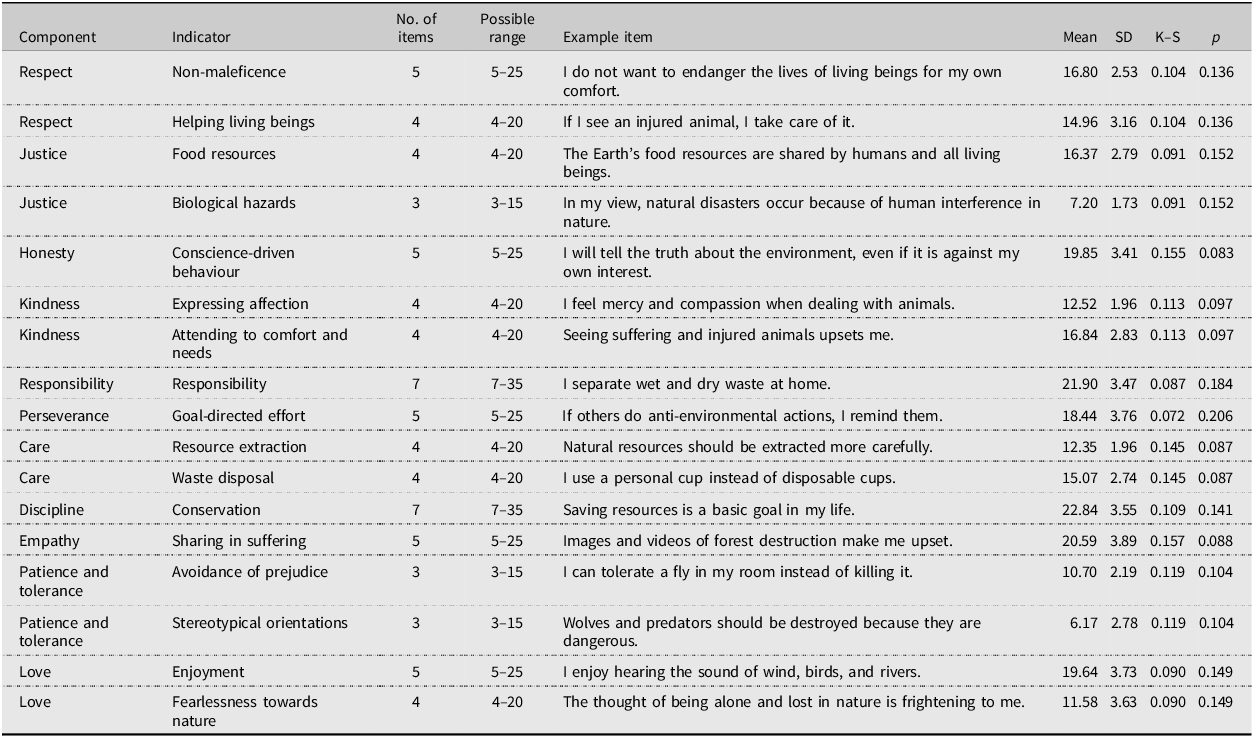
Table 1 summarises descriptive statistics for the extracted environmental character components (and their indicators) and reports Kolmogorov–Smirnov (K–S) tests to check distributional assumptions prior to subsequent parametric analyses. Overall, the K–S tests were non-significant for all components (all p values > 0.05), indicating no statistically detectable departures from normality in these scores and supporting the use of parametric procedures in the later factor-analytic and effectiveness analyses. Across components, K–S statistics ranged from 0.072 to 0.157, with corresponding significance levels ranging from 0.083 to 0.206, suggesting broadly acceptable distributional properties.
Descriptive indices of the extracted components and Kolmogorov–Smirnov test results

Table 1. Long description
A table summarizing descriptive statistics for environmental character components and Kolmogorov-Smirnov test results. The table has 18 rows and 8 columns. The columns are labeled Component, Indicator, No. of items, Possible range, Example item, Mean, SD, K-S, and p. The rows are grouped by components such as Respect, Justice, Honesty, Kindness, Responsibility, Perseverance, Care, Discipline, Empathy, Patience and tolerance, and Love. Each component has indicators with corresponding number of items, possible range, example item, mean, standard deviation (SD), Kolmogorov-Smirnov statistic (K-S), and p-value. For example, the Respect component includes indicators like Non-maleficence and Helping living beings, with respective items, ranges, example items, means, SDs, K-S values, and p-values. The table provides detailed statistics for each indicator within the components, showing the mean, standard deviation, and Kolmogorov-Smirnov test results to check distributional assumptions.
Descriptively, the indicator means showed meaningful variability across the component set. The highest average scores were observed for Discipline (Conservation) (M = 22.84, SD = 3.55) and Responsibility (M = 21.90, SD = 3.47), followed by Empathy (Sharing in suffering) (M = 20.59, SD = 3.89) and Honesty (Conscience-driven behaviour) (M = 19.85, SD = 3.41). The lowest mean levels were reported for Patience (Stereotypical orientations) (M = 6.17, SD = 2.78) and Justice (Biological hazards) (M = 7.20, SD = 1.73). Standard deviations were generally moderate (approximately 1.73–3.89), indicating sufficient spread for subsequent modelling; comparatively greater dispersion was observed for Empathy (Sharing in suffering), whereas Justice (Biological hazards) showed more homogeneous responses. As these descriptive values are presented at the indicator level, and indicators may differ in score ranges (e.g., due to differing numbers of items), comparisons should be interpreted as descriptive patterns rather than definitive rank-ordering of latent strengths.
RQ1. Key components of environmental character education
The qualitative phase identified 11 components of environmental character education: respect, justice, honesty, kindness, responsibility, perseverance, care, discipline, empathy, patience and tolerance, and love. Together, these components formed the conceptual basis for instrument development and subsequent quantitative testing.
Before factor extraction, sampling adequacy and factorability were examined. As shown in Table 2, the Kaiser–Meyer–Olkin measure was 0.850 and Bartlett’s test of sphericity was significant, χ 2(2850) = 12,666.877, p < 0.001, indicating that the data were suitable for factor analysis. Bartlett’s test was conducted on the 76-item correlation matrix; therefore, the reported degrees of freedom reflect p (p − 1)/2 for p = 76 observed items.
KMO measures and Bartlett’s test of Sphericity results in exploratory factor analysis of the 76-item questionnaire

Table 2. Long description
A table showing KMO measures and Bartlett’s test results for factor analysis. The table has 3 rows and 2 columns. Row 1: KMO, 0.850. Row 2: Bartlett’s test, Chi-square, 12,666.877. Row 3: Bartlett’s test, Degrees of freedom, 2,850. Row 4: Bartlett’s test, Significance level, less than 0.001.
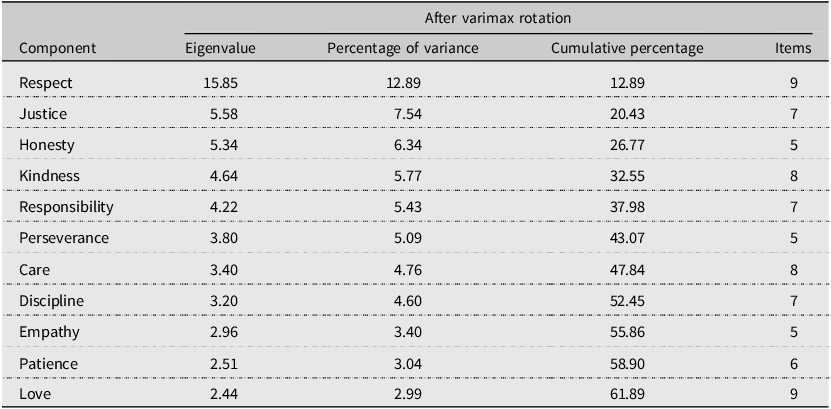
The exploratory Factor Analysis of the 76-Item Questionnaire supported an 11-component solution consistent with the proposed structure (Table 3). Together, the retained components explained 61.89% of the total variance. Respect accounted for the largest share of explained variance (eigenvalue = 15.85, 12.89%, 9 items), followed by Justice (5.58, 7.54%, 7 items), Honesty (5.34, 6.34%, 5 items), and Kindness (4.64, 5.77%, 8 items). The remaining components also showed acceptable contributions: Responsibility (4.22, 5.43%, 7 items), Perseverance (3.80, 5.09%, 5 items), Care (3.40, 4.76%, 8 items), Discipline (3.20, 4.60%, 7 items), Empathy (2.96, 3.40%, 5 items), Patience (2.51, 3.04%, 6 items), and Love (2.44, 2.99%, 9 items). These findings support the multidimensional structure of environmental character education in this sample.
Eigenvalues, rotated percentage of variance, cumulative variance, and number of items for the retained components

Table 3. Long description
A table with 11 rows and 5 columns. The columns are labeled Eigenvalue, Percentage of variance, Cumulative percentage, and Items. The rows are labeled with different components: Respect, Justice, Honesty, Kindness, Responsibility, Perseverance, Care, Discipline, Empathy, Patience, and Love. Each row contains values for the respective component across the columns. Row 1: Respect, 15.85, 12.89, 12.89, 9. Row 2: Justice, 5.58, 7.54, 20.43, 7. Row 3: Honesty, 5.34, 6.34, 26.77, 5. Row 4: Kindness, 4.64, 5.77, 32.55, 8. Row 5: Responsibility, 4.22, 5.43, 37.98, 7. Row 6: Perseverance, 3.80, 5.09, 43.07, 5. Row 7: Care, 3.40, 4.76, 47.84, 8. Row 8: Discipline, 3.20, 4.60, 52.45, 7. Row 9: Empathy, 2.96, 3.40, 55.86, 5. Row 10: Patience, 2.51, 3.04, 58.90, 6. Row 11: Love, 2.44, 2.99, 61.89, 9.
In Table 3, the eigenvalue column reports the eigenvalues from the factor-analysis output, whereas the percentage-of-variance column reports the rotated percentage of variance. Because these values refer to different parts of the factor-analysis output, they should not be summed as a single eigenvalue-to-variance calculation. The table has been revised to make this distinction explicit.
RQ2. Contribution of each component in the environmental character education model
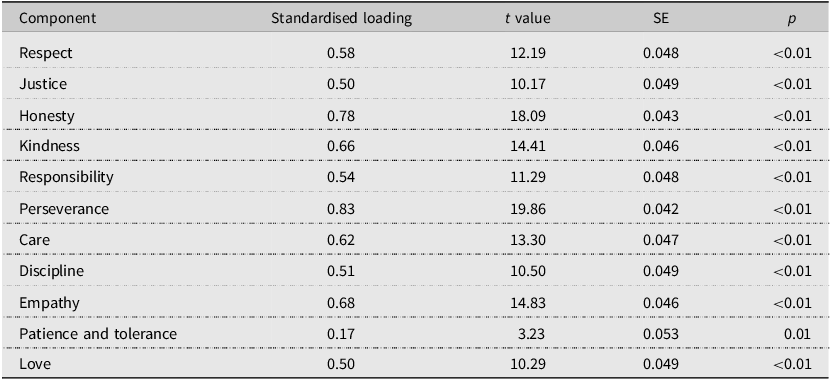
The relative contribution of each component was examined through confirmatory factor analysis of the higher-order model. As shown in Table 4, all 11 components loaded significantly on the overall environmental character education construct, with t values ranging from 3.23 to 19.86.
Factor loadings of the confirmatory factor analysis (CFA) model for the components of the environmental character education model

Table 4. Long description
A table titled ‘Factor loadings of the confirmatory factor analysis (CFA) model for the components of the environmental character education model’ with 11 rows and 5 columns. The columns are labeled ‘Component’, ‘Standardised loading’, ‘t value’, ‘SE’, and ‘p’. The table lists the components of the environmental character education model and their respective standardized loadings, t values, standard errors (SE), and p-values. The components include Respect, Justice, Honesty, Kindness, Responsibility, Perseverance, Care, Discipline, Empathy, Patience and tolerance, and Love. Each row provides the specific values for each component across the different columns. For example, Respect has a standardized loading of 0.58, a t value of 12.19, an SE of 0.048, and a p-value of less than 0.01. Honesty has a standardized loading of 0.78, a t value of 18.09, an SE of 0.043, and a p-value of less than 0.01. Perseverance has the highest standardized loading of 0.83, a t value of 19.86, an SE of 0.042, and a p-value of less than 0.01. Patience and tolerance has the lowest standardized loading of 0.17, a t value of 3.23, an SE of 0.053, and a p-value of 0.01. All components have p-values less than 0.01, indicating significant loadings on the overall environmental character education construct.
Perseverance showed the strongest standardised loading (λ = 0.83, t = 19.86), followed by Honesty (λ = 0.78, t = 18.09). Empathy (λ = 0.68, t = 14.83), Kindness (λ = 0.66, t = 14.41), and Care (λ = 0.62, t = 13.30) also made relatively strong contributions. Respect (λ = 0.58, t = 12.19) and Responsibility (λ = 0.54, t = 11.29) showed moderate contributions. Discipline (λ = 0.51, t = 10.50), Justice (λ = 0.50, t = 10.17), and Love (λ = 0.50, t = 10.29) were lower but still acceptable. Patience and tolerance had the weakest loading (λ = 0.17, t = 3.23), indicating that this component contributed less strongly than the others to the higher-order construct.
Patience and tolerance was retained despite its weak higher-order loading because it emerged from the qualitative phase, was retained through the Delphi process, and remains theoretically relevant to environmental character education. However, its loading (λ = 0.17) indicates that this component is psychometrically weak in the present sample and requires refinement in future validation studies.
Item-level CFA loadings are provided in Supplementary File 3 to allow readers to evaluate the internal coherence of each component of the measurement model.
RQ3. Application model for environmental character education
Based on the validated component structure and the implementation phase, an application model for environmental character education can be proposed. The model consists of three linked elements: (1) the validated 11-component framework as the curricular basis, (2) component-aligned learning activities implemented through a Telegram-based environment, and (3) pretest–posttest assessment using the validated questionnaire.
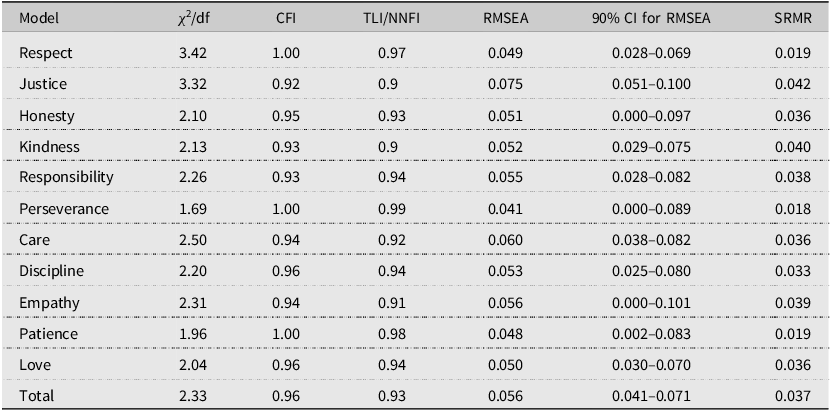
The fit indices reported in Table 5 support the adequacy of the application model. At the overall level, the model demonstrated acceptable fit to the observed data: χ 2/df = 2.33, CFI = 0.96, TLI/NNFI = 0.93, RMSEA = 0.056 with a 90% confidence interval of 0.041–0.071, and SRMR = 0.037. The component-level models also showed generally acceptable to excellent fit. Across the components, χ 2/df values ranged from 1.69 to 3.42, CFI values ranged from 0.92 to 1.00, TLI/NNFI values ranged from 0.90 to 0.99, RMSEA values ranged from 0.041 to 0.075, and SRMR values ranged from 0.018 to 0.042. Perseverance showed the strongest fit among the component models, with χ 2/df = 1.69, CFI = 1.00, TLI/NNFI = 0.99, RMSEA = 0.041, 90% CI = 0.000–0.089, and SRMR = 0.018. Respect also showed strong fit, particularly in terms of CFI = 1.00, TLI/NNFI = 0.97, RMSEA = 0.049, and SRMR = 0.019, although its χ 2/df value was relatively higher than those of the other components. Justice showed the weakest but still acceptable fit among the component models, with χ 2/df = 3.32, CFI = 0.92, TLI/NNFI = 0.90, RMSEA = 0.075, 90% CI = 0.051–0.100, and SRMR = 0.042. Overall, these findings indicate that the proposed application model provides an acceptable and empirically defensible representation of the observed data.
Model fit indices for the measurement model (components) and the overall structural model of environmental character education

Table 5. Long description
A table comparing model fit indices for various components and overall structural model of environmental character education. The table has 12 rows and 6 columns. The columns are labeled Model, χ²/df, CFI, TLI/NNFI, RMSEA, 90% CI for RMSEA, and SRMR. The rows are labeled with different models: Respect, Justice, Honesty, Kindness, Responsibility, Perseverance, Care, Discipline, Empathy, Patience, Love, and Total. Each row contains values for the respective model’s fit indices. Row 1: Respect, 3.42, 1.00, 0.97, 0.049, 0.028-0.069, 0.019. Row 2: Justice, 3.32, 0.92, 0.90, 0.075, 0.051-0.100, 0.042. Row 3: Honesty, 2.10, 0.95, 0.93, 0.051, 0.000-0.097, 0.036. Row 4: Kindness, 2.13, 0.93, 0.90, 0.052, 0.029-0.075, 0.040. Row 5: Responsibility, 2.26, 0.93, 0.94, 0.055, 0.028-0.082, 0.038. Row 6: Perseverance, 1.69, 1.00, 0.99, 0.041, 0.000-0.089, 0.018. Row 7: Care, 2.50, 0.94, 0.92, 0.060, 0.038-0.082, 0.036. Row 8: Discipline, 2.20, 0.96, 0.94, 0.053, 0.025-0.080, 0.033. Row 9: Empathy, 2.31, 0.94, 0.91, 0.056, 0.000-0.101, 0.039. Row 10: Patience, 1.96, 1.00, 0.98, 0.048, 0.002-0.083, 0.019. Row 11: Love, 2.04, 0.96, 0.94, 0.050, 0.030-0.070, 0.036. Row 12: Total, 2.33, 0.96, 0.93, 0.056, 0.041-0.071, 0.037.
χ 2/df = chi-square divided by degrees of freedom; CFI = comparative fit index; TLI/NNFI = Tucker–Lewis index/non-normed fit index; RMSEA = root mean square error of approximation; 90% CI for RMSEA = 90% confidence interval for RMSEA; SRMR = standardised root mean square residual.
The component-level rows in Table 5 refer to separate single-component measurement checks. Because such models may be just-identified or near-identified, they are interpreted descriptively rather than as strong evidence of model fit. The main fit interpretation is based on the total higher-order measurement model.
RQ4. Score responsiveness after Telegram-based learning
To examine whether environmental character scores were responsive to the Telegram-based intervention, pretest and posttest scores were compared after the one-month implementation. As shown in Table 6, mean environmental character scores increased from pretest (M = 3.83, SD = 1.17) to posttest (M = 3.92, SD = 1.19). The paired-samples t test showed that this difference was statistically significant, t = 8.86, p < 0.001. The increase from 3.83 to 3.92 was statistically significant, t (383) = 8.86, p < 0.001. However, the raw mean difference was only 0.09 on a five-point scale. Therefore, this result is interpreted as a small short-term increase in questionnaire scores rather than as strong evidence of substantial practical change or causal character development.
Paired t-test to examine the difference between students’ pretest and posttest environmental character scores

Table 6. Long description
A table comparing pretest and posttest environmental character scores. The table has 2 rows and 8 columns. The columns are labeled Variable, Pretest M, Pretest SD, Posttest M, Posttest SD, Mean difference, 95% CI, t (df), p, and Cohen’s dz. The row labels are Environmental character score. The values are as follows: Row 1: Environmental character score, 3.83, 1.17, 3.92, 1.19, 0.09, 0.07-0.11, 8.86 (383), <0.001, 0.45.
Table 1 reports summed indicator scores, and the possible ranges differ because indicators contain different numbers of items. By contrast, Table 6 reports the overall environmental character score as an item-level mean on the original 1–5 response scale. This explains why the means in Table 6 are around 3.83 and 3.92, while the indicator means in Table 1 are larger summed scores.
Harman’s single-factor test indicated that the first unrotated factor accounted for approximately 20.9% of the total variance, which was well below the conventional 50% threshold. This suggests that common-method bias was unlikely to fully account for the observed factor structure. Nevertheless, because all quantitative data were collected through self-report, common-method bias remains a potential limitation.
Discussion
This study examined environmental character education as a measurable educational outcome for upper-secondary students and found support for a multidimensional model comprising moral–ethical, relational–affective, and self-regulatory components. In this sense, environmental character in the present study was not reducible to information, attitudes, or isolated behavioural intentions. Rather, the findings suggest that environmentally relevant action may be better understood as depending on a structured configuration of dispositions that help learners interpret responsibility, regulate conduct, and sustain engagement over time. This interpretation is consistent with long-standing arguments in environmental education that durable environmental action requires more than awareness alone and depends on capacities that enable learners to translate concern into practice under real-world conditions (Hungerford & Volk, Reference Hungerford and Volk1990; Jensen & Schnack, Reference Jensen and Schnack1997; Stern, Reference Stern2000).
The identification of 11 components and the acceptable fit of the higher-order model also support the claim that environmental character education can be conceptualised as a coherent educational framework rather than as a loose collection of desirable traits. The model brings together virtue-like dispositions such as honesty, justice, and respect; relational dimensions such as empathy, care, and love; and self-regulatory dimensions such as perseverance, discipline, and responsibility. This triadic pattern is theoretically meaningful because major explanations of the value–action gap repeatedly point to the joint importance of internal drivers and contextual conditions. Learners may value environmental responsibility yet fail to act when behaviour is inconvenient, socially costly, weakly reinforced, or difficult to sustain. From that perspective, a framework that combines moral orientation, affective connection, and self-regulation is well positioned to address the practical bottlenecks highlighted in behavioural and environmental education research (Ajzen, Reference Ajzen1991; Kollmuss & Agyeman, Reference Kollmuss and Agyeman2002; Portus et al., Reference Portus, Aarnio-Linnanvuori, Dillon, Fahy, Gopinath, Mansikka-Aho, Williams, Reilly and McEwen2024; Steg & Vlek, Reference Steg and Vlek2009). It also aligns with evidence syntheses showing that EE is most likely to support meaningful outcomes when it includes social learning, authentic opportunities for action, and sustained engagement rather than one-off informational exposure (Ardoin et al., Reference Ardoin, Bowers, Roth and Holthuis2018, Reference Ardoin, Bowers and Gaillard2020; Van de Wetering et al., Reference Van de Wetering, Leijten, Spitzer and Thomaes2022).
A particularly notable result was the relative prominence of perseverance and honesty in the higher-order model. Perseverance showed the strongest loading on the higher-order construct, indicating that it covaried most strongly with the overall environmental character factor in this sample. This should not be interpreted as evidence that perseverance is universally the most central component of environmental character. This finding is theoretically plausible because environmentally responsible conduct often requires repetition, inconvenience, delayed reward, and persistence despite weak social reinforcement. Honesty, which also showed a strong contribution, may reflect the importance of integrity and consistency between values, communication, and behaviour. In social-networked environments this becomes especially relevant, because visible participation can encourage both genuine engagement and impression management. Interpreted cautiously, the prominence of these two components suggests that environmental character in digitally mediated settings may depend not only on caring about ecological issues but also on resisting superficial participation and maintaining consistency between expressed concern and enacted practice.
By contrast, patience and tolerance showed the weakest loading in the model. This does not necessarily mean that the component is unimportant educationally; rather, it suggests that in this instrument and sample it was less strongly aligned with the core latent structure than the other components. Several explanations are possible for the weak loading of patience and tolerance. It may indicate that the items did not adequately operationalise the construct, that this component is less strongly aligned with the higher-order factor in this sample, or that patience and tolerance become more visible under longer-term or conflict-based educational conditions. Therefore, this component should be treated as theoretically relevant but psychometrically weak and in need of refinement.
The findings also have implications for how environmental character is positioned within environmental education more broadly. The present study does not replace action competence or related capability-oriented approaches; rather, it complements them by adding a clearer virtue-ethical account of the dispositions that may support environmentally responsible agency under pressure. In that sense, the results are consistent with work emphasising participation, agency, and action competence in EE (Jensen & Schnack, Reference Jensen and Schnack1997; Torsdottir et al., Reference Torsdottir, Olsson and Sinnes2024), while also resonating with recent efforts to conceptualise environmental character as a civic and educational construct that goes beyond simple attitude measurement (Van Harskamp et al., Reference Van Harskamp, Knippels, Boeve-de Pauw and van Joolingen2023). The present findings further support the relevance of virtue-oriented approaches in education more generally, which argue that stable traits can be cultivated through intentional pedagogical design, modelling, and repeated practice, although implementation and measurement remain challenging (Oldham & McLoughlin, Reference Oldham and McLoughlin2025; Sandler, Reference Sandler and LaFollette2013). The relatively strong contribution of relational dimensions such as empathy, care, and kindness also accords with evidence that empathy with nature is linked to pro-environmental attitudes and may provide an affective pathway through which environmental learning becomes personally meaningful (Li et al., Reference Li, Zhao, Huang, Deng, Deng and Li2024).
A further contribution of the study concerns implementation in messaging-platform-based learning. The pretest–posttest results suggest that environmental character scores showed a small but statistically significant short-term increase to the Telegram-based programme, indicating that a structured Telegram-based learning environment may provide a feasible environment for component-based environmental character education. This interpretation should remain modest: the present design supports evidence of short-term improvement, not strong causal inference. Still, the finding is consistent with emerging literature suggesting that digital and social-media environments can support environmental learning and engagement when they are used through deliberate instructional design rather than passive exposure (Arnot et al., Reference Arnot, Pitt, McCarthy, Cordedda, Marko and Thomas2024; Chung et al., Reference Chung, Huang and Lin2020). The same applies to messaging platforms such as Telegram, which appear educationally useful when they support dialogue, feedback, sustained micro-participation, and organised learning routines rather than unstructured communication alone (Estrada Molina, Reference Estrada Molina2022; Faraji et al., Reference Faraji, Khodaei and Khodadadi2020; Khalil & Rambech, Reference Khalil, Rambech, Zaphiris and Ioannou2022). In this respect, the present study adds to the literature by showing that messaging-platform-based learning may be relevant not only for information sharing or motivation, but also for supporting dispositions associated with environmental character when learning tasks are explicitly aligned with those goals.
The pretest–posttest finding should be interpreted cautiously. Although the change was statistically significant, the raw mean increase was only 0.09 on a five-point scale. This indicates short-term score responsiveness rather than strong practical evidence of character development. The result may reflect the sensitivity of the questionnaire to short-term educational exposure, but it cannot establish substantial behavioural change or causal intervention effectiveness.
At the same time, the study has several limitations that should temper interpretation. First, the quantitative evidence for change is based on a one-group pretest–posttest design; therefore, alternative explanations such as testing effects, short-term sensitisation, or contextual influences cannot be ruled out. Second, the study relied on self-report data, which are vulnerable to social desirability and may be especially sensitive in value-laden constructs such as honesty, care, and responsibility. Third, although the sampling strategy was probabilistic at the cluster level, the findings remain context–bound and should not be generalised beyond similar educational settings without caution. Fourth, the relatively weak loading of patience and tolerance suggests that some components may require further conceptual or psychometric refinement. Taken together, these limitations suggest that future studies should test the model using stronger comparative or longitudinal designs, examine behavioural indicators alongside self-report measures, and investigate whether the structure remains stable across different cultural, age, and platform contexts.
Overall, the discussion supports three main conclusions. First, environmental character can be conceptualised as a coherent and measurable multidimensional outcome within environmental education. Second, the strongest elements of the model in this sample were not simply affective attachment or moral endorsement, but also self-regulatory and integrity-related dimensions, especially perseverance and honesty. Third, structured telegram-based learning environment appears to be a promising – though not yet definitively established – pathway for supporting environmental character development in adolescents. Together, these findings strengthen the case for treating environmental character education as a legitimate area of EE research and practice rather than as a peripheral moral add-on.
Conclusions
This study offers an initial validation of an environmental character education model for upper-secondary students and shows that its components can be organised as a multidimensional framework combining moral–ethical, relational–affective, and self-regulatory dimensions. The findings are promising but should be interpreted cautiously. Patience and tolerance showed a weak higher-order loading and require further refinement. The Telegram-based pretest–posttest evidence indicates a small short-term increase in questionnaire scores, not causal proof of character development. Future studies should test the model using stronger longitudinal or comparative designs, behavioural indicators, and samples from diverse educational and platform contexts.
The study also showed that a structured Telegram-based learning environment can serve as a feasible setting for implementing component-based environmental character education. Although the pretest–posttest results should be interpreted cautiously, they suggest that environmental character scores showed a small but statistically significant short-term increase following the intervention within the study period. Taken together, the findings support environmental character education as a legitimate area of environmental education research and practice and suggest that telegram-based learning environment, when deliberately designed, may offer a practical pathway for fostering environmentally responsible dispositions in adolescents.
Limitations and implications
Several limitations should be considered when interpreting the findings. First, the intervention evidence was based on a one-group pretest–posttest design; therefore, the observed changes should be interpreted as short-term improvement rather than strong causal evidence. Second, all quantitative data were collected through self-report from a single source, which means that common-method bias cannot be ruled out. This issue is particularly important because the questionnaire assessed value-laden constructs such as honesty, responsibility, care, and empathy, where responses may be influenced by social desirability (Kormos & Gifford, Reference Kormos and Gifford2014; Krumpal, Reference Krumpal2013). Third, the same questionnaire was administered at both pretest and posttest, so testing effects may have partly contributed to the observed score changes. Fourth, self-reported dispositions may not fully correspond to observable pro-environmental behaviour. Fifth, although multistage cluster sampling was used, no explicit design-effect adjustment was applied; therefore, the effective sample size and the precision of the estimates should be interpreted cautiously. Finally, the comparatively weak higher-order loading of patience and tolerance suggests that this component requires further conceptual and psychometric refinement.
These limitations point to several implications for future research and practice. Future studies should test the model using comparative, experimental, or longitudinal designs in order to provide stronger evidence about the stability and causal relevance of the proposed framework. Researchers should also include behavioural indicators, teacher or peer ratings, and observational measures alongside self-report questionnaires to examine whether students’ reported environmental character dispositions are reflected in actual pro-environmental behaviour. In addition, future research should examine whether the component structure remains stable across different age groups, cultural settings, school contexts, and digital learning platforms (Putnick & Bornstein, Reference Putnick and Bornstein2016). From a practical perspective, the findings suggest that EE may benefit from moving beyond the transmission of knowledge and attitudes toward the cultivation of character-based dispositions that help learners sustain environmentally responsible action over time.
Supplementary material
The supplementary materials for this article include the complete Environmental Character Education Questionnaire and scoring instructions (Supplementary File 1), a description and component mapping of the Telegram-based learning programme (Supplementary File 2), and item-level CFA loadings and additional measurement-model information (Supplementary File 3). The supplementary material for this article can be found at https://doi.org/10.1017/aee.2026.10204.
Data availability statement
The data supporting this study are available from the corresponding author on reasonable request. The full questionnaire, including component labels, indicators, item numbers, reverse-worded items, and scoring instructions, is provided as Supplementary File 1. Details of the Telegram-based learning materials are provided as Supplementary File 2. Item-level CFA loadings and additional measurement information are provided as Supplementary File 3
Acknowledgements
The authors thank the students who participated and the colleagues who supported data collection and study implementation.
Financial support
This research received no specific grant from any funding agency, commercial, or not-for-profit sectors.
Ethical standards
No formal institutional ethics approval code was issued for the original dissertation-based study; therefore, no approval number is reported. The study was conducted as minimal-risk school-based educational research within a doctoral dissertation completed and defended at Payame Noor University. Participation was voluntary, students could decline or withdraw without penalty, and the questionnaire did not collect names or direct personal identifiers. Data were analysed and reported only in aggregate form.
Artificial intelligence
During the revision process, the authors used ChatGPT 5.5 (OpenAI; accessed via https://chatgpt.com during 2026.02.01 to 2026.07.10) to assist with drafting and revising selected passages, English-language editing, structural refinement, and formatting. All analyses, interpretations, citations, and references were independently reviewed and verified by the authors, who take full responsibility for the final content.
Author Biographies
Mohammad Hassan Seif is an Associate Professor and faculty member in the Department of Educational Sciences at Payame Noor University, Iran. His teaching and research interests include distance education, educational technology, research methodology, curriculum studies, and digitally supported learning. He has extensive experience in teaching, supervising postgraduate research, and conducting studies in educational sciences.
Mohammad Hosein Alborzi Haghighi holds a PhD in English and is currently a doctoral student in Distance Education at Payame Noor University, Iran. His academic interests include distance and online education, educational technology, English-language education, digital learning environments, and research methodology. His work focuses on improving teaching and learning through technology-supported educational approaches.
Masoud Abdollahrash holds a PhD in Distance Education and has 30 years of teaching experience in biology and environmental studies. His academic and professional interests include environmental education, biology education, distance learning, teacher experience, and the application of educational approaches to developing students’ environmental knowledge, responsibility, and character.




 Open access

