HISTORICAL OVERVIEW TO 1986
“Schizophrenia,” a term coined by Bleuler (Reference Bleuler1950), was originally named “dementia praecox” by Kraepelin (Reference Kraepelin1919), to characterize a disorder of young adulthood involving deterioration of cognitive, social, behavioral and personality features. Deficits in attention, memory, associative thinking, reasoning, and language were observed by these pioneering clinicians. Kraepelin and Bleuler hypothesized that brain dysfunction caused this catastrophic early decline, speculating that frontal and/or temporal lobe dysfunctions were associated with cognitive disturbances, but they could not demonstrate a brain disorder with the tools of their era. Despite Plum’s (Reference Plum1972) famous statement that, “Schizophrenia is the graveyard of neuroanatomists” because no single neuropathological lesion was found, Mirsky (Reference Mirsky1969) noted there was ample evidence of brain dysfunction from cognitive, neurological and electroencephalographic examinations, but concluded that an integrated picture of schizophrenia had not been developed. New data continued to emerge over the next decade regarding the limbic system, genetics, and the high frequency and severity of neuropsychological deficits in individuals with chronic schizophrenia. Importantly, the neuropsychological deficits in chronic patients were associated with ventricular enlargement, one of the first structural brain abnormalities identified by computed tomography (CT; Johnstone, Crow, Frith, Husband, & Kreel, Reference Johnstone, Crow, Frith, Husband and Kreel1976).
Seidman (Reference Seidman1983) sought to integrate the literature regarding the biological basis of schizophrenia, in an era when CT and positron emission tomography (PET) began to be applied to people with schizophrenia. He concluded: “Neuroradiological, neurophysiological, and neuropsychological data suggest brain impairment in at least 20–35% of schizophrenic patients. The abnormalities are nonspecific and can result from a variety of causes. Preliminary evidence suggests that there are two or more syndromes that differ in severity and type of brain abnormality, rather than a unitary schizophrenic illness. A complex, variable picture of brain dysfunction, including ventricular enlargement and cerebral atrophy, disturbances of cerebral metabolism, neuropsychologic deficits, and neurologic “soft” signs, is found especially in chronically impaired schizophrenics with “negative” symptoms. Extent and locus of dysfunction in a cortical-subcortical arousal-attention system involving areas of the frontal cortex, limbic system, and brain stem reticular formation are hypothesized to determine the relative prominence of positive and negative symptoms” (Seidman, Reference Seidman1983, pp. 195).
In essence, a paradigm shift had occurred in characterizing chronic schizophrenia as a neurobehavioral disorder particularly involving the frontal lobe (Levin, Reference Levin1984; Weinberger, Berman, & Zec, Reference Weinberger, Berman and Zec1986) and executive deficits (Goldberg, Weinberger, Berman, Pliskin, & Podd, Reference Goldberg, Weinberger, Berman, Pliskin and Podd1987), rather than a “functional psychosis.” At that time, the hypothesis of neurobiological subgroups in schizophrenia was intriguing but not tested. However, recently, a cluster analytic approach designed to identify distinct psychosis biotypes demonstrated that cognitive control (executive) deficits were most strongly associated with a biotype linked to schizophrenia (Clementz et al., Reference Clementz, Sweeney, Hamm, Ivleva, Etheridge, Pearlson and Tamminga2016).
While this brief sketch of the early science of schizophrenia leaves out contributions by many scientists, we believe it summarizes the state of the art as of approximately 30 years ago. At that time, the prevailing view was that schizophrenia is an adult onset disorder with subsequent deterioration after the first episode. However, evidence has accumulated demonstrating that in people who later developed schizophrenia, neurocognitive impairment was present in the childhood premorbid phase (Woodberry, Giuliano, & Seidman, Reference Woodberry, Giuliano and Seidman2008), as well as during an adolescent, prodromal phase (Giuliano et al., Reference Giuliano, Li, Mesholam-Gately, Sorenson, Woodberry and Seidman2012). In essence, substantial neurocognitive impairment was often found before the advent of full-blown psychosis, supporting the idea that schizophrenia is a neurodevelopmental disorder. This was consistent with the identification of a number of cognitive, behavioral, and physiological abnormalities found in various populations at risk for schizophrenia leading to an alternative, developmental, stress-vulnerability model (Zubin & Spring, Reference Zubin and Spring1977).
MAJOR DEVELOPMENTS SINCE 1986
Schizophrenia research has changed dramatically over the past 30 years, as schizophrenia has been increasingly understood as a neurodevelopmental disorder. However, the clinical definitions have remained largely the same, except for the elimination of subtypes (e.g., paranoid, hebephrenic, etc.) from the Diagnostic and Statistical Manual of Mental Disorders (APA, 2013), and increased use of positive, negative, and disorganization symptom factors (Liddle, Reference Liddle1987) and phenomenological experience (Sass & Parnas, Reference Sass and Parnas2003). The centrality of neurocognitive impairments has been recognized (Kahn & Keefe, Reference Kahn and Keefe2013), particularly because neurocognitive deficits are strongly related to social and role functioning (Green, Reference Green1996). As a result, neuropsychological assessment has become a regular clinical assessment of people with schizophrenia at all phases of the illness (Seidman, Cassens, Kremen & Pepple, Reference Seidman, Cassens, Kremen and Pepple1992). Moreover, much research is on young people at risk and on the developmental evolution into the first episode of psychosis (Keshavan, DeLisi, & Seidman, Reference Keshavan, DeLisi and Seidman2011; McGorry, Hickie, Yung, Pantelis, & Jackson, Reference McGorry, Hickie, Yung, Pantelis and Jackson2006; Yung & McGorry, Reference Yung and McGorry1996), in contrast to a prior focus on chronic schizophrenia.
SCHIZOPHRENIA AS A NEURODEVELOPMENTAL DISORDER
Premorbid difficulties had been reported earlier by Bleuler (Reference Bleuler1950) and Sullivan (Reference Sullivan1927) but they had not been considered to be central. However, beginning in the 1950s, Barbara Fish (Reference Fish1977) pioneered the family (“genetic”) high-risk (FHR) design in which offspring of mothers with schizophrenia were studied from birth onward and the children were followed into the peak age of risk for schizophrenia, ages 16–30 (Liu, Keshavan, Tronick, & Seidman, Reference Liu, Keshavan, Tronick and Seidman2015). These studies have yielded a consistent picture in which “approximately 50–70% of the offspring of parents with schizophrenia manifest a range of observable difficulties including socioemotional, cognitive, neuromotor, speech-language problems, and psychopathology, and roughly 10% will develop psychosis.” (pp. 801, Liu et al., Reference Liu, Keshavan, Tronick and Seidman2015). The evidence indicates that cognitive abnormalities often precede the onset of psychosis by many years (Agnew-Blais & Seidman, Reference Agnew-Blais and Seidman2013), and premorbid cognitive deficits are more closely linked to schizophrenia than to affective psychosis (Agnew-Blais et al., Reference Agnew-Blais, Seidman, Fitzmaurice, Smoller, Goldstein and Buka2017).
It was not until two key review papers were published in 1987 that the view of schizophrenia as a neurodevelopmental disorder became well accepted (Murray & Lewis, Reference Murray and Lewis1987; Weinberger, Reference Weinberger1987). Why did these papers have a paradigm shifting effect on the whole field including neuropsychological studies (Seidman, Reference Seidman1990), and ultimately clinical models of development and intervention? At least in part, it is because they independently and systematically linked the growing evidence of neurological abnormalities and frank brain alterations with early obstetrical events.
However, it is of interest that Weinberger’s model, which was focused on explaining the onset of psychosis in adolescence and young adulthood, after early obstetrical lesions, particularly to the hippocampus, tended to minimize the pre-psychotic phenotypes such as cognitive abnormalities. Rather, it mainly emphasized the relative absence of behavioral abnormalities and sought to explain the later adolescence emergence of psychosis. In support of this “two-hit” neurodevelopmental model, is evidence of pre-perinatal events that set the stage for later abnormal neural processes during adolescence or young adulthood when psychotic symptoms typically emerge (Brown, Reference Brown2011; Cannon et al., Reference Cannon, van Erp, Bearden, Loewy, Thompson, Toga and Tsuang2003; Feinberg, Reference Feinberg1982). There is growing evidence that altered cortical pruning during adolescence is a second “hit” to the brain that may be responsible, at least in part, for the emergence of schizophrenia (Cannon et al., Reference Cannon, Chung, He, Sun, Jacobson, van Erp and Heinssen2015; Keshavan, Anderson, & Pettegrew, Reference Keshavan, Anderson and Pettegrew1994; Sekar et al., Reference Sekar, Bialas, de Rivera, Davis, Hammond, Kamitaki and McCarroll2016). While neurocognitive data from cross-sectional studies are consistent with this model (i.e., worse neurocognitive function in the prodrome than in the premorbid period in those who convert to psychosis), to our knowledge, there are no studies that link neurocognition and brain changes across those epochs.
Many early developmental abnormalities have been identified that influence the chance of developing schizophrenia including: abnormal laminar cortical organization; genetic alterations in protein expression that regulate the migration, proliferation, and death of cells; common and rare genetic variants; copy number variants (CNVs), including both microdeletions and duplications, obstetric complications, and increased rates of prenatal viral or bacterial infections (Brown, Reference Brown2011; Rapoport, Giedd, & Gogtay, Reference Rapoport, Giedd and Gogtay2012).
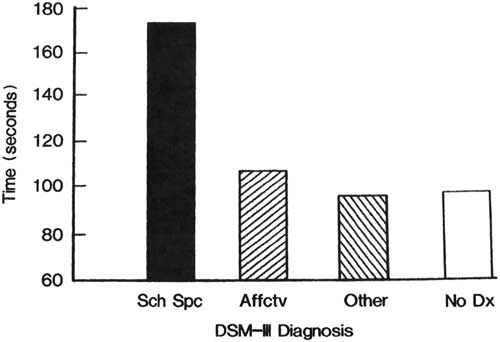
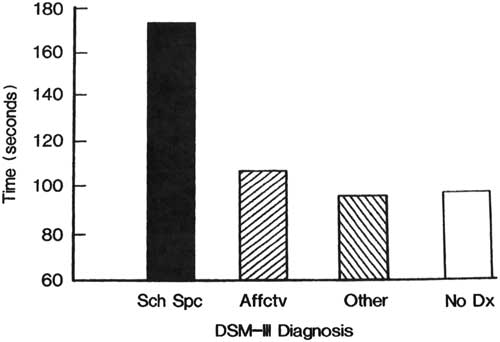
In contrast to the idea of a dormant or latent period without much behavioral deviance, abnormal cognition has emerged as a key developmental factor, particularly measures of attention, among the many studies identifying childhood predictors of schizophrenia. For example, in the NIMH-Israeli High-Risk study, poor performance at age 11 on a number cancellation task, under conditions of distraction, was predictive of the development of schizophrenia spectrum disorders at age 25 (Mirsky, Reference Mirsky1988, Figure 1).
Scores on an attention test (time to complete number cancellation task under conditions of distraction) at age 11 predict psychiatric diagnoses at age 25. Sch Spc=schizophrenia spectrum disorder; Affctv=affective disorder; Other=other psychiatric disorder; No Dx=no psychiatric diagnosis. Figure 1, p. 290 in Mirsky, A. F. (Reference Mirsky1988). The Israeli high-risk study. In D. L. Dunner, J. E. Barrett, & E. S. Gershon (Eds.), Relatives at risk for mental disorders (pp. 279–297). New York, NY: Raven Press.
In the New York High Risk Study, Cornblatt adapted the Continuous Performance Test (CPT; Rosvold, Mirsky, Sarason, Bransome, & Beck, Reference Rosvold, Mirsky, Sarason, Bransome and Beck1956), into the CPT-Identical Pairs (CPT-IP, Cornblatt et al. (Reference Cornblatt, Risch, Faris, Friedman and Erlenmeyer-Kimling1988), finding that childhood performance on the CPT-IP combined with other attention and short-term memory tests predicted development of adult schizophrenia (Cornblatt & Keilp, Reference Cornblatt and Keilp1994). The fact that so many studies find impaired attention in schizophrenia in the high risk period and in the illness per se (Seidman, Reference Seidman1983; Nuechterlein & Dawson, Reference Nuechterlein and Dawson1984) suggests that the pathophysiology underlying the disorder is linked to basic cerebral mechanisms underlying attention, arousal, and alertness (e.g., Kornetsky & Mirsky, Reference Kornetsky and Mirsky1966) and are part of the premorbid, neurointegrative deficit (Fish, Reference Fish1977).
NEUROIMAGING
Developments in assessing information processing using event-related potentials (ERPs), and structure and function with CT and magnetic resonance imaging (MRI: structural, functional MRI [fMRI], resting state, etc.) have had a profound effect on validating brain dysfunction and have been associated with neurocognitive dysfunction in schizophrenia.
ERPs
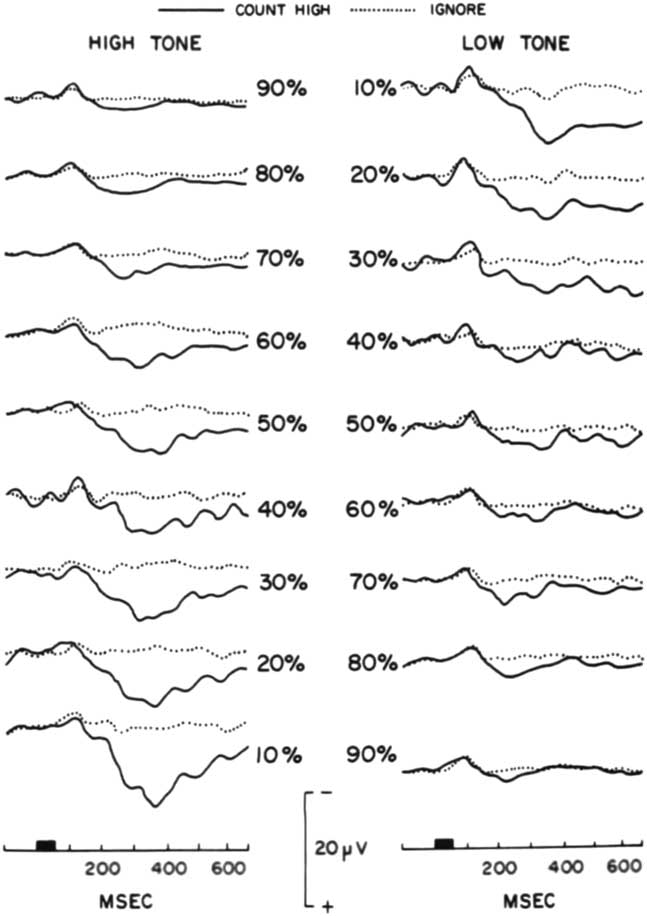
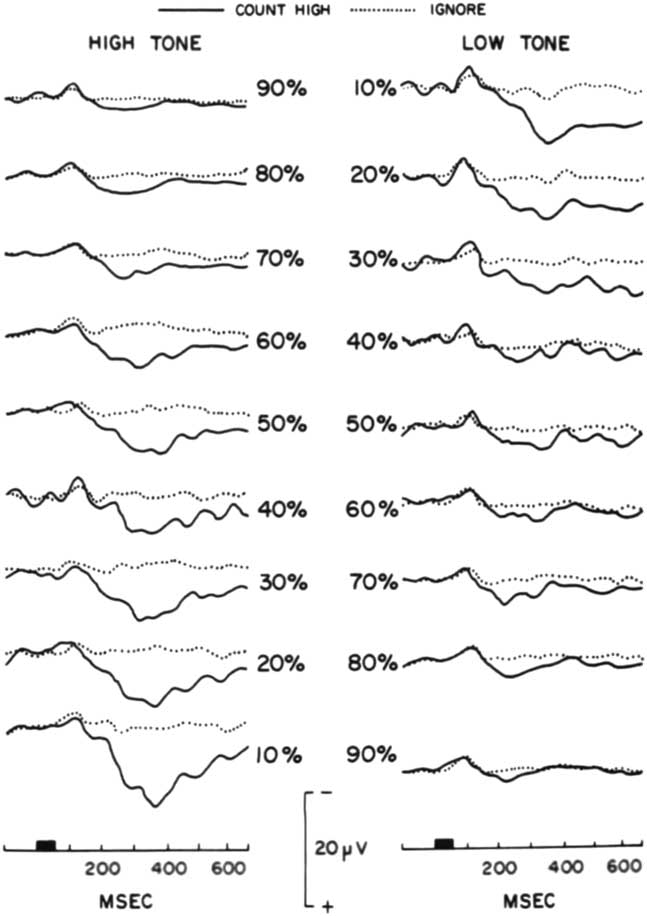
Sutton and colleagues opened a new approach to the study of attention and information processing through the electroencephalogram (Sutton, Braren, Zubin, & John, Reference Sutton, Braren, Zubin and John1965). They stated that “the fluctuations of the late positive component (i.e., P300) of the evoked potential are a reflection of the information content of the stimulus” (Sutton et al., Reference Sutton, Braren, Zubin and John1965). Subsequent research has confirmed that the P300 component is a sensitive index of the allocation of attention and reflects processes involved in the evaluation of a stimulus. An example of P300 variation as a function of task relevance and probability is shown in Figure 2 (Duncan-Johnson & Donchin, Reference Duncan-Johnson and Donchin1977).
ERPs elicited by high (1500 Hz) and low (1000 Hz) tones at nine levels of stimulus probability in an oddball task. The data collected in task-relevant (Count high) and distraction (Ignore, a word puzzle) tasks are superimposed at each level of probability. The amplitude of P300 to high and low tones depends on the probability of the stimuli. When the tones were not task-relevant (Ignore), P300 was not elicited by stimuli at any probability. Figure 1a, p. 458 in Duncan-Johnson, C. C. & Donchin. E. (1977). On quantifying surprise: The variation of ERPs with subjective probability. Psychophysiology, 14(5), 456–467.
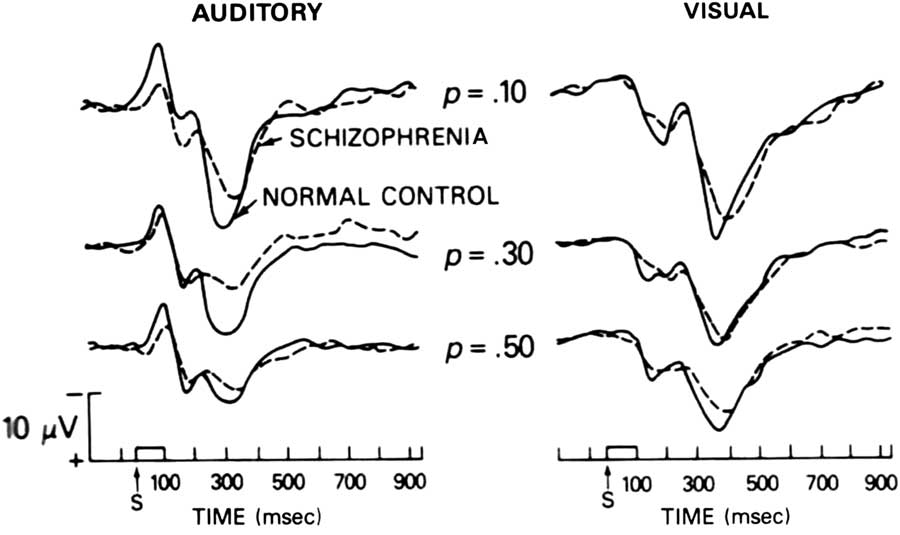
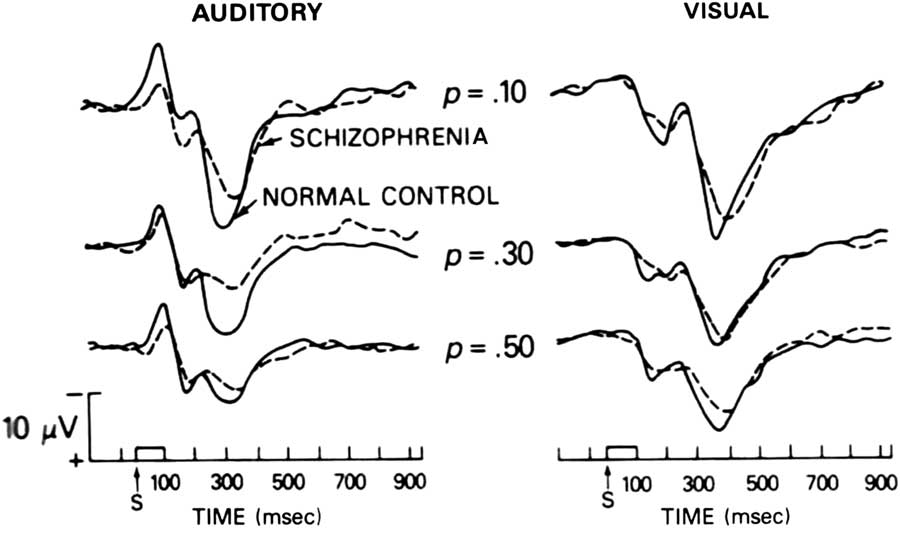
Numerous studies have shown that individuals with schizophrenia have a marked reduction in P300 amplitude. This is seen in the work of Duncan, Pearlstein, & Morihisa (Reference Duncan, Perlstein and Morihisa1987) that also indicated that visual P300 was more likely to normalize following neuroleptic medication than auditory P300. They depicted modality differences in a group of patients on and off medication and suggested that visual P300 could be a state marker for the disorder, whereas auditory P300 could be a trait marker. Figure 3 shows an example from Duncan et al. (Reference Duncan, Perlstein and Morihisa1987) of P300 in response to visual and auditory stimuli in a patient with schizophrenia.
ERPs averaged over subjects, elicited by visual and auditory stimuli in a reaction time task. Healthy controls are represented by solid lines, patients with schizophrenia by dashed lines. Note that the P300 component is smaller and later for patients than controls; the maximal difference is for low probability auditory stimuli. Figure 1, p. 672 in Duncan et al. (Reference Duncan, Perlstein and Morihisa1987). In R. Johnson, Jr., et al. (Eds.), Current trends in event-related potential research (EEG Suppl. 40). Amsterdam: Elsevier Science Publishers, B.V.
Auditory gamma oscillations have also emerged as a key part of the pathophysiology of schizophrenia and are thought to be crucial essential for cognition (Uhlhaas & Singer, Reference Uhlhaas and Singer2013). Auditory evoked gamma-band activity is reduced in patients and in first-degree relatives (Leicht et al., Reference Leicht, Karch, Karamatskos, Giegling, Moller, Hegerl and Mulert2011), as well as in unaffected, monozygotic twins (Hall et al., Reference Hall, Taylor, Sham, Schulze, Rijsdijk, Picchioni and Salisbury2011). Similar patterns are observed in the auditory P50 measure of sensory-motor gating (Freedman et al., Reference Freedman, Adler, Gerhardt, Waldo, Baker, Rose and Franks1987) and in auditory mismatch negativity. Some data support a model in which early auditory processing deficits lead to poor functional outcome via impaired cognition and greater negative symptoms (Thomas et al., Reference Thomas, Green, Hellemann, Sugar, Tarasenko, Calkins and Light2017).
CT and MRI
Early in the 20th century, pneumoencephalographic (PEG) data suggested that brain changes, particularly enlarged ventricles and cortical atrophy were structural abnormalities associated with the “dementia” syndrome (e.g., cognitive impairment) in chronic schizophrenia (Seidman, Reference Seidman1983). The CT findings that individuals with chronic schizophrenia had enlarged ventricles (Johnstone et al., Reference Johnstone, Crow, Frith, Husband and Kreel1976) validated the older PEG findings as did subsequent applications to first episode patients. Subsequently, many MRI studies demonstrated widespread abnormalities in cortex and subcortical regions (e.g., hippocampus, amygdala, thalamus, striatum) in patients (Shenton, Dickey, Frumin, & McCarley, Reference Shenton, Dickey, Frumin and McCarley2001), first-degree relatives, and youth at familial risk for schizophrenia (Thermenos et al., Reference Thermenos, Keshavan, Juelich, Molokotos, Whitfield-Gabrieli, Brent and Seidman2013).
Studies of youth at clinical high risk (CHR) for psychosis suggest that neurocognitive abnormalities are worse amongst those who go on to develop psychosis compared with those who do not (Seidman, Shapiro, et al., 2016). In a multisite study, CHR participants who converted to psychosis showed a steeper rate of gray matter loss in the right superior frontal, middle frontal, and medial orbitofrontal cortical regions as well as a greater rate of expansion of the third ventricle compared with CHR subjects who did not convert to psychosis and healthy control subjects (Cannon et al., Reference Cannon, Chung, He, Sun, Jacobson, van Erp and Heinssen2015). Thus, the period leading up to psychosis is comprised of dynamic changes in cortical thickness rather than a static encephalography as previously thought. Future research on the relationship of neurocognition or possible neurocognitive change and brain changes during this period is needed.
fMRI has been extensively applied to individuals with schizophrenia and those at risk in many task evoked (e.g., working memory, declarative memory) and resting state fMRI paradigms. For example, working memory tasks, typically activating prefrontal (PFC) and parietal cortical activity, especially the dorsolateral PFC, elicit altered PFC activity in patients (Glahn et al., Reference Glahn, Ragland, Abramoff, Barrett, Laird, Bearden and Velligan2005) and first-degree relatives (MacDonald, Thermenos, Barch, & Seidman, 2009; Zhang, Picchioni, Allen, & Toulpoulou, Reference Zhang, Picchioni, Allen and Toulopoulou2016) even where there are no in-scanner performance differences.
In contrast, due to impaired performance on tasks outside the scanner, working memory has received considerable support as an endophenotypic marker of risk for schizophrenia (Park & Gooding, Reference Park and Gooding2014). Demonstrating that nonpsychotic, unmedicated, first-degree relatives share the dysfunctional phenotype with their ill relatives emphasizes two things: (1) The brain or cognitive difference cannot be attributed to medications, because the relatives are rarely medicated; and (2) The trait abnormality is likely, at least in part, to be genetically transmitted. In resting state fMRI, where participants are “just thinking” and not performing a task, a literature is emerging suggesting that patients and first-degree relatives show alterations in default mode network (DMN) activity and functional connectivity (Whitfield-Gabrieli et al., Reference Whitfield-Gabrieli, Thermenos, Milanovic, Tsuang, Faraone, McCarley and Seidman2009). DMN activity in the parahippocampal gyrus has been shown to be linked to working memory performance in these relatives (Seidman et al., Reference Seidman, Rosso, Thermenos, Makris, Juelich, Gabrieli and Whitfield-Gabrieli2014).
GENETICS AND ENDOPHENOTYPES
Schizophrenia has long been known to run in families. However, familiarity does not prove genetic etiology, because families also transmit environmental factors. In the 1960s, a convincing study was done separating genetic and environmental factors in the transmission of schizophrenia (Kety, Rosenthal, Wender, & Schulsinger, Reference Kety, Rosenthal, Wender and Schulsinger1971). They found a significantly higher prevalence than expected of schizophrenia-related illness in the biological relatives of individuals with schizophrenia who were adopted early in life. However, the rearing-family environment was shown to interact with genetic risk in a study by Tienari et al. (Reference Tienari, Wynne, Sorri, Lahti, Läksy, Moring and Wahlberg2004). The key finding was that, in the adopted children of mothers with schizophrenia, but not those at lower genetic risk, adoptive-family behavior was a significant predictor of schizophrenia at follow-up. This suggested that high genetic risk is more sensitive to adverse environments than low genetic risk.
Perhaps the most studied individuals with schizophrenia are the Genain Quadruplets, four genetically identical sisters, all of whom developed schizophrenia by their early 20s (Rosenthal, Reference Rosenthal1963). They are a remarkable demonstration that schizophrenia is highly heritable; the typical estimates of the genetic contribution to etiology are approximately 60–80%. Despite their genetic identity, the severity of their illness and degree of neuropsychological impairment varied widely. Attempts to relate this variability to several measures of brain structure or function found no strong relationships (Buchsbaum et al., Reference Buchsbaum, Mirsky, DeLisi, Morihisa, Karson, Mendelson and Kessler1984). However, the history of the sisters pointed to other factors that could account for the variability including parental treatment and birth order (Mirsky & Quinn, Reference Mirsky and Quinn1988).
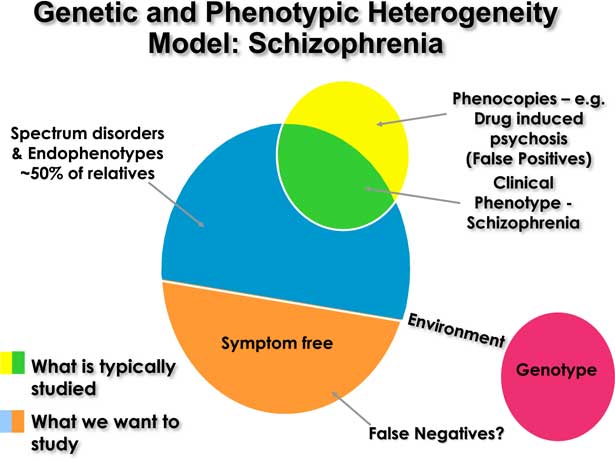
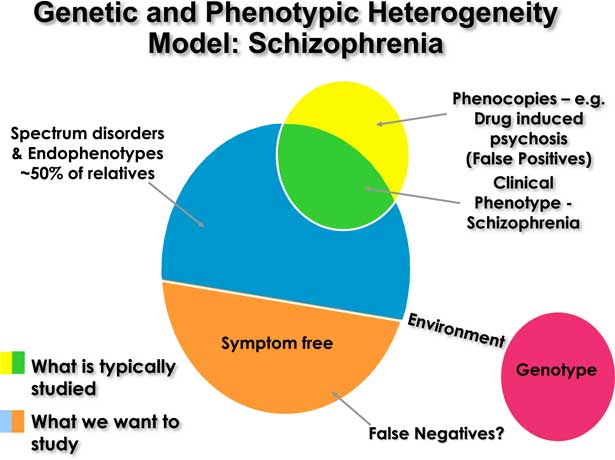
These data strongly emphasize the idea of studying non-ill, first-degree relatives of individuals with the illness, as “carriers” of traits (such as cognition) that may be expressed more severely in patients with the full-blown illness. This approach refers to “endophenotypes,” a term introduced by Gottesman and Shields (Reference Gottesman and Shields1972). Endophenotypes are quantitative measures and often laboratory based, and may not be observed directly within a standard clinical framework, such as ERPs (e.g., gamma oscillations), or neurocognitive characteristics (e.g., working memory) (Tsuang, Faraone, & Lyons, Reference Tsuang, Faraone and Lyons1993) (Figure 4). Braff, Freedman, Schork, and Gottesman (Reference Braff, Freedman, Schork and Gottesman2007) note the enormous growth of studies of endophenotypes in schizophrenia over the past 2 decades and discuss the criteria typically used to define endophenotypes. The effect sizes in unaffected relatives of patients with schizophrenia tend to be small to moderate, but robustly replicated, such as attention, verbal memory, and P300 measures (Gur et al., Reference Gur, Calkins, Gur, Horan, Neuchterlein, Seidman and Stone2007; Mirsky Yardley, Jones, Walsh, & Kendler, Reference Mirsky, Yardley, Jones, Walsh and Kendler1995; Turetsky et al., Reference Turetsky, Calkins, Light, Olincy, Radant and Swerdlow2007).
Model of genetic and phenotypic heterogeneity. An approach to identifying endophenotypes. This figure depicts the strategy of assessing individuals without the illness (i.e., non-psychotic relatives), some of whom are symptom-free and others who carry some of the abnormal traits found in the patients with the illness. This represents the idea that approximately 50% of first-degree relatives manifest some abnormalities found in the patients and these are presumably genetic in origin. It also depicts the distinction between “true” idiopathic schizophrenia and disorders that present like schizophrenia but may have a different origin (“drug-induced psychoses”). Adapted with permission from Tsuang, Gilbertson, & Faraone, 1991.
Large multi-site consortia such as the Consortium on the Genetics of Schizophrenia (COGS; Braff et al., Reference Braff, Freedman, Schork and Gottesman2007) have robustly identified endophenotypes. For example, in COGS, Seidman et al. (Reference Seidman, Hellemann, Nuechterlein, Greenwood, Braff, Cadenhead and Green2015) studied the extent to which common neurocognitive and neurophysiological measures reflect shared versus unique endophenotypic factors. Factor analyses yielded five distinct factors from 15 tests: (1) Episodic Memory, (2) Working Memory, (3) Perceptual Vigilance, (4) Visual Abstraction, and (5) Inhibitory Processing. Neurophysiological measures had relatively low associations with the factors. Significant heritability estimates for the factors ranged from 22% (Episodic Memory) to 39% (Visual Abstraction). Neurocognitive measures have much shared variance whereas neurophysiological measures are largely independent dimensions.
Finally, genetic discoveries have accelerated in schizophrenia. These include an elevated frequency of CNVs and presence of rare mutations (Sullivan, Daly, & O’Donovan, Reference Sullivan, Daly and O’Donovan2012) compared to controls. Additionally, polygenic risk profile scores constructed from alleles showing modest association with schizophrenia in a discovery genome-wide association study can predict case-control status in independent samples and greater polygenic loading for schizophrenia is found in cases with a family history of illness (Bigdeli et al., Reference Bigdeli, Ripke, Bacanu, Lee, Wray and Gejman2016).
In the largest molecular genetic study of schizophrenia, 108 schizophrenia-associated loci met genome-wide significance. Many of the associations were genes expressed in brain, including dopamine genes long thought to be central to schizophrenia (i.e., DRD2) and genes involved in glutamatergic neurotransmission. Unexpectedly, genes that have important roles in immunity had enriched associations, providing support for the hypothesized association between the immune system and schizophrenia (Schizophrenia Working Group of the Psychiatric Genomics Consortium, 2014). An important goal is to determine how much variance of neuropsychological deficit in schizophrenia such as general intellectual functioning, attention or memory is related to genetic factors (Toulopoulou et al., Reference Toulopoulou, Goldberg, Mesa, Picchioni, Rijsdijk, Stahl and Murray2010).
SCHIZOPHRENIA AS A DISORDER OF PHASES
Recently, a clinical approach has developed suggesting that psychiatric disorders, like medical illnesses, can be developmentally “staged” (McGorry et al. Reference McGorry, Hickie, Yung, Pantelis and Jackson2006). This has focused attention on characterizing the prodromal phase of schizophrenia with the goal of earlier detection and intervention (McGlashan & Johannessen, Reference McGlashan and Johannessen1996; Yung & McGorry, Reference Yung and McGorry1996). This idea is similar to the concept of “mild cognitive impairment” used to characterize the period before onset of Alzheimer’s Disease. The “prodromal” or CHR phase reflects a period when deterioration in an individual’s functioning becomes more pronounced suggesting that psychosis may be emerging (cf, Cannon et al., Reference Cannon, Cadenhead, Cornblatt, Woods, Addington, Walker and Heinssen2008; Woodberry, Shapiro, Bryant, & Seidman, Reference Woodberry, Shapiro, Bryant and Seidman2016). Rates of conversion to psychosis tend to be roughly 20–35% over 2–3 years after initial identification; and neurocognitive impairment, especially in attention, working memory, and declarative memory is consistently associated with later conversion to psychosis (Seidman et al., Reference Seidman, Pousada-Casal, Scala, Meyer, Stone, Thermenos and Faraone2016).
The field has been spurred by prospective assessments, using standardized clinical interviews (Yung & McGorry, Reference Yung and McGorry1996; McGlashan, Walsh, & Woods, Reference McGlashan, Walsh and Woods2010). As a result, it is now possible to prospectively diagnose a CHR state. The idea that early intervention could actually prevent psychosis has galvanized the field. That is, despite being of largely neurobiological origin, due to brain plasticity and an absence of clearly degenerative elements, schizophrenia could be prevented. What is the evidence so far?
A qualitative review (Woodberry et al., Reference Woodberry, Shapiro, Bryant and Seidman2016) and meta-analyses suggest that the transition to psychosis can be reduced significantly in the short term (Schmidt et al., Reference Schmidt, Schultze-Lutter, Schimmelmann, Maric, Salokangas, Riecher-Rossler and Ruhrmann2015) using cognitive behavioral treatment for anxiety, depression, and psychotic thinking. Risk reduction with psychosocial treatment is as good or better than pharmacological treatment (e.g., 57% vs. 55% at 1 year, 48% vs. 34% at 2 years) (Woodberry et al., Reference Woodberry, Shapiro, Bryant and Seidman2016). The type of intervention is important because concerns about side effects, especially with antipsychotic medications, may limit their use in youth or young adults. Because neurocognition is frequently impaired in CHR youth, cognitive remediation approaches are beginning to be tested (Hooker et al., Reference Hooker, Carol, Eisenstein, Yin, Lincoln, Tully and Seidman2014). Longer follow-up studies are also needed.
SUMMARY OF NEUROPSYCHOLOGICAL FUNCTIONING
Neurocognitive impairment in schizophrenia, particularly attention, has been robustly demonstrated since the original experimental research on schizophrenia. Shakow first described the inability of patients with chronic schizophrenia to maintain a “set” to respond: “The schizophrenic patient seems unable to keep the ‘set’ (readiness to respond) for even a few seconds—this even at his own low level of performance” (Shakow, Reference Shakow1946, p. 61). Zubin proposed that patients with schizophrenia had difficulty in shifting their focus in an adaptive, flexible manner (Zubin, Reference Zubin1975).
Measures of vigilance and sustained attention have been considered key elements (Cornblatt, & Keilp, Reference Cornblatt and Keilp1994; Mirsky, Anthony, Duncan, Ahern, & Kellam, Reference Mirsky, Anthony, Duncan, Ahearn and Kellam1991; Nuechterlein & Dawson, Reference Nuechterlein and Dawson1984; Seidman, Reference Seidman1983) and are represented in neurocognitive batteries that are used to standardize treatment research in schizophrenia: MATRICS (Measurement And Treatment Research to Improve Cognition in Schizophrenia) (Nuechterlein et al., Reference Nuechterlein, Green, Kern, Baade, Barch, Cohen and Marder2008).
Vigilance tasks require subjects to develop a state of readiness and to sustain their attention to subtle sensory signals, to minimize distractibility to irrelevant stimuli, and to maintain alertness over time. Vigilance tasks can vary according to a large number of parameters. For example, CPTs have been made more demanding by degrading the sensory clarity of the stimulus or by increasing working memory load and typically use visual stimuli. Some CPT versions incorporate distraction (e.g., Wohlberg and Kornetsky, Reference Wohlberg and Kornetsky1973, Mirsky et al., Reference Mirsky, Yardley, Jones, Walsh and Kendler1995). Mirsky et al. (Reference Mirsky, Yardley, Jones, Walsh and Kendler1995) and Seidman et al. (Reference Seidman, Meyer, Giuliano, Breiter, Goldstein, Kremen and Faraone2012) and Seidman, Pousada-Casal, et al. (Reference Seidman, Pousada-Casal, Scala, Meyer, Stone, Thermenos and Faraone2016) developed auditory CPTs to complement visual tasks in schizophrenia.
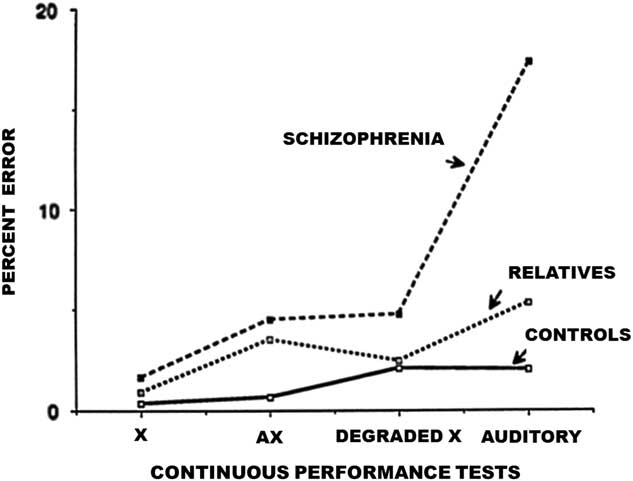
In Mirsky’s task, the auditory version of the CPT required differentiation among three tones differing in frequency and was particularly difficult for the patients as well as their relatives (Figure 5). Mirsky and Duncan (Reference Mirsky and Duncan2004) suggested that this vulnerability may have implications for the auditory-related symptoms of schizophrenia.
Percent error scores on four tasks of the CPT: X, AX, Degraded X, and Auditory (three tones). Whereas patients with schizophrenia made more errors on all versions of the CPT than the relatives or controls, their performance is much worse on the auditory task. Based on Fig. 2, p. 34 in Mirsky, A. F., Yardley, S. J., Jones, B. P. et al. (1995). Analysis of the attention deficit in schizophrenia--A study of patients and their relatives in Ireland. Journal of Psychiatric Research, 29, 23–42.

In Seidman’s CPT battery, tasks differ in degree of auditory vigilance, working memory load and interference. In young, unmedicated, first-degree relatives at FHR for schizophrenia (FHR-SZ) or for affective psychosis, the most robust deficit compared to controls was in working memory in FHR-SZ (Seidman et al., Reference Seidman, Pousada-Casal, Scala, Meyer, Stone, Thermenos and Faraone2016). The auditory CPT measures were among the most sensitive tasks discriminating CHR participants from controls, and in separating CHR converters (i.e., worse CPT performance) from CHR-nonconverters (Seidman, Shapiro, et al., Reference Seidman, Shapiro, Stone, Woodberry, Ronzio, Cornblatt and Woods2016).
Beyond the attention deficit, a broad range of neurocognitive impairments was shown by meta-analysis in patients in chronic (Heinrichs & Zakzanis, Reference Heinrichs and Zakzanis1998) and first-episode (Mesholam-Gately, Giuliano, Goff, Faraone, & Seidman, Reference Mesholam-Gately, Giuliano, Goff, Faraone and Seidman2009) schizophrenia, including attention, memory, language, motor, and executive dysfunctions. We briefly summarize studies related to the lifespan evolution of neurocognitive function.
When Does Neurocognitive Impairment begin?
Many studies (Woodberry et al., Reference Woodberry, Giuliano and Seidman2008) have shown cognitive impairments in children as young as 3 years of age who later develop schizophrenia (Cannon et al., Reference Cannon, Caspi, Moffitt, Harrington, Taylor, Murray and Poulton2002; Seidman et al., Reference Seidman, Cherkerzian, Goldstein, Agnew-Blais, Tsuang and Buka2013). The childhood impairments appear to be relatively stable in crystallized verbal intelligence, but fluid intelligence increasingly lags from ages 7 to 13 (Reichenberg et al., Reference Reichenberg, Caspi, Harrington, Houts, Keefe, Murray and Moffitt2010). Verbal abilities begin to lag behind that of healthy comparisons during the teen years (Fuller et al., Reference Fuller, Nopoulos, Arndt, O’Leary, Ho and Andreasen2002; MacCabe et al., Reference MacCabe, Wicks, Lofving, David, Berndtsson, Gustafsson and Dalman2013). CHR youth demonstrate deficits (roughly 1/2 standard deviation/SD), and the impairment is significantly greatest in CHR youth who go on to develop psychosis (roughly 3/4 SD) (Giuliano et al., Reference Giuliano, Li, Mesholam-Gately, Sorenson, Woodberry and Seidman2012), especially in attention, working memory, and declarative memory (Seidman, Shapiro, et al., Reference Seidman, Shapiro, Stone, Woodberry, Ronzio, Cornblatt and Woods2016). These impairments are milder then the typical 1.0 SD decrements seen in chronic schizophrenia, suggesting that there is subsequent deterioration. However, longitudinal research from the prodrome onward is needed to test this hypothesis.
Are All Persons with Schizophrenia Neurocognitively Impaired?
There is a broad consensus that a large majority (75–100%) of individuals with schizophrenia are cognitively impaired (Kremen, Seidman, Faraone, Toomey, & Tsuang, Reference Kremen, Seidman, Faraone, Toomey and Tsuang2000; Palmer et al., Reference Palmer, Heaton, Paulsen, Kuck, Braff, Harris and Jeste1997) at any one time. In children who later develop schizophrenia, approximately 45% are impaired at age 7 (Seidman et al., Reference Seidman, Cherkerzian, Goldstein, Agnew-Blais, Tsuang and Buka2013).
Is There Heterogeneity of Neurocognitive Profiles?
Neurocognitive syndromes in schizophrenia can vary from essentially normal to dementia-like pictures (Seidman et al., Reference Seidman, Cassens, Kremen and Pepple1992) and heterogeneity is present in the early psychosis period (Seidman, Reference Seidman1990). There are variable profiles (Kremen, Seidman, Faraone, Toomey, & Tsuang, Reference Kremen, Seidman, Faraone, Toomey and Tsuang2004; Weickert et al., Reference Weickert, Goldberg, Gold, Bigelow, Egan and Weinberger2000) that can be identified at the individual patient level, including those with widespread impairments and those with relatively specific deficits in executive of memory functions.
Is There Deterioration in Neurocognition Based on Longitudinal Studies?
There is significant decline from the premorbid period into early mid-life (ages 30–50) after psychosis begins (Kremen et al., Reference Kremen, Vinogradov, Poole, Schaefer, Deicken, Factor-Litvak and Brown2010; Meier et al., Reference Meier, Caspi, Reichenberg, Keefe, Fisher, Harrington and Moffitt2014; Seidman, Buka, Goldstein, & Tsuang, Reference Seidman, Buka, Goldstein and Tsuang2006). Some studies from the CHR to first episode demonstrate cognitive decline (Caspi et al., Reference Caspi, Reichenberg, Weiser, Rabinowitz, Kaplan, Knobler and Davidson2003), while others do not (Bora & Murray, Reference Bora and Murray2014). Studies beginning in the first episode of schizophrenia with 10-year follow-ups show a stable composite score (Rund et al., Reference Rund, Barder, Evensen, Haahr, Hegelstad, Joa and Friis2016), while subtle impairment is related to number of relapses early in the course of illness (Barder et al., Reference Barder, Sundet, Rund, Evensen, Haahr, Ten Velden and Friis2013a), as well as to the total duration of time in psychosis after the first episode (Barder et al., Reference Barder, Sundet, Rund, Evensen, Haahr, Ten Velden and Friis2013b). More research is needed to identify change over a longer time frame.
SUMMARY AND FUTURE DIRECTIONS
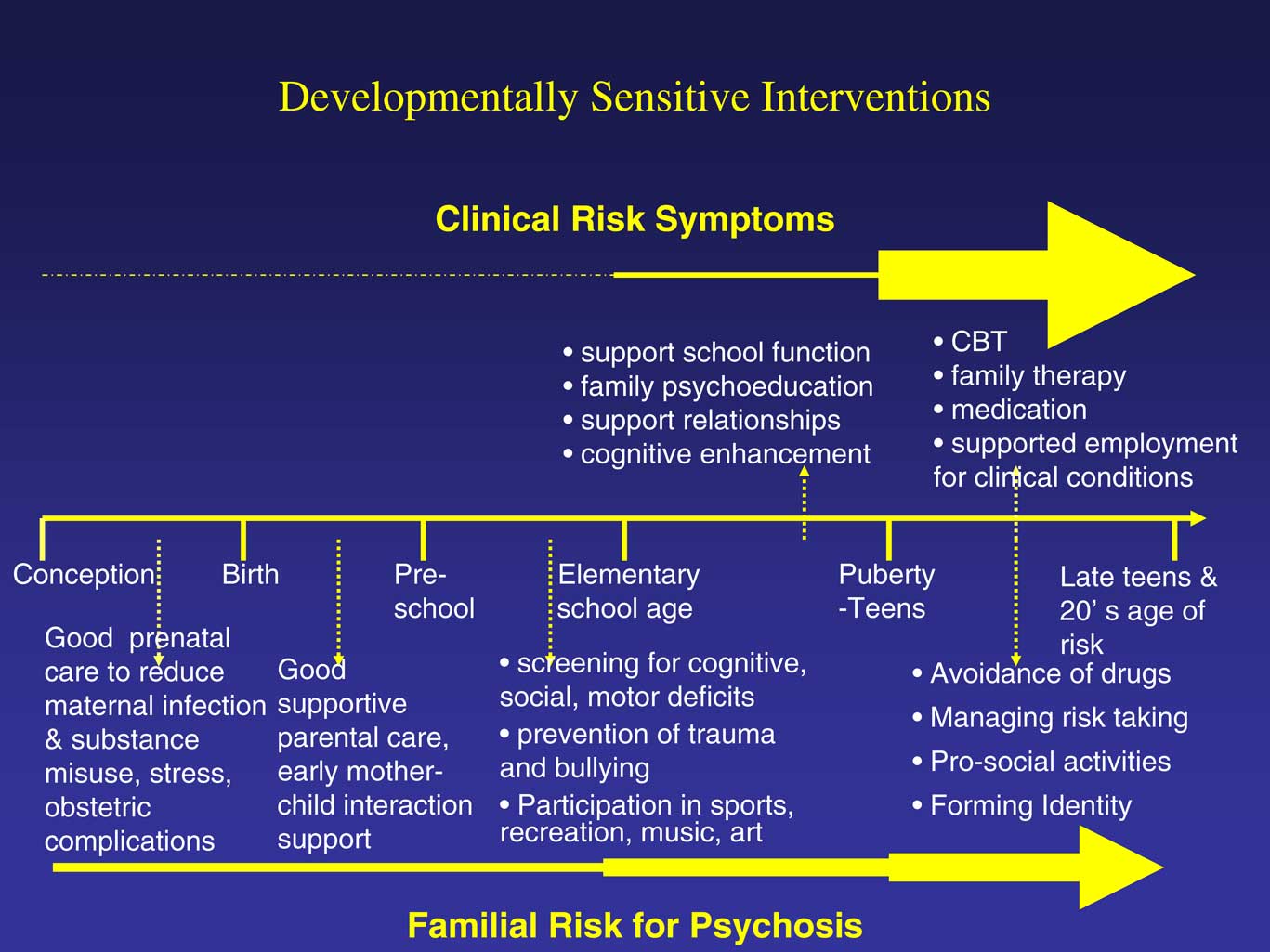
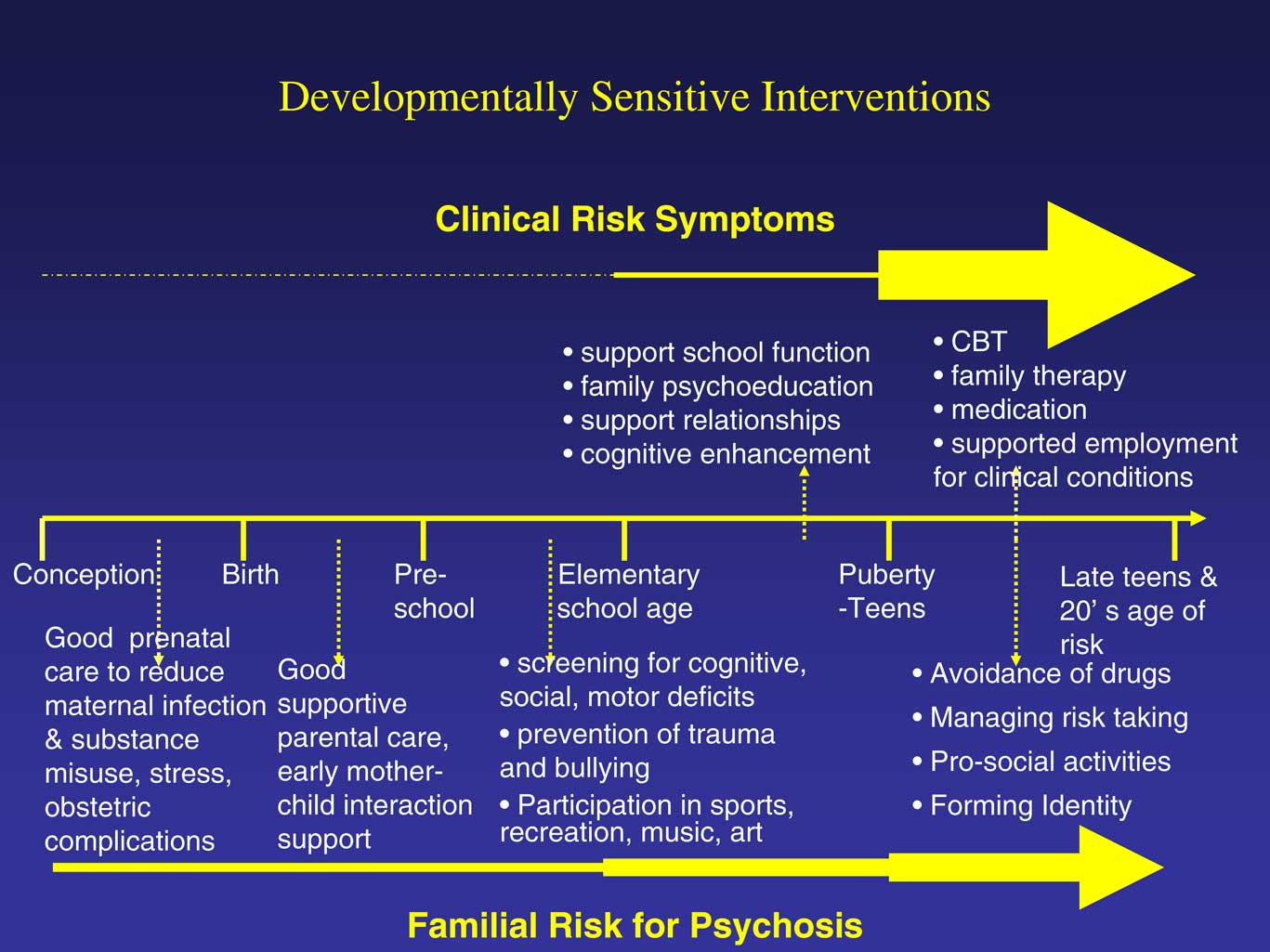
Schizophrenia is now considered a dynamically evolving, developmental neuropsychiatric disorder best understood from a psychobiological perspective. Gene–environment interaction, stress, and risk and protective factors, all play a role in the onset, maintenance, and recovery from illness. The shift to a neurodevelopmental model and understanding the disorder as one of evolving phases has focused treatment interventions onto the CHR phase and the early results are promising. The idea that schizophrenia might be prevented was unheard of 30 years ago. It’s too early to know if that promise will be met. Furthermore, several research groups have begun to develop primary prevention strategies, based on the idea that the CHR period is a relatively late phase of developmental derailment. Thus even earlier intervention in the premorbid phase is being considered (Seidman & Nordentoft, Reference Seidman and Nordentoft2015; Figure 6).
Phase specific early intervention & prevention strategies for clinical and familial high risk. Clinical risk symptoms are contrasted with family risk for psychosis by depicting the greater likelihood of conversion to psychosis to occur in the clinical risk group by the larger yellow arrow. Interventions above the line for the clinical risk group begin around the end of elementary school reflecting the earliest period that prodromal symptoms are typically reported, whereas those below the line begin during pregnancy reflecting more of a primary prevention approach (adapted from Seidman & Nordentoft, Reference Seidman and Nordentoft2015).
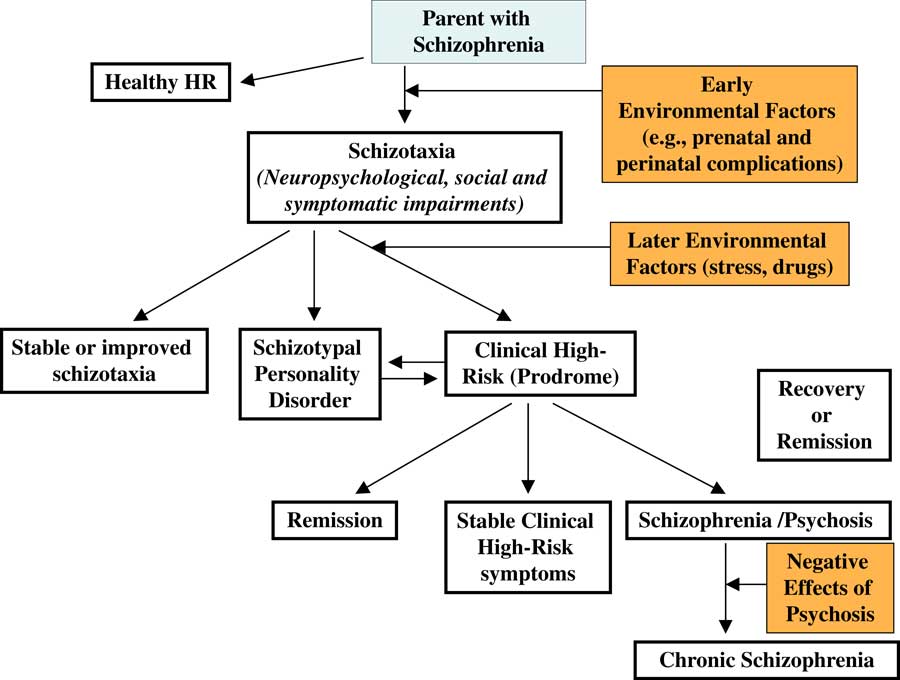
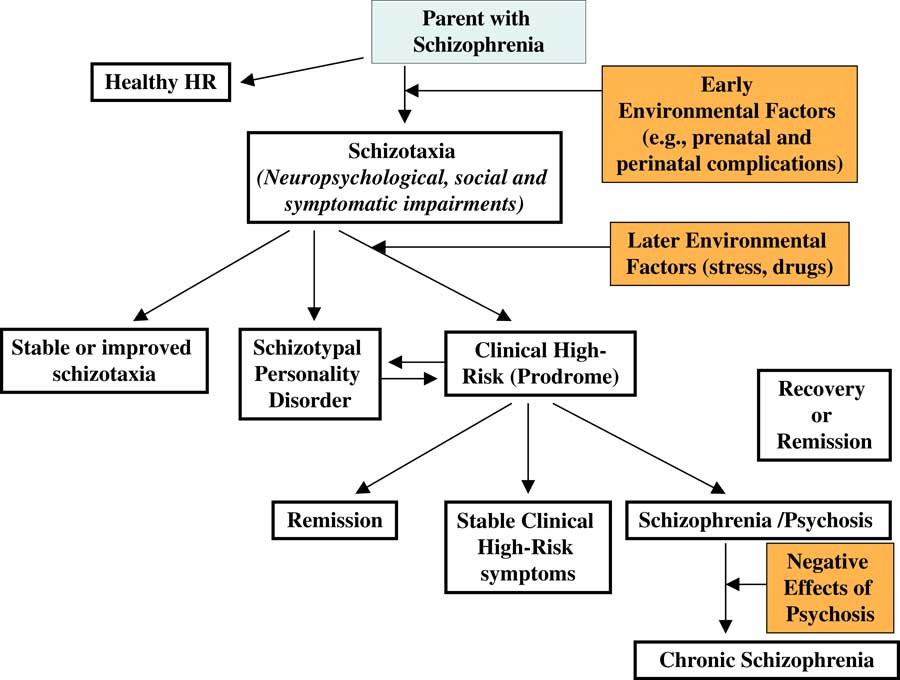
The importance of neurocognition in schizophrenia is well accepted, with debate now about its role in individual diagnosis (Kahn & Keefe, Reference Kahn and Keefe2013). Cognitive neuroscience approaches to altered cognition (Barch, Reference Barch2005), and social cognition, a domain distinct from neurocognition (Green, Horan, & Lee, Reference Green, Horan and Lee2015), are essential, complementary approaches. Future clinical neuropsychological research can contribute by focusing on individuals and defining subgroups, by longitudinally characterizing neurocognition at important junctures associated with illness and remission (Figure 7), by integrating information on treatment into longitudinal designs, and by integrating social cognition measures.
Developmental pathway of familial high risk for schizophrenia (adapted from Thermenos et al., Reference Thermenos, Keshavan, Juelich, Molokotos, Whitfield-Gabrieli, Brent and Seidman2013). This picture depicts the possibility that negative outcomes such as “stable schizotaxia” or schizophrenia can be partially or significantly reversed at different phases (adapted from Seidman & Nordentoft, Reference Seidman and Nordentoft2015).
Moreover, the use of neurocognitive measures in prediction algorithms, such as “risk calculators” (Cannon et al., Reference Cannon, Yu, Addington, Bearden, Cadenhead, Cornblatt and Kattan2016), may bring us closer to predicting and preventing schizophrenia. Finally, while there is limited evidence for reversibility of impairments from pharmacological interventions, promising results have emerged from cognitive remediation techniques (Keshavan, Vinogradov, Rumsey, Sherrill, & Wagner, Reference Keshavan, Vinogradov, Rumsey, Sherrill and Wagner2014; Wykes, Huddy, Cellard, McGurk, & Czobor, Reference Wykes, Huddy, Cellard, McGurk and Czobor2011). Thus, we expect cognitive interventions to play a larger role in the neuropsychology of schizophrenia in coming years.
ACKNOWLEDGMENTS
We thank Dr. Connie C. Duncan for her helpful comments on this manuscript. Dr. Seidman’s contribution was supported by the Commonwealth Research Center of the Massachusetts Department of Mental Health, SCDMH82101008006. Conflicts of Interest: None