The main conclusion from collecting evidence between September 2009 and March 2011 was that there is a common desire at all levels of society for a change to a more sustainable lifestyle. Indeed, there is a positive vision of what Scotland could achieve in a low-carbon future. But this enthusiasm is tempered with puzzlement, or even frustration, that it is proving so difficult to implement change. There is an abundance of discussion leading to policy recommendations that affect activities at the level of the EU, the UK Government, Scottish Government, Local Authorities, local communities, families and individuals. However, the integration of implementation strategies at all levels from national to local is missing. The Inquiry team found that there is sometimes a clear disconnect between parallel policies in different spheres of interest and also between different levels of governance. Other problems arise when seemingly progressive low-carbon/equality policies interact in an unanticipated way with other existing or new policies.
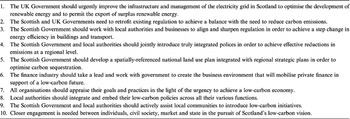
This paper explores the issues at a regional level. It brings together the findings from other papers in this Special Issue of EESTRSE and identifies the principal barriers that are holding Scotland back. The Inquiry Report (Royal Society of Edinburgh (RSE) 2011) outlines the key recommendations (Table 1) and the purpose of this paper is to cover the background to, and rationale for, action. We structure our analysis around different levels of governance, further subdividing issues according to different groups of actors at each level. The purpose is to offer a coherent overview of actions needed from international/national to local level. Our hope is that tackling necessary change at all levels will add coherence and momentum to the drive to a low-carbon society. Such coherence will provide the joined-up approach necessary to garner the support and trust of the public.
Primary Recommendations, Royal Society of Edinburgh Inquiry, 2011.

To what extent can Scotland, with its own Parliament and democratic traditions of governance, shape the unfolding of events associated with a changing climate? On the one hand, Scotland is an affluent country, with abundant natural resources and a history of innovation, enterprise and knowledge creation which shaped the Industrial Revolution. On the other hand, it has a small population, a legacy of poverty and inequality, and faces uncertainties (along with most of Europe) about its future economic capacities and prospects. The Scottish Parliament and Government are part of the system of devolved UK government, and the UK is in turn a member state of the European Union. This means that Scotland's opportunities to face climate change constructively are made in the circumstances of multiple levels of governance, which constrain policy and fiscal powers. The Parliament has legislative responsibility for significant policy areas on land use and forestry, environmental protection, waste management, housing, planning and most transport matters; all can be used to mitigate emissions and adapt to climate change. Planning policies and powers are significant in shaping the mix of energy production, while building standards and transport policies, as well as environmental protection, are significant in shaping energy consumption. The regulation of energy markets is reserved to Westminster (as are international relations and fiscal policy), although promotion of energy efficiency is devolved. Energy technology innovation can be promoted through business development aid, and the level of energy market incentives (notably the Renewables Obligation) can be determined in Scotland, but the form of such incentives cannot be changed. The Scottish Parliament decides how the budget is spent, but the overall level of spending (around 85%) is determined by the UK-level block grant system. Scotland's capacity to meet targets set by the Climate Change (Scotland) Act (2009) is therefore constrained by its multi-level interactions with the UK Government and the EU Parliament and Commission, but it has considerable powers and resources which can be directed to creation of a low-carbon economy. The effective exercise of such powers depends on the skills of political leadership, influence and coordination, which are developing through inter-government cooperation in the UK, as well as negotiation over any future constitutional settlement. Scottish governments have, for example, sought to influence the future of electricity market regulation (currently under review; Department of Energy and Climate Change (DECC) 2011a), in order to improve the prospects for renewable energy transmission through the grid. They have also negotiated at European level over sub-sea grid connections. Local government is, however, critical to Scotland's ability to meet climate change mitigation and adaptation commitments. The 2007 concordat between Scottish and local government reduced ring-fenced local budgets, giving more autonomy to local authorities to determine their own priorities. Hence, there is considerable uncertainty about how far local authorities will prioritise climate change actions as public finances tighten. Overall, much can be done at the Scottish level to create a low-carbon society, but this demands political leadership, skilful negotiation between levels of government, targeted use of resources and public engagement.
1. International/UK/Scotland
1.1. European Union
Since much UK and Scottish environmental policy is driven by EU initiatives, it is appropriate to begin this assessment of multi-level governance with emerging initiatives by the European Environment Agency, aimed at measuring and monitoring the progress of its members towards sustainable economies. Making progress towards a low-carbon economy is a key component in sustainable development. It is worth noting that our structures of government from EU to devolved government in the UK reflect traditional assumptions that the best way to govern is to categorise environment as a separate matter from economy and society/welfare. Each of these is treated as a specialist, discrete domain. This has made it difficult to create coherent policy for transition to a low-carbon society. The European Environment Agency is in this sense a significant organisation, because it is not directly controlled by EU member states, but has a degree of autonomy which enables it to pose more critical questions about the interactions between social and economic organisation and exploitation of natural resources.
The Inquiry team heard from the European Environment Agency that emerging environmental legislation which is currently under consideration will report on five indicators of environmental quality and socio-economic wellbeing and provide a valuable metric of progress towards both goals. In addition to GDP, there will be analyses of resource efficiency (including water, natural capital, forests, agriculture and biodiversity, environmental and green technologies (ECT), greenhouse gas emissions, poverty, and employment (RSE 2011). This agenda closely matches the vision of a low-carbon Scotland in that it integrates environmental, social and economic affairs. It involves the integration of renewable energy generation, energy-efficiency measures, transport (reducing the number of car journeys and car use in general) and land use. At the very least, this initiative by the European Environment Agency is a stimulus for action. A key question for Scotland is how will it compare with other countries of comparable size in Scandinavia, or with other devolved nations such as Wales.
1.2. Electricity
An area of potential difference in energy policy between the UK and Scottish governments concerns the future development of the UK national grid. The Inquiry team heard a wide range of different views and hence our concern that a strategy should be clarified. We listened to views from industry, small to medium-sized enterprises and local councillors in urban areas and rural communities that there was concern about the future of renewables in Scotland. They were collectively concerned over problems of access to the grid and its current design and management.
One fear is that the lack of a direct interconnector with northern Europe will prevent the optimum exploitation of Scottish wind, tidal and wave-based renewables. Discussions with officials at the Department of Energy and Climate Change confirmed that an interconnector with Norway would help maximise the potential of renewables in Scotland, since it would allow the use of Norwegian pump-storage hydro-electric capacity to supplement Scottish supplies when demand peaked or wind-generated electricity periodically dipped. In return, Scottish electricity could help recharge the pump storage at times of peak production or low demand. At present, such a link helps Denmark to optimise the generation and export of renewable energy generation, and the same would apply to Scotland. This potential would be best exploited if it were part of an integrated North Sea grid linking areas of production with areas of high demand, such as Germany.
The Inquiry team heard different visions of the future of the grid. For example, the projections for the UK grid and generation sources outlined at the 2020 Holyrood Meeting in Edinburgh (June 2010) by the Commercial Director, Transmission, National Grid, envisaged a centralised UK grid in the future, relying on renewables from offshore in the first half of the 21st Century, but returning to a centralised system based mainly on nuclear power in mid-century (RSE 2011). Such a view would seem to constrain the scale and duration of the renewable revolution in Scotland, and could be particularly damaging in view of the present Scottish policy of not renewing nuclear power stations. In contrast, officials at the Department of Energy and Climate Change argued that the resources of wind, tidal and wave-based energy in Scotland are badly needed if the UK is to meet its carbon-reduction targets. The latter vision seems to line up with a vision of a smart, flexible grid in Scotland, with long-term generation from renewables and storage distributed across the grid. Such a grid can be argued to be cheaper to establish and is inherently more resilient (DECC 2011a). Moreover, it offers significant economic and social advantages to Scotland.
There are also issues concerning the costing and capacity of the grid to accept renewables, especially in the more remote parts of Scotland. The evidence from Westray revealed that present restrictions not only reduced the potential amount of electricity produced from renewables but, because this reduced the financial payback, it made it more difficult to get loans to build a turbine in the first place. Many of the problems relate to how the grid is managed and the Inquiry heard from senior advisors that, if the UK adopted different transmission standards, many immediate problems could be solved because the capacity of the grid could be increased significantly.
The range of views about the future shape of the grid, its management, the energy mix and the need for, and location of, interconnectors requires integrated action involving the Scottish Government, the UK Government and the European Union. The risk is that an unintegrated response will lead to sub-optimal and inefficient schemes or, at worse, unnecessary duplication of investment. It is so crucial to the future of a low-carbon Scotland and the potential gains to come from a renewable revolution that we highlighted the issue in our first recommendation in Table 1. Much will follow from the current electricity market reform consultation and proposals outlined by the Department of Energy and Climate Change (DECC 2011a). The consultation will feed into the next Energy Act (DECC 2011b).
1.3. Environmental regulation
The Inquiry discovered that on many occasions, and in different circumstances, existing environmental legislation implemented in the past was impeding efforts to move to a low-carbon future. When asked why this was, the response was often to point to EU legislation. The Inquiry team was not convinced by this argument.
We discussed this issue with the Scottish Environmental Protection Agency (SEPA) and welcomed their willingness to investigate certain environmental issues. This is important, because SEPA plays an important role across the spectrum; for example, in relation to energy efficiency in their role as a statutory consultee, in granting planning consent and in the thermal treatment of waste and energy recovery from waste (SEPA 2011b). Since much environmental legislation derives from the EU, it is good to see SEPA involved in the EU Environmental Protection Agency Network, which provides the opportunity to share good practice directly throughout 34 European countries. Most recent EU environmental legislation is via Framework Directives and allows different national approaches to achieve commonly-agreed outcomes, with considerable latitude to follow different solutions. With this in mind, we note that EU water quality regulations are generally interpreted in the UK as ‘end-of-pipe’ solutions requiring significant carbon-intensive investment in water and waste-water treatment. An alternative river-basin approach, using integrated land-use and water management to improve the quality of inputs to water supply reservoirs and the processing of waste water, can bring wider environmental benefits at lower cost in terms of carbon. The introduction of any micro-hydro scheme on a river can be viewed as detrimental to the status of the river; thus we understand SEPA's preference for fewer, larger schemes (SEPA 2010). And yet it can be argued that a river with micro-hydro schemes is yielding wider local environmental and social benefits. It is the small-scale developments that bring economies and resilience for the scattered farms and small settlements typical of the rural community.
SEPA could also take firmer control of the low-carbon agenda when applying environmental regulations. The example of a whisky distillery supplying its barley waste to a local farmer to spread on the land and fertilise it provided a telling example. Because the fertiliser was classified as waste, there was a charge both to the distillery and to the farm that had to apply for permission to distribute the waste block by block (RSE 2011). If the barley waste had been classified as a by-product, there would be no charge other than the cost of transport, and less bureaucracy. The operation would still be regulated by the relevant water quality standards. This issue of over-prescriptive local regulation was also raised as a general problem by the Scottish Council for Development and Industry.
The Inquiry team believes that this problem affects fields other than the examples we quote. Changes will involve reviewing cross-cutting regulations at EU, UK and devolved level, but there is scope for immediate changes in implementation within Scotland. Since efficient and effective environmental regulation is of key importance to the low-carbon strategy, we highlight the issue as our second recommendation (Table 1).
2. Scotland: the Scottish Government
During the course of the Inquiry, we heard from experts in various fields of ways to catalyse change towards a low-carbon future at a national scale. Many of these ideas involved investment from private industry and government, and many others pointed to a smarter way of doing things. These are examples where the Scottish Government has the power to make a difference, and not all require extra cost.
2.1. Energy efficiency (buildings and transport)
Improving the energy efficiency of buildings emerges as perhaps the single most important way in which Scotland can make rapid progress in reducing its carbon footprint. Heating buildings in Scotland produces ∼9 million tons of carbon per year, equivalent to 1.8 tons per person per year. In 2008, the residential sector contributed 14% of Scotland's total carbon emissions.
The Inquiry team discovered widespread disappointment both about the poor quality of housing and the slow progress being made in improving it, especially in retrofitting the existing 2.4 million properties, and in ensuring that developers are held to common building standards across Scotland. This lack of effective progress is a missed opportunity, because improvements would bring important additional benefits: (a) the reduction in demand for energy would begin immediately and thus help Scotland to reach its carbon-reduction targets in the coming decade, a time when the impact of renewables in reducing carbon totals is still limited and yet to ramp up; (b) it would bring employment to many small businesses (electricians, plumbers, builders) distributed in settlements of all sizes throughout the land and help increase the level of skills; and (c) the upgrading of housing is a way of tackling fuel poverty and supporting community initiatives.
The overwhelming view of many respondents was that the feed-in tariff (FIT) and renewable heat incentive (RHI) are powerful policy instruments, but that they need more incentives and/or ‘teeth’ to release pent-up domestic demand. Germany's impressive take up of solar panels combined FIT with the provision of low-interest loans. A particular problem concerns rented property, where investment by the landlord in energy efficiency does not necessarily bring returns, so long as cheaper, less efficient properties are available for rent. Several responses from the energy, architectural and building fraternity suggested that teeth could be added to the legislation, for example by linking the energy heat performance (EHP) of a house to the levels of Council Tax, or perhaps to Stamp Duty when a property changes hands.
The Inquiry team identified specific bottlenecks that were making it difficult to achieve changes in housing quality. There is need for: (a) new financial instruments to support specialist businesses in improving existing buildings; (b) easier lending from banks to help funding of private home improvements; (c) measures to add long-term value to energy-efficient housing; (d) measures to upgrade the insulation of rented buildings; (e) tighter enforcement of building standards on the energy use of new build; and (f) improving the insulation of public buildings as exemplars of good practice.
Transport is the other main area where the Scottish Government can make a difference. An effective national transport strategy would make important inroads on Scotland's emission targets. Transport accounts for 29% of the total energy use in Scotland and in 2008 accounted for ∼14.5 million tons of carbon emissions. Approximately two-thirds of this energy is used in cars, with the remainder used by light or heavy goods vehicles, trains, ferries and aircraft.
At present, Scottish transport policy is not perceived by the general public to be an integral part of a low-carbon strategy. Rather, they see an increase in spending on trunk roads, while the removal of bridge tolls and local opposition to urban congestion charges encourages more car journeys. The lack of rail connections to Scotland's largest airports in Glasgow and Edinburgh is a source of comment and even embarrassment. The view that the low-carbon agenda has not influenced transport strategy is reinforced by the static or declining support for existing public transport networks and the small proportion of funding (1% in 2009–10) devoted to walking and cycling. Plans to encourage the latter are not backed by the investment needed to create the continuous and safe cycle ways that are common on the continent.
The Inquiry team concluded that transport priorities are not yet integrated into the government's thinking on a low-carbon economy. The Inquiry Report outlined possible approaches involving smart road-use pricing and links with other forms of transport, especially involving travel to and from work, and at work, with the overall aim of reducing car and van use (RSE 2011). The Inquiry team finds itself fully agreeing with the UK Climate Change Committee (UKCCC 2010) that improving heating efficiency and transport are urgent priorities. Since both spheres lie within the powers of the Scottish Government, we highlight the issue as our third national/international recommendation (Table 1).
2.1.1. Integrating national and local authority actions
The actions of local authorities, working at the scale most relevant to people's day-to-day lives, will largely determine whether or not Scotland reaches its carbon emission targets. The social and economic geography of each region affects where you live, how you travel to work, how you shop, how you heat your house, and how and where you spend your leisure time. Local authorities play a major role in shaping these decisions via the infrastructure and the services provided for individuals and communities. The city regions have the potential to make the largest difference, since the density of populations and activities in cities means that they produce the most carbon and yet have more options to cut emissions than elsewhere.
During the course of the Inquiry, we met with officials and held public meetings in the cities of Aberdeen, Dundee, Edinburgh, Glasgow and Inverness. In addition, we met with COSLA and officials in Fife, Orkney and Dumfries. The results of our consultations are covered in detail in Chapter 7 of the Report (RSE 2011). We also held discussions with many organisations involved in building and maintaining the infrastructure in Scotland. The most important conclusion from these two sets of meetings is that there are startling difficulties in reconciling national and regional goals when trying to implement change.
Before exploring such issues further, it is worth raising our sights by looking at what is possible at the scale of a local authority and referring to Thisted in Denmark. Here, the vision and energy of the local council over 25 years has blended economic success and social progress and achieved a low carbon footprint in a town of 46,000 souls. An array of environmentally-sustainable measures have been put in place, including waste and biomass for district heating, geothermic cooling and heat, passive house technology, hydrogen vehicles, wind turbines and energy management. The result is that 100% of the electricity and 85% of the heat provided to the region comes from renewable resources. Community and industry involvement is strong, due to consultation at an early stage that actively engages the public. 251 of the 252 wind turbines are privately owned (http://www.eea.europa.eu/atlas/eea/power-to-the-people/video/power-to-the-people-environmental-atlas-ofeurope-2014-denmark/view). Perhaps similar success can be applied to towns and cities in Scotland.
2.1.2. Transport
Even a cursory comparison between Scottish cities and equivalent counterparts in Scandinavia suggests that we have much to learn about balancing the conflicting demands of car usage and public transport as an effective way of reducing emissions. Several local authorities pointed out that there was a conflict between the goals of the national transport system and those desired by the regions. For example, the priority of the rail network at a national scale is to reduce intercity journey times, whereas the city regions seek more commuter stations and rail links to their airports. New commuter stations have been refused in several authorities, constraining regional transport plans and economic development as a result. Here is a clear disconnect between goals at different scales, the effect of which is to limit the actions of local authorities.
A similar argument applies to trunk roads and the administration of travel concessions, which are planned and maintained nationally by Transport Scotland. Local authorities do not have the power to control traffic on trunk roads or to refine travel concessions to help achieve low-carbon goals. The restriction this puts on local authorities is best illustrated in Glasgow, where the presence of trunk roads running through the centre rules out any possibility of operating a traffic congestion scheme. This illustrates how the arrangement that may seem sensible at a national level restricts the ability of a local authority to use the full range of tools to tackle traffic problems in their cities. We were impressed by the argument by COSLA that cities should have more control over car taxation if they are to tackle the issue of congestion and its social and economic downsides.
Boosting walking and cycling in urban areas emerged as an area where there is an apparent disconnect between national and local priorities. Many journeys are short and local authorities are responding in different ways. In a compact city such as Edinburgh, 25% of journeys to work and education are by foot and 4% by cycle, and here the ambition is to approach continental levels and achieve 15% of journeys by cycle by 2020. Comparable cycling plans in Glasgow are as yet undeveloped. Bearing in mind the small proportion of the transport budget that goes to cycling as opposed to trunk roads, here is a field where backing at the national scale could make a difference.
2.1.3. Heating
The Inquiry team noted the absence of significant district heating and combined heat and power (DHCHP) systems in Scotland's cities and urban areas. DHCHP is an established energy-saving technology on the Continent, not only reducing carbon but also providing more affordable heat and power. The benefits are recognised by the UK Government as a cost-effective means of reducing CO2 emissions, required by climate change legislation:
• The UK Committee on Climate Change (2010) stated that district heating connected to low-carbon electricity generation (fossil fuel with carbon capture and storage (CCS)/nuclear) is the most cost-effective carbon abatement (−£110/t CO2) measure.
• The UK Department of Energy and Climate Change estimated that if all suitable areas were served by biomass combined heat and power connected to district heating, carbon savings would be 19.3 Mt CO2 annually, in comparison with a saving of 2–3 Mt CO2 if the same buildings were heated with ground source heat pumps (DECC 2009).
Such systems are the norm in many Scandinavian cities and housing schemes. We talked to those responsible for the success of Aberdeen City Council in establishing the not-for-profit company Aberdeen Heat and Power, and to councils where several attempts to introduce district heating had fallen down at the last hurdle (RSE 2011). One problem is the difficulty of applying UK-level grant schemes locally. For example, supplier obligation funding, such as the Community Energy-Saving Programme intended to reduce fuel poverty (Ofgem 2011), has been allocated on a postcode basis, resulting in obstacles to systematic improvements to energy efficiency in multi-storey public housing, when adjacent blocks (or even a single block) fall into different postcode sectors. Here is a field where UK policy could make a significant impact on Scotland's emissions and reduce the costs of heating if it was linked more effectively to the priorities of local councils. Under the current Community Energy-Saving Programme, initial estimates suggest that 1.4 Mt (lifetime) CO2 has been saved of a 19.25 Mt target, indicating that the major utilities are failing to meet their Community Energy-Saving Programme targets. There is considerable scope for greater local authority control over such funds, to ensure that targets are met and that funds are used in to maximise local energy saving.
2.1.4. Quantity versus quality of new housing
The Inquiry team concluded the current building standards on new houses in terms of energy efficiency were too low and that they were indifferently monitored. Such a conclusion is immediately apparent to a visitor to a Scandinavian country, and it is clear that there is much to learn from their experience. Existing regulations need to be improved and more rigorously enforced by local authorities and private developers. It is frustrating to realise that we are still building new houses that will be contributing to unnecessarily high emissions for years to come. It is encouraging that a strategy for raising standards due to come into force in 2016/17 is now in train (Sullivan Reference Sullivan2007). But even given where we are, local authorities face major difficulties in applying existing national standards.
Two problems arise. First, flexibility in the standard of energy efficiency means that developers can play one authority off against another by seeking to build lower-spec houses in another less suitable location, as has arisen in the case of Glasgow and in Midlothian (RSE 2011). Secondly, Councils are faced with an impossible choice when faced with a fixed capital costs that could provide either fewer high-quality houses or more lower-quality houses. COSLA gave the example of a new school where an authority might be faced with choosing between an energy-efficient school with no gym or a less energy-efficient school with a gym (RSE 2011). Glasgow City Council gave the example of the choice between more social housing built to lower specifications or less housing with higher specifications. Clearly, policy on how building regulations are applied to achieve reductions in whole-life emissions from a building needs to find a better way of linking national goals with those of local authorities.
2.1.5. Retrofitting existing houses
The 2.4 million buildings in Scotland that will be around in 2050 is a stark reminder of the importance of effective action in improving the energy efficiency of existing houses. The response of some local authorities is that the existing funding schemes are ineffective, especially in relation to the rented sector (RSE 2011). If local authorities are to be responsible for their emissions then, as argued above, it would help to have regulation that councils can enforce with supporting policies, inducements (such as a meaningful council tax rebates for energy-efficient houses), sticks and regulatory frameworks that are firm and sufficiently enabling to encourage private investment.
The city regions are critical to Scotland's success in moving to a low-carbon society. At present, local authorities are finding it hard to implement change effectively and one reason is that there is a mismatch between their responsibilities and the resources needed to meet them. There is a need for effective regulatory and financial powers allowing local authorities to invest in energy efficiency, decentralised heat and power systems and coherent transport services. This might be done by rebuilding the historical strengths of municipal government in improving public life and well-being for an era where the problems of climate change and environmental degradation, rather than those of industrialisation, are foremost. For the above reason, we highlighted as our fourth recommendation the urgent need to integrate national and regional goals to reduce emissions at a regional level (Table 1).
3. Land use
There is huge potential for land use and soils to be managed in such a way as to reduce emissions quickly and at relatively low cost. Actions on forestry, soil carbon and restoring peatlands offer opportunities to sequester hundreds of thousands of tonnes of carbon. Further, the cost of reducing emissions by land-use change is low in relation to alternative solutions. For example, Moran et al. (Reference Moran, Macleod, Wall, Eory, Pajot, Matthews, McVittie, Barnes, Rees, Moxey, Williams and Smith2008) estimated that the land use and forestry sectors could reduce emissions in 2022 by about 6 million tonnes of CO2e at no extra cost, through changing management practices. In a win-win situation, it appears that all measures to reduce carbon emissions from land-use change have wider environmental benefits, for example in amenity and biodiversity.
At present, it is difficult to integrate the separate initiatives within forestry, agriculture, environment and recreation to achieve an optimal result. For example, the strategy to increase forest cover to 25% of the land will sequester carbon, but it will compete with agricultural land used for livestock. The lack of integration between forestry and agriculture makes it difficult for Scotland to follow the integrative agro-forestry approach in Scandinavia. Indeed, no Scottish university offers an integrated agriculture and forestry course. Further, there is uncertainty about how different management practices contribute to the maintenance or loss of carbon levels in soil. We encountered contrasting views about the role of low-till agriculture in sequestering carbon in soils and, in view of the potential large store of carbon, we conclude that more research is needed in this important area. Finally, we noted the absence of an indicative land-use strategy that would be essential in creating effective regional strategic plans.
One attractive way forward is to use an ecosystem services approach, which is a means of integrating management of land, water and living resources in order to promote sustainable use and conservation. The concept of ecosystem services is a way of integrating human wellbeing and the health of ecosystems (Haines-Young & Pochin Reference Haines-Young and Potschin2007), and stresses the role of ecosystems in supporting life, providing sustenance, regulating the environment and providing cultural amenities. Campbell et al. (Reference Campbell, Lilly, Towers, Chapman, Werritty and Hanley2012, this volume) show how the ecosystem approach can be linked to the need to reduce emissions. The Land Capability for Agriculture (LCA) land classification system, based on the physical constraints to land use, such as soils, climate, topography and vegetation, is used by planners, land managers and policy makers, and is a starting point. The need to reduce emissions could be used to modify the economic and social values placed on the different land uses.
The new Common Agricultural Policy (CAP) post-2013 offers a real opportunity to link carbon accounting with the way land is managed by farmers. In order to achieve this, it will be helpful to develop indicative land use plans that can be implemented at a regional scale. This is the line of argument that urges a spatially referenced national land-use plan, integrated with regional strategic plans, in order to maximise carbon sequestration (Table 1, Recommendation 5).
4. Finance
Given the confluence in Scotland of both world-class financial institutions and the huge potential for energy-efficiency measures and renewables, there is a clear opportunity for the finance industry to take a lead in the move to a low-carbon society. But there are two particular bottlenecks: (a) the need for instruments to finance the small-scale improvements in energy efficiency for small businesses and households, returns on which may take up to a decade or more; and (b) investments tailored for intermediate-sized renewable schemes which involve high start-up costs and relatively low running costs, and take longer than 3–5 years to bring financial returns. In 2011 we wrote “There seems to be an opportunity for the finance industry to work with the Government to create the business environment that will mobilise private finance in support of a low-carbon future. Establishing the Green Investment Bank in Scotland would reinforce this.” (RSE 2011, p. 163). Since then, there has been considerable movement. Investment in offshore wind is massive, while the Scottish Government now covers some of the risks of local renewable initiatives, the Co-operative bank is supporting local green investment, and Community Energy projects are developing. The Green Investment Bank is being established in Edinburgh, but its current business model does not address the bottlenecks identified above, because it is required to use its funds on commercial terms rather than, for example, on underwriting loans or providing startup capital for intermediate-scale low-carbon energy schemes that are not currently being funded by large banks. There is not yet a straightforward means of borrowing to invest in low-carbon infrastructure at a local scale.
Importantly, despite the state of national/international finances, we recognise that public finance should also be focused on supporting innovative technologies at key stages. The economic case for such involvement is made by Hanley & Brennan (Reference Hanley and Brennan2012, this volume). A good example is the investment in the EMEC facility in Orkney for wave and tidal power, which has been an effective way of attracting a variety of businesses trialling different ways of extracting energy from the sea. It has the particular merit of providing support, and an enabling facility within which different technologies can innovate. Successful operations evolve and build up local supply chains, with the potential to involve Scottish business in development and maintenance. A barrier that caused a delay of a year and a loss of impetus in one case was the cost of finding insurance for a tidal installation (EMEC). It was suggested to us that a government guarantee underwriting the insurance of such prototype installations would be a cost-effective way by which the Scottish Government could encourage progress in such future demonstration technologies.
If Scotland is to reap the full rewards of a low-carbon future, then effective financial instruments are required. At present, there is a lack of coherence between different policies as they play out at national, regional and local level. In particular, there is a mismatch between the need for action at the regional and local level and the lack of accessible finance at such levels. Since there are investors looking for opportunities, this is a challenge for the finance industry. Hence the rationale for a sixth recommendation urging a lead from the finance industry (Table 1)
5. Other organisations with a national remit
The transition to renewables and, particularly, the issue of locating wind turbines has exposed some difficult issues for quasi-governmental and non-governmental environmental organisations. The issue is how to balance the wider socio-economic case for an increase in renewables against the local environmental case for or against a particular development. As an illustration, one respondent wrote eloquently about the problems faced by a local community in Assynt, whose ambitions for three wind turbines was turned down (RSE 2011, p. 235). The plans were opposed by SNH, The Ramblers and the John Muir Trust.
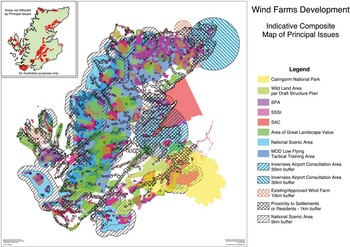
This and other examples suggest that, at present, the balance is tilted overmuch towards environmental protection. A remarkable illustration of this is a map of the Highlands and Islands in 2005 showing the extent of protection against wind turbines for environmental reasons (and low-flying exercises) (Fig. 1). Virtually all of the windy west coast and western Highlands is excluded and indeed there are “issues” which trumped the potential of wind power in all but a small area of the eastern Highlands. With many applications for wind turbines failing to get planning permission at the time, it is no wonder that developers told us of the acronym BANANA (‘build absolutely nothing anywhere near anybody’) and have moved offshore, even though it is a more expensive option for consumers. The estimated cost of terrestrial wind power is 9.4 pence per kWh, compared to 15.7 pence per kWh for offshore wind (Hanley & Brennan Reference Hanley and Brennan2012, this volume).
Indicative composite map (available in 2005) of the issues facing wind-farm development in the Highlands, showing how few areas were available for development. Such maps are an interesting reflection of the balance between conservation and development at the time. Note that this unofficial map pre-dates the planning changes in Scottish Planning Policy (2010).

In retrospect, one wonders whether the environmental movement, had it seen climate change as more of a social issue, could have done more to support the building of wind turbines and to help local communities build them. We recognise that many environmental organisations are reviewing their positions over turbines and new electricity lines, and it is notable that the former RSPB policy objection to wind turbines has been reversed, even though the legacy of the earlier opposition is still with us in the form of required bird surveys.
There are other charities and professions with national reach whose practices impact on progress towards a low-carbon economy. Thus, Eco-Congregations Scotland (an ecumenical charity which promotes more sustainable living and the shift to low carbon) now has over 240 congregations registered in its programme. Commended by both the Scottish Parliament and the Scottish Government for its programme of community engagement, it is a telling example of how national churches (in this case mainly the Church of Scotland, the Scottish Episcopal Church and the Roman Catholic Church) with a locally-grounded membership can be effective agents of change at the individual and community level.
Perhaps the legal profession could improve its practices. The single wind turbine owned by the community in Westray required 800 legal documents before it could be deployed! Understandably, participants talked of volunteer fatigue. Surely the legal profession could help to streamline procedures as a contribution to a low-carbon Scotland? The Inquiry team suspects that other professional bodies could also usefully appraise their practices in the light of the need to reduce carbon emissions. Our efforts to learn of progress among the professions drew only one response from 20 specific enquiries. In the light of the above, it seems a priority for the professions along with other groups to get engaged with a low-carbon society and hence a seventh recommendation to this effect (Table 1).
6. Integrating low carbon activities within local authorities
It is clear from our discussions with local authorities that it is proving difficult to implement coherent low-carbon policies. Some of the difficulties arise from the sheer complexity of bringing together a host of policies and actions in a particular place, whilst responding to initiatives at EU, UK and Scottish levels, implementing cuts, and adapting to changing demands from the population. The result is that cuts in emissions are organised within individual departments and that such efforts will achieve far less than if they were integrated across the board.
The lack of coordination was well demonstrated by visits made to two award-winning environmental buildings, where the energy efficiency measures were outstanding and fully justified the awards. However, both buildings were in out-of-town locations, had large car parks and relied heavily on access by car. It is not difficult to believe that, had the buildings been in the centre of their respective urban centres, the life-time emissions created by the building and the travel of their occupants would have been far less.
The lack of joined-up thinking that such examples illustrate was recognised by local authority officials (RSE 2011). The difficulty of linking planning, the electricity grid and decentralised power generation was highlighted by COSLA. The divisions between architects, building control and planning within individual authorities is illustrated by the inability of a local authority to specify the type of heating in a house. Other problems arise at the interface between environment and transport, especially where development schemes such as road widening or out-of-town shopping centres have the effect of boosting car use. Linking development with public transport is a problem, especially coordinating rival bus companies to achieve an integrated public transport system. The problem was acute in Aberdeen, where the issue dominated our public meeting in 2009. In contrast, in Edinburgh there seems to be successful integration of bus services, and Oxford was mentioned as another exemplar.
The overriding problem seems to be that no single person within a local authority ‘owns’ the problem of transition to a low-carbon/sustainable society. There was a tendency to blame lack of powers, or leadership in other departments, or the low priority given to the issue. The results are: (a) delay in introducing district heating or heat and power schemes in Edinburgh; (b) the continued building of out-of-town shopping centres; and (c) the Clyde Gateway project, which could have built in greater cuts in emissions if it had been developed as a whole rather than sub-zone by sub-zone.
The Inquiry team was surprised at the low profile of spatial planning within authorities as a way of achieving integration of the various activities and their impact on emissions. We met planners who had been subsumed in another department (Aberdeen) and others who complained of low morale in the profession (RTPI). This was a surprise, and in complete contrast to our expectations when perusing the central role of planning as outlined by the Director of RTPI (RSE 2011). The guidelines provide a comprehensive approach to cutting emissions from transport, housing and land use. Moreover, they stress the importance of balancing the needs of economic growth. Above all they stress the importance of integration across all activities and at different scales. To an outsider, it seems that the problems of integration within local authorities have a solution at hand. It is to prioritise and give teeth to strategic planning. Interestingly this is similar to a recommendation of the Royal Commission Report: Adapting Institutions to Climate Change (Lawton Reference Lawton2010).
Local authorities will play an important role in the move to a low-carbon society. This is because their decisions affect the way communities carry out their work, social and recreational lives and also because they can act as exemplars for change in improving public buildings and their travel arrangements. At present, the effort often depends on the initiative of certain individuals in pursuing specific goals. Integrating a response across all activities and learning from best practice within Scotland and abroad would enable a step change in achieving emission reductions. This is the background to the eighth recommendation seeking greater integration throughout all activities of a single authority (Table 1).
7. Local communities
During the course of the Inquiry, we were impressed by many local enthusiasts brimming with ideas for their local community. Many are active members of environmental and social charities, churches, local societies and councils and devote energy and time to their community. This is civil society at it best and we were struck by two things. First, there is the sheer potential of this energy if it is harnessed towards the goal of a low-carbon society. Secondly, it is a tragedy that at present so much local energy is consumed in opposing the large wind farms that are seen to damage the local community. The latter is a classic case where the scale of development and its ownership conflicts with the goals of the local community. Sometimes a compromise may be reached, as in the growing number of cases where a small proportion of the income is returned to the local community.
Since effective action on energy efficiency or renewables requires local knowledge and local buy in, there is a case for sweeping away tiers of regulation and episodic grant schemes and instead introducing policies to release private initiative and finance. On the basis of our discoveries, there are clear opportunities for communities to take a lead in: (a) installing community wind turbines; (b) housing improvement; (c) local transport; (d) school energy savings; (e) micro-hydro; (f) bio-fuel heating; (g) waste recycling; (h) building local businesses; and (i) growing local food and planting woodlands.
The risk is that Scotland is missing an opportunity to use the move to a low-carbon economy to invigorate local communities. Policies could be designed which, at a relatively low cost, bring both carbon reductions and increased local prosperity. Effective policies would remove local resistance to large outside schemes, bring profits of wind energy to local communities, and help finance improvements in housing, schools and other community assets. Above all, the cost of such policies would be modest if the power of private finance is harnessed.
The example of wind turbines is one significant area where barriers, perceived or real, seem to be holding back change at a community level. Perhaps rural Scotland can take inspiration from the island communities of Westray, Gigha and Eigg, where renewable energy schemes have been used to drive local development and have succeeded in reversing population decline (RSE 2011). The involvement of the local community in the Westray project from the beginning avoided planning objections, and the turbine is now generating income for the island. Two problems of general concern arose. First, it was difficult to raise the relatively high upfront capital costs. The second problem was the capacity of the grid. Limits to the power the grid can accept reduces the payback and this in turn made it more difficult to raise the initial capital.
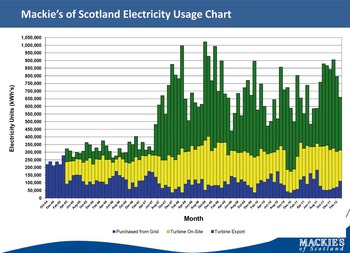
Renewable energy can be harnessed to generate income for a single enterprise and its diffusion could change the fortunes of rural Scotland. An inspirational example is that of Mackie's of Scotland. Figure 2 summarises the financial background and opportunity over a period of over four years. In a nutshell, the initial cost of £2.5 million for three turbines was recovered in four years, since when they have been earning an income. The chart shows the power obtained from the grid, the amount used and displaced by the turbines, and the surplus sold to the grid. The enterprise grew in the period and cut its costs dramatically. Further, the resultant product (ice cream) benefits from marketing its green credentials. The significance of this example is that any community, business, school, hotel or hospital could use the same approach to meet their electricity demand and to earn extra income.
An example of the economic value of community-based renewable energy. Three Vesta V52 turbines, operating from August 2007 on Mackie's of Scotland dairy farm, provide a total generation capacity of 2.5 MW. The business uses around 40% of the energy generated, allowing it to reduce energy purchased from the grid, and sells the remainder to Good Energy.

The Inquiry team feel that such small-scale wind turbine initiatives could have a major part to play in the economic future of rural Scotland, and indeed of some urban enterprises (e.g., the Michelin turbines in Dundee). The potential of local community involvement and the complexities in getting local schemes off the ground provides the background to our ninth recommendation to replace, remove or redesign our structures and practices at a local level to support local communities. (Table 1).
8. The role of individuals, civil society, business and the state
Most everyday activities have a significant carbon footprint: individuals are involved in their homes, work, travel to work, membership of local, national and international charities in civil society, shopping and holiday preferences, and so on. If individuals believe in the goal of a low-carbon society, and have trust in their elected representatives and their ability to deliver, then they are a powerful force for change. Individuals can adopt a more sensitive and carbon-efficient approach to all they do at home, at work and in recreational and holiday activities.
As argued by Webb (Reference Webb2012, this volume), such everyday efforts need to be part of wider social action if they are to be effective, and here the role of civil society is crucial. The turning point will come when the various environmental, social, economic and faith groups appreciate that the challenge of climate change involves us all in the single endeavour of making a step change in the relationship between human society and the global ecosystem. Organisations such as Stop Climate Chaos, which bring together groups representing the environment, society, faith groups and business, amongst others, are an excellent start. A priority would be an open and mature debate to build support for joined-up policies, openly grasping such awkward nettles as the balance between economic growth and well being, and how best to ensure that the needs of individuals and communities are met effectively and efficiently.
Real progress requires certain crucial developments to occur in parallel. They are:
• Education and deliberative public engagement to help everyone to understand that every activity affects our carbon footprint. We badly need an open and mature debate (TV news and documentaries, newspapers).
• Investment in infrastructure (energy efficiency, decentralised energy supply, active travel in urban centres, recycling and re-use, land use).
• True integration of the activities of business, voluntary and public sectors, with the clear goal of achieving a low-carbon future. The 2020 Group is potentially a good example of this.
• Bringing together environmental, faith and social NGOs in pursuit of a low-carbon future.
• Neighbourhood partnerships involving communities, business, energy companies, landlords and social enterprises in every part of Scotland.
• Access to predictable, accessible low-carbon finance for initiatives on energy efficiency, renewables, transport, food and waste.
• Political leadership through prominent, coherent and consistent action which demonstrates energy saving and carbon reduction across all areas of government and government performance.
It is with this background in mind that the Inquiry highlights as its tenth recommendation the importance and strengthening of civil society and its link with individuals, the market and the state (Table 1).
9. Wider reflections
The original RSE Report Facing up to climate change: breaking the barriers to a low-carbon Scotland was published in March 2011 and is based on evidence collected mainly in 2010. This issue of EESTRSE was finalised in late 2011–mid 2012 and gives the opportunity to reflect on changes since 2010 and also on reactions to the report. Initial reactions to the report were somewhat overshadowed by major world events – the Libyan Revolution and the Japanese earthquake and tsunami in the Spring of 2011 – but it is possible to draw some wider implications.
9.1. Opportunity
During the early days of the Inquiry in the Autumn of 2009, much discussion of a low-carbon future was about the reality of climate change and whether we needed to act just now. There were doubts about climate change being due to human activity and the costs of introducing renewable energy. Gradually, over the course of the Inquiry, it became more common to hear of the opportunity that a low-carbon future offered. The issue of energy security loomed when it was appreciated that the UK lay at the end of a gas pipeline from Russia: energy produced domestically is clearly more secure. The cost of oil and petroleum jumped remarkably in 2011 and the concept of peak oil production was discussed in the media; both trends weakened the opposition to the higher costs of a renewable energy supply. The goal of sustainability and the importance of local communities became a firmer part of political agendas, both in the UK Election of 2010 and the Scottish Election of 2011. Overall it became apparent that a change could reap economic, social and environmental benefits.
Viewed in this light, the change to a low-carbon society becomes an opportunity. After all, if there can be economic benefits, a cleaner environment and social gains at the level of local communities, then there is much to go for.
9.2. Climate variability
In the paper on climate change (Werritty & Sugden Reference Werritty and Sugden2012, this volume) we discuss the climate record in Scotland and the predictions based on models. Results of the models are presented in terms of probability, in order to highlight the most probable future but also the variability. It is the variability that leads to extreme events such as droughts, extreme rainfalls and storms. To supplement this, we also include the actual climatic record for over 100 years for the west, east and north of Scotland.
We discovered in discussions with policy makers that emphasis was being placed on the most probable climatic future, with stress on average trends. Since these averages point to a drier and warmer climate, especially in summer, the climatic prognosis is favourable. While this is appropriate for certain activities, such as agriculture, there is a danger that such a view will underplay the variability and lead to greater than expected disruptions when extreme events occur. It is not difficult to imagine the difficulty of justifying massive investment in snow ploughs for London's Heathrow airport after a decade of little snow and preceding the chaos caused by the heavy snowfall in December 2010! And yet the heavy snowfall was related to warm sea temperatures in December and this is in line with what one would expect in a warmer world.
There are two points of caution which, together, suggest that much more attention should be placed on extreme events. First, there is a growing realisation that models tend to favour stability and average conditions. There is now an open scientific debate as to how they underplay abrupt and sudden events, a view outlined for example in recent issues of Nature Geoscience (Valdes Reference Valdes2011). The implication is that model predictions can be expected to underplay the magnitude and rapidity of extreme events. Nonetheless, the models do suggest that variability can be expected to increase in a warmer world, mainly because of changing temperature gradients between the equator and the poles, and because a warmer atmosphere will hold more water and favour high-magnitude rainfall events. Given this background, perhaps a wise course of action would be for policy makers to place more emphasis on the observational record. In the case of Scotland, we could simply assume that the observed variability of the last century is likely to occur in the future and, indeed, it could be aggravated because of climate change. This change of perspective could make it easier for policy makers and operators to justify investment for extreme events.
9.3. Integration
The challenge of a low-carbon future is so far reaching that it affects every aspect of our lives. Since we compartmentalise our activities for convenience and tractability, it is not surprising that implementing change across the piece is difficult. Thus we have separate government departments of the environment; climate change is added to the activities of one or another department depending on political priorities; universities teach forestry and agriculture as separate subjects; local authorities frequently have firewalls between departments of planning, environment, transport and business and have limited capacity and capability to plan strategically for low carbon energy; the TV news and media focus on short term, single issue controversies; and people in local communities commonly are active supporters of single-issue charities or pressure groups. Given this background, it is easy to understand why it is difficult to have a measured and mature debate about the fundamental issues that will affect our future over the longer term. But the latter is what is needed and it behoves everyone to try and broaden the debate. One step forwards would be to prioritise the need for a low-carbon outcome on every decision we make. This would apply to policy makers, government at all levels, the media, business, local communities and individuals.
9.4. Society
It is helpful to recognise that different models of society point to different solutions when assessing different policy options. If a society is viewed as comprised of economically-rational individuals, it makes sense for government to use incentives to persuade people into changing behaviour, for example following the ‘nudge’ ideas of Thaler & Sunstein (Reference Thaler and Sunstein2008). Measures such as these encourage people to drive more slowly or less, turn the house thermostat down one degree, or turn the tap off while cleaning their teeth. All such measures are commendable but as argued by Webb (Reference Webb2012, this volume), the overall effect is insufficient to drive the step change required to meet the emission targets. A paradox at the time of writing (November 2011) is that the UK government seems to be nudging behaviour in the opposite direction, with discussion of higher motorway speed limits, reduced passenger airport taxes and lower fuel duty!
The alternative approach is to view society as comprising dynamic social systems and cultures. This suggests that the emphasis should be on full engagement, supported by legislation as, for example, in the case of the compulsory use of seat belts and the Scottish tobacco control legislation. The equivalent in this case might be, for example, using legislation to introduce incrementally-increasing energy efficiency standards in all manufacturing (and to enforce a tax on high-carbon imported goods), and to enforce increasing energy performance standards in all buildings (domestic, public and commercial) at point of sale and in any redevelopment, as well as for new build. Such investment could be backed up by low cost finance via a Green Investment Bank or similar vehicle.
Something due for mature discussion is the issue of carbon embedded within imported goods. While Scotland is making good progress in reducing territorial emissions by closing or improving major sources of emissions, the total carbon footprint continues to rise as a result of the consumption of imported goods and is part of a global pattern (Peters et al. Reference Peters, Minx, Weber and Edenhofer2011). There is a danger that, if people feel their efforts are making no impact in reducing our overall footprint, they will become demoralised and give up. The practical reasons for the current emphasis on territorial emissions need explanation and discussion and the public need to be alert to the impact of imports if we are to make further progress.
A low-carbon future is more than an environmental problem. The Inquiry showed how the separate messages arising from the environmental, faith and other voluntary groups diminished their overall impact. A step change will occur when all voluntary groups combine in focusing on the overall goal of a low-carbon society.
9.5. Importance of city regions and local communities
The Inquiry concluded that city regions held the greatest potential for carbon savings and that Scotland would not reach its emissions targets without significant changes at the regional level. Set against the potential was the Inquiry's discovery that actions at city region level are beset by numerous barriers. The city regions are so vital to Scotland's low-carbon future and progress so limited in relation to other comparable-sized Scandinavian countries that the Inquiry devoted three out of ten first-order recommendations to the problem. The challenge is for government, working with civil society and business, to help bring the step changes required. It follows from the arguments in the Inquiry report that a sharp focus on a low-carbon infrastructure is most economic and effective (Webb Reference Webb2012, this volume). In turn, this requires imaginative regional leadership to drive strategic planning and implementation.
At the level of local communities, the Inquiry encountered local initiatives that were impeded by the complexity of local government administrative procedures and the difficulty of finding finance. Since publication of the report, we still await news on the green deal or the green investment bank. Instead, announcements in the Autumn of 2011 introduced uncertainty into the future level and persistence of feed-in tariffs. This was one factor that led consultants to recommend shelving a local hydro scheme in Midlothian (www.lasswadecivic.com). Once again, the message is that local communities need clarity and access to straightforward finance for investment in local ideas.
10. Conclusions
A low-carbon Scotland could be prosperous in rural and urban areas, environmentally enriched and community based. But if this is to be achieved, it requires joined-up policy affecting how we live, our core values and priorities. We have highlighted examples of where policies for low-carbon transition are not joined up. Worse still, policy at different scales sometimes brings contradictory outcomes. Once recognised, these barriers can be removed or minimised. In this paper we recommend actions that may help to achieve this. Of course, removal of these barriers will not guarantee a path to a low-carbon future, but they are a step in the right direction. Although Scotland has ambitious and well-publicised targets for significant reduction in its carbon footprint, it is some way behind several European countries, including smaller comparable countries, in implementation. This brings the advantage that there are tested examples abroad of policies that work.