Yogurt is commonly produced using two specific types of lactic acid bacteria (LAB), Lactobacillus delbrueckii ssp. bulgaricus and Streptococcus thermophilus (Lb-St) (Regazzo et al. Reference Regazzo, Dalt, Lombardi, Andrighetto, Negro and Gabai2010; Iyer et al. Reference Iyer, Tomar, Mohanty, Singh and Singh2011; Ng et al. Reference Ng, Yeung and Tong2011). These bacteria have a strong and efficient symbiosis, as demonstrated by the rapid growth of both bacteria and production of new molecular structures. This symbiotic behaviour is initiated during the early stages of the incubation process, where Lb stimulates the growth of St by releasing amino acids from casein and producing a small reduction in pH (Hess et al. Reference Hess, Roberts and Ziegler1997; Ramesh, Reference Ramesh2006), and this acidification process induces the production of new chemical structures including exopolysaccharides (EPS) and organic phosphates. The resulting high population of St (in acid conditions) produces CO2 that stimulates the growth of Lb (Driessen et al. Reference Driessen, Kingma and Standhouders1982; Tinson et al. Reference Tinson, Broome, Hillier and Jago1982; Rajagopal & Sandine, Reference Rajagopal and Sandine1990;) by rapidly reducing the pH to 4·5 from the production of pantothenic acid (Nagendra & Warnakulsuriya, Reference Nagendra and Warnakulsuriya1997; Tamime, Reference Tamime1997). The interaction between these bacteria improves the fermentation process and reduces the incubation time. The symbiosis from the combination of these bacteria is called protocooperation, as these bacteria do not depend on each other for survival (Radke et al. Reference Radke and Sandine1984, Reference Radke and Sandine1986).
Another factor responsible for this protocooperation is the presence of a proteinase, bound to the extracellular cell wall of Lb (Gilber et al. Reference Gilber, Atlan, Blanc, Portailer, Germond, Lapierre and Mollet1996) but absent in St, which degrades the milk proteins into peptides and amino acids which can then be metabolised by St. Consequently, when one type of bacterium in the inoculum is changed, the transformation kinetics are modified.
In recent years, there has been an increase in research into the properties of food in order to provide consumers with better health benefits. Probiotics, such as Lb-St, are widely used as starter cultures in the preparation of fermented milks as they provide important health benefits that are not found in standard yogurt.
Probiotics generally provide the following benefits: (a) they are LAB and convert lactose into lactic acid (Desiere et al. Reference Desiere, Pridmore and Brüssow2000); (b) and they can generate a variety of nutrients such as vitamins and short chain fatty acids (Johnson et al. Reference Johnson, Phelps, Cummins, London and Gasser1980); (c) they produce abundant viable microorganisms in the final product, which can then colonise the gastrointestinal tract (GIT) and increase the intestinal lactobacilli; (d) they improve the preservation of several dairy products including yogurt; (e) they are highly resistant to acids within the GIT; (f) they can adhere onto the walls of the GIT and colonise the intestine; (g) they are well tolerated by the host during their transit through the intestine; (h) they have good resistance to antibiotics; (i) they are non-pathogenic and have antibacterial properties against pathogenic microorganisms present in the GIT; (j) they do not interfere with the organoleptic characteristic of yogurt-type fermented milks; (k) they provide a high shelf-life and retain their functionality; and (l) they have positive effects on human health due to their immunomodulation, pathogen inhibition and epithelial cell attachment effects (Isolauri et al. Reference Isolauri, Joensuu, Suomalainen, Luomala and Vesikari1995; Brassart & Schiffrin, Reference Brassart and Schiffrin1997; Rossi et al. Reference Rossi, Amaretti and Raimondi2011). Therefore, these bacteria are commercially produced in abundance to meet consumer demands.
The selection of a probiotic is important and depends on the specific purpose required for the benefit of the consumer; however, different probiotics have different effects on the morphology and chemical kinetics in the production of fermented milk. One of the most commonly used probiotics is Lactobacillus casei (Lc1), which has recently been used as a starter culture in combination with St. A recent study found that the Lc1-St combination is highly symbiotic during the first few minutes of the fermentation process by increasing the bacterial growth rate, but was not as efficient over longer periods of time, as observed for Lb-St. However, their health benefits were found to be remarkable (Rodríguez et al. Reference Rodríguez, Vargas, Estévez, Quintanilla, López and Hernández2013).
Lc1 is a particularly important commercial probiotic due to its wide use as co-inoculum for the preparation of yogurt-type fermented milk. The inclusion of Lc1 has been found to reduce the levels of triglyceride, cholesterol, transaminase and total bilirubin in rats (Kawase et al. Reference Kawase, Hashimoto, Hosoda, Morita and Hosono2000). The use of Lc1 in starter cultures results in a considerable reduction in the time required for bacterial reproduction, however, the production of lactic acid from lactose is delayed (0–60 min) compared to Lb-St (20 min), similar to La1-St. In addition, the viability of Lc1 is high (80%) and its optimum growth temperature (42 °C) is lower than that for Lb (45 °C), making it a good candidate as a starter culture. The change in temperature affects the kinetics, in particular the rate of bacterial reproduction, lactic acid production and EPS production, in addition to reducing the pH (Vinderola et al. Reference Vinderola, Costa, Regenhardt and Reinheimer2002; Lee & Lucey, Reference Lee and Lucey2004; Kailasapathy et al. Reference Kailasapathy, Harmstorf and Phillips2008).
The aim of this work was to investigate the effects of using an alternative starter culture (Lc1-St) on the morphological and structural transformations that occur in the preparation of yogurt-type fermented milks, and to compare this starter culture with other inocula (Lb-St and La1-St).
Materials and methods
Experimental
Lactobacillus casei (Lc1) and Streptococcus thermophilus (St), obtained from a commercial yogurt sample (Lc1, Nestle™), were used as starter culture (Lc1-St). The fermented milk was prepared by mixing this inoculum with commercial (pasteurised) 4% fat milk (Leche Querétaro, México) with mild agitation. The fermentation procedure used was similar to that reported elsewhere using other inocula (Rodríguez et al. Reference Rodríguez, Vargas, Estévez, Quintanilla, López and Hernández2013). Four different experimental samples were prepared, at two incubation temperatures (37 or 42 ± 0·5 °C) and with three inocula concentrations (C1 = 1 g/100, C2 = 2 g/100 and C3 = 3 g/100 ml). As the optimum growth temperature for Lb is 45 °C, some results were reported at this temperature. Three replicates were prepared for each treatment group. After the addition of the starter culture, 1 ml was removed every 20 min for analysis. This procedure was not affected by the eventual syneresis of the samples.
Characterisation techniques
As reported previously (Rodríguez et al. Reference Rodríguez, Vargas, Estévez, Quintanilla, López and Hernández2013), two techniques were used for the determination of the morphological and chemical transformations that occurred during the fermentation process: dynamic light scattering (DLS) and micro-Raman spectroscopy. The pH was also monitored throughout the experiment. DLS allowed for the determination of particle size (R) for all particles dispersed or dissolved in the liquid, and also provided the total scattered intensity (I S) which is proportional to the concentration (c n ) of the scattering particles (Berne & Pecora, Reference Berne and Pecora1976; Schmitz, Reference Schmitz1990). Therefore, the DLS apparatus was used to determine the size of particles including fat globules, proteins, casein micelles and bacteria. Raman spectroscopy detected the chemical structures produced during the transformation from milk to yogurt. This technique is similar to Fourier transform infrared spectroscopy (FTIR), which determines the chemical functional groups present in the system. Due to the short time required to obtain information from these two techniques (from a few seconds to 1 min); it is possible to follow the kinetics of the morphological and structural changes in the milk during fermentation.
Results and discussion
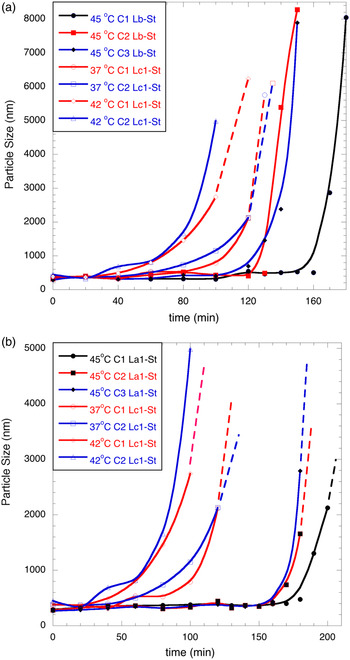
In this study we examined the role of different starter cultures on fermentation kinetics by studying their effects on the chemical and physical properties. The optimum bacterial growth temperatures for the production of fermented milks are 42 °C for Lc1, 45 °C for Lb, 37 °C for La1 and 40 °C for St. Using a temperature close to the optimum temperature significantly reduces the transformation kinetics (Anwar et al. Reference Anwar, Kralj, Van Der Maarel and Dijkhuizen2008). Aggregation profiles were obtained by measuring the size (R) for all particles present in the system as a function of time, after the starter culture was added. Figure 1a, b show a comparison of the particle size profiles for each inoculum at different temperatures. As shown in these figures, the formation of the characteristic large aggregates of yogurt begins from 30 to 80 min for Lc1-St, 120 to 210 min for Lb-St and from 160 to 220 min for La1-St, depending on the concentration and temperature. There was a significant reduction in time for Lc1-St compared to the other two inocula. Each of the profiles shown in Fig. 1a, b show two well-defined mechanisms, primary and secondary metabolism. Primary metabolism is characterised by an almost constant particle size, with an average size of 325 nm observed for Lb-St, 337 nm for La1-St and 373 nm for Lc1-St, which are consistent with the size of the bacteria. Secondary metabolism is characterised by a rapid increase in particle size due to the aggregation of casein particles induced by the pH of the medium. These aggregates are stabilised by bridges of EPS molecules, which are produced from the onset of the reaction, and these macromolecules provide the yogurt-type fermented milk with its characteristic texture.
A comparison of the particle size profiles of (Lc1-St) with: a) (Lb-St) and b) (La1-St).

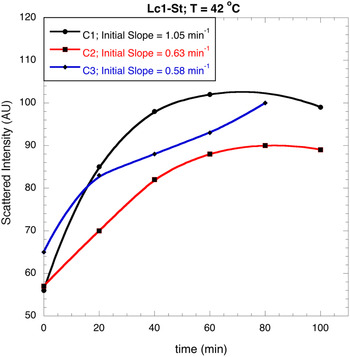
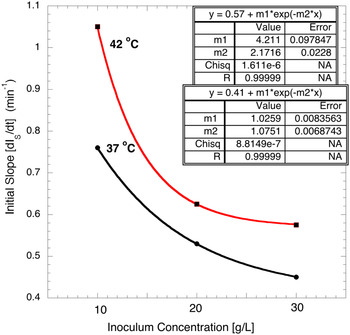
As previously mentioned, in addition to measuring the particle size, DLS also measures the scattered intensity (I S) which is related to the number concentration of scattered particles by the equation I S = I o × K × c n × R 6, where I o is the incident light intensity, K is a constant which is dependent on several parameters, c n is the number concentration of particles and R is the particle size (Berne & Pecora, Reference Berne and Pecora1976; Schmitz, Reference Schmitz1990). For the first mechanism (primary metabolism) R is practically constant and I S is linearly correlated with the c n of particles, including casein micelles, proteins (β-lactoglobulin and α-lactalbumin), fat globules and bacteria. However, I S changes with time, which is due to the growth of viable bacteria c n (via bac). The initial slope of the IS profile is related to the rate of bacterial growth by the equation (dI S/dt) = I o × K × R 6 (dc n via bac/dt). The I S profiles for Lc1-St at 42 °C at each concentration are reported in Fig. 2, which was similar for the other temperature profiles. These profiles show growth over time during the first 60 min of the reaction, where the initial slope dI S/dt was proportional to the growth rate of the bacterial population: (dI S/dt) ~ dc n (via bac)/dt. The increase in bacterial population growth eventually stops when the available space, nutrients are reduced, as shown in Fig. 2, where the slope of the I S profiles are significantly reduced with increasing time. The initial slopes at 42 °C are shown in Fig. 2, which were 1·05, 0·63 and 0·58 min−1 for C1, C2 and C3, respectively. These slopes were also determined at 37 °C, and were 0·76, 0·53 and 0·45 min−1 for C1, C2 and C3, respectively (Fig. 3). As shown in Fig. 3, the rate of bacterial growth depends strongly on the temperature, where the solid line corresponds to a fitting using an inverse power law at 42 °C with the equation dI S/dt] = 0·57 + 0·48/c3·45 and at 37 °C with the equation [dI S/dt] = 0·27 + 0·49/c0·93. This behaviour may be explained by the quorum sensing effect, which has been demonstrated by some LAB as a regulatory mechanism (Quadri, Reference Quadri2002).
Scattered intensity I S profiles at 42 °C and concentrations: C1, C2 and C3 = 3C1.

Initial slope of the I S profile (proportional to bacteria growth rate) as a function of the inoculum concentration.

For comparison purposes, the average dI S/dt (proportional to bacterial growth rate) for all inocula are shown in Table 1. From these results it is evident that the Lc1-St and Lb-St cultures grew at average rates of 0·5–1·1 and 0·9–1·0 min−1, respectively, while the average growth rate for La1-St was significantly slower from 0·01–0·02 min−1, which was between 45 to 60 times slower compared to the other cultures. These results clearly show that there was no symbiosis between La1 and St, and that these bacteria grow independently. On the other hand, the symbiosis for Lc1-St was as strong as that observed for Lb-St.
The Table shows: the inocula and their optimal temperatures, the temperature for the preparation of fermented milk, the time at which occurs aggregation (i.e. when start the secondary metabolism), the I S initial slope (proportional to the rate of bacteria growth), the delay on the lactic acid production, the delay on the organic phosphorous production, the delay on the EPS production

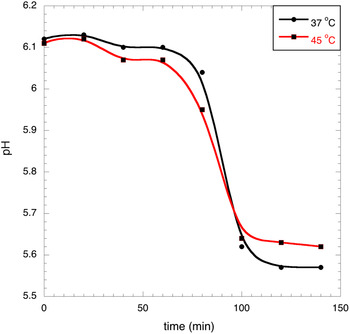
As mentioned earlier, the measurement of pH is important for the characterisation of the fermentation reaction, as it provides information on the conversion of lactose to lactic acid. The pH profiles at two temperatures are shown in Fig. 4. During the first 60–70 min of the reaction, the reduction in pH to approximately 6 was very slow, however, after 70 min there was a rapid reduction to approximately pH 5·6. This acidification process accelerates the physical and chemical changes, producing new structures (large casein aggregates, EPS and organic phosphates) and changes in morphology (high viscosity and soft texture). This rapid reduction in pH occurs at high bacterial populations.
pH profiles at 37 and 45 °C.

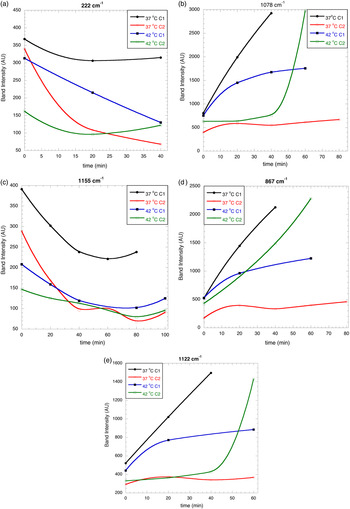
The chemical transformation kinetics were obtained using micro-Raman spectroscopy, and the results are reported in Fig. 5a–e. Figure 5a shows the Raman profile of the band at 222 cm−1, which is associated with the torsional vibration of the OH of the primary hydroxyl group (-CH2-OH) of lactose (Socrates, Reference Socrates1994; Gremlich & Yan, Reference Gremlich and Yan2001). This band was highest at the beginning of the reaction, meaning that the lactose concentration was highest at the start of the process. The lactose concentration was reduced over time due to the conversion from lactose to lactic acid, which requires between 20 to 40 min from the beginning of the process, depending on temperature and concentration. For La1-St the lactose concentration was found to start decreasing after 40–80 min, which is an important delay in lactic acid production (Table 1), while for Lb-St there was no delay in lactic acid production, except for the C3 sample which showed a delay of 40 min. The entire transformation took longer (more than 2 h) for the Lb-St inoculum.
Intensity profiles of the bands at: (a) 222 cm−1; (b) 1078 cm−1; (c) 1155 cm−1; (d) 867 cm−1; (e) 1122 cm−1.

The band at 1078 cm−1 (Fig. 5b) was associated with the C–O stretching vibration (νC–O) of the carboxyl group of lactic acid. The intensity of this band increases with time corresponding with the decrease in lactose, and this behaviour was observed at all concentrations and temperatures tested. The formation of lactic acid, and consequently a reduction in pH, begins at the start of the reaction. This decrease in pH occurs rapidly at the low inoculum concentration, but a delay of between 40 to 80 min was observed for the high inoculum concentration (Fig. 5b). For La1-St, this band was delayed by 20 min and the duration was increased by more than 2 h, suggesting a slower transformation process. For Lb-St, the transformation to lactic acid was found to be accelerated during the first 20 min (Table 1), followed by a slower increase for the rest of the process. After the conversion of lactose to lactic acid was complete, a further reduction in intensity of this band was observed, which suggested that other molecules such as peptides, free amino acids or fatty acids, which contain carboxyl groups, were decreasing faster than the lactic acid production.
The disappearance of inorganic phosphate was measured from a reduction in the intensity of the band at 1155 cm−1, corresponding to the vibrational stretching of the P-OH group (Fig. 5c). As shown in this figure, the intensity of these bands was reduced with increasing time, beginning at the start of the reaction. This suggests that the acidification process consumes inorganic phosphates. This reduction was associated with the appearance of new structures, such as organic phosphates, which was observed from the increase of the 867 cm−1 band, associated with the vibrational stretching of the P-OC group (Fig. 5d). The transformation from inorganic to organic phosphates occurs at different rates depending on temperature and concentration. The production of organic phosphates occurred slower at the high concentration and low temperature compared to the low concentration (Fig. 5d).
The EPS molecules are important for the formation and stabilisation of the internal network characteristics of the final product. The kinetics of EPS formation can be determined from IR or Raman spectroscopy (Marcotte et al. Reference Marcotte, Kegelaer, Sandt, Barbeau and LaXeur2007) by measuring the intensity of the bands within the range of 970–1182 cm−1, which are associated with the νC–O of the alcohol and ether functional groups. All polysaccharides, including exopolysaccharides, contribute to this region of the spectra. The intensity profiles for the band at 1122 cm−1 are characteristic of EPS, shown in Fig. 5e. At low inoculum concentrations the intensity of this band increased rapidly from the beginning of the process, indicating the fast production of EPS. However, at high inoculum concentrations, there was a delay in the production of EPS of between 40 to 60 min, which is detrimental to the stability of the casein aggregates. The combination of reduced pH and EPS production is responsible for the destabilisation of the casein colloid, and the resulting formation and stabilisation of the soft gel characteristics of yogurt.
Conclusions
In this study the fermented milk was prepared using a combination of the probiotics Lactobacillus casei and Streptococcus thermophilus (Lc1-St) as the starter inoculum. The results obtained for this inoculum were compared with those reported for systems prepared with Lb-St and La1-St. The kinetics of aggregation and chemical transformation were determined as a function of the incubation time. Two machanisms were observed. The first one was characterised by an almost constant particle size, with a linear increase in the scattered intensity, indicating the growth of the bacterial population. The second one was distinguished by a rapid increase in particle size and the formation of large casein aggregates, which were stabilised by EPS. At a concentration of 1 g/100 ml, EPS is rapidly produced from the start of the process, while for 2 g/100 ml there was a delay of between 40 to 60 min. As expected, a similar delay was observed for lactic acid production and the reduction in pH. There was also a delay in the conversion of lactose to lactic acid, and a delay in the production of organic phosphate.
Conflict of interest
None.
The authors are indebted to Domingo Rangel for his valuable help in the characterization techniques. We are also indebted to Blanca Huerta, Guadalupe Méndez and Carolina Muñoz for their assistance in the revision, comments and suggestions on the manuscript. This work was supported by DGAPA-CTIC (Conacyt-Mexico). We would also like to thank the project DGAPA-PAPIIT IN116716.