




No CrossRef data available.
Article contents
Memory retrieval in schizophrenia: Evidence from part-list cuing
Published online by Cambridge University Press: 04 May 2005
Abstract
Schizophrenia patients are known to exhibit episodic verbal memory deficits. Although their neural origin is debated, they have often been compared to the memory problems found in temporal lobe amnesia or frontal lobe dysfunction. Furthermore, it is unclear to what extent such deficits arise at either memory encoding or retrieval. We addressed the issue of retrieval deficits in schizophrenia in a part-list cuing experiment, testing the effect of the presentation of a subset of previously learned material on the retrieval of the remaining items. The part-list cuing procedure generally impairs retrieval but previous work showed that the detrimental effects are more pronounced in amnesic participants than in healthy people, indicating a retrieval deficit under part-list cuing conditions in amnesia. In the present study, schizophrenia patients did not exhibit increased susceptibility to part-list cuing effects and thus showed no increased retrieval inhibition from part-list cuing. Moreover, in part-list cuing, schizophrenia patients did not mirror the pattern found in amnesia, demonstrating a dissociation between amnesia and schizophrenia patients with respect to this particular memory effect. Implications for the neural basis of the part-list cuing effect and of memory disturbances in schizophrenia are discussed. (JINS, 2005, 11, 273–280.)
Information
- Type
- Research Article
- Information
- Journal of the International Neuropsychological Society , Volume 11 , Issue 3 , May 2005 , pp. 273 - 280
- Copyright
- © 2005 The International Neuropsychological Society
INTRODUCTION
Memory deficits are one of the hallmark features of the cognitive impairments observed in schizophrenia. Even against the background of generally reduced intellectual functioning, verbal learning and memory have been suggested to be especially impaired (Binks & Gold, 1998; Heinrichs & Zakzanis, 1998; Saykin et al., 1991). While the presence of memory deficits in schizophrenia is uncontroversial, their exact nature and neuronal origin is.
Neuropsychologically, schizophrenia patients' memory performance has been likened to that of participants suffering from medial-temporal lobe amnesia (McKenna et al., 1990; Rushe et al., 1999; Saykin et al., 1991), to the memory performance of patients with frontal lobe damage (Torres et al., 2001) or to both (Cirillo & Seidman, 2003; Gold et al., 1992; Kolb & Whishaw, 1983). Similarities with patients with striatal pathology have also been pointed out (Perry et al., 2000; van Oostrom et al., 2003), reflecting observations of prominent retrieval deficits against a background of relatively intact recognition and mild encoding deficits.
Concerning encoding, storage, or retrieval deficits in schizophrenia and the underlying brain mechanisms, the literature is rather inconsistent but encoding and retrieval deficits are implicated more often than storage degradation (Gur et al., 2000; Paulsen et al., 1995). Several studies show that schizophrenia patients make little use of spontaneous semantic organization, indicating inefficient encoding strategies (Brebion et al., 1997; Gold et al., 1992; Koh et al., 1976; Larsen & Fromholt, 1976). Cirillo and Seidman (2003) in a recent review also conclude that the verbal declarative memory deficit in schizophrenia is largely accounted for by deficits at the encoding stage.
Yet, a considerable amount of evidence points to retrieval deficits as an important source of memory problems in schizophrenia. Poor semantic organization at recall can arise from both encoding and retrieval deficits (Riefer et al., 2002) but data demonstrating disproportionate improvement of performance in recognition memory tests suggest that schizophrenia patients may primarily have problems retrieving stored material (Paulsen et al., 1995; van Oostrom et al., 2003). Further information on participants' retrieval performance comes from interference experiments: Proactive interference has been reported to be largely normal in schizophrenia patients (O'Carroll et al., 1993; Torres et al., 2001) but susceptibility to retroactive interference appears increased. This has been interpreted as evidence for a marked retrieval deficit attributed to deficient frontally mediated executive functions (Torres et al., 2001), although the converse pattern has also been observed (Kareken et al., 1996).
One reason for the inconsistent evidence regarding retrieval deficits in schizophrenia may be the fact that different experimental procedures test different types of retrieval failure: For proactive and retroactive interference, retrieval failure is likely to result from increased competition arising from the encoding of additional material (Bäuml, 1996; Mensink & Raaijmakers, 1988). But retrieval failure can also be induced by factors that are commonly thought to aid recall. Although cuing is often beneficial for subsequent retrieval (Tulving, 1974), in part-list cuing, the presentation of a subset of the previously learned material as retrieval cues for the remaining material impairs recall of the remaining portions of the material (Roediger, 1973; Slamecka, 1968; see Nickerson, 1984 and Roediger & Neely, 1982, for reviews). A recently demonstrated dissociation between susceptibility to part-list cuing and retroactive interference in amnesia (Bäuml et al., 2002) underscores the existence of different types of retrieval deficits. Although amnesics were more vulnerable to part-list cuing effects, they did not exhibit increased retroactive interference. In schizophrenia, the effect of part-list cuing on memory retrieval has not yet been investigated but schizophrenia patients, unlike amnesics, have been shown to suffer from excessive retroactive interference (Torres et al., 2001).
Examining part-list cuing in schizophrenia is of basic interest in order to better characterize the pattern of memory deficits found in this patient group. Comparing schizophrenia patients' performance on memory tests with the performance found in other populations with memory deficits can also help to delineate the psychological and neural mechanisms that underlie the memory deficits in schizophrenia. Conversely, combined evidence from studies in different populations will give a clearer picture of the nature of the part-list cuing effect.
So far, there are very few studies of part-list cuing in populations other than university students. As mentioned above, in amnesia increased susceptibility to the negative effects of part-list cuing has recently been reported (Bäuml et al., 2002). In elderly participants, a new and extensive investigation of part-list cuing indicates a robust cuing effect that on some measures may exceed the amount of part-list cuing observed in younger participants (Marsh et al., 2004), although previous data were ambiguous (Foos & Clark, 2000; Hultsch & Craig, 1976).
For part-list cuing in schizophrenia patients, several alternative predictions can be made based on the theoretical accounts and on neuropsychological findings. Part-list cuing has been explained by either strategy disruption or active inhibition induced by the retrieval cues. Within a strategy disruption account the presentation of retrieval cues is assumed to disrupt participants' preferred recall strategy (Basden & Basden, 1995) or, in a similar vein, to induce an incongruency between learning context and retrieval context that disrupts recall (Sloman et al., 1991). Schizophrenia patients have been demonstrated to show deficient strategic control processes in memory (e.g., Hazlett et al., 2000; Stone et al., 1998) and are particularly sensitive to the presence of distracting stimuli (e.g., Fleming et al., 1995). Thus, they may be expected to suffer more from the distracting presence of retrieval cues in part-list cuing resulting in a larger part-list cuing effect.
Based on the neuropsychological evidence, schizophrenia patients may also be expected to show increased part-list cuing effects, if in a part-list cuing situation their memory performance were similar to what is found in temporal lobe amnesia, where the part-list cues have more disruptive effects than in comparison participants (Bäuml et al., 2002). Analogous results in schizophrenia would support the hypothesis that similar mechanisms underlie the memory problems of amnesia and schizophrenia patients and may give rise to speculations about the neural underpinnings of the part-list cuing effect.
An alternative explanation of the part-list cuing effect is an active inhibition account. Here, the presentation of portions of the learned material is assumed to lead to active inhibition of the remaining material (Bäuml & Aslan, 2004; Bäuml & Kuhbandner, 2003; Foos & Clark, 2000), a process which in the memory domain has recently been theoretically attributed to prefrontal and anterior cingulate functions (Levy & Anderson, 2002). If so, schizophrenia patients might be expected to have reduced rather than increased part-list cuing effects, since they have repeatedly been shown to suffer from inhibition deficits in various tasks. These inhibition deficits are usually ascribed to frontal lobe dysfunction (e.g., Braver et al., 1999; Perlstein et al., 2003).
Finally, normal part-list cuing effects in schizophrenia in spite of reduced memory performance would indicate that the processes that mediate part-list cuing are undisturbed in schizophrenia. Moreover, schizophrenia patients would show a dissociation from amnesia patients demonstrating that increased susceptibility to part-list cuing is not a default consequence of poor memory.
To test whether schizophrenia patients are more, less, or equally susceptible to part-list cuing as normal people, we used the same experimental paradigm as previously with amnesic patients (Bäuml et al., 2002). Participants studied categorized item lists that consisted of items that were either strongly and moderately (“STRONG” list) or weakly and moderately (“WEAK” list) associated with their category cue. Moderate items were used as part-list cues, the strong and weak items served as target items. Memory for target items was tested either with the moderate items as retrieval cues (part-list cuing condition) or without such retrieval cues (no part-list cuing). Previous work has shown that in healthy people the detrimental effects of part-list cuing are restricted to strongly associated members of a category, whereas in amnesia patients the retrieval deficits extend to the weak members of a category.
METHODS
Research Participants
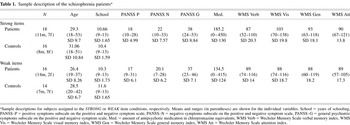
Demographical and clinical data of the research participants for the two lists are detailed in Table 1. Altogether, 30 comparison participants and 34 schizophrenia patients took part in the study. Sixteen comparison participants and 18 patients were assigned to the strong list and 14 comparison participants and 16 patients were assigned to the weak list. All patients had received a DSM–IV (American Psychiatric Association, 1994) diagnosis of schizophrenia and at the time of testing were inpatients at the research unit of the Center for Psychiatry, Reichenau, Germany. Their clinical status was evaluated by their psychiatrist or clinical psychologist by means of the Positive and Negative Symptoms Scale (PANSS, Kay et al., 1987). Diagnoses were initially made by individual therapists and then reviewed and confirmed during weekly team conferences of the involved staff. Most patients received a diagnosis of paranoid-hallucinatory schizophrenia (n = 24), some of undifferentiated (n = 4), disorganized (n = 4) schizophrenia or schizoaffective disorder (n = 2). Patients were also administered the Wechsler Memory Scale–Revised (WMS–R; Wechsler, 1987) to assess their general memory performance. Comparison participants were partly recruited through public advertisements and partly consisted of hospital staff. They were questioned as to their general health, history of neurological disorders, treatment for psychiatric or psychological disorders, or psychoactive substance abuse. Only participants who reported to be free of any such conditions were included in the study. Overall, patients and comparison participants did not differ in average age [F(3,60) = 0.6, p = .9] or educational level [F(3,60) = 1.35, p = .27]. All participants received a financial bonus for participation.
Sample description of the schizophrenia patientsa

Materials and Procedures
For each item type (STRONG and WEAK), two parallel categorized item lists were constructed. These consisted each of six target categories, two non-target categories and three filler categories. Target and non-target categories in turn consisted of three strong items and three moderate items for the STRONG lists or three weak items and three moderate items for the WEAK lists. Filler categories consisted of two moderate items per category. The items were drawn from several published taxonomic frequency norms (Battig & Montague, 1969; Mannhaupt, 1983; Scheithe & Bäuml, 1995). Item strength was determined from rank order on these norms: The STRONG items were chosen to have a rank order between 5 and 10 according to these norms, and WEAK items had a rank order between 30 and 40 on the taxonomic frequency norms. The moderate items were chosen to have a rank order between 15 and 20.
For each list, effort was made to minimize inter-category similarity and phonemic similarity between category names. Within the categories, no two items began with the same letter, ensuring that each letter cue would be unique at test. Items with strong item-to-item associations were avoided.
For comparison participants, the lists consisted of the six target, two non-target, and three filler categories, yielding 54 items per list (6 * 6 + 2 * 6 + 3 * 2). For schizophrenia patients, shortened lists were used, consisting of the six target and three filler categories, yielding 42 items per list (6 * 6 + 3 * 2). This difference in list length was introduced to roughly equate acquisition levels across participant groups (see Bäuml et al., 2002). Participants were randomly assigned to either the STRONG or the WEAK list.
PROCEDURE
Overview
In the experiment, schizophrenia patients and comparison participants were tested on two categorized item lists that consisted of either “strong” or “weak” category exemplars (“strong” and “weak” list). For each list, two parallel versions, one part-list cuing (PLC-list) and one non-part-list cuing (NPLC-list) were created. Patients and comparison participants were individually tested on both parallel versions within one session. The order of testing (PLC versus NPLC) was counterbalanced as was the assignment of the parallel versions to the individual conditions. Within each session, the presentation of all items from one list, say PLC-list, was followed by a short distracter task, which was then immediately followed by the test phase. After a 15-min intermission during which the participants had to perform two short visuo-spatial tasks, the items from the remaining list were presented. Again a distracter task preceded testing.
Presentation Phase
Individual items were presented together with their category name (e.g., Fruit-Orange) printed on cardboard cards of about 20 × 12 cm size. Cards were successively shown for 5 s each and read out to the participant by the experimenter. The order of cards in each list was randomized across six subsequent blocks of items containing each one item per target category (plus, for the comparison participants, non-target category). The first and last three items of each list always consisted of buffer items from the filler categories to reduce primacy and recency effects on subsequent recall. The presentation of an item list was promptly followed by the distracter task which consisted of 30 s of backward subtraction by 2s from a random three-digit number.
Test Phase
Immediately following the distracter task a cued recall test was carried out. In the NPLC condition, for each target category the participants were shown a sheet with the category name and the unique first letters of the three strong items of the respective target category on it. Participants were instructed to recall the items that corresponded to the cue from any portion of the presented list. They were allowed 45 s for a category's three items, after which the next category was tested.
In the PLC condition, participants were shown a category's moderate items, asked to read them aloud and encouraged to use them as retrieval cues before they were given the category's test sheet. In the PLC condition, the three moderate items were printed on the test sheet in addition to the category name and the first letters of the strong items. Again, participants had 45 s to complete a test sheet. In both conditions, participants were asked to say the remembered items out loud and the experimenter wrote them down for them.
RESULTS
Strong Items
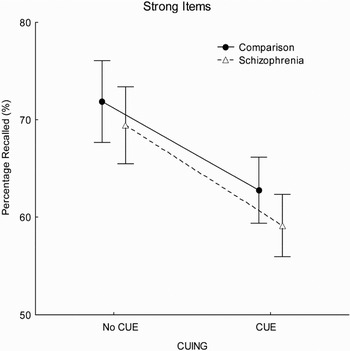
The results of a 2 × 2 ANOVA with the factors GROUP (healthy comparison, schizophrenia) and CUING (NPLC, PLC) demonstrated that part-list cuing adversely affected recall in both the comparison participants and the schizophrenia patients [CUING, F(1,32) = 11.00, p < .001]. Schizophrenia patients did not differ from comparison participants in overall recall levels [GROUP, F(1,32) = .48, p = .49] and the PLC effect did not interact with participant group [GROUP × CUING, F(1,32) = .04, p = .84]. Figure 1 shows the recall levels of strong items in the two cuing conditions for the two participant groups from the present experiment. Schizophrenia patients' memory performance was not significantly correlated with the amount of medication received. The correlation between number of items recalled in the NPLC condition and chlorpromazine equivalents was r = −.05 (p > .1) and between number of items recalled in the PLC condition and chlorpromazine equivalents it was r = −.24, (p > .1).

Mean percentage and standard deviations of recall performance for STRONG items are shown for normal participants and schizophrenia patients. The left side of the plot shows recall performance without cues, the right side depicts performance when cues were provided.
Weak Items
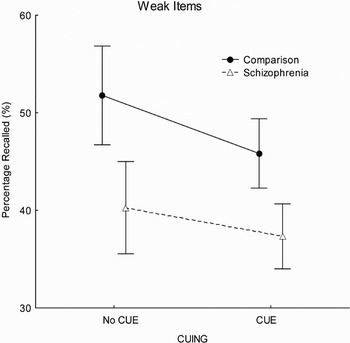
The effect PLC had on recall levels of weak items in the two participant groups is illustrated in Figure 2. Results of a 2 × 2 ANOVA with the factors GROUP (healthy comparison, schizophrenia) and CUING (NPLC, PLC) showed no significant influence of part-list cuing on recall of the weak items in either group [CUING, F(1,28) = 2.18, p = .15] and no interaction between participant group and part-list cuing [GROUP × CUING, F(1,28) = .25, p = .62]. However, the schizophrenia patients tended to have overall lower recall levels for the weak items independently of cuing [GROUP, F(1,28) = 3.74, p = .06]. Schizophrenia patients memory performance was not significantly correlated with the amount of medication received. The correlation between number of items recalled in the NPLC condition and chlorpromazine equivalents was r = −.01 (p > .1) and between number of items recalled in the PLC condition and chlorpromazine equivalents it was r = −.33 (p > .1).

Mean percentage and standard deviations of recall performance for WEAK items are shown for normal participants and schizophrenia patients. The left side of the plot shows recall performance without cues, the right side depicts performance when cues were provided.
Part-List Cuing in Amnesia
In the following, results of our previous study (Bäuml et al., 2002) of amnesic participants are briefly described. Amnesic patients and age and education-matched controls studied a “STRONG” list (12 patients and 18 controls) and a “WEAK” list (12 patients and 22 controls), respectively. Patients had normal intelligence quotients (IQs) and attention indices but markedly reduced verbal memory (mean verbal WMS index was 68.83 for the “STRONG” list and 70.58 for the “WEAK” list). The lesions mostly affected medio-temporal and subcortical structures, although their amnesia resulted from various types of lesions (thalamic infarcts, septal cysts, subarachnoidal hemorrhages, RCA aneurysms). Three of the patients assigned to either list showed additional evidence of frontal lobe involvement. Excluding these participants from the analyses did not affect the following results.
Analogous to the present study, cuing generally impaired recall of the STRONG list [CUING; F(1,30) = 16.01, p < .001] and this effect did not interact with subject group [GROUP × CUING, F(1,30) = 1.02, p = .32]. For the WEAK list, however, the effect of cuing interacted significantly with subject group [GROUP × CUING, F(1,30) = 4.1, p = .05] and was present only in the amnesic participants [CUING, F(1,11) = 5.74, p < .05] but not in controls [CUING, F(1,21) = .60, p = .45]. The results for the amnesic patients thus contrast sharply with those of the schizophrenia patients, who, like their controls did not show a detrimental effect when cued with WEAK items [CUING, F(1,15) = .46, p = .51] but only when cued with STRONG items [CUING, F(1,17) = 5.19, p < .05].
DISCUSSION
The present results replicate prior work by showing that the presentation of a subset of previously learned material as retrieval cues can impair recall of the non-cue items (Basden & Basden, 1995; Roediger, 1973; Slamecka, 1968; Sloman et al., 1991). In particular, the thesis is supported that the size of this detrimental effect depends on the associative strength between the to-be-retrieved item and the category cue (Bäuml et al., 2002). For strongly associated items a highly significant part-list cuing effect was found, whereas the effect was considerably reduced and did not reach statistical significance for weakly associated items. The main result of the present study, however, is that schizophrenic patients show the same pattern of results as healthy controls. This parallel indicates normal retrieval performance in schizophrenia patients under conditions of part-list cuing.
Previous work suggested a dissociation between schizophrenia and amnesia patients by finding increased retroactive interference in schizophrenia (Torres et al., 2001) but normal retroactive interference in amnesia (Bäuml et al., 2002). The results from the present study suggest a second dissociation between the two patient groups by showing a normal size of part-list cuing in schizophrenia patients, compared to enhanced detrimental effects in amnesic people (Bäuml et al., 2002). Concerning retroactive interference and part-list cuing, schizophrenia and amnesia patients thus show the opposite pattern of retrieval deficits, supporting the hypothesis that the two types of episodic forgetting reflect the action of different retrieval mechanisms. Thus, in schizophrenia the retrieval processes and neural mechanisms responsible for the part-list cuing effect appear intact. Neither the prediction based on the inhibition deficit proposal that schizophrenic patients would show reduced part-list cuing nor the hypothesized greater strategy disruption due to excessive distractability from the cues were borne out.
At first glance, this may appear surprising, given that deficits in tasks that require the formation of strategies or the inhibition of cues have often been reported in schizophrenia and have commonly been attributed to deficient frontal lobe functioning in schizophrenia (Davidson & Heinrichs, 2003; Hutton et al., 1998). However, the existing neuropsychological data and also data from the elderly may suggest an alternative interpretation. In our previous study, amnesic patients with organic damage to medial temporal lobe and subcortical structures were more susceptible to the part-list cuing effect and further statistical analysis showed that the additional presence or absence of frontal-lobe damage in some amnesic patients did not affect their part-list cuing patterns (Bäuml et al., 2002). Furthermore, the fact that older adults do not show reduced inhibition in a part-list cuing task (Marsh et al., 2004) may corroborate the view that part-list cuing is not mediated by the frontal lobes as older people have repeatedly been shown to exhibit severe deficits in frontal lobe functioninga
Older adults have also been found to show deficits in temporal lobe functioning (e.g., Daselaar et al., 2003). However, these appear more variable than the frontal lobe deficits (Prull et al., 2000). If part-list cuing is mediated by the temporal lobes and deficits in this area enhance the effect (Bäuml et al., 2002), then older adults may occasionally show enhanced detrimental effects of part-list cuing. Under certain conditions, this seems to be the case (Marsh et al., 2004).
The finding that amnesic patients show increased part-list cuing may point to a special role of the medial temporal lobes and surrounding subcortical structures in part-list cuing. Also, the fact that the part-list cuing effect decreases when participants form inter-item associations (Bäuml & Kuhbandner, 2003) may be consistent with a special role of binding mechanisms in the medial temporal lobes in part-list cuing.
Clearly, more data on the neural underpinnings of part-list cuing are needed, but although the terms inhibition and strategy are commonly associated with frontal lobe functions, regarding retrieval inhibition they may be used in much too broad a sense. Using other paradigms demonstrating inhibitory effects in memory, namely directed forgetting and retrieval-induced forgetting (see Levy & Anderson, 2002 and MacLeod, 1998 for reviews), it has recently been shown that these two forms of inhibition are neurologically dissociable, directed forgetting being vulnerable to frontal and retrieval-induced forgetting being affected by temporal lobe lesions (Conway & Fthenaki, 2003). Similarly, the inhibition or strategy disruption induced by part-list cuing may not be primarily attributable to frontal lobe mechanisms, consistent with recent work showing that part-list cuing and retrieval-induced forgetting show many parallels (Bäuml & Aslan, 2004; Bäuml & Kuhbandner, 2003). Conceivably, deficits in frontal-lobe-related functions such as initial organization of material, formation of semantic associations, holding information on-line for further processing, and reduced attention capacities or general slowing may contribute to quantitatively poorer memory performance in situations like the present one (Schacter, 1987; Weinberger et al., 1994). Deficits in such functions have been widely reported in schizophrenia (e.g., Brebion et al., 1997).
As outlined above, memory deficits in general and more specifically retrieval deficits can arise from various sources that are likely to differ in their underlying cognitive and neural substrates. A number of well-conducted studies suggest that retrieval deficits can indeed occur in schizophrenia (Torres et al., 2001). However, the present study demonstrates that these are not general retrieval deficits but rather deficits in certain types of retrieval tasks. Specifying exactly which types of tasks reveal such a deficit, and which ones do not, is a high priority for future research.
Obviously, schizophrenia is a heterogeneous disorder and the same clearly goes for amnesia. Therefore, further studies might address in greater detail whether the patterns reported so far hold for selected subgroups of either disorder. At present, we have shown that part-list cuing patterns in a reasonably sized population of predominantly paranoid-hallucinatory schizophrenia patients do not differ from normal. Furthermore, previous work showed that amnesic patients with predominantly medial temporal lobe and subcortical lesions are more susceptible to the detrimental effects of part-list cuing than normal and that this pattern did not covary with the presence of additional frontal lobe lesions. Whether more narrowly defined subtypes of schizophrenia or amnesia might deviate from this pattern is open to further research. Comparing the arising pattern of results with neuroimaging data in healthy participants may elucidate the neural underpinnings of part-list cuing and reveal the nature of memory disturbances in clinical populations.
ACKNOWLEDGMENTS
Many thanks to Claudia Catani and Christine Kraft for help with data collection and to Drs. Karl Pröpster and Hans Watzl for providing the diagnostics and clinical status of the patients.
References
REFERENCES
American Psychiatric Association
(1994).
Diagnostic and Statistical Manual of Mental Disorders
(4th ed.).
Washington, DC:
American Psychiatric Association Press.
Anderson, N.D. &
Craik, F.I.M.
(2000).
Memory in the aging brain. In
E. Tulving &
F. I. M. Craik (Eds.),
The Oxford handbook of memory (pp.
411–426).
New York:
Oxford University Press.
Basden, D.R. &
Basden, B.H.
(1995).
Some tests of the strategy disruption hypothesis of part-list cuing
inhibition.
Journal of Experimental Psychology: Learning, Memory, and
Cognition,
21,
1656–1669.Google Scholar
Battig, W.F. &
Montague, W.E.
(1969).
Category norms for verbal items in 56 categories: A replication and
extension of the Conneticut category norms.
Journal of Experimental Psychology,
80,
1–46.Google Scholar
Bäuml, K.-H.
(1996).
Revisiting an old issue: Retroactive interference as a function of
the degree of original and interpolated learning.
Psychonomic Bulletin and Review,
3,
380–384.CrossRefGoogle Scholar
Bäuml, K.-H. &
Aslan, A.
(2004).
Part-list cuing as instructed retrieval inhibition.
Memory and Cognition,
32(4),
610–617.CrossRefGoogle Scholar
Bäuml, K.-H.,
Kissler, J., &
Rak A.
(2002).
Part-list cuing in amnesic patients: Evidence for a retrieval
deficit.
Memory and Cognition,
30(6),
862–870.CrossRefGoogle Scholar
Bäuml, K.-H. &
Kuhbandner, C.
(2003).
Retrieval-induced forgetting and part-list cuing in associatively
structured lists.
Memory and Cognition,
31(8),
1188–1197.CrossRefGoogle Scholar
Binks, S.W. &
Gold, J.M.
(1998).
Differential cognitive deficits in the neuropsychology of
schizophrenia.
The Clinical Neuropsychologist,
12,
8–20.CrossRefGoogle Scholar
Braver, T.S.,
Barch, D.M., &
Cohen, J.D.
(1999).
Cognition and control in schizophrenia: A computational model of
dopamine and prefrontal function.
Biological Psychiatry,
46(3),
312–328.CrossRefGoogle Scholar
Brebion, G.,
Amador, X.,
Smith, M.J., &
Gorman, J.M.
(1997).
Mechanisms underlying memory impairment in schizophrenia.
Psychological Medicine,
27,
383–393.Google Scholar
Cirillo, M.A. &
Seidman, L.J.
(2003).
Verbal declarative memory dysfunction in schizophrenia: From
clinical assessment to genetics and brain mechanisms.
Neuropsychology Review,
13(2),
43–77.Google Scholar
Conway, M.A. &
Fthenaki, A.
(2003).
Disruption of inhibitory control of memory following lesions to the
frontal and temporal lobes.
Cortex,
39(4–5),
667–686.CrossRefGoogle Scholar
Daselaar, S.M.,
Veltman, D.J.,
Rombouts, S.A.,
Raaijmakers, J.G., &
Jonker, C.
(2003).
Deep processing activates the medial temporal lobe in young but not
in old adults.
Neurobiology of Aging,
24(7),
1005–1011.CrossRefGoogle Scholar
Davidson, L.L. &
Heinrichs, R.W.
(2003).
Quantification of frontal and temporal lobe brain-imaging findings
in schizophrenia: A meta-analysis.
Psychiatry Research,
122(2),
69–87.CrossRefGoogle Scholar
Fleming, K.,
Goldberg, T.E.,
Gold, J.M., &
Weinberger, D.R.
(1995).
Verbal working memory dysfunction in schizophrenia: Use of a
Brown-Peterson paradigm.
Psychiatry Research,
56(2),
155–161.Google Scholar
Foos, P.W. &
Clark, M.C.
(2000).
Old age, inhibition, and the part-set cuing effect.
Educational Gerontology,
26,
155–160.Google Scholar
Gold, J.M.,
Randolph, C.,
Carpenter, C.J.,
Goldberg, T.E., &
Weinberger, D.R.
(1992).
Forms of memory failure in schizophrenia.
Journal of Abnormal Psychology,
101(3),
487–494.CrossRefGoogle Scholar
Gur, R.C.,
Moelter, S.T., &
Ragland, J.D.
(2000).
Learning and memory in schizophrenia. In
T. Sharma &
P. Harvey (Eds.),
Cognition in schizophrenia: Impairments, importance and treatment
strategies (pp.
72–91).
Oxford, England:
Oxford University Press.
Harnishfeger, K.K. &
Pope, R.S.
(1996).
Intending to forget: The development of cognitive inhibition in
directed forgetting.
Journal of Experimental Child Psychology,
62,
292–315.CrossRefGoogle Scholar
Hazlett, E.A.,
Buchsbaum, M.S.,
Jeu, L.A.,
Nenadic, I.,
Fleischman, M.B.,
Shihabuddin, L.,
Haznedar, M.M., &
Harvey, P.D.
(2000).
Hypofrontality in unmedicated schizophrenia patients studied with
PET during performance of a serial verbal learning task.
Schizophrenia Research,
43(1),
33–46.CrossRefGoogle Scholar
Heinrichs, R.W. &
Zakzanis, K.K.
(1998).
Neurocognitive deficit in schizophrenia: A quantitative review of
the evidence.
Neuropsychology,
12(3),
426–445.CrossRefGoogle Scholar
Hultsch, D.F. &
Craig, E.R.
(1976).
Adult age differences in the inhibition of recall as a function of
retrieval cues.
Developmental Psychology,
12,
83–84.CrossRefGoogle Scholar
Hutton, S.B.,
Puri, B.K.,
Duncan, L.J.,
Robbins, T.W.,
Barnes, T.R., &
Joyce, E.M.
(1998).
Executive function in first-episode schizophrenia.
Psychological Medicine,
28(2),
463–473.CrossRefGoogle Scholar
Kareken, D.A.,
Moberg, P.J., &
Gur, R.C.
(1996).
Proactive inhibition and semantic organization: Relationship with
verbal memory in patients with schizophrenia.
Journal of the International Neuropsychological Society,
2(6),
486–493.Google Scholar
Kay, S.R.,
Fiszbein, A., &
Opler, L.A.
(1987).
The positive and negative symptoms scale (PANSS) for
schizophrenia.
Schizophrenia Bulletin,
13,
261–276.CrossRefGoogle Scholar
Koh, S.D.,
Kayton, L., &
Peterson, R.A.
(1976).
Affective encoding and consequent remembering in schizophrenic young
adults.
Journal of Abnormal Psychology,
85(2),
156–166.Google Scholar
Kolb, B. &
Whishaw, I.Q.
(1983).
Performance of schizophrenic patients on tests sensitive to left or
right frontal, temporal, or parietal function in neurological
patients.
Journal of Nervous and Mental Disease,
171(7),
435–443.CrossRefGoogle Scholar
Larsen, S.F. &
Fromholt, P.
(1976).
Mnemonic organization and free recall in schizophrenia.
Journal of Abnormal Psychology,
85(1),
61–65.CrossRefGoogle Scholar
Levy, B.J. &
Anderson, M.C.
(2002).
Inhibitory processes and the control of memory retrieval.
Trends in Cognitive Science,
6(7),
299–305.CrossRefGoogle Scholar
MacLeod, C.M.
(1998).
Directed forgetting. In
J.M. Golding &
C.M. MacLeod (Eds.),
Intentional forgetting: Interdisciplinary approaches (pp.
1–57).
Mahwah, New Jersey:
Erlbaum.
MacPherson, S.E.,
Phillips, L.H., &
Della Sala, S.
(2002).
Age, executive function, and social decision making: A dorsolateral
prefrontal theory of cognitive aging.
Psychology and Aging,
17(4),
598–609.Google Scholar
Mannhaupt, H.-R.
(1983).
Produktionsnormen für verbale Reaktionen zu 40 geläufigen
Kategorien. [German category norms for verbal items in 40
categories].
Sprache und Kognition,
2,
264–278.Google Scholar
Marsh, E.J.,
Dolan, P.O.,
Balota, D.A., &
Roediger, H.L.
(2004).
Part-set cuing effects in younger and older adults.
Psychology and Aging,
19(1),
134–144.CrossRefGoogle Scholar
McKenna, P.J.,
Tamlyn, D.,
Lund, C.E.,
Mortimer, A.M.,
Hammond, S., &
Baddeley, A.D.
(1990).
Amnesic syndrome in schizophrenia.
Psychological Medicine,
20,
967–972.CrossRefGoogle Scholar
Mensink, J.G. &
Raaijmakers, J.G.W.
(1988).
A model of interference and forgetting.
Psychological Review,
95,
434–455.CrossRefGoogle Scholar
Nickerson, R.S.
(1984).
Retrieval inhibition from part-set cuing: A persisting enigma in
memory research.
Memory and Cognition,
12,
531–552.CrossRefGoogle Scholar
O'Carroll, R.E.,
Murray, C.,
Austin, M.P.,
Ebmeier, K.P.,
Goodwin, G.M., &
Dunan, J.
(1993).
Proactive interference and the neuropsychology of
schizophrenia.
British Journal of Clinical Psychology,
32(3),
353–356.Google Scholar
Paulsen, J.S.,
Heaton, R.K.,
Sadek, J.R.,
Perry, W.,
Delis, D.C.,
Braff, D.,
Kuck, J.,
Zisook, S., &
Jeste, D.V.
(1995).
The nature of learning and memory impairments in
schizophrenia.
Journal of the International Neuropsychological Society,
1(1),
88–99.CrossRefGoogle Scholar
Perlstein, W.M.,
Dixit, N.K.,
Carter, C.S.,
Noll, D.C., &
Cohen, J.D.
(2003).
Prefrontal cortex dysfunction mediates deficits in working memory
and prepotent responding in schizophrenia.
Biological Psychiatry,
53(1),
25–38.CrossRefGoogle Scholar
Perry, W.,
Light, G.A.,
Davis, H., &
Braff, D.
(2000).
Schizophrenia patients demonstrate a dissociation on declarative and
non-declarative memory tests.
Schizophrenia Research,
46,
167–174.CrossRefGoogle Scholar
Prull, M.W.,
Gabrieli, J.D.E., &
Bunge, S.E.
(2000).
Age related changes in memory: A cognitive neuroscience
perspective.
In
F.I.M. Craik &
T.A. Salthouse (Eds.),
The handbook of aging and cognition
(2nd ed., pp.
91–153).
Mahwah, New Jersey:
Erlbaum.
Riefer, D.M.,
Knapp, B.R.,
Batchelder, W.H.,
Bamber, D., &
Manifold, V.
(2002).
Cognitive Psychometrics: Assessing storage and retrieval deficits in
special populations with multinomial processing tree models.
Psychological Assessment,
14(2),
184–201.CrossRefGoogle Scholar
Roediger, H.L.
(1973).
Inhibition in recall from cuing with recall targets.
Journal of Verbal Learning and Verbal Behavior,
12,
1123–1125.Google Scholar
Roediger, H.L. &
Neely, J.H.
(1982).
Retrieval blocks in episodic and semantic memory.
Canadian Journal of Psychology,
36,
213–242.Google Scholar
Rushe, T.M.,
Woodruff, P.W.,
Murray, R.M., &
Morris, R.G.
(1999).
Episodic memory and learning in patients with chronic
schizophrenia.
Schizophrenia Research,
35(1),
85–96.Google Scholar
Saykin, A.J.,
Gur, R.C.,
Gur, R.E.,
Mozley, P.D.,
Mozley, L.H.,
Resnick, S.M.,
Kester, D.B., &
Stafiniak, P.
(1991).
Neuropsychological function in schizophrenia. Selective impairment
in memory and learning.
Archives of General Psychiatry,
48(7),
618–624.CrossRefGoogle Scholar
Schacter, D.L.
(1987).
Memory, amnesia, and frontal lobe dysfunction.
Psychobiology,
15,
21–36.Google Scholar
Scheithe, K. &
Bäuml, K.-H.
(1995).
Deutschsprachige Normen für Vertreter von 48 Kategorien.
[German normative data for representatives of 48
categories].
Sprache und Kognition,
14,
504–513.Google Scholar
Slamecka, N.J.
(1968).
An examination of trace storage in free recall.
Journal of Experimental Psychology,
76,
504–513.Google Scholar
Sloman, S.A.,
Bower, G.H., &
Rohrer, D.
(1991).
Congruency effects in part-list cuing.
Journal of Experimental Psychology: Learning, Memory, and
Cognition,
17,
974–982.Google Scholar
Stone, M.,
Gabrieli, J.D.,
Stebbins, G.T., &
Sullivan, E.V.
(1998).
Working and strategic memory deficits in schizophrenia.
Neuropsychology,
12(2),
278–288.CrossRefGoogle Scholar
Torres, I.J.,
Flashman, L.A.,
O'Leary, D.S., &
Andreasen, N.C.
(2001).
Effects of retroactive and proactive interference on word list
recall in schizophrenia.
Journal of the International Neuropsychological Society,
7(4),
481–490.CrossRefGoogle Scholar
Van Oostrom, I.,
Dollfus, S.,
Brazo, P.,
Abadie, P.,
Hallbecq, I.,
Thery, S., &
Marie, R.M.
(2003).
Verbal learning and memory in schizophrenic and Parkinson's
disease patients.
Psychiatry Research,
117,
25–34.CrossRefGoogle Scholar
Wechsler, D.
(1987).
Wechsler Memory Scale–Revised.
San Antonio, TX:
Psychological Corporation.
Weinberger, D.R.,
Aloia, M.S.,
Goldberg, T.E., &
Berman, K.F.
(1994).
The frontal lobes and schizophrenia.
Journal of Neuropsychiatry and Clinical Neurosciences,
6,
419–427.Google Scholar
Zacks, R.T.,
Radvansky, G., &
Hasher, L.
(1996).
Studies of directed forgetting in older adults.
Journal of Experimental Psychology: Learning, Memory &
Cognition,
22(1),
143–156.CrossRefGoogle Scholar
Zellner, M. &
Bäuml, K.-H.
(2005).
Intact retrieval inhibition in children's episodic
recall. Memory and Cognition,
in press.CrossRefGoogle Scholar
Sample description of the schizophrenia patientsa
Mean percentage and standard deviations of recall performance for STRONG items are shown for normal participants and schizophrenia patients. The left side of the plot shows recall performance without cues, the right side depicts performance when cues were provided.
Mean percentage and standard deviations of recall performance for WEAK items are shown for normal participants and schizophrenia patients. The left side of the plot shows recall performance without cues, the right side depicts performance when cues were provided.
 You have
Access
- 15
- Cited by