Despite decades of experience, the use of contact precautions (CP) for endemic methicillin-resistant Staphylococcus aureus (MRSA) and vancomycin-resistant Enterococcus (VRE) remains controversial.Reference Fätkenheuer, Hirschel and Harbarth 1 , Reference Morgan, Kaye and Diekema 2 As a result, there is a growing diversity of practice for CP in acute care hospitals.Reference Fätkenheuer, Hirschel and Harbarth 1 , Reference Morgan, Pineles and Shardell 3 A North American group of adult and pediatric hospital epidemiologists and infection prevention experts with expertise in guideline development met on the Society for Healthcare Epidemiology of America (SHEA) Guidelines committee and, independent of SHEA or SHEA endorsement, completed this article to elucidate the current state of the literature pertaining to the application and discontinuation of CP for endemic MRSA and VRE. In addition, the group administered a survey to the SHEA Research Network of hospital epidemiologists and infection preventionists to better ascertain the practice and experience with CP for endemic MRSA and VRE. Finally, a convenience sample of hospitals that do not use CP for MRSA or VRE was identified from the literature and an infection control listserv, and their experiences were elicited and summarized.
METHODS
Guidelines were reviewed for recommendations relating to use of CP for endemic MRSA or VRE. A literature search for English language publications from 2003 through 2013 was conducted on PubMed using the search terms “CP,” “barrier precautions,” “isolation,” “MRSA,” and “VRE” to identify papers that compared the use of CP with some other standard for the control of MRSA and VRE in endemic settings. Publications focusing on outbreak settings were excluded. A survey was mailed electronically to all SHEA Research Network members. Hospitals not using CP for MRSA or VRE were identified from both the literature and an infection control listserv and queried on practice and experience; we summarize only reports previously published or with permission from the institutions.
RESULTS
Guideline Recommendations for CP for MRSA and VRE in Acute Care Facilities
Multiple guidelines address strategies for preventing cross-transmission of MRSA and VRE in acute care settings that reference the use of CP. SHEA and the Infectious Diseases Society of America jointly recommend that CP be used for MRSA-infected and MRSA-colonized patients in acute care settings for the control of MRSA in both endemic and outbreak settings.Reference Calfee, Salgado and Milstone 4 More broadly, the Healthcare Infection Control Practices Advisory Committee and the Centers for Disease Control and Prevention recommend that CP be implemented routinely in “all patients infected with target MDROs [multidrug-resistant organisms] and for patients that have been previously identified as being colonized with target MDROs” without identifying explicitly which MDROs are to be included. 5
Impact of CP on Endemic MRSA
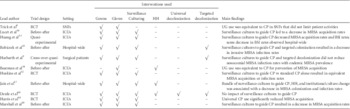
Forty-eight articles were reviewed by 2 individuals (Z.R. and B.C.C.) and final results discussed by all authors regarding MRSA. CP as an intervention to decrease MRSA acquisition was rarely analyzed separately from other interventions, and most studies were performed in outbreak settings where multiple control measures were initiated simultaneously. Initially, only studies that evaluated CP alone were included in the review. However, only 2 studies in endemic settings qualified for inclusion, one of which was a prospective quasi-experimental studyReference Bearman, Marra and Sessler 6 , Reference Safdar, Marx, Meyer and Maki 7 and one a randomized trial.Reference Trick, Weinstein and DeMarais 8 Given the paucity of studies evaluating the effect of CP alone, we then included other studies that evaluated the effect of active surveillance cultures (ASC) and resultant increase in use of CPReference Harbarth, Fankhauser and Schrenzel 9 – Reference Robicsek, Beaumont and Paule 15 or universal gown and gloves.Reference Harris, Pineles and Belton 16
Lower quality, quasi-experimental studies generally demonstrated a decrease in transmission of MRSA with CP. In a retrospective analysis of interventions to decrease MRSA bacteremia, authors concluded that CP and ASC resulted in a 67% decrease in the incidence of MRSA bacteremia.Reference Huang, Yokoe and Hinrichsen 13 MRSA acquisition decreased from 7.0% to 2.8% after implementation of similar interventions in another quasi-experimental study.Reference Lucet, Paoletti and Lolom 14 In a larger quasi-experimental study, Robicsek et alReference Robicsek, Beaumont and Paule 15 instituted ASC and CP on all hospital admissions with a subsequent decrease in MRSA. This study included a decolonization regimen in its final phase. Marshall and colleaguesReference Marshall, Richards and McBryde 10 performed a quasi-experimental study in an intensive care unit (ICU) with endemic MRSA and noted decreased rates of MRSA after changing from no-CP to CP-based ASC. Another before-after study compared 4 different infection prevention strategies and demonstrated a decrease in MRSA bacteremia with CP.Reference Huang, Yokoe and Hinrichsen 13 Finally, all hospitals of the US Department of Veterans Affairs implemented a before-after bundle that included CP based on ASC, hand hygiene, and cultural change. This study found a small decrease in MRSA colonization and a larger decrease in MRSA healthcare-associated infections.Reference Jain, Kralovic and Evans 17
In contrast to uncontrolled studies, prospective trials with control groups largely failed to demonstrate a benefit of CP for MRSA. In a prominent controlled quasi-experimental study, Harbarth et alReference Harbarth, Fankhauser and Schrenzel 9 screened surgical patients for MRSA colonization at admission. Using a cross-over design in 12 surgical wards, they compared rapid ASC with CP to standard infection control measures, which included less frequent CP and decolonization for patients with MRSA by clinical cultures. They observed no difference in MRSA rates between the 2 periods (adjusted incidence rate ratio, 1.20 [95% CI, 0.85–1.69]; P=.29). Huskins et alReference Huskins, Huckabee and O’Grady 12 conducted a multicenter cluster randomized controlled trial examining ASC and CP for MRSA-colonized patients and found no difference in the incidence of MRSA colonization or infection. A 2014 study conducted across 13 European ICUs evaluated multiple interventions for MDROs in a quasi-experimental fashion. The final phase of the study evaluated ASC with application of CP for carriers.Reference Derde, Cooper and Goossens 11 The authors found that colonization with MDROs (MRSA, VRE, and Enterobacteriaceae) decreased slightly during an earlier chlorhexidine and hand hygiene intervention phase of the study (relative risk, 0.98 [95% CI, 0.95–0.99]; P=.04) but did not decrease with subsequent addition of ASC.Reference Bearman, Marra and Sessler 6
Studies examining the use of universal gloves or universal gowns and gloves have identified mixed results, with the largest study identifying a decrease in MRSA transmission.Reference Harris, Pineles and Belton 16 However, in units randomized to universal gowns and gloves, the number of patient interactions by healthcare personnel (HCP) was lower with better hand hygiene and thus the decreased transmission of MRSA may have been due only indirectly to gown and glove use.Reference Harris, Pineles and Belton 16 In a quasi-experimental study comparing CP for MRSA versus universal gloving, Bearman et alReference Bearman, Marra and Sessler 6 showed no difference in MRSA acquisition. Harris and colleaguesReference Harris, Pineles and Belton 16 published a cluster randomized trial in which the use of universal gowns and gloves, regardless of colonization status, decreased MRSA acquisition by 40%.
In summary, many studies suffer from methodologic limitations, such as small sample size, interventions introduced simultaneously, and lack of comparison groups. Adherence to CP was often not monitored, and when assessed, adherence was poor (Table 1a). Although retrospective studies suggest that CP decreases MRSA acquisition, this was not observed in more rigorous studies.
Literature Review of Articles From 2004 to 2013 That Examined the Effect of CP (With or Without Other Measures) on MRSA

NOTE. BSI, bloodstream infection; CP, contact precautions; HH, hand hygiene; ICU, intensive care unit; MRSA, methicillin-resistant Staphylococcus aureus; RCT, randomized controlled trial; SNF, skilled nursing facility; UG, universal gloving.
Impact of CP on Endemic VRE
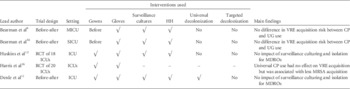
Forty-five articles were reviewed by 2 individuals (M.B. and B.L.J.) for VRE. The literatureReference Fournier, Monteil and Lepainteur 18 – Reference Hachem, Graviss and Hanna 33 abounds with publications reporting the benefit of CP in terminating VRE outbreaks. As with the MRSA literature, CP as an intervention to decrease VRE acquisition was rarely studied separately from other interventions or compared with standard precautions as the only intervention. Therefore, reviewers included studies that compared CP alone or with some other intervention with a defined control. The search for published studies examining use of CP for VRE control in non-outbreak settings identified 5 studies (Table 1b).
Literature Review of Articles From 2004 to 2013 That Examined the Effect of CP (With or Without Other Measures) on VRE

NOTE. CP, contact precautions; HH, hand hygiene; ICU, intensive care unit; MDRO, multidrug-resistant organism; MICU, medical intensive care unit; MRSA, methicillin-resistant Staphylococcus aureus; RCT, randomized controlled trial; SICU, surgical intensive care unit; UG, universal gloving; VRE, vancomycin-resistant Enterococcus.
Bearman et alReference Bearman, Marra and Sessler 6 , Reference Bearman, Rosato and Duane 34 conducted 2 quasi-experimental studies where CP for patients with VRE was compared with universal glove use. The authors found no difference in VRE acquisition and higher healthcare-associated infection rates with universal glove use in one of the studies. In 2014, De Angelis et alReference De Angelis, Cataldo and De Waure 35 published a systematic review and meta-analysis of measures taken to control VRE in ICU settings. They reported results from 3 studiesReference Bearman, Marra and Sessler 6 , Reference Huskins, Huckabee and O’Grady 12 , Reference Slaughter, Hayden and Nathan 36 that had application of CP as their only intervention. CP did not significantly reduce the VRE acquisition rate (pooled relative risk, 1.08 [95% CI, 0.63–1.83]).
The remaining 3 studies were cluster-randomized trials that examined the impact of CP on VRE acquisition in ICUs.Reference Derde, Cooper and Goossens 11 , Reference Huskins, Huckabee and O’Grady 12 , Reference Harris, Pineles and Belton 16 Huskins et alReference Huskins, Huckabee and O’Grady 12 used CP in the intervention group after ASC. The mean ICU-level incidence of colonization or infection with VRE/1,000 patient-days at risk did not differ between the 2 groups (P=.53). In a cluster randomized trial among ICUs, HCP in intervention ICUs wore gowns and gloves for all patient contacts and room entries in comparison with control ICUs where CP was used only for patients with known antibiotic-resistant bacteria, and the researchers found no difference.Reference Harris, Pineles and Belton 16 Likewise, a study in the setting of universal chlorhexidine body washes and hand hygiene improvement identified no benefit to ASC for addressing VRE or other MDROs.Reference Derde, Cooper and Goossens 11
In conclusion, the literature has not identified a benefit to CP over standard precautions in acute care settings for controlling the spread of VRE. Unfortunately, no study has compared CP with standard precautions alone. Positive publication bias likely exists and study quality is generally low.
Studies in Children
Studies assessing the impact of CP for MRSA or VRE in children are limited to quasi-experimental studies in outbreak settings.Reference Carmona, Prado and Silva 20 A case-control study with 16 cases and 62 controls identified the absence of CP (odds ratio, 17.16 [95% CI, 1.49–198.21]) and the presence of a gastrointestinal device (4.03 [1.04–15.56]) as factors associated with VRE acquisition.Reference Nolan, Gerber and Zaoutis 25 As with adult studies, the pediatric literature is limited to quasi-experimental studies that examined CP as part of a bundle, often in response to an outbreak.Reference Carmona, Prado and Silva 20
Potential Harms Associated With CP for MRSA and VRE
Studies exploring the negative consequences of CP have focused on the impact on HCP behavior, patient flow, adverse physical events, psychological harm, and patient satisfaction.
Various studies have examined the impact of CP on HCP behavior.Reference Morgan, Pineles and Shardell 3 , Reference Evans, Shaffer and Hughes 37 – Reference Saint, Higgins, Nallamothu and Chenoweth 41 CP has been associated with fewer bedside visits and physical examinations by HCP. In ICU and medical/surgical wards at 4 hospitals, patients on CP were observed having fewer hourly HCP visits (2.78 vs 4.37; P<.001) and shorter contact time (14.0 vs 17.0 minutes/hour; P=.02).Reference Morgan, Pineles and Shardell 3 In surgical settings, patients on CP received 5.3 hourly visits compared with 10.9 among patients not on CP, and had a shorter contact time (29 vs 37 minutes/hour; P=.008).Reference Evans, Shaffer and Hughes 37 In a medical ICU, patients on CP had fewer contacts than those who were not on CP (2.1 vs 4.2 per hour; P=.03).Reference Kirkland and Weinstein 38 Similarly, attending physicians examined patients on CP less frequently (35% vs 73%; P<.001).Reference Saint, Higgins, Nallamothu and Chenoweth 41
Studies suggest that CP may delay admission from emergency to inpatient settings. Duration of time for admission from the emergency department to a CP room was 12.9 hours for patients with MRSA compared with 10.4 hours for a standard room.Reference Gilligan, Quirke, Winder and Humphreys 42 Average admission wait was 54 minutes longer in patients with a history of MDRO (298 minutes vs 244 minutes; P=.045).Reference McLemore, Bearman and Edmond 43 CP may also result in delayed discharge of patients. Patients on CP awaiting transfer to long-term care facilities experienced an average delay of 10.9 days compared with 4.3 days for similar patients not on CP.Reference Gilligan, Quirke, Winder and Humphreys 42 – Reference Goldszer, Tamplin and Yokoe 44
A retrospective study at 2 tertiary medical centers found adverse event rates were higher in patients on CP (31/1,000 patient-days vs 15/1,000 patient-days; P<.001) as were preventable adverse event rates (20/1,000 patient-days vs 3/1,000 patient-days; P<.001).Reference Stelfox, Bates and Redelmeier 45 Karki et alReference Karki, Leder and Cheng 46 studied inpatients before and after application of CP for positive VRE status and found no difference in rates of adverse events (incidence rate ratio, 1.04 [0.85–1.27]) but sub-analyses noted more injuries after CP were initiated (3.24 [1.16–11.17]).Reference Karki, Leder and Cheng 46 By contrast, in a case-control study, patients with MRSA (on CP) with heart failure or chronic obstructive pulmonary disease found no difference in complication rates with patients without MRSA (P=.40).Reference Masse, Valiquette and Boukhoudmi 40 Notably, 2 trials that randomly applied CP to patients regardless of MDRO status found no increase in adverse events associated with use of CP.Reference Harris, Pineles and Belton 16 , Reference Klein, Perloff and Maki 39 Additionally, 2 studies failed to find differences in morbidity or complications in patients on CP and those that were not.Reference Klein, Perloff and Maki 39 , Reference Masse, Valiquette and Boukhoudmi 40
There is a significant quantity of literature related to psychological and psychiatric outcomes in patients on CP but findings vary.Reference Catalano, Houston and Catalano 47 – Reference Day, Perencevich and Harris 56 Among inpatients at 3 general hospitals, patients on CP had higher Hospital Anxiety and Depression Scale scores (12.8 vs 8.2; P<.001).Reference Gammon 51 For patients on a spinal cord injury rehabilitation unit, those on CP had higher Beck Depression Inventory scale scores (16.5 vs 12.3; P=NS).Reference Kennedy and Hamilton 52 Subsequent controlled studies by Day et alReference Day, Morgan, Himelhoch, Young and Perencevich 53 , Reference Day, Perencevich and Harris 56 suggest that CP may not be associated with depression and anxiety.
The issue of isolation is relevant to the care of pediatric patients, who may be unable to visit unit playrooms or schoolrooms in hospitals owing to their isolation status. Despite these potential concerns, one study in pediatrics found no difference in care.Reference Cohen, Austin, Weinstein, Matlow and Redelmeier 57
Although a number of studies have investigated the relationship between CP and patient satisfaction, patient perceptions about the quality of care varied.Reference Mehrotra, Croft and Day 58 , Reference Gasink, Singer and Fishman 59 In medical and surgical inpatient wards, Mehotra et alReference Mehrotra, Croft and Day 58 found that patients on CP were more likely to have concerns with their care than patients who were not on CP (odds ratio, 2.0 [95% CI, 1.3–3.2]). In contrast, Gasink et alReference Gasink, Singer and Fishman 59 administered the Consumer Assessment of Healthcare Providers and Systems Hospital Survey to medical and surgical inpatients exposed and unexposed to CP and reported that CP was not associated with less satisfaction.
In conclusion, CP consistently appears to modify HCP behavior, leading to fewer patient contacts. Multiple types of harm have been described with CP in the literature but results have been inconsistent and study quality has been relatively low.
Proportion of Patients on CP for MRSA or VRE
CP is applied to a substantial proportion of hospitalized patients and varies by geographical area and the methods used to identify MRSA or VRE. If samples obtained during routine clinical care are the basis for identifying MRSA or VRE, an estimated 5%–10% of patients in US acute-care facilities are isolated compared with 20%–25% of patients when surveillance testing for MRSA or VRE is used to identify colonization.Reference Huskins, Huckabee and O’Grady 12 , Reference Harris, Pineles and Belton 16 , Reference Jain, Kralovic and Evans 17 , Reference Siegel, Rhinehart, Jackson and Chiarello 60 – Reference Shenoy, Kim and Rosenberg 62 Because patients on CP have longer lengths of hospital stay, the proportion of patients on CP on a ward can be as high as 60%.Reference Dhar, Marchaim and Tansek 61
Survey of SHEA Members/SHEA Research Network on Use of CP
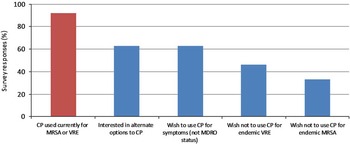
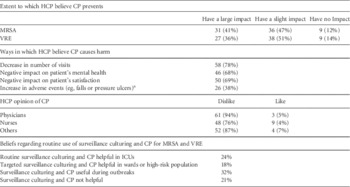
The SHEA Research Network is an international consortium of more than 200 hospitals conducting multicenter research projects in healthcare epidemiology. A total of 87 members of the SHEA Research Network responded to the survey regarding their institutions’ use of CP for MRSA and VRE (response rate, 33% [87/267]). Table 2 summarizes respondent perceptions and attitudes toward CP. Most respondents worked at acute care hospitals (93%) and belonged to teaching or teaching-affiliated hospitals (72%). Ninety-two percent of respondents reported using CP in their respective facilities for both MRSA and VRE. Respondents applied CP for positive surveillance screens (nasal, axillary, or perineal screen) for MRSA (48%) and VRE (49%), diarrhea (71%), uncontrolled secretions (44%), and uncovered wounds (27%). Cohorting of MRSA- or VRE-colonized patients in double occupancy rooms was either never done (46%) or performed only in extreme cases of bed shortage (43%). Most respondents (63%) were in favor of implementing CP in a different fashion than current practice (Figure 1), and most felt that CP decreased the number of HCP visits to patients (78%) and had a negative impact on mental health (68%) and on patient satisfaction (69%). In addition, a high proportion of respondents (63%) were in favor of employing CP for symptoms such as diarrhea, draining wounds, and uncontrolled secretions, regardless of MDRO status.
Results from Society for Healthcare Epidemiology of America Research Network survey respondents regarding opinions for use of contact precautions (CP). MDRO, multidrug-resistant organisms; MRSA, methicillin-resistant Staphylococcus aureus; VRE, vancomycin-resistant Enterococcus.

Results of SHEA Research Network Survey of Respondents’ Beliefs Relating to CP

NOTE. CP, contact precautions; HCP, healthcare personnel; ICU, intensive care unit; MRSA, methicillin-resistant Staphylococcus aureus; SHEA, Society for Healthcare Epidemiology of America; VRE, vancomycin-resistant Enterococcus.
a Additional responses: decrease 16 (24%), no impact 26 (38%).
Alternative Approaches to CP for Endemic MRSA or VRE
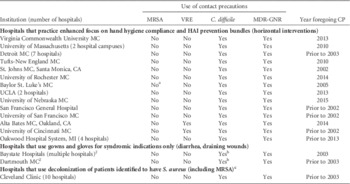
Most US hospitals use CP for endemic MRSA or VRE. However, some hospitals are not using CP for MRSA or VRE but are employing different approaches. Approaches to MRSA or VRE control that do not use CP generally fall into 3 categories: (1) focus on improved general or horizontal infection control methods without CP, (2) enhanced efforts on syndromic use of gowns and gloves for patients with syndromes correlated with greater contamination (eg, diarrhea, wounds), and (3) targeted decolonization of patients found to be positive for MRSA without CP (see Table 3).
Practices Being Used in Place of Standard Centers for Disease Control and Prevention Contact Precautions for Patients Identified With MRSA or VRE by a Convenience Sample of Hospitals in the United States

NOTE. All institutions agreed to publication of their name and practice or were in the published literature. C. difficile, Clostridium difficile; CP, contact precautions; HAI, healthcare-associated infection; HCP, healthcare personnel; MA, Massachusetts; MC, Medical Center; MDR-GNR, multidrug-resistant gram-negative rods including carbapenem-resistant Acinetobacter and carbapenem-resistant Enterobacteriaceae; MRSA, methicillin-resistant Staphylococcus aureus; UCLA, University of California, Los Angeles; VRE, vancomycin-resistant Enterococcus.
a Only if MRSA present in wounds with uncontained drainage are patients placed on contact precautions.
b Use gloves without gowns for all patients with diarrhea regardless of C. difficile testing.
c Decolonization consisted of chlorhexidine bathing and intranasal mupirocin.
Several institutions (Table 3) focus on general horizontal approaches to limiting transmission of MRSA and VRE, such as hand hygiene, bathing patients with chlorhexidine, or environmental cleaning and disinfection. These hospitals continue to apply CP for Clostridium difficile and multidrug-resistant gram-negative rods. There were multiple anecdotal reports from these institutions of stable or declining rates of infections with MRSA or VRE after foregoing CP.Reference Edmond 63 – Reference Haessler 65
Three centers reported using CP for patients with specific syndromes regardless of colonization status. These centers made a specific effort to use CP for all patients with diarrhea who were unable to self-toilet or with incontinence (including C. difficile or norovirus), open wounds that cannot be contained within a dressing, pneumonia or upper respiratory tract infection in patients unable to practice respiratory etiquette, and patients with urinary tract infection unable to self-toiletReference Haessler 65 or with incontinence.Reference Kirkland 66 The limited reports from these hospitals noted no change in percentage of S. aureus that is methicillin-resistant, a low rate of MRSA during a prevalence survey, and stable or declining rates of ventilator-associated pneumonia, central line–associated bloodstream infection, and surgical site infection (both overall and due to MRSA).Reference Haessler 65
Given the importance of preventing infections with either methicillin-susceptible and methicillin-resistant S. aureus, the Cleveland Clinic hospital system implemented surveillance cultures of patients for S. aureus upon admission to ICU with targeted decolonization with chlorhexidine bathing and intranasal mupirocin. They reported decreased S. aureus in a single medical ICU (6.28 vs 3.32 acquisitions/1,000 patient-days) and healthcare-associated infections (3.52 to 1.29 cases/1,000 patient-days).Reference Fraser, Fatica and Scarpelli 67 This policy has since been implemented at all 10 Cleveland Clinic hospitals with reported declining rates of MRSA. These hospitals continue to apply CP for C. difficile and multidrug-resistant gram-negative rods.
DISCUSSION
The literature does not provide strong evidence of benefit from CP over standard precautions for controlling endemic VRE or MRSA. To our knowledge, to date, no study has compared CP with standard precautions. Determining the optimal use of CP is an important issue because it affects 10%–25% of hospitalized patients, may have a negative impact on patient throughput, and may cause harm and decrease quality of care by reducing HCP-patient contact. Understanding the true benefits and harms of CP is important. Our survey of SHEA Research Network members found that most hospitals responding currently use CP for MRSA and VRE, but a high proportion expressed interest in using CP in a different manner.
Hospitals no longer using CP for MRSA or VRE paid special attention to collecting metrics focusing on processes and outcomes. Process measures generally focused on HCP compliance with policies related to hand hygiene and use of gloves and gowns, as well as compliance with other horizontal infection control strategies being employed at each institution (eg, hand hygiene improvement, line insertion checklists, chlorhexidine bathing, environmental cleaning, and antimicrobial stewardship). In addition, the availability of single patient rooms was reported by some facilities to factor in the decision to not routinely use CP for MRSA and VRE. Outcome measures focused on overall, hospital-wide rates of healthcare-associated infections, especially those due to MRSA or VRE. A few facilities conducted either limited or ongoing surveillance culturing for MRSA patient colonization to ensure that MRSA and VRE rates did not increase after foregoing CP.
Surprisingly, hospitals not using CP for patients with MRSA or VRE reported no negative feedback from the Joint Commission or the Centers for Medicare and Medicaid Services after hospital visits. Because not using CP for MRSA or VRE is uncommon, many respondents stated that they had been proactive in providing data to surveyors related to MRSA and VRE rates and having infection prevention policies that clearly stated the rationale for not using CP for MRSA or VRE. At all institutions it was important that staff be educated with regard to use of gowns and gloves so that they would be compliant with policies and could explain policies if asked by regulatory reviewers. Interestingly, some hospitals designed their program to forego CP with assistance from the local and state Departments of Health and reported that this step assisted with regulatory review.
It is notable that many hospitals not using CP for MRSA or VRE are in states with legislation mandating active surveillance culturing for MRSA. Despite mandating use of active surveillance, state laws often do not require use of CP for those identified with MRSA. This was not seen as a barrier to foregoing use of CP.
Relevant questions for future research include when and where CP may provide additional benefits over assiduous use of standard precautions, especially when hospitals are using horizontal control measures, such as chlorhexidine bathing, universal gloving, hand hygiene surveillance, and environmental cleaning. Additionally, a more rigorous examination of universal or targeted chlorhexidine bathing or syndromic use of CP compared with standard use of CP for MRSA or VRE would advance the field. Our findings suggest that a “one size fits all” approach to MRSA and VRE control in endemic settings is not supported by robust science. Across multiple healthcare systems, various strategies are reported for the control of endemic, hospital-acquired MRSA and VRE infections, suggesting that local factors, needs, and resources should drive the choice of optimal CP utilization.
In conclusion, no high quality data support the use of CP for endemic MRSA or VRE and there may be patient harms and unintended consequences associated with CP. The burden of CP is not insignificant because approximately 25% of hospitalized patients are on CP when surveillance culturing is employed. Although most US hospitals currently use CP for MRSA and VRE, a high proportion of SHEA Research Network respondents expressed interest in foregoing CP for the control of endemic MRSA and VRE. At least 30 US hospitals do not use CP for endemic MRSA or VRE and generally rely on broad-based, bundled interventions such as hand hygiene, chlorhexidine bathing, environmental cleaning, and checklists. Higher quality research on the risks and benefits of CP is needed. Until more definitive data are available, the use of CP for control of endemic MRSA or VRE in acute care hospitals should be guided by local needs and resources.
ACKNOWLEDGMENTS
We thank Valerie Deloney for her invaluable assistance with the preparation of this article.
Financial support. SHEA Research Network.
Potential conflicts of interest. D.J.M. reports that he has an advisory/consultant role for Welch Allyn, Sanogiene/Biomed, and 3M. B.C.C. reports that he has received research grants/contracts from Pfizer, Merck, and the Centers for Disease Control and Prevention (Preventing Hemodialysis-Related Bloodstream Infections). E.P.D. reports that he has an advisory/consultant role and has received honoraria from Merck, Baxter, Ortho-McNeil, Targanta, Schering-Plough, Astellas, CareFusion, Durata, Pfizer, and Rib-X; and research grants/contracts from Exoxemis. B.L.J. reports that she has received research grants/contracts from Gilead Sciences and Pfizer Canada, education grants from GlaxoSmithKline, Sunovion Pharmaceuticals Canada, Optimer Pharmaceuticals Canada for Infectious Diseases Continuing Medical Education for Family Physicians (October 2013), and grants from Merck Canada, ViiV Healthcare Canada, Bristol-Myers Squibb Canada, and Gilead Sciences for Atlantic Canada Human Immunodeficiency Virus Educational Conference. R.M. reports that she has received research grants/contracts from Medimmune. K.V.S. reports that he has received research grants/contracts from Nanosphere, Techlab, and Premier. G.B. reports that he has received research grants from Pfizer, Cardinal Healthcare, BioVigil, and Vestagen. M.E.R. reports that he has received research grants/contracts from National Institutes of Health, 3M, Magnolia; Consultant, and Sharklet. All other authors report no conflicts of interest relevant to this article.