Introduction
China has a population of 1.3 billion. With life expectancy in the country increasing, the proportion of elderly is growing rapidly. Depression is a common psychological problem among older people and can place substantial personal, economic and social burdens on those afflicted and their families (Hansson, Reference Hansson2002). Hong Kong, one of China's special administrative regions, has a population of about 7 million, of which 12.5% are aged 65 and over (Census and Statistics Department, 2007). It is estimated that about 5% (40,000) of the elderly population suffer from depression (Chan et al., Reference Chan, Jia, Chiu, Thompson, Hu and Lam2009a; Reference Chan, Chiu, Chien, Goggins, Thompson, Lam and Hong2009b). However, there are relatively few studies on depression conducted in older Chinese population.
A review of the literature indicates that women and people with less education, low incomes and living alone are more susceptible to depression. Other studies have shown that depression among older people is affected by multiple factors, including poor physical health, functional impairment, unhealthy behavior, and a lack of social and family support (Zhang et al., Reference Zhang, Yu, Yuan, Tong, Yang and Foreman1997).
Treatment outcomes of depression tend to focus on symptom reduction by antidepressants, but this conventional treatment approach fails to capture a holistic view of health. Although long-term medication educes the rate of recurrence of major depressive episodes by approximately 50%, the quality of life of patients is far from satisfactory (Reynolds, Reference Reynolds2008).
Health-related quality of life (HRQoL) is now recognized by healthcare providers as an important treatment goal for persons with depression and is also an important outcome measure for treatment of mental disorders (Chan and Iu, Reference Chan and Iu2004). To date, there is still limited understanding of the link between the treatment of depression and improvement in HRQoL. A number of studies have examined HRQoL and its determinants among depressed older persons but results are inconclusive. Contradictory evidence has been reported about the relationship between HRQoL and physical health problems, functional abilities, and social support. Most studies were inconclusive on the matter of whether demographic factors (e.g. gender, age) and clinical variables (e.g. duration of illness, number of prior episodes, age of onset) are predictors of HRQoL (Zhang et al., Reference Zhang, Yu, Yuan, Tong, Yang and Foreman1997; Shmuely et al., Reference Shmuely, Baumgarten, Rovner and Berlin2001; Wada et al., Reference Wada, Ishine and Sakagami2004; Naumann and Byrne, Reference Naumann and Byrne2004; Carbonare et al., Reference Carbonare, Noale, Rozzini and Crepaldi2008).
The majority of available studies of HRQoL are cross-sectional and seldom provide information on important predictors of HRQoL over time in the older population. Shmuely et al. (Reference Shmuely, Baumgarten, Rovner and Berlin2001) conducted a longitudinal study investigating predictors of improvement in the HRQoL of hospitalized depressed older people three months after discharge and found that the initial level of depression and physical health were important predictors. The evidence so far is not conclusive as to whether there is link between the treatment of depression and improvement in HRQoL.
The purpose of this study was to identify predictors of change in HRQoL among community-dwelling older Chinese patients with depression in Hong Kong. The specific objectives were to describe the HRQoL of older outpatients who had been diagnosed with major or minor depression at the first psychiatric consultation and again at the 12-month follow-up, and to further examine the predictive value of changes in physical health, psychological health, physical function, daily activity function, and social function status on HRQoL over 12 months.
Methods
Design
This was a prospective, longitudinal study conducted at a psychogeriatric outpatient department (OPD) in Hong Kong (New Territories). The study venue is the biggest psychogeriatric OPD in the region. Patients attending the OPD were treated under standard protocol. The standard interventions for treatment of depression included antidepressant treatment, psychoeducation for patients and family caregivers, information provision, and referral to social workers for financial or social problems. Patients might also be referred to day hospital if needed.
Data were collected when the participants were first diagnosed by their attending psychiatrist as having a depressive disorder and then 12 months later. The determination of the time of the follow-up evaluation was based on previous studies that report significant observable changes in HRQoL scores from 9 months to more than 1 year after first consultation among patients with mental disorders (Pyne et al., Reference Pyne1997; Henkel et al., Reference Henkel2000; Shmuely et al., Reference Shmuely, Baumgarten, Rovner and Berlin2001).
Face-to-face individual interviews were conducted by two trained research assistants (RAs) using a set of structured questionnaires. As many of the older patients were illiterate or had low levels of education, they were likely to have difficulty understanding written words or sustaining interest in responding to a lengthy set of questionnaires. The face-to-face interview format is superior to self-completion of written questionnaires. In addition, one-to-one contact with the RA helped improve the cooperation and motivation of participants, and the RA could clarify the meaning of questionnaire items as necessary. This study was conducted from March 2006 to May 2008. To avoid bias, the baseline and 12-month follow-up assessments were conducted by two different RAs.
Sample
A convenience sample was used. All patients who met the inclusion criteria were recruited. This sampling method enabled the researchers to recruit targeted depressed older people, and was more feasible and economical than taking random samples from all psychogeriatric OPDs in Hong Kong. The study focused on older patients who were newly diagnosed with major or minor depression by their attending psychiatrists, and who attended the OPD for treatment and follow-up. The inclusion criteria were: age ≥65 years; Hong Kong Chinese resident; residing in the community; a diagnosis of depressive disorder according to the criteria of the Diagnostic and Statistical Manual of Mental Disorders, 4th edition (DSM-IVTR; American Psychiatric Association, 2000); and the ability to understand and speak Cantonese. The exclusion criteria were: other psychiatric diagnosis, such as schizophrenia or dementia; visual, language or other communication difficulties; or having been judged by the attending psychiatrist to be too unwell or mentally unfit to participate in the study. We did not exclude participants who had medical conditions, as the majority of the older participants were likely to have physical health problems.
Potential participants were recruited during their first attendance at the OPD. The recruitment process lasted for 12 months and we aimed to recruit all eligible participants. We approached 102 clients of whom 12 refused to join the study. Of the 90 participants who were recruited, 13 refused to take the 12-month follow-up assessment or were lost at follow-up. Of the latter, some had moved to Mainland China, and about 70% were male. In total, 77 participants completed the study. There were no significant differences in the demographic and clinical characteristics or baseline measures between those who completed the study and those who were lost to follow up.
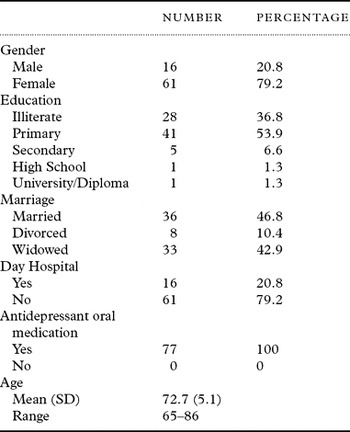
Table 1 summarizes the demographic statistics of the 77 participants. They had a mean age of 72.7 years (SD = 5.1) (range: 65–86). Sixty-one (79.2%) of the 77 subjects were female. Many were illiterate (36.8%) or had only primary-level education (53.9%). The sample was almost equally split between those married (46.8%) and those widowed (42.9%), with the rest being divorced (10.4%). All patients were taking antidepressant medication.
Demographic data and clinical characteristics (N = 77)

Measures
Physical health status was measured using the 15-item Physical Health Condition Checklist (PHCC), which contains 15 physical health problems that elderly people commonly experience (e.g. hypertension, renal disease, stroke and diabetes). This checklist has been used extensively in medical research to assess health problems in elderly people, and shown good reliability and validity. Participants were asked to answer “yes” or “no” to each health problem, with “yes” equal to 0 and “no” equal to 1 (Yip and Chiu, Reference Yip, Chi and Chiu2002; Chan et al., Reference Chan, Jia, Chiu, Thompson, Hu and Lam2009a; Reference Chan, Chiu, Chien, Goggins, Thompson, Lam and Hong2009b). A higher rating indicates poorer physical health.
Psychological health status was measured using the Chinese version of the 15-item Geriatric Depression Scale (GDS). The GDS is the most widely used scale for detecting depression in elderly people, with a reported sensitivity of 96.3% and specificity of 87.5%. A cut-off score of ≥8 is recommended in Hong Kong as an indication of depression (range: 0–15) (Yesavage et al., Reference Yesavage1983; Lee et al., Reference Lee, Chiu, Kwok, Leung, Kwong and Chung1993).
Physical function status was measured using the Chinese version of the 15-item Modified Barthel Index (MBI). The MBI is one of the most widely used measures of functional independence in daily living activities, with a test-retest reliability of 0.89 and Cronbach's α of 0.98. It has a total score ranging from 0 (totally dependent) to 100 (independent) (Granger, Reference Granger, Albrecht and Hamilton1979; Woo et al., Reference Woo1994). Cronbach's α of the present study was 0.83.
Daily activity function status was assessed using the Chinese version of the eight-item Instrumental Activities of Daily Living (IADL) scale. This scale is commonly used to assess the ability of elderly people to perform IADL. Cronbach's α of 0.78 has been reported. A higher score indicates better functioning (range: 8–40) (Lawton and Brody, Reference Lawton and Brody1969; Chan et al., Reference Chan, Jia, Chiu, Thompson, Hu and Lam2009a; Reference Chan, Chiu, Chien, Goggins, Thompson, Lam and Hong2009b). Cronbach's α of the present study was 0.92.
Social function status was measured using the Chinese version of the 6-item Social Support Questionnaire (SSQ-6). The SSQ-6 assesses the sources of and satisfaction with social support in the immediate social environment. It has a Cronbach's α that ranges from 0.83 to 0.89. The items are rated on a 6-point Likert scale (1 = very dissatisfied, 6 = very satisfied) (Sarason et al., Reference Sarason, Shearin and Pierce1987; Chan et al., Reference Chan, Jia, Chiu, Thompson, Hu and Lam2009a; Reference Chan, Chiu, Chien, Goggins, Thompson, Lam and Hong2009b). Cronbach's α of the present study was 0.98.
HRQoL was measured using the 28-item Hong Kong Chinese World Health Organization Quality of Life Scale-Brief Version (HK-WHOQOL-BREF; hereafter, WHOQOL). This scale was modified from the WHOQOL-100, a multilingual assessment for generic quality of life, and translated into Chinese (Leung et al., Reference Leung, Tay, Cheng and Lin1997; World Health Organization Quality of Life Group, 1998). The items are grouped into four domains: physical health, psychological health, social relationships, and environment, and rated on a 5-point Likert scale, with a high score indicating a better quality of life (total score range: 28–140). The psychometric properties of the translated version have been found to be sound (Cronbach's α coefficients: 0.67–0.79; test-retest reliability: 0.64–0.90) for application in clinical settings in Hong Kong (Leung et al., Reference Leung, Tay, Cheng and Lin1997). This instrument has been used in studies of depressed elderly people in Australia and Hong Kong and has demonstrated good validity and reliability (Naumann and Byrne, Reference Naumann and Byrne2004; Chan et al., Reference Chan, Jia, Chiu, Thompson, Hu and Lam2009a; Reference Chan, Chiu, Chien, Goggins, Thompson, Lam and Hong2009b). Cronbach's α of the present study was 0.93.The use of this instrument allows the comparison of the quality of life perceptions among people with various medical conditions and across different cultures.
The sociodemographic and clinical characteristics of the participants measured included the demographic data of age, gender, education, marital status, monthly household income, and living arrangements, and the clinical data of medication use and day hospital attendance.
Ethical considerations
The study was conducted with the approval of the study venue and the Chinese University of Hong Kong. The RA offered a thorough explanation of the study to establish rapport with the participants. Special effort was made to give them verbal explanations in simple and clear language to ensure that they understood the information presented. Those who agreed to participate in this study signed a written consent form.
Procedure
Having given informed written consent, the participants were interviewed in a distraction-free consultation room. The RA read the questionnaire items and then asked the participants to rate each item. Information on their physical health condition and psychotropic medication use was collected from their medical records. At the 12-month follow up, another RA who was blinded to the initial assessment contacted the participants to administer the same set of questionnaires in the OPD or patients’ homes.
Statistical analyses
SPSS for Windows version 16 was used for all analyses. The descriptive statistics were used to summarize the scores of the HRQoL measure at the baseline and 12-month follow-up assessments. The skewness and kurtosis values for all measures were all within the recommended range of −1.96 to +1.96, suggesting no violation of the assumption of normality (George and Mallery, Reference George and Mallery2006). Cross-sectional and longitudinal analyses were then conducted. Linear regression models were computed to investigate the relative importance of each variable (such as psychological status and physical functional status) in describing the variation in the HRQoL rating at baseline. The analyses examined the relations between (a) baseline predictors and final HRQoL rating at 12 months while controlling for baseline HRQOL, and (b) changes in predictors between baseline and 12 months and final HRQoL rating at 12 months, also controlling for baseline HRQOL. We followed the recommendation of Vickers and Altman (Reference Vickers and Altman2001) that the effect of covariates on changes be evaluated by fitting linear regression models with the follow-up value of HRQoL as the outcome while controlling for baseline HRQoL as a covariate. Confounders controlled for in the linear regression model included age (continuous variable), gender, education (some education vs. none) and marital status (divorced or widowed vs. married).
Results
Measures at baseline and 12-month follow-up
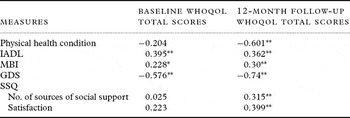
There was no significant difference among groups in terms of age, gender, level of education or whether they attended day hospital in their baseline measures. Table 2 presents the results of the Pearson's product moment correlation tests. The WHOQOL total scores had a significant positive modest correlation with the IADL and MBI, and a significant negative modest correlation with the GDS scores at baseline measure. This indicates that participants who had better daily activity function and better physical function had a better perceived HRQoL. Those who had poor mental condition had a lower perceived HRQoL.
Correlation between WHOQOL total scores and other variables at baseline and 12-month follow up (N = 77)

*correlation is significant at the 0.05 level (2-tailed).
**correlation is significant at the 0.01 level (2-tailed).
WHOQOL = World Health Organization Quality of Life Scale-Brief Version; IADL = instrumental activities of daily living; MBI = Modified Barthel Index; GDS = Geriatric Depression Scale; SSQ = Social Support Questionnaire.
For the 12-month follow-up, the WHOQOL total scores had a significant positive modest correlation with IADL, MBI, number of social support and satisfaction with social support. The WHOQOL total scores also had a significant negative correlation with the GDS scores and PHCC. This indicates that those who had a higher score in their depression scale also had a lower perceived HRQoL. Those with more physical illnesses also had a lower perceived HRQoL. The two most commonly mentioned physical problems were hypertension (n = 46, 59.7%) and joint pain (n = 38, 49.4%).
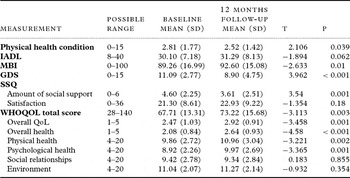
Table 3 summarizes the findings on the differences among various measures between the baseline and follow-up assessments. Because 12 comparisons were made a stricter significance criterion of p < 0.004 was used (Vickers and Altman, Reference Vickers and Altman2001). Non-significant improvements were found in the means of the PHCC scores (p = 0.039) and MBI scores (p = 0.01), IADL (p = 0.062), satisfaction with social support (p = 0.18), as well as the social relationship (p = 0.85) and environment (p = 0.354) subscales of the WHOQOL. Significant improvements were found for GDS scores (p < 0.001), the number of persons offered social support (p = 0.001), the total WHOQOL scores (p = 0.003), and the overall QOL (p = 0.001), overall health (p < 0.001), physical health (p = 0.002), and psychological health (p = 0.001) subscales of the WHOQOL. When each individual score was counted, 47 (61%) participants had positive changes in their GDS scores, 7 (9%) remained unchanged and 23 (30%) had deteriorated scores. For the total WHOQOL scores, 48 (62%) participants had positive changes and 29 (38%) had deteriorated scores.
Difference between first and second assessments (N = 77)

IADL = instrumental activities of daily living; MBI = Modified Barthel Index; GDS = Geriatric Depression Scale; SSQ = Social Support Questionnaire; WHOQOL = World Health Organization Quality of Life Scale-Brief Version;
The predictive value of related variables for changes in HRQoL over 12 months
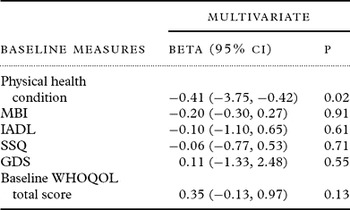
Table 4 shows the results of multivariable regression models assessing baseline predictors of the follow-up WHOQOL total scores, controlling for baseline WHOQOL total scores and demographic variables. Each variable was included in the “all variable” analysis. Results showed that only lower baseline PHCC scores were significantly associated with higher final WHOQOL total scores.
Predictors of 12-month follow up WHOQOL total scores (N = 77)

IADL = instrumental activities of daily living; MBI = Modified Barthel Index; GDS = Geriatric Depression Scale; SSQ = Social Support Questionnaire; WHOQOL = World Health Organization Quality of Life Scale-Brief Version;
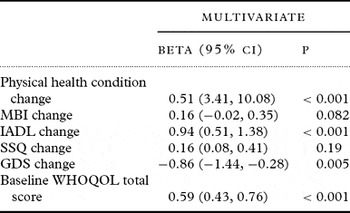
Table 5 shows the results of multivariable regression models assessing the effect of changes from baseline to follow-up in variables as predictors of the final WHOQOL total scores, while controlling for baseline WHOQOL total scores and demographic variables. The results show that increases in the IADL, and decreases in the PHCC and GDS scores were significantly associated with higher final WHOQOL total scores.
Change from baseline to follow-up in variables as predictors of final WHOQOL total scores (N = 77)

IADL = instrumental activities of daily living; MBI = Modified Barthel Index; GDS = Geriatric Depression Scale; SSQ = Social Support Questionnaire; WHOQOL = World Health Organization Quality of Life Scale-Brief Version;
Discussion
This study aimed to identify predictors of change in HRQoL among older Chinese patients with depression. All of the participants were taking antidepressants, which indicated that the oral antidepressant is the most common method of treatment for depression in the OPD.
The demographic characteristics of the participants in the present study were consistent with those of participants in previous studies (Chan et al., Reference Chan, Jia, Chiu, Thompson, Hu and Lam2009a; Reference Chan, Chiu, Chien, Goggins, Thompson, Lam and Hong2009b). Similar to previous studies (Naumann and Byrne, Reference Naumann and Byrne2004; Wada et al., Reference Wada, Ishine and Sakagami2004), demographic factors were not associated with participants’ perceived HRQoL.
The majority of the participants in this study were women who were mostly illiterate or had only attained primary-level education. The profile of the participants was consistent with previous studies (Chan et al., Reference Chan, Jia, Chiu, Thompson, Hu and Lam2009a; Reference Chan, Chiu, Chien, Goggins, Thompson, Lam and Hong2009b). In traditional Chinese society, these women were probably housewives in their younger days. For older men in this study, many also had low educational attainment, which is common among older Chinese people. They probably had low-paid jobs before retirement and many of them did not have a pension. Without the better welfare and health care systems for elderly people found in some Western countries, many of the older people in Hong Kong were living below the poverty line (Chan et al., Reference Chan, Jia, Chiu, Thompson, Hu and Lam2009a; Reference Chan, Chiu, Chien, Goggins, Thompson, Lam and Hong2009b).
More women than men participated in this study as more women attended the OPD for their depression. It does not necessarily mean that more women than men suffer from depression. The suicide rate among older men is higher than that of older women in Hong Kong (Chan et al., Reference Chan, Chien and Tso2008). It may indicate that when older men suffer from depression, they keep their depression to themselves and do not seek help.
In the present study, about 70% of those who were lost to follow-up were men. Some of them had moved to mainland China and could not be traced. It is a common practice for older people in Hong Kong to move to mainland China as the cost of living there is lower than that in Hong Kong. However, the loss of more male participants to follow-up might also be related to the traditional Chinese belief that men should shed their blood, not their tears. Many Chinese older men refuse to acknowledge their mental health problems and refuse treatment as they are afraid to “lose face” (Hui, Reference Hui2007).
Changes from baseline to follow-up
This study showed that after 12 months of treatment, the improvement in WHOQOL total scores correlated with improvements in physical function, daily living functioning as well as psychological well-being. Comparison of the baseline and 12-month follow-up measures revealed significant improvements in depression symptoms, social support, and perception of their overall HRQoL and health, and their perception of psychological health. They also had better perceived physical health despite there being no significant change in the number of physical illnesses.
Depression may severely compromise quality of life (Shmuely et al., Reference Shmuely, Baumgarten, Rovner and Berlin2001). Common symptoms of depression, such as lack of energy and reduced motivation, can lead to reduced physical functioning. Treatment of depression may help to improve the energy level and mood of the individuals, who may thus report their health and HRQoL in a more positive light. The findings of this study suggested that treatment of depression had a positive impact on the persons’ perceived HRQoL.
Though there was generally an improvement in all measures at the 12-month follow-up, some of the variables, such as satisfaction with social support and relationships, and environmental factors, showed no significant differences between pre and post measures. These variables might not be significantly influenced by the treatment process.
The predictive value of different variables for changes in HRQoL over 12 months
Multivariate analysis showed that among all of the baseline measures, the PHCC score was a significant predictor of the baseline WHOQOL scores. Participants who had fewer physical health problems had better perceived HRQoL. The multivariable model also showed that a reduction in the PHCC scores and GDS scores and an increase in IADL scores from baseline to follow-up were significantly associated with higher follow-up WHOQOL scores. Note that these results are from models controlling for baseline WHOQOL scores; hence, they essentially mean that increased IADL scores were associated with more positive changes in the WHOQOL scores, whereas increases in the PHCC and GDS scores were associated with less positive or negative changes in the WHOQOL scores.
Many participants in this study suffered from hypertension and joint pain. This study also found that PHCC score was a predictor of the baseline WHOQOL score as well as the WHOQOL score at the 12-month follow-up assessment. Depression is often associated with chronic illnesses (Vinkers et al., Reference Vinkers2005). There is a need to provide health services which are easily accessible and affordable to older people which could help to improve the management of their chronic physical illness, for example through better symptom control. Good clinical management of physical illness may help to improve the mood and functioning of patients, leading to improvement in their HRQoL.
Previous studies suggested that when visiting the doctor, many Chinese older people do not mention depression, and instead describe other physical ailments such as joint pain or heart problems (Kleinman, Reference Kleinman1988). Depression is often a hidden health problem in older persons who have a chronic physical illness. It is important that healthcare and social service professionals who are working in general OPD, general practitioners’ clinics or welfare sectors have the skills to assess and recognize older people with depression, especially in older men. For those who may not want to acknowledge their mental health problem or attend a psychiatric OPD, outreach services could help to provide support as well as close monitoring.
The IADL score was a predictor of the WHOQOL score at the 12-month follow-up assessment. Older people who have better ability to carry out IADL will have better perceived HRQoL. This finding is consistent with that of previous studies which have shown that low functional ability is an important factor in predicting depression in older people (Carbonare et al., Reference Carbonare, Noale, Rozzini and Crepaldi2008). Poor functional ability is likely to lead to dependence; it also affects emotions, leading to depression. Being able to take care of oneself and being functionally independent are highly valued by older people. Interventions such as rehabilitation programs to reduce the disabilities related to chronic illness could enhance the ability of older people to carry out daily living activities, such as shopping, cooking or using public transport. It may also help to improve their mood and perceived HRQoL.
Regarding social relationships, Shmuely et al. (Reference Shmuely, Baumgarten, Rovner and Berlin2001) suggested that satisfaction with social support may be influenced by a negative mood in depressed people. However, the present study found improvement between the first and second measures in the number of sources of support but not the satisfaction scores. Thus, satisfaction with social support might not be influenced by depressed mood and treatment. Previous studies in Hong Kong found that depressed older people had more social support than non-depressed older people, with children being the main source of support. However, the depressed participants were not satisfied with the social support they received (Chan et al., Reference Chan, Chien and Tso2008; Reference Chan, Jia, Chiu, Thompson, Hu and Lam2009a). Studies using Chinese populations suggest that depression is usually associated with poor interpersonal relationships among people or family members (Chan et al., Reference Chan, Levy, Chung and Lee2002). Further studies are needed to obtain more conclusive results about the association between relationships and social support, depression, and HRQoL. However, it should be noted that the participants in this study might have been unhappy about their social relationships. Helping depressed older people to identify interpersonal difficulties with their family, and to enhance their capacity to handle their situations might be useful.
This longitudinal study contributes to the understanding of the clinical, physical, functional, and social factors that predict the HRQoL of older people with depression. Although antidepressants may help to improve older people's depressive symptoms and their HRQoL, this study highlights the need to take into account their physical illnesses and functional abilities in the prevention and treatment of depression. Interdisciplinary healthcare services are required with coordination among various service components to meet the complex healthcare needs of this population (Carbonare et al., Reference Carbonare, Noale, Rozzini and Crepaldi2008). The study also supports the use of HRQoL as outcome measures for treatment of depression.
To our knowledge, this is the first study of its kind to be carried out in a Chinese population. It improves the existing knowledge of predictors of change in HRQoL among older people with depression. The study could be replicated in other settings to obtain more conclusive results.
Limitations of the study
The study found positive impacts of treatment on older people's depressive symptoms and their HRQoL. However, the sample was a convenience sample that was drawn from a single geographical region of Hong Kong. Thus, the findings may not be generalizable to other geographical region of Hong Kong. Though we tried to recruit the total population attending the OPD during the recruitment period, the sample size was small, which could also limit the generalizability of the study's findings. The participants were referred to this study by their attending psychiatrist and thus there is a possibility of selection bias. Furthermore, the participants were those who were willing to participate in this study and attend a follow-up assessment at the OPD; hence, we cannot generalize the findings to those who refused to participate or did not attend the follow-up assessment.
The participants in this study were newly diagnosed patients and their duration of treatment was similar. However, this study did not take into account the dosage and the effects that antidepressants might have on their HRQoL. Those who responded well to antidepressants might feel better and have a better perceived HRQoL. We did not monitor whether the participants had received interventions other than antidepressants, such as psychosocial intervention outside the OPD. Some older people might have also attended community center activities and received psychosocial support there. Further we did not monitor whether there a significant life event occurred during the 12-month follow-up period. Particularly stressful life events, such as the death of a spouse, could influence the person's physical and mental health condition as well as their perceived HRQoL.
Conflict of interest
None.
Description of authors’ roles
S. Chan designed the study, supervised data collections, analyzed the data and wrote the paper. H. Chiu designed the study, supervised data collection, and contributed to writing the paper. W.T. Chien helped to design the study and supervised data collection. B. Goggin helped with designing the study, data analysis and data interpretation. D. Thompson helped to design the study. B. Hong helped with data collection and data entry.
Acknowledgments
The study was supported by the School Fund of the Nethersole School of Nursing, The Chinese University of Hong Kong.