

Introduction
In 1945, the Banque Française et Italienne pour l’Amérique du Sud (Sudameris) represented a key strategic remnant of the prewar multinational banking network of the Banca Commerciale Italiana (BCI), Italy’s leading state-controlled commercial bank, and Paribas, France’s foremost private investment bank. Established in 1911 as a Franco-Italian joint venture, Sudameris had operated as a BCI subsidiary since 1919. While the war forced its liquidation in Brazil in 1942, branches survived in Argentina, Chile, Colombia, and Uruguay, making Sudameris one of the few European banking footholds left in South America, alongside the British Bank of London and South America (Bolsa), the Dutch Banco Holandes Unido, and the Belgian Banque Italo-Belge.
In September 1945, the French head of Bolsa’s foreign exchange department in Argentina, A. Hennequin, urged the French president of Sudameris to take advantage of Italy’s defeat to transform the bank into a French institution. Vehemently anti-Italian, Hennequin argued South Americans showed “deep fondness” for France and contempt for Sudameris’s Italian managers, under whom the French “acted as servants.” Hennequin prophesied that Sudameris “will start to make progress as soon as it becomes an exclusively French bank.”Footnote 1 In contrast, in late 1944, Giovanni Malagodi, the departing wartime Italian managing director of Sudameris, stressed the bank’s highly regarded Italian identity and important links to the national business milieu and the Italian diaspora.Footnote 2
These two conflicting statements underscore contested narratives of France’s and Italy’s standing in South America at the end of the Second World War. They foreshadow the protracted and bitter conflict as Paribas acted on Hennequin’s call, albeit with its own motivations, to transform Sudameris into a French banking establishment. At stake was influence in South America at a critical juncture in European economic history.
In contrast to the rich historiography on pre-1945 European banks, early postwar European banking in South America is underexamined. Jones, Miller, Nützenadel, and Bonin illuminate Bolsa’s adjustment to South American nationalism, Deutsche Bank’s limited return, and the activities of France’s nationalized commercial banks.Footnote 3 Yet we still lack a comparative account of inter-European rivalry during the early postwar years and the 1950s. This article offers the first systematic study, extending Piluso’s interwar work on Sudameris and addressing the neglected postwar activities of Paribas and Italian commercial banks, in contrast to the better-studied medium-term Italian export credit institutions.Footnote 4
Bonin observed that postwar France was “obsessed” with rebuilding its “commercial power”, entrusting its banks to serve as “weapons in economic and commercial wars.”Footnote 5 This study supports Bonin’s thesis showing that the French government backed Paribas’s failed hostile bid to acquire Sudameris’s shareholding majority recognizing the bank as a crucial asset for promoting French commercial interests in postwar South America.
Paribas’s hostile bid underscores South America’s centrality to Europe’s postwar reconstruction and export growth. In the immediate aftermath of the war, European states and banks rushed to restore ties with the continent, seeking raw materials and outlets for manufactured and capital goods exports, even as its largest economies pursued import substitution industrialization (ISI) and drifted increasingly into the orbit of the United States.Footnote 6 It reveals that under the Bretton Woods’ “embedded liberalism,” European integration overlapped and coexisted with nationalist competition abroad. European states and banks continued to pursue narrow national advantage in South America making the region a central arena of Europe’s postwar commercial rivalries.
South America’s centrality—and the intensity of European nationalist competition across a continent swept by strong nationalist winds—is further underscored by the BCI’s strenuous resistance to Paribas’s opportunistic bid for Sudameris. For Italy, Sudameris was as vital as it was for France, perhaps even more so, since, as Malagodi observed in late 1944, Italy was a defeated nation that, unlike France, could not rely on an empire.Footnote 7
The article examines the Italo-French corporate warfare over Sudameris arguing that this unfolded in two distinct phases. The first phase began in late 1946, when Paribas sought to wrest Sudameris shares from the Vatican—BCI’s crucial wartime ally and largest shareholder—and ended in October 1948 with the BCI regaining majority control, a position it further consolidated in the early 1950s. The corporate clash during the second phase (1948–1955) was of a different nature, not unlike a war of attrition. After eight years of unyielding pressure, the BCI succeeded in dislodging Paribas’s absolutist grip on management. While cloaking its own nationalism in the language of banking technocracy, the BCI denounced the French for their myopic nationalism and managerial incompetence.
Accordingly, the Paribas–BCI clash was more than a power struggle. It reflected two opposing visions. Paribas’s decentralized holding model, accused by the BCI of failing to boost shareholders’ foreign trade with South America, and the BCI’s centralized, active approach. With an Italian managing director from 1955, and the BCI mediating disputes, Sudameris shifted from transactional to relationship banking, embedding itself more deeply in South America’s business milieu. Like Bolsa, Sudameris responded to the South American nationalism by reshaping its business model.
Viewed through the lens of international joint venture theory (IJV),Footnote 8 the Franco-Italian corporate warfare illustrates how Paribas exercised positive control of Sudameris—direct authority over management and strategy—through French corporate law, while the BCI wielded negative control—vetoes, blocking rights, unanimity rules—to eventually force the appointment of an Italian managing director. Crucially, performance at Sudameris was inseparable from control. Whereas Paribas’s dominance led to stagnation, the BCI’s eventual control translated into recovery and renewed growth.
It is important to note that Paribas and the BCI were not Sudameris’s only shareholders but rather the leaders of rival blocs. The Paribas-led group included French partners such as the Banque de l’Indochine, while the BCI-led bloc encompassed the Vatican’s Administration of the Holy See (ASSS) until late 1947 and, thereafter, the Union de Banques Suisses (UBS), with the ASSS retaining only a small residual stake. It should also be acknowledged that this article does not examine Sudameris’s operations in each host country individually; instead, it offers an overall assessment of the bank’s performance. This is a limitation that future research will need to address.
The article draws on the historical archives of Paribas and the BCI, preserved respectively at BNP Paribas and Intesa Sanpaolo. Although these archives are publicly accessible, this is the first study to use them for research on Sudameris during the postwar period.
European Banks in South America, 1945–1960
Bértola and Ocampo described South America as entering a “new era” of economic change in 1945, its “privileged position” owed to rapid interwar growth and its relative role as a wartime “bystander.”Footnote 9 Postwar economic policy remained characterized in Argentina, Brazil, Chile, and Colombia by the 1930s drive toward import substitution industrialization (ISI), while the rest of the region remained committed to export-led growth of primary goods, increasingly diversified and marked by more stable growth and lower inflation.Footnote 10 Wartime official reserves sustained a burst of investment and the purchase of foreign-owned utilities. Reserve shortages, however, soon returned producing the balance of payments crises that marked the “classic” ISI era (1944–1960).Footnote 11 In this context, tariffs and capital controls featured prominently as policy tools.
All Latin American countries welcomed postwar foreign direct investment (FDI). As Bulmer-Thomas noted, the region lacked the capital and “the technology required for mounting sophisticated industrial enterprise.”Footnote 12 Yet FDI flowed primarily into extractive industries, especially oil. Manufacturing was not generally prohibited, but restrictions emerged in the mid-1950s. In 1954, the Inter-American Conference of the Organization of American States passed a resolution limiting FDI if it was deemed to “adversely affect previously established enterprise.”Footnote 13 Between 1950 and 1961, Latin America received $9.6 billion in FDI, according to Pierre Moran.Footnote 14 In addition, South America was a recipient of official finance through bilateral and World Bank loans, while private short-term capital flows remained small.Footnote 15
The United States dominated FDI as it became the major Western power in South America at Britain’s expense, the region’s traditional financial hub, and leading FDI investor.Footnote 16 The U.S. economic and political clout over South America notwithstanding, Western Europeans regarded the continent as crucial to postwar reconstruction and as a stable trading partner essential to rebuilding its export industries. The Second World War left European countries bankrupt and struggling with dollar shortages (the “dollar gap”), which hindered reconstruction and industrial modernization until the launch of the Marshall Plan (1948–1952). In this context, South America offered raw materials access and vital export outlets as Western Europe sought to reassert its commercial power. Accordingly, European countries competed fiercely for South American market shares while they deepened cooperation within Western Europe through the European Payments Union (1949–1950) (EPU) and the Common Market.
That competition highlights a crucial postwar dynamic. While Western European countries committed to economic integration within the continent—thus shedding nationalist tensions in favor of a shared vision of prosperity—they simultaneously competed fiercely for market shares in South America. Economic nationalism abroad thus coexisted with the project of European economic cooperation at home. In 1950, European countries negotiated the EPU to establish multilateral trade and payments within the continent, while negotiations culminated in the Treaty of Rome in 1957, which created the European Economic Community (EEC).
Western Europe’s major banks were central to this competitive struggle. Competing both with rivals at home and with European and American counterparts, they sought to expand exports and underpin national recovery, making banking an important channel of economic diplomacy. In this way, they played a significant and propulsive role in shaping the postwar economic relationship between Western Europe and South America.
In 1945, only a handful of European banks remained active in South America. The largest was the Bank of London and South America (Bolsa), a British overseas bank with an extensive branch network across the region’s major economies. Sudameris ranked second, while Banco Italo-Belge and Banco Holandés Unido (a joint venture between Rotterdamsche Bank and Nederlandsche Handel-Maatschappij) completed the list of European institutions still operating there. German banks, by contrast, had been liquidated during the war at the Allies’ request. Thus, by the end of the war, Britain, France, Belgium, and the Netherlands relied on these few banks to sustain and promote their exports to South America. By the early 1950s, just 9 of Argentina’s 90 banks were foreign-owned.Footnote 17 In Brazil, the number of foreign banks (including branches) fell from 80 in 1941 to 42 in 1950Footnote 18; Colombia and Uruguay counted only four and eight foreign banks, respectively.Footnote 19
Among the first European commercial banks to enter South America in the early postwar years were the French nationalized commercial banks, the Société Générale, Crédit Lyonnais, and the Banque Nationale pour le Commerce et l’Industrie (BNCI). Between 1948 and 1953, Crédit Lyonnais, then one of the world’s largest multinational banks, opened subsidiaries in Brazil, Peru, and Venezuela. The BNCI was followed between 1951 and 1955, establishing branches in Uruguay and Colombia and subsidiaries in Mexico and Panama. According to Bonin, the BNCI used its Mexican subsidiary as a “handover instrument to help French companies to be informed about industrial projects and to bid for parts of that market.” Crédit Lyonnais adopted a similar approach, relying on its subsidiaries to “collect information useful to French exporters and help them when prospecting outlets.”Footnote 20
German banks re-entered South America on a far more modest scale than before the Second World War, through representative offices. Whereas Deutsche Bank had operated 23 interwar branches across Argentina, Brazil, Bolivia, Chile, Peru, and Uruguay through the Ueberseeische Bank (UAB),Footnote 21 it returned to South America after the UAB’s re-establishment in 1953, opening representative offices in Argentina and Mexico (1954), Venezuela (1955), Brazil and Chile (1956), and Colombia (1962).Footnote 22 Commerzbank’s representative offices were opened in Argentina and Brazil, the former covering also Uruguay.Footnote 23 In 1953, the Dresdner Bank partnered in Brazil with Rhein–Main Bank and Brazilian industrialists to establish the Companhia de Organização Técnica Industrial e Comercial (Cotinco S.A.), a Rio-based financial company with branches in São Paulo and Bahia, created to support German industrial penetration and foster cooperation with Brazilian firms.Footnote 24
Like the Germans, Italy’s major banks—except the BCI—operated through representative offices. The Credito Italiano disinvested from the Banque Italo-Belge opting for opening in 1948 representative offices in Argentina and Brazil. In addition to offices in these countries, the Banca Nazionale del Lavoro (BNL)—Italy’s largest bank albeit a newcomer to international banking—also opened an office in Venezuela. Controlling these offices was its New York subsidiary established in 1950.Footnote 25 While the Banco di Roma opened an office in 1948 in Argentina, it subsequently failed to establish a joint venture in Venezuela in 1950, and explored opening in Brazil in 1952, but without success.Footnote 26
As the entry of European banks into South America during the late 1940s and early 1950s shows, foreign banking institutions faced no restrictions on establishment except in Argentina until the late 1950s. Yet, once inside, they operated under central banks that tightly controlled foreign exchange, interest rates, and credit through both quantitative and qualitative measures.Footnote 27 Economic nationalism further undermined European institutions, as local firms increasingly turned to domestic banks that were now able to provide foreign trade finance and integrated services, as this article shows in the last section.
The German, French, and British states actively supported exports to the region through the specialized credit institutions granting medium-term export credits.Footnote 28 Italy was a laggard in this regard. Indeed, a 1955 Finmeccanica report stated that the Italian state intervened in the commercial race “only late, and partially, with inadequate means for its needs.”Footnote 29 Nevertheless, the Istituto Mobiliare Italiano (IMI) soon became active in South America.Footnote 30 Furthermore, in 1953, Italy passed its first export credit law enabling medium-term export credits with state support.
The BCI’s assessments of South America reveal both the challenges facing European banks in the early post war years and their ambitions, the BCI’s at least. In 1948, it described the region as marked by “acute” nationalism, “tainted” by autarky, macroeconomic instability, and volatile political regimes, “even more delicate than what Europe was experiencing.”Footnote 31 By January 1954, its view had scarcely changed: nationalism remained entrenched, macroeconomic instability persisted, and “autarkic” tendencies endured. The BCI also noted that South America sought to recast its relationship with Europe from one of “dependence” to “complete equality,” while foreign trade increasingly pivoted toward the United States. Yet despite these headwinds, the BCI remained optimistic, arguing in 1954 that Sudameris’s role was to control “economic relations between Europe (first and foremost France, Italy, and Switzerland) […] and the South American continent.”Footnote 32
As this bird’s-eye view of European banks in South America shows, all of Europe’s major institutions established some form of presence on the continent. Within this competitive, policy-heavy environment, Sudameris emerged as a pivotal asset for both France and Italy, not least for Switzerland, which held a minority share in the bank through the Banque Union Suisse (UBS), a BCI ally.
The struggle for Sudameris ownership and control between Paribas and the BCI highlights the persistence of national rivalries and that South American markets functioned as a contested arena where Europeans sought raw materials and secured export outlets crucial for economic growth.
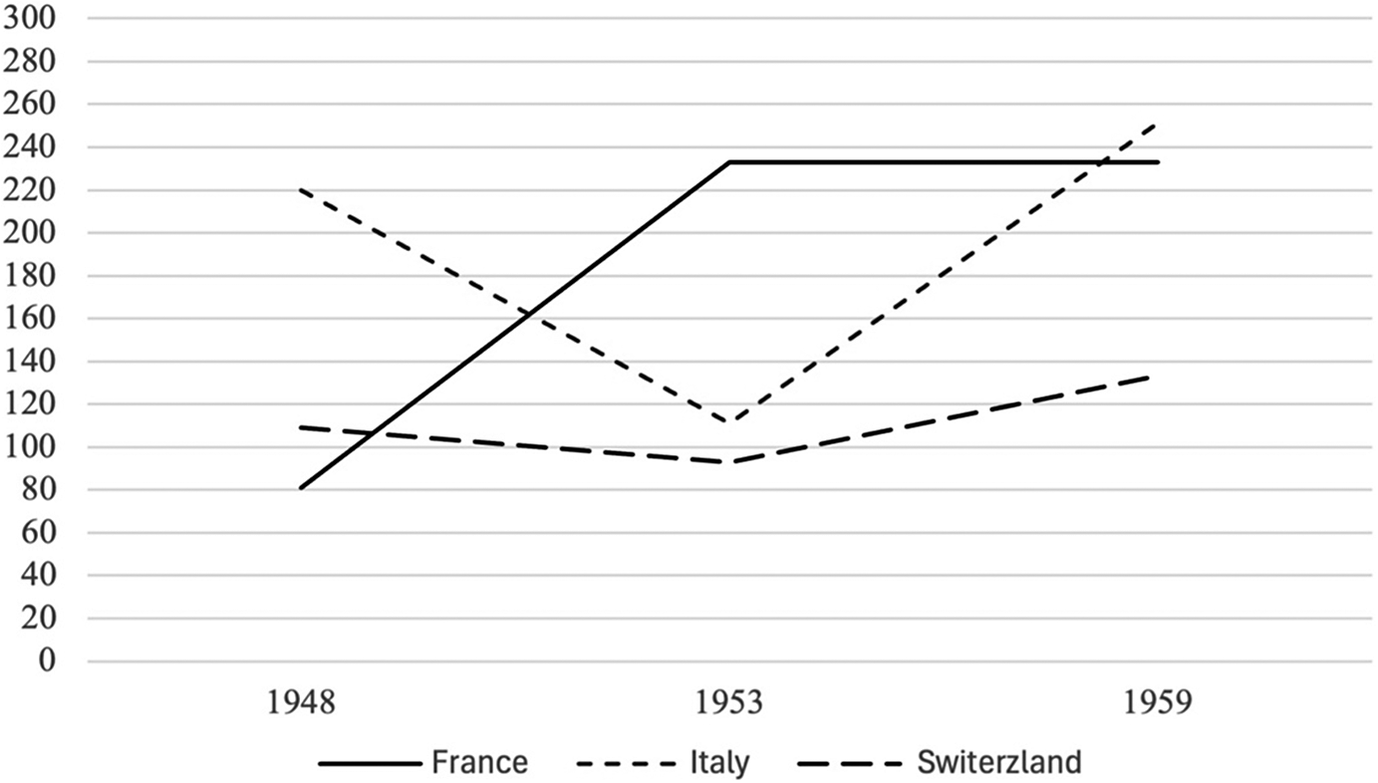
Figure 1 illustrates Italian, French, and Swiss exports to South America between 1948 and 1959. Italy’s exports fell sharply in the early postwar years, declining from $220 million in 1948 to $111 million in 1953, almost a 50% contraction. In the second half of the decade, however, Italian exports recovered steadily, surpassing their 1948 level and reaching $251 million in 1959. For Italy, therefore, the period 1948-1959 can be read as one of boom, bust, and renewed expansion.
French, Italian and Swiss exports to South America, 1948–1959 ($ million)
Sources: United Nations Statistical Office, Historical Statistics of the World Economy, 1900–1960, Direction of Trade tables (New York, 1962)

Figure 1. Long description
The Y-axis represents value in millions of dollars, ranging from 0 to 300 in increments of 20. The X-axis marks three specific years: 1948, 1953, and 1959.
* France (solid line): Starts at 80 in 1948, shows a steep linear increase to 235 in 1953, and remains at a plateau of 235 through 1959.
* Italy (short-dashed line): Starts at 220 in 1948, drops sharply to 110 in 1953, then rises steeply to end at 250 in 1959, becoming the highest exporter.
* Switzerland (long-dashed line): Starts at 110 in 1948, decreases slightly to 95 in 1953, and then shows a moderate increase to 135 in 1959.
The French trajectory differs markedly. French exports rose rapidly from $81 million in 1948 to $233 million in 1953 but thereafter declined as Italian exports surged. By 1959, Italy had overtaken France in the South American market by roughly $18 million. Swiss exports, by contrast, displayed far greater stability throughout the period, fluctuating only modestly between a low of $93 million and a high of $133 million.
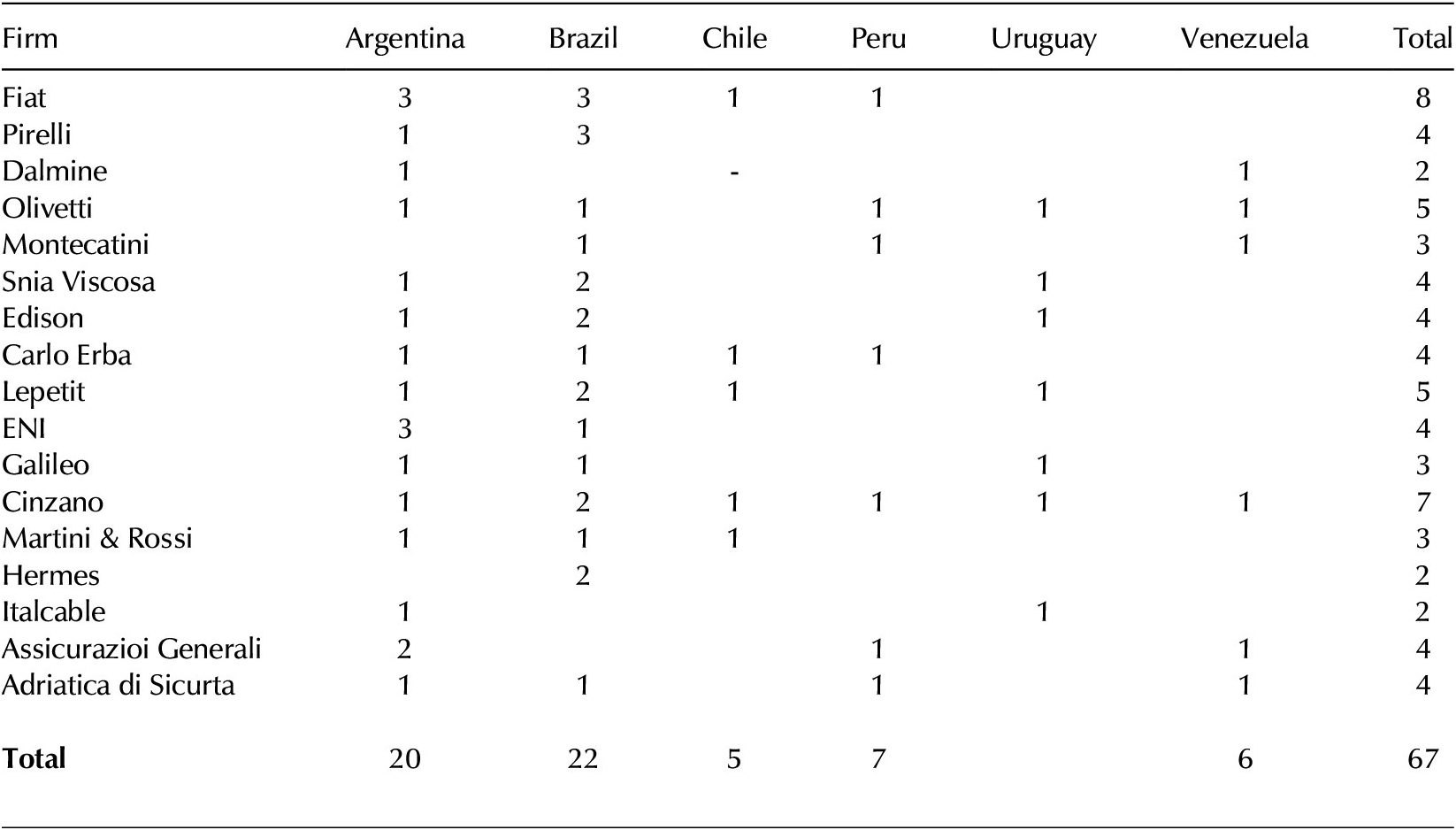
Italian firms operating in South America, through FDI, during the 1945-1960 period are illustrated in Table 1. In 1964, 67 Italian firms operated across South America’s leading economies with Brazil and Argentina representing the most important targets of Italian FDI. These financial and commercial interests built on longer-standing connections created by large-scale Italian emigration to South America since the late nineteenth century, which fostered durable social, commercial, and cultural ties between Italy and the region and sustained Italian interest in South America.Footnote 33 Instead, in 1960, there were 71 French firms operating in Brazil through branches.Footnote 34 French firms were also important in Argentina, including Venezuela and Peru. In Argentina, seven French companies featured in the ranking of the 100 largest foreign industrial firms.Footnote 35 The CIA reported in March 1964 that French FDI in South America amounted to “$350 million to $400 million”, adding that “in no country did they accounted for as much as 10 percent” of FDI.Footnote 36 Italian FDI in South America, by contrast, stood at approximately $1 billion in 1964.Footnote 37
Sample of Italian multinational manufacturing and insurance companies operating in South America under different organizational forms, 1945–1964

Table 1. Long description
The table consists of 8 columns: Firm, Argentina, Brazil, Chile, Peru, Uruguay, Venezuela, and Total. There are 17 firms listed followed by a Total row.
* Fiat: Argentina 3, Brazil 3, Chile 1, Peru 1, Total 8.
* Pirelli: Argentina 1, Brazil 3, Total 4.
* Dalmine: Argentina 1, Venezuela 1, Total 2.
* Olivetti: Argentina 1, Brazil 1, Peru 1, Uruguay 1, Venezuela 1, Total 5.
* Montecatini: Brazil 1, Peru 1, Venezuela 1, Total 3.
* Snia Viscosa: Argentina 1, Brazil 2, Uruguay 1, Total 4.
* Edison: Argentina 1, Brazil 2, Uruguay 1, Total 4.
* Carlo Erba: Argentina 1, Brazil 1, Chile 1, Peru 1, Total 4.
* Lepetit: Argentina 1, Brazil 2, Chile 1, Uruguay 1, Total 5.
* E N I: Argentina 3, Brazil 1, Total 4.
* Galileo: Argentina 1, Brazil 1, Uruguay 1, Total 3.
* Cinzano: Argentina 1, Brazil 2, Chile 1, Peru 1, Uruguay 1, Venezuela 1, Total 7.
* Martini and Rossi: Argentina 1, Brazil 1, Chile 1, Total 3.
* Hermes: Brazil 2, Total 2.
* Italcable: Argentina 1, Uruguay 1, Total 2.
* Assicurazioi Generali: Argentina 2, Peru 1, Venezuela 1, Total 4.
* Adriatica di Sicurta: Argentina 1, Brazil 1, Peru 1, Venezuela 1, Total 4.
The final Total row shows: Argentina 20, Brazil 22, Chile 5, Peru 7, Venezuela 6, with a grand Total of 67.
Sources: AS BCI, Servizio Estero, VAL-E, cart. 5, Il Sole 24 Ore, “Un miliardo di dollari italiani investiti nell’America Latina,” Carte Valiani, Fondo Vl-E.
This broader pattern of Italian and French foreign trade and investment in South America helps explain why control over Sudameris assumed such strategic importance. For both France and Italy, the ability to support exports, secure raw materials, and sustain overseas business networks increasingly depended on banking institutions capable of operating within South America’s nationalist and tightly regulated financial systems. Equally crucially, banks such as Sudameris were well placed to support incoming European manufacturing firms by supplying working capital and market and legal knowledge, including information on local suppliers and potential joint-venture partners. This working capital function was particularly important in contexts of currency fluctuation that discouraged excessive capital imports by foreign multinational firms.
Fighting for Share Ownership, 1946-1948
At the end of the Second World War, Paribas held a strong position in Sudameris. Though a minority shareholder, it benefited from the November 1941 French corporate law requiring French citizens to serve as president-managing directors of publicly listed companies. However, the president could delegate the managing director function to a non-French. This gave Paribas managerial control, while the BCI was limited to the vice-presidency, held by Raffaele Mattioli, the managing director of the BCI. It was from this position of strength that Paribas moved to take over ownership control of Sudameris in late 1946.
Paribas’s hostile bid represented the wish to assert French control over an institution the Italians historically managed. Indeed, during the interwar years, Sudameris expanded from Brazil into Argentina, Colombia, Chile, and Uruguay as a BCI subsidiary since 1919.Footnote 38 The marginal role Paribas played in the bank was underlined in 1944 and in 1948 by Malagodi and by Emile Oudot, Paribas-appointed president of Sudameris, respectively. Whereas Malagodi complained that Paribas “did nothing for us,”Footnote 39 Emile Oudot admitted that “the opportunities offered [by Sudameris] had so far been minimally exploited [by Paribas].”Footnote 40 During the Second World War, Paribas lost contact with Sudameris as its head offices relocated to Argentina after the Nazi invasion of France in 1941 and communications with the country collapsed. The BCI, therefore, continued to run the bank, sustained by Italy’s ongoing communications with Argentina. Sudameris continued to operate in Argentina as the country remained neutral until early 1945.
Sudameris survived the war by restructuring as a Vatican subsidiary. In 1938, the Vatican’s stake rose from 3% to 61%, after the BCI shifted its holdings to Profima, a Swiss company controlled by the Vatican’s Administration of the Holy See (ASSS) under Bernardino Nogara, also a BCI director and later vice-president.Footnote 41 This arrangement gave the bank a neutral appearance, though Allied intercepts showed the Vatican acted only as a legal shield while the BCI retained control. Despite being blacklisted by the Allies from 1942 to 1945, Sudameris was liquidated only in Brazil, continuing to operate in the other countries.
Paribas moved to assert control over Sudameris as the Allies removed the bank from the blacklist in December 1945. In November 1946, Bordaz, the government-appointed director of Paribas, urged the French finance minister to pursue an aggressive expansion into South America by transforming Sudameris into a French bank. He argued that Sudameris was strategically positioned to advance French interests in South America’s “rapidly developing countries,” which offered “an outlet for French exports and a source of raw materials.” An additional motive, framed as being of “utmost importance,” was to prevent the BCI from discriminating against French firms, which “still hold a number of important businesses in South America.”Footnote 42
Paribas judged Sudameris’s postwar position strong notwithstanding the blacklist and its expulsion from Brazil. An early May 1945 memorandum praised Sudameris’s “reputation for solidity and correctness” and its organization” perfectly adapted to the tasks ahead.” It concluded that the bank was “an important element of French expansion in South America” and that “no other French bank has so far been able to establish itself and prosper in this part of the world.” Still, the memo admitted that Paribas will continue to be “criticized for our association with Italian elements” in countries where France had “small colonies.” However, the BCI’s postwar role in Sudameris was limited to supplying mid-level managers to help recruit clients within the Italian diaspora but only insofar as this did not compromise the “indisputably French character of the bank.”Footnote 43
This strategic reframing reveals how postwar European banks operated as instruments of national policy, transforming banking partnerships into nationalist competition for commercial influence in overseas countries. The Paribas memos also suggest that Paribas’s bid to wrest control of Sudameris was plainly opportunistic.
The BCI showcased deep resentment toward Paribas’s plan. It was determined to fight back, even with the odds stacked against a defeated Italy. In his final months at the BCI, Malagodi underscored Sudameris’s strategic importance to postwar Italy. He argued that Sudameris “continued to be in the eyes of people everywhere much more Italian than French” due to its tradition of Italian management. Moreover, politically and economically, South America’s markets are ideally suited for the postwar expansion of Italian trade. Malagodi foresaw a new global order of “massive blockades, progressive industrialization and modernization of agriculture in overseas countries, and stronger international competition than ever before.” In such an environment, “well-equipped banks (capital, standing and management) with a tradition in foreign trade [like Sudameris] will be needed more than ever.” Italy could no longer, he warned, “do our bit without too much difficulty and despite our lagging development” as it had in the interwar years. Instead, Italy would be “pushed like everyone else” toward the export of manufactured goods where “all dogs will be around the same bones.”Footnote 44
Malagodi’s language captured Italy’s wider anxiety. Without Sudameris, its industries risked being shut out of the scramble for hard-currency markets. Like Malagodi, Mattioli favored continued cooperation with Paribas on equal terms. Therefore, in May 1947, Mattioli warned that if “the gentlemen of Paribas […] want to take over the BCI’s shares” in Sudameris, then “the BCI will start over again” in South America and would “punish” Paribas for its actions.Footnote 45
Securing Paribas’s victory over the BCI was the decisive intervention of the French government. Indeed, the Vatican flatly rejected Paribas’s repeated demands to transfer its stock to a French syndicate.Footnote 46 Convinced that the BCI and the ASSS coordinated (despite Mattioli’s repeated denialsFootnote 47), the French government abandoned its usual practice of unfreezing Italian assets in France for reasons of “haute politique.” Instead, it re-sequestrated the BCI’s Sudameris shares and explicitly tied their release to the Vatican’s compliance with Paribas’s request. This amounted to outright blackmail. Either the Vatican ceded its holdings to a French syndicate, or the BCI’s frozen assets would remain blocked indefinitely. The French government extended the pressure to the diplomatic arena. During the May 1947 peace treaty negotiations with Italy, France raised the ownership issue directly. Rome replied that it could not force the Vatican’s hand; the Holy See was a sovereign entity.Footnote 48 As Oudot bluntly told Nogara in December 1946—and repeated to Mattioli in the summer of 1947—“as long as the situation does not change, the French government has no intention to unlock [BCI’s Sudameris shares].”Footnote 49 Under this sustained political and financial pressure, the BCI–ASSS alliance eventually capitulated to French demands.
As pressures mounted, the BCI sought in May 1947 the ASSS’s backing “one last time.”Footnote 50 It proposed transferring ASSS’s Sudameris shares to a planned Swiss consortium bank, hoping—with the support of UBS—to attract American partners. The plan collapsed in July 1948 when Bank of America withdrew, refusing cooperation with New York banks insisted on by the BCI, exposing the limits of Italian banking diplomacy. The BCI’s plan, to which the ASSS agreed, was meant as retaliation. Indeed, as Mattioli told Oudot, the ASSS agreed to cede its Sudameris shares to an “American financial group” in response to “the attitude shown by Paribas.”Footnote 51 Yet talks with U.S. bankers began only after the BCI–ASSS bloc ceded part of those shares to the French, while Paribas warned that any American entry must come “at the expense of the BCI’s shareholding.”
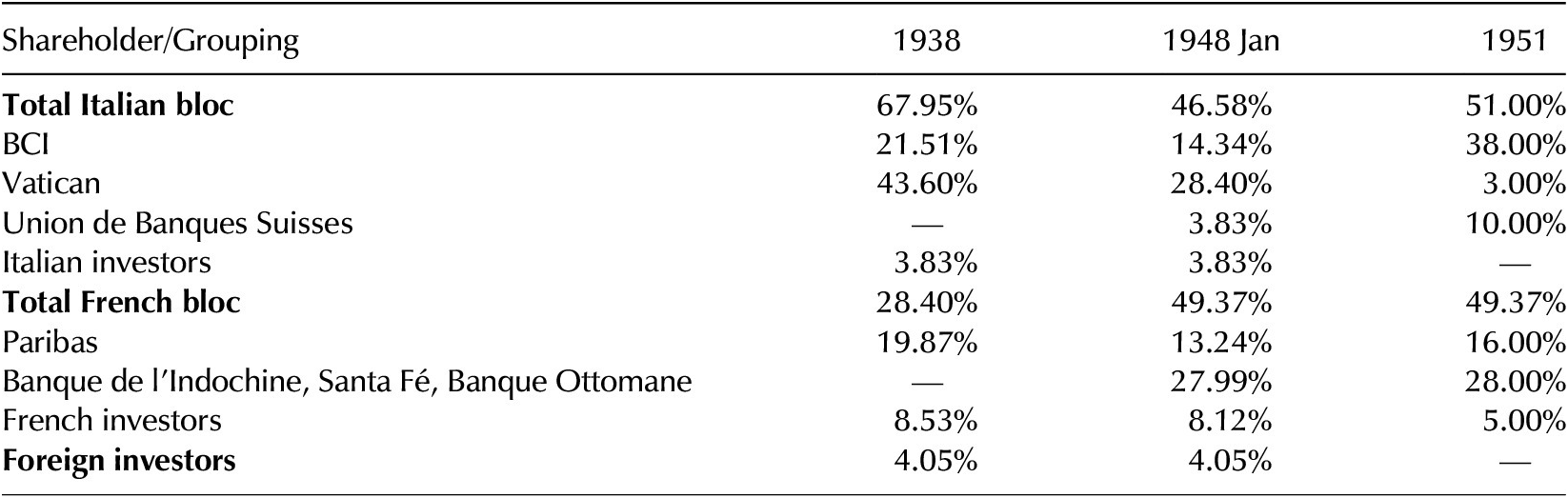
Paribas’s apparent victory notwithstanding, the BCI had regained majority control of Sudameris by October 1948. French miscalculations enabled this. When Paribas moved to consolidate its position, it had yet to secure the 4.3% of shares held by what it described as a “presumed foreign group.” In what must have been frantic months, the BCI scrambled successfully to acquire these shares. As a result, while Paribas’s stake in Sudameris rose in December 1947 to 49.37% of the capital, the BCI overtook it in October 1948, its shareholding increasing from 46.5% in January to 50.5%. Carlo Bombieri, director of the BCI’s international banking department, observed in mid-October that Paribas had “evidently, albeit belatedly, realised that their position is much less strong than the one they had deluded themselves into creating.”Footnote 52 The BCI’s majority position only strengthened thereafter, reaching 51% in June 1950 and 52% by April 1951.Footnote 53 These incremental gains unfolded against the backdrop of a shareholders’ syndicate agreement established in March 1951—see next section.
Table 2 illustrates the evolution of Sudameris’s ownership between 1938 and 1952, showing the decline and rebound of the BCI bloc alongside the rise and stabilization of the Paribas group. It also shows the Vatican’s near-complete withdrawal—from 43.60% in 1938 to just 3%—and the entry of the UBS whose stake grew from 3.83% in 1948 to 10% in 1951, bolstering the BCI’s return to majority share ownership.
Sudameris shareholdings by group, 1938–1952

Table 2. Long description
Fallback
Sources: AHBNPP, 11AH/232, letter from Wibratte to Rafaelle Mattioli 7 November 1947; AHBNPP, 11AH/1174, Banque Française et Italienne pour l’Amerique du Sud, 8 January 1948AHBNPP, 14AH/677 Protocol, 1 March, 1951.
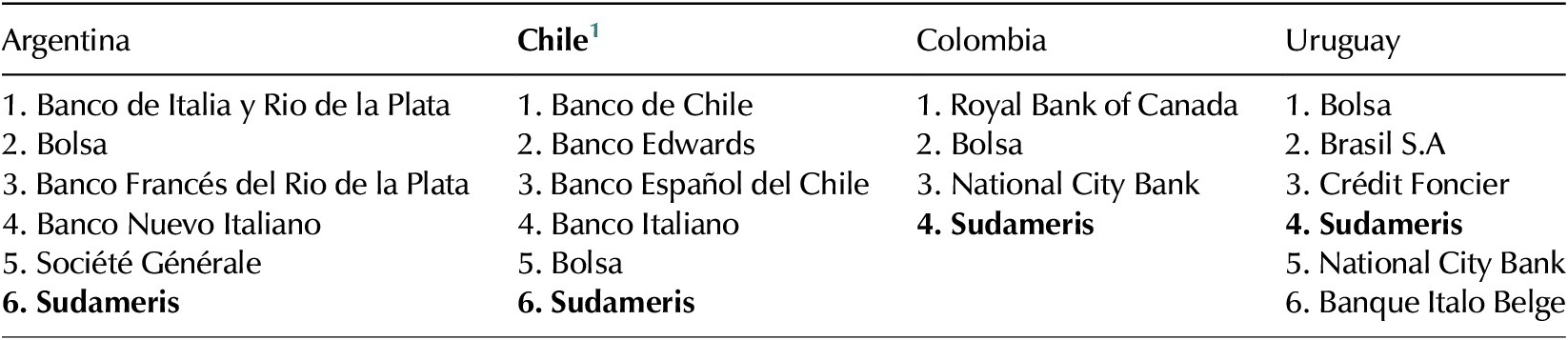
The task of resurrecting Sudameris was daunting, however. Sudameris, in fact, lagged in equity capital behind its European rivals, including banks founded by European settlers. Sudameris ranked last in Chile and Argentina—its postwar most important market—though it was somewhat better placed in Colombia and Uruguay (Table 3). Thus, Sudameris was uncompetitive as its low capital kept in check deposit growth. In Argentina, the central bank subordinated bill discounting to capital increases; in Chile, deposits were capped at five times capital; and in Colombia, capital had to equal at least 15% of deposits.Footnote 54
Ranking of foreign banks in South America by Capitalization, 1945

Table 3. Long description
The table is organized into four columns representing South American countries.
Argentina column:
1. Banco de Italia y Rio de la Plata
2. Bolsa
3. Banco Francés del Rio de la Plata
4. Banco Nuevo Italiano
5. Société Générale
6. Sudameris
Chile column:
1. Banco de Chile
2. Banco Edwards
3. Banco Español del Chile
4. Banco Italiano
5. Bolsa
6. Sudameris
Colombia column:
1. Royal Bank of Canada
2. Bolsa
3. National City Bank
4. Sudameris
Uruguay column:
1. Bolsa
2. Brasil S. A
3. Crédit Foncier
4. Sudameris
5. National City Bank
6. Banque Italo Belge
Sudameris is highlighted in bold across all four countries, ranking 6th in Argentina and Chile, and 4th in Colombia and Uruguay.
1 The Paribas ranking erroneously classified Banco de Chile as a European-founded bank; in fact, the institution was owned by Chilean nationals.
Sources: AHBNPP, 14AH/677 Undated memo by Paribas, 3 May 1948.
The bold text is to highlight Sudameris ranking.
Between 1948 and 1952, Sudameris repeatedly raised capital also to fund its return to Brazil (via a local bank purchase in 1949), open a branch in Venezuela (1950), and expand into Peru by acquiring the BCI affiliate (1951). Entry into Cuba was considered in 1950 but never implemented, while a 1951 proposal to expand into Ecuador was rejected by the BCI. Table 4 shows the capital allocation of 1952. Argentina emerged as the most capitalized branch—surpassing even Paris—while Venezuela and Brazil held middle positions and Chile emerged as the weakest link. This hierarchy underscored both the geographic imbalances within Sudameris and the overriding importance attributed to Argentina, Brazil, and Venezuela. In 1950, Sudameris issued a public call for managers in France, Italy, and Switzerland.
Capital and reserves of Sudameris in 1952 ($ million)

Table 4. Long description
The table consists of eight columns representing different geographic locations and a total. The values are as follows
* Argentina: 1.68
* Brazil: 1.23
* Chile: 0.86
* Colombia: 1.00
* Uruguay: 1.14
* Venezuela: 1.57
* France: 1.43
* Total: 8.91
All values are expressed in millions of dollars.
Sources: ASI BCI, CM, cart. 44, fac. Burnier Henri, Mattioli letter to Burnier, 20 January 1954.
Clashing over Control, 1948–1955
Paribas’s failure to secure Sudameris’s ownership was a bruising defeat. True, French corporate law still gave it executive power. But the BCI was not toothless. As the majority shareholder, it could wield negative power to force cooperation. Thus, even as capital increased and branch expansion went ahead, Sudameris became a battleground where Paribas pressed to sideline the BCI from executive power while the BCI fought back.
Sudameris’ relaunch in South America unfolded amid escalating Italo-French conflict as Paribas gradually implemented its plan of a French Sudameris. In November 1947, the BCI threatened to exit Sudameris unless Franco-Italian cooperation prevailed based on a “well-understood nationalism, without overdoing it.”Footnote 55 Yet, in December, President Oudot appointed his close collaborator, Baron Fédéric d’Orgeval, as deputy managing director. Oudot used underhanded tactics to appoint d’Orgeval by exploiting Mattioli’s absence from the Sudameris board. The French plan was on full display again in early 1948. In March, Paribas flatly rejected Milan’s plan to implement the Banque Ottomane governance model at Sudameris, based on parallel French and Italian committees (the latter in Geneva).Footnote 56 In December, Paribas applied its plan to Argentina, the center of Sudameris unsuccessfully attempting to withdraw the Italian co-directorship of Sudameris/Argentina from Ettore Bottoni. The plan’s implementation shows that Oudot’s assurance of June 1947, that French control of Sudameris would not disadvantage the BCI, was hollow.Footnote 57 Rather than a genuine partnership, Paribas pursued a calculated strategy of turning Sudameris French while maintaining the facade of cooperation.
At that stage the BCI’s strategy was protest and threats. It decried d’Orgeval’s appointment as “extremely dangerous,”Footnote 58 reacted bitterly to Oudot’s refusal of the Banque Ottomane model; and described Oudot’s plan to oust Bottoni as “a cavalier way of conducting business” and as a personal insult.Footnote 59 In April 1949, the BCI accused Paris of having “accomplished nothing” at Sudameris besides turning the BCI into “Sherlock Holmes” because its management strategically communicated behind its back. The BCI threatened to exit Sudameris once again, noting that it had “basically taken a car assigned to a chauffeur without our consent.”Footnote 60 Paribas stuck to its plan regardless. Accordingly, in late 1950, Oudot blocked a board seat for the Vatican’s IOR, which sought a 10% stake in the Brazilian affiliate, thwarting Milan’s bid to strengthen its position.Footnote 61
The BCI had significant negative power to cripple the bank. The BCI could paralyze Sudameris by blocking board decisions and withholding approval of annual accounts. This exposed the bank to the risks of legal noncompliance, supervisory sanction, and reputational damage in financial markets.
In March 1951, these pressures, including the exit option, reluctantly committed the French to cooperation. The French agreed to change the banking model underpinning Sudameris’s operations and to reform top management. The BCI requested these changes to implement its vision of European banking in South America. This rejected Paribas decentralized management, with large leeway to branch managers, in favor of a centralized model with direct control over branch policy. As events later demonstrated, the BCI’s requested managerial reform—replacing two managing directors with a president managing director supported by a deputy—as the first step toward the appointment of an Italian managing director under the presidency. Crucially, the BCI committed the French to unanimous decision-making thereby securing a veto on all policy matters.Footnote 62
The March agreement marked the turning point representing the springboard of the BCI’s ultimate bid for Sudameris’s executive control. It represented, in IJV terms, a major victory of negative control as it enabled the BCI to secure unanimous decision-making and veto rights, thus crippling Paribas’s hold over management. It reveals the BCI’s evolving strategy based on trial-and-error methods and adaptation to circumstances. The BCI changed strategy after discovering that the limits of protests and threats were less effective than systematic vetoes embedded in corporate governance structures.
Meanwhile, Brunier—the new Paribas-appointed president of Sudameris—relied on leave of absence to buy time.Footnote 63 By then, Sudameris was perceived as a French bank as revealed by a January 1952 statement from the Banco di Roma. The Banco explained its failure to establish a representative office in Brazil by noting that it could not “counter the monopoly France exerts through [Sudameris] which, however, is very little Italian and very much French.”Footnote 64
By January 1954, frustration in Milan had reached a breaking point. The BCI forced the issue, launching its fiercest attack yet on Paribas. In his letter to Brunier, Mattioli fully repudiated Paribas’s management of Sudameris since the end of the war while demanding the implementation of the March agreement. According to Mattioli, Sudameris stagnated in Argentina and in Brazil, where it represented a “serious handicap” as it damaged the BCI’s relations with local bank correspondents.Footnote 65 In contrast to Argentina and Brazil, Sudameris achieved a “quasi monopoly” in trade finance in Chile, Colombia, and Uruguay and was “promising” in Venezuela. Yet, overall, the bank was “surviving.”Footnote 66
Mattioli acknowledged the challenges of autarky, shifting trade patterns, and South America’s push for equality with Europe. Yet he insisted that Brunier could not use these trends to excuse his failures. Mattioli accused Brunier of turning Sudameris into a “headless holding company” and an “embarrassment,” failing to support Italian exports to South America, unlike the Peruvian affiliate, the Banco de Crédito, “the only constructive achievement after the war.”Footnote 67 “Do you think,” Mattioli asked President Brunier “that Sudameris could provide us today with a complete list of Italian, French, and Swiss firms that trade or invest in South America but are not among our clients?” Endless nationalist quarrels were “just idle talk,” Mattioli stated while adding that an Italian deputy managing director was required to transform Sudameris into a “sharp and effective tool” for shareholders’ business relations with South America. Mattioli told Brunier that “as you know, the deputy managing director can only be Bottoni,” the Italian co-director of Sudameris/Argentina.Footnote 68
Mattioli’s comprehensive critique reveals the weaponization of negative control through performance accountability. By documenting Sudameris’s failures across multiple markets, the BCI built its case that French management violated fiduciary duties to shareholders. This strategy shifted the conflict from nationalist rivalry to managerial competence, a more defensible position that could justify Italian executive control even to French partners.
The French unwillingness to implement the 1951 agreement was evident by 1954–1955, as the BCI pressed relentlessly for Bottoni’s appointment as managing director. In May 1955, Paribas and the Banque de l’Indochine had forced Brunier to retreat from his earlier commitments to appoint Bottoni.Footnote 69 Brunier’s remark that Bottoni wanted “to have it all and leave nothing for me” revealed French anxieties that he would become the de facto head of Sudameris.Footnote 70 In July, the French attempted to dilute Italian control by proposing that Bottoni share executive authority with Vicénot, a former Treasury bureaucrat, while Brunier retained the presidency. Mattioli dismissed this arrangement as untenable, anticipating that Brunier would simply “offload everything” onto the Italian managing director, especially under a “naked” presidency. Instead, he insisted that Brunier also serve as managing director. This move isolated Vicénot and reaffirmed that “the general management is Italian.” Brunier further conceded that Mattioli would arbitrate any future tensions between Bottoni and his deputy. For Mattioli, this compromise was “serious” precisely because it “does not allow for questions of nationality.” By clearly securing Italian control, it sought to render future disputes over national influence moot. Yet, as Mattioli admitted to Bottoni, “in essence we [the BCI] are more nationalistic than [Paribas], even if [Paribas] is not aware [of this]!”Footnote 71
That Paribas had swallowed a bitter pill became evident from its desperate summer 1956 attempt to dilute the BCI’s role by transforming Sudameris into a consortium bank with Deutsche Bank as a new shareholder. Paribas apparently bet that it could undermine the BCI by leveraging its good relations with Deutsche Bank.
Acting as a channel between the Deutsche Bank and the BCI was Stefano von Ambro Ambro, the head of the BCI’s representative office in West Germany. Von Ambro explained that the Germans met with Brunier “around ten times” welcoming Brunier’s offer. However, Deutsche Bank was willing to take a stake in Sudameris only by implementing the formula of “30% the BCI, 30% the French group, 30% Deutsche Bank, 5% the Vatican and 5% the public.”Footnote 72 When the BCI rejected the plan the Germans replied, “but if you only have 47% of the shares […] according to what Brunier told us, who as general manager should know!”Footnote 73 They also added that “Abs doesn’t want to enter through the back door but through the main entrance” in Sudameris, signaling their rejection of ad hoc collaborations in South America.Footnote 74
As FIAT’s example in Chile in 1959 shows, Italo-French tensions continued undiminished. In May, FIAT’s managing director, Vittorio Valletta, intervened personally with Mattioli on behalf of its Chilean affiliate, Agrotecnica, which, Valletta alleged, was discriminated against by Sudameris’s French management by refusing credit while favoring firms linked to France.Footnote 75 Valletta “appreciated” Mattioli’s intervention adding that “only with this banking intervention it is possible to enable Agrotecnica to carry out the modest work that is permitted under [Chile’s] currency restrictions."Footnote 76 The episode illustrates Sudameris’ crucial role for Italian industries in South America since without its help, FIAT’s expansion in Chile would have been severely constrained. The BCI used the episode to encourage Valletta to become a Sudameris board member in December. “As you know, I accepted with the intention of doing something that would be welcome and useful, if possible, to your bank [BCI], ” Valletta told Mattioli.Footnote 77 Valletta’s entry onto Sudameris’s board showcased the cooperation between banking and industry in advancing Italian economic interests in South America.
The depth of the rivalry between Paribas and the BCI was evident in late 1958, when Paribas established the Société Franco-Italienne de Développement Industriel (SFIDI) with the BCI’s main competitors, the Banca Nazionale del Lavoro (BNL) and the Istituto Mobiliare Italiano (IMI). With a capital of Fr. 50 million—half from Paribas and the rest split between IMI and BNL—SFIDI was created as a medium-term credit institution for export financing. Its mission was to support industrial development by helping firms secure raw materials, technology licenses, and bond financing, with planned operations in South America, Africa, and the EEC.Footnote 78
By then, and under Italian management, Sudameris was a bank transformed along the lines of the Bottoni-Vicénot report, see next section, which was submitted to the board in June 1955—after a mission to South America in 1954—the month prior to their appointments. The Italian executive control of Sudameris thus led to a new phase in Sudameris’s chapter. The Bottoni-Vicénot report provided the roadmap for that reinvention.
The BCI’s success in Sudameris reflects Mattioli’s tenacity and tactical brilliance. Mattioli viewed the BCI’s international banking identity as that of an export bank and as a strategic instrument for projecting Italy’s economic power abroad. “Promoting exports,” Mattioli noted in June 1952, “is part of our very nature as an international bank.” The battle for Sudameris shows that South America lies at the core of this identity. Indeed, in January 1953, Bombieri stated that the BCI had “chosen South America as the theatre of our deeds.”Footnote 79 Mattioli’s strategy demanded patience, maneuver, and relentless pressure to force the French into cooperation, as the French corporate law reserved the presidency for a Frenchman. Executive control could therefore only be won by forcing Paribas to accept an Italian managing director as deputy to the French presidency. The BCI wielded relentless negative control in IJV terminology. Enabling this strategy was its majority shareholdings. The Sudameris case shows how postwar corporate law could override majority ownership and that determined shareholders could weaponize governance to overcome such limits. More broadly, the corporate warfare over Sudameris illuminates how European integration at home coexisted with fierce nationalist competition abroad. The BCI’s victory thus represents the successful transformation of blocking rights into operational control in the contested arena of postwar European multinational banking in South America.
Reinventing Sudameris, 1955–1960
The IJV literature is divided on whether control drives performance, though Mjøen and Tallman stress that outcomes depend on how performance is measured.Footnote 80 Sudameris shows this dynamic as it stagnated under Paribas’s decentralized model but grew again after 1958 when the BCI imposed centralized management and relationship banking.
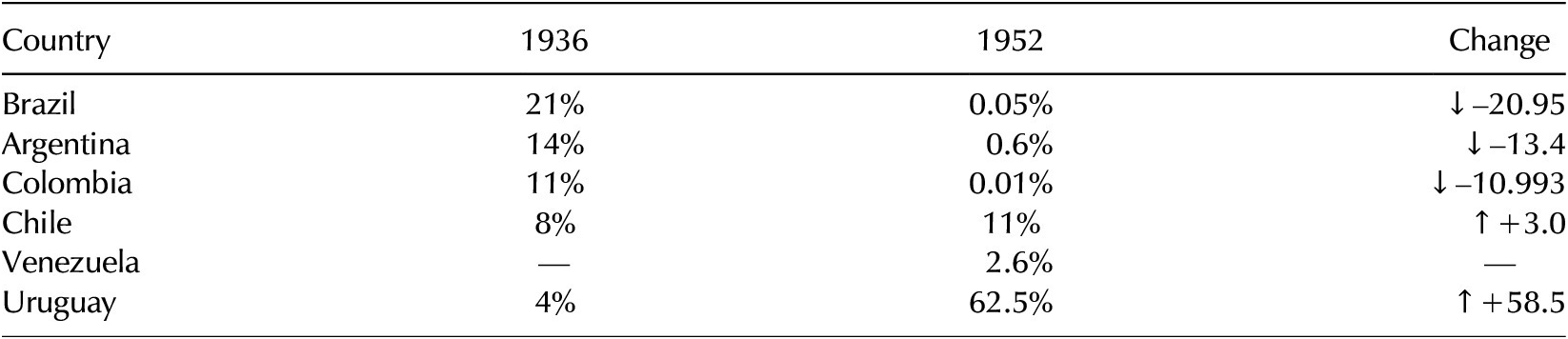
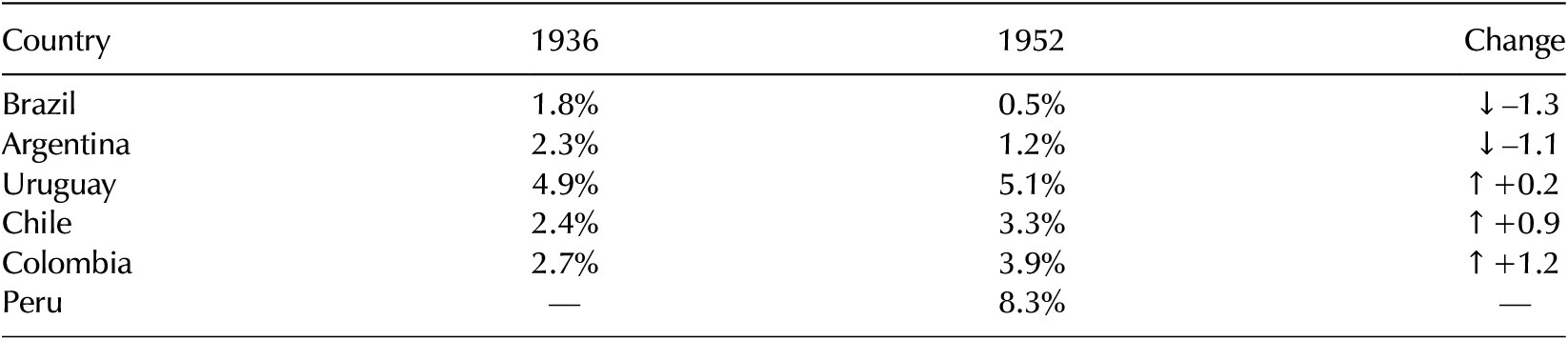
In January 1954, the BCI demanded that an Italian managing director reverse Sudameris’s decline by contrasting the bank’s performance in 1952 against that of 1936Footnote 81—a turbulent year marked by deglobalization, but one in which the BCI controlled the bank. By 1952, foreign currency deposits, once central to Sudameris’s business model, collapsed under the combined pressure of the postwar global dollar shortage and the spread of capital and exchange controls. Argentina, Brazil, and Colombia all registered drastic falls, with the share of foreign currency deposits dropping from 14%, 21%, and 11%, respectively, in 1936 to virtually nothing by 1952. The exception was Uruguay, where foreign currency deposits surged from 4% to 62.5% of branch deposits (Table 5).Footnote 82 Domestic deposits also declined in Brazil and Argentina, though far less sharply, while in other countries they increased slightly compared to 1936 (Table 6).
Foreign currency deposits of Sudameris as a % of total bank deposits, (1936–1952)

Table 5. Long description
The table contains four columns: Country, 1936, 1952, and Change.
* Brazil: 21 percent in 1936, 0.05 percent in 1952, representing a decrease of 20.95.
* Argentina: 14 percent in 1936, 0.6 percent in 1952, representing a decrease of 13.4.
* Colombia: 11 percent in 1936, 0.01 percent in 1952, representing a decrease of 10.993.
* Chile: 8 percent in 1936, 11 percent in 1952, representing an increase of 3.0.
* Venezuela: No data for 1936, 2.6 percent in 1952.
* Uruguay: 4 percent in 1936, 62.5 percent in 1952, representing an increase of 58.5.
Sources: ASI BCI, CM, cart. 44, fac. Burnier Henri, letter from Mattioli to Burnier, 20 January 1954.
Non-foreign currency deposits of Sudameris as % of total bank deposits (1936–1952)

Table 6. Long description
The table contains four columns: Country, 1936, 1952, and Change.
* Brazil: 1.8 percent in 1936, 0.5 percent in 1952, with a decrease of 1.3.
* Argentina: 2.3 percent in 1936, 1.2 percent in 1952, with a decrease of 1.1.
* Uruguay: 4.9 percent in 1936, 5.1 percent in 1952, with an increase of 0.2.
* Chile: 2.4 percent in 1936, 3.3 percent in 1952, with an increase of 0.9.
* Colombia: 2.7 percent in 1936, 3.9 percent in 1952, with an increase of 1.2.
* Peru: No data for 1936, 8.3 percent in 1952, change not applicable.
Arrows in the Change column indicate the direction of the trend: down arrows for Brazil and Argentina, and up arrows for Uruguay, Chile, and Colombia.
Sources: ASI BCI, CM, cart. 44, fac. Burnier Henri, letter from Mattioli to Burnier, 20 January 1954.
The Bottoni-Vicénot report of June 1955 echoed the BCI’s grievances over Sudameris. Like the BCI, the report attributed stagnation to mismanagement, blaming Brunier’s passive leadership for reducing the bank to merely “collecting” intelligence on South America, “as has been the case until now.”Footnote 83 Endorsing the 1951 blueprint for reform, the report called for managerial reshuffling as the necessary first step toward active management, tasked with designing and coordinating credit, liquidity, and risk strategies across all branches.Footnote 84
The task ahead was to transform Sudameris’s business model from transactional to relational banking by building domestic capabilities. This reflected the changing bank–industry relations in South America. Whereas before the Second World War local firms relied on foreign banks’ monopoly over trade finance, in the postwar years demand shifted to domestic institutions, which generated foreign trade finance business through domestic lending, thereby offering integrated financial services.Footnote 85 The report thus recognized that Sudameris could not survive as a purely foreign trade bank in an era of economic nationalism. Yet this transformation was hampered by aging, socially detached branch managers who failed to embed the bank in local networks or meet evolving client expectations. To overcome these obstacles, Bottoni and Vicénot advocated a policy of acquisitions and, aware of the liabilities of foreign branding, proposed renaming the bank Banco Francés e Italiano para la América del Sud to “sound less foreign.” Targets included the Banco Italiano (Chile), Banco Italiano (Uruguay), Banco de los Andes (Colombia), and Banco de Caracas (Venezuela). As the report explained:
“The evolution of the situation of the banks in the South American countries […] is such that at the moment we cannot think of developing or even maintaining the rhythm of our business without increasing our possibilities of penetrating the local networks. In other words, the increase in our size is linked to the problem of resources, but the key is almost everywhere the closer contact with the local environment.”Footnote 86
Embedding Sudameris in local markets meant supporting European exports toward South America more effectively while simultaneously enabling its entry in intra-South American trade finance, including the region’s foreign trade with the United States. Local banks already offered integrated financing packages—combining trade credit with domestic working capital—thanks to their strong deposit bases and growing connections with foreign banking centers. A deeper domestic presence would have enabled Sudameris to match these services while also providing market intelligence, business network access, and credit assessment to European firms.
In the second half of the 1950s, with Bottoni as managing director, under an Italian directorship, Sudameris launched a significant programme of expansion as it attempted to shift its business model.
Argentina, Brazil, and Venezuela were the main targets. Indeed, out of a total of 45 new branches opened, 37 were concentrated in those countries.Footnote 87 In Argentina, Sudameris opened 11 new branches, increasing the total to 16. Besides organic expansion, in Brazil in 1958, Sudameris acquired the Banco Aliança,Footnote 88 adding 11 new branches to the other 6 it opened, increasing the total to 27 branches across the country. In Venezuela, Sudameris opened 13 new branches while it established an alliance with the Crédit Lyonnais-controlled Banco Provincial de Venezuela.Footnote 89 In Chile, while a 1959 bid to acquire a local bank failed,Footnote 90 Sudameris opened three branches while it opened two branches in Colombia. In parallel, Sudameris renewed branch managers “thorough the recruitment and training of young, qualified personnel.” Sudameris also offered language courses within and outside the bank while supporting staff with housing.Footnote 91 In addition, Sudameris established local committees to advise branch management in Chile and Colombia.Footnote 92
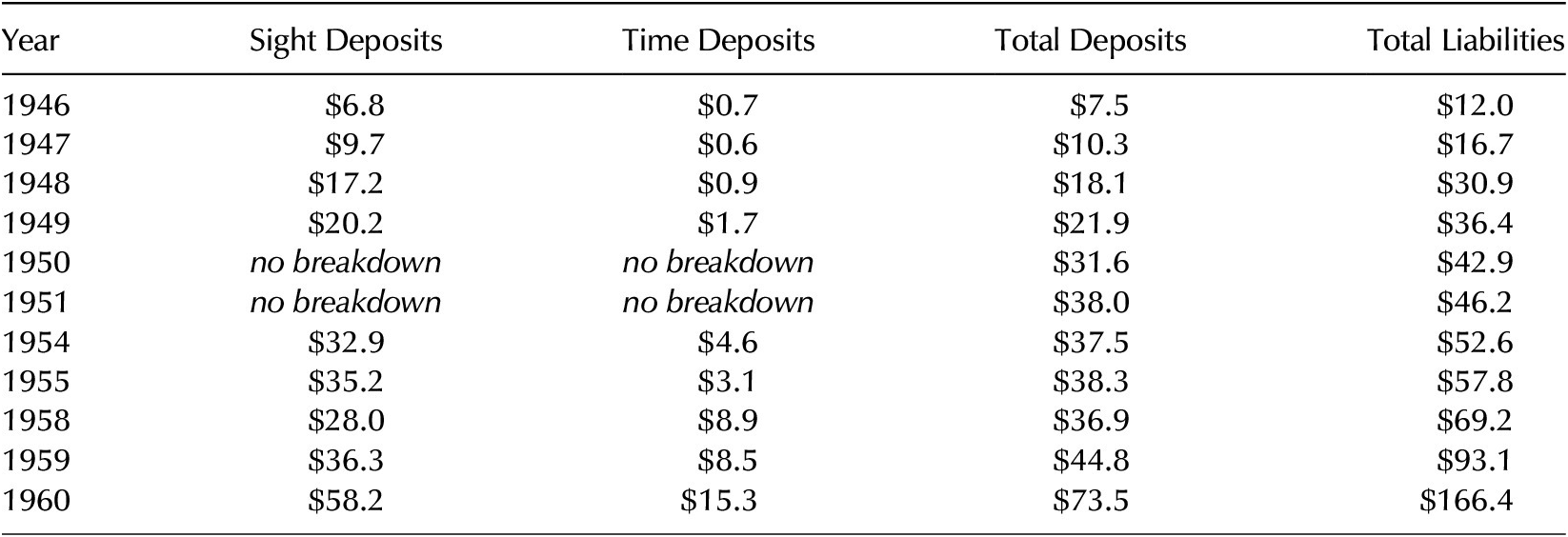
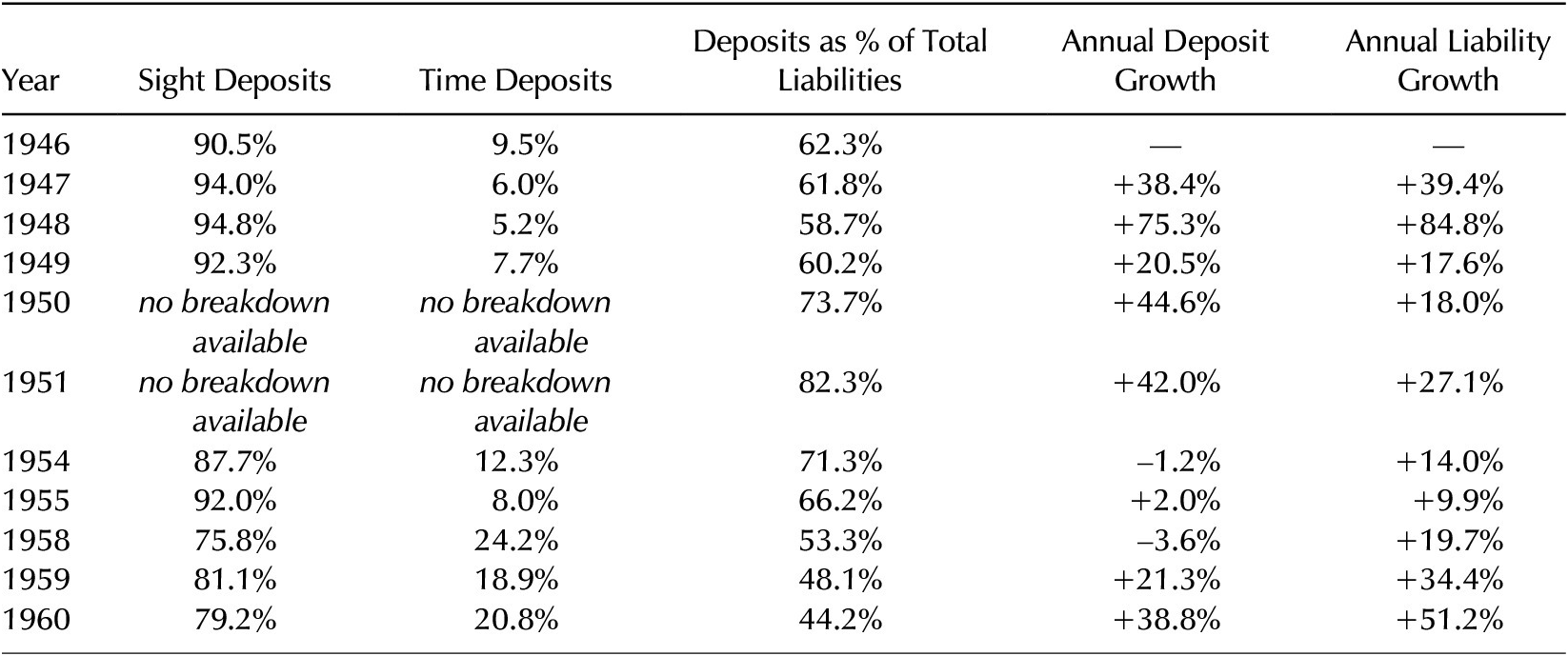
Tables 7 and 8 illustrate Sudameris’s success in reversing the mid-1950s stagnation, albeit with a lag. While the period of flat deposit growth persisted until 1958, from 1959 deposits rose sharply, by 21.3% in that year and by 38.8% in 1960. Over the same period, total liabilities more than tripled, from $57.8 million to $166.4 million, suggesting that the new strategy restored momentum and consolidated Sudameris’s competitive position in South America.
Sudameris deposits and liabilities, absolute values (US$ millions), 1946–1960

Table 7. Long description
The table consists of five columns: Year, Sight Deposits, Time Deposits, Total Deposits, and Total Liabilities. All values are in U S dollars millions.
* 1946: Sight Deposits 6.8, Time Deposits 0.7, Total Deposits 7.5, Total Liabilities 12.0.
* 1947: Sight Deposits 9.7, Time Deposits 0.6, Total Deposits 10.3, Total Liabilities 16.7.
* 1948: Sight Deposits 17.2, Time Deposits 0.9, Total Deposits 18.1, Total Liabilities 30.9.
* 1949: Sight Deposits 20.2, Time Deposits 1.7, Total Deposits 21.9, Total Liabilities 36.4.
* 1950: No breakdown for Sight or Time, Total Deposits 31.6, Total Liabilities 42.9.
* 1951: No breakdown for Sight or Time, Total Deposits 38.0, Total Liabilities 46.2.
* 1954: Sight Deposits 32.9, Time Deposits 4.6, Total Deposits 37.5, Total Liabilities 52.6.
* 1955: Sight Deposits 35.2, Time Deposits 3.1, Total Deposits 38.3, Total Liabilities 57.8.
* 1958: Sight Deposits 28.0, Time Deposits 8.9, Total Deposits 36.9, Total Liabilities 69.2.
* 1959: Sight Deposits 36.3, Time Deposits 8.5, Total Deposits 44.8, Total Liabilities 93.1.
* 1960: Sight Deposits 58.2, Time Deposits 15.3, Total Deposits 73.5, Total Liabilities 166.4.
Sources: AHBNPP, 11AH/1145, Banque Française & Italienne pour L’Amérique du Sud, Assemblée générale ordinaire, various years; Annuaire Desofossés various years, https://dfih.fr/.
Sudameris deposits and liabilities, percentages and growth rates, 1946–1960

Table 8. Long description
The table contains 11 rows of data across 6 columns.
* 1946: Sight Deposits 90.5%, Time Deposits 9.5%, Deposits as % of Total Liabilities 62.3%.
* 1947: Sight Deposits 94.0%, Time Deposits 6.0%, Deposits as % of Total Liabilities 61.8%, Annual Deposit Growth +38.4%, Annual Liability Growth +39.4%.
* 1948: Sight Deposits 94.8%, Time Deposits 5.2%, Deposits as % of Total Liabilities 58.7%, Annual Deposit Growth +75.3%, Annual Liability Growth +84.8%.
* 1949: Sight Deposits 92.3%, Time Deposits 7.7%, Deposits as % of Total Liabilities 60.2%, Annual Deposit Growth +20.5%, Annual Liability Growth +17.6%.
* 1950: Sight and Time breakdown unavailable, Deposits as % of Total Liabilities 73.7%, Annual Deposit Growth +44.6%, Annual Liability Growth +18.0%.
* 1951: Sight and Time breakdown unavailable, Deposits as % of Total Liabilities 82.3%, Annual Deposit Growth +42.0%, Annual Liability Growth +27.1%.
* 1954: Sight Deposits 87.7%, Time Deposits 12.3%, Deposits as % of Total Liabilities 71.3%, Annual Deposit Growth -1.2%, Annual Liability Growth +14.0%.
* 1955: Sight Deposits 92.0%, Time Deposits 8.0%, Deposits as % of Total Liabilities 66.2%, Annual Deposit Growth +2.0%, Annual Liability Growth +9.9%.
* 1958: Sight Deposits 75.8%, Time Deposits 24.2%, Deposits as % of Total Liabilities 53.3%, Annual Deposit Growth -3.6%, Annual Liability Growth +19.7%.
* 1959: Sight Deposits 81.1%, Time Deposits 18.9%, Deposits as % of Total Liabilities 48.1%, Annual Deposit Growth +21.3%, Annual Liability Growth +34.4%.
* 1960: Sight Deposits 79.2%, Time Deposits 20.8%, Deposits as % of Total Liabilities 44.2%, Annual Deposit Growth +38.8%, Annual Liability Growth +51.2%.
Sources: AHBNPP, 11AH/1145, Banque Française & Italienne pour L’Amérique du Sud, Assemblée générale ordinaire, various years; Annuaire Desofossés various years, https://dfih.fr/.
These developments are consistent with a shift toward relationship banking in Sudameris’s business model. The rising share of time deposits (Tables 7 and 8), combined with branch expansion, acquisitions, and renewed recruitment, points to deeper local embedment and more stable funding by Sudameris. In short, the reforms achieved their intended effect and placed the bank back on a trajectory of growth.
That growth is all the more remarkable given the difficult macroeconomic and political environment and the mounting competition across markets. In Argentina, the 1957 banking reform allowed banks to “regain the freedom to use their deposits,” but reduced rediscounting, intensifying “increasingly fierce competition” for deposits; pressures escalated in 1959 with a banking strike, high reserve requirements, the “suppression” of rediscounting, and sharp currency depreciation.Footnote 93 Conditions were even more difficult in Venezuela, where the 1958 crisis deepened in 1959 and spread to the currency in 1960, tightening liquidity and forcing Sudameris to cut lending, including to “privileged clientele.”Footnote 94 In Brazil, despite liquidity tightening and a broader crisis in 1959–60, Sudameris raised deposits by 30% in 1958 and continued to “meet customer demand with relative ease” and “expanded its activities” through branch-level “propaganda” departments.Footnote 95 Chile and Colombia also faced difficulties, though Sudameris’s “revival” in Chile was due “to a large extent” to the “effective action of new committees […] within which eminent Chilean figures are keen to provide us with support.”Footnote 96 Overall, continued branch expansion and deposit growth indicate that local embedment helped Sudameris mitigate economic nationalism.Footnote 97
The 1958 Annual Report highlights a shift toward relationship banking at Sudameris. It notes that management took “care” in “selecting their clientele” and “reserving credit facilities for firms likely to offer the most attractive reciprocal terms,” particularly in “foreign exchange and documentary credits.”Footnote 98 While the report specifically references Colombia, it is reasonable to assume these practices were applied across Sudameris’s branches, signaling a move away from transactional banking to a relationship-based model.
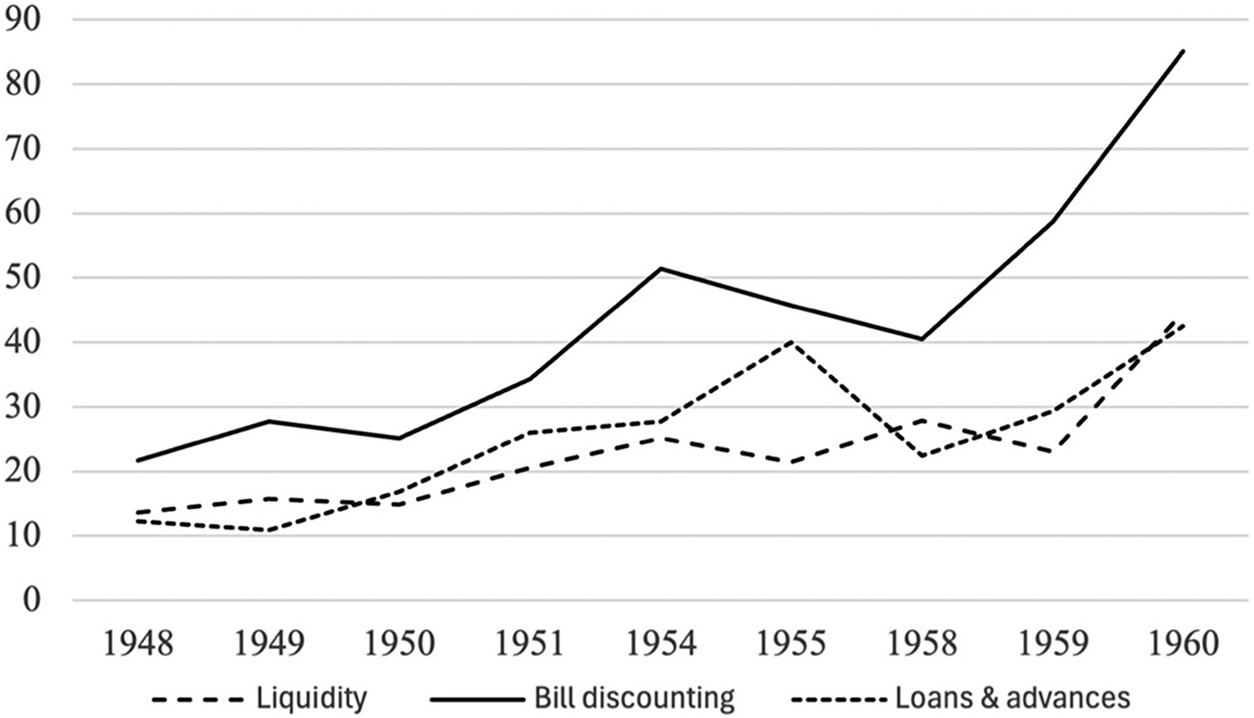
The parallel growth in Sudameris’s loans and advances and the post-1958 recovery indicate that this organizational transformation translated into renewed lending capacity. Figure 2 shows the evolution of Sudameris’s assets between 1948 and 1960. Throughout the period, bill discounting represented the largest share of assets, while loans and advances grew steadily, particularly after the mid-1950s. Liquid assets remained relatively stable until the end of the decade, when they increased sharply in 1960.
Sudameris’s assets, 1948-1960 ($ million)
Sources: AHBNPP, 11AH/1145, Banque Française & Italienne purl’Amérique du Sud, Assemblée générale ordinaire, various years

Figure 2. Long description
The X-axis represents years from 1948 to 1960, with non-linear intervals (1948, 1949, 1950, 1951, 1954, 1955, 1958, 1959, 1960). The Y-axis represents value in millions of dollars, ranging from 0 to 90 in increments of 10.
* Bill discounting (solid line): Starts at approximately 22 in 1948, fluctuates slightly until 1950, then shows a significant upward trend to a peak of 52 in 1954. It dips to 41 in 1958 before a sharp exponential increase to 85 by 1960.
* Liquidity (long-dashed line): Begins at 14 in 1948, remains relatively flat until 1950, then rises steadily to 25 in 1954. It fluctuates between 22 and 28 through 1958, ending with a sharp rise to 43 in 1960.
* Loans and advances (short-dashed line): Starts at 12 in 1948, dips slightly in 1949, then rises to 26 in 1951. It reaches a local peak of 40 in 1955, drops to 23 in 1958, and climbs back to 43 in 1960.
By 1960, Bill discounting is the dominant asset, while Liquidity and Loans and advances converge at nearly the same value.
Sudameris’s organizational and operational transformation in the late 1950s marked a clear departure from its earlier postwar model. Under Italian executive control, Sudameris renewed country-level management, invested in recruitment and training, expanded its branch network, and embedded decision-making more deeply within local markets also through committees and alliances. Trade finance remained central to Sudameris’s identity, but it was increasingly tied to reciprocal, longer-term relationships with selected clients and to the mobilization of domestic deposits. The shift from transactional to relationship banking is reflected in governance, staffing, client selection, and balance-sheet outcomes.
Unfortunately, no comparable data from other European banks operating in South America is currently available, making it impossible to compare Sudameris’s performance during 1946–1960 against that of its counterpart—a gap that future archival research could fill. However, as Rory Miller noted, like Sudameris, also Bolsa faced the need to adapt its business model in the mid-1950s. Under George Bolton’s leadership from 1957, Bolsa shifted from financing British trade to a broader role in Latin American and international trade finance, including the Eurodollar market, which it pioneered in LondonFootnote 99 in parallel to the BCI and the other big Italian banks in Italy.Footnote 100
Sudameris and Bolsa were in a league of their own in terms of the reforms they undertook and strategic reorientations they implemented, contrasting sharply with other European and American banks operating in South America.
The competitive advantage this transformation generated becomes evident from assessments by Sudameris branch managers across the region, who in the early 1960s observed that competitors struggled with obsolete business models. In Argentina, Sudameris’s director dismissed the Bank of Boston as having “missed the train” and described the Royal Bank of Canada as living “in the same lethargy as Boston; it’s really a bank you never hear of.” By contrast, the Banque Italo-Belge “never concealed from us that they had taken us as a model”—a telling acknowledgment of Sudameris’s successful adaptation. Even Bank of America’s 1960 Buenos Aires branch, backed by the world’s largest bank, posed no threat. “After a brilliant start we no longer see ourselves directly threatened by this emanation of the world’s largest bank,” the bank manager noted. Only National City Bank earned grudging respect as the most “pushing” foreign bank, having surpassed the Bank of Boston in assets through an “aggressive policy broadly supported by the Headquarters in New York.”Footnote 101
This pattern of stagnation by foreign banks extended across South America, validating the strategic diagnosis that had driven Sudameris’s mid-1950s transformation. In Brazil, Sudameris observed that British and American banks operated “almost exclusively” on behalf of multinationals. Meanwhile, competitors like Royal Bank of Canada remained “banks of reduced importance” despite recent expansion efforts.Footnote 102 Also in Peru, foreign banks served mainly multinational clients while capturing minimal market share, with National City, Bolsa, and Royal Bank accounting for mere 2.3%, 0.6%, and 0.6% of total deposits respectively in 1962. These figures underscore how thoroughly domestic banks had captured the trade finance business that foreign institutions once monopolized.Footnote 103 Venezuela showed similar patterns of foreign bank marginalization, completing a regional picture that validated Sudameris’s strategic pivot toward domestic market penetration and relationship-driven banking in an era of economic nationalism.Footnote 104
Against this backdrop, the BCI assessed positively Sudameris’s performance following the reforms of the mid-1950s. In 1963, Mattioli observed that in Argentina Sudameris ranked second only to National City Bank, while its Peruvian affiliate, the Banco de Crèdito, remained the country’s leading institution. He described Sudameris/Brazil as being in a “pretty good situation” and expressed satisfaction with its performance in Colombia, Chile, and Uruguay. Venezuela, however, was characterized as “discreet.”Footnote 105 Together, these observations revealed the dividends of the BCI’s decade-long struggle for control and strategic transformation. Sudameris had evolved from a stagnating institution focused on intelligence-gathering into a competitive force embedded in local markets.
Conclusions
The corporate war over Sudameris underscores the centrality of South America to postwar European reconstruction and the growth of the export industry during the 1950s. France envisioned Sudameris as an instrument to project its commercial interests in South America by operating exclusively as a French bank at the service of the French economy. Likewise, Italy, a defeated country at the end of the Second World War, saw Sudameris as a strategic asset enabling Italy to re-establish commercial relations with South America. A presence in the region, in fact, meant access to raw material markets and the possibility to boost exports.
The corporate war over Sudameris fully reveals the intensity of Franco-Italian rivalry in the postwar decades. “Embedded liberalism” and European cooperation coexisted with naked nationalism abroad. Indeed, while European governments deepened economic integration within Western Europe, European bankers waged trench warfare, so to speak, for markets thousands of kilometers away.
While the aggressor was Paribas, the BCI was the ultimate victor. To defend Italian interests, the BCI outmaneuvered Paribas managing, ultimately, to regain its majority shareholdings. After a long war of attrition, unfolding between 1948 and 1955, the BCI also undermined Paribas’s efforts to marginalize it from Sudameris’s management. This article, therefore, further strengthens the reputation of Raffaele Mattioli as a maverick banker and a towering figure of his days strongly committed to the development of the Italian export industry. In 1977, Guido Carli, Italy’s powerful central banker, argued that “the formidable development of the export industry would not have occurred without Mattioli.”Footnote 106
The corporate war between Paribas and the BCI over Sudameris underlines contradictions in international joint ventures during the postwar years. Sudameris was conceived as a Franco-Italian partnership, but that presumed cooperation was undermined by nationalist agendas. The distinction between positive and negative control, so central to IJV theory, captures the dynamic. Paribas could dominate management without an equity majority, while the BCI wielded vetoes and deadlock to block, delay, and finally force Italian leadership. The BCI proved that negative control, if sustained and strategically deployed, could be transformed into operational control. This, however, came at the immense cost of nearly a decade of attrition, wasted opportunities, and reputational damage for Sudameris.
Under the management of the BCI, Sudameris changed its business model reversing the several years of stagnation under Paribas. Under Italian direction, the bank shifted from transactional to relationship banking, embedding itself in South America’s national economies during the second half of the 1950s. This reflected an adjustment to local markets and a recognition by the Italians that the nationalist tide in South America required adjustment. Sudameris’s managers understood that to remain viable, the bank had to sound less foreign, act more domestic. Their strategy of acquisitions and alliances was deemed successful by the BCI. Indeed, after years of stagnation under Paribas’s decentralized management, deposits surged by the late 1950s. As the reports of Sudameris’s branch directors underscore, British, Canadian, even American competitors were lethargic, with the exception of National City Bank. Within the narrower field of European banks, Sudameris’s survival and relative dynamism stand out.
The Sudameris saga therefore illuminates three intertwined dynamics. First, it sheds light on postwar globalization. South America was indispensable to Europe’s postwar recovery and growth of the export industry. It was both a supplier of raw materials and a market for exports, and thus a theater of nationalist commercial rivalry. Second, the operations of European postwar multinational banks reflected the interplay between foreign policy objectives and foreign trade. Third, the case of Sudameris highlights how multinational banks had to adapt business models to survive in a changing global environment. Only when the BCI imposed centralized management and pushed relationship banking did the bank recover. Performance was thus tied not simply to who controlled the firm, but to how control translated into effective strategy.
Further research should shed light on the activities of European banks in South America during the 1950s, enabling comparative analysis of their management strategies and performance in this period thus widening the historiography.
Competing Interests
The author declares no competing interests.