Conserving wildlife has been much in the news in early 2014, owing to the rapid growth of wildlife crime since 2000. This is now a problem measured in tens of billions of dollars, with large, organized and violent criminal activity pushing rhinos towards extinction, and losses of African elephants measured in the thousands per year. Tigers, lions and other top predators are under severe pressure as well.
By designing tools to measure global benefits, environmental economics contributed to the birth of the Global Environment Facility (GEF) in 1991. The GEF is the financing instrument for the principal global conventions on biodiversity, climate change, persistent organic pollutants, desertification and releases of mercury into the environment.
Conserving wildlife is an issue where environmental economics has made an impact by arguing that successful conservation cannot be limited to fencing and enforcement. It must take the interests and wellbeing of local communities into account as well, if efforts to reduce poaching and encroachment are to succeed. As a World Bank study for Zambia shows (World Bank, 2007),Footnote 1 a truly comprehensive approach to leveraging protected areas as a contributor to growth needs to consider government institutional capacity, the business climate for private investors in wildlife ventures, household surveys to measure local benefits from wildlife tourism, and surveys of tourists to measure their expenditures, assess their willingness to pay (WTP), and elicit their suggestions for improving the wildlife experience.
The fact that setting aside land for the conservation of biodiversity incurs an opportunity cost – foregone agricultural production – for local communities was one of the key insights of David Pearce in a series of papers and books (see, for example, Pearce and Perrings, Reference Pearce, Perrings, Perrings, Maler, Folke, Holling and Jansson1995). While this cost could in principle be offset by GEF finance, Hamilton (forthcoming)Footnote 2 shows that the average annual grant finance and co-finance provided by the GEF biodiversity window amounted to only 8 per cent of the opportunity cost of conservationFootnote 3 in low-income countries in 2005.
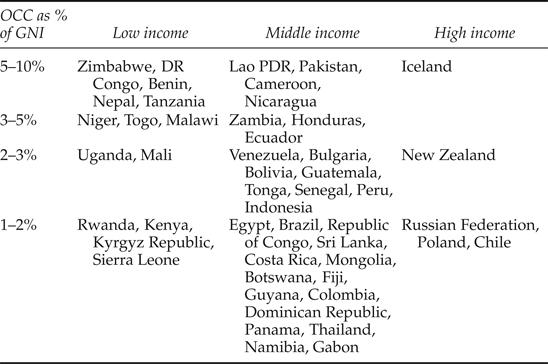
Table 1 updates the figures on the opportunity cost of conservation from Hamilton (forthcoming) to 2010. As can be seen, the opportunity cost is greater than 1 per cent of GNI in only five high-income countries, while it exceeds this threshold in 44 low- and middle-income countries. Conservation is very expensive for developing countries. These figures suggest that an ongoing challenge for environmental economics in the future will be finding ways to increase the returns to local communities from the creation and operation of protected areas. This is so because the opportunity costs of conservation are primarily borne by local communities. This cost and lack of benefits encourages communities to support or harbour poaching activities. While increasing the allocation of GEF resources to biodiversity could be an important source of finance, foreign aid tends to be fickle, and ‘donor fatigue’ is quite obvious in many donor countries.
Opportunity cost of conservation (OCC) as a percentage of GNI, 2010, by country and income class

Source: Data from The Changing Wealth of Nations 2014, World Bank (forthcoming).
An additional source of finance for local communities can be created if governments capture revenues from ecotourism. The potential sources of revenue are substantial. According to the World Travel and Tourism Council (WTTC, 2013), the direct impacts of tourism on the economy amounted to 5 per cent of GDP in Kenya, 4.8 per cent in Tanzania, 3.2 per cent in South Africa and 3 per cent in Namibia. In these countries, and many others in Africa, tourism is largely wildlife related.
A key insight from environmental economics is that Africa's wildlife resource should be a large source of economic rents. The resources are scarce and are in fact unique. The challenge for governments wishing to use ecotourism as part of a growth strategy is how to capture rents most efficiently. Many countries have established a high visa fee, but this revenue is unrelated to the duration of stay. More efficient instruments would be some combination of value added taxes, corporate taxes, daily park fees and ad valorem accommodation taxes. The capture of rents from ecotourism can enable governments to invest in the resource as well as to share benefits with local communities.
Many economic studies have shown, however, that benefit sharing with local communities is inefficient because of elite capture – see Bandyopadhyay and Tembo (Reference Bandyopadhyay and Tembo2010) for a Zambian example. An alternative instrument could be direct cash transfers to households – this has gained attention as a solution to sharing benefits in oil and mineral economies (Gelb and Majerowicz, Reference Gelb and Majerowicz2011), and is now feasible because of the rise of wireless banking. Cash transfers can contribute to conservation, however, only to the extent that the receiving households understand that the payment depends upon the protection of the wildlife resource.
Increasingly affordable technology for wildlife monitoring (portable camera traps, for example) opens the potential for payments for environmental services (PES) schemes to conserve wildlife.Footnote 4 Here the cash transfers to households could be contingent upon the health of the resource as measured by periodic wildlife counts, creating a direct link between payments and conservation outcomes.
In conclusion, environmental economics has not only shown how to value many global benefits, but it has established that a significant part of the cost of conservation is being borne by the poorest people on the planet. Going forward, environmental economists need to argue for greater international finance for conservation, assist developing country governments to capture wildlife rents, and experiment with new instruments to finance conservation, including providing benefits to local communities through direct cash transfers and payments for environmental services.
A herd of African elephants walking behind each other