Introduction
A diagnosis of dementia presents with serious consequences and care concerns at any age, but for younger dementia patients and their families, it is known to cause specific age related challenges (Werner et al., Reference Werner, Stein-Shvachman and Korczyn2009). These challenges are associated with diagnostic issues (van Vliet et al., Reference van Vliet2013a), work-related and financial issues, loss of self-esteem and identity, and a disrupted future perspective (Harris and Keady, Reference Harris and Keady2009; Werner et al., Reference Werner, Stein-Shvachman and Korczyn2009). Young-onset dementia (YOD) caregivers must provide care along with other responsibilities, such as work and parenting, and are often forced to prioritize caregiving responsibilities before their own future plans, such as career opportunities or personal development (Bakker et al., Reference Bakker, de Vugt, Vernooij-Dassen, van Vliet, Verhey and Koopmans2010).
The care giving process in YOD is hampered by the high levels of neuropsychiatric symptoms found in these patients (Hori et al., Reference Hori2005). Neuropsychiatric symptoms are known to cause high levels of caregiver distress and are considered a main predictor for institutionalization (Gaugler et al., Reference Gaugler, Yu, Krichbaum and Wyman2009; Bakker et al., Reference Bakker2013a). Neuropsychiatric symptoms may increase the patients reluctance to use services, such as day care or home care (Wolfs et al., Reference Wolfs, de Vugt, Verkaaik, Verkade and Verhey2010) leading to a postponement of service use. This might especially be an issue in YOD because of the high levels of neuropsychiatric symptoms in these patients, related to the high prevalence of frontotemporal dementia in YOD in which neuropsychiatric symptoms are a key feature. This will further add to the delay in the use of formal care in YOD related to the delay in the time to diagnosis and the lack of specialized services in YOD (Bakker et al., Reference Bakker2013b). At the same time, research regarding the care needs in YOD is largely lacking. Care needs that are not fulfilled are likely to have an adverse effect on patient and caregiver wellbeing and may negatively influence the course of neuropsychiatric symptoms.
Research on care needs in late onset dementia indicates that caregivers report more unmet care needs than patients do themselves and that there are differences in the areas in which they report unmet needs (van der Roest et al., Reference van der Roest2009). In more advanced dementia, it will become increasingly difficult for (in)formal caregivers to establish the patients care needs, and consequently increase the risk that care needs remain unfulfilled. This dilemma is in line with the need-driven, dementia-compromised behavior (NDB) model, which suggests that because of the inability of a person with dementia to make his or her needs known and the resulting difficulties of (in)formal caregivers in understanding these needs, neuropsychiatric symptoms may occur. In this model, behavior is seen as an attempt of the patient to communicate physical or psychological distress when unmet needs arise (Algase et al., Reference Algase1996). The literature suggests that reducing patients’ unmet care needs, such as addressing hearing disabilities, social isolation, or pain might lead to a decrease in the occurrence and severity of neuropsychiatric symptoms (Ayalon et al., Reference Ayalon, Gum, Feliciano and Arean2006).
Therefore, the aim of this study is to (1) explore the care needs of people with YOD, (2) explore patient and caregiver agreement on care needs and the extent to which these needs can be met, and (3) explore the relationship between changes in care needs and changes in the severity of neuropsychiatric symptoms. We expect that with more advanced dementia the number of unmet needs in YOD will also increase over time, and these unmet needs are related to the severity of neuropsychiatric symptoms.
Methods
This study is part of a Dutch prospective cohort study, the NeedYD (Needs in Young-onset Dementia) study, which has been described in detail elsewhere (van Vliet et al., Reference van Vliet, Bakker, Koopmans, Vernooij-Dassen, Verhey and de Vugt2010). This study recruited 215 YOD patients and their primary caregiver. Assessments were performed every six months for two years. Patients were sampled from specialized day care facilities (n = 115) or were community dwelling (referred by University Medical Centers in Maastricht and Amsterdam (n = 56), regional hospitals (n = 10), or regional community mental health services (n = 20), or the patients applied to participate (n = 14). Inclusion criteria were a dementia diagnosis established before age 65 years and availability of an informant who had contact with the patients at least once a week. A dementia diagnosis was made on the basis of clinical, neuropsychological, and brain imaging findings according to the criteria from the 4th edition of the Diagnostic and Statistical Manual of Mental Disorders, text revision (American Psychiatric Association, 2000), and the Dutch consensus guidelines, which use internationally accepted criteria for diagnosing dementia subtypes (McKhann et al., Reference McKhann, Drachman, Folstein, Katzman, Price and Stadlan1984; Erkinjuntti, Reference Erkinjuntti1994; Neary et al., Reference Neary1998; Mesulam et al., Reference Mesulam, Grossman, Hillis, Kertesz and Weintraub2003; CBO 2005; McKeith, Reference McKeith2006). Clinical diagnoses were checked against clinical patient files. Exclusion criteria were (1) lack of informed consent, (2) living in a nursing home, or (3) dementia caused by HIV, traumatic brain injury, Down's syndrome, Huntington's disease, or alcohol-related dementia.
The Medical Ethics Committee of the Maastricht University Medical Center approved the study protocol.
Data collection
Well-trained researchers and research assistants collected data using structured interviews and questionnaires.
Assessment of neuropsychiatric symptoms
Neuropsychiatric symptoms were assessed with the Dutch version of the Neuropsychiatric Inventory (NPI) (Cummings et al., Reference Cummings, Mega, Gray and Rosenberg-Thompson1994), which has high inter-observer reliability and is a valid rating scale for a wide range of neuropsychiatric symptoms of dementia (Kat et al., Reference Kat, de Jonghe, Aalten, Kalisvaart, Dröes and Verhey2002). The frequency (F) and severity (S) of each symptom is rated on a five- (0–4) and four-point (0–3) Likert scale, respectively. Scores ≥ 4 are considered clinically relevant. Scores are summed to calculate scores for four neuropsychiatric sub-syndromes, hyperactivity (agitation, euphoria, disinhibition, irritability, and aberrant motor behavior), mood (depression and anxiety), psychosis (delusions, hallucinations, and night-time behavioral disturbances), and apathy (apathy and appetite or eating abnormalities), based on the results of the European Alzheimer Disease Consortium (Aalten et al., Reference Aalten2008).
Assessment of care needs
Care needs were assessed with the Dutch version of the Camberwell Assessment of Need for the Elderly (CANE) (Reynolds et al., Reference Reynolds2000; van der Roest et al., Reference van der Roest, Meiland, van Hout, Jonker and Droes2008). The CANE is a semi-structured interview consisting of 24 domains that cover the social, physical, psychological, and environmental needs of the patient. Respondents are asked about any difficulties or problems in these areas. For instance, the domain of “behavior” refers to behavior that might cause conflicts with other people, inhibits (social) activities or causes others to negatively react to the person with dementia regarding his or her behavior. Needs are met when a difficulty in a particular area is being provided for, in such a way that the person no longer feels its negative impact on his or her overall quality of life. For instance, a person can be assisted by an informal or professional caregiver on a certain task. Unmet needs are experienced when a person is not supported for a problem that occurs in one of these domains, or receives insufficient or inadequate support. Both the patient self-report and caregiver proxy were used to determine whether the patient experienced a need and whether this need was met. The reliability and validity of the CANE were found to be adequate (Reynolds et al., Reference Reynolds2000; van der Roest et al., Reference van der Roest, Meiland, van Hout, Jonker and Droes2008).
Analyses
The analyses were performed using the Statistical Package for Social Sciences (SPSS) version 18.0.2 (SPSS Inc., Chicago, USA). Proportions or means were calculated to describe characteristics of the participants. Group comparisons were performed by χ 2 tests for categorical variables and t tests for continuous variables. Frequency distributions were calculated for identifying (un)met needs in the different areas of the CANE. The level of agreement between the patient's self-report and the caregiver's proxy was calculated using κ coefficients, which were rated as having poor (0.00–0.20), fair (0.21–0.40), moderate (0.41–0.60), good (0.61–0.80), or very good agreement (81–1.00) (Altman, Reference Altman1991). A Kruskal–Wallis test was performed to compare means across the five assessments of the total amount of reported needs. To examine the relationship between (un)met needs and neuropsychiatric symptoms over time, linear mixed models were used. Mixed models analysis allows for an estimation of an intercept and slope for each participant based on all available data for that individual, augmented by the data from the entire sample. Because missing data at one or more time points are common in prospective studies, the use of mixed models allows individual slopes to be estimated using the available data for that participant. In the model, neuropsychiatric symptoms (NPI total score) were included as the dependent variable, and the number of met and unmet needs were included as the key time-varying covariates. The model also included another time-varying covariate, disease severity (GDS; mild, moderate, or severe), and the following time-invariant covariates: patient's and caregiver's age at baseline, patient's gender, patient's and caregiver's educational levels (low, average, or high), type of dementia (Alzheimer's dementia (AD), frontotemporal dementia (FTD), mixed or vascular dementia (mixed/vasc), and other type of dementia), relationship of the caregiver to the patient (spouse, child, or other) and the duration of the disease at time of inclusion. Sensitivity analyses were performed to explore whether any effects of the key time-varying covariates applied to all four neuropsychiatric sub-syndromes (hyperactivity, mood, psychosis, and apathy). Because a relatively large proportion of patients were institutionalized during our study, a sensitivity analysis was also performed to determine whether the effects remained after this group was removed from the analysis. All tests were two-tailed unless otherwise specified. For all analyses, p < 0.05 was used as the threshold for statistical significance.
Results
Dropouts and missing data
From the original sample, 209 (out of 215) patient-caregiver dyads were included in the study. Six caregivers refused to participate due to high levels of subjective burden. For the baseline assessment, self-reports of 57 (out of 209) patients regarding their own needs were unavailable because these patients were unable to complete the CANE interview and were therefore not included in the analyses. Non-completers had more severe dementia (U = 5,529; p < 0.001) and a higher score on the apathy sub-syndrome (U = 5,088.5; p = 0.21).
Fifty-four dyads (25.8%) were lost to the two-year follow-up assessment: 16 (7.7%) were lost due to the death of the patient, and 38 (18%) dyads discontinued participation mainly due to burden or lack of time as a result of the caregiving situation. There was a significant difference between those who dropped out and those who completed all assessments regarding dementia severity; patients who dropped out had more severe dementia compared to patients who completed all assessments (U = 3,969; p < 0.001). We found no significant differences between those who dropped out and those who completed all assessments regarding the primary outcome measure and the other variables.
Patient and caregiver characteristics
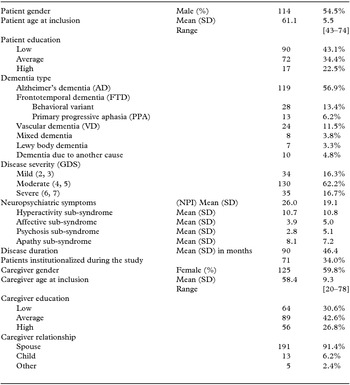
More than half of the patients were male, and most patients had moderate disease severity (Table 1). AD was the most common cause of dementia, followed by frontotemporal dementia and vascular dementia. Neuropsychiatric symptoms were highly prevalent in our sample, with 90.4% of the patients having at least one clinically relevant behavioral symptom. Patients scored highest on the hyperactivity and apathy sub-syndromes.
Baseline characteristics of patients and caregivers

GDS = Global Deterioration Scale; NPI = Neuropsychiatric Inventory.
Patients’ self-reports of care needs at baseline
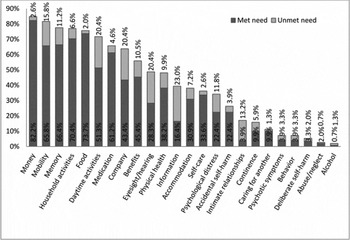
At baseline, patients reported a mean of 7.9 (SD 3.3) areas with met needs and a mean of 2.0 (SD 2.7) areas in which an unmet need existed. The majority of patients reported that they received some kind of (in)formal support in managing their finances, mobility (e.g., walking, climbing stairs, and traveling), memory (e.g., remembering appointments and coping with memory loss), or household activities and food (e.g., shopping and preparing meals) (Figure 1). The highest proportion of unmet needs were in the areas of information, eyesight and hearing, company, daytime activities, mobility, intimate relationships, and psychological distress.
Patients’ self-reports of met and unmet needs by percentages (N = 152).

Caregivers’ reports of met and unmet needs of patients at baseline
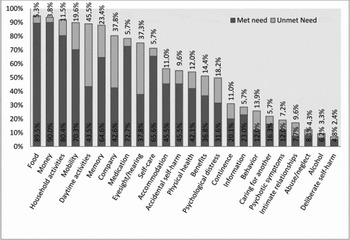
On average, patients had 9.6 (SD 2.9) areas in which a need existed that could be met and 3.1 (SD 2.4) areas in which an unmet need remained. The majority of caregivers reported that the patient received (in)formal support with food, money, household activities, mobility, daytime activities, memory, company, medication, eyesight, and hearing and self-care (Figure 2). The proportion of unmet needs varied between 2.4% for the domain of deliberate self-harm and 45.5% for daytime activities. The highest proportions of unmet needs included daytime activities, the company of others, eyesight, and hearing (i.e., difficulties in communicating, reading and writing), memory, mobility, and psychological distress.
Caregivers’ proxy reports on met and unmet needs by percentages (N = 209).

Agreement between patients and caregivers on care needs at baseline
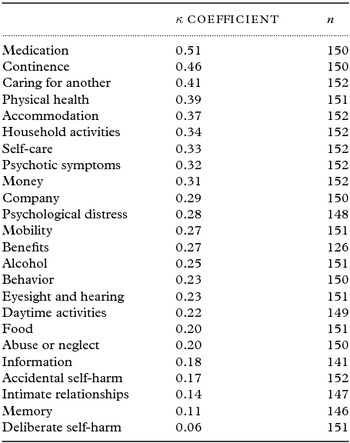
There was large variation in the degree of agreement (κ) within patient-caregiver dyads, with agreement varying between 0.06 (poor agreement) and 0.51 (moderate agreement) (Table 2.). The highest agreement was found in the areas of medication, continence and caring for another (e.g., caring for a child). Poor agreement was found in the areas of food, abuse/neglect, information, accidental self-harm, intimate relationships, memory, and deliberate self-harm.
Agreement between patients and caregivers on care needs

Cases with an unknown need in a specific area were not included in the analyses to obtain equal cross tables; therefore, n varies for the different κ values.
The two-year course of needs
According to the caregiver report, the total number of areas in which needs existed (either met or unmet) did not change significantly during the two-year study period H (4) = 4.21, p = 0.378. However, patients reported a significant decrease in the number of areas in which needs existed over time H (4) = 17.25, p = 0.002). Both caregivers and patients reported that the percentage of unmet needs in these areas decreased from approximately 24% (caregiver) and 18% (patient) at baseline to 14% and 10%, respectively, at two-year follow-up, with an obvious increase in the percentage of met needs.
The relationship between (un)met needs and neuropsychiatric symptoms over time
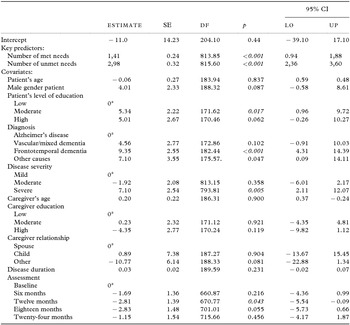
A linear mixed model analysis showed that the time-varying number of met needs and the number of unmet needs covaried with the level of total neuropsychiatric symptoms over time (Table 3). Patients with higher levels of met or unmet needs over time exhibited higher levels of neuropsychiatric symptoms over time, with the largest effect for unmet needs. Sensitivity analyses (not shown) for the four separate behavioral sub-syndromes (hyperactivity, psychosis, mood, and apathy) revealed that the effect for unmet needs remained significant. However, the effect for met needs remained significant for all sub-syndromes except for the hyperactivity cluster, for which there was only a trend (t = 1.837; df = 624.99, p = 0.067). When the patients who where institutionalized during the study were removed from the analysis, the effects for met and unmet needs on neuropsychiatric symptoms remained significant (not shown).
Linear mixed model of the relationship between changes in unmet needs and neuropsychiatric symptoms adjusted for covariates

aReference category.
p-values in italic represent values that met the threshold for statistical significance.
FTD patients showed significantly higher levels of neuropsychiatric symptoms over time compared with AD patients. A similar effect was found for the “other causes” group in our sample. Patients exhibiting severe dementia showed higher levels of neuropsychiatric symptoms over time compared with patients with mild dementia. Furthermore, patients with higher education showed higher levels of neuropsychiatric symptoms over time.
Discussion
This is the first prospective study to explore the course of care needs and the relationship between changes in these needs and changes in the severity of neuropsychiatric symptoms in people with YOD. Patients and caregivers reported similar areas in which they perceived needs. However, only modest agreement existed within patient-caregiver dyads regarding whether needs could be met. This study also reveals that YOD patients experience high levels of unmet needs in important areas of life, including daytime activities, social company, intimate relationships, eyesight and hearing/communication, memory, mobility, psychological distress, and unmet information needs. Contrary to our expectations, the number of unmet needs decreased over time. Furthermore, as we hypothesized, we found a strong relationship between unmet needs and the level of neuropsychiatric symptoms over time. We also found a similar relationship between neuropsychiatric symptoms and the amount of met needs.
There was fair agreement within patient-caregiver dyads on the areas in which a need occurred. Patients, contrary to their caregivers reported a significant decrease in the number of areas in which a need existed over time. Patients also reported fewer (un)met needs than did their caregivers. This is probably related to dementia progression, with patients becoming increasingly unaware of issues at hand and the amount and kind of support provided. This appears also supported by the fact that non-completers of the needs interview in our study had more severe dementia, suggesting that as the disease progresses, patients find it more difficult to reflect on their needs and how these needs can be met. These findings are in line with earlier research on the subjective needs of LOD patients (van der Roest et al., Reference van der Roest, Meiland, Maroccini, Comijs, Jonker and Droes2007, Reference van der Roest2009; Orrell et al., Reference Orrell, Hancock, Liyanage, Woods, Challis and Hoe2008;). The agreement on whether needs could be met within patient-caregiver dyads in our sample was generally modest, which is consistent with earlier research in LOD (Hancock et al., Reference Hancock, Reynolds, Woods, Thornicroft and Orrell2003; van der Roest et al., Reference van der Roest2009). We found the highest agreement in relatively unambiguous areas, such as medication use, incontinence or caring for another person, and the lowest agreement in areas in which patients’ judgment might rely on patients’ disease awareness, such as abuse/neglect, accidental or deliberate self-harm, food, and memory. There was little agreement on information needs and needs regarding intimate relationships, as caregivers contrary to the patient reported that no unmet needs existed in these areas. The difference between patients’ and caregivers’ ratings of (un)met needs might not be unproblematic because caregivers base care decisions partially on their assessment and prioritization of the patient's needs (Andersen, Reference Andersen1995), increasing the risk that care needs remain unmet.
Patients and caregivers reported high proportions (18% and 24%, respectively) of patient unmet needs at baseline. Both patients and caregivers reported that the proportion of unmet needs diminished with time by 8% and 10%, respectively. This result may indicate that during the course of the disease, appropriate support could be initiated. This underlines the importance of early introduction of professional services in the caregiving trajectory in YOD, especially given the known delay in the initiation of professional help and support in these young patients (Bakker et al., Reference Bakker2013b). Caregivers reported the highest proportions of unmet needs in the areas of social company, daytime activities, eyesight and hearing/communication, memory, mobility, and psychological distress. Patients additionally mentioned the areas of information and intimate relationships among the areas with the highest proportion of unmet needs. Van de Roest et al. conducted a study that explored the needs of community-dwelling older people with dementia and found similar results (van der Roest et al., Reference van der Roest2009). However, in their study, unmet mobility needs and unmet needs regarding intimate relationships were not among the areas with the highest proportions of unmet needs. Furthermore, overall proportions of unmet needs for the various areas of life in our study appear much higher. These differences may be due to study differences despite the use of the same assessment instrument, but it may also indicate age-related differences in the perception and weighting of unmet needs. For instance, losing the ability to work, perform social roles, or drive/travel may have a more profound impact on younger patients.
We found that patients who reported more unmet needs during the course of our study also showed significantly higher levels of neuropsychiatric symptoms over time. This finding indicates that, in line with the NDB model an increase in the number of unmet needs leads to the occurrence or worsening of neuropsychiatric symptoms. In contrast, it is possible that high levels of neuropsychiatric symptoms hamper care provision in these patients, decreasing the likelihood that care needs will be fulfilled. Sensitivity analyses revealed that the effect of unmet needs applied to all four behavioral sub-syndromes. Our findings are consistent with previous research on LOD patients, which found that unmet needs were associated with neuropsychiatric symptoms, such as anxiety and depression (Hoe et al., Reference Hoe, Hancock, Livingston and Orrell2006), agitation (Beck and Vogelpohl, Reference Beck and Vogelpohl1999) and resistiveness to care (Mahoney et al., Reference Mahoney1999). Contrary to our expectations, we also found a relationship between met needs and the occurrence of neuropsychiatric symptoms over time. This finding suggests that the relationship between (un)met needs and neuropsychiatric symptoms is indeed bi-directional in nature. It may also indicate that appropriate help and support with care needs do not necessarily counter the overall adverse effect of dementia on patients with YOD. As in YOD patients, the loss of functional abilities, increasing dependency on others, and the consequential loss of various roles lead to an important loss of sense of self, self-esteem, and identity (Harris and Keady, Reference Harris and Keady2009). This may be especially true for patients with active careers and many social responsibilities because of the relationship we identified between higher levels of education and higher levels of neuropsychiatric symptoms over time. However, our findings indicate that it is worthwhile to target unmet needs to reduce neuropsychiatric symptoms and the related caregiver distress in YOD. Some of the unmet needs identified in our study, such as unmet needs related to social interaction, daytime activities, information about the disease, and psychological distress, may be amendable to intervention (Algase et al., Reference Algase1996). Our previous research on awareness in YOD suggests that young-onset AD patients are more aware of the disease and related issues compared to late onset AD patients. Therefore, these patients may be open to or may benefit from day care, volunteers’ help with daytime activities or psychological counseling (van Vliet et al., Reference van Vliet2013b).
Patients with a diagnosis of frontotemporal dementia as well as patients with advanced dementia showed significantly higher levels of neuropsychiatric symptoms over time. Thus, the caregivers of these patients may be particularly at risk of being adversely affected because neuropsychiatric symptoms are known to adversely affect the quality of marital relationships (de Vugt et al., Reference de Vugt2003) and cause high levels of caregiver distress (Gaugler et al., Reference Gaugler2010).
Several limitations of this study should be discussed. First, our findings may not be valid for the entire YOD population because we did not include patients with alcohol-related dementia, HIV/AIDS-related dementia complex, Huntington's disease, traumatic brain injury, or Down's syndrome. Because we enrolled patients and caregivers who sought care and provided consent for participation, patients we subsequently missed may have differed in terms of care needs, neuropsychiatric symptoms or dementia severity. Additionally, a large proportion of patients were unable to complete the needs assessment. We found that this inability was related to advanced dementia. Given the explorative nature of our study and our interest in studying the needs of all patients (including those with advanced dementia), we used the caregiver proxy for the analyses. We are aware that this may have biased our results given the known differences between patient and caregiver perspectives. We also did not include socio-economic factors, such as income and ethnicity or factors such as premorbid personality or psychiatric illness into our analyses, which might influence the course of (un)met needs and the level of neuropsychiatric symptoms respectively. However, despite these limitations we were able to explore patients’ care needs and their relationship with neuropsychiatric symptoms in a unique and relatively large sample of YOD patients and caregivers despite low prevalence rates and difficulties in diagnosing YOD.
This study provides important insights into a relatively unexplored area of YOD. Our findings suggest that healthcare professionals should be aware that in YOD there are specific areas of life in which unmet needs are more likely to occur. The high proportion of unmet needs in some areas, such as daytime activities, social company, and information, in these younger patients should raise some concern. Our study also suggests an important bi-directional relationship between (un)met needs and the course of neuropsychiatric symptoms, stressing the need for multi-component interventions that target neuropsychiatric symptoms directly and provide anticipatory care to prevent unmet needs in YOD. This warrants the periodic assessment of care needs in which patient and caregiver views on patients’ needs are considered complementary.
Conflict of interest
None.
Description of authors’ roles
C. Bakker designed the study, collected parts of the data, performed the analyses, and wrote the paper. M. de Vugt, F. Verhey, and R. Koopmans supervised and supported the process of formulating the research questions, designing the study, and they reviewed the paper. M. de Vugt supervised data collection. Van Vliet collected parts of the data and reviewed the paper. M. Vernooij-Dassen reviewed the paper and aided with analyzing the data. Y. Pijnenburg supervised part of the data collection and reviewed the paper.
Acknowledgments
This research was funded by a grant of the Dutch Alzheimer Society, a grant of the Florence Care Group, the Hague, the Netherlands, and a grant of the Stichting Wetenschapsbevordering Verpleeghuizen, the Netherlands.