INTRODUCTION
Hermit crabs are known to coexist on intertidal shores in various sites throughout the world. For example, six Pagurus hermit crabs and Paguristes ortmanni occur sympatrically in Hakodate Bay (Goshima et al., Reference Goshima, Wada and Ohmori1996; Wada et al., Reference Wada, Kitaoka and Goshima2000; Wada & Mima, Reference Wada and Mima2003; Oba & Goshima, Reference Oba and Goshima2004). Seven species of hermit crabs are commonly found on the coast of Hane-Cape, Tosa Bay (Wada et al., Reference Wada, Mima and Ito2005). Six Pagurus hermit crabs are found on the outer coast of Washington (Abrams, Reference Abrams1987). There should be mechanisms to allow coexistence in these hermit crab guilds.
Empty shells are a critical resource for hermit crabs since the shells provide hermit crabs with a protective space against predation and affect growth and reproduction (reviewed by Hazlett, Reference Hazlett1981). Because shells are a limited resource in many communities of hermit crabs, sympatric hermit crab species are under interspecific competition (Vance, Reference Vance1972; Kellogg, Reference Kellogg1976; Bertness, Reference Bertness1980; Abrams, Reference Abrams1987). Therefore, many studies have focused on shell resource partitioning for adult hermit crabs as a factor for decreasing interspecific competition in considering the coexisting mechanism (Vance, Reference Vance1972; Fotheringham, Reference Fotheringham1976; Kellogg, Reference Kellogg1977; Bertness, Reference Bertness1980; Gherardi, Reference Gherardi1990; Floeter et al., Reference Floeter, Nalesso, Rodrigues and Turra2000; Turra & Leite, Reference Turra and Leite2002).
On the other hand, interspecific variation in reproductive traits may also function as another mechanism to allow coexistence in sympatric hermit crabs. Reese (Reference Reese1968) reported that the breeding season of sympatric hermit crabs is separated and suggested that this temporal separation could be explained as a mechanism to reduce competition between the planktonic larvae. Oba & Goshima (Reference Oba and Goshima2004) found that spatial segregation of larval settlement occurred between Pagurus middendorffii and P. nigrofascia in the early spring. These studies suggest the competition for shell resources at settlement could influence the coexistence mechanism among sympatric hermit crabs. The reproductive phenology has been, however, scarcely considered as a factor that influences the coexistence mechanism.
In Akkeshi, the north-eastern part of Hokkaido, two hermit crab species, Pagurus middendorffii and P. brachiomastus inhabit the intertidal and shallow subtidal area, forming a simple coexistence system. Their resource utilization patterns and life histories are still unclear. Although many studies about the life history of hermit crabs have centred on tropical and temperate zone species, there are few studies about sub-Arctic species (but see Wada, Reference Wada2001). The purpose of this study is to investigate the resource utilization patterns of P. middendorffii and P. brachiomastus and discuss the influence of resource utilization on the mechanism of coexistence between the sympatric hermit crabs. We investigated: (1) the spatial distributions; (2) shell utilization patterns; (3) shell resource distribution; (4) body size distribution; and (5) shell preference to estimate the resource utilization patterns of P. middendorffii and P. brachiomastus. We also investigated: (6) the reproductive phenology of these hermit crabs to consider the possibility of competition between newly settled individuals of hermit crabs.
MATERIALS AND METHODS
Field sampling
Field research was carried out monthly, from April 1998 to December 1998 in the intertidal and shallow subtidal area in Akkeshi (43°01′N 144°50.5′E), north-eastern Hokkaido, Japan. In this site, annual air and water temperature fluctuate from −10 to 20°C and from −1 to 20°C, respectively (annual mean temperature is 5°C and 8°C, respectively). No hermit crabs were collected in winter because hermit crabs moved offshore (T. Oba, personal observations). In September, we could not carry out transect sampling because of bad weather conditions. We carried out line-transect sampling on a rocky intertidal shore to investigate spatial distribution patterns of Pagurus middendorffii, P. brachiomastus and gastropod species, and the shell utilization pattern of the two hermit crabs. Four lines were set on the rocky intertidal shore at 5 m intervals parallel to the shoreline. The uppermost line (transect 1) was placed along the mean low water level of the spring tide. These lines were exposed to the air during spring low tides, although some sections of the line remained underwater due to the formation of shallow pools. The depths of lines were about 90 cm below mid-tidal height and the tidal range of spring tide was about 150 cm. In the two more onshore lines (transects 1 and 2), 12 quadrats (50 × 50 cm) were placed at 5 m intervals. In the two more offshore lines (transects 3 and 4), five quadrats were placed. All hermit crabs and gastropods within the quadrats were collected. We estimated the potential shell resource distribution from the gastropod distribution, because empty shells were extremely rare in this site (mean density of empty shells in April 1998 was 1.29 shells m−2). Hermit crabs were identified to species and sex, and body size (shield length; SL) was measured to the nearest 0.1 mm by a micrometer. Shells utilized by hermit crabs were also identified for gastropod species, and the shell height (SH) was measured to the nearest 0.1 mm with Vernier calipers. We recorded whether the shells were damaged or undamaged. We defined the shells without missing parts and holes as undamaged shells.
The degree of overlap in spatial distribution was estimated from their distribution patterns described by Spearman's rank correlation for each quadrat unit and monthly Morisita's index; C δ (Morisita, Reference Morisita1959):

N x indicates the total number of individuals of species X; n x is the number of individuals of species X occurring in the i-th quadrat; q is the total number of quadrats. This index takes a value of 1 when distributions of both species are completely overlapping, and a value of zero when there is no overlap.
Shell utilization overlap was estimated using the Kellogg's index; D (Kellogg, Reference Kellogg1977):

where P x,i is the proportion of crab species x inhabiting shell species i. This index has a value of 1 when the shell utilization of both species completely overlaps and a value of zero when there is no overlap.
We used the shell adequacy index (SAI) of Littorina sitkana and Nucella freycineti (mainly used by hermit crabs in the field, see Results) to estimate how adequate the shell sizes were in relation to the hermit crab sizes. For calculation of the SAI, we conducted a shell size preference experiment. Ten hermit crabs sized from approximately 2.0 mm to 4.0 mm SL were placed in a plastic tank (42 × 32 × 16 cm) filled with natural seawater and containing empty shells of one of the gastropod species. Seventy-seven shells of L. sitkana comprising 11 size-classes were used, with each size-class including seven shells. For L. sitkana, shell height ranged from 5.50 mm to 13.75 mm. Seventy shells of N. freycineti comprising 14 size-classes were used, with each size-class including five shells. For N. freycineti, shell height ranged from 8.00 mm to 23.00 mm. The hermit crabs were allowed to select their preferred shell size over a 24-h period. These experiments were carried out for the two Pagurus species and shells of the two gastropod species respectively. We analysed the regressions between crab and shell size using the following logarithmic equation:

where a and b are constants. We used shell height as the size indicator of shells to minimize measurement error by Vernier calipers. We estimated the theoretical SL from SH by this equation. The SAI was calculated from the ratio of estimated SL and actual SL:

The SAI indicates that the hermit crab uses optimal sized shell when SAI = 1, larger shells when SAI > 1 and smaller shells when SAI < 1. The SAI was calculated for only hermit crabs inhabiting undamaged shells. The above calculation of SAI follows the method detailed in Vance (Reference Vance1972).
The SAI deviation from 1 was compared between hermit crab species and shell species using a two-way analysis of variance (ANOVA). The SAI deviation data were transformed by Box–Cox transformation for satisfying the normality and the homogeneity of variance.
To supplement the number of individuals for estimating reproductive traits, we caught hermit crabs additionally after the line-transect sampling. For all ovigerous females, developmental stages of eggs were classified into five stages on the basis of Wada et al. (Reference Wada, Goshima and Nakao1995). Stage A eggs are newly deposited and completely filled with yolk. Stage B eggs have more than 80% of the original yolk volume. Stage C eggs have yolk reduced to 60–80% and without eye pigment. In Stage D, eye pigments were formed but had incomplete shapes, yolk was less than 50%. Stage E eggs have completely developed oval eye shape and yolk was reduced less than 20%.
Shell species preference experiment
Pagurus middendorffii and P. brachiomastus differed in their shell utilization pattern in the field (see Results). To test whether the utilization patterns of shells in the field resulted from interspecific differences in the shell species preference or not, we conducted a shell species preference experiment in August 2001 at the Akkeshi Marine Station, Aquatic Research Station, Field Science Center for Northern Biosphere, Hokkaido University. We used Littorina sitkana and Nucella freycineti for the experiment because in the field the shells of these species were used mainly by P. middendorffii and P. brachiomastus, respectively (see Results).
Before the shell species preference experiment, we determined the size ranges of L. sitkana and N. freycineti from the same data of shell size preference experiments as SAI. In general, few hermit crabs in the field occupy shells of a preferred size because empty shells are generally scarce (Vance, Reference Vance1972; Kellogg, Reference Kellogg1976; Bertness, Reference Bertness1980; Gherardi, Reference Gherardi1990; Floeter et al., Reference Floeter, Nalesso, Rodrigues and Turra2000), and hermit crabs of the same size may have interspecific differences in the size range of shells utilized.
Based on the regressions in shell size preference experiment (see Results), we determined the size ranges of shells used by 2.0–3.5 mm SL hermit crabs and carried out shell species preference experiments. We divided the shell size range into ten size-classes. Specimens for experiments, approximately 2.0–3.5 mm SL, were caught randomly from the same site. We placed a hermit crab in the plastic container (20.5 × 13 × 7.5 cm) filled with natural seawater and 20 shells (one shell from each size-class of L. sitkana and N. freycineti). The shell initially utilized by crabs was marked. After 24 h, we recorded the gastropod species of shells used by P. middendorffii or P. brachiomastus. This experiment was replicated 27 and 26 times for P. middendorffii and P. brachiomastus, respectively.
RESULTS
Field patterns
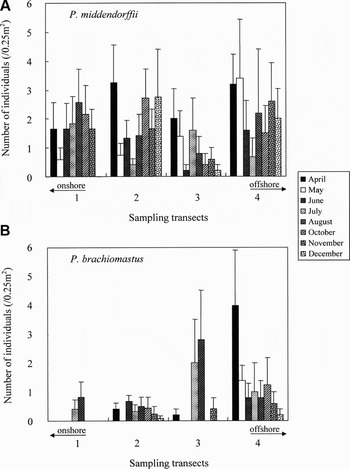
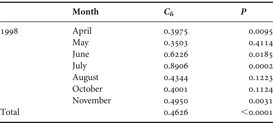
The two Pagurus hermit crab species occurred on all four transect lines (Figure 1). Their distribution areas overlapped. Pagurus middendorffii was observed similarly in all lines and months during the sampling period, whereas P. brachiomastus was found more in the offshore area and varied with months. Monthly Morisita's index between P. middendorffii and P. brachiomastus varied from 0.350 to 0.891 and also the abundances in each quadrat positively correlated except for May, August and October (Table 1).
Spatial distributions of (A) Pagurus middendorffii and (B) P. brachiomastus from April to December 1998 in Akkeshi. In September, distribution data are not given because transect sampling was not conducted. Error bars indicate standard error.

Morisita's index and Spearman's rank correlation analysis between abundance of Pagurus middendorffii and P. brachiomastus. December was excluded because the abundance of P. brachiomastus was low.

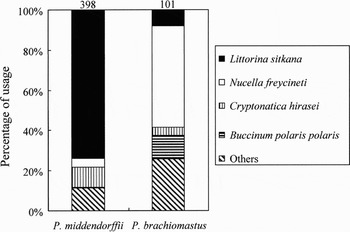
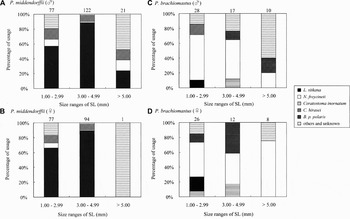
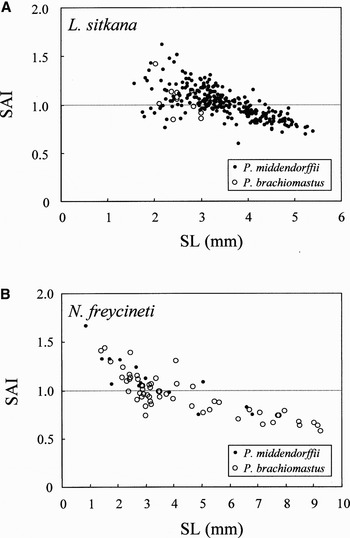
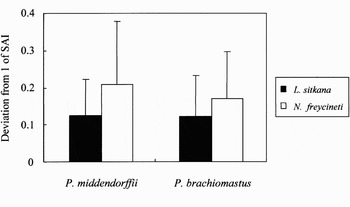
Shell utilization patterns of the two Pagurus species were significantly different (Figure 2, χ2-test for independence, df = 3, χ2 = 1630, P < 0.0001; frequency data was categorized only as Littorina sitkana, Nucella freycineti, Cryptonatica hirasei and others to satisfy the assumption of the χ2-test). Pagurus middendorffii mainly used L. sitkana and C. hirasei whereas P. brachiomastus used N. freycineti, Buccinum polaris polaris and Buccinum middendorffi. Kellogg's shell utilization overlap index (D) was 0.23. General patterns of utilization where Pagurus middendorffii primarily utilized L. sitkana and P. brachiomastus utilized N. freycineti were found for both sexes and in all size-classes (Figure 3). More than 25% of shells used by the hermit crabs were damaged. The SAI decreased with hermit crab size in all combinations of hermit crabs and shell species (Figure 4). Average SAI deviation from 1 was 0.13 and 0.16 in P. middendorffii and P. brachiomastus, respectively. The SAI deviation from 1 did not differ among hermit crab species, but was significantly higher in N. freycineti compared with L. sitkana (Figure 5, two-way ANOVA, F = 0.422; P = 0.517; hermit crab species, F = 5.720; P = 0.017; shell species, F = 0.372; P = 0.543; interaction). This indicated that the shells of N. freycineti were less adequate than L. sitkana for both hermit crabs.
Shell utilization patterns of Pagurus middendorffii and P. brachiomastus. Values on the top of column indicate total numbers of individuals of each species.

Shell utilization patterns categorized by sex and size-classes of: (A) Pagurus middendorffii male; (B) female; (C) P. brachiomastus male; and (D) female.

Shell adequacy index (SAI) of (A) Littorina sitkana and (B) Nucella freycineti for Pagurus middendorffii (closed circle) and P. brachiomastus (open circle).

Deviation from the 1 of the SAI of Pagurus middendorffii and P. brachiomastus utilizing Littorina sitkana and Nucella freycineti.

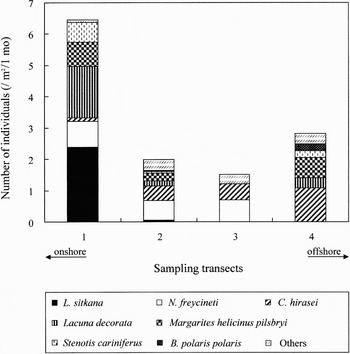
Gastropods were abundant in the uppermost sampling line (Figure 6). Littorina sitkana and N. freycineti (most commonly used by hermit crabs) were both abundant and found on the uppermost sampling line and upper three sampling lines, respectively. Cryptonatica hirasei, Lacuna decorata and Margarites helicinus pilsbryi were common in the study site.
Spatial distributions of living shell species. Values are average densities of all the sampling months.

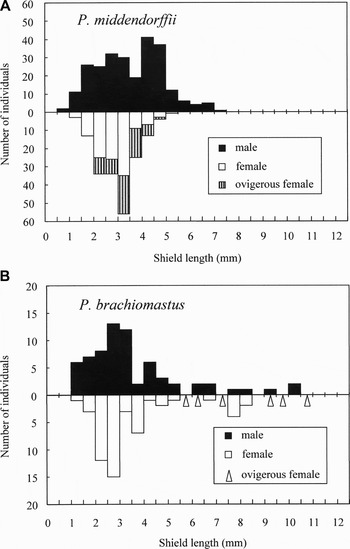
The body size of P. middendorffii ranged from 0.93 mm to 7.93 mm and P. brachiomastus ranged from 1.14 mm to 13.86 mm. There was no significant difference between the SL of both species (Figure 7, Mann–Whitney U-test, z = −0.850, P > 0.05). A few large individuals (<7.5 mm: SL) of P. brachiomastus were found offshore in summer. Sizes of ovigerous P. brachiomastus females (5.94–10.94 mm) were much larger than non-ovigerous females.
Size distributions of (A) Pagurus middendorffii and (B) P. brachiomastus. Open triangles indicate the occurrence of an ovigerous female of P. brachiomastus from the monthly random sampling.

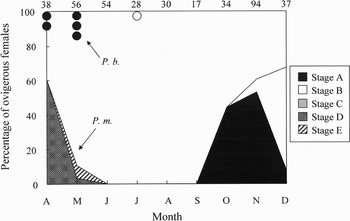
Ovigerous season of P. middendorffii was from October to May, and the developmental stages of eggs were synchronized (Figure 8). For P. brachiomastus, only six ovigerous females that had newly deposited eggs (Stage A) were found in April and May, and one female that had Stage B eggs was found in July.
Occurrence of ovigerous females of Pagurus middendorffii. Numerals indicate the monthly sample sizes. Circles indicate the occurrence of an ovigerous female of P. brachiomastus and the egg developmental stage. See text for the egg developmental Stages A–E.

Shell preference experiment
From the size preference experiment, we obtained four regression equations about relationships between the shell size (shell height) and the hermit crab size (shield length) (Table 2). Compared with P. middendorffii, the same size crab of P. brachiomastus preferred a larger size of shell for both species of gastropod shell (analysis of covariance, df = 1, F = 61.38, P < 0.0001, L. sitkana; df = 1, F = 131.39, P < 0.0001, N. freycineti).
Results of regression analysis and equations between shield length and shell height for each combination of shells and crabs.

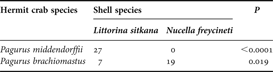
Shell species preference of hermit crabs is shown in Table 3. Pagurus middendorffii significantly chose shells of L. sitkana while P. brachiomastus chose N. freycineti shells (χ2-test for goodness of fit; df = 1, χ2 = 27, P < 0.0001 and df = 1, χ2 = 5.54, P = 0.019, respectively). Their shell preference showed significant interspecific differences (χ2-test for independence; χ2 = 30.76, P < 0.0001).
Results of the shell preference experiment.

DISCUSSION
Pagurus middendorffii was distributed on all sampling transects similarly while P. brachiomastus was found more in the offshore area. Morisita's index and correlation analysis between the abundances of hermit crabs, however, showed their distributions were independent and overlapped. These results suggest that they did not partition their habitat and that considerable overlap occurred. Their body sizes also largely overlapped but they might have interspecific difference in relationships of body size and shell size. For Littorina sitkana and Nucella freycineti, we estimated the size distributions of shells expected to be utilized by both species of hermit crabs in natural conditions based on the equation from regression analysis. These size distributions largely overlapped. Thus it is suggested that both hermit crab species utilize potentially the same shell resource pool. The shell utilization patterns, however, were remarkably different between P. middendorffii and P. brachiomastus. Kellogg's indices (D) were low compared with other hermit crab studies (D = 0.384–0.622, Gherardi & Nardone, Reference Gherardi and Nardone1997; D = 0.17–0.74, Kellogg, Reference Kellogg1977; D = 0.143–0.545, Orians & King, Reference Orians and King1964), therefore our result is a clear and simple example of resource partitioning of hermit crabs by using different shell species.
From shell preference experiments, it is suggested that these utilization patterns are mainly influenced by their shell preference but not interspecific competition in the present study species. The SAI deviations from 1 of N. freycineti were low for both hermit crab species. This indicates that empty shells of N. freycineti were less available than L. sitkana in this site. The SAI deviation from 1, however, did not differ among hermit crabs species. This indicates that both hermit crabs may achieve even adjustment to size of shell, presumably because of the shell species partitioning. It is unclear whether the two hermit crabs during the process of co-evolution have partitioned their shell usage to reduce competition or the preference for shell species originally differed enabling coexistence. At least, however, difference of shell preference among species would have a positive effect for the coexistence of the two species of hermit crabs.
Distributions of gastropods (potential shell resource) did not correspond with the abundance of hermit crabs using the shells as habitats. Littorina sitkana was distributed only along the uppermost sampling line but P. middendorffii was distributed along all the sampling lines while N. freycineti was distributed along the upper three sampling lines but P. brachiomastus was distributed mainly along the lower sampling lines. Therefore, gastropod distributions would not be the main factor that influenced the interspecific difference of shell utilization.
More than 25% of utilized shells were damaged and the density of empty shells in the field (1.29 shells m–2 in April) was far less than the density of hermit crabs (8.28 ind m–2) and living gastropods (3.61 ind m–2). Additionally, referring to individuals in undamaged shells, the SAI indicated that the utilized shell sizes showed a 10–20% deviation from optimal shell sizes. Consequently, it is considered that there were insufficient shells for hermit crabs to enable them to select optimal shells and shell resources were scarce compared with the demand by hermit crabs.
In reproductive phenology, P. middendorffii was considered to have a clutch from October to May, because their egg development was synchronized. Wada et al. (Reference Wada, Goshima and Nakao1995) also found that P. middendorffii in Hakodate Bay had only one clutch per year. It is therefore considered that larvae hatch out in April and May in P. middendorffii although the data from January to March were absent. Ovigerous females of P. brachiomastus were very rare, and females with Stage A (newly deposited) eggs were found in April and May. We could not confirm when the larval release period of P. brachiomastus was and whether they spawn a single clutch or multiple clutches per year because of the small sample size. In either case, however, females of P. brachiomastus with newly spawned eggs were found at the end period of larval release of P. middendorffii. Thus, at least, the two Pagurus species would have interspecific difference in the reproductive phenology and larval settlement period. Although this is not direct evidence, the difference in reproductive traits would have a positive effect on the coexistence of hermit crabs.
In our study site, hermit crabs could acquire shells of the preferred species, although the shell resource abundance was extremely low. How do they seek and acquire their preferred shells? Hazlett (Reference Hazlett1980) reported that the shell species used by hermit crabs could influence the tendency of initiating shell exchange depending on crab preference. Elwood & Neil (Reference Elwood and Neil1992) found that shell species would influence the decision by attackers of whether or not to escalate the shell fight. These behaviours will cause shell exchange to be asymmetrical between sympatric species. Asymmetrical shell exchange would progressively form specific shell utilization patterns. This explanation may account for how P. middendorffii and P. brachiomastus can acquire specific preferred shells.
In conclusion, shell utilization, shell preference and reproductive phenology are clearly different between P. middendorffii and P. brachiomastus in the intertidal and shallow subtidal areas of Akkeshi. This will enable the coexistence in such a low resource habitat. Although adult resource utilization among sympatric hermit crabs has been focused on in many studies, life history traits relating to the larval stage may be important in discussion about coexistence in hermit crabs. Various life history traits need to be examined for considering the coexistence mechanisms of hermit crabs that have multi-developmental stages.
ACKNOWLEDGEMENTS
We thank Professor S. Nakao, Assistant Professor T. Noda, Dr K. Yoshino and A. Mima for suggestions on this study. This research was carried out at the Akkeshi Marine Station, and we thank Professor H. Mukai for providing the facilities. The members of the Benthos Research Group, Laboratory of Marine Biology and Marine Biodiversity, Hokkaido University kindly checked the manuscript and helped us with the field sampling and experiment. This work was partly supported by a Grant-in-Aid for Scientific Research (Kakenhi, no. 15770010, 98J02268, 19570012) to S. Wada from the Ministry of Education, Culture, Sports, Science and Technology of Japan.