I
When the Cambridge Historical Journal changed its name in 1958 to the Historical Journal, no explanation or editorial statement of intent was provided. It was an era of blithely unstated assumptions, long before the era of neurotically overstated missions. Yet the editors plainly intended to declare that the Journal would no longer be parochially Cantabrigian but would now be a general journal, open to every aspect of history and every kind of historian. The verso of the front cover proclaimed (though admittedly not until 1978) that the HJ publishes articles ‘on all aspects of history’. For a journal to call itself the historical journal is certainly an ambitious claim. Among several hundred history journals in 1958, and over a thousand now, it is in danger of hubris.Footnote 1
Consider the following data. Taking its half-century as a whole, 76 per cent of the HJ's articles have been in British history, and most of the remaining 24 per cent in French and German history.Footnote 2 Its coverage of North America has been small and of the world beyond, with the exception of British imperial history, practically non-existent. It publishes only on the period since 1500, and hence nothing at all on ancient and medieval history. Most of its British history has been political rather than social, economic, or cultural. Some 90 per cent of the authors of its articles have been scholars working in Britain or North America, with more than a quarter from just three universities, the so-called ‘golden triangle’ of Cambridge, London, and Oxford. Of its articles, 83 per cent have been authored by men, and the editorial board included no woman until 2001.Footnote 3 The claim to universalism begins to look hollow. Nor can much mitigation be found in changing patterns over time. Whether it is the focus on British history, or the characteristics of the authors of articles, there have been no dramatic shifts over the Journal's half-century.
The picture looks no less bleak when considered conceptually. The period from the 1950s to the 1970s saw the high tide of a remarkable generation of Marxist historians, but in the pages of the HJ there were no articles by Christopher Hill, Eric Hobsbawm, or E. P. Thompson. The period saw flourishing relationships among history, anthropology, and sociology. In the HJ there was no Keith Thomas, no Natalie Zemon Davis. The Annales school reached its height of influence: but Jacques Le Goff, Pierre Chaunu, and Fernand Braudel are not to be found in the HJ. The period saw a rich efflorescence of agrarian history, the history of landed society, and urban history, but there was no Joan Thirsk, F. M. L. Thompson, John Habakkuk, Jim Dyos, or Asa Briggs. Quantification in economic and demographic history became paramount and Clio fell in love with the computer. The HJ saw no Eugene Genovese or Robert Fogel or W. W. Rostow, and no graph sullied its pages before 1977. Cambridge's home-grown school of historical demography, pioneered by Peter Laslett, took its publications elsewhere. Michel Foucault has been cited in the HJ around twenty times and Geoffrey Elton around 120 times. The word ‘gender’ has appeared in the titles of four articles and the words ‘politics’ and ‘political’ in 172.
1958 was perhaps an inauspicious moment to launch a general journal, for the profession was embarking on a period of energetic balkanization. New sub-disciplines declared their independence and marked their new nationhood by launching journals. French Historical Studies and Comparative Studies in Society and History began in 1958; History and Theory and the Journal of African History in 1960; the Journal of Contemporary History, Journal of Social History, and Renaissance Quarterly in 1966–7; to name but a few. The proliferation of specialist journals in so variegated a discipline as history has arguably rendered fragile the very idea of a general journal. It might be said that the HJ came to resemble Vienna after the First World War, a splendid imperial capital that had lost its hinterland.
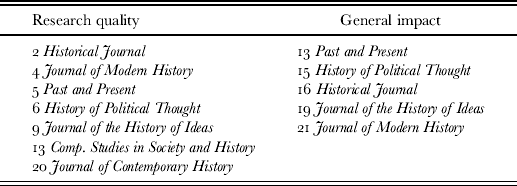
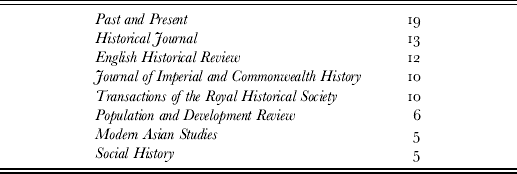
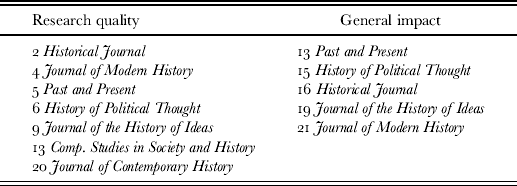
So far, I have engaged in an all too self-conscious attempt to avoid the self-congratulation endemic on anniversary occasions. There is of course a contrasting story to tell, for it is hard to dispute that the HJ is one of the most prominent journals in the profession. This is, in the first place, simply a function of size. The HJ publishes more articles than any other historical journal, by quite a margin. The Journal typically receives 80–100 submissions each year, and rejects about two-thirds of them, a rejection rate higher than for most journals. Its sales, at an informed guess, place it in the top dozen among English-language history journals, in circumstances where two or three of those that exceed it have the advantage of subscriptions tied to membership organizations.Footnote 4 The Journal's subscriptions are international, typically 85 per cent deriving from outside the UK. In the 2001 Research Assessment Exercise, in which academics in the UK submitted what they regarded as their best publications for national assessment, the HJ appeared more frequently than any other history journal bar one.Footnote 5 In 1990, two political scientists invited their colleagues in British university departments of politics to rank the journals they judged to have the greatest impact: four history journals appeared in the top twenty, with the HJ the second highest ranking; when rated for quality alone, the HJ was ranked the highest among the history journals.Footnote 6
We confront, then, the paradox of a journal whose claims to generality seem dubious, but which nonetheless commands high respect in the profession. How to resolve the paradox? One possible explanation is that the character of the journal reflects the character of the profession. That is to say, the biases of the HJ, as to types of history and types of historian, are perhaps not substantially out of line with the biases of the discipline as a whole, as reflected in other journals.
Take, for example, the bias toward British history. British historians have a strong propensity to study British history. Of the 713 doctoral theses completed in UK universities in 2002, 53 per cent concerned British history (and 46 per cent concerned post-medieval British history).Footnote 7 A journal like the HJ will unavoidably reflect this. And it turns out that the HJ is not untypical. Tony Wrigley's analysis of fifty years of the Economic History Review shows that three-quarters of its articles were in British history, and the rest overwhelmingly in European and North American history. He remarks that ‘this seems an excessively parochial pattern’.Footnote 8 Jacques Le Goff's analysis of Past and Present over twenty-four years (1959–82) shows that half its articles were on British history and almost 40 per cent on continental Europe, with only 10 per cent on the rest of the world. He reproaches the journal for such narrowness, and also for the fact that half its articles were on the early modern period, to the neglect of other periods, especially ancient, medieval, and the twentieth century. He furthermore could count only twenty-eight authors who were not either British or North American.Footnote 9 A recent commentator on the coverage of the English Historical Review calculated that 43 per cent of book reviews in a typical issue were written by scholars working in the ‘golden triangle’, and accordingly doubted its pretensions to being ‘a truly national historical institution’.Footnote 10 Regional biases in journals can be strong. Over its first half-century, 90 per cent of contributors to the Journal of Economic History were North Americans.Footnote 11
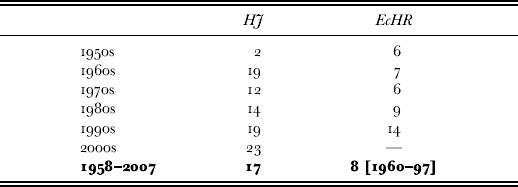
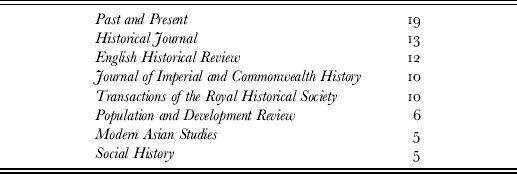
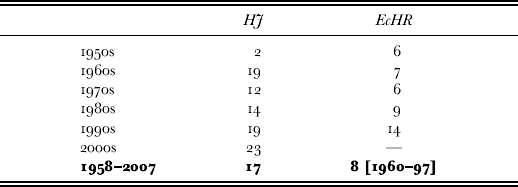
Or take the issue of gender imbalance among authors in the HJ. The only other long-period analysis known to me is Wrigley's for the Economic History Review, which shows that the HJ achieved twice the proportion of women contributors. If we take a snapshot comparison of several other journals for the seven-year period 2000–6, we find that although History Workshop Journal had a far higher proportion of women authors than the HJ, nonetheless the proportion in the HJ is not unusually low compared with others.Footnote 12
In parenthesis, I should mention the strange absence of ancient and medieval history from the HJ. It is true that in 1978, when the Journal introduced its claim to publish ‘on all aspects of history’, it added the explicit caveat, ‘since the fifteenth century’. But it has never offered a reason for this exclusion. This is all the more peculiar when we note that the old Cambridge Historical Journal did publish distinguished work on earlier periods: for instance A. H. M. Jones's classic article on ‘Athenian democracy and its critics’ of 1953. Between 1945 and 1957 one quarter of the articles in the Cambridge Historical Journal were in ancient and medieval history. The medievalists Christopher Brooke, David Knowles, and Walter Ullmann all published in there in that period. Hence, the Journal's change of name in 1958 involved a silent coup d'état. At the very moment that it turned itself into a ‘general’ journal, the brothers Ancient and Medieval were murdered in the Tower. Ancient and medieval history has been numerically weak elsewhere, constituting only 15 per cent of articles in the Economic History Review and 22 per cent in Le Goff's analysis of Past and Present. But this ‘weakness’ may be an illusion created by citing only those journals, for they, together with the HJ, almost certainly felt – the more so around 1960 than latterly – that medieval history had enough outlets of its own (not least in the English Historical Review), and that modern history needed more space.Footnote 13
II
I referred earlier to a survey of political scientists to discover which journals they most valued. The results were published by Pippa Norris and Ivor Crewe in Political Studies in 1993. Their study was the result of anxieties about the possible arbitrariness of judgements made by Research Assessment Exercise panels in presuming to determine which journals were ‘the best’. If the ranking of journals was to occur, they argued, better it were done transparently and by peer review across the profession. I know of no comparable study of history journals. Although Norris and Crewe set out to produce ranking tables, they drew one important distinction, and raised one important doubt about rankings. The distinction they drew was between valuing a journal for its research quality and valuing it for its teaching utility. Judgements of quality might differ between these two functions, some journals being more highly regarded for pedagogy than for research. On the whole, history journals do not promote themselves in terms of teaching versus research, perhaps because the discipline is gifted with a close union between those two activities. (It is of course the case that a journal like History traditionally had a mission to appeal to school teachers, and also that there are valued magazines that have a higher profile in pedagogy than in research, notably History Today.)
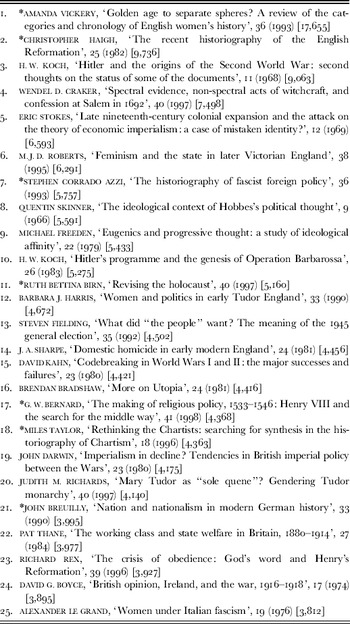
In the case of the HJ, the distinction is, nonetheless, a real one, but, crucially, it lies within its covers, in the difference between the research articles and the review essays. A singular feature of the HJ is its commitment to reviewing books chiefly through review essays rather than individual book reviews.Footnote 14 This practice was another silent revolution undertaken by the newborn Journal in 1958 and a wholly beneficent one. The historiographical reviews and review articles are more important to the Journal than perhaps even its editors realize, and it is salutary to recognize that a scholar may achieve greater impact through this medium than in writing up their own research. Since the turn of the twenty-first century it has become possible, via statistics available online, to distinguish patterns of pedagogic use from patterns of research use. When we examine rankings measured by online downloads we find a somewhat different set of articles scoring high as compared with rankings measured by citation indexes. A third to a half of the top twenty-five articles measured by online downloads are review essays. By contrast, just two of the top twenty-five articles scoring high in citation indexes are review essays.Footnote 15 Now, whilst we cannot be sure who is engaging in online downloading or why, it seems overwhelmingly likely that most online downloading reflects student and pedagogic use of articles; in contrast, and by definition, a citation index measures the use of an article in other published research articles. Historians' own pedagogic experience confirms this surmise, because the two articles which score highest in downloads via JSTOR are both historiographical reviews that are familiar as staples of student reading lists: Amanda Vickery's ‘Golden age to separate spheres?’ (1993) and Christopher Haigh's ‘Recent historiography of the English Reformation’ (1982).Footnote 16 (Vickery's article is, by any measure, the HJ's most successful article, for it also scores highest in citations.) Ruth Bettina Birn's ‘Revising the Holocaust’ (1997), a coruscating dissection of Daniel Goldhagen's Hitler's willing executioners, is another example, and one which is to be found on reading lists for historiography as well as for Nazism.Footnote 17 It was an historiographical review rather than a research article that prompted a leader article in The Times in 2000.Footnote 18 It ought to be mentioned that the Journal's review essays, unlike its research articles, are commissioned, and it is editorial policy to use the review section as an opportunity to redress some of the imbalances of the research section, both as to subject-matter and as to gender of authors.
Norris and Crewe not only distinguished the pedagogic from the research function of journals, but also they questioned the plausibility of making rankings of journals. Here they drew a distinction between consensus and pluralist models, which we might also dub vertical versus horizontal models. The vertical or consensus model presumes that journals can be ranked qualitatively from most prestigious to least, and that practitioners within the profession will broadly share such judgements. This is to view journals hierarchically. On the other hand, the horizontal or pluralist model suggests that journals serve many distinct intellectual sub-fields, and are not reducible to a single qualitative scale. The discipline of history is largely populated by specialist journals which enjoy high standing within their sub-field, but which may not be familiar to scholars beyond their field. Thus, the journals most esteemed by scholars in, say, medieval or French history are not the same as those working in intellectual or Indian history. This is to construe journals as incommensurable in a discipline in which a hundred flowers bloom.
Any investigation of where historians publish their work soon shows the dizzying multiplicity of journals. The 245 scholars who held posts in the eight history departments in the UK ranked as 5* in the 2001 Research Assessment Exercise published their work in as many as 180 journals. They were scarcely queuing up to get into the allegedly ‘top’ journals. When I asked a department-wide group of Ph.D. students where they would most relish publishing their first article, there was no consensus, and virtually no journal was named more than once. If Speculum is the acme for one, it is the Hispanic American Historical Review, the William and Mary Quarterly, or the Journal of Contemporary History for others. If this evidence for the pluralist model carries weight, then the notion of a ‘general’ journal, that sits above the Babel of sub-disciplinary journals and publishes ‘the best’, wears thin. It is worth noting here that British publishing practices may be more dispersed than in some other countries; there is no equivalent in the UK of the American Historical Review, as the core journal of the national discipline, the journal of the ‘trade union’, the American Historical Association; perhaps because the Royal Historical Society, which is the largest British membership body, has not sought to position its Transactions in the same way.
We could reformulate the critique of the concept of the ‘general’ journal in a postmodern mood, by saying that the claim of any journal to be ‘general’ and somehow superior to ‘niche’ journals is self-deluding, and betrays a superannuated attempt at an ideological hegemony, by which the subjects upon which it publishes, though in fact narrow in range, implicitly purport to define the domain of the discipline. It is also a feature of the postmodern marketplace that massive fragmentation and differentiation of products is occurring in all cultural spheres, most notably in music, radio, and television: the ‘mainstream’ ceases to exist, and the distinction between producer and consumer is eroded, with products increasingly designed for small cohorts of producer-consumers.Footnote 19 It would be naïve to exempt academic publishing from this trend. On this argument, it is no more plausible to define the historical community as that which reads Past and Present, the English Historical Review, or the HJ, than it is any longer plausible to define British national culture as that which watches or listens to the BBC. This matter is politically important, for there is increasing external pressure on the humanities to accede to a version of the consensus model, in which, inter alia, metrics of excellence would be derived from qualitative hierarchies of journals. For any history journal to claim to be ‘general’ (other than in the weak sense of being a medley or soupçon of all that is available), with its implication of transcending ‘niche’ journals, may in fact be damaging to the profession at large. This sensitivity became apparent at the turn of 2008 when a number of historical bodies published their objections to a table – which too easily is read as a table of rankings but which its originators deny to be so – drawn up by the European Science Foundation and published on the website of the UK Arts and Humanities Research Council. The Foundation's panel included one member of the editorial board of the HJ; a letter objecting to this ‘flawed, crude, … oversimplified’ and ‘harmful’ exercise was signed by another member of the editorial board of the HJ.Footnote 20
III
It is time to leave the data behind and turn toward a brief sketch of historiographical trends. Having highlighted conceptual absences from the Journal at the outset, I now want to point toward presences. We should first note that some early absences were arguably quite deliberate and a matter of methodological commitment. A case in point is the absence of Marxism. I think it fair to say that the HJ was not only bypassed by the Marxist historians themselves,Footnote 21 but that the Journal was actively hostile to their outlook. This was more than merely the Cold War cold-shouldering that dogged the early days of Past and Present. It was a considered rebuttal, for the Journal published explicit critiques from its early days. Peter Laslett savagely reviewed C. B. Macpherson's influential work of Marxist history of political thought, The political theory of possessive individualism (1962), claiming that Macpherson was ‘a dogmatic, economic sociologist of a familiar, if refined, Marxian cast … rather than … a political theorist, a philosopher, or an historian’.Footnote 22 Geoffrey Best was sceptical about E. P. Thompson's Making of the English working class (1965), while Geoffrey Elton steamrollered Lawrence Stone's Marxisant The causes of the English Revolution (1973).Footnote 23 We can add to the list Eric Stokes's favourable survey of the impact of Robinson and Gallagher's Africa and the Victorians (1961) in dismantling the Hobson–Lenin thesis about imperial history.Footnote 24
Some of the conceptual absences in the early decades of the HJ may have been regrettable, but in this instance it was evidently a conscious position. More generally, the Journal has, I think, always been implicitly suspicious of the sort of sociological approach exemplified by Stone's book. The causes of the English Revolution is not a book that has many people or events in it. If the HJ has had an overriding, and almost intuitive, methodological predilection, it is one that has been inimical to structuralist accounts of the historical process, whether Marxian, sociological, economistic, or of the Annales school. The Journal has been committed to historical explanation through agency and contingency, the specificity of contexts and conjunctures, and the particularities of human motive and personality. It has tended to believe in the primacy of the political. If, in the pages of Past and Present, Le Goff could express surprise and anxiety at Stone's later bouleversement – his announcement in 1979 of ‘the return of narrative’ – the HJ would have been astonished to learn that narrative had ever left the scene.Footnote 25 And if Theda Skocpol, in 1985, could announce to historians that it was time once more to ‘bring the state back in’, the HJ had never thought to leave it out.Footnote 26 The HJ is not a journal that would ever have treated the term ‘empiricist’ as an imprecation, which it became on the Left in the third quarter of the last century, although its preferred single-word epitome of its methodology would probably be ‘nominalist’. Geoffrey Elton, who published more articles in the HJ than any other author,Footnote 27 liked to remark of Braudel's The Mediterranean that it had no people in it, and that it told one nothing more than that mountains are high and plains are low. In this respect, the HJ's nominalism has helped to define the profession's general conception of the ‘Cambridge School’ of history, here using the term of the faculty as a whole, and not specifically of its well-known approach to the history of political thought.
Yet a word of caution is needed here. It is surely the case that a considerable number of Cambridge historians would not themselves think of the HJ as the natural home for their own work; and accordingly they help to narrow the Journal's range. Peter Laslett's early démarche is indicative: as an historian of political thought he published in the HJ, as an historical demographer he did not. (And no doubt Elton's prejudices played their part in excluding him.)Footnote 28 Many of the editors of the Economic History Review, a journal profoundly different from the HJ in methodological character, have been Cambridge-based: Michael Postan, Charles Wilson, Donald Coleman, Barry Supple, Tony Wrigley, John Hatcher, and Richard Smith. The journal Continuity and Change, a ‘journal of social structure, law, and demography in past society' launched in 1986, had its roots in the Cambridge Group for the History of Population and Social Structure, and was created to sustain the kind of ‘historical sociology’ which Laslett, Wrigley, and their colleagues felt was not finding voice in existing journals. There is, therefore, nothing quintessentially ‘Cambridge’ about the HJ's methodological character. The extent to which those who do not like its flavour have simply preferred to go elsewhere, or have felt pushed to go elsewhere, is hard to assess. That said, Cambridge lacks an equivalent of the magnetic polarity which makes, at Oxford, the English Historical Review and Past and Present so self-consciously unlike each other.
If these remarks seem excessively Cantabrigian, that is because the character of the early HJ did not in fact differ much from its earlier incarnation as the ‘Cambridge’ Historical Journal, its predecessor founded in 1923. The HJ has always been ambivalent about its Cantabrigian character, striving to jettison the incubus of being seen as merely a house journal, yet anxious to invest the Journal with the quintessence, or marque, of a faculty that, it believes, is highly regarded internationally.Footnote 29
The Journal has, I suspect, a reputation for being deeply scholarly, at worst cautiously and solidly empirical, at best exuding gravitas and teutonic professionalism. It is neither demotic nor experimental nor modish, and it would be unblushing if told that its content was ‘undertheorized’. In its early years, this had much to do with a Butterfieldian and Eltonian commitment to an ideal of professionalism. Among the things those historians disdained was what they regarded as the facile and picturesque amateurism of their erstwhile colleague G. M. Trevelyan. Clio, no longer a muse, was chiefly occupied in checking her footnotes in the Public Record Office. The tone is best captured in an essay Elton wrote in the Times Literary Supplement in 1956, in which the words ‘professional’ and ‘professionalism’ were used with punishing frequency, and in which previous generations of historians were treated as if in their nonage; he opined that Tudor history had now reached ‘adulthood’.Footnote 30 For Elton, to be an historian was to be a highly skilled technician: he, a deep-dyed Tory, would have been dismayed to realize how much he echoed the 1950s national (and latterly Wilsonian) talk of a ‘white heat’ of the technological revolution, a new age led by a meritocracy of white collar technicians.Footnote 31 Herbert Butterfield, too, talked of the necessity for ‘technical’ and ‘analytical’ history. Michael Bentley, whose recent fine book seeks to explain to postmodernists what on earth modernism was about, regards the early HJ as exemplifying the high modernism of the mid-twentieth century.Footnote 32 One consequence was that the HJ was resolutely intramural, in the sense of immured within the academy, a vehicle for university historians, at a time when the discipline put itself at its longest arm's length from popular, or what is now called ‘public’, history. It belonged to what Peter Mandler has identified as ‘the drifting away’ at mid-century of the profession from public life.Footnote 33 Bentley has remarked that ‘when David Cannadine brought G. M. Trevelyan back to the centre of academic history in his biography of 1992 he commented on a new mood that would infect tele-dons from Simon Schama to David Starkey – historians who, in an earlier incarnation, would have been trying to find a corner of unturned soil for dispatch to the English Historical Review or the Historical Journal’.Footnote 34
Yet, nominalist though it is, and as my remark on Skocpol makes clear, the HJ has not neglected one great hypostasis: the state. It is not, I think, an overstatement to say that the principal subject-matter of the HJ has been the state: the state as the arena of parliamentary politics, as the maker of wars, alliances, and empires, as an instrument of social reform, and as the subject of political theory. By contrast, class, gender, sexuality, and ethnicity have made limited inroads as the organizing categories of the research it has published, and likewise the Journal has had less to say about subaltern groups than about political and intellectual elites. The Journal has been broadly Weberian in its assumptions: the state has trumped class (and its postmodern derivatives) as the primary agent of change. If ‘Weberian’ is too specific, perhaps the HJ is merely mandarin. Even as late as its founding years, there was still a shadow of J. R. Seeley's conception, which he expressed at the creation of the Cambridge history school in the 1880s, of history as ‘the school of statesmanship’, and the undergraduate degree as a training for a governing patriciate. Of course, reflection on the state does not preclude histories of civil society. In an illuminating essay on the development in the 1950s of a conservative style of social history, Miles Taylor has argued that the HJ expressed a high Tory scepticism about the post-war welfare state, notably in a classic article by Oliver MacDonagh and in work by Kitson Clark. Similarly, he noted inklings in the Journal of a counter-Marxist economic history which lent a positive valuation to entrepreneurship – this at the height of historiographical warfare over whether the Industrial Revolution had been a Good Thing.Footnote 35 Yet, one could equally suggest that the Journal lay in the long shadow of New Liberalism, in so far as many of its authors, particularly in contrast to Marxists, instinctively viewed the state in its more benign aspects, as the object of intellectuals' agendas for reform, as engaged in salutary reconstruction and the building of institutions, and as a pluralistic entity in which diverse groups aspired to partake, an entity which provided means by which such groups could negotiate the exercise of power. Even the politically conservative Elton can be seen, in his roseate picture of Thomas Cromwell's state-building, to have endorsed a version of what David Cannadine dubbed the historiography of ‘welfare state whiggism’.Footnote 36 The speed of the Eltonian English Reformation, its secular purposes, and its construal as an event brilliantly managed from the desk of the king's chief minister, all betokened a high modernist confidence in the reforming capacities of the state.
In passing, we may notice that there was one aspect of classical Whig historiography that was eroded by Cambridge nominalism. It is hard to find in the HJ anything remotely akin to constitutional history, and indeed the word ‘constitution’ or its derivatives rarely appears in any article title (and, when occurring, as likely as not in the form of an examination of a mythic ‘Ancient Constitution’).Footnote 37 This betokens an assumption that there was politics and there was the state, and if the ‘constitution’ existed at all, it was an epiphenomenon of politics and state-building, a reification of practices that had their origins in the contingent manoeuvres of politicians. On this point, Butterfield and Elton would have had no disagreement with Lewis Namier.Footnote 38 The Journal sometimes figured work inspired by Maurice Cowling, who was particularly insistent on the mirage of the ‘constitution’.Footnote 39
One early and emphatic feature of the Journal was that it took intellectual history seriously. Looked at from the perspective of its early years, we can say that, the previous remark notwithstanding, it largely steered clear of Namierism, a school that dominated the English historical profession in the 1950s. Namier comprehensively denied any role to the history of ideas or the study of public language. The professed beliefs of past historical agents were ‘flapdoodle’; to bother to engage with them was a naïve distraction from the ‘real’ mechanics of power.Footnote 40 In the HJ's rejection of this view, we most especially see the stamp of Butterfield, who, though he ceased to be editor in 1952, cast a long shadow over the Journal well into the 60s and 70s; indeed, he was the longest-serving member of its board, thirty-six years (1936–72). His quiet rage against Namier resonates through the early HJ. His epigones, and those of J. H. Plumb, sought to write histories in which parties and ideologies mattered. ‘Human beings’, wrote Butterfield in 1957, ‘are the carriers of ideas as well as the repositories of vested interests.’Footnote 41 It is an important fact that J. G. A. Pocock, who went on to become one of the most influential intellectual historians at work in the late twentieth century, was a graduate student of Butterfield's in 1950s Cambridge.
All this is to paint the Journal with a broad brush. Perhaps more fruitful is to isolate a series of constellations that have been conspicuous by their presence in the early decades of the Journal's half-century. By constellations, I mean loose groupings of articles that have shared a common approach or subject-matter, though not necessarily a common thesis. In some cases, the constellations are no more than a striking salience of a certain kind of subject-matter that represent particular strengths of the Journal.
Taking diplomatic history as an example, the HJ's early years were redolent of an era when European history remained a Rankean history of crises in Great Power relations. Accordingly, the terms ‘diplomacy’ and ‘diplomatic’ figure prominently in titles of articles published in the old Cambridge Historical Journal. This was history written from Foreign Office files and ambassadorial dispatches, and it retained its prominence in the early HJ, not least through the influence of Harry Hinsley as editor in the 1960s.Footnote 42 As this indicates, the impact of individual editors on the Journal's content should not be underestimated. In the 1990s, for example, Jonathan Steinberg and John Morrill provided twin poles of attraction for article submissions on, respectively, twentieth-century Germany and Italy, and seventeenth-century Britain. As regards the history of German Nazism and Italian fascism, two articles by H. W. Koch on Hitler remain among the most frequently cited, whilst Ruth Bettina Birn's review of Daniel Goldhagen's Hitler's willing executioners (1996) is one of the most discussed in the Journal's history, not least because its publication provoked the initiation of a libel action.Footnote 43 Meanwhile, with respect to seventeenth-century Britain, the HJ had been in the forefront of the deconstruction both of Marxian accounts and of lingering Whig shibboleths concerning the history of the British civil wars. In contrast to Lawrence Stone's Causes of the English Revolution, which represented the last hurrah for the Marxian schema, articles published in the HJ interpreted the conflict as, by turns, a war of religion, a baronial revolt, a war among distinct nations, and a revolt of the provinces.Footnote 44 It was a conflict in which statecraft and the personalities of monarchs once more made a difference. HJ articles not only punctured pieties concerning the Petition of Right and the radicalism of the New Model Army,Footnote 45 but also participated in moves towards regional differentiation through studies of counties and localities. At the same time, even before the upsurge in ‘Three Kingdoms’ history, the Journal paid particular cognizance to the history of Ireland. Strikingly, it published twice as many articles on Irish as on Scottish history, a disproportion that perhaps has two explanations: the more introverted character of Scottish historiography and a particular relationship between Cambridge and Irish historiography which Butterfield had fostered.
A further Butterfieldian feature was the marked number of articles on historiography, especially English historiography, in both its Whig and counter-Whig forms. This predilection for the history of historical writing was explored less via the philosophy of history, and more as an interest in the practice, and practitioners, of history. This tendency might have been yet more marked had the profession heeded John Pocock's plea that historiography offered a substantial domain for intellectual history. In the event, intellectual history took the more delimited form of history of political thought, and here the Journal proved a chief engine in the general renaissance of that subject. It was a renaissance whose practitioners presented their methodological claims in journals other than the HJ, but whose substantive exemplars appeared in its pages.Footnote 46 Indeed, about 12 per cent of all articles published have been in the field of intellectual history, a relatively high figure, given the paucity of this sub-field in the profession as a whole. Within British historical writing this development can be identified as having inserted itself between the Marxian and Namierite consensuses that commanded the scene in the 1960s.
Meanwhile, another reaction against Namierism can be seen in the Journal's interest in popular politics, that is, in the study of political culture ‘out of doors’, beyond the House of Commons. This was connected to Plumb's abandonment of Namierism, announced in his Ford Lectures of 1965, which insisted on the reality of the ‘rage of party’ in the eighteenth century.Footnote 47 In helping to reinvent party, the HJ pursued not so much the path of historical psephology, but rather of political culture and party ideology.Footnote 48 In its publishing on later historical periods, the Journal evinced a strong interest in the character of the reforming state of nineteenth- and twentieth-century Britain. I remarked earlier on Miles Taylor's comments on the Journal's interest in the historical roots of voluntarist alternatives to state collectivism. The post-war creation of the welfare state loomed large in the mid-century imaginative landscape, and this prompted historians to search for its origins. Finally, and further afield, the one area in which the HJ has enjoyed an established non-European presence is British imperial and Commonwealth history, extending Robinson and Gallagher's shift of the subject away from exclusively metropolitan perspectives. However, notwithstanding their seminal work's focus on Africa, the Journal tended to register Cambridge's longstanding expertise in South Asian history, with more articles published on India than on Africa or the Far East.Footnote 49
IV
This last section considers some topics that arise for the Journal now, some of which are specific to the HJ, and some of relevance to any humanities journal.
First, the pattern of subscriptions. Traditionally, there were around 1,400. This was much lower than that of a small number of leading journals, such as Past and Present which had over 3,000, or the English Historical Review, which, as the oldest national journal, held its place in local public libraries; but it was much greater than that of the great majority of journals, which operated in the region of 300–500. (It should, though, be added that leading American journals like the American Historical Review and the Journal of Modern History far outstrip the largest circulation British journals.) Of subscribers to the HJ, nine-tenths were institutional and one tenth individuals. About half of sales were in the United States. But in the past ten years these patterns have fast become obsolete. Two revolutions have occurred in Cambridge University Press's marketing of journals. Internet access to the HJ began in 1997, and many readers now access it online, or print out hard copy from online sources. Until 2002 print and electronic versions were automatically ‘bundled’, but since that time, subscriptions have been of three sorts, print only, online only, or bundled. Electronic access is rapidly outpacing print access. The second revolution was the Press's positive response in 2003 to the formation of multi-institution library consortia seeking to negotiate access to tranches of related, rather than to individual, journals. In the era of consortia subscriptions, it becomes impossible to discern which purchasers have sought out access to the HJ in particular, as distinct from any other humanities or social science journal within the package. The number of traditional stand-alone subscriptions has begun to decline sharply, as institutions switch over to the new arrangements. For the HJ, the tipping point occurred in 2006, when traditional subscriptions dropped below the number of consortia subscriptions. The current total number of subscriptions to the HJ stands at over 2,000, but it will hereafter no longer be possible to use subscription data to tell us much about preferences for an individual journal.Footnote 50
However, internet access creates new, and highly refinable, classes of user data, and the future of journal metrics lies not in numbers of subscriptions but numbers of electronic hits, on the journal as a whole and on individual articles, as well as the citation metrics generated by such organizations as the Web of Knowledge. For example, by 2005 the HJ was achieving some 6,000 article downloads per month, and it is possible to tabulate the most popularly accessed articles.Footnote 51 In this context, whatever jitters scholars in the humanities entertain about ‘metrics’ – that they smack of mere productivism, or of favouring the quantitative over the qualitative – it may be that their apprehensions are Luddite, for few scoffers were ever embarrassed about measuring sales of hard copies. We ought not to dismiss a journal's ability to communicate to as wide an audience as possible, even if what is being measured may not be the same thing as peer-reviewed judgements of quality.
Worldwide marketing to consortia of higher education institutions, coupled with the opening up of former Communist nations, is also dramatically shifting the global patterns of uptake of journals. Universities in less wealthy regions can collectively, through consortia, afford access to more journals than they could if acting individually. Thus, by 2005 marked growth was visible in sales in the Far East, Eastern Europe, and Latin America. This carries a warning for a journal like the HJ. Can its largely British historical focus, in its editorship, refereeing, and content, be sustained in a world market in which fewer readers live in, or study the history of, the Atlantic world? In the 1960s critics complained that British historiography was culpably neglectful of history beyond Europe; it may be that market globalization will soon make this point more pressingly. The new economic base – those paying to receive the Journal – may prove unwilling to support the old scholarly superstructure. In 2000 the HJ created an international advisory board, whose names are printed on the verso of the front cover, to counterbalance the Cambridge character of its main board. The publisher is rightly anxious that all its journals globalize.
We saw earlier that some of the imbalances in the HJ have mitigating circumstances, in so far as other journals follow similar patterns. Adjusting imbalances in coverage is neither easy nor an unmixed advantage. It is not easy because journals tend to become typecast. Scholars send them the kind of thing that they find published in its pages. The ambitions of editors to catholicity are thwarted by their in-trays.Footnote 52 This could be redressed by proactive commissioning of articles in novel fields, and perhaps publishing themed issues, a practice used by many journals. The HJ has not adopted this approach, chiefly because it readily fills its pages from unsolicited submissions; it prints what is submitted (though of course only a proportion of what it receives). And it would not necessarily be wise to turn down an even higher proportion of unsolicited submissions to make room for commissioned articles. This is fundamentally why the HJ has never had a formal mission and does not seek to set substantive agendas: its task is to hold a mirror to the extant profession, to reflect what scholars happen to be researching.
It was noted earlier that two-thirds of submissions are rejected. This is, undoubtedly, less stringent than rejection rates for journals such as Past and Present and the Economic History Review. The latter may hold the British record, in part because it functions as a ‘trade union’ journal, that is to say, a journal in which every member of the relevant sub-discipline seeks to publish as a mark of membership. In the case of Past and Present, it probably holds the reputational palm as the journal most aspired to, at least within the UK. But the main explanation for publication in the HJ being less competitive is a quantitative one. As noted earlier, the HJ is an uncommonly large journal. It publishes around thirty-five articles a year, as against twenty-five in Past and Present, and twenty or fewer in the English Historical Review, Economic History Review, and History. The HJ is voracious and needs a large flow of submissions. There is another factor at work too. Some scholars will be apprehensive about submitting an article, sometimes unduly so. There is pre-selection by the scholarly community itself. In the HJ editors' experience, the general quality of submissions is high, and some nine-tenths deserve, and receive, peer assessment; the ‘tail’ is small. The suspicion is that much good material is lost, because never submitted. If the submission rate is curtailed by authorial self-doubt or, worse, suspicion about ‘the kind of scholar/research that will be acceptable’, then the HJ suffers in much the way that undergraduate admissions, and lectureship applications, in Cambridge can also sometimes suffer, for they too can be damaged by the self-denying ordinances of potential candidates. The HJ is genuinely anxious not to be typecast.
Will the HJ continue to receive 80–100 submissions a year? Does the climate of the profession bode ill or well for this mode of publication? Some trends run in its favour and some against. Since the 1990s there has been disruption in the flow of submissions as a result of the Research Assessment Exercise (RAE), with peaks and troughs determined by RAE cut-off dates. After the RAE deadline of 2001, the Journal (temporarily) shrank in size for the first time in its history. On the other hand, the alleged general growth in scholarly ‘productivity’ attributable to the RAE does not reveal itself, for the Journal grew in size spectacularly in the 1960s, but only modestly in the 1990s: thus the Journal's growth resulted more from the expansion of higher education than from the alleged latter-day ethos of productivism.Footnote 53 This, however, does not belie the phenomenon of the growth of scholarly publishing, for much of the productivity is being diverted elsewhere, not least into monograph writing. One trend that dampens journal submissions is the growth of the edited collection of essays. In British historical output these appear to have increased more than tenfold between the 1960s and 1990s.Footnote 54 It is a striking fact that in the 2001 RAE, taking the Cambridge History Faculty as an example, only half of all the essay-length publications submitted for consideration were published in journals; the rest appeared in essay collections. This phenomenon renders lopsided any undue focus on citation indexes or electronic ‘hits’, because such indexes (so far at least) measure only what occurs in journals. It also renders improbable the canard that essays-in-books are regarded, at least by historians, as of lesser quality than journal articles. Essay publication in books reduces the pressure on journals, yet there is a counteracting trend elsewhere. The growing selectivity of scholars about which journals they approach for publication has had a deleterious effect on a raft of established local and regional journals, which are often hybrids which straddled academia and ‘public’ history. Once supported by both academics and non-professional historians, some of these have been virtually abandoned by the academics. In this respect, ‘public’ history has been damaged by institutional demands. There is a final factor which may increase pressure on ‘leading’ journals. It is harder now for postdoctoral students to publish their theses in monographic form, albeit that the ‘death’ of the monograph is probably exaggerated. It is an adage of one of the current directors of Cambridge University Press that an entrant to the academic profession is likely to achieve greater impact with three articles in ‘leading’ journals than with a monograph: because of the high profile of journals, their market reach, their online accessibility, and their registering on citation indexes.
There is a cross-cutting profusion of trends. In spite of the previous observation, it is often remarked that journals are the places where young scholars publish. It is increasingly the case that pre-doctoral students seek to achieve a publication. It is sometimes said that senior historians have deserted journals, because they write books, or essays in books, or because they prefer more public and less intramural outlets.Footnote 55 Certainly, it would be unlikely now that Simon Schama would submit an article to the HJ; he was twenty-five when he published there in 1970. Putting aside the condescension implied by the thought that journals ‘are only for the young’, two remarks are worth making about the age profile of the HJ. The first is that, despite the tendency (until recently) to gerontocracy in the HJ's editorial board,Footnote 56 one distinctive demographic of the Journal has been a deliberate bias toward youth in its pages. It has prided itself on publishing what it rather feyly calls ‘debut’ articles. Many scholars published their first articles there. Among scholars whose early work appeared in its pages are John Brewer, Jonathan Clark, Linda Colley, Lawrence Goldman, Noel Malcolm, Roy Porter, and Quentin Skinner. Undergraduate dissertations have been published;Footnote 57 likewise postgraduate seminar papers. Within the Cambridge context, there remains a lingering element of the cursus honorum, of the village elders talent-spotting among the young stags (and, latterly, roes). In its origins, the Journal was the offspring of the Cambridge Historical Society, an institution worthy of the attentions of an anthropologist, which had the habit of inviting neophytes to deliver a paper, who, if they survived the rite of passage, would be invited to publish it. Before the Second World War, the CHJ did not solicit submissions: the editorial committee decided whom to invite.Footnote 58 The second remark is that the process of blind refereeing can have the salutary result that work by established professors is rejected as poor and work by postgrad neophytes enters with flying colours. (Every HJ editor has savoured this pleasure.)
It is to refereeing that I finally turn. For every journal, it is the lifeline. It is astonishing that so many members of the profession devote so much time to assessing the work of others for no financial return and virtually no recognition. All journals rely on this procedure (and it saves publishers large sums of money). Whether scholars will continue to be so willing is unclear. There is one question about refereeing worth addressing. Should it be ‘double blind’? When I was editor, I moved the Journal to ‘double blind’ refereeing, ensuring that not only referees but also authors were anonymized. The names of referees are withheld from authors to ensure that they have a free hand in issuing judgements without fear of being barracked by the disappointed or aggrieved. The names of authors are withheld from referees so that the latter do not judge prejudicially on grounds of age, gender, or institution. Increasingly, however, the anonymity of referees, as a widespread practice throughout the peer-review process in the humanities, is being challenged, on the ground that it provides a screen of unaccountability and a licence for casual assassination. It would be interesting to know what the victims think.Footnote 59
V
This essay has attempted to capture the past fifty years. It is an historical essay, not an agenda. Yet it is appropriate to end on a note of editorial frustration. A theme that has been recurrent is that of being typecast or stereotyped. Like an ocean liner, an established journal is slow to change course. Historians submit articles of a kind they are habituated to finding there. Whatever doubts there may be about the concept of a ‘general’ journal in the current climate, the HJ continues to aspire to be so. If it is to publish on ‘all aspects of history’, then all sorts of history should be sent to it for consideration. Its editors wish to publish in social, cultural, economic, global, urban, scientific, and gender history; and this list is non-exhaustive. Its most read article is in gender history; one of its most cited is in the history of geology, and another in the history of industrialization. In 2003 the Journal switched to publishing on glossier paper, in order to accommodate more and better illustrations. This allowed it to do justice to, for instance, Emma Winter's article, ‘German fresco painting and the new Houses of Parliament at Westminster, 1834–1851’ (2004).
There is one very good reason why general journals, having as much catholicity as possible, should flourish, particularly in the current climate, and this is the importance of scholars writing, and reading, beyond their own niches. The academy ought not to resolve itself into an indefinite series of coterie conversations, their methodologies and argots increasingly remote from each other.
Tables
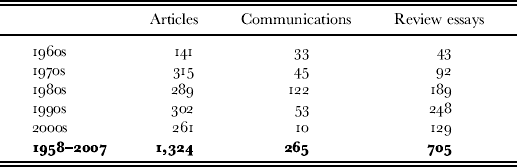
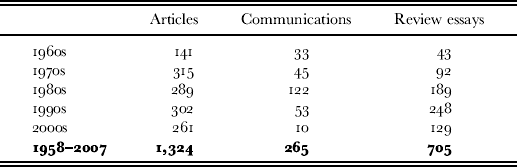
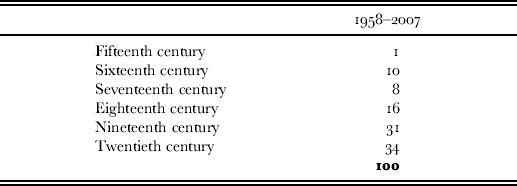
During the half-century, 1958–2007, the HJ published 1,324 ‘main’ articles. In addition, it published ‘communications’ and review essays (see Table 2). The data in Tables 4–9 refers only to ‘main’ articles. Of the ‘main’ articles, 1,000 (76 per cent) were on British history (including Irish and British imperial), and 324 (24 per cent) on non-British history. This is the basis of Tables 4–6. (Articles that bridged this distinction have been allocated according to their main focus.) In the tables, data has been analysed by ‘standard’ decades (e.g. 1960s), as being more user-friendly than counting decades from 1958. ‘2000s’=2000–7. Summary data is also given for the whole period, 1958–2007.
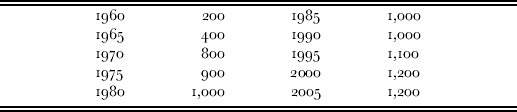
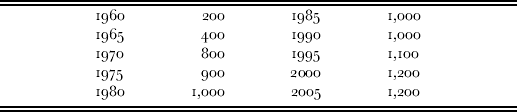
Table 1 Size of the HJ
Table 2 Make-up of the HJ
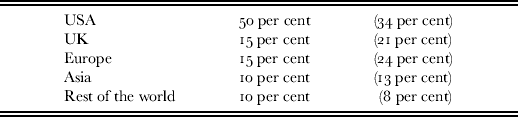
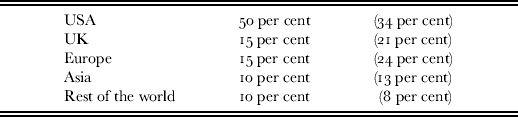
Table 3 Subscriptions to the HJ
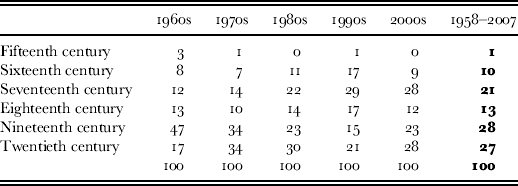
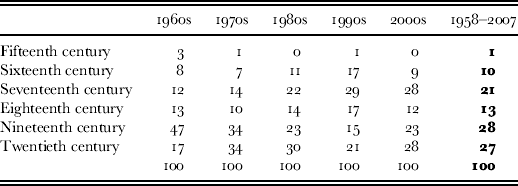
Table 4 Articles on British history by period
Table 5 Articles on non-British history by period
Table 6 Articles on non-British history by country
Table 7 Subject-matter of articles
Table 8 Institutional affiliation of authors
Table 9 Gender of authors
Table 10 Journals most cited in the RAE
Table 11 Journals ranked by political scientists
Table 12 Journals most frequently citing the HJ
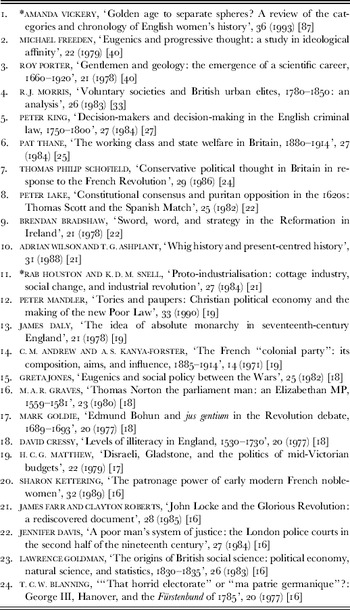
Table 13 Top twenty-five articles, 1970–2007 (citations in Web of Knowledge)
Table 14 Top twenty-five articles, 1958–2002 (online downloads via JSTOR)
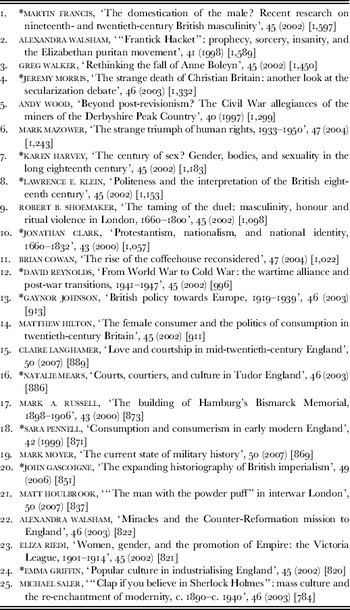
Table 15 Top twenty-five articles, 1997–2007 (online downloads via CJO)
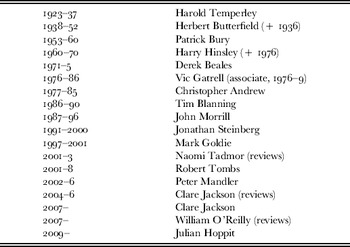
Table 16 Editors, 1923–2007
Size of the HJ
Nearest 100 pages.
Notes
(a) The journal had two issues per year from 1958 to 1964, three from 1965 to 1968, and four thereafter.
(b) Figures for the 2000s disguise an erratic pattern, which had not hitherto occurred, induced by the UK Research Assessment Exercise deadline falling in 2000. The journal dropped to 1,000 pages in 2002, before rising again.
Make-up of the HJ
‘Review essays’=historiographical reviews plus review articles, but excluding single reviews.
Note
The overall total is 2,294. In addition, there were some hundreds of single reviews, giving a grand total of around 3,000 items.
Subscriptions to the HJ
The earliest extant data is for 1984, which shows c.1300 institutional and c.130 individual subscriptions. Before the advent of online availability in 1997, the typical distribution pattern for institutional subscriptions was as follows. (For comparison, data for the Economic History Review in 1999 is shown in brackets. Source: Wrigley, ‘The Review’.)
Notes
(a) Five countries accounted for four-fifths of subscriptions: USA, UK, Japan, Germany, Italy.
(b) For the impact of online availability and consortia subscriptions, see above p. 835.
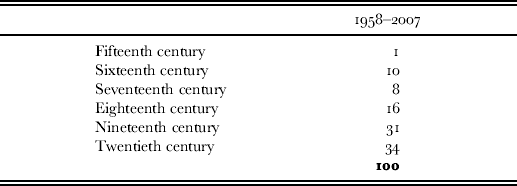
Articles on British history by period
Percentages of articles covering each century of history. N=1,000.
Note
The most considerable changes were the steep decline in nineteenth-century history, and the substantial growths in seventeenth- and twentieth-century history.
Articles on non-British history by period
Percentages of articles covering each century of history. N=324.
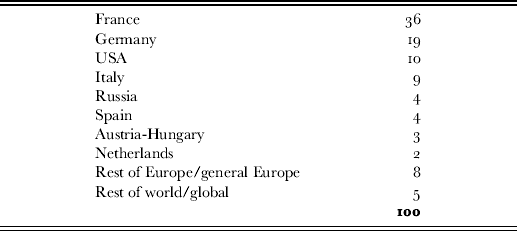
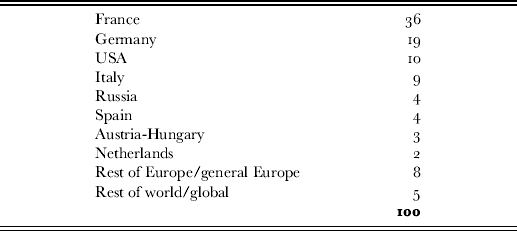
Articles on non-British history by country
Percentages of articles covering each country. N=324. Articles have been categorized by their principal focus, though often they were multinational in scope.
Notes
(a) The largest blocs by country and period (percentages) were:
(b) Half of all articles on United States history were published in the past decade.
(c) Though only a quarter of all articles were on non-British history, for nineteenth- and twentieth-century history, the proportion is one third.
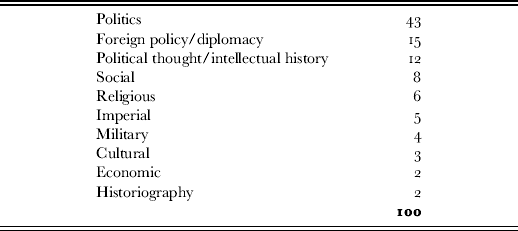
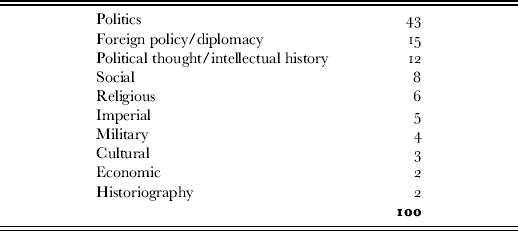
Subject-matter of articles
Percentages of all articles. N=1,324. Many articles had more than one approach; as far as possible they have been allocated by identifying a main approach.
Notes
(a) There are only small differences in patterns of subject-matter as between British and non-British articles, except that a higher proportion of non-British articles dealt with foreign policy/diplomatic history, and most of the articles in imperial history concerned the British empire.
(b) Five examples showing the most significant changes over time: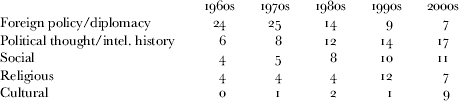
These figures can usefully be compared with data (for the USA) in Robert Townsend, ‘What's in a label: changing patterns of faculty specialization since 1975’: www.historians.org/perspectives/issues/2007/0701/0701new1.cfm.
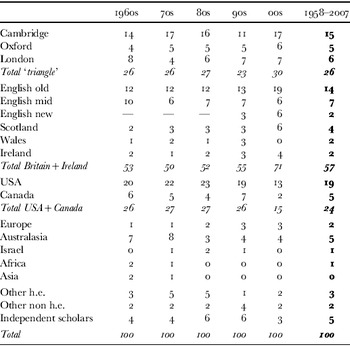
Institutional affiliation of authors
Percentages of authors. N=1,131 (authors of 1,324 articles). ‘English old’=pre-1945 universities; ‘English mid’=1945–92; ‘English new’=post 1992; ‘Other h.e.’=polytechnics or similar; ‘Other non h.e.’=mainly schoolteachers.

Notes
(a) The total number of institutions from which these authors came was c. 450.
(b) 158 authors (14 per cent) published more than one article in the HJ.
(c) It is a striking fact that 10 per cent of authors were not postholders in universities.
(d) For the journal History of Political Thought, during its first ten years of publication, the breakdown of affiliations of authors of articles submitted (i.e. including unsuccessful submissions) was: UK 43 per cent, USA 35 per cent, Canada 6 per cent, Australia 4 per cent, Germany 3 per cent, Israel 2 per cent, New Zealand 2 per cent: ‘The first ten years’, History of Political Thought, 11 (1990), Supplement.
Gender of authors
Percentages of articles authored by women. N=1,210 articles for which gender of author is known. Figures for the 1950s include the Cambridge Historical Journal, 1950–7. Comparable data is given for the Economic History Review (Source: Wrigley, ‘The Review’).
Notes
(a) A minor social change is observable: the propensity of authors to use forenames instead of initials rose rapidly after c. 1980. However, local knowledge has been used to identify the genders of most articles having initials only.
(b) It would be valuable to know gender ratios as between articles submitted and articles accepted, but such data is not available.
(c) It is editorial policy to seek to use the review essay section, where articles are commissioned, to redress the journal's gender (and subject-matter) imbalance.
(d) An analysis of the Journal of Economic History puts the figure of female contributors at about 5 per cent in the 1940s, declining in the 1950s and 1960s, then reaching a plateau of about 15 per cent from the 1980s. Whaples, ‘Quantitative history’, p. 297.
(e) A comparison with some other journals (articles only), for the period 2000–6 (percentages of female authors):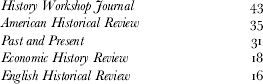
Journals most cited in the RAE
Data from the 2001 UK Research Assessment Exercise (RAE) is available online. University academics were required to submit for assessment the four publications they judged their best. The journals in which the highest number of submissions appeared were as follows. The data is confined to the 245 historians in the eight departments ranked highest (5*) in the RAE (Birkbeck London, Cambridge, Durham, East Anglia, King's London, London School of Economics, School of Oriental and African Studies London, Oxford Brookes). See: www.hero.ac.uk/rae.
Notes
(a) Size of journal will affect the number of appearances: the HJ is a large journal.
(b) Ironically, a truly international journal might arguably score low, for it would have less space available for UK historians, to which this data is confined.
(c) Arguably, this list is less interesting than the fact that these 245 historians published in no less than 180 different journals.
(d) Data from a wider cohort would certainly be desirable, but is onerous to compile.
Journals ranked by political scientists
In 1990 teachers of political science in British universities were asked to rank the journals they used. A number of history journals appeared in the top quartile of the c. 90 journals included in the survey, and these are listed here. Different rankings were produced. ‘Research quality’=quality of research as judged by respondents who were familiar with the journal. ‘General impact’=a combination of judgements on the quality of research, usefulness for teaching, and familiarity of the title (i.e. the journal was known to the respondent). Source: Norris and Crewe, ‘The reputation of political science journals’.
Journals most frequently citing the HJ
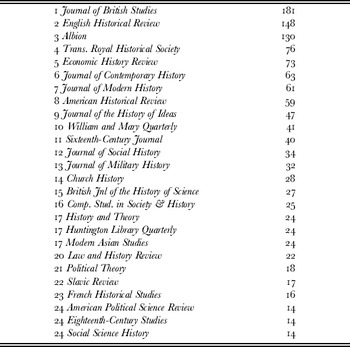
Some sense of the ‘footprint’ of the journal can be gained by looking at which other journals most regularly cite it. This table is based on numbers of citations by journals available on JSTOR (total citations 2,070). It lists the twenty-six journals with the highest number of citations of the HJ. The table must be used with considerable caution. The search term ‘historical journal’ produces background noise, only some of which can be eliminated. Another defect is that JSTOR, although covering c. 700 journals including c. 70 in history, does not include several leading journals, such as Historical Research, History of Political Thought, History Workshop Journal, Journal of Ecclesiastical History, Journal of Imperial and Commonwealth History, and Social History. (Because of citational peculiarities, it is not possible to rank Past and Present, although it is included in JSTOR.) See www.jstor.org (accessed 31 Dec. 2007).

Notes
(a) A total of c. 100 journals cited the HJ. However, some 60 per cent of all citations are found in these twenty-six journals, and one-fifth in the top three. The leading three tally with the HJ's predominant British history content.
(b) 73 per cent of all citations are found in history journals and 27 per cent in journals in other disciplines. The most strongly represented neighbour disciplines are political science (8 per cent), literature (7 per cent), and history of science (4 per cent).
(c) It is noticeable that a handful of articles generate extensive citational ‘tentacles’ in other disciplines, for example, Michael Freeden's on eugenics (1979) in sociological journals, Quentin Skinner's on Hobbes (1965–6) in political science journals, and Roy Porter's on ‘gentlemen and geology’ (1978) in history of science journals. There is a similar effect within historical sub-disciplines: articles such as Neil McKendrick's on factory discipline (1961) generate a significant presence in economic history journals.
Top twenty-five articles, 1970–2007 (citations in Web of Knowledge)
The Thomson Reuter Web of Knowledge records citations of articles published since 1970, and hence does not include articles of the 1960s, some of which are much cited. Citation scores are given in square brackets. Citation indexes record citations in journals only and not in books. Most articles on the list were published before 1990: these have had a longer time to accumulate citations. A twenty-fifth ranked article is not included as seven articles have the same number of citations. Asterisked items (*) are review essays. Source: http://wok.mimas.ac.uk. Accessed 31 Dec. 2007.

Note
If review essays and single reviews are excluded, the total number of articles on this database is 1,345. The pattern of citations is: 10 articles have 20+ citations; 19 articles have 15–19; 46 articles have 10–14; 197 articles have 5–9; 704 articles have 1–4; 369 articles have no citations. Average citations per article: 2·84.
Top twenty-five articles, 1958–2002 (online downloads via JSTOR)
This table measures numbers of readers seeking electronic access via JSTOR from December 2001 (when the HJ became available there) to the end of 2007. JSTOR covers articles since the HJ's beginning in 1958, but excludes articles published after 2002, the journal being released to JSTOR through a five-year moving barrier. Figures in square brackets are the numbers of ‘viewings’ plus ‘printings’: rankings are derived by adding one to the other. Asterisked items (*) are review essays. Source: JSTOR via Cambridge University Press. Accessed 25 Jan. 2008.

Notes
(a) The total number of HJ articles (and reviews) available on JSTOR was 3,057; the total number of viewings was one million, the annual rate rising rapidly and reaching a quarter of a million by 2006. The top twenty-five articles represent about 10 per cent of all viewings. 42 per cent of all viewings were from the USA, but this dominance is declining steadily.
(b) This table is likely to be especially indicative of pedagogic usage; scholarly usage is better measured by citations.
(c) Seven of the top twenty-five were review essays.
(d) Half were published before 1990: historical research has a long shelf-life.
Top twenty-five articles, 1997–2007 (online downloads via CJO)
Numbers of readers seeking electronic access via Cambridge Journals Online (CJO). Articles are ranked by number of ‘fulltext views’ during five years, 2003–7 (statistics for ‘abstract views’ alone are also produced but are less revealing of usage than those for fulltext views). Figures in square brackets are the number of fulltext views. CJO began in 1997 and only articles published from that date are included; usage reports began in 2003 and data refers only to usage from that date. Asterisked items (*) are review essays. Source: Cambridge University Press. Accessed, 10 Jan. 2008.

Notes
(a) A shorter-term snapshot of data, such as the number of views during the most recent year, would tend to rank recently published articles highly, as readers seek out the latest material. This five-year table counters that effect somewhat. Conversely, the most recent articles have not been available long enough for many of them to impact the five-year table.
(b) Numbers of ‘abstract views’ loosely correlate with ‘fulltext views’, but there are marked variations. ‘Fashionable’ topics win markedly higher abstract views than fulltext views. For instance, an article with ‘human rights’, ‘coffee house’, or ‘witchcraft’ in its title will win high abstract view scores, but more limited follow-through to fulltext views. By contrast, articles on more specialist topics, or whose authors are widely admired, often win higher fulltext scores than abstract scores.
(c) As in Table 14, electronic access data is probably especially indicative of pedagogic usage.
(d) Eleven out of the top twenty-five were review essays.
(e) Nine out of the top twenty-five were authored by women.
Editors, 1923–2008
Listed chronologically. Includes the Cambridge Historical Journal (1923–57). There was no change in editor (or board membership) when the journal changed its name in 1958. The journal had a sole editor from 1923 to 1975, two from 1976 to 2000, and three from 2001 (the third being a reviews editor). The board had seven to nine members 1923–75; fourteen by 2000; nineteen by 2005. Until the mid-1990s board membership was normally for life (or departure from Cambridge), thereafter membership lapsed shortly after retirement (or upon departure). In 2000 an international advisory board was created, including historians from half-a-dozen countries.