INTRODUCTION
One in six adults identifies as an informal caregiver (CG) (Hudson et al., Reference Hudson, Aranda and Kristjanson2004), characterized as an unpaid family member or friend who cares for a seriously ill or disabled individual. Most of the primary caregivers for dying patients in the United States are informal CGs (Pinquart & Sörensen, Reference Pinquart and Sörensen2006; Weitzner et al., Reference Weitzner, McMillan and Jacobsen1999). While many CGs cite positive outcomes of their caregiving experiences, such as a sense of fulfillment (Cohen et al., Reference Cohen, Colantonio and Vernich2002) and an enhanced appreciation for life (Tarlow et al., Reference Tarlow, Wisniewski and Belle2004), numerous negative outcomes may also result from the significant stressors associated with care-related tasks. The substantial burden and resulting adverse effects of informal caregiving have been well-established among prospective and cross-sectional studies (Garlo et al., Reference Garlo, O'Leary and Van Ness2010; George & Gwyther, Reference George and Gwyther1986; Nielsen et al., Reference Nielsen, Hansen and Ritz2014; Sautter et al., Reference Sautter, Tulsky and Johnson2014; Stansfeld et al., Reference Stansfeld, Smuk and Onwumere2014) and notably include heightened risk for psychological distress (e.g., depression and anxiety), poorer self-rated health, less social interaction (Chentsova-Dutton et al., Reference Chentsova-Dutton, Shucter and Hutchin2000), and disruption of daily activities. Consideration of these potential consequences by hospice and palliative care providers is critical, as they work to improve the quality of life of both patients and their informal CGs (Weitzner et al., Reference Weitzner, McMillan and Jacobsen1999).
Depression
CGs exhibit a higher point prevalence and more severe depression relative to non-CGs, even after controlling for age and education (Chentsova-Dutton et al., Reference Chentsova-Dutton, Shucter and Hutchin2000; Clark & King, Reference Clark and King2003). Factors that correlate with and predict the onset of CG depression include general pre-dispositional variables (e.g., female gender) and unique qualities of caregiving (e.g., patient's functionality). Given and colleagues (2004) provided a review of these correlates, although much previous research has limited generalizability because disease-specific populations (e.g., cancer patients receiving chemotherapy) were the focus, as disease specificity was believed to divergently impact CG depression and levels of burden (Stajduhar et al., Reference Stajduhar, Funk and Toye2010). Two cross-sectional studies compared groups of CGs circumscribed by their respective patient's disease (e.g., cancer and dementia, Alzheimer's and stroke survivors) to evaluate the influence of illness type on CG depression. The results revealed that illness type was largely noncontributory to depression severity (Clark & King, Reference Clark and King2003; Kim & Schulz, Reference Kim and Schulz2008). Grov and Valeberg (Reference Grov and Valeberg2012) found nonsignificant differences in depression levels of CGs for cancer patients who were either in the disease-directed treatment phase or receiving an exclusively palliative approach to care; however, this study was cross-sectional in design. While preliminary, these findings suggest relatively commensurate levels of CG depression across diseases and treatment conditions.
Suicidality
Little is known about suicidality among informal CGs, despite the fact that caregiving presents as a risk factor for the onset and exacerbation of depressive symptoms, including suicidal ideation (SI) (i.e., thoughts of suicide; O'Dwyer et al., Reference O'Dwyer, Moyle and Pachana2014). Despite the large socioeconomic costs of suicide, and middle-aged and older adults having the first and second highest suicide rates, respectively (Malouff et al., Reference Malouff, Thorsteinsson and Schutte2007), CG suicidality is vastly understudied. Among the few existing studies of CGs reporting SI, the methodology is quite variable, which is understandable given the challenges in recruiting and following this population. Among the small body of existing research on caregiver SI, a recent study identified a two times greater risk of suicide death in male spousal CGs of Parkinson's disease patients, compared to non-CG male spouses (Nielsen et al., Reference Nielsen, Hansen and Ritz2014). A separate study of CGs of patients with advanced cancer found that CGs' perceptions of the patient's quality of life at the end of life was shown to predict post-bereavement CG suicidality (Abbott et al., Reference Abbott, Prigerson and Maciejewski2014): the more CGs perceived the patient's quality of life to be poor, the greater the CG's risk for SI during bereavement.
Impact of Patient's Symptom Subtype on Caregiver Depression
Family CGs of patients with life-limiting illnesses often report distress when observing uncontrolled acute physiological patient symptoms (e.g., unmanaged pain, nausea, vomiting). CG distress in this context is exacerbated by the intensity of patient symptoms, a perceived inability to assist the patient in managing these symptoms, and difficulties in understanding the patient's needs (Kim & Schulz, Reference Kim and Schulz2008; Stajduhar et al., Reference Stajduhar, Funk and Toye2010). The chronic effects of the dying process are also difficult for CGs to observe. Increasing frailty, weakness, functional decline, and similar symptoms increase both the physical and emotional demands of providing care (Kim & Schulz, Reference Kim and Schulz2008). Previous studies have reported a high correlation between increasing care demands on time and effort and negative outcomes reported by CGs (Bevans & Sternberg, Reference Bevans and Sternberg2012; Kim & Schulz, Reference Kim and Schulz2008; Stajduhar et al., Reference Stajduhar, Funk and Toye2010).
Caregivers furthermore report that their levels of distress are affected by the patient's emotional state. When patients themselves are coping adaptively with their illness, their CGs fare better as well (Stajduhar et al., Reference Stajduhar, Funk and Toye2010). Conversely, when patients are affectively distressed, their CGs often find coping with the caregiving situation to be more difficult. This may be the result of a perceived inability to ease the patient's emotional suffering, as is observed with physical suffering (Kim & Schulz, Reference Kim and Schulz2008; Schulz et al., Reference Schulz, Hebert and Dew2007). CG distress may also be affected by ineffective coping strategies on the part of the patient. For example, if a patient is struggling to cope with his prognosis, he may lash out in anger toward his CG, which may in turn result in increased CG distress. Importantly, research suggests that patients' psychological symptoms (e.g., sadness, worrying) are often perceived by informal CGs as more stressful than patients' physical symptoms (Ratkowski et al., Reference Ratkowski, Washington and Craig2015).
Study Objectives
Objective 1: While previous research suggests that emotional and physical symptoms have disparate effects on the patient (Sarna & Brecht, Reference Sarna and Brecht1997), it is not known whether the burden associated with patients' emotional and physical symptoms differentially affect caregiver depression. The primary aim of the present study was to evaluate the extent to which CG burden associated with patients' symptom subtypes (i.e., emotional/psychological and physical) predicted informal hospice CG depression. Two hypotheses were established based on prior research: (1) CG depression would be positively associated with CG burden related to patient symptoms, and (2) CG burden related to the patient's psychological symptoms would contribute to CG depression above and beyond CG burden related to the patient's physical symptoms.
Objective 2: There exists a paucity of research on suicidal ideation (SI) among informal CGs, despite the reality that CGs are likely to be in age groups identified as being at high risk for SI (Malouff et al., Reference Malouff, Thorsteinsson and Schutte2007) and the fact that caregiving is a risk factor for the onset and exacerbation of depressive symptoms, including SI. Thus, researchers sought to describe the characteristics of CGs who endorsed SI and those who did not. Given the lack of extant evidence on this issue, no related hypotheses were established.
METHODS
Study participants were adults (aged 18 and older) who were informal family CGs of adult patients receiving hospice services. The patients varied with regard to time spent receiving hospice services (median = 6.5 weeks, M = 19.23 weeks, SD = 30.90); number of illnesses (median = 2, M = 2.61, SD = 1.37); and type of illness (e.g., heart disease, lung disease, cancer, dementia). Family CGs were defined as any individuals identified as such by the patient; a legal or biological relationship was not required. Participants were recruited from a large, not-for-profit, community-based hospice agency in the mid-Southern United States. During each family's initial social work contact, potential participants were informed of the agency's partnership with the university-based research team and given the opportunity to schedule a follow-up phone call with a research team member to learn more about the study. In accordance with procedures approved by the university's institutional review board, CGs who elected to take part in the study provided verbal consent and were given the option of providing responses to the study measures by telephone or online. A copy of the informed consent statement was made available to all participants via email or the U.S. Postal Service.
Measures
Demographic Information Form
CGs completed a demographic form. The demographic variables in the present analysis included the following characteristics: gender (male, female); race (black, white); marital status (never married, married/partnered long-term, divorced, separated, widowed); relationship to patient (spouse/long-term partner, adult child, other); living arrangement (lives with patient 50% or more of the time, less than 50% of the time); and employment status (not employed outside of the home, part-time employment, full-time employment, volunteer outside of the home).
Memorial Symptom Assessment Scale–-Short Form (MSAS)
The MSAS (Portenoy et al., Reference Portenoy, Thaler and Kornblith1994) was originally created as a patient-rated instrument to assess the degree of distress associated with 32 symptoms over the prior 7 days (5-point Likert-type scale: 0 = “not at all,” 4 = “very much”). Item factor loadings revealed three symptom subscales: a 6-item psychological subscale (Psych; e.g., worrying); a 12-item subscale of highly prevalent physical symptoms (PhysH; e.g., lack of energy); and a 12-item low-frequency physical symptom subscale (PhysL; e.g., numbness/tingling in hands or feet). Interitem reliability coefficients of the subscales demonstrated adequate fit (α = 0.76–0.87) (Chang et al., Reference Chang, Hwang and Feuerman2000). Previous research has successfully used modified versions of the MSAS to better understand family CGs' perceptions of patients' symptom experiences (Lobchuk & Vorauer, Reference Lobchuk and Vorauer2003) and to measure the degree of symptom burden to CGs (McMillan et al., Reference McMillan, Small and Weitzner2006).
In the present study, a modified version of the MSAS was administered to the patient's CG as a measure of CG burden. CGs were asked to indicate which of the 32 symptoms their patients had experienced in the previous week and how stressful they (i.e., the CGs) found the symptoms to be (0 = “not at all”; 4 = “very much”). The decision to use the term “stressful” (as opposed to “burdensome”) was based on feedback from nonparticipant informal CGs who reviewed the full survey instrument prior to the start of the study. Symptoms were defined as stressful in the instrument instructions if the CG found the fact that the patient experienced the symptom to be difficult or troubling, either because the CG felt distressed about it or because the CG had to use considerable effort to manage the symptom. We analyzed MSAS total scores and symptom subscales (Psych, PhysH, PhysL) in the present study, with greater scores reflecting a higher degree of symptom burden. In the present sample, the interitem reliability coefficients for the MSAS total score and subscales demonstrated adequate reliability or better (range of α = 0.72–0.88).
Patient Health Questionnaire-9 (PHQ–9)
The Patient Health Questionnaire–9 (Kroenke et al., Reference Kroenke, Spitzer and Williams2001; Spitzer et al., Reference Spitzer, Williams and Kroenke1994), a nine-item self-report questionnaire, originally developed from the Primary Care Evaluation of Mental Disorders (PRIME–MD) instrument, measures the presence of nine depressive symptoms (e.g., anhedonia, depressed mood, feelings of failure, psychomotor retardation/agitation, suicidal ideation). Respondents rate each item on a 4-point Likert-type scale (0 = “not at all” to 3 = “nearly every day”), which indicates the frequency of the symptom over the previous two weeks. The PHQ–9 has demonstrated internal reliability coefficients (α = 0.86–0.89) well above the adequate range (Kroenke et al., Reference Kroenke, Spitzer and Williams2001) and outstanding generalizability, with use across treatment settings (e.g., primary care, nursing homes), patient populations (e.g., adults and older adults), and psychiatric comorbidities (Kroenke et al., Reference Kroenke, Spitzer and Williams2010). Within the current sample, the internal consistency of the PHQ–9 was adequate (α = 0.86), and total scores ranged from no depressive symptoms to severe depression (i.e., PHQ–9 total score range = 0–27), and an average endorsement in the mild depression range (PHQ–9 total M = 6.49, SD = 5.60). The PHQ–9 was selected due to its solid psychometric qualities, brevity, and inclusion of an item measuring suicidal ideation.
Suicidal Ideation
Suicidal ideation was assessed with one item from the PHQ–9. Item 9 queries for the presence of SI (“thoughts that you would be better off dead, or of hurting yourself in some way”). SI was assessed as positive for any response other than “not at all.”
Data Analysis
The characteristics of the total sample and subsamples (i.e., participants who did and did not endorse SI) were reported to draw qualitative group comparisons. Preliminary analyses were performed to ensure no violation of the assumptions of normality, linearity, and homoscedasticity. Exploratory analyses compared differences in group means between the participant samples who did and did not endorse SI via Fisher's exact test (i.e., with two categorical variables) or an independent-samples t test (i.e., with a continuous variable). Fisher's exact test was employed rather than the chi-squared test due to the low frequency of cell sizes. The magnitude of the relationships between outcome and predictor variables were assessed via Pearson's product-moment correlations or Spearman's rank-order correlations (i.e., with PHQ–9 item 9): the dependent variables (DVs) were depression (PHQ–9 total score) and SI (item 9 on the PHQ–9); the independent variables (IVs) included MSAS total score and the subscales of psychological symptoms (Psych), highly prevalent physical symptoms (PhysH), and low-frequency physical symptoms (PhysL). Hierarchical regression analyses evaluated the unique predictability of the patient's psychological symptoms on CG depression, controlling for the patient's physical symptoms. This analysis allows for the IVs to be sequentially entered into “blocks,” whereby IV(s) in earlier blocks (i.e., block 1; B1) are statistically controlled for when IV(s) are entered into subsequent blocks (i.e., B2); the final block is typically of most interest in the output as this provides information about the unique predictability of each IV. Beta coefficients and part correlations (also called semipartial correlations) correspond to the individual slopes and variance attributed to each IV. In the current study, only one of the two physical-symptom subscales was controlled for per analysis, indicating that either the highly prevalent or low-frequency physical symptom subscales were input in B1 and the psychological symptom subscale was entered in B2. Regression evaluations with SI as an outcome variable were underpowered, given the small number of CGs who endorsed SI, and so were not conducted. Analyses were performed using the IBM SPSS statistical software package (v. 22).
RESULTS
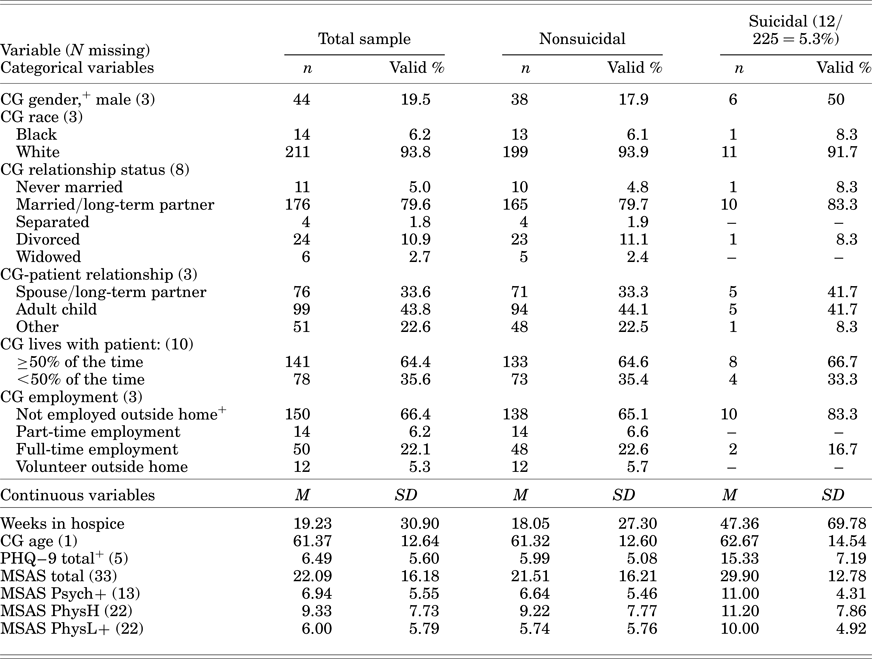
Scatter plots revealed linear bivariate relationships. CG characteristics for the entire sample and subsamples are given in Table 1. The particularly notable results are discussed here. The entire sample consisted of 229 CGs (M age = 61.4 years, SD = 12.6), 44 of whom were male (19.5% of the sample who reported gender). Most CGs reported living with the patient 50% or more of the time (n = 141; 64.4% of responses to residential status) and not being employed outside of the home (n = 150; 66.4% of responses to employment status). SI was endorsed by 12 of the 225 CGs who responded to PHQ–9 item 9 (5.3%). The subsample who endorsed SI was compared to the subsample who denied SI (i.e., non-SI): these subsamples had relatively equivalent age ranges (SI: M age = 62.7 years, SD = 14.5; non-SI: M age = 61.3 years, SD = 12.6) and percentages of CGs that reported living with the patient 50% or more of the time (SI n = 8, 66.7%; non-SI n = 133, 64.6%). Fisher's exact test yielded significant differences in CG gender (SI n = 6 males, 50%; non-SI n = 38 males, 17.9%; p = 0.015). Although notable percentage differences appeared present in CGs not employed outside of the home (SI n = 10, 83.3%; non-SI n = 138, 65.1%), Fisher's exact test was nonsignificant. Independent-samples t tests (Table 2) revealed significant group differences between the SI and non-SI CG samples in total self-reported depression scores (M difference = 9.34, t[11.63] = 4.44, p = 0.001); the MSAS psychological symptom subscale (M difference = 4.36, t[213] = 2.72, p = 0.007); and the MSAS low-frequency physical symptom subscale (M difference = 4.26, t[203] = 2.50, p = 0.013). Within the entire study sample, bivariate associations with PHQ–9 total scores revealed modest correlations with SI (r = 0.28, p < 0.001; Table 3); MSAS total score (r = 0.48, p < 0.001); and MSAS symptom subscales (Psych r = 0.43 to PhysH r = 0.39, all p < 0.001). SI demonstrated weak yet significant correlations with MSAS total score (r = 0.14, p = 0.047) and its subscales of psychological symptoms (r = 0.19, p = 0.006) and low-frequency physical symptoms (r = 0.21, p = 0.003).
Total sample, nonsuicidal, and suicidal caregiver characteristics

Total N = 229; n = variable's sample; valid % = count divided by the total number of valid observations (= non-missing); CG = caregiver; M = mean; SD = standard deviation; weeks in hospice = estimation of the number of weeks patients had been receiving hospice services; PHQ–9 total = total Patient Health Questionnaire–9 score; MSAS total = total Memorial Symptom Assessment Scale score; MSAS Psych = MSAS psychological subscale score; MSAS PhysH = MSAS highly prevalent physical symptoms subscale score; MSAS PhysL = MSAS low-frequency of physical symptoms subscale score; + indicates variables were tested for mean comparison.
Independent t tests for suicidal and nonsuicidal caregiver characteristics

Means were compared between CGs who endorsed suicide on the PHQ–9 and CGs that denied suicide. Means and standard deviations of variables are given in Table 1. When Levene's F test was significant, statistics represent when equal variances were not assumed. SE = standard error of mean difference; CI 95% = 95% confidence interval for mean difference; Psych = MSAS psychological symptoms subscale score; PhysL = MSAS low-frequency physical symptoms subscale score.
*p < 0.05, **p < 0.01, ***p < 0.001.
Bivariate correlations

Parenthetical numbers in the diagonal are Cronbach's alpha internal consistency coefficient values. Correlations with PHQ–9 item 9 were conducted with Spearman's correlation.
Psych = MSAS psychological symptoms subscale score; PhysH = MSAS highly prevalent physical symptoms subscale score; PhysL = MSAS low-frequency physical symptoms subscale score.
*p < 0.05, **p < 0.01, ***p < 0.001.
Hierarchical Regressions
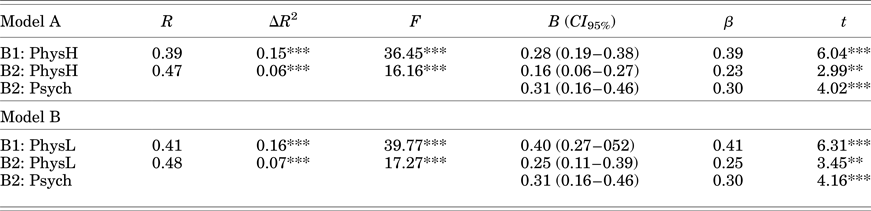
These results are reported in Table 4. Model A, Block 2 (B2), predicted CG depression (PHQ–9 total score) from the MSAS subscales of highly prevalent physical symptoms (PhysH) and psychological symptoms (Psych). Model B, B2, similarly evaluated the unique predictability of the MSAS psychological symptoms subscale on CG depression while accounting for the MSAS low-frequency physical symptoms subscale (PhysL). Multiple R and incremental R 2 were statistically significant in both models, indicating that the IVs accounted for substantial variance in CG depression scores, and the psychological symptoms subscale significantly added a unique amount of variance to the models. As shown in Table 4 Model A, a one-unit increase in PhysH initially corresponded to a 0.28 increase in PHQ–9 total scores, but this β coefficient decreased to 0.16 when Psych was added to the model. Direct comparisons of the standardized coefficients (β in Table 4) demonstrate that CG burden associated with patients' psychological symptoms was a stronger predictor of CG depression scores than patients' highly prevalent physical symptoms (Psych β = 0.30, PhysH β = 0.23). Although formal testing of the difference in slopes revealed that the paths were not significantly different, the discrepancy in predictability appears clinically meaningful given the part correlation findings, wherein highly prevalent physical symptoms and psychological symptoms uniquely contributed to 19 and 25% of the variance in CG depression scores, respectively. Model B, which supplanted the subscale of highly prevalent physical symptoms with the low-frequency physical symptoms subscale, yielded similar results. Specifically, the β coefficient of PhysL decreased from 0.40 to 0.25 when Psych was added, and the standardized results were comparable, such that Psych was more impactful than PhysL (Psych β = 0.30, PhysL β = 0.25). These findings corroborated our hypotheses that CG depression was related to the burden associated with the patient's symptoms and that the subtype of patient's symptoms have a differential influence on the caregiver.
Hierarchical regressions predicting caregiver depression from patient's symptom subtype

Model A, n = 202; Model B, n = 204; R = multiple R; ΔR 2 = change in R 2; F = F change statistic; B = unstandardized β coefficient (CI 95%); β = standardized coefficients; B1 = block 1; B2 = block 2; PhysH = MSAS highly prevalent physical symptoms subscale; Psych = MSAS psychological symptoms subscale score; PhysL = MSAS low-frequency physical symptoms subscale. In both models' block 1, ΔR 2 represents the adjusted R 2.
**p < 0.01, ***p < 0.001.
DISCUSSION
Consistent with our predictions, the results suggested that CG burden associated with the patient's psychological distress significantly predicted CG depressive symptoms when controlling for CG burden associated with the patient's physical symptoms. In other words, CGs' self-reported depression scores were differentially affected by burden associated with different patient symptom subtypes. Although the individual slopes revealed a nonsignificant difference between the patient's psychological symptoms predicting CG depressive symptoms and the physical symptom subscales, the standardized β coefficients of the psychological symptom subscale were consistently stronger. These findings corroborate existing research with disease-specific populations (Lindenbaum et al., Reference Lindenbaum, Stroka and Linder2014). A notable longitudinal study demonstrated that changes in patients' emotional suffering predicted changes in CG depression, even when other caregiving-related factors were controlled (Fassberg et al., Reference Fassberg, Cheung and Canetto2016).
The present study's sample (informal CGs of patients enrolled in hospice care) presented a study limitation. Due in part to hospice eligibility criteria, families typically seek hospice services late in the disease trajectory (Weitzner et al., Reference Weitzner, McMillan and Jacobsen1999), and it would therefore be reasonable to presume that the present study sample had ample exposure to the patient's symptomatology prior to their participation in the study. Repeated exposure to the patient's symptoms may contribute to CG habituation of the psychological distress that they might have initially experienced. Evaluating CGs of patients with a variety of chronic/advanced illnesses who have not yet engaged with formal end-of-life supports would be useful to compare their subjective experience. Another study limitation was the low endorsement rate of CG SI, which resulted in subsequent analyses being limited due to power issues. Low endorsement of CG SI may be attributable in part to the fact that SI was measured in the present study by a single item (i.e., item 9 on the PHQ–9). Although item 9 directly queries the presence of SI, providing face validity, its singularity restricts response variability and may not accurately capture the phenomenology of CG suicidality. For instance, SI is commonly experienced as passive, with fleeting suicidal thoughts (e.g., “What would it be like if I weren't here?”), and such rather inconspicuous thoughts may not be inferred as SI when an individual responds to PHQ–9 item 9. Employment of broader suicidality measures that include suicide cognitions (i.e., ideation) and behaviors (Beck et al., Reference Beck, Weissman and Lester1974), as well as exploration of affective factors known to influence suicidality (e.g., Beck Hopelessness Scale; Wilkinson & Lynn, Reference Wilkinson and Lynn2005), would better inform future studies aimed at understanding the nature of SI and behavior in this population. CGs' responses to open-ended questions would likely also shed light on this topic, offering support for future research employing qualitative or mixed methods. Furthermore, social desirability and/or concerns about what would happen if SI were endorsed might have prevented CGs who had experienced SI from accurately reporting their experiences, introducing the possibility that greater than 5.3% of our sample had experienced SI. In addition, CG psychiatric history was not assessed, which presents as a limitation to the current study's validity. It is possible that CGs with current or past depressive episodes have a skewed perception of their patient's symptom presentation, which reflects the CG's depressive perspective rather than the patient's symptomatology. Future research would also be strengthened by consideration of CG anxiety in addition to depression, as anxiety has been found to have a higher prevalence among hospice CGs than depression (Parker Oliver et al., Reference Parker Oliver, Washington and Smith2016), and might reasonably be related to challenges associated with pain and symptom management.
Although female CGs were overrepresented in our study sample, consistent with much of the existing CG research (George & Gwyther, Reference George and Gwyther1986; Given et al., Reference Given, Wyatt and Given2004; Fiske et al., Reference Fiske, Smith, Price and Lichtenberg2015), 50% of the CGs who endorsed SI in the present study were male. The preponderance of female CGs was demographically against these findings, which raises many questions. Given the gender distribution of the present sample, would gender moderate the analyzed relationships between patient symptoms and SI if there was a sufficient sample size to evaluate? The suicide literature predominantly points to older males as a group at elevated risk for suicide generally, and it would thus be useful to elucidate the impact of caregiving on suicide risk specifically in male CGs. Additionally, the negative outcomes of caregiving tasks, such as CG suicidality and depression, may have been attenuated in the present CG sample due to the patient's enrollment in hospice. It would be likely that CG endorsement of SI was mitigated in the present study via patients having a certain level of formal support, particularly as one study found higher post-bereavement SI when the CG perceived the patient to have had poorer quality of life at the end of life (Abbott et al., Reference Abbott, Prigerson and Maciejewski2014). The phenomenological experience of caregiving has been marked by a number of specific factors associated with increased SI, including isolation, poor social support, and exposure to pain and illness (O'Riley & Fiske, Reference O'Riley and Fiske2012). Prior studies have noted a relationship between self-efficacy for help-seeking and SI in CGs (O'Riley & Fiske, Reference O'Riley and Fiske2012; Fiske et al., Reference Fiske, Smith, Price and Lichtenberg2015), and it may be possible that diminished self-efficacy for seeking support in CGs could lead to increased suicide risk. There is a paucity of studies that evaluate suicidality in CGs. Although the costs associated with such studies are substantial, the public health impact of CG suicidality and depression warrants such an investment.
Implications for Practice
Our finding that burden associated with patients' psychological symptoms uniquely contributes to CG depression underscores the need for hospice providers to respond to the emotional needs of both patients and their family CGs. While the focus of many CG support programs has understandably revolved around the management of the patient's physical symptoms, the current study and associated evidence suggest that CGs would benefit incrementally from learning adaptive ways to respond to their patient's psychological distress. In addition, psychosocial interventions aimed at directly treating the patient's emotional health may positively influence the CG's mood as well. Further, while the majority of CGs in our study did not endorse SI, the presence of even one CG at risk of suicide is concerning. Recent research suggests that most hospice professionals will encounter CGs who exhibit warning signs for suicide as part of their professional practice and that professional education on identifying and responding to suicide risk would be welcome among providers (Washington et al., Reference Washington, Albright and Parker Oliver2016). Hospice agency leadership should strongly consider developing procedures to routinely assess patients' and caregivers' emotional well-being, including suicide risk, and to provide appropriate clinical interventions based on those assessments.
DISCLOSURES AND ACKNOWLEDGMENTS
This study was supported by funding from the John A. Hartford Foundation Geriatric Social Work Initiative (Principal Investigator: Washington). The content of this article is solely the responsibility of the authors and does not necessarily reflect the views of the John A. Hartford Foundation.