




No CrossRef data available.
Article contents
Looking beyond training as a solution to workplace sexual harassment and discrimination
Published online by Cambridge University Press: 28 July 2020
Abstract
An abstract is not available for this content. As you have access to this content, full HTML content is provided on this page. A PDF of this content is also available in through the ‘Save PDF’ action button.
Information
- Type
- Commentaries
- Information
- Copyright
- © Society for Industrial and Organizational Psychology, Inc. 2020
References
Australian Human Rights Commission. (2018). Everyone’s business: Fourth national survey on sexual harassment in Australian workplaces. Retrieved from https://www.humanrights.gov.au/our-work/sex-discrimination/publications/everyones-business-fourth-national-survey-sexualGoogle Scholar
Bagdasarov, Z., Olson-Buchanan, J., & MacDougall, A. E. (2019). Improving sexual harassment and sexual assault training effectiveness by aligning training efforts with business strategy. Industrial and Organizational Psychology, 12, 84–88.CrossRefGoogle Scholar
Bezrukova, K., Spell, C. S., Perry, J. L., & Jehn, K. A. (2016). A meta-analytical integration of over 40 years of research on diversity training evaluation. Psychological Bulletin, 142, 1227–1274.CrossRefGoogle ScholarPubMed
Bohnet, I. (2016). What works: Gender equality by design. Cambridge, MA: Harvard University Press.CrossRefGoogle Scholar
Buengeler, C., Leroy, H., & De Stobbeleir, K. (2018). How leaders shape the impact of HR’s diversity practices on employee inclusion. Human Resource Management Review, 28, 289–303.CrossRefGoogle Scholar
Castilla, E. J. (2015). Accounting for the gap: A firm study manipulating organizational accountability and transparency in pay decisions. Organization Science, 26, 311–333.CrossRefGoogle Scholar
Chun, E., & Evans, A. (2019). Conducting an institutional diversity audit in higher education: A practitioner’s guide to systematic diversity transformation. Sterling, VA: Stylus Publishing, LLC.Google Scholar
Dobbin, F., Kim, S., & Kalev, A. (2011). You can’t always get what you need: Organizational determinants of diversity programs. American Sociological Review, 76, 386–411.CrossRefGoogle Scholar
Dover, T. L., Kaiser, C. R., & Major, B. (2020). Mixed signals: The unintended effects of diversity initiatives. Social Issues and Policy Review, 14, 152–181. doi: 10.1111/sipr.12059CrossRefGoogle Scholar
Hamilton, K. M., Snoeyink, M. J., & Martinez, L. R. (2019). Blurred lines: How to approach sexual harassment training when sexual harassment isn’t always about sex. Industrial and Organizational Psychology, 12(3), 345–349.CrossRefGoogle Scholar
Heilman, M. E., & Caleo, S. (2018). Combatting gender discrimination: A lack of fit framework. Group Processes & Intergroup Relations, 21, 725–744.CrossRefGoogle Scholar
Kaiser, C. R., Major, B., Jurcevic, I., Dover, T. L., Brady, L. M., & Shapiro, J. R. (2013). Presumed fair: Ironic effects of organizational diversity structures. Journal of Personality and Social Psychology, 104, 504–519.CrossRefGoogle ScholarPubMed
Kalev, A., Dobbin, F., & Kelly, E. (2006). Best practices or best guesses? Assessing the efficacy of corporate affirmative action and diversity policies. American Sociological Review, 71, 589–617.CrossRefGoogle Scholar
Kalysh, K., Kulik, C. T., & Perera, S. 2016. Help or hindrance? Work-life practices and women in management. Leadership Quarterly, 27(3), 504–518.CrossRefGoogle Scholar
Kaplan, R. S., & Norton, D. P. (1992). The balanced scorecard—measures that drive performance. Harvard Business Review, 70, 71–79.Google ScholarPubMed
Leslie, L. M. (2019). Diversity initiative effectiveness: A typological theory of unintended consequences. Academy of Management Review, 44, 538–563.CrossRefGoogle Scholar
Lowman, R. L. (2012). The scientist-practitioner consulting psychologist. Consulting Psychology Journal: Practice and Research, 64, 151–156.CrossRefGoogle Scholar
Madera, J. M., Lee, L., & Dawson, M. (2019). Sexual harassment and sexual assault training: Consider the industry. Industrial and Organizational Psychology, 12, 96–99.CrossRefGoogle Scholar
Magley, V. J., Fitzgerald, L. F., Salisbury, J., Drasgow, F., & Zickar, M. J. (2013). Changing sexual harassment within organizations via training interventions: Suggestions and empirical data. In Burke, R. & Cooper, C. (Eds.), The fulfilling workplace: The organization’s role in achieving individual and organizational health (pp. 225–246). Burlington, VT: Bower.Google Scholar
McDonald, P., Charlesworth, S., & Graham, T. (2015). Developing a framework of effective prevention and response strategies in workplace sexual harassment. Asia Pacific Journal of Human Resources, 53, 41–58.CrossRefGoogle Scholar
Quick, J. C., & McFadyen, M. (2017). Sexual harassment: Have we made any progress? Journal of Occupational Health Psychology, 22, 286–298.CrossRefGoogle ScholarPubMed
Roehling, M. V., & Huang, J. (2018). Sexual harassment training effectiveness: An interdisciplinary review and call for research. Journal of Organizational Behavior, 39, 134–150.CrossRefGoogle Scholar
Troiano, E. (2020, January 28). Topic overview: Diversity councils. Retrieved from https://www.catalyst.org/research/diversity-councils-overview/Google Scholar
Vinkenburg, C. J. (2017). Engaging gatekeepers, optimizing decision making, and mitigating bias: Design specifications for systemic diversity interventions. Journal of Applied Behavioral Science, 53, 212–234.CrossRefGoogle ScholarPubMed
Workplace Gender Equality Agency. (2019). Workplace flexibility. Retrieved from https://www.wgea.gov.au/topics/workplace-flexibilityGoogle Scholar
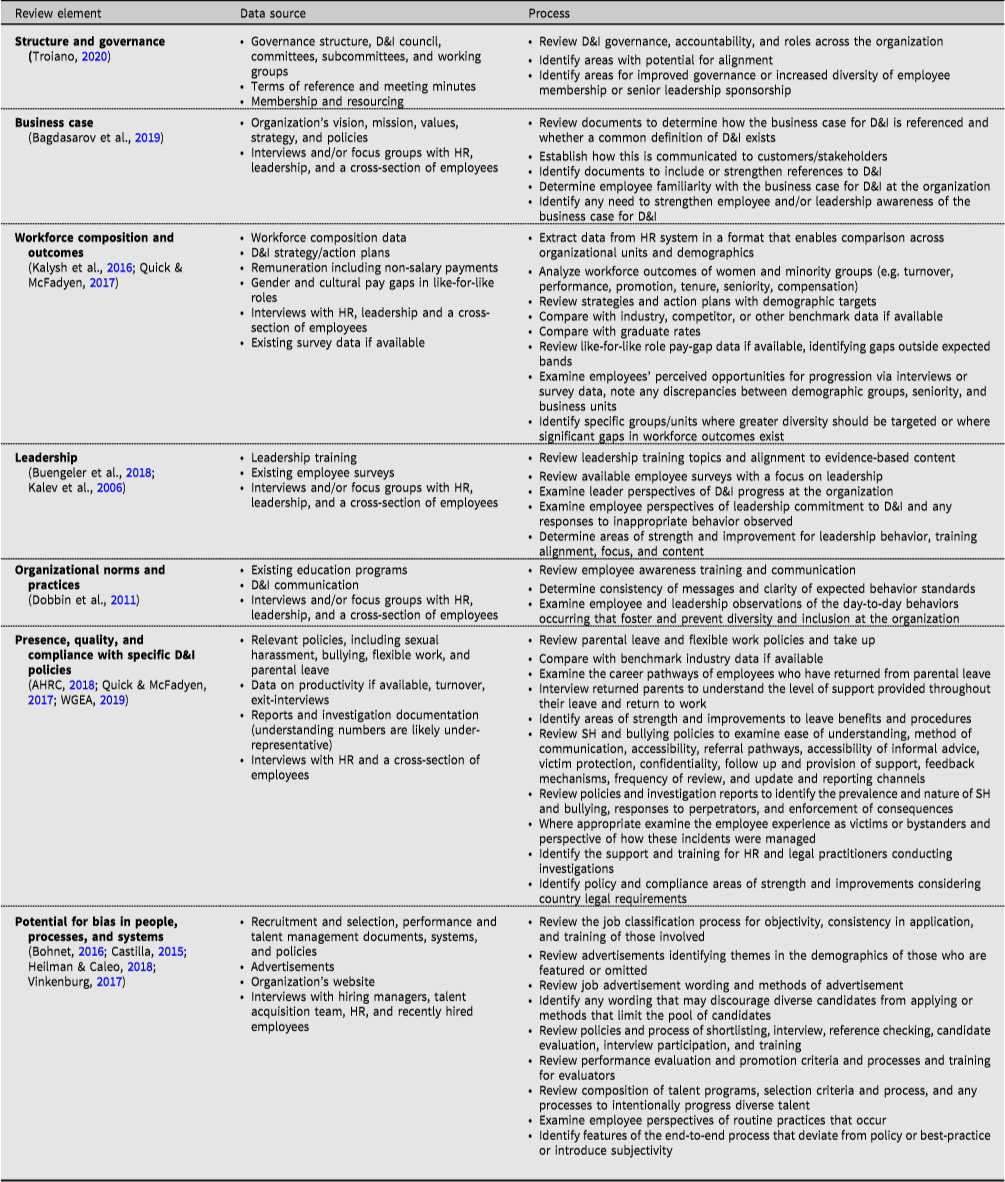
Table 1. Diversity and inclusion audit: Focus, data sources, and process
 You have
Access
- 1
- Cited by
To concur with Hayes et al. (2020), industrial and organizational (I-O) psychologists have more to offer to reduce workplace sexual harassment (SH) and discrimination than “stale training programs and free coffee” (p. XX). The focal article provided an extensive outline of the lack of evidence for training as an intervention for workplace SH and racial discrimination. It was, therefore, surprising that the authors’ concluding advice for applied psychologists was to “approach these issues with energy and optimism” and “act as if … ‘training works’” (p. XX). Based on the available evidence, it is difficult to assent to the authors’ proposal that training is “a natural starting point” (p. XX) and “the most obvious intervention option” (p. XX) for I-O and applied psychologists addressing SH or unlawful racial discrimination. Why is training assumed to be the preferred solution despite evidence of its inefficacy? Are we as I-O psychologists overly narrow in our focus of “revitalizing” training at the expense of other, potentially more effective interventions?
The perspective through which problems are framed impacts the subsequent intervention in terms of the content (intervention focus) and level of intervention (individual versus organizational). SH and discrimination are best conceptualized as systemic rather than individual level problems (McDonald et al., Reference McDonald, Charlesworth and Graham2015; Quick & McFadyen, Reference Quick and McFadyen2017; Roehling & Huang, Reference Roehling and Huang2018; Vinkenburg, Reference Vinkenburg2017). Where I-O psychologists frame these issues at the individual level, training will continue to be espoused as a preferred resolution. In the absence of an organization-wide intervention, such an approach is, at best, incomplete and limits our capacity to impact substantive change. Moreover, we risk complicity in perpetuating the status quo of organizational dynamics that maintain harassment and discrimination (McDonald et al., Reference McDonald, Charlesworth and Graham2015).
Lowman (Reference Lowman2012) reasoned that when science is limited, science–practitioners should proceed in a disciplined manner based on theory or conceptual models, integrating what is known in the scientific literature. The contemporary practice of diversity and inclusion audits may provide a useful starting point to address workplace SH and discrimination.
Diversity and inclusion audits
In the Australian consulting sphere, practitioners have introduced organizational diversity and inclusion (D&I) audits. A D&I audit evaluates the organizational structures, processes, systems, and practices identified in research to impact diversity and inclusion outcomes (Chun & Evans, Reference Chun and Evans2019). It should be noted that discrimination in the workforce is not unique to race or sex and can be targeted toward minority groups of various diversity dimensions, for example, (dis)ability, sexual orientation, gender, age, religion, and so forth.
Employing an action-research methodology, the D&I audit is process-oriented and seeks to identify gaps between current approaches and best practices in industry and research. Careful data-based problem identification avoids “solutioneering” by implementing an intervention (e.g., training) misaligned to the organizational context and root causes (Kaiser et al., Reference Kaiser, Major, Jurcevic, Dover, Brady and Shapiro2013; Vinkenburg, Reference Vinkenburg2017). Table 1 illustrates the focus, sources of data, and process of the D&I audit. The D&I audit takes a typical consulting process: data gathering, data analysis, data interpretation, and feedback. Both quantitative and qualitative data are collected to identify themes and areas of strength and improvement. The audit process, data sources, and depth of analysis vary according to the organizational context and structure, available time, and resources. Regardless of the context, successful implementation requires the following:
Visible senior leadership commitment. The audit is typically sponsored by the organization’s CEO, Chief Diversity Officer (CDO), or diversity committee.
Planned communication. Audit implementation requires input and feedback from leaders and employee representatives throughout the organization. An organization-wide, multichannel communication plan should be developed to encourage stakeholder engagement and reduce any unease. Communication should emphasize executive commitment and provide transparent information regarding the purpose, process, and expected outcomes of the audit, linking to the organization’s values and objectives.
Diversity and inclusion audit: Focus, data sources, and process
Findings are typically delivered in a report and presentation to the executive. This is often a platform for further discussion and an opportunity to further engage the executive with D&I.
D&I audit findings provide organizational leadership with a holistic view of the systems and processes contributing to SH and discrimination at their organization. This is an important step in shifting the focus from individuals to the broader organizational culture and systems (McDonald et al., Reference McDonald, Charlesworth and Graham2015). Findings provide leadership with a rationale for prioritization of focus areas and inform D&I strategy development. Ongoing measurement commonly occurs through the development of D&I scorecards. Based on Kaplan and Norton’s (Reference Kaplan and Norton1992) Balanced Scorecard, a D&I scorecard translates areas of improvement found in the D&I audit into a set of critical performance measures with audit data as a baseline. Measures may relate to workforce profile, recruitment and selection outcomes, employee awareness and education, parental leave and flexible work participation, investigations, and legal costs. Like the D&I audit, the D&I scorecard should be customized and cannot be implemented wholesale to organizations. The performance indicators will vary based on audit findings, the organization’s strategic priorities, country, and industry context.
I-O practitioners conducting D&I audits require comprehensive knowledge of organizational systems, D&I research, and practice (Madera et al., Reference Madera, Lee and Dawson2019). Poorly implemented diversity initiatives risk a number of negative outcomes such as the following:
Backfire: Poor D&I could result in decreased representation of minority groups and backlash through increased discrimination against targets.
Negative spillover: Outcomes other than those targeted are impacted in a negative direction, for example decreased employee engagement.
False progress: An intervention results in metric improvement without true change, for example metric improvement in the percentage of women in management through reclassification of role titles (Dover et al., Reference Dover, Kaiser and Major2020; Leslie, Reference Leslie2019).
Training cannot be completely abandoned. However, the need for training intervention should be dictated by the D&I audit findings and focus on cognitive learning rather than attitudinal outcomes (see meta-analysis by Bezrukova et al., Reference Bezrukova, Spell, Perry and Jehn2016). For training interventions to be effective, they should be implemented as part of a more holistic intervention (Hamilton et al., Reference Hamilton, Snoeyink and Martinez2019; Magley et al, Reference Magley, Fitzgerald, Salisbury, Drasgow, Zickar, Burke and Cooper2013).
Conclusion
Workplace sexual harassment and discrimination are complex phenomena that are best addressed with multilevel, systemic interventions. As I-O psychologists and researchers, we are well placed to deliver increased benefit to individuals and organizations by expanding our focus beyond training. Diversity and inclusion audits offer a data-driven approach to problem diagnosis and effective intervention design. To advance the maturity of I-O practice in diversity and inclusion, this approach requires further research and evaluation.