




No CrossRef data available.
Congressional Politics of Financing the International Monetary Fund
Published online by Cambridge University Press: 24 April 2006
Abstract
We address the question of how international public goods are financed by analyzing voting in the U.S. Congress on legislation to increase the U.S. contribution to the International Monetary Fund (IMF). We argue that legislators are more likely to vote in favor of an increase (1) the more campaign contributions they obtain from banks that specialize in international lending, and (2) the greater the share of high-skilled “proglobalization” workers in their districts. The first argument supports the inference that a financially strong IMF mitigates the risks of international lending, to the benefit of the lending banks. The second reflects our claim that voters view the IMF as a positive force for global economic integration that—following Stolper-Samuelson reasoning—benefits high-skilled workers. Lastly, we analyze IMF loan decisions and find modest support for the claim that IMF policy reflects the interests of major international banks. Overall, our results suggest that private actors within the United States have individual stakes in funding the IMF.We presented earlier versions of this paper at the 8th Annual International Society for New Institutional Economics Conference (ISNIE), Tucson, Ariz., September–October 2004, and at the Delegation to International Organization Conference, Del Mar, Calif., September 2003. We thank participants for comments. We also thank Michael Hiscox, Mathew McCubbins, J. R. DeShazo, David Lake, Jeffry Frieden, James Vreeland, William R. Clark, Erica Gould, Joseph Joyce, Devesh Kapur, Louis Pauly, Shanker Satyanath, Beth Simmons, and Michael Tierney for suggestions; and Mark Farrales and Molly James for excellent research assistance.
Information
- Type
- Research Article
- Information
- Copyright
- © 2006 The IO Foundation and Cambridge University Press
The primary mandate of the International Monetary Fund (IMF or Fund) is to safeguard the stability of the global financial system—an international public good. The IMF obtains the resources it needs for its stabilization operations from member governments, with large members contributing most of the funds. In this article, we analyze the politics of funding the IMF from the perspective of its largest contributor, the United States. Rather than treating the United States as a single entity with a unified “national interest” at the Fund, we consider the preferences of political actors within the United States who exert power over financing the IMF. Specifically, we analyze how members of Congress vote on requests for IMF “quota” increases.1
Quotas are the capital subscriptions that member governments make to the IMF. Quotas serve as the Fund's main resource for stabilization activities and also determine member governments' voting power in the organization. The U.S. Congress has final authority to approve or deny any increase in the U.S. quota contribution to the Fund.
Voting to increase quotas is a clear indicator of support for the IMF: more resources allow the Fund to make more stabilization loans.2
As local concerns typically influence congressional positions on foreign economic policy issues, we argue that members of Congress are more apt to support a funding increase (1) the more campaign contributions they get from commercial banks that engage in international lending, and (2) the more high-skilled “proglobalization” constituents they have in their districts. The first argument reflects the inference that a strong IMF mitigates the risks of international lending, to the benefit of the lending banks. The second supports our claim the IMF is a force for global economic integration, which benefits high-skilled workers in the United States by increasing the demand for their labor but harms low-skilled workers, who must compete with low-skilled workers in developing countries. We also attempt to estimate the impact that U.S. banking interests have on the behavior of the IMF and find that IMF loan decisions partly reflect the interests of major banks. Our primary goal, however, is to provide microfoundations for U.S. support of the IMF, and thereby to contribute to our understanding of how international public goods are financed.Financing national or local public goods is complicated enough. Financing international public goods, which benefit citizens of many nations, exacerbates the difficulties of nonrivalry and nonexcludability.3
See Sandler 2002; Ferroni and Mody 2002; and Kaul et al. 2003.
These findings suggest that the IMF obtains funding because it produces “joint products,” that is, two or more complementary outputs that vary in their degree of publicness.5
On one hand, IMF rescue operations promote international financial stability, a global public good attributable to the nonexcludable and nonrival aspects of financial stability.6See Kindleberger 1986; and Wyplosz 1999.
For other applications of the joint products model, see Broz 1999 and 1998; and Cornes and Sandler 1984.
While private benefits may encourage contributions from the United States (and other large members), treating the United States as a unified entity with a foreign policy interest in the IMF is problematic. As a matter of formal procedure, Congress, not the foreign policy executive, has the final authority to decide U.S. contributions to the Fund.9
The Bretton Woods Agreement Act of 1944 states, “Unless Congress by law authorizes such action, neither the President nor any person or agency shall on behalf of the United States request or consent to any change in the quota of the United States under the Articles of Agreement of the Fund.” See U.S.C. Title 22, Section 286c.
Although the U.S. executive may influence the IMF's day-to-day decisions, funding the IMF is a congressional prerogative.
As a matter of theory, treating the United States as a single entity does little to clarify the individual incentives (micro-foundations) that motivate IMF funding. While it is possible that foreign policy elites have personal career or electoral stakes in using the IMF as a tool of U.S. foreign policy, the precise nature of their incentives is not considered in the existing literature. In this article, we begin by identifying the private individuals within the United States that have economic stakes in funding the IMF. We look to the economics literature on international financial rescues and international trade to derive these interests. We then relate the motivations of members of Congress to the pecuniary interests of constituent groups through the electoral channel and, on these foundations, specify an incentive structure for funding the IMF that reflects the interests of individuals, not aggregate entities. The intuition is that U.S. support for the IMF need not be based on aggregate national benefits. When specific domestic actors gain from having a well-financed IMF, and these “winners” have their interests represented in Congress, majority support for a quota increase can arise without consideration of either foreign policy or global public goods.
The heart of our article is an analysis of voting in the House of Representatives on roll calls dedicated exclusively to funding IMF quota increases. We argue that the incomes of voters and interest groups are affected by IMF activities and that these distributional effects give constituents a personal incentive to engage Congress in IMF quota decisions. In turn, members of Congress have incentives to take positions on the IMF that partially reflect voter and interest group stakes. Finally, to illustrate the impact of U.S. domestic politics on IMF policy, we shift our analysis to the IMF level, where we expect policy decisions to partially reflect the interests of U.S. banks. This last step provides a tentative connection between domestic politics and international politics, and an account of some of the political incentives that motivate Fund lending.
The article is organized as follows. In the first section, we outline the procedures for funding the IMF. The second section contains our arguments and evidentiary strategy. The third section provides the empirical analysis of congressional roll-call votes on quota increases. The fourth section explores the determinants of IMF lending. The final section addresses implications.
The Procedure for Increasing IMF Quotas
The IMF was created in 1944 to support world trade and economic growth by stabilizing the international financial system—a global public good.11
To do so, the Fund provides assistance to countries facing balance-of-payments difficulties. When a country spends more abroad on goods and services than it receives, it incurs a current account deficit. Selling assets or borrowing can finance this shortfall and involves a private capital inflow into the country. But when private sources do not cover the current account deficit, a country's government must finance it through the sale of its official reserves of foreign currencies. The core responsibility of the IMF is to provide loans to deficit countries when they exhaust their reserves. This assistance helps countries rebuild their reserves, stabilize their currencies, and continue paying for imports, while they adjust policies and make reforms to correct the payments problems.The Fund's approach to financial assistance has two main components—financing and conditionality—that jointly address the payments crisis and the underlying factors that contributed to it. Access to Fund assistance is conditioned on the adoption and pursuit of economic and structural policy measures negotiated by the IMF with the recipient country.12
See Przeworski and Vreeland 2000; and Vreeland 2003.
The IMF's financial resources come from members' subscriptions, which are known as “quotas.” Each country's quota is calculated by a formula reflecting the relative size of its economy, using various measures of output and trade. Quotas also determine members' voting power in the organization. Each member has 250 “basic” votes, plus one additional vote for each part of its quota equal to SDR 100,000. As basic votes make up only a small fraction of total votes, control of the IMF is heavily weighted toward its larger members. To illustrate, the United States, with its quota of $54.2 billion has 371,743 votes (17.1 percent of the total), while Palau has 281 votes (0.013 percent of the total). Large members have even greater influence because important decisions are subject to special majorities. The United States, with more than 17 percent of the votes, has veto power over decisions, such as quota increases, that require 85 percent approval.13
These voting rules may be an endogenous solution to the global free-rider problem. By tying contributions to voting power, large nations are able to use their influence to promote policies with nation-specific benefits.14
Stone, for example, finds that the United States and other large members use IMF loans to advance their foreign policy goals in Africa.15 Such benefits create incentives for large members to contribute to organizations that produce both global public and nation-specific joint products.In the case of the largest member, however, the foreign policy executive does not control contributions to the IMF; increases in the U.S. quota require legislative consent. This suggests that diplomatic influence may not be the only, or even the most important, nation-specific benefit driving U.S. support for the IMF.
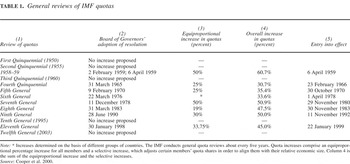
The procedure for increasing quotas begins at the IMF and the main method is to establish an equiproportional increase for all members under a “General Review of Quotas.” General reviews are held about every five years and have produced eight large quota increases since 1946 (see Table 1). On each occasion—including those when the IMF chose not to propose any increase—a major factor affecting the outcomes has been the difficulty in obtaining authorization from Congress for an increase in the U.S. quota.
General reviews of IMF quotas

Every member country must consent to its quota increase. In the United States, this means legislative approval and appropriations. Since the United States is predominant at the IMF, Congress commands extraordinary leverage in the process of changing quotas. According to Pauly, “Quota increases, although strongly preferred by the Fund, sometimes entail legislative affirmation within member-states. They certainly do in the United States, a reality which has complicated the life of the Fund since the beginning.”16
Pauly 1997, 113.
Boughton 2001, 858–72.
Each time an increase in IMF quotas or a replenishment of the Bank's IDA has been negotiated, the Congress has used the opportunity to threaten to reduce or withhold the funds, being yet more prepared than even the executive agencies—Treasury and State Departments—to set down special preconditions for U.S. contributions. As a result, other shareholders and officials within the institutions have grown used to placating not just the powerful Departments of State and Treasury, but also the feisty U.S. Congress. The overall result seems to have enhanced the capacity of the United States unilaterally to determine aspects of policy and structure within both the IMF and the World Bank.18
Woods 2003, 98.
Congress, however, is not a single entity. It is composed of individual legislators, who hold varied positions on funding the IMF. While there are members within Congress who are obstacles to quota increases, there are also members who are allies—those who want to give the Fund more resources to stabilize world financial markets. We take a closer look at the battle that occurs in Congress because, depending on who wins, Congress can be just as much an ally as an obstacle to the IMF. Furthermore, analyzing the factors that shape member votes is important to understanding the nature of the private benefits the United States obtains from the IMF. While it is reasonable to expect the U.S. executive branch to use its voting power and informal influence at the IMF to advance foreign policy goals, when it comes to funding the IMF, we expect members of Congress to be motivated by local concerns relevant to their electoral prospects.
In summary, increases in IMF quotas require broad support within the IMF, because 85 percent of the votes are required to approve changes. With more than 17 percent of the votes, the United States is the pivotal actor. But U.S. officials cannot act independently of Congress. Congress must formally approve changes in the U.S. quota, which means that anyone seeking an increase—the president, the treasury secretary, the U.S. executive director to the IMF, other member governments—must be sensitive to diverse congressional sentiment.
Approach and Arguments
Which members of Congress will vote in favor of (or against) quota increases? Legislator positions are influenced by many factors, including partisan identity, political ideology, and expectations about the future consequences of IMF rescues (such as the moral hazard problem). We make the standard assumption that legislator behavior is self-interested and derives, at least in part, from the desire to remain in office. Thus positions on quota increases reflect how the policy affects members electorally. This means we need to know something about the interests of voters and special interest groups with respect to the IMF. To derive these interests, we ask: Who benefits and who loses from IMF policies? We look to the literature on international finance and trade to derive such distributional effects.
Our first argument is that “money-center” banks make up a key constituency for the IMF and lobby on its behalf.19
Money-center banks specialize in wholesale and international banking and are located in financial centers such as New York, Chicago, and San Francisco. Their clients include governments, corporations, and other banks. Citigroup, JPMorgan Chase & Co., and Bank of America are among these types of banks.
We are not the first to identify banks as an important constituency for the IMF. A radical “dependencista” version of the argument has been around since at least the 1970s, and a more orthodox variant is currently circulating.20
See Stiglitz 2002; Bhagwati 2002; and Soros 1998.
Bhagwati 2002, 8–9.
See Gould 2003; Oatley 2002; and Oatley and Yackee 2004.
We also treat international financiers as central actors in the politics of the IMF. However, we are less concerned with the reasons why banks have influence on the details of individual IMF loan programs than with the reasons why such banks might endorse granting more resources to the Fund. A quota increase gives the IMF greater resources to support the international payments system. It does not dictate how these resources are used or to whom they are allocated. Hence we emphasize a broader reason why money-center banks endorse quota increases: they benefit from the moral hazard created by Fund financial rescues.
Even if intended to stabilize the international financial system, IMF rescues are a form of insurance for private creditors and thus a source of “moral hazard.”25
See Bulow and Rogoff 1990; and Rogoff 1999.
While there is a vigorous ongoing debate on the extent of the moral hazard problem, there is agreement that it exists.26
See Dell'Ariccia, Schnabel, and Zettelmeyer 2002; Jeanne and Zettelmeyer 2001; and Dreher and Vaubel 2004.
Address by Anne Krueger, given at the National Economists' Club Annual Members' Dinner American Enterprise Institute, Washington, D.C., 26 November 2001.
Report of the International Financial Institutions Advisory Commission, March 2000.
Thomas C. Dawson, statement to the Subcommittee on General Oversight and Investigations, Committee on Banking and Financial Services, U.S. House of Representatives, “Review of the Operations of the International Monetary Fund,” 21 April 1998, 105th Congress, 2d sess.
Our argument is that money-center banks are among the most direct private beneficiaries of IMF-created moral hazard. Bird finds that IMF financial assistance to debtor countries is often used to repay loans to commercial banks.31
In some instances, debt service is an explicit component of IMF programs.32 More generally, unanticipated increases in U.S. financial commitments to the IMF are associated with increases in the stock market capitalization of the exposed money-center banks.33 To state this in terms of the joint products model, moral hazard is the complementary output of IMF financial rescues—the private benefit that induces money center banks to support funding the IMF. As a concentrated industry, international banks should have little problem organizing for political purposes. We therefore expect international banks to lobby Congress to expand the resources of the IMF.Other constituencies in the United States are affected by IMF policies, but the effects are more diffuse than with banks. Our insight is that IMF rescues affect district constituencies indirectly, by way of their effect on the openness of international trade and capital markets. The primary rationale for the IMF is to preserve the openness of the world economy.34
See Kindleberger 1986; and Frankel and Roubini 2001.
Stolper and Samuelson, and Mundell identified the winners and losers from economic globalization in terms of factors of production from which factor owners, like high-skilled and low-skilled labor, derive their incomes.35
See Stolper and Samuelson 1941; and Mundell 1957. We opt for this model over the “specific-factors” model because a strong, well-funded IMF affects the overall level of economic integration rather than the well-being of particular import-competing or export sectors within the United States. Nevertheless, we follow Baldwin and Magee 2000; and Beaulieu 2002; and control for Ricardo-Viner effects in our regressions.
Our extension of trade theory to IMF funding recognizes that the IMF's mandate to protect the world economy from financial disorder confers individual benefits to people who gain income from globalization. We thus expect voters with high (low) skills to support (oppose) the IMF. As diffuse interests, we do not expect lobbying from these actors, but we do expect their interests to find expression in Congress by way of the electoral calculations of legislators. Legislators calculate the distributional effects of a policy on voting constituencies within their districts and take positions that reflect these districts interests.39
See Bailey 2001; and Denzau and Munger 1986.
From a joint products perspective, our arguments imply that the IMF's stabilization of world financial markets creates private benefits for two sets of actors within the United States: money-center banks and high-skilled citizens. The benefit to banks is subsidized risk insurance; the benefit to the high-skilled is increased real income. The interests of these actors are reflected in the voting behavior of members of Congress via the electoral connection and induce some members to support funding the IMF. In this way, joint production of private and public goods reduces the usual problem of underprovision of public goods.
Data and Analysis: Congressional Votes on IMF Quota Increases
The IMF conducts a general review of the adequacy of quota resources at least once every five years. If it determines that a quota increase is needed, the U.S. Congress must first ratify the U.S. increase. Roll-call voting provides an opportunity to test our arguments.
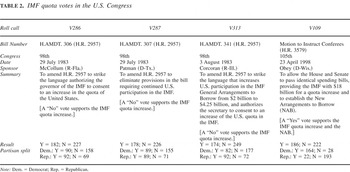
We analyze congressional votes in 1983 and 1998 on quota increases. These are the only quota increases for which “clean” roll-call votes were taken. When Congress considers a quota increase, it usually does so by including the issue in an omnibus spending bill, which makes it impossible to isolate legislator positions' on the IMF issue. However, we identified three amendments and one motion to the 1983 and 1998 spending bills that dealt exclusively with IMF quotas. Table 2 summarizes these votes.
IMF quota votes in the U.S. Congress

These are “clean” votes in the sense that a vote for or against captures only a member's position on increasing U.S. contributions to the IMF. Even though these votes took place during the Latin American debt crisis and the Asian currency crisis, we are not overly concerned with bias. On one hand, the crisis context might work against our arguments if members tend to ignore antiglobalization constituents during a crisis, for fear of being held responsible if a global economic meltdown follows a “no” vote on funding the IMF. On the other hand, it may work in favor of our claims if banks and proglobalization workers lobby harder during periods of global instability. Fortunately, the data we use for our variables of interest make the sampling issue moot, as they come from noncrisis periods. We measure district skill levels with census data from 1980 and 1990, well before the onset of either crisis. With respect to bank campaign contributions, we lag the data one legislative cycle (two years), which places our measure of lobbying pressure well ahead of each crisis.
Three of the votes (V286, V287, and V313) occurred in 1983 following the IMF's eighth General Review. The debt crisis provoked worries among some members of Congress that the quota increase would fund a bailout of commercial banks, and these members were reluctant to approve the quota increase without also tightening regulatory control over banks.40
This Congress did with the International Lending Supervision Act of 1983. This act was conjoined in a single bill (H.R. 2957) which, in addition to funding the IMF, also extended the authority of the Export-Import Bank, encouraged worldwide economic growth, and provided for continued U.S. participation in multilateral development banks. Just before this omnibus bill passed the House by a close vote of 217 to 211, three members proposed amendments that would strip the bill of the IMF quota increase. We analyze votes on these amendments.The fourth vote (V109) came in 1998 during the Asian crisis and involved a motion to an emergency supplemental spending bill (H.R. 3579). What prompted the motion was that the House and the Senate were considering two different versions of the same bill. The Senate version included funding for the U.S. peacekeeping missions in Bosnia and the Middle East, disaster relief for storm victims in the United States, as well as $18 billion for an IMF quota increase and funding the establishment of the IMF's New Arrangements to Borrow (NAB). However, the House separated these funding requests into two bills: H.R. 3579 included funding for Bosnia, the Middle East, and disaster relief; while H.R. 3580 funded $18 billon for the IMF/NAB and provided $500 million to pay down U.S. arrears to the UN.
With the House bill diverging from the Senate's, IMF funding was under threat. Procedure requires that bills pass both Houses in identical form. In an attempt to reconcile the bills, David Obey (D-Wis.), ranking member of the House Appropriations Committee, offered a motion to instruct the conference committee to put the IMF's $18 billion back in the emergency bill. On 23 April, Congress defeated Obey's motion by a vote of 186 to 222, stalling the appropriation of funds for the IMF and the NAB for another six months. The spread of the crisis to Russia and Brazil, along with President Bill Clinton's admonishment of congressional foot-dragging as “irresponsible,” finally helped convince opponents that they would be held responsible if a global recession were to take place.41
We have two hypotheses. First, we expect the probability of a vote in favor of funding the IMF to increase with a member's affinity with money-center banks. This affinity is proxied by the amount of campaign contributions each member receives from money-center banks. Second, we expect variation in skill levels across House districts to affect member voting. Specifically, we anticipate that the higher the skill level of constituents, the more likely a member will be to vote for the IMF quota increase. This illustrates our argument that members see the IMF as an organization that promotes global economic integration and take positions that reflect the impact of globalization on their constituencies.
To identify money-center banks, we use the regulatory classification in the U.S. Federal Financial Institutions Examination Council's (FFIEC) Country Exposure Lending Survey. The FFIEC identifies the specific banks that make up the “money-center” group the list on which to base our collection of campaign contribution data.42
See Appendix 1 for the banks that make up this group.
We thank a reviewer for suggesting this normalized specification. An alternate specification—the amount of money-center bank contributions to each member—gives nearly identical results.
We measure constituent skill levels in two ways: by educational attainment and by occupational classification. The variable college is the share of district population with four years of college. skills is the percentage of district workers in executive, administrative, managerial, professional, and professional specialty occupations.44
See Appendixes 1 and 2 for variable descriptions, sources, and summary statistics.
In all our models, we control for member “ideology” and party affiliation. Our proxy for ideology is the first dimension of the dw-nominate score.45
Higher values denote a more “conservative” ideology and we expect a negative sign: more economically conservative members should oppose increasing the quota because they see the IMF as an unnecessary and remote bureaucracy whose interventions in the market create moral hazard.46According to Newt Gingrich, the 1998 quota increase was “typical liberal foreign policy … we're not turning over $18 billion to a French Socialist to throw it away,” as quoted by Walter Shapiro in “Newt the Plagiarist,” Slate, 18 September 1998.
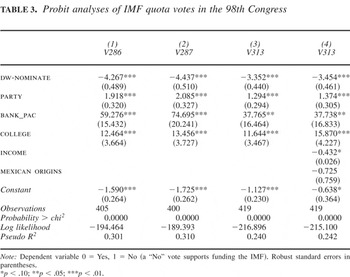
Table 3 presents results of Probit analyses of the three 1983 votes. While we find strong ideological and partisan effects, our variables of interest—bank_pac and college—are correctly signed and highly significant. For all three votes (Models 1 to 3), the more campaign contributions from international banks and the higher the education level in a district, the more likely a member is to vote in favor of an IMF quota increase. In Model 4, we include controls for district income (median household income) and mexican origins (share of district population of Mexican ancestry). The latter is intended to capture any effect that proximity to Mexico—the first victim of the debt crisis—might have on member voting. Our core results are not affected by the inclusion of these controls.
Probit analyses of IMF quota votes in the 98th Congress

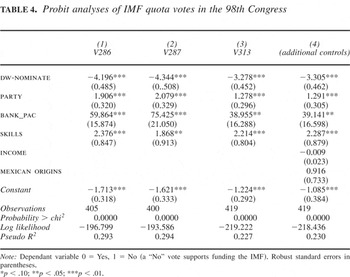
Table 4 contains results after substituting the variable skills (share of district population working in high-skilled industries) for college attainment. Our findings are robust to this alternative specification.
Probit analyses of IMF quota votes in the 98th Congress

The vote on Obey's 1998 motion (V109) should be difficult for our argument because House members voted strongly along party lines. This should not come as a surprise because the division between the parties was wider during the 106th Congress than at any time since before World War I.47
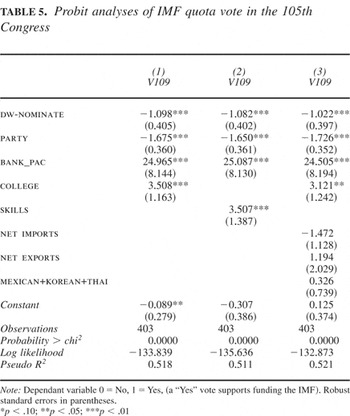
With the Clinton administration standing behind the IMF quota increase, all but twenty-two Republican members opposed the measure while only twenty-eight Democrats took positions against the president. Yet, despite the strong partisan character of this vote, our main variables are signed correctly and significant in several alternative models, as shown in Table 5. Model 1 includes our two variables of interest. Model 2 substitutes skills for college, and Model 3 controls for other potentially relevant district characteristics. mexican+korean+thai is the share of district population of ethnic groups originally from three countries that suffered major currency crisis in the 1990s. Our estimates do not support a relationship. We control for the possibility that the Ricardo-Viner “specific-factors” model predicts voting on IMF funding with net imports and net exports, which measure district industrial characteristics. Since the IMF pursues a protrade mandate, members representing districts that face strong import competition should oppose funding the IMF, while members with export-oriented industries in their districts should support it. These results are only suggestive; the coefficients are correctly signed but not significant.Probit analyses of IMF quota vote in the 105th Congress

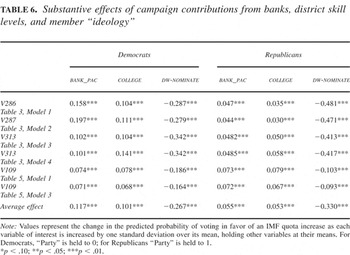
In Table 6, we provide a substantive interpretation of these findings. Using models from Tables 3 and 5, we simulated the predicted probability of observing a vote in favor of an IMF quota increase for both Democrats and Republicans, then we examined how these probabilities change as each explanatory variable is increased by one standard deviation above its mean.48
The simulations were performed with “Clarify.” See Tomz, Wittenberg, and King 1998; and King, Tomz, and Wittenberg 2000.
Substantive effects of campaign contributions from banks, district skill levels, and member “ideology”

Discussion
These findings corroborate existing evidence that private financiers play an important role in the politics of international financial policy. But while Gould and Oatley examine the impact of international investors on the specifics of Fund lending—the conditions attached to loans, the size and destination of loans, and so on—we show that banks also play a role in shaping the funding of the IMF.49
See Gould 2003; and Oatley 2002.
Congressional scholars may be skeptical of the positive relationship between bank campaign contributions and member support for the IMF, as there is little general evidence that campaign money systematically influences congressional voting.50
See Wright 1996; Snyder 1992; and Hall and Wayman 1990.
One possible explanation for our persistently strong results on campaign giving is that contributions from banks are different than money from other sources. The banking industry is one of the largest contributors to member campaigns. Commercial banks rank in the top ten in terms of total giving (PAC, individual, soft money) to Congress among more than 80 industries.51
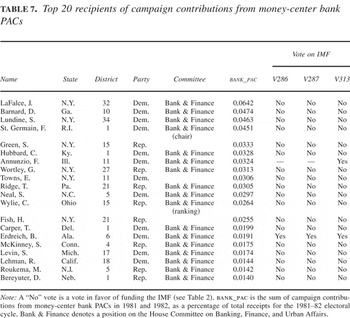
This may help explain why other studies also find an effect of bank money on roll-call voting.52 A second possibility is that money-center banks carefully target members with particular influence over banking and financial policy. Table 7 shows that all but two of the top twenty recipients of bank contributions were members of the Committee on Banking, Finance, and Urban Affairs. Eighteen of these members also voted in favor of the IMF quota increase. This targeting may derive from the decentralized nature of congressional decision making: banks may understand that money allocated to the committee is more efficiently spent.53 It may also reflect an understanding of the committee assignment process: banks may know that they are more likely to find a sympathetic audience in this committee.54Top 20 recipients of campaign contributions from money-center bank PACs

Another potential concern is whether special interests target members with similar positions, or “buy votes,” when they give contributions.55
We are largely agnostic on the issue, because it makes little difference to our argument whether banks give money to reward members or give money to sway their votes. Either way, the money is an observable indication of a relationship in which members are more likely to vote the way banks want. Note, however, that Broz, using techniques developed by Stratmann, finds evidence that bank money does influence member voting on international financial rescues provided by the Exchange Stabilization Fund.56See Broz 2005; and Thomas Stratmann 2002.
Our finding that higher district skill levels increase the probability that a member will support the IMF is also open to alternative explanations. Our inference is that member positions on rescues reflect the relative wage effects of globalization on district constituencies. Perhaps the result indicates that more educated constituents are more “cosmopolitan” and better equipped intellectually to understand the need for international financial rescues. We think not. Although a college education or a high-skill occupation could give rise to an internationalist outlook, there is no compelling reason why these attributes imply support specifically for IMF rescues. Academic economists are highly divided on whether the IMF should engage in rescues, with some taking public stances against rescues on moral hazard grounds.57
See Calomiris 1998; Meltzer 1998; and Schwartz 1998.
Our argument also requires that constituents and members of Congress understand the connections between IMF rescues and economic globalization, and between globalization and relative income shares. Do people really connect the dots that run from IMF rescues to domestic distributional consequences? Anecdotal evidence from peak organizations, industry groups, and congressional testimony suggests they do. Organized labor connected the dots when the executive council of the AFL-CIO adopted a resolution in 1998 urging Congress to reject U.S. participation in the IMF unless borrowers adopted strict labor standards. Corporate organizations like the U.S. Chamber of Commerce connected the dots by taking a strong pro-IMF position and including a Senate vote on IMF funding in its 1998 legislator ratings.58
In Congress, Bernard Sanders (I-VT), ranking member of the International Monetary Policy and Trade Subcommittee, connected the dots: “The real winners [of the IMF loan to Brazil in 2002] are the large, profitable U.S. banks such as Citigroup that have made billions of dollars in risky investments in Brazil, and now want to make sure their investments are repaid. This bailout represents an egregious form of corporate welfare that must be put to an end. Interestingly, these banks have made substantial campaign contributions to both political parties.”59Bernard Sanders, “$30 Billion IMF Bailout for Brazil Is a Windfall to Banks, A Disaster for U.S. Taxpayers,” News release, Burlington, Vt., 15 August 2002.
IMF Lending Patterns
We established a relationship between money-center bank contributions and congressional voting on IMF funding. In this section, we check to see if money-center bank interests are reflected in IMF policy decisions. Our findings suggest that IMF lending decisions are correlated with the size of outstanding U.S. commercial bank loans in IMF member countries.
Two questions about IMF behavior motivate this analysis. First, does the extent of commercial bank exposure make the IMF more likely to bail out a country should it face a currency or debt crisis? Second, does greater commercial bank exposure induce the IMF to provide larger loans to a country, all else equal? In order to examine these questions, we adopt a two-stage approach. In the first stage, we look solely at the decision by the IMF to offer assistance; in the second, we examine the amount of assistance approved by the IMF.60
We treat the decision to lend as separate from the actual amount of assistance because of the potential for endogeneity; the decision to support a country may serve as a “seal of approval,” inducing further lending from the private sector, as in Gould 2003.
Our data covers the period 1983–2002, during which the IMF approved 369 loans under the Stand-By and Extended Fund Facilities (EFF) programs. In the first stage of our analysis, the dependent variable is binary, representing whether or not a member country received an IMF loan in a given year. In the second stage, we analyze the size of IMF loans approved for member countries.
As our prior analysis focused on the ties between money-center banks and Congress, the chief explanatory variable for this part of the analysis is the country exposures of these same banks abroad. Individual banks do not disclose the geographic profile of their foreign loans, but the FFIEC collects, aggregates, and publishes this information for the group of money-center banks. Thus our key independent variable is us_banks, the amount owed to U.S. money-center banks by each IMF member country.61
These figures represent the total amount of U.S. money-center banks loans outstanding in the IMF member country. As there is significant annual variation in total bank lending, while lending patterns to individual countries remain relatively constant, we do not scale this variable as a percentage of the total annual lending portfolio, opting instead for the more stable, actual dollar amounts.
Our argument does not lead us to predict that increased bank lending will necessarily cause a country to require IMF assistance, but rather that of those countries experiencing debt or currency crises in a given year, the IMF will be more likely to provide assistance to those with larger debts to U.S. banks. Consequently, our model includes the principal variables used to predict and identify sovereign debt and currency crises. Economists at the IMF and elsewhere have modeled currency and debt crises to establish an Early-Warning-System (EWS) that can be used by the Fund in its surveillance of the world's economies. A recent review of EWS models identified the economic indicators that yield the best predictive power.62
We draw on this review and include several indicators related to countries' overall debt, debt profile, international reserves, and overall economy. We also include an indicator of financial crises (economic crisis) from another study.63 Finally, because instability may persist beyond the duration of the Fund's assistance, we also include a dummy variable prior imf loans for countries that have received any Stand-By or EFF loans over the previous decade.U.S. foreign policy goals may also affect IMF decision making. We follow standard practice and include the variable un_affinity, UN voting affinity scores for debtor countries vis-à-vis the United States.64
Similarly, we include loans from the World Bank and International Development Association (ibrd loans), on the grounds that the IMF might be more willing to lend to countries that are receiving development assistance from the World Bank. A set of additional controls round out the model: year dummies, a time trend, and dummy variables for regions and economic groupings.Data and Analysis
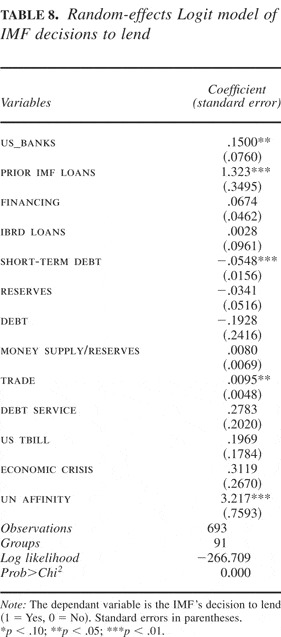
We expect greater commercial bank exposure to increase the likelihood of IMF assistance for countries in crises. To evaluate this claim, we ran a time-series cross-section Logit model of our binary dependent variable (did the member-country receive an IMF loan in a given year?) on our independent variables and controls. The results in Table 8 provide modest support for our argument. The exposure of U.S. money center banks (us_banks) is positively and significantly related to the likelihood that the IMF will provide a loan to a country.65
Our substantive results are stable across methodological specifications. We obtained nearly identical results (in sign, magnitude, and level of significance) for our indicator of U.S. bank lending using alternate regression techniques, robust standard errors, fixed-effect estimators, and controls for temporal autocorrelation.
Including other major IMF donors' bank lending into the model yields very similar results and suggests that the interests of German banks (but interestingly not those of the United Kingdom, France, or Japan) are also represented in Fund decision making.
Random-effects Logit model of IMF decisions to lend

The results also suggest that IMF decisions reflect U.S. foreign policy goals. Recipient countries' degrees of similarity with U.S. positions at the United Nations also are highly correlated with the likelihood of receiving IMF assistance. A 5 percent increase in a country's voting similarity with the United States would equate to a 7.5 percent greater likelihood of receiving Fund assistance,.
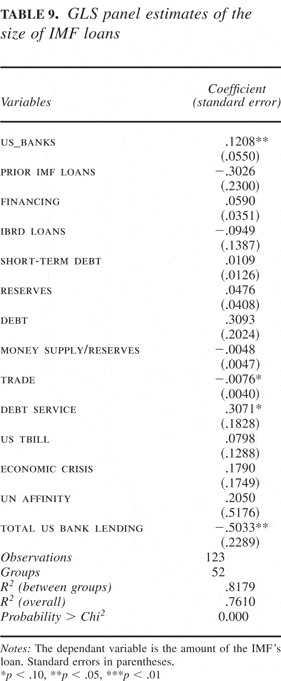
Our second hypothesis relates to the size of IMF Stand-By or EFF loans. Using the same economic indicators and control variables, we expected to see a positive relationship between the amount of U.S. bank lending to a country and the size of the loan it receives from the IMF.67
As the size of IMF assistance packages could vary significantly based merely on the size of the recipient countries' GDP, we also ran our analysis scaling IMF loans and our major explanatory variables to countries' economic size. This respecification does not significantly alter our results.
The results in Table 9 suggest that commercial bank exposure is related to the amount of IMF support a country receives.68
As with our first-stage analysis, our statistical results are stable across alternate methodological specifications.
Including the bank exposure of other major IMF donors does not significantly alter our results.
GLS panel estimates of the size of IMF loans

Both sets of results suggest that countries where U.S. banks are heavily exposed are more likely to receive IMF assistance and more likely to receive a larger amount of IMF assistance. These findings support work done by Gould, who posits that because the IMF is dependent on supplementary financiers (including private banks), Fund decisions will necessarily reflect the interests of those financiers.70
Gould observed the reflection of those interests in Fund conditionality mechanisms. Our analysis helps confirm her findings by showing the broader reflection of U.S. bank interests in IMF decision making.Together, these results imply that U.S. interests are well represented in IMF decision making. Although there is clearly no single “national” interest, our findings indicate that decisions made at the IMF tend to reflect the interests of its most powerful member, the United States, but that those interests are actually the interests of important actors within the U.S. policymaking arena. Ultimately, it appears that decision making at the IMF reflects both private interests within the United States, as well as the broader interests of the U.S. foreign-policy apparatus.
Conclusions
Existing scholarship has analyzed U.S. policy toward the IMF at an aggregate level, treating the United States as if it is a single entity with a unified foreign policy interest in the IMF. By contrast, we ground our analysis at the micro level, defining the individual stakes that private U.S. citizens have in the IMF, then we show that these interests find expression in congressional politics. This step has often been ignored in the study of international organizations, even though such organizations are often funded through domestic legislation in powerful member states.
We establish that the organized segment of this constituency, money-center banks, actively participate in domestic politics by supplying legislators with campaign funds. Judging from our empirical results, members of Congress appear to be responsive to these appeals, as well as to the interests of unorganized groups benefited or harmed by the IMF's proglobalization mandate. Our findings relating to the Stolper-Samuelson theorem are especially interesting because they reveal that political divisions on the IMF mirror divisions on globalization more generally. Members representing districts that gain (lose) on average from international trade are more likely to vote in favor (against) funding the IMF.
The final step in our analysis is to analyze IMF outcomes. Here, we join other scholars who see the Fund as at least partially beholden to the interests of international banks.71
See Gould 2003; Oatley 2002; and Oatley and Yackee 2004.
Exactly how banks influence IMF policy remains a topic for additional research. Gould's point is that international banks have leverage because they command “supplementary finance,” which the IMF needs to make its programs work. Conversely, Bhagwati's view is that Wall Street bankers have a “revolving door” relationship with the U.S. Treasury Department and actually have a hand in day-to-day IMF policy. Our research found little evidence that Congress is involved in the financial details of IMF lending; apparently Congress is not the primary conduit of private bank interests.
Our analysis speaks to the question of how international public goods are financed. While the IMF's capacity to stabilize financial markets—a global public good—depends on contributions from member countries, the incentives that drive large members to bear a disproportionate share of the financial burden have not been clearly identified. It has long been suspected that the United States uses its voting power at the IMF to advance its own interests, which might explain why the U.S. executive has a stake in funding it. However, Congress controls the purse, not the executive, and members of Congress tend to be motivated by local, as opposed to national or diplomatic, concerns. To specify the motivations of the political actors that formally decide levels of U.S. funding, we identified two constituencies—money-center banks and high-skilled citizens—that benefit from a well-funded IMF and tested to see if connections between these pro-IMF groups and Congress shaped member voting. Our positive results suggest a simple, yet logically compelling reason why the United States funds the IMF: private actors have individual stakes in funding the IMF. In terms of the joint-products model, money-center banks and high-skilled constituents obtain excludable private benefits (subsidized risk insurance and increased real income, respectively) from the IMF's provision of global public goods. The existence of these private benefits reduces the problem of underprovision of public goods in this decentralized, global setting.
Appendix 1. Data and Sources
party: 0 = Democrat; 1 = Republican.
dw-nominate: The first dimension of the dw-nominate score, which is interpreted as capturing a member's ideological position on government intervention in the economy. Higher values denote a more conservative ideology (Poole and Rosenthal 1997).
bank pac: Campaign contributions from money-center bank political action committees to candidates in the previous electoral cycle, divided by the total receipts per candidate from the previous electoral cycle. Money-center banks are identified by the U.S. Federal Financial Institutions Examination Council (FFIEC), Country Exposure Lending Survey, various years. In 1983 the FFIEC list includes Bank of America, Bankers Trust, Chase Manhattan Bank, Chemical Bank, Citibank, Continental Illinois, First National Bank of Chicago, Manufacturers Hanover, and Morgan Guaranty. By 1998, consolidations and takeovers had reduced the list of money-center banks to J.P. Morgan, Chase Manhattan, Bank of America, Citicorp, First Chicago, and Bankers Trust. bank_pac in Table 5 was calculated from the contributions of these six banks. PAC contributions are from the Federal Election Commission. Available at 〈http://www.tray.com〉.
college: Share of district population with four years of college (U.S. Bureau of the Census, Congressional Districts).
skills: Share of district population aged sixteen years and over employed in executive, administrative, managerial, and professional specialty occupations (U.S. Bureau of the Census, Congressional Districts).
income: Median household income (U.S. Bureau of the Census, Congressional Districts).
mexican origins: Share of district population of Mexican ancestry (U.S. Bureau of the Census, Congressional Districts).
mexican+korean+thai: Share of district population of Mexican, Korean, and Thai ancestry (U.S. Bureau of the Census, Congressional Districts).
net imports: Percent district population aged sixteen years and over employed in net import industries. Net import industries are two-digit SIC manufacturing sectors where the ratio of imports to consumption is greater than the ratio of revenues from exports to total industry revenue—Textiles 22, Apparel 23, Lumber 24, Furniture 25, Paper 26, Petroleum 29, Rubber 30, Leather 31, Stone, clay, and glass 32, Primary metals 33, Fabricated metals 34, Industrial machinery 35, Electronic goods 36, Transportation equipment 37, Other manufactures 39 (U.S. Bureau of the Census 1997). County-level employment data was aggregated up to the congressional district level using the following procedure: if a county contains more than one congressional district within its borders, the number of workers from an industry who are in each district is estimated by using the fraction of the county's population residing in each district. For example, if 10 percent of a county's population lives in a district, that district receives 10 percent of the county's workers in each industry. We obtained the geographic information from the MABLE '98/Geocorr v3.0 Geographic Correspondence Engine. Available at 〈http://plue.sedac.ciesin.org/plue/geocorr〉.
net exports: Percent district population aged sixteen years and over employed in net export industries. Net export industries are two-digit SIC manufacturing sectors where the ratio of revenues from exports to total industry revenue is greater than the ratio of imports to consumption–Food 20, Tobacco 21, Printing 27, Chemicals 28, Instruments 38). See net imports above and the text for the concordance procedure.
imf loans: (log) Amount of IMF loans approved under the Stand-By and Extended Fund Facilities during the fiscal year, in millions of Special Drawing Rights (IMF Annual Reports, 1983–2002).
us_banks: (log) Total amount owed U.S. money-center banks by foreign borrowers (excluding revaluations gains on foreign exchange and derivative products) as of 31 March of the reporting year (FFIEC, Country Exposure Lending Survey, various years).
prior imf loans: Dummy variable indicating whether or not a country received IMF assistance during the previous ten years (IMF Annual Reports, 1983–2002).
financing: Financing from abroad (percentage of GDP). Financing from abroad (obtained from nonresidents) refers to the means by which a government provides financial resources to cover a budget deficit or allocates financial resources arising from a budget surplus. It includes all government liabilities—other than those for currency issues or demand, time, or savings deposits with government—or claims on others held by government and changes in government holdings of cash and deposits. Government guarantees of the debt of others are excluded. Data are shown for central government only (World Bank, World Development Indicators).
ibrd loans: (log) IBRD loans and IDA credits (current US$). IBRD loans and IDA credits are extended by the World Bank Group. The International Bank for Reconstruction and Development (IBRD) lends at market rates. Credits from the International Development Association (IDA) are at concessional rates. Data are in current U.S. dollars (World Bank, World Development Indicators).
short_term_debt: Short-term debt (percentage of total external debt). Short-term debt includes all debt having an original maturity of one year or less and interest in arrears on long-term debt (World Bank, World Development Indicators).
reserves: International reserves–in months of imports (World Bank, World Development Indicators).
debt: (log) External debt, total current US$. Total external debt owed to nonresidents repayable in foreign currency, goods, or services. Total external debt is the sum of public, publicly guaranteed, and private nonguaranteed long-term debt, use of IMF credit, and short-term debt. Short-term debt includes all debt having an original maturity of one year or less and interest in arrears on long-term debt. Data are in current U.S. dollars (World Bank, World Development Indicators).
money supply/reserves: Money and quasi money (M2) to gross international reserves ratio. Money and quasi money comprise the sum of currency outside banks, demand deposits other than those of the central government, and the time, savings, and foreign currency deposits of resident sectors other than the central government. This definition is frequently called M2; it corresponds to lines 34 and 35 in the IMF International Financial Statistics (IFS). Gross international reserves comprise holdings of monetary gold, special drawing rights, reserves of IMF members held by the IMF, and holdings of foreign exchange under the control of monetary authorities. The gold component of these reserves is valued at year-end (31 December) London prices (World Bank, World Development Indicators).
trade: Trade (percentage of GDP). Trade is the sum of exports and imports of goods and services measured as a share of gross domestic product (World Bank, World Development Indicators).
debt_service: (log) Public and publicly guaranteed debt service (current US$)
Public and publicly guaranteed debt service is the sum of principal repayments and interest actually paid on long-term obligations of public debtors and long-term private obligations guaranteed by a public entity. Data are in current U.S. dollars (World Bank, World Development Indicators).
us_tbill: nominal U.S. Treasury Bill rate (IMF, International Financial Statistics).
un_affinity: Voting affinity score of countries relative to the U.S. position in the UN General Assembly. Voting affinity scores are measured on a −1 to 1 scale using Signorino and Ritter's “S” score, for three categories of voting behavior (with/abstain/against) A score of 1 indicates complete similarity of voting positions with the United States, while a score of −1 indicates complete dissimilarity of voting (Gertzke and Jo 2002).
us bank total lending: (log) Total Amount owed U.S. money-center banks by foreign borrowers (excluding revaluations gains on foreign exchange and derivative products) as of 31 March of the reporting year (FFIEC, Country Exposure Lending Survey, various years).
economic crisis: Dummy variable indicating whether or not the country experienced a systemic banking crisis during that year (Caprio and Klingebiel 2003).
Appendix 2. Summary Statistics


References
REFERENCES
Baldwin, Robert E., and
Christopher S. Magee.
2000.
Congressional Trade Votes: From NAFTA Approval to Fast-Track
Defeat.
Washington, D.C.:
Institute for International Economics.
Bailey, Michael.
2001.
Quiet Influence: The Representation of Diffuse Interests on Trade
Policy, 1983–1994.
Legislative Studies Quarterly
26 (1):45–80.Google Scholar
Barro, Robert J., and
Jong-Wha Lee.
2002.
IMF Programs: Who Is Chosen and What Are the Effects?
NBER Working Paper 8951.
Cambridge, Mass.:
National Bureau of Economic Research.
Beaulieu, Eugene.
2002.
The Stopler-Samuelson Theorem Faces Congress.
Review of International Economics
10 (2):337–54.Google Scholar
Bhagwati, Jagdish N.
2002.
The Wind of the Hundred Days: How Washington Mismanaged
Globalization.
Cambridge, Mass.:
MIT Press.
Bird, Graham.
1996.
The International Monetary Fund and Developing Countries: A Review
of the Evidence and Policy Options.
International Organization
50 (3):477–511.Google Scholar
Bordo, Michael D., and
Harold James.
2000.
The International Monetary Fund: Its Present Role in Historical
Perspective.
NBER Working Paper 7724.
Cambridge, Mass.:
National Bureau of Economic Research.
Boughton, James M.
2001.
Silent Revolution: The International Monetary Fund,
1979–1989.
Washington, D.C.:
International Monetary Fund.
Broz, J. Lawrence.
1998.
The Origins of Central Banking: Solutions to the Free-Rider
Problem.
International Organization
52 (2):231–68.Google Scholar
Broz, J. Lawrence.
1999.
Origins of the Federal Reserve System: International Incentives and
the Domestic Free-Rider Problem.
International Organization
53 (1):39–70.Google Scholar
Broz, J. Lawrence.
2005.
Congressional Politics of International Financial Rescues.
American Journal of Political Science
49 (3):479–96.Google Scholar
Bulow, Jeremy, and
Kenneth Rogoff.
1990.
Cleaning Up Third-World Debt Without Getting Taken to the
Cleaners.
Journal of Economic Perspectives
4 (1):31–42.Google Scholar
Calomiris, Charles W.
1998.
The IMF's Imprudent Role as Lender of Last Resort.
Cato Journal
17 (3):275–94.Google Scholar
Caprio, Gerard, and
Daniela Klingebiel.
2003.
Episodes of Systemic and Borderline Financial Crises.
Unpublished manuscript,
World Bank,
Washington, D.C.
Data set available at 〈http://econ.worldbank.org/WBSITE/EXTERNAL/EXTDEC/EXTRESEARCH/0,,contentMDK:20699588∼pagePK:64214825∼piPK:64214943∼theSitePK:469382,00.html〉.
Accessed 23 December 2006.
Cornes, Richard, and
Todd Sandler.
1984.
Easy Riders, Joint Production, and Public Goods.
Economic Journal
94 (3):580–98.Google Scholar
Cooper, Richard N.,
Joseph L.S. Abbey,
Montek Singh Ahluwalia,
Muhammad S. Al-Jasser,
Horst Siebert,
György Suranyi,
Makoto Utsumi, and
Roberto Zahler.
2000.
Report to the IMF Executive Board of the Quota Formula Review Group,
September.
Washington, D.C.:
International Monetary Fund.
Dell'Ariccia, Giovanni,
Isabel Schnabel, and
Jeromin Zettelmeyer.
2002.
Moral Hazard and International Crisis Lending: A Test.
IMF Working Paper 181.
Washington, D.C.:
International Monetary Fund.
Demirguc-Kunt, Asli, and
Harry Huizinga.
1993.
Official Credits to Developing Countries: Implicit Transfers to the
Banks.
Journal of Money, Credit and Banking
25 (3):430–44.Google Scholar
Denzau, Arthur, and
Michael Munger.
1986.
Legislators and Interest Groups: How Unorganized Interests Get
Represented.
American Political Science Review
80 (1):89–106.Google Scholar
Dreher, Axel, and
Nathan Jensen.
2003.
Independent Actor or Agent? An Empirical Analysis of the Impact of
US Interests on IMF Conditions.
Leitner Working Paper 2003–04,
Leitner Program in International Political Economy, Yale
University,
Hartford, Conn.
Dreher, Axel, and
Roland Vaubel.
2004.
Do IMF and IBRD Cause Moral Hazard and Political Business Cycles?
Evidence from Panel Data.
Open Economies Review
15 (1):5–22.Google Scholar
Ferroni, Marco, and
Ashoka Mody, eds.
2002.
International Public Goods: Incentives, Measurement, and
Financing.
Dordecht, Netherlands:
Kluwer.
Frankel, Jeffrey, and
Nouriel Roubini.
2001.
The Role of Industrial Country Policies in Emerging Market
Crises.
NBER Working Paper 8634,
Cambridge, Mass.:
National Bureau of Economic Research.
Gertzke, Erik, and
Dong-Joon Jo.
2002.
The Affinity of Nations Index, 1946–1996, Version 3.0.
Available at 〈http://www.columbia.edu/∼eg589/datasets.htm〉.
Accessed 23 December 2006.
Gould, Erica R.
2003.
Money Talks: Supplementary Financiers and International Monetary
Fund Conditionality.
International Organization
57 (3):551–86.Google Scholar
Grier, Kevin B., and
Michael C. Munger.
1991.
Committee Assignments, Constituent Preferences, and Campaign
Contributions.
Economic Inquiry
29 (1):24–43.Google Scholar
Hall, Richard L., and
Frank W. Wayman.
1990.
Buying Time: Moneyed Interests and the Mobilization of Bias in
Congressional Committees.
American Political Science Review
84 (3):797–820.Google Scholar
Haskel, Jonathan E., and
Matthew J. Slaughter.
2000.
Have Falling Tariffs and Transportation Costs Raised U.S. Wage
Inequality?
NBER Working Paper 7539.
Cambridge, Mass.:
National Bureau of Economic Research.
International Monetary Fund (IMF).
Various years.
IMF Annual Report.
Washington, D.C.:
IMF.
International Monetary Fund (IMF).
Various years.
International Financial Statistics.
Washington, D.C.:
IMF.
Jacobson, Gary C.
2000.
Party Polarization in National Politics: The Electoral
Connection. In
Polarized Politics: Congress and the President in a Partisan
Era, edited by
Jon R. Bond and
Richard Fleisher,
9–30.
Washington, D.C.:
Congressional Quarterly Press.
Jeanne, Olivier, and
Jeromin Zettelmeyer.
2001.
International Bailouts, Moral Hazard, and Conditionality.
Economic Policy
16 (33):409–32.Google Scholar
Kahler, Miles.
1990.
The United States and the International Monetary Fund. In
The United States and Multilateral Institutions, edited by
Margaret P. Karns and
Karen A. Mingst,
91–114.
Boston:
Unwin Hyman.
Kaminsky, Graciela,
Saul Lizondo, and
Carmen Reinhart.
1998.
Leading Indicators of Currency Crises.
IMF Staff Papers
45 (1):1–48.Google Scholar
Kaul, Inge,
Pedro Conceicao,
Katell Le Goulven, and
Ronald U. Mendoza, eds.
2003.
Providing Global Public Goods; Managing Globalization.
New York:
Oxford University Press.
Kindleberger, Charles P.
1986.
Rev. ed. The World in Depression, 1929–1939.
Berkeley:
University of California Press.
King, Gary,
Michael Tomz, and
Jason Wittenberg.
2000.
Making the Most of Statistical Analyses: Improving Interpretation
and Presentation.
American Journal of Political Science
44 (2):341–55.Google Scholar
Kroszner, Randall S., and
Thomas Stratmann.
1998.
Interest-Group Competition and the Organization of Congress: Theory
and Evidence from Financial Services' Political Action
Committees.
American Economic Review
88 (5):1163–87.Google Scholar
Lipscy, Phillip.
2003.
The Political Economy of International Bailout Lending: Joint
Products and Distributive Conflict.
Unpublished manuscript,
Harvard University,
Cambridge, Mass.
Locke, Mary.
2000.
Funding the IMF: The Debate in the U.S. Congress.
Finance and Development
37 (3):6–7.Google Scholar
Makinson, Larry.
2003.
Open Secrets: The Encyclopedia of Congressional Money and
Politics. Available at 〈http://www.opensecrets.org〉.
Accessed 23 January 2006.
Mayda, Anna Maria, and
Dani Rodrik.
2005.
Why Are Some People (and Countries) More Protectionist than
Others?
European Economic Review
49 (6):1393–430.Google Scholar
Mundell, Robert A.
1957.
International Trade and Factor Mobility.
American Economic Review
47 (3):321–35.Google Scholar
Oatley, Thomas.
2002.
Commercial Banks and the International Monetary Fund: An Empirical
Analysis.
Unpublished manuscript.
University of North Carolina,
Chapel Hill.
Oatley, Thomas, and
Jason Yackee.
2004.
American Interests and IMF Lending.
International Politics
41 (3):415–29.Google Scholar
O'Rourke, Kevin,
2003.
Heckscher-Ohlin Theory and Individual Attitudes towards
Globalization.
NBER Working Paper 9872.
Cambridge, Mass.:
National Bureau of Economic Research.
Pauly, Louis W.
1997.
Who Elected the Bankers? Surveillance and Control in the World
Economy.
Ithaca, N.Y.:
Cornell University Press.
Poole, Keith T., and
Howard Rosenthal.
1997.
Congress: A Political-Economic History of Roll Call Voting.
New York:
Oxford University Press.
Przeworski, Adam, and
James R. Vreeland.
2000.
The Effect of IMF Programs on Economic Growth.
Journal of Development Economics
62 (2):385–421.Google Scholar
Rogoff, Kenneth.
1999.
International Institutions for Reducing Global Financial
Instability.
Journal of Economic Perspectives
13 (4):21–42.Google Scholar
Sandler, Todd.
2002.
On Financing Global and International Public Goods. In
International Public Goods: Incentives, Measurement, and
Financing, edited by
Marco Ferroni and
Ashoka Mody,
183–192.
Dordecht, Netherlands:
Kluwer.
Scheve, Kenneth F., and
Matthew J. Slaughter.
2001.
What Determines Individual Trade-Policy Preferences?
Journal of International Economics
54 (2):267–92.Google Scholar
Schwartz, Anna J.
1998.
Time to Terminate the ESF and IMF.
Cato Foreign Policy Briefing 48. Washington, D.C.:
Cato Institute.
Shepsle, Kenneth A.
1978.
The Giant Jigsaw Puzzle: Democratic Committee Assignments in the
Modern House.
Chicago:
University of Chicago Press.
Soros, George.
1998.
The Crisis of Global Capitalism: Open Society Endangered.
New York:
Public Affairs.
Snyder, James.
1992.
Long-Term Investment in Politicians; or, Give Early, Give
Often.
Journal of Law and Economics
35 (1):15–43.Google Scholar
Stiglitz, Joseph.
2002.
Globalization and Its Discontents.
New York:
W.W. Norton.
Stolper, Wolfgang, and
Paul A. Samuelson.
1941.
Protection and Real Wages.
Review of Economic Studies
9 (1):58–73.Google Scholar
Stone, Randall W.
2004.
The Political Economy of IMF Lending in Africa.
American Political Science Review
98 (4):577–91.Google Scholar
Stratmann, Thomas.
2002.
Can Special Interests Buy Congressional Votes? Evidence from
Financial Services Legislation.
Journal of Law and Economics
45 (2):345–73.Google Scholar
Tomz, Michael,
Jason Wittenberg, and
Gary King.
1998.
CLARIFY: Software for Interpreting and Presenting Statistical
Results.
Version 1.2. Cambridge, Mass.:
Harvard University.
U.S. Bureau of the Census.
Congressional Districts of the United States.
CD-ROM, Summary Tape Files 1D and 3D.
Washington, D.C.:
Bureau of the Census.
U.S. Bureau of the Census
1997.
County Business Patterns 1997.
CD-ROM. Washington, D.C.:
Bureau of the Census.
U.S. Chamber of Commerce.
1998.
How They Voted.
Washington, D.C.:
U.S. Chamber of Commerce.
U.S. Federal Financial Institutions Examination Council
(FFIEC).
Various years.
Statistical Release E.16, Country Exposure Lending Survey and
Country Exposure Information Report.
Washington, D.C.:
FFIEC.
Vreeland, James R.
2003.
Why Do Governments and the IMF Enter into Agreements?
International Political Science Review
24 (3):321–43.Google Scholar
Wood, Adrian.
1994.
North-South Trade, Employment, and Inequality: Changing Fortunes in
a Skill-Driven World.
Oxford:
Clarendon Press.
Woods, Ngaire.
2003.
The United States and the International Financial Institutions:
Power and Influence within the World Bank and the IMF. In
U.S. Hegemony and International Organizations—the United
States and Multilateral Institutions, edited by
Rosemary Foot,
S. Neil MacFarlane, and
Michael Mastanduno,
92–115.
London:
Oxford University Press.
World Bank.
Various years.
World Development Indicators.
Washington, D.C.:
World Bank.
Wright, John R.
1996.
Interest Groups and Congress.
Boston:
Allyn and Bacon.
Wyplosz, Charles.
1999.
International Financial Instability. In
Global Public Goods: International Cooperation in the 21st
Century, edited by
Inge Kaul,
Isabelle Grunberg, and
Marc Stern,
152–89.
New York:
Oxford University Press.
General reviews of IMF quotas
IMF quota votes in the U.S. Congress
Probit analyses of IMF quota votes in the 98th Congress
Probit analyses of IMF quota votes in the 98th Congress
Probit analyses of IMF quota vote in the 105th Congress
Substantive effects of campaign contributions from banks, district skill levels, and member “ideology”
Top 20 recipients of campaign contributions from money-center bank PACs
Random-effects Logit model of IMF decisions to lend
GLS panel estimates of the size of IMF loans
 You have
Access
- 64
- Cited by