Introduction
Representatives of the family Echinochasmidae Odhner, 1910 are parasitic flatworms with a wide range of intermediate and definitive hosts. Intermediate hosts of these trematodes are molluscs (first intermediate hosts), amphibians and freshwater fishes (second intermediate hosts), and the definitive hosts are birds and mammals, including humans (Skrjabin et al., Reference Skrjabin and Bashkirova1956; Kostadinova et al., Reference Kostadinova, Jones, Bray and Gibson2005).
The family Echinochasmidae is currently being actively studied, but there is a major problem with species identification within this taxon. On the one hand, representatives of the family have similar morphological structures at all developmental stages (Besprozvannykh et al., Reference Besprozvannykh, Rozhkovan and Ermolenko2017; Tatonova et al., Reference Tatonova, Izrailskaia and Besprozvannykh2020). On the other hand, nuclear markers frequently show insufficient variability, making them less effective for distinguishing closely related species (Tatonova et al., Reference Tatonova, Izrailskaia and Besprozvannykh2020; Kalinina et al., Reference Kalinina, Besprozvannykh, Tatonova and Shchelkanov2023). Additionally, there are often no data on mitochondrial markers that could clarify the taxonomy of such species. For example, it has previously been shown that the species Echinochasmus milvi Yamaguti, 1939 and Echinochasmus suifunensis Besprozvannykh, 1991, from the southern part of the Russian Far East exhibit morphological differences at various life-cycle stages. However, these two species did not differ in the nuclear 28S rRNA gene, while exhibiting significant interspecific differences in the cox1 mtDNA gene (cox1) sequences (Tatonova et al., Reference Tatonova, Izrailskaia and Besprozvannykh2020).
During a survey of the parasite fauna of molluscs in different regions of the southern part of the Russian Far East, we found snails of the genus Koreoleptoxis emitting cercariae of the family Echinochasmidae, which were characterized as long-tailed cercariae and assigned to the genus Echinochasmus. To verify this identification and detect the possible presence of cryptic species among the collected cercariae, we used partial nucleotide sequences of the mitochondrial cox1 gene. This paper presents the results of an analysis of genetic divergence and phylogenetic relationships of the newly sequenced taxa and provides preliminary data for the geographical distribution of the identified lineages of Echinochasmus in the region.
Materials and methods
Cercariae of the genus Echinochasmus were obtained from naturally infected snails, Koreoleptoxis spp. Burch & Jung, 1988. The map of the area where the mollusc samples were collected is shown in Figure 1. The collected cercariae were identified as belonging to the genus Echinochasmus based on their characteristic morphology, specifically the presence of a head collar armed with spines and a distinctly long tail. A notable behavioural feature was the ability of the cercariae to form lineages in the water column, which is typical for this taxonomic group. According to Tatonova et al. (Reference Tatonova, Izrailskaia and Besprozvannykh2020), E. suifunensis and E. milvi can be differentiated by subtle morphological characters, including body measurements and the specific size and arrangement of collar spines. Initially, all collected specimens (except for those tentatively identified as E. suifunensis based on these criteria) were morphologically indistinguishable from E. milvi and were preliminarily assigned to this species.
Collection localities of Echinochasmus spp. in the Russian Far East. (1) River Zeya, (2) River Tom, (3) River Bira, (4) River Gur, (5) River Machtovaya, (6) Lake Gassi, (7) River Odyr, (8) River Kiya, (9) River Bikin, (10) River Ilistaya, (11) River Komissarovka, (12) River Razdolnaya.

Figure 1. Long description
The map shows the Russian Far East bordered by China to the west and Japan to the southeast, with Sakhalin Island to the northeast. Numbered stars indicate collection localities. From north to south, star 1 is at River Zeya in the northwest. Star 2 is southwest at River Tom near the China border. Star 3 is southeast at River Bira. Stars 4, 5, and 6 are clustered eastward at River Gur, River Machtovaya, and Lake Gassi. Star 7 is further east at River Odyr. Star 8 is south at River Kiya. Star 9 is southeast at River Bikin. Stars 10, 11, and 12 are River Ilistaya, River Komissarovka, and River Razdolnaya. A scale bar at the bottom right indicates 200 kilometers. Major geographic labels include China, Japan, Sakhalin Island, and Vladivostok.
All cercariae were fixed in 96% ethanol and stored at 4 °C to obtain molecular data. Genetic analysis was performed on individual cercariae isolated from different snails. For parasites emitted from the same snails, data were obtained for more than one cercaria. However, since we did not find genetic differences within cercariae from the same host, only one sequence for cercariae from each snail was included in the analysis. DNA extraction was performed using the HotSHOT method (Truett et al., Reference Truett, Heege, Mynatt, Truett, Walker and Warman2000). The forward JB3 (5′-TTT TTT GGG CAT CCT GAG GTT TAT-3′) and two reverse, JB4.5 (5′-TAA AGA AAG AAC ATA ATG AAA ATG-3′) and CO1-R trema (5′-CAA CAA ATC ATG ATG CAA AAG G-3′) primers (Bowles et al., Reference Bowles, Hope, Tiu, Liu and McManus1993; Miura et al., Reference Miura, Kuris, Torchin, Hechinger, Dunham and Chiba2005) were used to amplify the partial cox1 mtDNA fragment. Partial fragments of the 28S rRNA gene were amplified using the forward LSU-5 (5′-TAG GTC GAC CCG CTG AAY TTA AGC A-3′) and reverse 1500R (5′-GCT ATC CTG AGG GAA ACT TCG-3′) primers (Olson et al., Reference Olson, Cribb, Tkach, Bray and Littlewood2003). Sequencing of partial cox1 was performed using the same primers as for amplification, while a reverse primer 1200R (5′-TAT TTA GCC TTG GAT GGA GTT TAC C-3′) (Waeschenbach et al., Reference Waeschenbach, Webster, Bray and Littlewood2007) was used for 28S sequencing.
Phylogenetic analyses included the newly generated sequences and all available Echinochasmidae sequences from the GenBank (NCBI) database; some identical sequences of Microparyphium spp. and Echinochasmus spp. were excluded from the analysis.
The length of the cox1 alignment used in the phylogenetic analysis was 363 bp. The best-fit model of nucleotide substitution TIM3+I+G was estimated in the jModeltest 2.1.8 program (Darriba et al., Reference Darriba, Taboada, Doallo and Posada2012) based on the Akaike information criterion. Phylogenetic relationships were constructed using the Bayesian Inference (BI) algorithm of the MrBayes program (Ronquist & Huelsenbeck, Reference Ronquist and Huelsenbeck2003) and the Maximum Likelihood (ML) algorithm of the PhyML3.0 program (Guindon et al., Reference Guindon, Dufayard, Lefort, Anisimova, Hordijk and Gascuel2010). For BI phylogenetic reconstruction, 1,200,000 generations were performed. The number of generations was determined as sufficient, since the SD value calculated was ˂0.01. The chain was sampled every 100 generations. Of the samples assessed, 25% were discarded as ‘burn-in’, and the construction of the consensus trees was based on the remaining samples. The ML analysis was run with 100 bootstrap replicates. Genetic distances (uncorrected p-distance) between and within lineages were calculated with the program MEGA 10 ver. 10.2.4 (Kumar et al., Reference Kumar, Stecher, Li, Knyaz and Tamura2018) without including indels for 28S rDNA sequences. MEGA 10 was also used for the calculation of intraspecific variability, standard error, and translated nucleotide sequences into amino acid form using the translation table 21 (Trematode Mitochondrial).
Results
A total of 41 cox1 sequences (375 bp in length for all specimens) were generated from cercariae emerged from different snails. Two random samples were taken from each genetic lineage in the phylogenetic reconstruction based on the cox1 gene (Figure 2). Specifically, eight 28S rRNA sequences (743 bp in length) were additionally generated for Echinochasmus spp. from Lineages 2, 3, 5, and 6 (specimens PX521593, PX521592; PX521596, PX521597; PX521594, PX521595; and PX521598, PX521599, respectively). All sequences used for the phylogenetic analysis, including GenBank data, are listed in Table 1.
Phylogenetic tree for the family Echinochasmidae constructed from partial sequences of the cox1 mtDNA gene. Nodes show posterior probability ≥70 for BI and nodal support ≥0.70 for ML, respectively. The scale bar indicates the number of substitutions per site. Sequences obtained in this study are shown in bold.

Figure 2. Long description
The tree starts at the top left with outgroup taxa MT560390 Notocotylus intestinalis and KP844722 Echinochasmus japonicus. The next group rightward is the Microparyphium group, including multiple Microparyphium sp. MN-2021 (Japan) sequences. Below, six main lineages are highlighted by colored backgrounds and labeled Lineage 1 through Lineage 6 from top to bottom. Each lineage contains multiple sequences labeled with accession numbers, species names, and collection localities, primarily from rivers in Russia, with some from Japan. Sequences obtained in this study are in bold. Support values for Bayesian inference and maximum likelihood are shown at nodes, with values such as 1.00/99, 0.98/84, and others. The scale bar at the bottom left indicates 0.1 substitutions per site. The tree structure shows branching relationships among taxa, with each lineage grouping closely related sequences.
List of sequences used in the analysis with GenBank and distribution data

Table 1. Long description
Starting from the top, the table columns are Species, GenBank ID (cox1 and 28 S rDNA), Locality, and Reference. The first entries are Echinochasmus japonicus isolate EjPT (KP844722, Vietnam, Le et al. 2016), Microparyphium sp. MN–2021 (multiple LC8053xx IDs, Japan: Hokkaido, Honshu, Shikoku, Kyushu, Miura and Takisawa Reference Miura and Takisawa2024), and Microparyphium sp. MN–2021 (LC599809, LC599810, Japan: River Nagayama-Shinkawa, Nakao and Sasaki Reference Nakao and Sasaki2021). Section headers for Lineages 1 through 6 appear as full-width rows, each followed by species entries. For example, under Lineage 1: Echinochasmus sp. B sensu Miura and Takisawa Reference Miura and Takisawa2024 (multiple LC8053xx and LC5998xx IDs, Japan, Miura and Takisawa Reference Miura and Takisawa2024). Lineage 2 includes Echinochasmus sp. Lineage 2-Gassi–1 (PX504651, PX521593, Russia: Khabarovsk Krai, Lake Gassi, This study), and similar entries for Gassi–2 and Machtovaya–1. Lineage 3 lists Echinochasmus sp. 3 Lineage 3-Gassi–3 (PX504655, PX521596, PX504656, PX521597, PX504657, Russia: Khabarovsk Krai, Lake Gassi, This study). Lineage 4 includes Echinochasmus suifunensis (MT444917, MT444918, Russia: Primorsky Krai, River Razdolnaya, Tatonova et al. 2020) and Echinochasmus sp. Lineage 4-Razdolnaya–1 (PX504658–PX504661, Russia: Primorsky Krai, River Razdolnaya, This study). Lineage 5 contains multiple entries for Echinochasmus sp. from various rivers in Russia, each with unique PX5046xx or PX5215xx IDs and localities such as Komissarovka, Gassi, Zeya, Bira, Gur, Tom, and Ilistaya, all referenced as This study. Additional entries for Echinochasmus sp. MN–2021 sensu Nakao and Sasaki Reference Nakao and Sasaki2021 (LC599808, LC599799, LC599797, Japan: River Nagayama-Shinkawa, Nakao and Sasaki Reference Nakao and Sasaki2021; LC805350, Japan: Hokkaido, Honshu, Shikoku, Kyushu, Miura and Takisawa Reference Miura and Takisawa2024) are included. Lineage 6 lists Echinochasmus milvi (MT444915, MT444916, Russia: Primorsky Krai, River Komissarovka, Tatonova et al. 2020), and several Echinochasmus sp. Lineage 6 entries from Bikin, Odyr, Gur, Kiya, Machtovaya, Komissarovka, Zeya, each with unique PX5046xx or PX5215xx IDs and localities, all referenced as This study. The final section, Outgroup, lists Notocotylus intestinalis (MT560390, China, Xu et al. 2021). Asterisks indicate 28 S r DNA sequences. Equal signs denote synonymous GenBank IDs. All references are cited as given in the table.
Phylogenetic analysis
In the phylogenetic tree based on the cox1 marker, sequences of Echinochasmus spp. with long-tailed cercariae collected in the present study in the Russian Far East and previously published from Japan formed six lineages (Figure 2, Table S2). Echinochasmus japonicus with short-tailed cercariae and Microparyphium sp. MN-2021 occupied an external position in relation to long-tailed representatives of the family Echinochasmidae. All lineages had high statistical support, but the relative positions of most of them remained unresolved (low bootstrap support); therefore, we do not discuss this issue in this paper. Genetic p-distances between Lineages 1–6 varied from 6.7% to 8.7%.
Lineage 1 occupied a basal position in relation to the remaining lineages and included sequences for cercariae of Echinochasmus sp. B sensu Miura & Takisawa (Reference Miura and Takisawa2024) from different snails collected in the islands of Japan, Hokkaido, Honshu, Shikoku, and Kyushu. The genetic distances within the lineage ranged from 0 to 0.5%.
Lineage 2 included sequences from samples obtained in Khabarovsk Krai (River Machtovaya and Lake Gassi); within-lineage genetic distances ranged from 0 to 1.6%.
Lineage 3 was sister to Lineage 2, both lineages being basal to Lineages 4, 5, and 6. Lineage 3 represented unidentified Echinochasmus sp. collected in Primorsky Krai (River Komissarovka) (3 identical sequences).
Lineage 4 included two sequences of Echinochasmus suifunensis from Primorsky Krai (River Razdolnaya) published by Tatonova et al. (Reference Tatonova, Izrailskaia and Besprozvannykh2020) and four sequences for unidentified Echinochasmus cercariae collected in the same locality. The values of genetic distances within the Lineage ranged from 0% to 1.1%.
Lineage 5 included cercariae from Amur Oblast (rivers Zeya and Tom), Primorsky Krai (River Komissarovka), Khabarovsk Krai (River Gur and Lake Gassi), and the Jewish Autonomous Oblast (River Bira). Sequences for Echinochasmus sp. MN-2021 sensu Nakao & Sasaki (Reference Nakao and Sasaki2021) were also included in this lineage. Genetic distances within the Lineage varied between 0% and 1.4%.
Lineage 6 included worms from Khabarovsk Krai (rivers Machtovaya, Gur, Kiya, and Odyr), Primorsky Krai (rivers Bikin, Ilistaya, and Komissarovka), and Amur Oblast (River Zeya). This Lineage also included sequences for mature specimens of Echinochasmus milvi from Primorsky Krai (River Komissarovka) published by Tatonova et al. (Reference Tatonova, Izrailskaia and Besprozvannykh2020). Genetic distances within the Lineage varied from 0% to 1.4%.
Microparyphium sp. (Japan) occupied an external position in relation to the studied species. The distance within this clade was 4.6%, and the distance between the Microparyphium clade and all Echinochasmus lineages varied from 14.2% to 15.7% (Table 2, mean value is 14.7%). Ten amino acid substitutions were identified between E. japonicus and long-tailed Echinochasmus lineages. Echinochasmus japonicus (Vietnam) has an unclear position on the phylogenetic reconstruction, which was poorly supported. The distance between E. japonicus and Microparyphium sp. clade was 14.3%, and between E. japonicus and all six lineages of Echinochasmus with long-tailed cercariae, it ranged from 15.1% to 17.4% (Table 2, mean value is 17.1%).
Genetic distances between species and lineages based on cox1 sequences. Mean uncorrected p-distances are shown below the diagonal; standard errors for the corresponding genetic distance values are shown above the diagonal

Table 2. Long description
The table has eight rows and eight columns, each corresponding to a species or lineage: Echinochasmus japonicus, Microparyphium sp. MN–2021, and Lineages 1 through 6 of Echinochasmus with long-tailed cercariae. The diagonal is empty. For each cell below the diagonal, the mean uncorrected p-distance is given; above the diagonal, the standard error for that pair is shown. For example, the mean p-distance between Echinochasmus japonicus (row 1) and Microparyphium sp. MN–2021 (column 2) is 0.143, with a standard error of 0.017. The lowest within-group distances are along the diagonal (not shown), while the highest between-group distances are between Echinochasmus japonicus and Lineage 4 or 6 (0.174). Standard errors range from 0.011 to 0.019. The table allows direct comparison of genetic divergence and its variability among all pairs.
Analysis of nucleotide substitutions and variability
A nucleotide substitution matrix for cox1 was also generated for the species of Echinochasmus possessing long-tailed cercariae (Figure 3). Lineage 3 had the highest number of unique fixed substitutions, while Lineages 2 and 5 had the lowest. Most of the substitutions were synonymous. However, for isolates included in Lineage 3, a unique fixed nonsynonymous substitution was found at position 198 bp, which results in the replacement of isoleucine with methionine. Sequences included in Lineage 2 were characterized by the presence of a unique fixed nonsynonymous substitution (glycine → serine) at position 262 bp.
Matrix of unique fixed nucleotide substitutions for cox1 in lineages of Echinochasmus with long-tailed cercariae. Lineages are labelled as in the phylogenetic reconstruction (Figure 2). All unique fixed substitutions within individual lineages are shown in dark purple; nucleotide substitutions resulting in an amino-acid substitution are shown in bright yellow. The positions of the substitutions are indicated at the top.

Figure 3. Long description
The table is divided into six horizontal colored sections, each corresponding to a numbered Echinochasmus lineage group. From top to bottom, the groups are: 1 (light purple), 2 (blue), 3 (light blue), 4 (yellow), 5 (green), and 6 (magenta). Each section contains multiple rows, each labeled at the left with a sequence ID and lineage name, matching those in the phylogenetic reconstruction. Across the top, nucleotide positions are numbered sequentially from 1 to 355. Each cell contains a nucleotide letter (C, T, A, or G). Dark purple highlights mark unique fixed substitutions within a lineage, while bright yellow highlights indicate substitutions that result in amino acid changes. For example, in group 4 (yellow), several substitutions are highlighted in both dark purple and bright yellow, indicating both nucleotide and amino acid changes. The spatial distribution of substitutions varies by lineage, with some lineages showing clusters of substitutions at specific positions. All unique fixed substitutions are visually mapped to their respective positions and lineages, allowing comparison of genetic divergence among the groups.
For Lineage 1, seven unique fixed substitutions were identified (С15, А24, С93, Т156, G192, A262, and C357; here and below, the position and variant of the nucleotide in the partial sequence of the cox1 mtDNA gene with a length of 363 bp are indicated), distinguishing the isolates of this lineage from the remaining Echinochasmus lineages; one of them is a transversion, and the remaining six are transitions. Isolates of Lineage 2 have three unique substitutions represented by transitions (С159, С240, and С261). For Lineage 3, 10 substitutions were identified (4 transversions and 6 transitions: A15, C33, С75, С112, А198, T237, A267, G279, C309, and A345). For Lineage 4, 8 substitutions were identified (2 transversions and 4 transitions; G108, A114, С186, G207, G243, C398, C313, C330). For Linage 5, 3 substitutions were identified (2 transversions and 1 transition; G120, A216, and T264). For Lineage 6, 6 substitutions were identified (1 transversion and 5 transitions; A87, C118, C138, A225, A288, T351).
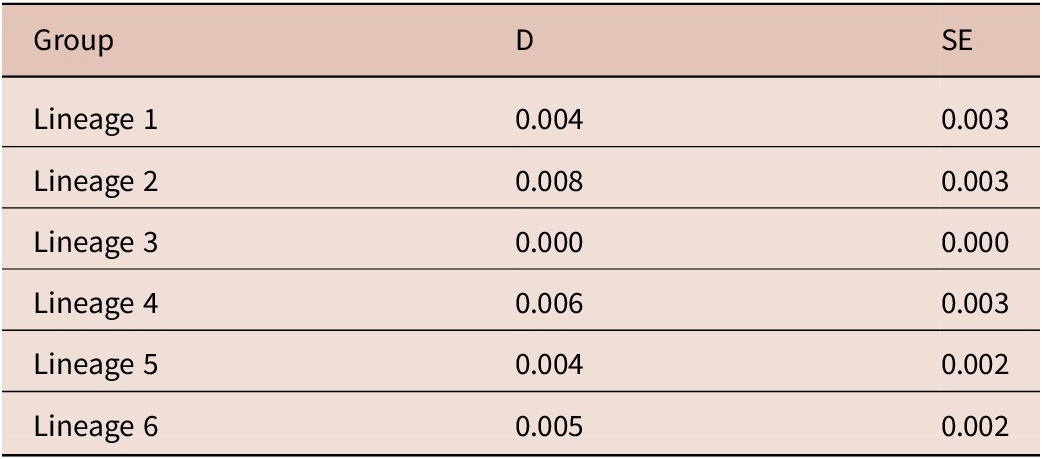
Mean values of intraspecific variability of the mitochondrial marker for Lineages 1–6 varied between 0 and 0.8% (Table 3). The highest level of intraspecific variability was found for sequences in Lineage 2 (0. 83% ± 0. 31%). Echinochasmus suifunensis and E. milvi showed a lower level of intraspecific variability (0.59% ± 0. 31% and 0. 53% ± 0. 24%, respectively). Lineage 1 and Lineage 5 also showed similar levels of intraspecific variability (0. 44% ± 0. 30% и 0. 37% ± 0. 15%, respectively), the values of which were 1.2–2 times lower than for E. suifunensis and E. milvi. The sequences from Lineage 3 were identical to each other.
Intraspecific variability for species-level lineages of Echinochasmus based on the cox1 mtDNA gene

Table 3. Long description
From the top row moving downward, the table lists six lineages of Echinochasmus. Lineage 1 has D 0.004 and SE 0.003. Lineage 2 has D 0.008 and SE 0.003. Lineage 3 has D 0.000 and SE 0.000. Lineage 4 has D 0.006 and SE 0.003. Lineage 5 has D 0.004 and SE 0.002. Lineage 6 has D 0.005 and SE 0.002. The columns are labeled Group, D, and S E, where D stands for distance and SE for standard error.
Abbreviations: D, distance; SE, standard error.
When comparing the values of genetic distance within and between Lineages based on the nuclear marker (28S rRNA gene), the values varied in the range from 0 to 0.1% (Supplementary Table S1). In the analysis of these sequences, single nucleotide polymorphisms were recorded for two individuals: a transversion (T → A) at position 338 bp in Echinochasmus sp. Lineage 3 (PX521596), and a transition (C → T) at position 397 bp in E. milvi (Lineage 6, PX521599). Notably, the chromatogram from direct Sanger sequencing of the E. milvi isolate (PX521599) showed a second peak at this position.
Additionally, a phylogenetic tree was constructed based on the 28S rRNA gene sequences and is provided in the Supplementary Materials (Figure S1). However, the interspecific genetic distances for this marker were minimal, making it impossible to clearly differentiate the studied species using this locus.
Discussion
Analysis of the cox1 mtDNA gene
Recent studies have shown that numerous endemic species of trematodes circulate in the Russian Far East (Shumenko et al., Reference Shumenko, Tatonova and Besprozvannykh2017; Izrailskaia et al., Reference Izrailskaia, Besprozvannykh, Tatonova, Nguyen and Ngo2019). Phylogenetic relationships within the family Echinochasmidae are also a subject of active studies in this area (Tatonova et al., Reference Tatonova, Izrailskaia and Besprozvannykh2020; Kalinina et al., Reference Kalinina, Besprozvannykh, Tatonova and Shchelkanov2023), thus making it possible to identify new species in this taxonomic group. The present study provides the first large-scale sampling of Echinochasmus spp. in the Russian Far East, significantly expanding the molecular data for this group. Specifically, our results reveal two entirely novel lineages of Echinochasmus possessing long-tailed cercariae (Lineages 2 and 3). Furthermore, we provide additional sequences for E. milvi and E. suifunensis, as well as for a lineage previously sequenced only in Japan (Lineage 5).
In this study, analysis within the family Echinochasmidae based on partial cox1 sequences revealed six well-differentiated lineages of Echinochasmus spp. with long-tailed cercariae. These lineages are separated from Microparyphium spp. and Echinochasmus japonicus both in the phylogenetic reconstruction and based on genetic distance values (Table 2). Moreover, these values exhibit levels of intergeneric divergence rather than intraspecific (Tatonova et al., Reference Tatonova, Izrailskaia and Besprozvannykh2020; Kalinina et al., Reference Kalinina, Besprozvannykh, Tatonova and Shchelkanov2023; Miura & Takisawa, Reference Miura and Takisawa2024). To evaluate the taxonomic status of the identified lineages, we applied genetic distance thresholds established for the family Echinochasmidae and related Echinostomatidae. In these groups, interspecific (congeneric) cox1 genetic distances typically range from 5% to 10% (Tatonova et al., Reference Tatonova, Izrailskaia and Besprozvannykh2020; Miura & Takisawa, Reference Miura and Takisawa2024), while intergeneric distances generally exceed 12–15% (Le et al., Reference Le, Blair and McManus2002; Besprozvannykh et al., Reference Besprozvannykh, Rozhkovan and Ermolenko2017). Our results perfectly align with these criteria: the p-distances between Lineages 1–6 (6.7–8.7%) correspond to distinct species within a genus, whereas the distances between the long-tailed and short-tailed groups (>15%) support their separation at the generic level.
Lineages 4 and 6 included sequences of E. suifunensis and E. milvi, respectively, whose life cycles were described and supported by morphological and molecular data published by Tatonova et al. (Reference Tatonova, Izrailskaia and Besprozvannykh2020). Since for all isolates of Lineage 4 and Lineage 6, the genetic distances are in the range of intraspecific differences (0–1.1% and 0–1.4%), and the interspecific distance between E. milvi and E. suifunensis is 6.7% (Tatonova et al., Reference Tatonova, Izrailskaia and Besprozvannykh2020), the sequences obtained in the present study belong to the valid species, E. suifunensis (Lineage 4) and E. milvi (Lineage 6). Additionally, the genetic divergence values between Lineages 1–6 (6.7–8.7%) also correspond to the interspecific genetic distance and, therefore, the sequences within each lineage belong to separate species. Moreover, these differences are 6–8 times greater than the values within each separate lineage, which serves as a clear sign of the presence of a hiatus indicating a higher taxonomic level. It is worth noting that Nakao & Sasaki (Reference Nakao and Sasaki2021) also observed a mito-nuclear discordance for specimens from Lineage 5. These specimens from Japan shared identical 28S rDNA sequences with E. milvi from the Russian Far East (Tatonova et al., Reference Tatonova, Izrailskaia and Besprozvannykh2020), while the cox1 sequences showed a pairwise divergence of 5.9–6.7% (Nakao & Sasaki, Reference Nakao and Sasaki2021). Our findings confirm this high level of mitochondrial diversity, which remains undetected by the more conserved 28S rRNA marker.
Additional evidence of isolation between the members of different lineages is the presence of 3 to 10 unique fixed substitutions for isolates from all six lineages. Moreover, the substitutions included both transitions and transversions. Furthermore, amino-acid sequence analysis revealed a unique fixed nonsynonymous substitution at position 198 bp, which results in the replacement of isoleucine with methionine in isolates included in Lineage 3. Concerning Lineage 2, a unique fixed non-synonymous amino-acid substitution (glycine to serine) was also identified at position 262 bp; this also confirms the isolation of these isolates from other representatives of the genus.
In summary, representatives of Lineage 4 and Lineage 6 belong to the previously described species E. suifunensis and E. milvi, respectively. These two species are valid, as their life cycles have been described and subtle morphological differences across all stages were previously established (Tatonova et al., Reference Tatonova, Izrailskaia and Besprozvannykh2020). Our molecular data further confirm the distinct taxonomic status of these two species. In contrast, all other collected cercariae (Lineages 1, 2, 3, and 5) were morphologically indistinguishable from E. milvi, so we initially assigned them to this species. However, genetic data indicate that the newly sequenced Lineage 5 isolates from Russia belong to Echinochasmus sp. MN-2021 sensu Nakao & Sasaki, Reference Nakao and Sasaki2021, which was originally identified in Japan, while Echinochasmus sp. B sensu Miura & Takisawa (Reference Miura and Takisawa2024) (Lineage 1), Echinochasmus Lineage 2, and Echinochasmus Lineage 3 appear to be new cryptic species. All these lineages have significant genetic divergence and unique fixed substitutions. Therefore, the use of the mitochondrial marker cox1 will allow identification of cryptic species within the family Echinochasmidae and clarify their phylogenetic status (Tatonova et al., Reference Tatonova, Izrailskaia and Besprozvannykh2020; Kalinina et al., 2022; Nakao et al., Reference Nakao, Ishikawa, Hibino, Ohari, Taniguchi, Takeyama, Nakamura, Kakino, Ikadai and Sasaki2022).
The taxonomic position of the identified lineages Echinochasmus within the family Echinochasmidae also needs further careful analysis. Morphological differences between species with short-tailed cercariae (24 spines) and those with long-tailed cercariae (20–22 spines) have been previously noted by Tkach et al. (Reference Tkach, Kudlai and Kostadinova2016). These differences were subsequently supported by studies using nuclear markers (Kalinina et al., Reference Kalinina, Besprozvannykh, Tatonova and Shchelkanov2023; Islas-Ortega et al., Reference Islas–Ortega, Aldama–Prieto, Sereno–Uribe and Varela2024; Cajiao-Mora et al., Reference Cajiao–Mora, Dutton, Jacobs, Beytell, Netherlands, DuPreez and Bullard2025). However, this issue has not been studied in terms of mitochondrial markers. In the present study, the average cox1 p-distance between E. japonicus (with short-tailed cercariae) and the lineages of Echinochasmus (with long-tailed cercariae) studied here was 17.1%, while the distance between these lineages and Microparyphium sp. was 14.7% (Table 2). These values, along with the 10 amino acid substitutions identified between E. japonicus and the other studied Echinochasmus spp. (Table 4), highlight a high level of mitochondrial divergence between these morphological groups. Such mitochondrial data are consistent with the differentiation levels previously observed using the 28S rRNA marker (Kalinina et al., Reference Kalinina, Besprozvannykh, Tatonova and Shchelkanov2023; Islas-Ortega et al., Reference Islas–Ortega, Aldama–Prieto, Sereno–Uribe and Varela2024; Cajiao-Mora et al., Reference Cajiao–Mora, Dutton, Jacobs, Beytell, Netherlands, DuPreez and Bullard2025). Further studies involving an expanded sample of Echinochasmus species with short-tailed cercariae will be valuable to fully characterize the evolutionary patterns of the cox1 marker within the family Echinochasmidae. Nevertheless, as mentioned above, we observed 10 fixed amino acid substitutions in the cox1 protein between the long-tailed and short-tailed groups. In Trematoda, the cox1 protein is highly conserved; intraspecific and congeneric variations typically involve only 0–3 substitutions. According to comparative mitogenomic data (Le et al., Reference Le, Blair and McManus2002; Brant & Loker, Reference Brant and Loker2009), a divergence of 10 fixed amino acid positions is consistent with the levels observed between well-established genera in related families, such as Echinostomatidae and Fasciolidae. This significant biochemical divergence supports the separation of these groups at the generic level.
Amino-acid substitutions within the genus Echinochasmus at the cox1 marker

Table 4. Long description
Starting from the top row, the table lists nucleotide positions and corresponding amino-acid positions. For each position, the amino acid in species with long-tailed cercariae of Echinochasmus is compared to that in short-tailed cercariae, specifically Echinochasmus japonicus. At nucleotide position 79–81 (amino-acid position 27), valine is present in long-tailed species, methionine in short-tailed. At 118–120 (position 40), leucine in long-tailed, methionine in short-tailed. At 175–177 (position 59), methionine in long-tailed, isoleucine in short-tailed. At 196–198 (position 66), isoleucine in long-tailed (methionine for Echinochasmus, Lineage 3), valine in short-tailed. At 214–216 (position 72), valine in long-tailed, methionine in short-tailed. At 226–228 (position 76), tryptophan in long-tailed, glycine in short-tailed. At 235–237 (position 79), valine in long-tailed, methionine in short-tailed. At 259–261 (position 87), isoleucine in long-tailed, methionine in short-tailed. At 310–312 (position 104), isoleucine in long-tailed, methionine in short-tailed. The substitutions highlight differences in amino-acid composition at specific cox1 marker positions between the two groups.
Analysis of the 28S rRNA gene
Genetic distances for the 28S rRNA gene both within and between lineages were minimal (0–0.1%), which is insufficient for species delimitation in this group. Given that the cercariae of most of the lineages lack clear diagnostic morphological characters and nuclear markers fail to differentiate these taxa (Tatonova et al., Reference Tatonova, Izrailskaia and Besprozvannykh2020; Kalinina et al., Reference Kalinina, Besprozvannykh, Tatonova and Shchelkanov2023), additional markers are required. In this study, the mitochondrial cox1 gene provided reliable separation of the identified lineages.
Despite the low genetic distances, it is worth noting that we found a second peak in the chromatogram of the E. milvi isolate (Lineage 6, PX521599), suggesting intragenomic polymorphism. While concerted evolution typically homogenizes rDNA copies (Pereira & Baldwin, Reference Pereira and Baldwin2016), processes such as incomplete homogenization or recent evolutionary events can lead to polymorphic sites within an individual’s genome (Tatonova et al., Reference Tatonova, Chelomina and Nguyen2017). This phenomenon requires further confirmation through molecular cloning or analysis of additional cercariae from the same snail. Nevertheless, such polymorphisms must be considered when analysing interspecific differences based on nuclear markers in this trematode group.
Geographical distribution of the studied species and lineages of Echinochasmus
Based on the data obtained, we provide a preliminary characterization of the geographical distribution of Echinochasmus spp. with long-tailed cercariae discovered in this study (Figure 4). The named species (E. suifunensis and E. milvi) occupy areas previously described by Tatonova et al. (Reference Tatonova, Izrailskaia and Besprozvannykh2020). Regarding the newly identified lineages, Echinochasmus sp. B sensu Miura & Takisawa (Reference Miura and Takisawa2024) (Lineage 1) has been found only in Japan, Lineages 2 and 3 occur in the southern Russian Far East, while Lineage 5 trematodes circulate in both regions (Figure 4).
Maps showing the geographical distribution of species and species-level lineages of Echinochasmus with long-tailed cercariae in the Russian Far East and Japan.

Figure 4. Long description
Top-left panel shows Echinochasmus sp. B sensu Miura and Takisawa Reference Miura and Takisawa2024, with a single large circle centered on Japan. Top-right panel shows Echinochasmus sp. Lineage 2 with two circles, one in Lake Gassi and one in River Machtovaya. Middle-left panel shows Echinochasmus sp. Lineage 3 with a single circle in River Komissarovka. Middle-right panel shows Echinochasmus suifunensis with a single circle in River Razdolnaya. Bottom-left panel shows Echinochasmus sp. Lineage 5 and Echinochasmus sp. MN-2021 sensu Nakao and Sasaki Reference Nakao and Sasaki2021, with six circles: two in Amur Region (River Zeya, River Tom), two in Khabarovsk Krai (Lake Gassi, River Gur), two in Primorsky Krai (River Komissarovka), one in Jewish Autonomous Oblast (River Bira) and one in Japan. Bottom-right panel shows Echinochasmus milvi with five circles in Amur Region, Khabarovsk Krai and Primorsky Krai of the southern Russian Far East. All panels include labeled geographic features: China, Vladivostok, Sakhalin Island, and Japan. Each panel is labeled with the corresponding species or lineage and citation below the map.
Presumably, in most cases, the distribution of Echinochasmus spp. across the Russian range follows the currents of the Amur River Basin except for E. suifunensis, found only in River Razdolnaya, which is not connected to the Amur River Basin to date. The areas of these species are listed in more detail in Table 5. It is worth noting that Lineage 5 trematodes circulate using mollusks from different genera: Koreoleptoxis spp. in Russia (this study) and Semisulcospira libertina in Japan (Nakao & Sasaki, Reference Nakao and Sasaki2021). This indicates the potential for other Echinochasmus species detected in the present study to colonize new areas, both in continental Russia and on the Japanese islands.
Areas and possible transmission routes of identified species/lineages of Echinochasmus

Table 5. Long description
The table has four columns: Species, Country, Reservoirs, and Possible way of spreading parasites. From the top row: Echinochasmus sp. B sensu Miura and Takisawa Reference Miura and Takisawa2024 (Lineage 1) is found in Japan, with reservoirs in bodies of water in Hokkaido, Honshu, Shikoku, and Kyushu; transmission occurs via short-distance bird migrations and movement through Japanese waterbodies. Echinochasmus sp. (Lineage 2) is in Russia, reservoirs in Khabarovsk Krai (Lake Gassi and River Machtovaya); transmission is by migration through narrow habitats with intermediate hosts using water currents. Echinochasmus sp. (Lineage 3) is in Russia, reservoirs in Primorsky Krai (River Komissarovka); transmission is the same as Lineage 2. Echinochasmus suifunensis (Lineage 4) is in Russia, reservoirs in Primorsky Krai (River Razdolnaya); transmission is preferential migration via intermediate hosts by water along River Razdolnaya. Echinochasmus sp. MN–2021 sensu Nakao and Sasaki Reference Nakao and Sasaki2021 (Lineage 5) is in Russia, reservoirs in Amur Region (River Zeya, River Tom), Khabarovsk Krai (Lake Gassi, River Gur), Primorsky Krai (River Komissarovka), and Jewish Autonomous Oblast (River Bira); transmission is by long bird migrations over sea water and migration with currents of River Amur. The same lineage is also found in Japan, with reservoirs in Hokkaido Island, River Nagayama-Shinkawa, and bodies of water in Hokkaido, Honshu, Shikoku, and Kyushu; no transmission route is listed. Echinochasmus milvi (Lineage 6) is in Russia, reservoirs in Amur Region (River Zeya), Khabarovsk Krai (River Odyr, River Gur, River Kiya, River Machtovaya), Primorsky Krai (River Bikin, River Komissarovka, River Ilistaya); transmission is by migration with currents of River Amur and its large tributary River Komissarovka, and short-distance bird migrations.
For Lineages 1–6, the intraspecific variability for the mitochondrial marker ranged from 0 to 0.8% (Table 3). Notably, no apparent relationship was observed between the levels of intraspecific variability and the respective range sizes. This may indicate the need to expand the sampling of each species. Alternatively, such variability may depend on environmental factors including habitat conditions, host population density and diversity (both intermediate and definitive ones), and their physiological state (Smyth & Halton, Reference Smyth and Halton2007; Galaktionov & Dobrovolskij, Reference Galaktionov and Dobrovolskij2003).
Conclusion
Using the mitochondrial cox1 marker, we showed that at least six species and species-level lineages of the echinochasmid genus Echinochasmus parasitize snails in the Russian Far East and Japan. Two of these species, E. milvi and E. suifunensis, were previously described as valid species in Russia, and two species-level lineages (Echinochasmus sp. B sensu Miura & Takisawa (Reference Miura and Takisawa2024) and Echinochasmus sp. MN-2021 sensu Nakao & Sasaki (Reference Nakao and Sasaki2021)) were sequenced in Japan. The data obtained not only provide a robust basis for identifying lineages of morphologically similar species but also help identify potential localities for subsequent elucidation of life cycles and morphological characterization of various developmental stages. Our results also highlight the importance of further study of this and other trematode groups circulating in the Russian Far East to uncover previously unknown biodiversity.
Supplementary material
The supplementary material for this article can be found at http://doi.org/10.1017/S0022149X2610162X.
Data availability
The sequence data generated in this study are available in the NCBI GenBank database under the accession numbers PX521592–PX521599; PX504651–PX504691.
Acknowledgements
The experiments described in this study were set up using the equipment at the Instrumental Centre for Biotechnology and Gene Engineering, Federal Scientific Center of the East Asia Terrestrial Biodiversity, Far Eastern Branch, Russian Academy of Sciences (Vladivostok, Russia).
Financial support
The research was carried out within the state assignment of Ministry of Science and Higher Education of the Russian Federation (theme No. 124012400285-7).
Competing interests
The authors declare no conflicts of interest.