Introduction
Behavioral and psychological disturbances are commonly found among patients with neurodegenerative disease (e.g. Parkinson's disease patients may not present with dementia but still display associated neuropsychiatric changes, which the Neuropsychiatric Inventory (NPI) may tap into without the presence of cognitive changes), regardless of its type (Fuh et al., Reference Fuh, Wang and Cummings2005). Symptoms such as apathy/indifference, disinhibition, depression, psychosis and agitation commonly accompany cognitive and performance decline in dementia. It has been suggested that neuropsychiatric manifestations in patients with dementia may become a more consistent feature of the disease as it progresses over time (Kaufer et al., Reference Kaufer2000). The prevalence of these symptoms is estimated to be more than 80% in patients with Alzheimer's disease (AD) (Hope et al., Reference Hope, Keene, Fairburn, Jacoby and McShane1999). Neuropsychiatric symptoms contribute considerably to the overall burden of AD of both patients and caregivers, thus underscoring the importance of identifying and quantifying patient symptoms and their impact on caregivers (Schulz and O'Brien, Reference Schulz and O’ Brien1995; Kaufer et al., Reference Kaufer1998).
Several measures have been constructed to assess the psychological and behavioral symptoms of dementia patients, including the Behavior Rating Scale for Dementia of the Consortium to Establish a Registry for Alzheimer's Disease (CERAD-BRSD), the Behavioral Pathology in Alzheimer's Disease Scale (BEHAVE-AD), and the Neuropsychiatric Inventory (Conn and Thorpe, Reference Conn and Thorpe2007).
The Neuropsychiatric Inventory (NPI) was constructed with the aim of assessing psychiatric symptoms in patients with dementia (Conner et al., Reference Conner, Sabbagh and Cummings2008). Cummings et al. (Reference Cummings, Mega, Gray, Rosenberg-Thompson, Carusi and Gornbein1994) developed the Neuropsychiatric Inventory (NPI) to assess a wide range of behaviors encountered in dementia patients to provide a means of distinguishing frequency and severity of behavioral changes, and to facilitate rapid behavioral assessment. The NPI uses a structured, caregiver-based interview format to assess 10 behavioral domains including delusions, hallucinations, agitation/aggression, depression/dysphoria, anxiety, apathy/indifference, irritability/lability, euphoria, disinhibition and aberrant motor behavior. The domains are rated according to both their frequency and severity. Two other domains have also been assessed: night-time behavioral disturbances and appetite/weight changes (Cummings et al., Reference Cummings, Mega, Gray, Rosenberg-Thompson, Carusi and Gornbein1994). NPI uses both screening and in-depth questions; a further advantage is that this instrument allows the practitioner to complete it in a relatively quick and easy format. The instrument also allows the emotional stress of the caregiver to be registered in the same interview if needed (Kaufer et al., Reference Kaufer1998).
Alternate forms of the standard NPI have also been designated including the Neuropsychiatric Inventory-Nursing Home Version (NPI-NH) (Wood et al., Reference Wood2000) referred to as the Neuropsychiatric Inventory Questionnaire (NPI-Q)(2), and Caregiver-Administered Neuropsychiatric Inventory (CGA-NPI) (Kang et al., Reference Kang, Choi, Lee, Jeong, Hahm, Han and Cummings2004). The NPI has been translated into many languages such as Chinese, Dutch, Finnish, German, Japanese, Portuguese, Greek, French and Thai (Fuh et al., Reference Fuh, Liu, Mega, Wang and Cummings2001; Leung et al., Reference Leung, Lam, Chiu, Cummings and Chen2001; Boada et al., Reference Boada, Tarraga, Modinos, Lopez and Cummings2005; Selbaek et al., Reference Selbaek, Kirkevold, Sommer and Engedal2008).
This instrument has not been studied and normalized for the Farsi-speaking population. In Iran, as in the rest of the world, we have witnessed a noticeable shift in the demographics of the aging population. In recent decades in Iran, the number of people aged 65 years and over has increased to more than 3,500,000, nearly 5% of the total population (www.amar.org.ir). Considering the strong association between age and developing dementia, it is expected that the number of dementia patients and their caregivers needing health services will rise in the near future. The NPI, as a clinical and research instrument for assessing psychological and neurobehavioral disturbances of these patients as well as caregivers’ burden, can be helpful in these situations. To the best of our knowledge, no other instruments with similar utility have been validated to date in Iran. The present investigation can be regarded as the first attempt in this regard.
Methods
The human subject committee of Tehran Psychiatric Institute approved this project.
To prepare the Farsi version of the NPI (F-NPI), it was first translated into the Farsi language by two bilingual psychiatrists and then back-translated into English by two other independent bilingual psychiatrists. Then the F-NPI was discussed in a meeting to resolve the discrepancies between the two transcripts, comparing them with the original English version. The modified version was tested for its acceptability by using it in interviews with five caregivers of individuals with dementia. The final version was developed for use in the validation study.
Participants
One hundred participants were selected from members of the Iranian Alzheimer's Association (IAA) through convenience sampling. The IAA registration system was used to recruit the study sample. They were contacted via telephone and those who agreed to participate in this study made an appointment in the IAA office for a clinical interview and examination. Fifty participants were used to assess inter-rater reliability, and of these, 30 subjects were selected randomly for test-retest reliability. Another 50 participants were recruited to the study for concurrent validity evaluation. The inclusion criteria were: (1) a diagnosis of dementia; (2) aged 60–90 years; (3) able to read and write; and (4) able to communicate properly.
Two psychiatrists were trained to perform the interview and complete the study instruments. The study samples were re-evaluated to confirm the diagnosis before recruitment. First, the interviewees were screened by Mini-Mental State Examination (MMSE) and Geriatric Depression Scale (GDS) for dementia and depressive disorder; next, using DSM-IV criteria, a clinical interview was performed to confirm the diagnosis of dementia and major depressive disorder.
Forty-nine subjects were selected as a control group and compared with study subjects in a concurrent study for discriminating validity. The criteria for control participants were: (1) not having dementia, according to MMSE score ≥ 23 and DSM-IV criteria; (2) not being depressed, ascertained by screening with GDS; (3) being matched with 49 study participants yielded from concurrent study sample, on age (±2 years) and education level (in the same class of education: able to read and write/primary/middle/high schooling and college level). The control participants, after being screened by MMSE (for dementia) and GDS (for depression), were interviewed for DSM-IV criteria to rule out dementia and depressive disorders.
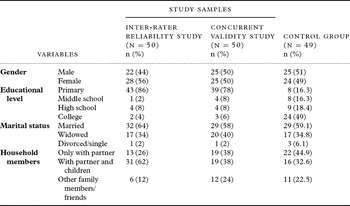
The demographic features of the study sample are presented in Table 1. The numbers of men and women were almost the same. The mean and standard deviation of age were 74.5 and 8.3 years respectively. Most of the sample were living with their family members (51%) and were able to read and write ability.
Demographic features of study sample (N = 149)

The mean age of the sample in inter-rater study was 75 years, SD = 8.1, (male: 73, 8; female: 76.5, 8); in concurrent study group 73.7 years, SD = 8.4, (male: 73.8, 9.6; female: 73.6, 7.3); and in control group 74.3 years, SD = 8.5, (male: 74.7, 9.4; female: 73.9, 7.5).
Instruments
GDS-15 (Geriatric Depression Scale-15 items): the GDS-15 is a short form of the GDS-30 (Sheikh and Yesavage, Reference Sheikh, Yesavage and Brink1986). Its Farsi version was validated among Iranian elderly with an optimum cutoff score of 7/8, sensitivity and specificity of 0.9 and 0.84, respectively (Malakouti et al., Reference Malakouti, Fatollahi, Mirabzadeh, Salavati and Zandi2006).
MMSE (Mini-Mental State Examination): used as a screening tool (Folstein et al., Reference Folstein, Fostein and McHugh1975). The MMSE was used in this study to evaluate the severity of dementia of those in the study with dementia and for matching the control cases. The Farsi version has been validated with a cutoff score of 21–23, sensitivity and specificity of 90–98% and 84–100%, respectively (Foroughan et al., Reference Foroughan, Jafari, Shirinbayan, Ghaem Magham Farahni and Rahgozar2008; Ansari et al., Reference Ansari, Naghdi, Hasson, Valizadeh and Jalaie2010). In this study the cutoff score was 23.
PANSS (Positive and Negative Symptoms Scale): this scale has been translated and used extensively in Iranian clinical and research works (Noorbala et al., Reference Noorbala, Akhondzadeh, Davari-Ashtiani and Amini-Nooshabadi1999; Akhondzadeh et al., Reference Akhondzadeh, Rezaei, Larijani, Nejatisafa, Kashani and Abbasi2006; Malakouti et al., Reference Malakouti2009; Abbasi et al., Reference Abbasi2010). Inter-rater reliability for the PANSS was reported to be 0.71 (Amini et al., Reference Amini, Alimadadi, Nejatisafa, Sharifi and Ahmadi-Abhari2009). Although the PANSS is generally used to evaluate the psychopathology of severely mentally ill patients, the diversity of its items is useful to evaluate the behavioral symptoms of individuals with dementia. In this study, 11 items corresponding to the NPI domains of “delusion”, “hallucination”, “emotion”, “grandiosity”, “aggressive behaviors”, “apathy/indifference”, “isolation”, “anxiety”, “impulsivity” and “violence” were selected and used for concurrent validity with the NPI symptoms domain.
Procedures
The following methods were used to evaluate the reliability and validity of the NPI questionnaire.
1. Inter-rater reliability was determined by comparing the NPI score of 50 caregivers (the caregivers were close family members who were living with and spending most of their time with the patients). In this study most of them were spouses. Twenty-five interviews were conducted by the first psychiatrist in the presence of the second psychiatrist, and the next 25 interviews were performed by the second psychiatrist by the same method. NPI scoring was done simultaneously and independently.
2. Test-retest reliability was conducted on 30 caregivers selected randomly from among study subjects of the between-rater study by the same interviewer two weeks after the first interview. The first and second interviews were conducted by using the method of a face-to-face interview.
3. For concurrent validity, another 50 patients with dementia were recruited. PANSS and GDS were used to evaluate concurrent validity of NPI items. PANSS items including delusion, hallucination, agitation/aggression, violence, anxiety, apathy/indifference, disinhibition, irritability/lability and motor/behavioral disturbances were used in this study. The GDS score was used to compare with the dysphoric domain of NPI. Given that it was difficult for some study subjects to complete the questionnaire, in these instances the GDS was completed by interviewers who read the items to interviewees. The MMSE was conducted to assess the severity of dementia.
4. Discriminant validity was determined with 49 recruited normal control subjects. They were selected from one of the residential areas of Tehran. Appointments were made at the volunteers’ home and the interview performed with the control cases and their partners (or close family member).
Statistical analyses
Cronbach's α coefficient was used to determine internal consistency. Inter-rater and test-retest reliability were conducted using intra-class correlation and Pearson correlation coefficient statistical methods, respectively. For assessing the concurrent validity and discriminant validity, Pearson correlation coefficient and independent t-test statistics were used.
Results
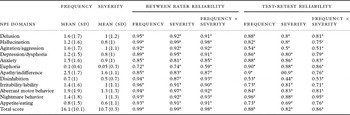
The neuropsychiatric symptoms were prevalent among the study subjects as follows: apathy/indifference 74%, irritability/lability 54%, aberrant motor behavior 54%, anxiety 54%, delusion 52%, depression/dysphoria 48%, night distorted behavior 44%, hallucination 42%, disinhibition 34%, eating distorted behavior 28%, and euphoria 4%. Table 2 shows the frequency and severity scores of 12 items. “Apathy/indifference” was the most common item and “euphoria/elation” and “disinhibition” the least frequent/severe items as reported by the caregivers.
Inter-rater and test-retest reliability for the NPI domains

* Significance <0.001.
NPI = Neuropsychiatric Inventory.
The mean of total NPI scores was 35.2 (SD = 26.7), for frequency 16 (SD = 10) and for the severity of symptoms 10 (SD = 7.3) (Table 2).
Reliability
Internal consistency was evaluated on 50 NPIs from the concurrent validity study. Cronbach's coefficient α was 0.8. For severity it varied between 0.76 (agitation/aggression) and 0.82 (apathy), and for frequency between 0.73 (hallucination) and 0.80 (euphoria), revealing a high level of internal consistency.
Inter-rater reliability between two trained psychiatrists, who interviewed the study samples, was determined by calculating the intra-class correlation coefficient. The results revealed that except for “euphoria”, which had low reliability compared to other domains (but which showed significance), it varied between 0.0.85 and 0.99 for frequency, 0.0.81 and 0.99 for the severity of the symptoms and 0.85 and 0.98 for (severity × frequency) index. The correlation coefficients between two raters in all 12 domains were significant (Table 2). Test-retest reliability for each domain and total score was assessed within two weeks of initial assessment. The Pearson's correlation coefficient analyses for frequency of symptoms after two weeks were 0.53–0.96, and for severity after two weeks were 0.44–0.88; the (frequency × severity) index was 0.51–0.95. The correlation coefficient was significant for all 12 domains (P < 0.001) (Table 2).
Validity
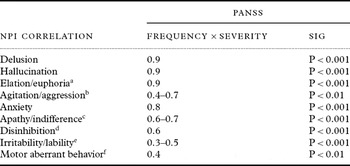
Concurrent validity was performed by comparing the scores of 50 study subjects on the relevant domains of NPI, PANSS and GDS. Delusion, hallucination, agitation/aggression, anxiety, apathy/indifference, disinhibition, irritability/lability and motor behavioral disturbances were compared on PANSS and NPI items. The index of “frequency × severity” was only considered for this comparison. The results showed a significant Pearson correlation coefficient between items (Table 3), however, the correlation of agitation/aggression, irritability, lability, and motor aberrant behavior were mild to moderate. The score of depression/dysphoria subscale of NPI (frequency × severity) was correlated (r = 0.6) with total score on the GDS (P = 0.000).
Concurrent validity of NPI domains

a Elation/euphoria from NPI with grandiosity in PANSS.
b Agitation/aggression of NPI with anger/violence/excitement of PANSS.
c Apathy/indifference from NPI with emotional withdrawal and Passive/apathetic social withdrawal in PANSS.
d Disinhibition of NPI with poor impulse control of PANSS.
e Irritability/lability from NPI with excitement from PANSS.
f Motor aberrant behavior in NPI with mannerism and posturing in PANSS.
NPI = Neuropsychiatric Inventory; PANSS = Positive and Negative Symptoms Scale.
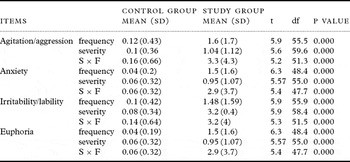
Discriminant validity was evaluated by using t-test student statistics to compare the NPI scores between case and control subjects. The control group sample is described in the methods section and Table 1.
For the items of delusion, hallucination, depression, anxiety, apathy/indifference, disinhibition, motor disturbances, night-time behavior and appetite, the scores of control subjects were zero and the differences were significant between the two groups (P < 0.000) The symptoms of agitation/aggression, anxiety, irritability/lability and euphoria were seen among control subjects but less severe than study subjects (P < 0.000) (Table 4).
Discriminant validity of NPI domains

Relationship of NPI items with MMSE and age
In the concurrent study sample the mean score of MMSE was 11.3 (SD = 7.5) and in the control group it was 29.4 (SD = 1). When the MMSE scores were categorized into severe (0–9), moderate (10–19) and normal, the study sample of the first group was divided into 44%, 32% and 24% in each group respectively; however, all of the control sample were in the normal class.
Out of 12 items of the NPI (severity × frequency), the scores of the MMSE showed a significant negative relationship with five items: apathy (r = −0.4, p < 0.005), night-time behavior (r = −0.35, p < 0.01), agitation (r = −0.34, P = 0.01), aberrant motor behavior (r = −0.56, P = 0.000) and total NPI score (r = −0.49, P = 0.000). Hallucination showed a trend and a weak negative relationship with the severity of dementia (r = −0.29, P = 0.06). There was no significant relationship between NPI items and MMSE with age.
Discussion
Behavioral and psychological symptoms of dementia have been poorly studied in developing countries (Shah et al., Reference Shah, Dalvi and Thompson2005). The aim of this study was the evaluation of the psychometric properties of the Farsi version of Neuropsychiatric Inventory (F-NPI) as an instrument for promoting local and cross-cultural research on the neuropsychiatric symptoms of individuals with dementia.
Our study showed that internal consistency, test-retest and inter- rater reliability, and concurrent validity of the F-NPI are all acceptable, with the values being somewhere between moderate to excellent. This finding has been proved in other more recent studies implemented in Asian (Choi et al., Reference Choi, , Kwon, Yoon, Jeong and Ha2000 Leung et al., Reference Leung, Lam, Chiu, Cummings and Chen2001; Fuh et al., Reference Fuh, Wang and Cummings2005) and non-Asian (Camozzato et al., Reference Camozzato2008) countries. The concurrent validity of most behavioral domains (delusion, hallucination, restlessness, anxiety, apathy/indifference, disinhibition, irritability/lability, motor disturbances and depression) showed satisfactory results when compared with PANSS and GDS. The results of this study also revealed that the F-NPI is able to discriminate with respect to the frequency and severity of psychopathology, and therefore can be used in clinical studies to quantify behavioral changes in dementia.
The profile of behavioral disturbances was similar to other study results. The severity of dementia was correlated with the higher mean score of NPI in the current study, which was not concordant with a study carried out in Turkey (Yener, Reference Yener2009). About 50% of the study subjects in this study had MMSE scores equal to or less than 10 indicating severe dementia in the study subjects at the screening level.
The most prevalent symptoms were “apathy/indifference” and “aberrant motor behavior” and the least one was “euphoria”. These findings were also confirmed by other studies (Kaufer et al., Reference Kaufer2000; Choi et al., Reference Choi, , Kwon, Yoon, Jeong and Ha2000; Fuh et al., Reference Fuh, Wang and Cummings2005; Camozzato et al., Reference Camozzato2008).
Limitations
Lack of public awareness of dementia, as a pathological feature of aging, has resulted in very late referral of affected people to medical and social support service centers in Iran. Therefore, our sample, which was taken from IAA, had low MMSE scores and were in advanced stages of dementia. This might have influenced their neuropsychiatric symptom profiles. Although the PANSS as a semi-structured interview was translated and is used extensively in Iran, the short form (11 items, used in this study) needs to be validated in this culture.
Conclusion
The Farsi version of NPI showed satisfactory indexes of reliability and validity. It is a suitable instrument for use in clinical evaluation and research on neuropsychiatric symptoms among individuals with dementia.
Conflict of interest
None.
Description of authors' roles
S.K. Malakouti designed and carried out the study, supervised the data collection, and wrote the paper. L. Panaghi designed the study, carried out the statistical analysis and assisted with writing the paper. M. Foroughan designed the study, and assisted with writing the paper. M. Heidari and L.K. Habibi conducted the interview. T. Zandi designed the study and assisted with writing the paper. M. Salehi assisted with data collection.
Acknowledgments
We acknowledge the Iranian Alzheimer Association's assistance in conducting this research and thank the members and clients of the IAA who dedicated their time to this study. This research was supported by a grant (no. MT 117) from Iran University of Medical Sciences, Deputy of Research.