Agricultural cooperatives began to spread throughout Western Europe from about 1870. Around the same time the need to compete against cheap cereals coming from Russia and America triggered the start of a process of profound transformation in European agriculture. Cooperatives were potentially a great stimulating force for agrarian modernisation, and an especially suitable instrument with which to reinforce the capacity for technical change of the family farm, which was to supply a growing portion of Europe's agricultural output after the Great Depression at the end of the nineteenth century. Although cause and effect are hard to distinguish, from then on there must have been a strong positive correlation between the performance of the different national agricultures and the level of development of farmer cooperation. But this is a difficult hypothesis to test.
‘Perhaps more than any other factor’, writes Jan Bieleman (2001: 245), ‘cooperation constituted the structural base that explains the success of Dutch agriculture since the beginning of the twentieth century’. But he adds, a little paradoxically, that to date very little is known about it. It is not just a Dutch paradox. There are hardly any series of data that allow us to quantify the economic repercussions of agricultural cooperatives before the Second World War, and ‘there is little hope to make cooperation statistics anywhere near complete’ (Dovring, Reference Dovring1965: 211). As a result, international comparisons are difficult to carry out. J. L. Van Zanden (Reference Zanden1991), for example, calculated the evolution of agricultural productivity in sixteen European countries between 1870 and 1914 using sophisticated analytical methods, but was forced to make rather vague allusions to cooperatives when he resorted to them to explain the reason for the differences.
In any case, the intensity with which cooperatives developed varied a lot, both between countries and between regions and crops. According to Van Zanden (1991: 237), most farmers in Scandinavia, the Netherlands, Germany, Switzerland, Ireland and most of Eastern Europe were already members of some kind of cooperative around the year 1910, but ‘almost nothing of this kind occurred in Britain, France, and Southern Europe’. The observation is not particularly well suited to the case of France,Footnote 1 and, in fact, a large assortment of situations coexisted in southern Europe: in Portugal (Fonseca, Reference Fonseca1985), southern Italy (Galassi and Cohen, Reference Galassi and Cohen1994), and southern Spain (Garrido, Reference Garrido1996) few cooperatives were set up before 1950, but this was not the case in northern Italy (Sapelli, Reference Sapelli1981), Greece (Gousiuos and Zacopoulou, 1992) or northern and eastern Spain (Garrido, Reference Garrido1996). What gave rise to these differences?
Between 1906 and 1933 no fewer than 9,000 agrarian syndicates, a name chosen by most Spanish cooperatives in order to be subject to the provisions of the 1906 Agrarian Syndicates Act (Ley de Sindicatos Agrícolas), were set up in Spain.Footnote 2 But most of them were short lived. At certain times they displayed a high capacity to mobilise people and to act as a lobby in favour of agricultural interests, but their economic activity was generally limited. Due to such marked contrasts, the factors that stopped Spanish agricultural cooperation from consolidating are relatively easy to identify, and make it possible to gain a better understanding of the reasons behind what happened in other places.
This article will first document the spectacular rise of Spanish agricultural cooperation in the early twentieth century. Next the article investigates what Spanish cooperatives did and analyses the repercussions of State intervention on the development of cooperatives, the attitude the different social groups of producers showed toward cooperation, and the significance of ideology in explaining the failure of cooperatives. Lastly, it explores the reasons behind the success of some Spanish agrarian syndicates.
How many cooperatives?
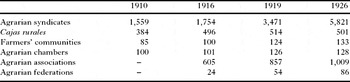
As happened in Portugal, Greece and southern Italy, ‘modern’ agricultural cooperation got under way in Spain at a relatively late date. The first Spanish cooperatives appeared in the 1890s, but they only mushroomed after the enactment of the 1906 Agrarian Syndicates Act. With the introduction of this law, for the first time under Spanish legislation associated farmers were entitled to important tax advantages. Furthermore, by the end of the nineteenth century the Spanish Catholic Church had begun to pursue the goal of organising small farmers by means of cooperatives, and the passing of the 1906 Act led them to renew their efforts in this direction (Castillo, Reference Castillo1979; Cuenca, Reference Cuenca2003). Official statistics provide (very low quality) information about the six types of agrarian societies that appear in Table 1: it was not uncommon for all of them to perform cooperative functions.Footnote 3
Agrarian associations in Spain, 1910–26

Source: Ministerio de Fomento (1912), Dirección General de Agricultura (1917), Anuario estadístico de España, 1921–22, p. 310, Muñiz (1927).
The cajas rurales were rural credit banks and usually had fertiliser and machinery sections. Certain farmers’ communities (Comunidades de Labradores)Footnote 4 and some agrarian chambers (Cámaras Agrarias) did the same. The latter were semi-official institutions, created thanks to a legal provision of 1890, which acted as a pressure group. Largely made up of wealthy landowners, they attempted to attract the peasantry by offering cooperative services, and only those that actually had flourishing cooperatives managed to achieve continued operation (Planas, Reference Planas1998). Many of the institutions the statistics referred to as agrarian associations were cooperatives motivated by socialists, anarchists or republicans who, believing that the 1906 Agrarian Syndicates Act provided a conservative-oriented interclassist model of cooperation, refused to follow this legal course on ideological grounds. The agrarian federations, finally, acted as second degree cooperatives; they consisted mainly of agrarian syndicates, but even those that basically consisted in agrarian chambers or farmers’ communities made numerous attempts to channel the purchase of fertilisers, insecticides or machinery produced by federated bodies, as they understood that this was the only way to avoid becoming merely nominal organisations.
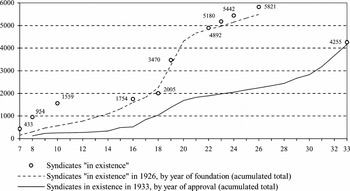
It is no exaggeration to say, then, that there was a lively cooperative atmosphere in Spanish farming at the beginning of the twentieth century. The average life of Spanish cooperatives, however, was very short.Footnote 5 Until 1910 1,559 syndicates had been established all over Spain: by 1916 sixty-three per cent of them no longer existed. According to official figures, the number of syndicates increased steadily between 1916 and 1926 (5,821 syndicates). But in 1934 the first relatively rigorous statistics were produced, and the results were shocking: there were then only 4,255 syndicates, almost half of which had been set up after 1926. Figure 1 shows the foundation figures (accumulated total) for the organisations mentioned in the statistics from 1926 and from 1934: the gap between the two curves gives an idea of the magnitude of the number that disappeared.Footnote 6 If the agrarian chambers hoped to carry out cooperative activities in order to guarantee they would not disappear, it must be supposed that the syndicates failed because they were unable to offer their members satisfactory cooperative services.
Spanish agrarian syndicates, 1907–33.
Sources: Garrido (1996: 23), Muñiz (1927), Dirección General de Agricultura (1934).

What did cooperatives do?
Practically all Spanish agrarian syndicates had a fertiliser section. In 1930 chemical fertilisers were still not in widespread use in Spain, but there were marked differences from one region to another compared to the national average of 16.8 kilograms of pure fertilising material per hectare (Pujol, Reference Pujol1998: 160). Consumption levels were especially high (more than seventy kilograms per hectare) in some provinces along the Mediterranean coast (Valencia and Catalonia), and it was there that the more economically powerful cooperatives appeared.Footnote 7 At the other extreme, the low (far below the national average) consumption of the new fertilisers may have been one of the factors that played a decisive role in the weak economic power of cooperatives in Inner Spain, but the relation also had to operate in the opposite direction, because cooperatives sold only small amounts of fertilisers there.Footnote 8
In 1930 cereals continued to take up most of the cultivated land in Spain, but humidity and temperature conditions usually prevented the dry expanses of land away from the coasts from being used for anything else. These same conditions often imposed a low ceiling on the increase in yield obtained by a greater use of the new fertilising techniques, and it is for this reason that it has been claimed that mechanisation was the best option the farmers of these areas had to increase their competitiveness (Simpson, Reference Simpson1996: 47). Indeed, in 1932 harvesters and threshing machines were already common in Navarre, Castile and Catalonia, which were territories in which the important weight of the small holdings coincided with the strong implantation of agrarian syndicates.
Before 1936, however, most syndicates had very low capital: the 4,255 syndicates that existed in 1933 owned on average just 22,000 pesetas,Footnote 9 while the threshing machine purchased by one Catalan cooperative in 1929 cost 10,570 pesetas (Santesmases, Reference Santesmases1996: 131). On the other hand, the development of cooperative credits and the cooperative commercialisation of crops was scant. There were many cooperatives that conducted a great deal of credit activity on a local basis, but in 1924 the number of loans offered by all the cooperatives barely covered five per cent of the financial needs of Spain's agricultural sector (Carasa, Reference Carasa and Yun1991: 306). As regards cooperative commercialisation, I will cite three significant cases.
In 1922, cereals and legumes accounted for seventy-six per cent of the land cultivated in Spain. Several very solid syndicates appeared that were based on cooperative flour mills (Martínez, Reference Martínez1982; Ramon, Reference Ramon1999), but few of these were set up in Spain. The small wheat producers in the northern half of the country were the mainstay of the powerful National Catholic-Agrarian Confederation (Confederación Nacional Católico-Agraria). Nevertheless, the 4,451 syndicates that the confederation claimed to have as members in 1920 only owned twelve flour mills, with a grinding capacity (sixty metric tonnes of wheat per day) that did not reach 0.5 per cent of the total for the whole of Spain.Footnote 10
Spanish production of citrus fruits, which were to be sold in the industrialised countries of Europe, was almost wholly carried out in the fields of the Valencian Region: only 5.3 per cent of orange exports went through the Valencian agrarian syndicates during their best campaign (that of 1911–12), and would not reach a similar figure again until 1967–8.Footnote 11
According to Juan Pan-Montojo (1994: 365), in 1923 the wine-making capacity of the cooperative wineries was situated somewhere between two extremes that could have been around 9.4 and 2.3 per cent of Spain's total wine production. Catalonia had eighteen per cent of Spanish vineyards and eighty per cent of the Spanish cooperative wineries (Pomés, Reference Pomés2000a: 169).
Elizabeth Hoffman and Gary Libecap (1991) and Ingrid Henriksen (Reference Henriksen1999) have made good use of economic theory to explain why, in California and in Denmark, cooperatives were successful in some crops and not in others. What needs to be explained in the case of Spain is why they were not successful (on a supralocal level) in any line of production whatsoever.
The intervention of the state
After the crisis at the end of the nineteenth century, Europe's public authorities began to show a generalised interest in encouraging agrarian cooperation. It is possible that state aid did not act as an indispensable requisite for the expansion of the cooperatives in Holland or Denmark, where they were supported by a thick layer of middle farmers (Knibbe, Reference Knibbe1993; Henriksen, Reference Henriksen1999). Yet, in Spain this social group was scarce in most regions and what predominated was the small peasant. According to Edward Malefakis (1982: 481), in 1959 there were nearly six million agrarian landowners in Spain, of whom 91.7 per cent were ‘small’, 7.5 per cent ‘middle’ and 0.8 per cent ‘large’, but the latter owned 52.4 per cent of the total land area, 27.9 per cent was in possession of the ‘middle’ landowners and only 19.7 per cent belonged to the ‘small’ ones.Footnote 12
Agricultural cooperatives received government aid for at least five reasons. (1) After the Great Depression the state became increasingly interventionist and began to get actively involved in improving productive conditions (Koning, Reference Koning1994; Garrabou, Reference Garrabou1993). (2) Within a context characterised by the downward trend in the prices of agricultural products and increasing costs of salaries, the family farm arose as the most efficient system of organising agricultural activity, and governments came to the conclusion that cooperatives were to play a crucial part in enabling family farmers to join the technical change. (3) When the sector was hit by the crisis, farmers took action to pressure the state in order to obtain protection. Legislative measures concerning cooperation were partly a result of that pressure, and also an instrument used by the state to channel agrarian associationism and enhance its most easily integrable forms. (4) After the heightened state of social conflict during the difficult years at the end of the nineteenth century, the state acted as a mediator between owners, farmers and farm-labourers. As the cooperatives favoured vertical groupings, their presence made it easier to carry out this task. (5) With the spread of the mechanisms of a representative democracy, the small farmer became an attractive source of votes: cooperatives were used to recruit them and to oversee the insertion of peasantry in the political life of the nation.
Yet the above-mentioned reasons did not display the same degree of compatibility everywhere. Where there were consolidated democratic institutions, the more strictly productivist (1 and 2) and political (5) considerations tended mutually to reinforce each other. Spain did not have a democratic regime and the desire its authorities had to use the cooperatives to bolster the growth and improvement of the agricultural sector was accompanied by a strong feeling of political mistrust.
According to Carl Solberg (Reference Solberg1987), the distinct development of agricultural cooperation in Canada and Argentina was partly a result of the farmers’ capacity to exert political pressure in the two countries: high in the former and very low in the latter. At the same time, cooperation was one of the paths that enabled the peasantry to gain political power in western societies. In Belgium the proclamation of (weighted) universal suffrage for men in 1893 set off a race between the political groups to attract rural voters; it was won by the Catholic Party, which encouraged the creation of hundreds of confessional cooperatives and carried out an active agrarian policy (Wils, Reference Wils and Villani1986; Van Molle, Reference Molle1990). Thanks to cooperatives, early twentieth-century French society as a whole viewed small farmers as an organised mass that the State needed to take into account (Moulin, 1990); but French cooperatives had only been able to consolidate their position because from the 1880s the republican state, in order to compete with the monarchist notables and social Catholicism, found it necessary to ‘gagner les ruraux’ for the Republic (Barral, Reference Barral1968).
Likewise, the founders of the first Spanish cooperatives were linked to parties which not only did not participate in the control of state affairs but also wanted to bring about a deep transformation in the political system (although not necessarily in a democratic direction).Footnote 13 Nevertheless, unlike their French (or Belgian) counterparts, the Spanish authorities did not attempt to use cooperatives to attract the opinion, which they did not want to promote but just to neutralise, of those living in rural areas. Even after the enactment of the universal suffrage for men in 1890 the Spanish rulers still resorted to the systematic manipulation of elections (Riquer, Reference Riquer1999). This was possible thanks to the use of clientelist practices, to the unpunished breaking of the law by local notables and, above all, to the political demobilisation of the rural electorate. From the very moment the cooperatives encouraged their members to vote, often involving the use of intense propaganda and mobilisation campaigns, they were seen as a threat.Footnote 14 So the Spanish State's dealings with cooperation were contradictory. On the one hand, many laws were enacted so as to promote its diffusion, within the framework of a broad set of State-run initiatives aimed at fostering the modernisation of the agrarian sector (Fernández-Prieto, Reference Fernández-Prieto1998). On the other hand, there was little political desire to apply these laws, and the cooperatives had to go about their business in an atmosphere of complete indifference (and often hostility) from the government.
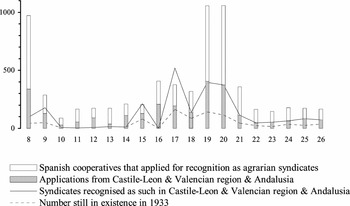
The 1906 Agrarian Syndicates Act (the principal legislation on cooperation in Spanish law before the 1936–9 Civil War) came into force in 1908, but until 1915 the societies it covered were not able to benefit from most of the tax exemptions that had been promised (Garrido, Reference Garrido1994). And, as can be seen in figure 2, it was not easy to benefit from its application before 1917. The increasing rural conflict that took place that year and during those immediately afterwards led to a revaluation of the contribution the cooperatives made to maintaining ‘social peace’, and from then on the 1906 law was applied without any kind of hindrance. Being able to obtain the preferential treatment the state supposedly granted must have been very important for the agrarian syndicates to operate properly, but the truth is that the average life of those started up in the 1920s continued to be very short. This was without doubt due to the fact that neither before nor after 1917 were any channels set up to facilitate access to credit.
The application of the Agrarian Syndicates Act, 1908–26.
Source: Garrido (1996: 76), Muñiz (1927), Dirección General de Agricultura (1934).

In a study on southern Europe, James Simpson (2000: 115) comes to the conclusion that the spread of cooperative wineries was strongly conditioned by the possibility of having long-term, low-interest state-backed loans at their disposal. French vineyard proprietors were entitled to them, but financial obstacles stopped cooperative wineries from being implemented on the other side of the Pyrenees. Of the approximately ninety wine cooperatives set up in Spain before 1923, seventy-five were in Catalonia, and seventy per cent of them had appeared between 1919 and 1923 (Pomés, Reference Pomés2000a: 160). This was not the only reason, but during those years there was a relatively efficient agrarian loan system operating in Catalonia, which was organised by the regional authorities and dismantled in 1924 by the Primo de Rivera dictatorship, and the wine cooperatives were its main beneficiaries (Pomés, Reference Pomés2000a: 159–72). Cooperatives that supplied productive factors required far lower initial investments, and this is what made it possible to set up so many in rural Spain. Nevertheless, they still needed to resort to loans to carry out their business. Since they received no aid from the state, whether they could operate in more or less favourable conditions or not depended on the financial capacity of the cooperatives themselves, and this, in turn, was a function of the total individual solvency of their members.
The role of farmers
The German credit cooperatives ‘perform the apparent miracle of giving solvency to a community composed almost entirely of insolvent individuals’ (cited by Guinnane, Reference Guinnane1994: 45). Spanish cooperatives did not. In Spain the result of a group of assetless small-holders coming together produced a cooperative without capital that could not obtain loans. ‘I cannot see any use for [the cooperative I have set up] if I cannot find anywhere willing to lend us money’, wrote a country priest in 1908. Because ‘without money’, complained another clergyman the following year, ‘we cannot stamp out usury . . . What do we achieve by bringing fertilisers and so on if the harvest comes and our members have to ask the usurer for money because we have none?’ (cited by Garrido, Reference Garrido1996: 92 and 94). The solvency of the cooperatives was only high when a substantial number of the members were prosperous farmers, or when they benefited from the protection afforded by some big landowner. The latter was sometimes the case,Footnote 15 but was by no means frequent, and in 1942 one old Catholic leader complained about the fact that before 1936 ‘the wealthy farmer . . . deliberately withdrew from the Catholic−agrarian syndicate movement because he did not believe he needed it nor did he wish his responsibilities to be mistaken for those of a more modest farmer’ (cited by Garrido, Reference Garrido1996: 89). We will see how, on occasions, a substantial number of the cooperative members were relatively wealthy people; however, the first Spanish cooperatives attracted mainly poor people (Garrido, Reference Garrido1996: 87–98).
Cooperation could provide the farmer with many advantages of an economic nature (the purchase of fertilisers or insecticides at prices below normal market prices, the sale of crops at higher prices, and so on). But benefiting from these advantages meant accepting a number of inconveniences. For instance, the credit sections of the agrarian syndicates, most of which followed the Raiffeisen system, demanded the solidarity and unlimited liability of their members; the banks also required the solidary liability of the cooperative members when they granted loans to a cooperative, as did the fertiliser suppliers when the cooperatives did not pay cash for the goods. On the other hand, once a farmer joined a cooperative he had to renounce a part of his entrepreneurial freedom,Footnote 16 since decisions that were previously made by himself (such as where to buy fertilisers, or when, to whom and for how much he would sell his crop) were now made collectively. Consequently, each social group of farmers adopted an attitude toward cooperation that was somewhere between the following two extremes.
At one of the extremes, smallholders showed a strong tendency to adhere. This was so because they normally considered the potential benefits of cooperation to be indispensable for the survival of their farms. Furthermore, the loss of entrepreneurial freedom was very limited for the small farmers and often did not even exist because, owing to their weak financial position, when they dealt on the market alone, both as buyers or as sellers, they did so in worse conditions than if they traded collectively. For instance, the urgency with which the smallholders often needed to obtain hard cash forced them to sell crops immediately after the harvest, when prices were lower. The Barberá Farm Workers’ Society (Sociedad de Trabajadores Agrícolas del Pueblo de Barberá), the first to set up a cooperative winery in Catalonia (1901), offers a good example of how the presence of a cooperative could mean a gain in entrepreneurial freedom for the humble. This society, which was mainly made up of landless peasants who worked under share-cropping contracts, was founded in 1894 in order to break
a hard agreement which had been in use for longer than could be remembered (in Barberá), according to which a vineyard owner always had the right to keep the tenant farmer's part for the general average price set in that area . . . Freedom to sell fruit . . . was the association's first victory and with it came a general modification in share-cropping contracts.
But its members immediately realised that ‘although [they had] become free to sell, [they had] become slave[s] to the buyer, . . . who, every year in late September, was waiting to exploit [them]’ (Cited by Mayayo, Reference Mayayo1994: 153). It was at that moment that the society decided to build (with the financial backing of a big republican landowner) the cooperative winery, in order to be able to regain a little more entrepreneurial freedom.
The large farmers were usually at the other extreme: to be a member of a cooperative meant accepting certain very powerful disadvantagesFootnote 17 when it came to gaining access to economic profits which, although they were seen to be positive, were in no way indispensable. It is true that their attitude toward the cooperatives could have been greatly conditioned by criteria concerning social and political opportunity: the interest the large farmers had in promoting cooperation was often inspired by ‘antirevolutionary’ motives, for prestige and because the cooperatives helped them to capture votes at election time. Nevertheless, it was quite usual for them to adopt a free rider behaviour when they joined one. In the correspondence received by the Jesuit Antonio Vicent, the great leader of the first Spanish confessional cooperatives, there are abundant references to this respect, like the one that follows, written in 1910 by the rector of Alqueria de la Comtessa, a Valencian town:
The wealthiest and most prominent in each village do not appear as members [of the Catholic syndicates] because, by purchasing [fertilisers] in regular quantities, they obtain the same or greater advantages individually without having to commit themselves to solidary liability. And although I have managed to register the rich in the Syndicate in Alqueria, they do not buy from the society and obtain their supplies from elsewhere – and that includes even the President himself!Footnote 18
Moreover, cooperation tended to provide the smallholder with favourable conditions for running a farming business, which was often seen by the landlords as an attack on their interests. On occasions, the landlords showed themselves to be extremely hostile toward the cooperatives,Footnote 19 and insofar as the situation analysed by Alberto Sabio (Reference Sabio1996) for the Aragonese region of Las Cinco Villas can be generalised (and it seems that it can be for a substantial amount of Inner Spain), this was understandable: at the beginning of the twentieth century, informal credit activities represented a guaranteed source of income for those who had sufficient liquidity to be able to lend money, created political dependencies in favour of the moneylenders, and granted them access from a privileged position, as buyers, to land and work markets. But what really acted as a factor to block cooperation was the free rider behaviour of the landowners who apparently gave their support, since this left the cooperative movement immersed in a sea of internal, difficult-to-resolve contradictions. To illustrate this I will take the examples of the cooperative wineries and the cooperative flour mills.
In the Catalan region of Penedès quite a considerable number of cooperative wineries were set up. But the most prosperous locals (who had the best land and produced the highest quality grapes) wanted to be free to sell their wine to whoever they chose. As the wineries needed to have the better off as members to be able to get credit, they often attracted the wealthy landowners by not including the principle of exclusivity (the obligation all members had to give their whole harvest over to the cooperative) in their statutes, and when it was included they were extremely tolerant with offenders (Saumell, Reference Saumell2002). However, if a cooperative society dealing in the commercialisation of produce does not adopt this principle the result is usually a loss of competitiveness: members will tend to give over only their worst quality produce to the cooperative, which will often be unable to work at its full capacity, leading to a rise in its unit costs.Footnote 20
Due to its size, the wheat sector was the one in which market regulation by cooperatives would have had the greatest social and economic repercussions. Yet the agrarian syndicates in the wheat-growing areas were only able to exercise this regulatory action in the few places where cooperative flour mills operated. These required huge investments and therefore also needed the involvement of wealthy landowners. But the wealthy landowners were not usually very interested in this kind of experiment as they often took advantage of seasonal price variations: they stored the harvest until prices were highest and then brought it onto the market. Meanwhile, the small farmer had to sell his produce at low prices and if he ran out of reserves he later had to repurchase it at high prices in order to have seeds to sow and grain to feed the family. Nearly all the cooperative flour mills set up in Spain before 1936 appeared during the years immediately after the First World War. This was triggered by the fact that in 1918, in an attempt to ensure a supply for consumers, the government enacted several legislative measures that favoured flour manufacturers at the expense of the interests of all the wheat producers (Ramon, Reference Ramon1999: 112–22). From the year 1920, when those legislative measures were repealed, the large landowners once again looked upon the flour cooperatives with scepticism. In 1922 an Aragonese Catholic syndicate (in the region of Las Cinco Villas) attempted to create one, but the project failed because of opposition from its own regional federation (Sanz, Reference Sanz1999: 551–4), which (like all the Catholic federations) was in the hands of rich landowners who showed little desire to get involved, in any but a nominal manner, in the projects run by the cooperatives.
In France the big landowners were more inclined to take part in cooperative life, and this enabled the local notables to have a political clientele. French family farms, on the other hand, were able to use the cooperatives as a way to gain access to technical services that helped them to consolidate themselves, to the detriment of the large estates. In the light of the results, Ronald Hubscher (2000: 146) posed the following question: ‘Paysans manipulés ou manipulateurs?’ In France, perhaps manipulators; in the Spanish case, the answer seems to be manipulated. It is true that family farms also managed to consolidate themselves in Spain, but the economic services cooperation offered them were of relatively little importance. Undoubtedly the key lay in the state intervention. In the same way the owners of large estates in Andalusia studied by Juan Martínez-Alier (Reference Martínez-Alier1968) were aware of the fact that tenant farming, more profitable in the short term than direct exploitation, would end up undermining the bases of their economic power, it is difficult to believe that the great French landowners did not take into account the long-term repercussions of lending support to the cooperatives. Since the state made it quite easy for cooperatives to gain access to loans, their dilemma was whether to participate in them or to allow cooperatives to develop without their mediation: the great French landowners decided to participate. Their Spanish counterparts were able to adopt an ambivalent attitude: they encouraged the spread of cooperation and acted as its leaders; at the same time, they were a hindrance to its development.
‘Non-business’ cooperatives?
A great deal of importance has been granted of late to ideological factors as elements to explain the success of cooperation in certain countries (for example Henriksen, Reference Henriksen1999: 57–61; Simpson, Reference Simpson2000: 116). This kind of argument has also traditionally been used in Spain, but in a negative sense: as most Spanish cooperatives were confessional, many authors have considered that the weakness of the Spanish cooperative movement was largely due to the ideological background that led the Catholics to act as its promoters. Emilio Majuelo and Angel Pascual (1991) claimed that Catholic cooperation was of a ‘non-business’ nature, and according to Pedro Carasa (Reference Carasa and Yun1991) the cooperation fostered by the Church was basically aimed at acting as an instrument for the social control and ‘moralisation’ of the peasantry, while loans or the improvement of agricultural technology were very much a secondary concern. I do not believe this was so, no matter how true it may be that the Catholics (like the patrons of non-confessional agrarian syndicates) sought to use their cooperatives to influence the behaviour of the rural population and that ideological factors did indeed play a part in bringing about the collapse of many of their organisations.
With regard to the French ‘right-wing agrarian syndicates’, Hubscher and Lagrave (1993: 115) have pointed out the pragmatism of their members: ‘prestataire de service, le syndicat doit prouver son efficacité sous peine d’être abandonné’. The Spanish case was not substantially different. As has been claimed for Italy (Piva, Reference Piva1981), the Spanish Church sought to make ‘specific Catholic use’ of certain agronomic theories and from the outset was very aware that the agrarian syndicates could only hope to gain their members’ trust by offering them cheap loans, by selling them high quality fertilisers or by granting them access to machinery. What happened was that to accomplish their aims fully the project needed the support of the big landowners, who only gave it to a limited extent.
The Catholic cooperatives were, and wanted to be, businesses. If they often did not manage to become efficient, this was partly due to the characteristics of the Catholic form of cooperation. The Church wanted to organise the small and middle farmers to keep them away from the more radical social and political proposals, but did not trust its own bases and feared that the controlled mobilisation in a conservative direction that they advocated would slip out of their hands. To prevent this, the Catholics were very strict when it came to admitting new members and membership was by no means open to everybody. Furthermore, the management systems they adopted were deeply antidemocratic. In theory, the Spanish Catholic syndicates followed the principle of one man, one vote, but in practice members’ opinions were barely taken into account and the boards of directors resorted to very effective procedures to remain in their positions and to impose their will (Garrido, Reference Garrido1996: 242–51). One unintentional consequence of the lack of control was that it helped fraud to become widespread. If they were the object of some kind of swindle, or if the decisions made by honest directors led to economic losses, the members did not see themselves as being responsible and left the syndicate. When one organisation disappeared for this reason it was very difficult, in the short term, for another one to start up again in the town, because the former members as well as their neighbours now tended to distrust the cooperatives. Thus, the Catholics, the main promoters of cooperation in Spain, helped to create an anti-cooperative feeling among certain Spanish farmers.
Why did cooperatives succeed?
In contrast to the general weakness of the Spanish cooperative movement, some economically very powerful cooperatives, which were essentially devoted to supplying fertilisers and loans, did appear in certain regions of the northern half of the Spanish peninsular. They were usually set in areas of irrigated land where commercial farming had been very dynamic from the nineteenth century, and were especially abundant in the Valencian Region. They often had more than a thousand members and were supported by a heterogeneous social base, made up of wealthy landowners, middle farmers, smallholders, and even landless labourers (Garrido, Reference Garrido1996: 175–86). The common feature these cooperatives shared was that they all had the support of a relatively large number of family farmers who were in charge of middle-sized farms and, thanks to their capacity to accumulate, were gradually going up in society. By way of example, I could cite two syndicates in Algemesí and Vila-real, towns situated in the heart of the Valencian orange-growing area. The ‘Sagrado Corazón’ syndicate in Algemesí had 1,557 members in 1919, forty-nine per cent of whom were landless labourers, twenty-seven per cent were smallholders, twenty-two per cent were middle farmers, and the remaining two per cent were wealthy farmers. The ‘Católico-agrario’ syndicate in Vila-real had a total of 1,168 members by the end of the same year, and these proportions were forty-seven, thirty-one, twenty and two per cent, respectively. Hence, middle farmers only made up about twenty per cent of the members but, both in Algemesí and in Vila-real, they held sixty-two per cent of all the land owned by them.
The organisations with these characteristics were few and far between during the early years of the twentieth century and the vast majority of those that existed in 1936 were set up during the First World War or immediately afterwards. Like the great landowners, prior to 1914 the middle-sized farmers in these areas had shown little willingness to become part of, that is to say, to hand over part of their entrepreneurial freedom to, the cooperatives. But during the years of conflict in Europe, when fertilisers were scarce and their prices rose steeply, they began to see cooperative purchasing as the best (and sometimes the only) way of obtaining them. Unlike the cooperatives that were made up of just small farmers, the ones joined by the middle farmers could obtain loans quite easily, generated an important business turnover and benefited from substantial economies of scale. All this enabled them to avoid being unsuccessful and (providing they were not badly run) to undergo continual growth during the 1920s and 1930s.
Thanks to the services they received from cooperatives of this sort, the economically weaker members saw how the danger of seeing their assets diminish receded, and many former landless labourers were able to gain access to ownership. Yet, the main role played by these cooperatives was to strengthen the social group that acted as their driving force: middle farmers of peasant origin who in regions like Valencia or Catalonia were promoting a new agrarian capitalism (Calatayud and Millán, Reference Calatayud and Millán1994). Unfortunately, there are no global data available that allow us to carry out an accurate evaluation of the magnitude of the phenomenon, but a number of local cases have been studied. In Vila-real, for example, in the early years of the twentieth century large areas of what until then had been bad dry-land (secano) were converted into orange groves, almost always thanks to an enormous amount of unpaid work put in by peasant families. As irrigation and citrus crops advanced, the number of agrarian landowners also rose from 3,263 in 1885 to 5,091 in 1920. As a result, many people became the owners of tiny plots, but there was also a significant increase in the number of ‘middle’ owners (from 654 to 900) and ‘large’ owners (from 71 to 117). Around 1930, the vast majority of medium-sized owners belonged to one of several agrarian cooperatives which operated in the town, and which undoubtedly played a key role in the functioning and activation of local agriculture (Garrido, Reference Garrido2000). The reason why a higher number of similar organisations did not appear in Spain is easy to deduce: ‘in Spain it was not very common to find middle-sized farms that were capable of maintaining the peasant family and meeting the most pressing financial needs of the farm’ (Jiménez-Blanco, Reference Jiménez-Blanco1986: 118). In the case of Vila-real cited above, which exemplifies what was taking place in the dynamic huertas of the Spanish Mediterranean coast, in 1885 medium-sized owners accounted for twenty-two per cent of all the landowners. It must be remembered, however, that, according to Malefakis (1982: 481 and 31), well into the twentieth century they represented barely 7.5 per cent in Spain as a whole, where ‘smallholding is as abundant [. . .] as medium-sized ownership is scarce’. In France, cooperation played a decisive role in the expansion of middle-sized farms (Simpson, Reference Simpson2000); Spanish cooperation only did so in places where middle-sized landowning had already been strongly present before the arrival of cooperatives.
Conclusions
This study has tried to show that combining explanations from different disciplines is the best way to understand the motives behind cooperation, its rhythms and its morphology. The success or failure of cooperatives depended on economic factors, but also on other factors of a social or political nature. In the early twentieth century a significant portion of European agrarian cooperation was sponsored by large landowners, claimed to have an ‘antisocialist’ vocation and showed itself to be especially active as far as economic issues were concerned when social relationships were at their tensest, only to decline again afterwards. Moreover, cooperatives were often founded as a means of wooing votes at election time, in a period when ‘mass politics’ advanced in the rural world and the peasantry became important as an electoral force. Thus, explanations that disregard this complex interaction of factors are very likely to be oversimplifications and of little use.
At the beginning of the twentieth century numerous laws were passed in order to further the diffusion of cooperation in Spain. Although these had several objectives, the main aim was to provide a suitable framework in which agrarian activity could be modernised and improved. It was partly thanks to this new legal framework that many cooperatives were set up. However, cooperatives usually appeared with the intention of influencing election outcomes. In consequence, the cooperative movement was quickly viewed as a politically disturbing phenomenon by those who controlled the state apparatus and who were generally quite reluctant to allow the new mass politics to spread to rural areas. Despite having acted initially as one of its great promoters, in practice the state subsequently took little notice of the needs of the Spanish cooperatives.
Thus, unlike countries where the public authorities developed an effective policy concerning cooperatives, in Spain cooperatives usually depended solely on their solvency to gain access to credit. As the majority of Spanish cooperatives were almost exclusively made up of smallholders, most of them had to face financial difficulties and would have needed the protection of large landowners to operate in a satisfactory manner. Partly because the state was not being run efficiently either, the landlords did not protect cooperatives and so failure was rife. From the last decades of the nineteenth century, the intensive use of unpaid family work was one of the main factors that granted the family farm a competitive advantage over the large farm that made use of paid work. Yet, the capacity of a cooperative of small farmers to compete with non-cooperative firms in the same business was basically determined by their capital – a scarce factor for most Spanish cooperative members and, therefore, also for their cooperatives.
But there were significant exceptions, because some cooperatives (few in relative terms, but quite a respectable number in absolute terms) stood out above the rest due to their entrepreneurial dynamism. They can be found scattered all over Spain, in areas where the most diverse crops dominate the local agricultural activity. An explanation as to why that type of institution exists must therefore take into account extremely varied case material, but what I have tried to stress here is that a dense concentration of very dynamic cooperatives only came into being in certain areas that satisfied two characteristics. On the one hand, from at least the second half of the nineteenth century, they had a great capacity to cope with changes in crop in response to new market opportunities. At the same time, they had an important (and, as time went by, growing) layer of medium-sized farmers with an unquestionable capacity to accumulate while circumstances were favourable. Such farmers were, without doubt, the ones who gained most advantage from cooperation in Spain during the first half of the twentieth century.
As I said at the beginning of this paper, it is not easy to determine whether, after the Great Depression, the development of cooperation was one of the causes or the effect of the structural evolution of European agriculture. However much there were feedback mechanisms at play, the Spanish case seems to corroborate Niek Koning's assertion (1994: 27–8) that it was the effect.