1 Introduction
Social presence is considered by some CMC researchers (e.g. Gunawardena, Reference Gunawardena1995; Garrison, Anderson & Archer, Reference Garrison, Anderson and Archer2000; Ubon & Kimble, Reference Ubon and Kimble2003; Lobry de Bruyn, Reference Lobry de Bruyn2004) as a key factor in determining the effectiveness of learning. Effectiveness in this study is defined as having “a strong causal relationship between an intervention, such as the use of a particular item of technology in a learning situation and a discernible change in the learning process, the learning climate or the learning achievement” (Felix, Reference Felix2005: 4). For Ubon and Kimble (Reference Ubon and Kimble2003), social presence makes learning effective because “it helps increase social interaction, encourage learning satisfaction, initiate in-depth discussions and promote collaborative learning” (op. cit.: 2). When learners perceive a higher degree of social presence, they are more likely to engage in higher order critical thinking (Rourke, Anderson, Garrison & Archer, Reference Rourke, Anderson, Garrison and Archer1999; Garrison et al., Reference Garrison, Anderson and Archer2000), and to be more satisfied with their instructor (Richardson & Swan, Reference Richardson and Swan2003) and learning experience (Gunawardena & Zittle, Reference Gunawardena and Zittle1997; Richardson & Swan, Reference Richardson and Swan2003). A paucity of social presence can cause more frustration (Ubon & Kimble, Reference Ubon and Kimble2003) and reduce the consciousness of learning (Yamada, Reference Yamada2009).
Visual cues are an essential aspect of establishing social presence in face-to-face learning settings. Providing multiple nonverbal or paralinguistic cues, a face-to-face context is a rich medium for oral communication (Garrison et al., Reference Garrison, Anderson and Archer2000). Social climates created by CMC are different from those in a traditional face-to-face classroom. Even two-way interactive video and audio media, which can transmit facial expressions, gestures, and tone of voice, create interaction patterns that are different from face-to-face communication patterns (Gunawardena, Reference Gunawardena1995).
The lack of visual and verbal cues has been shown to produce different effects on students’ learning. Hampel (Reference Hampel2006) indicated that a lack of such cues in an oral interaction environment could cause anxiety and lower motivation. Yamada and Akahori (Reference Yamada and Akahori2007) also found that the learners who used non-image systems in their study had higher communication anxiety due to the lack of social cues such as nodding. For Wang (Reference Wang2006), the availability of visual cues is helpful for distance learners to negotiate the meaning in online communication and to build a learning community, which is “an essential social environment for effective language learning” (Wang, Reference Wang2004: 106). Without visual cues, tutors need to work harder to create a sense of community in a learning environment (Hampel & Stickler, Reference Hampel and Stickler2005).
However, the paucity of nonverbal cues can also have positive effects on students’ learning. For example, the participants in the synchronous written chat group in Sykes's (2005) study were found to communicate more explicitly. Sykes examined a group of Spanish learners’ pragmatic development (refusals of an invitation) in three types of learning environments (synchronous written chat, synchronous oral chat and traditional face-to-face discussion) and discovered that the written group outperformed the other two groups in relation to complexity and variety of strategies. The lack of nonverbal cues can also reduce highly apprehensive communicators’ nervousness and inhibition, and increase their interpersonal interaction and relational social presence (High & Caplan, Reference High and Caplan2009; Keaten & Kelly, Reference Keaten and Kelly2008; Yildiz, Reference Yildiz2009).
Short, Williams, and Christie (Reference Short, Williams and Christie1976) suggested that people perceive a higher degree of social presence in some communication media than in others. When a medium is used for an educational purpose, teachers have to question if the chosen communication channels are beneficial to students’ quality of learning. Compared to audio and video-based forms of CMC, the application of text-based CMC in education to the establishment of social presence may be more questionable, since nonverbal cues are lacking in this environment. When cues are fewer, social presence is lower, and when social presence decreases, so does sense of community (Rovai, Reference Rovai2002). Students who perceive a higher degree of social presence in a community will be more willing to participate actively in group and community activities.
Based on the above arguments, this study investigates the impacts of different synchronous CMC environments on language learners’ perception of social presence.
2 Background literature
2.1 The concept of social presence
Social presence theory was developed by Short et al. (Reference Short, Williams and Christie1976) at a time when computer mediated communication had not yet been conceptualized. They defined social presence as the “degree of salience of the other person in the interaction and the consequent salience of the interpersonal relationships” (op. cit.: 65). With its main focus on telephony and telephone conferencing, social presence theory was developed to explain the impacts of a communication medium on the way people communicate and interact.
According to Short et al. (Reference Short, Williams and Christie1976), social presence was regarded as an attribute of a communication medium. They speculated that communication media differ in their degree of social presence, which is determined by its “capacity to transmit information about facial expression, direction of looking, posture, dress and nonverbal cues” (op. cit.: 65). For them, some communication media are perceived by communicators as having a higher degree of social presence (e.g., video) than others.
The origin of social presence lies in two social psychology concepts: intimacy (Argyle & Dean, Reference Argyle and Dean1965) and immediacy (Wiener & Mehrabian, Reference Wiener and Mehrabian1968). Intimacy is “a joint function of eye-contact, physical proximity, intimacy of topic, smiling, etc.” (Argyle & Dean, Reference Argyle and Dean1965: 293). According to Argyle and Dean's intimacy equilibrium theory, changes in one dimension, e.g. increasing physical proximity, will result in compensatory changes in the other dimensions. For example, “reducing eye-contact makes greater proximity possible, and that greater proximity reduces eye-contact” (op. cit.: 304).
Immediacy refers to “the relationship between the speaker and the objects he communicates about, the addressee of his communication, or the communication itself” (Wiener & Mehrabian, Reference Wiener and Mehrabian1968: 3). It is generated by both verbal and nonverbal behaviours (Gunawardena, Reference Gunawardena1995). Two forms of immediacy are distinguished: technological immediacy and social immediacy (Tu, Reference Tu2001). Technological immediacy can be achieved by transmission of the maximum amount of information; social immediacy can be conveyed by speech with its associated verbal and nonverbal cues.
Short et al. (Reference Short, Williams and Christie1976) hypothesized that language may replace or even overcompensate for missing nonverbal information. In their telephone conferencing research, they noticed that reduction of cues caused participants to change their behaviour. This principle of cue substitutability, supported by Argyle and Dean's equilibrium theory, suggests that other symbol systems can be adopted by communicators in order to express affective messages in contexts where nonverbal cues are unavailable (Gunawardena, Reference Gunawardena1995), such as text-based CMC.
2.2 Social presence and Communicative learning
Communication researchers started applying social presence theory to CMC in the late 1980s and early 1990s (Lowenthal, Reference Lowenthal2009). The theory has had a considerable effect on CMC research over the years, and the concept has been redefined by some CMC researchers. Garrison et al. (Reference Garrison, Anderson and Archer2000) defined social presence as “the ability of participants in a community of inquiry to project themselves socially and emotionally, as ‘real’ people (i.e., their full personality), through the media of communication being used” (op. cit.: 94). Biocca, Harms and Gregg (Reference Biocca, Harms and Gregg2001) defined social presence as “the moment-by-moment awareness of the copresence of another sentient being accompanied by a sense of engagement with the other” (op. cit.: 2).
The original social presence theory assumed that contact is in direct proportion to presence: more contact will increase social presence. According to the theory, the degree of social presence is equal to the degree of awareness of the other communicator in an interaction, which can be appreciably influenced by factors such as facial expression, direction of gaze, posture, dress, nonverbal and vocal cues (Tu, Reference Tu2001). Communication is considered effective when communication media have the appropriate social presence necessary for the level of interpersonal involvement that a task requires. According to the theory, face-to-face communication creates the most social presence and text-based CMC creates the least.
In face-to-face communication, nonverbal cues can enhance interaction (Ubon & Kimble, Reference Ubon and Kimble2003). These cues have three functions: discourse functions closely related to speech production and understanding; dialogue functions related to turn-taking signals and back-channel signals that serve to smooth the flow of interaction; and socio-emotional or relational functions that influence a person's perception and impression formation (Bente, Rüggenberg, Kramer & Eschenburg, Reference Bente, Rüggenberg, Kramer and Exchenburg2008). The loss of nonverbal cues can lead to misunderstanding (Thompson-Hayes, Gibson, Scott & Webb, Reference Thompson-Hayes, Gibson, Scott and Webb2009; Wang, Reference Wang2006; Yildiz, Reference Yildiz2009) or unemotional responses, as they serve to help communicators express their own emotions and decode or recognize others’ emotions; or undersocial communication, as they may cause communicators to be less aware of the other person (Derks, Fischer & Bos, Reference Derks, Fischer and Bos2008). In comparison to face-to-face communication, text-based CMC appears to be extremely low in social presence due to its lack of nonverbal cues and feedback (Walther & Burgoon, Reference Walther and Burgoon1992).
Different forms of text-based CMC environments may affect the social presence that learners construct (Tu, Reference Tu2001). According to social presence theory, learners’ social presence may be lower in asynchronous text chat due to the absence of immediacy, which enhances social presence (Gunawardena, Reference Gunawardena1995). Some students in So and Brush's (2008) blended-format course perceived that online communication media such as online forums had limited capacity to create a level of intimacy and immediacy due to their asynchronous nature. They considered that the lack of immediate feedback and synchronicity as negative aspects of their online collaborative learning.
Nevertheless, Walther (Reference Walther1992) noticed that communicators in a text-based CMC environment try to achieve desired levels of immediacy by manipulating verbal cues. They develop an ability to express emotion in written form (Gunawardena, Reference Gunawardena1995) by using paralanguage or emoticons to substitute for missing nonverbal cues (Gunawardena & Zittle, Reference Gunawardena and Zittle1997; Tu, Reference Tu2001; Ubon & Kimble, Reference Ubon and Kimble2003), and to give affective information and show informality. In Lomicka and Lord's (Reference Lomicka and Lord2007) study, a group of foreign language teachers used a number of verbal cues (e.g., vulnerability, self-constructive comments, compliments, encouragement, asking questions, advice/opinion, agreement, salutations, the use of names and the expression of feeling) to develop social presence.
For Garrison et al. (Reference Garrison, Anderson and Archer2000), emotional expressions are crucial to communication because they can contribute to social presence development among individuals. They emphasized two examples of emotional expressions – the expression of humour and self–disclosure, “a sharing of feelings, attitudes, experiences, and interests” (op. cit.: 100). Mazer, Murphy, and Simonds (Reference Mazer, Murphy and Simonds2007) reported that Facebook users can develop high levels of social presence through narrative self-disclosure.
In addition, appropriate course structure and activities could increase learners’ perception of social presence (Yildiz, Reference Yildiz2009). So and Brush (Reference So and Brush2008) found that learner-learner collaborative learning activities could generate more interactions and increase their perceived feelings of mutual connection. Similar results have also been found in Arnold and Ducate's (Reference Arnold and Ducate2006) study on a group of future foreign language teachers’ asynchronous interactions. Without the instructors’ participation in the participants’ online bulletin board discussions, social presence behaviours (emotional support, open communication and group cohesion) constituted the majority of the learners’ online activity. The above results differ from those of Meyer's (Reference Meyer2003) study where low levels of social presence were found in the learners’ interactions. Meyer explained that the results could be caused by the fact that as the learners met face-to-face in addition to asynchronous online discussion, they might not consider it necessary to maintain online personal relationships.
Social presence in synchronous CMC (SCMC), where responses are received in real time, is greater than in asynchronous CMC (ACMC) (Levy & Stockwell, Reference Levy and Stockwell2006). SCMC, effective in communication skills instruction in second language acquisition (Yamada & Akahori, Reference Yamada and Akahori2007), allow diverse types of interaction involving text, audio, and audio/video chats. Although synchronous text chat does not accommodate nonverbal behaviour, its immediacy, one of the features of social presence, seems to facilitate communication (Yamada, Reference Yamada2009). English learners in Krish's (Reference Krish2008) study were observed to adapt some behaviours to build their social presence while participating in an online synchronous text-chat tutorial. Those behaviours observed included agreeing and disagreeing, showing enthusiasm, correcting peers, expressing opinions and correcting incorrect words used.
Nonetheless, the power of nonverbal behaviours goes beyond immediacy. For Yamada (Reference Yamada2009), social cues “seem to play an important role in both enhancing social presence and promoting effective communicative language learning” (op. cit.: 831). He (Yamada & Akahori, Reference Yamada and Akahori2007; Yamada, Reference Yamada2009) examined learners’ perception of social presence in four types of SCMC: videoconferencing (image and voice), audioconferencing (voice but no image), text chat with image (image but no voice), and plain text chat (no image and no voice), and found that the simultaneous existence of image and voice allows learners to have a better perception of presence, since it could raise learners’ consciousness of natural communication that is similar to a face-to-face communication. All participants who used a form of SCMC where their partner's image was available reported a positive effect on English communication. Resulting in more active communication, the availability of image could enhance the perceived ease of communication, help learners to better understand their partner's situation (Yamada, Reference Yamada2009), and therefore raise their consciousness of accuracy (Yamada & Akahori, Reference Yamada and Akahori2007). Without image, the participants felt it difficult to communicate in the second language. Nevertheless, Bente et al. (Reference Bente, Rüggenberg, Kramer and Exchenburg2008) found that avatars also seemed to possess a similar function as image in terms of nonverbal activity and visual attention.
Tu and McIsaac (Reference Tu and McIsaac2002) suggested four dimensions and a number of variables for researchers to examine CMC learning from a social presence perspective. The dimensions they proposed consist of social context, online communication, interactivity and privacy. They examined social presence in an online learning environment, where the participants were 51 graduate level students. The findings of their qualitative data showed that social contexts, such as familiarity with recipients, informal relationships, better trust relationships, personally informative relationships, more private locations and positive psychological attitude towards technology, positively influence learners’ perception of social presence. Some researchers (Hampel & Hauck, Reference Hampel and Hauck2004; Wang, Reference Wang2004; Sykes, Reference Sykes2005) pointed out the adverse influences of technology problems on students’ learning outcomes. Students may feel frustrated and dissatisfied with the course when they encounter difficulty using technology early in a course (Benoit, Benoit, Milyo & Hansen, Reference Benoit, Benoit, Milyo and Hansen2006).
In addition, Tu and McIsaac's qualitative data revealed that keyboarding skills, expressiveness, characteristics of discussion, and language skills support online communication. Since text-based CMC users communicate with each other through typing, reading and writing, they need to possess a certain level of computer communication skills. Those who are not able, or who believe they are not able, to type, read or write well may experience communication anxiety (Gunawardena, 1991, cited in Tu, Reference Tu2000).
Interactivity includes collaborative activities and communication styles used by CMC users (Tu, Reference Tu2000; Reference Tu2001). The possibilities for receiving feedback from another person can contribute to one's degree of salience in the interaction (Tu, Reference Tu2001). Immediate responses also enhance interactivity and increase the level of social presence. For Gunawardena (Reference Gunawardena1995), social presence can be created when one notices interactivity in a CMC environment. Tu and McIsaac (Reference Tu and McIsaac2002) suggested that timely response to CMC messages, use of stylistic communication styles (e.g. attentive, relaxed, friendly, open, personal and so on), casual conversations, appropriate message length, particular task types (planning, creativity, intellectual, decision-making, and social tasks), and suitable group sizes can have a positive effect on one's feeling of interactivity.
Privacy also influences the degree of social presence (Tu, Reference Tu2001). The level of privacy is influenced by CMC users’ perception in addition to the actual quality of security of CMC systems (Tu, Reference Tu2002). When users perceive less privacy in a setting where they access CMC, their perception of social presence decreases. (Tu, Reference Tu2001). In Tu and McIsaac's (2002) study, the participants ranked e-mail as the most private system and bulletin board as the least private. One-to-one real time discussion is considered more private than many-to-many real time discussion. CMC users who have a better knowledge of computer systems will perceive low privacy because of insecurity of the systems (Tu, Reference Tu2002).
As far as I know, to date, little research has investigated the effect of different communication media on beginning-level foreign language learners’ social presence in the acquisition of communicative competence. This study aims to explore the effect of different communication media on FFL beginners’ social presence development in the process of learning productive skills and to provide a picture of how those media affect their social presence.
3 Methodology
3.1 Participants
The twelve beginning-level FFL Students (ten females and two males) were from diverse disciplines at a university in Taiwan. Their ages ranged from 19 to 23. They met in a two-hour basic French course every week. Before this study, they received only one semester of basic French instruction from the researcher as their instructor. All of them were living in the university dormitory and most of them were in the habit of daily surfing the Internet before the study.
3.2 Technology tools
This research was conducted with the use of webcams and/or headsets (with microphones attached) in synchronous CMC environments. The software used in this study was MSN Messenger, a successful chat program through which one can interact instantly with peers. It “creates an interface in which one can form a buddy list, consisting of people one regularly chats with” (Derks et al., Reference Derks, Fischer and Bos2008: 6). For Cziko and Park (Reference Cziko and Park2003), the audio capability of MSN Messenger is excellent because “it is capable of high-quality, full-duplex voice communication with short latencies” (op. cit.: 20). Conversations carried out through MSN Messenger are much like conversations held by telephone. Moreover, all the participants had got used to communicating with their friends or families through MSN Messenger before the study, which could reduce the impact of unfamiliarity with the software on their learning. Thus the choice of MSN Messenger was considered suitable for the synchronous CMC spoken interactions of this study.
Before the start of the study, I distributed to each of them an identical set of webcam and headset (with a microphone attached). The participants were trained to use the tools before the first task.
3.3 Procedure
My research adopted a case study approach, which can allow researchers to observe cause-effect relationship in the study context and to “penetrate situations in ways that are not always susceptible to numerical analysis” (Cohen, Lawrence & Keith, Reference Cohen, Lawrence and Keith2003: 181). The research instruments selected consisted of the participants’ interview transcriptions, learning journals, and the instructor's observation journal. The choice of these instruments was motivated by my belief that interviews can allow access to those data that researchers cannot observe (Merriam, Reference Merriam1990); and that journals can provide insights into personal teaching and learning experiences over the course of the study (Burgess, Reference Burgess1984).
The twelve students participated voluntarily after my presentation about the study (i.e., what data would be collected from them, how their data would be used). After the recruitment, they were divided into three groups. Four of the students (C, D, G, H) were paired with a partner they were not familiar with as I decided to examine the factor ‘familiarity’, which is a key factor in educational performance from the educational perspective (Yamada & Akahori, Reference Yamada and Akahori2007).
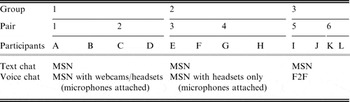
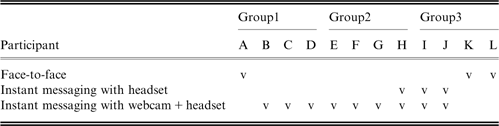
At the beginning of the study, the participants were allotted two weeks to get familiar with the technology tools and their task partner. Then they were required to complete the first task, which involved instant exchange of an online text-based CMC with their assigned partner from their rooms at the university dormitory. After their first text chat, students in Groups 1 and 2 carried out the first oral task with their partner in voice-based CMC environments (Group 1 with the use of webcam and headset; Group 2 with the use of headset only) from their rooms. Students in Group 3 arranged a time to meet face-to-face to carry out the same oral activities during week 3 (see Table 1).
Practice between participants

The study constituted cycles of three-week practice on three tasks (see Table 2). The task practice procedures and task content were posted on the class website in order for learners to follow the design of the study and complete the tasks appropriately. The content of the three tasks were inter-connected. The learners started by introducing themselves and one of their best friends to their partner. In the second task, they had to describe their daily life to each other based on their timetable. The third task was an invitation to go on a trip. Working from their personal timetable, they planned a trip to Nice. They had to work out together the details for this trip (e.g. the departure and return dates, the trains they would take) by exploring the website of the French national railway company.
Task Content

3.4 Data analysis
The data for this study were collected from participants’ interview transcriptions, learning journals, and the instructor's observation journal. The frequency of participants’ words in their interview transcriptions and learning journals was calculated and results are presented in Tables 3–8. Quantified summaries of those words provided a general idea of the frequency of activities or the strength of their feelings about those activities. Data analysis revealed several themes, which I interpreted in terms of their implications by exploring their interconnections and relation to the aims of this research.
4 Results
In this study, all the participants had to carry out the pre-tasks in the text-based CMC environment, where nonverbal cues are not available. They then performed the main oral tasks in three different learning situations: face-to-face, synchronous CMC with headset, and synchronous CMC with webcam and headset. Among the three situations, nonverbal cues are lacking in the synchronous CMC with headset learning mode. And even though visual cues are available in the two other environments, the participants’ interaction patterns created by them may be different. In the following sections, I present how these different learning environments affected the participants’ social presence.
4.1 Synchronous text chat
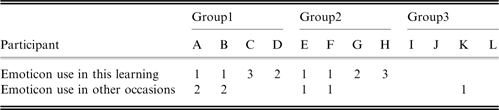
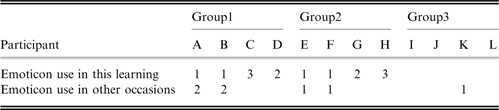
The eight participants in Groups 1 and 2 said that they used MSN emoticons in synchronous CMC text communication (Table 3). But Participants C, D, G and H used emoticons more often than the others. Intriguingly, these four participants did not know their partner before the study; it seems that the level of familiarity influenced the participants’ use of emoticons.
The use of emoticons in the MSN written communication
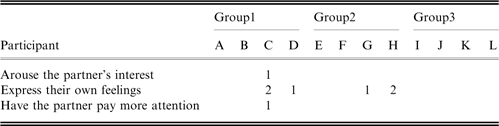
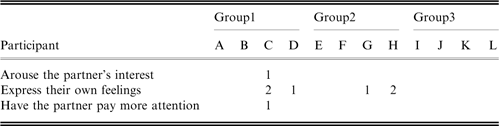
All the four participants considered the use of emoticons in their text discussion could allow their partner to know their feelings (Table 4). For Participant C, the use of emoticons could also attract her partner's interest and attention.
Reasons for using emoticons
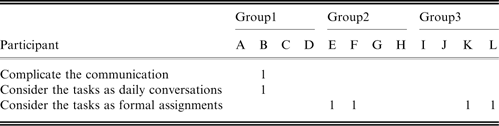
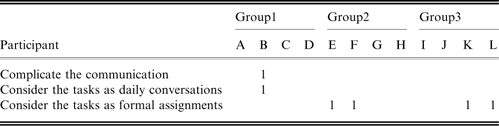
Although Participants A, B, E, and F also used emoticons in their MSN text communication, they actually used them less here than in other daily situations (Table 3). Participants E, F, K and L said that they did not use or avoided using emoticons because they considered the tasks to be formal assignments. For them, the use of emoticons would have increased the informality of the tasks (Table 5).
Reasons for not using emoticons
Participants E, F, and K pointed to the lack of visual cues as one disadvantage of the text-based communication, which can make the medium less personal. For Participant K, this paucity of visual cues might have had a bigger impact on his perception of social presence because he did not usually get immediate responses from his task partner.
E: Through typing, you cannot feel …
F: … your partner's emotions.
Interviewer: Do you consider it's a problem that you could not see your partner while doing the MSN tasks? …
K: Yes …sometimes through the MSN, I talk with a friend but don't get his/her immediate replies or he/she disappears suddenly …
Interviewer: With L, could you usually get his replies immediately?
K: Sometimes there were pauses …
Two participants (C and D) used the webcam in their MSN text communication, because they wanted to see each other's image. For Participant C, emoticons and the webcam had the same function – to convey feelings. When nonverbal cues are available through the webcam, her reason for using emoticons was reduced.
Interviewer: In this case, did you still feel the need to use emoticons when you used the webcam?
C: I felt less need when I used the webcam.
Interviewer: You just wanted to let your partner know how you really felt…
C: Yes. It's a kind of assistance…If I have to choose between the webcam and emoticons, I prefer the webcam … I would use less emoticons if I could use the webcam, since I could see my partner.
4.2 Oral chat in the three different learning environments
In addition to text-based communication, the participants in this study carried out the oral tasks in three different situations, which created different interaction patterns between them.
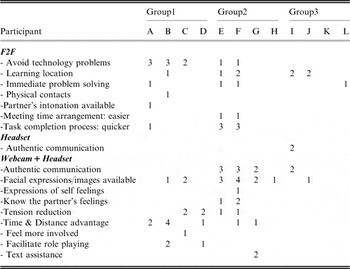
According to the participants, the level of immediacy was higher in face-to-face learning environments. Without technology problems, they considered problem solving was quicker, sound recording was more efficient, and meeting time arrangement was easier (Table 7). In addition, physical contact and intonation are available in face-to-face communication. And since they could perform the oral tasks wherever they want, their perception of privacy in the face-to-face learning mode was higher in comparison to the other two synchronous CMC modes.
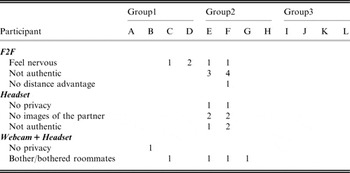
Nevertheless, some participants (C, D, E, F) thought face-to-face oral communication would make them feel more nervous and less real (Table 8). In addition, the advantage of distance was lacking in face-to-face situations.
As to the synchronous CMC with the use of headset learning mode, only Participant I was of the opinion that it could possibly provide her with more authenticity than face to face, since the latter mode did not allow her to feel involved in real communication with others. However, Participants E and F, who had experienced this learning mode, perceived a lack of authenticity in this environment because images were not available.
I: … I think I probably like least f2f mode. …
Interviewer: Why?
I: … I think the other two modes will …make me feel more real…I just think if I use the other two modes, I might … have the feeling that I really communicate with others.
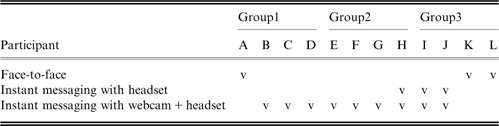
Synchronous CMC with the use of webcam and headset was the favourite learning mode of most participants (Table 6). Many took the view that the use of webcam allowed them to see mutual facial expressions and express each other's emotions, which made them feel more real (Table 7). For Participants B and D, the webcam promoted the simulation of the tasks, which better involved Participant B in doing the oral tasks.
Participants’ perception of their preferred learning environment after the study
Participants’ views about the advantages of three learning environments

Participants views about the disadvantages of three learning environments

The other advantages of the learning environment suggested by the participants included the reduction of tension and the flexibility of time and distance (Table 7). Participant G gave the opinion that synchronous CMC with the use of webcam and headset is a rich learning medium because of the simultaneous availability of images, texts and voice. With her partner, they sometimes turned on the webcam, which was not included in their learning mode, to get each other's nonverbal cues in the spoken practices.
G: With the webcam, I can see my partner's facial expression and gestures. I can know better what he/ she wants to say.
To sum up, the participants perceived the highest level of social presence in the synchronous CMC environment using webcam and headset, and the lowest in the synchronous CMC environment with headset only.
5 Discussion
The results showed that the three learning modes had different impacts on how social presence was perceived by the participants. The learners’ perception of social presence was highest in the CMC with webcam and headset, and lowest in the CMC with headset only. And they perceived the highest immediacy in the face-to-face environment.
The main factors that impacted on the participants’ perception of social presence in these three learning modes were the availability of nonverbal cues, peers’ immediacy, and the feeling of being ‘real’. The other factors were familiarity with their partners (Manstead, Lea & Goh, Reference Manstead, Lea and Goh2008), the location in which they performed the oral tasks and their perception of distance between each other (intimacy).
Although visual cues are available in both synchronous CMC with webcam and headset and also face-to-face, the participants favoured the former, where they perceived themselves to be more real persons. Doing the oral tasks in the face-to-face context gave Participants I and J a feeling that they were doing assignments.
The participants’ perception of mutual distance was the other factor that influenced their preference for the synchronous CMC using webcam and headset. Participants E and F stated that they would have been more nervous if they had carried out the oral tasks with someone unfamiliar in a face-to-face situation, which was confirmed by the evidence from Participants C and D. Unknown to each other before the study, they said they felt less nervous speaking through the webcam than face-to-face. For these four participants, the level of intimacy in face-to-face communication was higher, which generated more discomfort between the two unfamiliar communicators. This finding provides negative evidence against the assumption of the original research into social presence, namely that contact enhances social presence; it suggests rather than an appropriate level of contact can better enhance the learners’ social presence.
In the text-based CMC environment, the participants’ social presence was mostly enhanced by the use of emoticons. As noted in previous text-based CMC studies, the function of emoticons in this study was to substitute for missing nonverbal cues (Gunawardena & Zittle, Reference Gunawardena and Zittle1997; Tu, Reference Tu2001; Walther & D'Addario, Reference Walther and D'Addario2001; Ubon & Kimble, Reference Ubon and Kimble2003) and to express learners’ affect (Rourke et al., Reference Rourke, Anderson, Garrison and Archer1999; Tu & McIsaac, Reference Tu and McIsaac2002). Some participants claimed that the lack of visual cues made text-based communication difficult and less personal (Baralt & Gurzynski-Weiss, Reference Baralt and Gurzynski-Weiss2011). In addition, as found in Rourke et al.'s (Reference Rourke, Anderson, Garrison and Archer1999) study, a few of them (e.g. participants C and D) conveyed their feelings by self-disclosure, which also enhanced their social presence.
D: I'm shy to speak in French, especially when I need to record it. Hehe…, but after I told my partner about my feeling, I found that she had the same feeling as me.  So, we encouraged to each other in order to smooth our mood. In this way, I felt better than before.
Interestingly, Participant B avoided using emoticons because they seemed to make her less native speaker-like. It appeared that she regarded this text-based communication as oral communication; she did not put boundaries between writing and speaking.
Interviewer: Did you use emoticons in the written tasks to express your feelings?…
B: Very few. …
Interviewer: Why did you avoid using emoticons while doing the tasks?
B: Because we had to delete them later. That's more complicated. (laughs)…
Interviewer: Did you feel natural without using emoticons in your communication?
B: I always pretended I was a French native speaker. (laughs)
Interviewer: In the written tasks or in the spoken tasks?
B: In both. (laughs) … I imaged the way they talked, their tones, …. I just wanted to pretend. (laughs)…
Interviewer: Doing this made you not want to use emoticons, right?
B: Mm…. Just like daily conversations.
In addition to the unintended use of the webcam by four participants (C, D, G and H), the other surprising situation was two participants’ (J and D) use of the dormitory telephone in MSN text communication, since they considered problem solving was more efficient (immediate) through telephone than through texts. Tu and McIsaac (Reference Tu and McIsaac2002) pointed out that misunderstanding is a major concern for many text-based CMC students because they may have more difficulty in expressing intended meaning. The telephone use here can be considered as a strategy that the two learners employed to increase the quality of their communication, which in turn enhanced their feeling of social presence. For Participant D, the use of the telephone also helped to increase the familiarity with her partner, which was important in text-based CMC communication (Tu & McIsaac, Reference Tu and McIsaac2002).
D: … We used the telephone only at the beginning of the experiment; after knowing better each other, we didn't use the telephone anymore.
Although Participants C, D, G and H stated that they preferred having someone unfamiliar as their partner, unfamiliarity seems to have had a negative impact on the interaction between Participants C and D at the initial stage of the study. Participant D admitted feeling embarrassed, while Participant C was found to get nervous easily. It seems therefore reasonable to recommend that teachers can allot time for students to get to know each other at the start of learning.
C: No. I was hurried to send back my replies. I did not memorize those words immediately. I did not want to have my partner wait for me for a long time. I might feel sorry for that.
D: I'm not so familiar with the new partner. (  ; embarrassing) I don't know whether we can work together very well.
Keyboarding skills were found to be the other factor that was detrimental to the participants’ perception of social presence in this study. Most participants were not familiar with alphabet keyboarding before the study. Since they had to type in order to communicate with each other in the text-based CMC environment, they were ‘handicapped’ in their online communication (Tu, Reference Tu2001) because of their slow typing, which generated anxiety of the sort described by Gunawardena (1991, cited in Tu, Reference Tu2001). The need to type French-specific symbols worsened this communication problem. Nevertheless, omitting typing these symbols would diminish the learners’ attention to word forms and decrease their lexical accuracy.
Perse et al. (1992, cited in Tu, Reference Tu2001) found that the better the students perceived their own computer expertise to be, the higher their social presence was. Therefore, I suggest that language teacher allows students familiarise themselves with keyboarding skills required for their learning before the course.
To sum up, the learning mode had major effects on the participants’ perception of social presence. The level of social presence that they perceived was the highest in the CMC using webcam and headset and the lowest in the CMC using headset only. The availability of facial expressions played a vital role in improving the participants’ social presence in CMC. Lack of familiarity and keyboarding skills were two factors that negatively affected the participants’ social presence.
6 Limitation
One factor that influenced the validity of my study was the keyboarding problem. All the participants were used to a Chinese/English keyboard, although they were not good at typing in English. But since the target language was French, the fact that they had to type out French-specific symbols complicated the physical process of typing and therefore communication. The availability of French keyboards or the use of virtual French keyboards might have a different effect on the quality of learners’ communication, which in turn could influence their social presence to some extent. This is worthy of further investigation in future similar studies.
In addition, the place where the participants carried out their online tasks had a significant effect on their perception of social presence. In this study, all the participants did those tasks in the university dormitory, where many of them were concerned that their roommates might hear their conversation; privacy was therefore lacking in their online communication. We might recall that some of them stated that privacy was one of the advantages of face-to-face communication. As Tu and McIsaac (Reference Tu and McIsaac2002) pointed out, the location where learners access CMC has a major impact on their feelings of privacy: the learner perceives less privacy in a more public location, such as a computer laboratory. Thus, a higher perception of social presence can be expected if participants conduct their online tasks in a more private setting, for example an individual room, as opposed to a dormitory.
7 Conclusions
The results of this study should be interpreted with caution because of its small sample size, which does not allow its results to be generalized. The three CMC environments in this case study had different impacts on the participants’ perceptions. The use of the webcam seemed to be vital to the enhancement of the participants’ social presence in CMC. Despite some technology problems occurring over the course of the study (e.g. the bad quality of the Internet connection), most of them favoured CMC with webcam and headset mode because they viewed the availability of their partner's facial expressions as advantageous. Although nonverbal cues were also available in the face-to-face setting, they did not feel ‘real’ in that environment. Their feeling of being ‘real’ is possibly related to the design of the tasks, in which they were supposed to meet their partner the first time at a chat forum. According to the task situations, the webcam-plus-headset mode seemed to provide a more ‘authentic’ environment than the face-to-face environment. However, this task effect on learners’ social presence in CMC needs to be further explored in future research.
In addition, some of the learners stated they felt less nervous about communicating with their partner in CMC than in the face-to-face setting. Their words evidenced the findings of Rice and Markey (Reference Rice and Markey2008) who noted that unfamiliar interlocutors tended to be less anxious after CMC than after a face-to-face chat. For these learners, the level of intimacy is higher in the face-to-face than in the CMC environment; therefore, they feel less comfortable in communicating. This finding is in line with Rourke et al.'s (1999) claim that “there is an optimal level above which too much social presence may be detrimental to learning” (op. cit.: 16).
Lack of familiarity and keyboarding skills seemed to influence the participants’ social presence negatively, as reported in Tu and McIsaac's (2002) study. The fact that the four participants who were unknown to their partner at the beginning of the study used the webcam and the emoticons more often compared to their peers in the same groups pointed to greater anxiety about being misunderstood in CMC. As Garrison et al. (Reference Garrison, Anderson and Archer2000) indicated, the lack of visual cues might present particular challenges to the establishment of social presence when participants in CMC have never met. Using webcams and emoticons that allowed them to convey their feelings and know the emotional states of their partner helped them reduce their communication anxiety, which supports the findings of some previous studies (e.g. Hampel, Reference Hampel2006; Yamada & Akahori, Reference Yamada and Akahori2007).
Steinweg, Trujillo, Jeffs and Warren (Reference Steinweg, Trujillo, Jeffs and Warren2006) suggested that teachers could establish students’ social presence by using particular strategies. Here I would like to stress two strategies for future use in similar teaching situations: allotting students time to develop their keyboarding skills, and time to get to know their task partner at the start of a new online language course. Doing so could reduce learners’ communication anxiety and their feelings of social isolation (Garrison et al., Reference Garrison, Anderson and Archer2000).
Although this study is limited by the small sample size, its results support the findings of some previous studies. It is therefore hoped that this study can make a modest contribution to the CALL literature on the topic of social presence.
Acknowledgement
A major part of this paper is extracted from my PhD thesis. I wish to thank Dr. Tony Lynch and Dr. Cathy Benson at Edinburgh University for their supervision on my writing of this paper. Special thanks also to the anonymous reviewers for their constructive comments.