Introduction
The organization of organic guest species into layered inorganic solids, including clays and clay minerals, has been investigated widely from both fundamental and practical viewpoints (Theng, Reference Theng1974; Whittingham, Reference Whittingham, Whittingham and Jacobson1982; Lagaly & Dékany, Reference Lagaly and Dékany2006). Bentonite is a clay that consists mostly of montmorillonite and has sodium and/or calcium cations in the interlayer spaces. Organically modified clays and clay minerals including bentonite and montmorillonite have been investigated to construct novel functional inorganic-organic hybrid materials with altered physical and chemical properties. The intercalation of alkylammonium ions into clay minerals (Bujdák & Slosiariková, Reference Bujdák and Slosiariková1992; Xi et al., Reference Xi, Martens, He and Frost2005; He et al., Reference He, Zhou, Martens, Kloprogge, Yuan, Xi, Zhu and Frost2006a, Reference He, Frost, Bostrom, Yuan, Duong, Yang, Xi and Kloprogge2006b, Reference He, Ma, Zhu, Yuan and Qing2010; Khaorapapong & Ogawa, Reference Khaorapapong and Ogawa2011; Zhu et al. Reference Zhu, Zhou, Zhu, Xi and He2015), layered α-zirconium phosphate (Xiao et al., Reference Xiao, Dai, Kan, Clearfield and Liang2015), and various kinds of other layered host materials (Lagaly, Reference Lagaly1986) has been reported previously.
To date, a large number of organically modified clays have been studied and used in such applications as rheological controlling agents in a wide variety of solvent systems, lubricants, adsorbents, clay-based nanocomposites, catalysts, catalyst supports, etc. (Ogawa, Reference Ogawa, Auerbach, Carrado and Dutta2004; Khumchoo et al., Reference Khumchoo, Khaorapapong, Ontam, Intachai and Ogawa2016; Funes et al., Reference Funes, Peralta, Pettinari, Carlosb and Paroloa2020; Ryu et al., Reference Ryu, Hanga, Lee, Choi, Choi and Choy2020; Madejová et al. Reference Madejová, Barlog, Luboš, Slaný and Pálková2021). The intercalation of organic molecules such as alkylamines and acrylamine, and organic cations such as alkylamonium ions in the interlayer spaces of clays by adsorption of non-ionic molecules and ion-exchange methods via solid-solid, solid-liquid, and solid-gas reactions has been investigated (Lagaly, Reference Lagaly1986; Khaorapapong & Ogawa, Reference Khaorapapong and Ogawa2011; Lagaly et al., Reference Lagaly, Ogawa, Dékány, Bergaya, Theng and Lagaly2006; Okada et al., Reference Okada, Ide and Ogawa2012, Reference Okada, Seki and Ogawa2014). The properties of organophilic clays including their adsorption ability usually depend on the size, molecular structure, and loading amount of alkylammonium ions and the microstructure of the organophilic clays also.
A cationic dye, rhodamine 6G (R6G), is a member of the rhodamine family (Fig. 1) that is used widely as a colorant in papers, inks, foodstuffs, and textiles. Rhodamine dyes allowed to contaminate drinking water may lead to soft tissue sarcoma; reproductive toxicity and neurotoxicity have also been proven following exposure to the dyes (Shen & Gondal, Reference Shen and Gondal2017). With increasing industrialization, environmental problems associated with toxic dye-contaminated waste water have attracted significant interest. Several adsorbents such as chitosan-clay, used ground-coffee powder, organo-Laponite, kaolinite, palygorskite, beta zeolites, and MIL-53-Fe MOF/magnetic magnetite/biochar composites have been used to remove hazardous molecules, especially rhodamine dyes, from water (Salleres et al., Reference Salleres, López Arbeloa, Martínez, Arbeloa and López Arbeloa2008;Vanamudan & Pamidimukkala, Reference Vanamudan and Pamidimukkala2015; Shen & Gondal, Reference Shen and Gondal2017; Cheng et al., Reference Cheng, Li and Liu2018; Li et al., Reference Li, Potter, Rasmussen, Weng and Lv2018; Navarathna et al., Reference Navarathna, Dewage, Karunanayake, Farmer, Perez, Hassan, Mlsna and Pittman2020). Among all adsorbents, clays and clay minerals such as bentonite and montmorillonite and organically modified versions of them have been utilized extensively in the removal of dyes, including rhodamine dyes (Salleres et al., Reference Salleres, López Arbeloa, Martínez, Arbeloa and López Arbeloa2008; Wang et al., Reference Wang, Cheng and Zhang2014; Gomri et al., Reference Gomri, Finqueneisel, Zimny, Korili, Gil and Boutahala2018; Li et al., Reference Li, Potter, Rasmussen, Weng and Lv2018; Salam et al., Reference Salam, Abukhadra and Alyaa Adlii2020). Organophilic bentonites have been reported as an effective adsorbent for various organic dyes in water (Salleres et al., Reference Salleres, López Arbeloa, Martínez, Arbeloa and López Arbeloa2008; Jović-Jovičić et al., Reference Jović-Jovičić, Milutinović-Nikolić, Banković, Mojović, Žunić, Gržetić and Jovanović2010; Koswojo et al., Reference Koswojo, Utomo, Ju, Ayucitra, Soetaredjo, Sunarso and Ismadji2010; Kurniawan et al., Reference Kurniawan, Sutiono, Ju, Soetaredjo, Ayucitra, Yudha and Ismadji2011; Belhouchat et al., Reference Belhouchat, Zaghouane-Boudiaf and Viseras2017; Bergaoui et al., Reference Bergaoui, Nakhli, Benguerba, Khalfaoui, Erto, Soetaredjo, Ismadji and Ernst2018; Brito et al., Reference Brito, da Silva Filhoc, Fonsecab and Jaberd2018). The removal of rhodamine dyes in water using kaolinite, palygorskite, montmorillonite, and used coffee grounds has been discussed in terms of electrostatic force and/or physisorption (Shen & Gondal, Reference Shen and Gondal2017; Li et al., Reference Li, Potter, Rasmussen, Weng and Lv2018). To the best of the current authors’ knowledge, however, no report has been made of the preparation of alkylammonium-clay by using the reaction between bentonite from Lopburi mine, Thailand, (Tables S1 and S2 in the Supporting Information) and protonated alkylamines.
Chemical structure of rhodamine 6G dye

Because it shows good selectivity and adsorption, as well as being a practical, efficient, and low-cost treatment, the use of an organically modified, natural clay from Thailand as an absorbent for removal of rhodamine dyes from aqueous solutions is worthy of investigation. Therefore, because alkylamines are readily biodegradable (Yoshimura et al., Reference Yoshimura, Machida and Masuda1980) and their alkylammonium ions could enhance the adsorption properties when incorporated in the bentonite, the aims of the present study were to prepare and evaluate organically modified Thai bentonite, to assess its usability as an alternative adsorbent of R6G, and to determine its adsorption kinetics and reusability.
Experimental
Materials
The clay used as a host material in this work was bentonite (denoted bentonite/T) obtained from the Thai Nippon Chemical Industry Mine in Lopburi Province, Thailand. It was used as received (see Industrial process in the Supporting Information). The amount of interlayer Na+ cations determined by atomic absorption spectrometry (AAS) was 0.77 meq/g of clay, which was also its cation exchange capacity (CEC). A series of primary alkylamines including octylamine (Sigma-Aldrich, St. Louis, Missouri, USA), decylamine (Sigma-Aldrich, Milwaukee, Wisconsin, USA), dodecylamine (Fluka, Sweden), and octadecylamine (Fluka, Switzerland) was used as the guest species. Hydrochloric acid was obtained from Carlo Erba Regenti (Italy). The organic dye, rhodamine 6G (C28H31N2O3Cl, R6G), was purchased from Acros (Morris Plains, New Jersey, USA). All chemicals were of analytical grade and used as received, without further purification.
Preparation of Organobentonite
Alkylammonium-bentonites were prepared by a novel method. The alkylamines were protonated by treating with an aqueous solution of hydrochloric acid at 75°C and allowed to react for 1 h (Eq. 1) under magnetic stirring (pH 2–3). Subsequently, the ion exchange of alkylammonium ions was achieved by dispersing bentonite/T powder in the aqueous solutions of the appropriate alkylammonium ions under magnetic stirring at ambient conditions for 24 h (Eq. 2). After the ion-exchange reactions, the resulting products were separated by centrifugation and washed with deionized water repeatedly until a negative AgNO3 test was obtained. The molar ratios of alkylammonium ions to CEC were 1:1 and 2:1, respectively (the amount of alkylammonium ions was 1.0 and 2.0 × CEC). The resulting solids were identified by the amount of alkylammonium ions exchanged onto them. Subsequently, the alkylammonium-bentonite samples were referred to as C8N-, C10N-, C12N-, and C18N-bentonites/T(x) for octylammonium-, decylammonium-, dodecylammonium-, and octadecylammonium-bentonites, respectively, where x in the parentheses indicates the amount of alkylammonium ions of 1.0 and 2.0×CEC relative to the interlayer sodium cation. Because the pH of the supernatants after the ion-exchange processes was~6.2–6.4, the quantitative exchange with the alkylammonium ions was assumed to have been complete.
The protonation and the ion-exchange reaction were specified as follows:


Adsorption of R6G in Water/Ethanol Solution
The adsorption process was conducted by adding 15 mg of the bare bentonite or alkylammonium-bentonites into Erlenmeyer flasks, each flask containing 50 mL of R6G solution (1:1 v/v of DI water and ethanol) with an initial concentration of 20 ppm. The solutions were mixed under magnetic stirring at pH 6.6 in the dark for 3 h. The residual solution of dye was collected at various time intervals of 5, 10, 20, 30, 45, 60, 90, 120, 150, and 180 min. The mixtures were centrifuged at 5000 rpm (3715×g) for 10 min to separate the solution from the alkylammonium bentonites. The concentration of R6G solutions was determined quantitatively and the adsorption efficiency (Eq. 3) by using a UV-Vis spectrophotometer at a maximum wavelength of 526 nm.

where C 0 (mg/L) was the initial concentration of dye and C t (mg/L) the concentration of dye at time t (min).
The adsorption equilibrium data over the initial concentrations of R6G solution (20–100 ppm) was fitted by the equations (Eq. 4 for Langmuir isotherm and Eq. 5 for Freundlich isotherm) as follows:


where q e, q m, KL, and C e are adsorption capacity at equilibrium (mg⋅g–1), theoretical maximum adsorption capacity (mg⋅g–1), Langmuir constant (L⋅mg–1), and concentration of the dye at equilibrium (mg⋅L–1); K F and 1/n are the Freundlich constant (L⋅mg–1) and adsorption intensity, respectively.
Characterization
Powder X-ray diffraction patterns of the products were recorded on a Bruker D8-ADVANCE diffractometer (Germany) employing monochromatic CuKα Ni-filtered radiation. Infrared spectra of the samples were collected using a Perkin Elmer Spectrum One FTIR spectrophotometer (Waltham, Massachusetts, USA) by the KBr disk method. N2 adsorption–desorption isotherms were obtained on a BELSORP-miniX instrument (BEL Japan, Inc., Japan), after the sample was degassed at 120°C under vacuum for 6 h. Thermogravimetric and differential thermal analysis (TG-DTA) curves were collected using a Perkin Elmer Pyris Diamond TG-DTA instrument (Waltham, Massachusetts, USA) at a heating rate of 10°C min–1 under a dry-air atmosphere using α-alumina (α-Al2O3) as a standard material. Elemental (CHN) analysis (Perkin Elmer PE-2400II, Waltham, Massachusetts, USA) was used to determine the amounts of alkylammonium ions adsorbed. The amounts of the interlayer Na+ cation in bentonite/T were measured by atomic absorption spectrometry (Perkin Elmer AAnalyst 100, Waltham, Massachusetts, USA). UV-Vis absorption spectra of the dye solutions were acquired in the wavelength range of 200–800 nm using a Shimadzu UV-1700 Pharmaspec UV-Vis spectrophotometer (Japan).
Results and Discussion
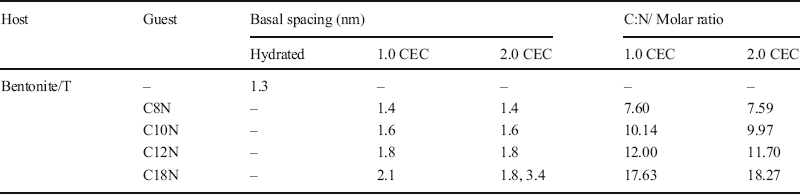
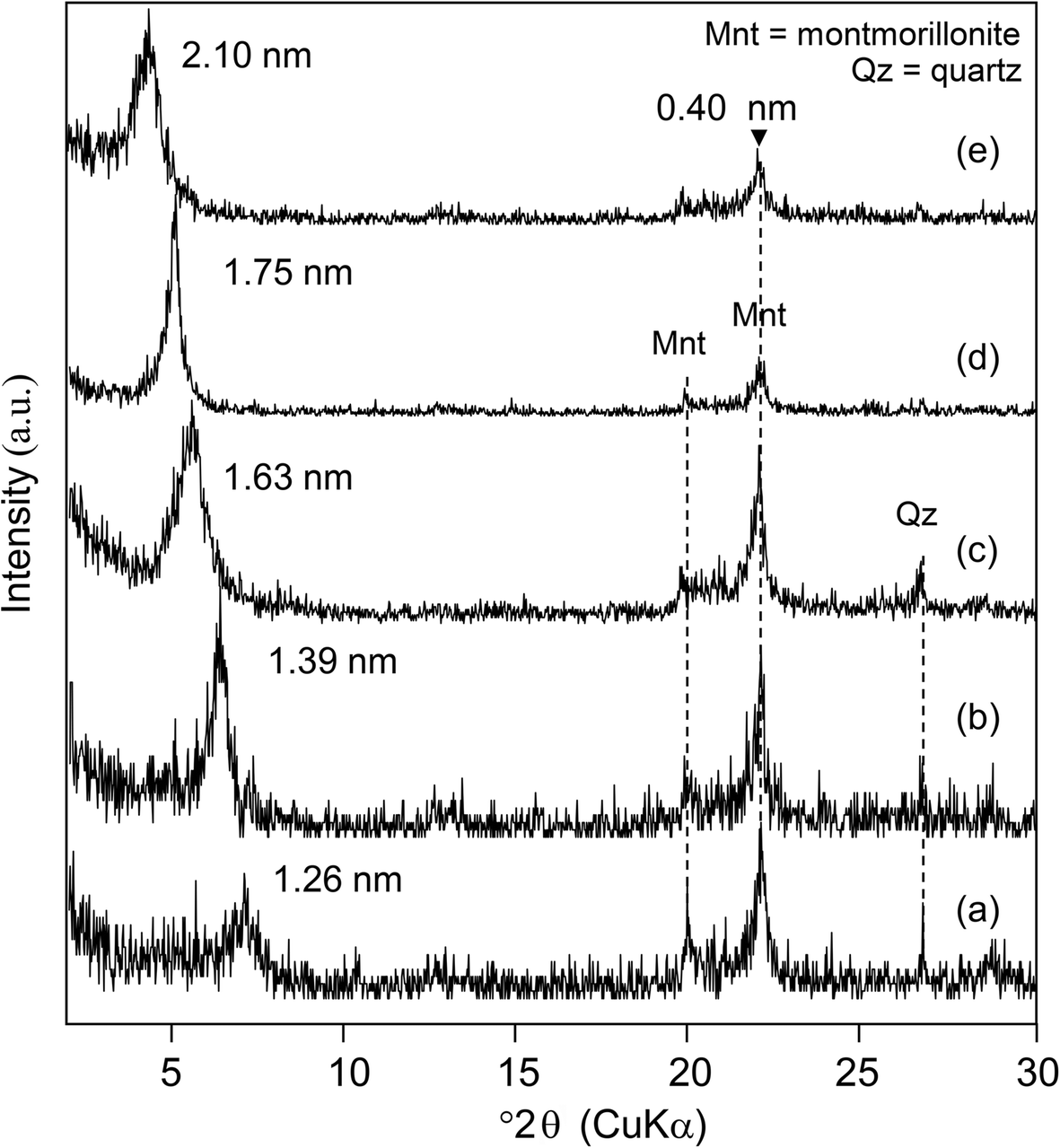
The XRD pattern of bentonite/T showed the characteristic d 00l reflection of montmorillonite at ~1.3 nm (Table 1), which is a characteristic peak of the (001) reflection in the orthorhombic crystal (JCPDS: 00-003-0010), confirming the presence of montmorillonite in the samples together with the reflection due to quartz (JCPDS: 46-1045) (Jović-Jovičić et al., Reference Jović-Jovičić, Milutinović-Nikolić, Banković, Mojović, Žunić, Gržetić and Jovanović2010; Brito et al., Reference Brito, da Silva Filhoc, Fonsecab and Jaberd2018; Salam et al., Reference Salam, Abukhadra and Alyaa Adlii2020) etc. (Table S1).
Basal spacings and carbon and nitrogen ratios of hydrated bentonite/T and the products prepared by conventional ion exchange reactions with alkylammonium cations

Because of the ion-exchange reactions of bentonite/T with the alkylammonium ions at 1.0 × and 2.0 × CEC, the basal spacings (d 001) of bentonite/T were changed. The basal spacings were observed at ~1.4, ~1.6, ~1.8, and ~2.1 nm for C8N-, C10N-, C12N-, and C18N-bentonites/T(1), respectively (Table 1, Fig. 2). The expansion of the interlayer spaces was determined to be 0.4, 0.6, 0.8, and 1.1 nm, respectively, by subtracting the thickness of the silicate layer (1.0 nm) from the observed basal spacings. Comparing the products prepared by the reactions between Na-montmorillonite (Kunipia F, obtained from Kunimine Industries, Japan, which is a reference clay mineral of the Clay Science Society of Japan, JCSS-3101, abbreviated as montmorillonite/J) and octylammonium, decylammonium, dodecylammonium, and octadecylammonium ions at 1.0 × CEC (abbreviated as montmorillonite/J(1)). The basal spacings were 1.4, 1.6, 1.8, as well as 1.8 and 2.5 nm (Table 1), reflecting expansions of the interlayer space by 0.4, 0.6, 0.8, and 1.1 nm for C8N-, C10N-, C12N-, and C18N-montmorillonites/J(1), respectively. Changes in the basal spacings of the products prepared by the reactions of bentonite/T with octylammonium, decylammonium, dodecylammonium, and octadecylammonium ions at 2.0 × CEC (abbreviated as montmorillonite/J(2)) were also observed (Table 1). These reactions increased the basal spacings to 1.4, 1.6, 1.8, as well as 1.8 and 3.4 nm, corresponding to the expansion of the interlayer space by 0.4, 0.6, 0.8, as well as 0.8 and 2.4 nm, respectively (Table 1). The basal spacings of C8N-, C10N-, C12N-, and C18N-montmorillonites/J(2) were observed at 1.6, 1.8, 3.7, as well as 1.7 and 3.3 nm. The expansion of the interlayer space indicated that intercalation of the alkylammonium ions occurred in bentonite/T, and the values were slightly different from those obtained from montmorillonites/J due to the difference in the CEC of the clay.
XRD patterns of a bentonite/T, b C8N-bentonite/T(1), c C10N-bentonite/T(1), d C12N-bentonite/T(1), and e C18N-bentonite/T(1)

By considering the d 001 value of the products (Table 1) and the alkyl chain length, the alkylammonium ions with shorter alkyl chain length (C8N, C10N, C12N = 1.0 and 2.0 CEC) or smaller loading amounts (C18N = 1.0 CEC) showed lateral structures, i.e. lateral monolayer (d 001 = 1.4 nm, for C8N-bentonite/T(1) and (2); Fig. 3a), lateral bilayer, (d 001 = 1.8 nm, for C12N-bentonite/T(1) and (2); Fig. 3b), and pseudo-trimolecular structure (d 001 = 2.1 nm, for C18N-bentonite/T(1); Fig. 3c), while those longer alkyl chains and more alkylammonium ions (C18N-bentonite/T(2)) revealed partial lateral-bilayer structure and paraffin-type monolayer (Fig. 3d) or bilayer structures (Fig. 3e). In the current study, lateral monolayer and bilayer structures were associated with the expansion of the interlayer space by 0.4 and 0.8 nm in which the alkylammonium ions were assumed to be arranged in a horizontal position, parallel to the surface (Fig. 3a, b) (Lagaly, Reference Lagaly1986; Lagaly et al., Reference Lagaly, Ogawa, Dékány, Bergaya, Theng and Lagaly2006). The arrangement of decylammonium ions, C10N, in the interlayer (d 001 = 1.6 nm for C10N-bentonite/T(1) and (2), respectively) is still difficult to estimate because the basal spacing observed (1.6 nm) was between the values expected for the lateral monolayer and bilayer structures of the alkyl chain arrangement in the interlayer. This meant that the arrangement of the alkylammonium ions proposed for C10N-bentonite/T was between lateral monolayer and bilayer structures. The C8N-bentonite/T(1) and (2) were expected to have the lowest hydrophobicity and/or pinning behavior by residual Na+ cations (Shi et al., Reference Shi, Lan and Pinnavaia1996) because of the smallest carbon number in the alkyl chains.
Schematic arrangement of alkylammonium ions in the interlayer space: a lateral monolayer, b lateral bilayer, c pseudo-trimolecular layer, d paraffin-type monolayer, and e paraffin-type bilayer structures

The tilting angle increases with increase in length of the alkyl chain. The expansion of the interlayer space of 2.4 nm exceeded the length of the full extension of the alkylammonium ions (Lagaly, Reference Lagaly1986; Lagaly et al., Reference Lagaly, Ogawa, Dékány, Bergaya, Theng and Lagaly2006), indicating that the intercalated surfactant cations adopted a tilted monolayer or bilayer structure in the interlayer (Fig. 3d, e). The model proposed for C18N-bentonite/T(2) was partial lateral bilayer (1.8 nm) and paraffin-type (3.4 nm) structures. In comparison with the products obtained from montmorillonite/J, no difference in the d 001 value was observed for C8N-, C12N- and C18N-bentonite/T(1) (Table 1); this was also true for montmorillonite/J(1), assuming that the change in the CEC of bentonite/T (0.77 meq/g of clay) to 1.20 meq/g of montmorillonite/J did not change the arrangement of the intercalated alkylammonium ions (C8N, C12N, and C18N). In the current study of montmorillonite/J, the result showed that the lateral bilayer was formed at 1.8 nm for C10N-montmorillonite/J(2), the paraffin type was formed at 3.7 nm for C12N-montmorillonite/J(2), the lateral bilayer and paraffin type were formed at 1.8 and 2.5 nm for C18N-montmorillonite/J(1), as well as at 1.7 and 3.3 nm for C18N-montmorillonite/J(2). The difference in the arrangement of the alkylammonium ions seen in bentonite/T and montmorillonite/J(2) was due to the difference in CEC and in the amount of alkylammonium ions, as well as the length of the alkyl chain.
The chemical compositions of the products were determined by CHN analysis (Table 1). The carbon and nitrogen contents of the products were in good agreement with those of the alkylammonium ions. The ratios of the alkylammonium ions adsorbed to the interlayer sodium cations were estimated to be 1:1 for CnN-bentonite/T(1) and 2:1 for CnN-bentonite/T(2), respectively, based on the C contents. This result confirmed the incorporation of the alkylammonium ions in the interlayer spaces.
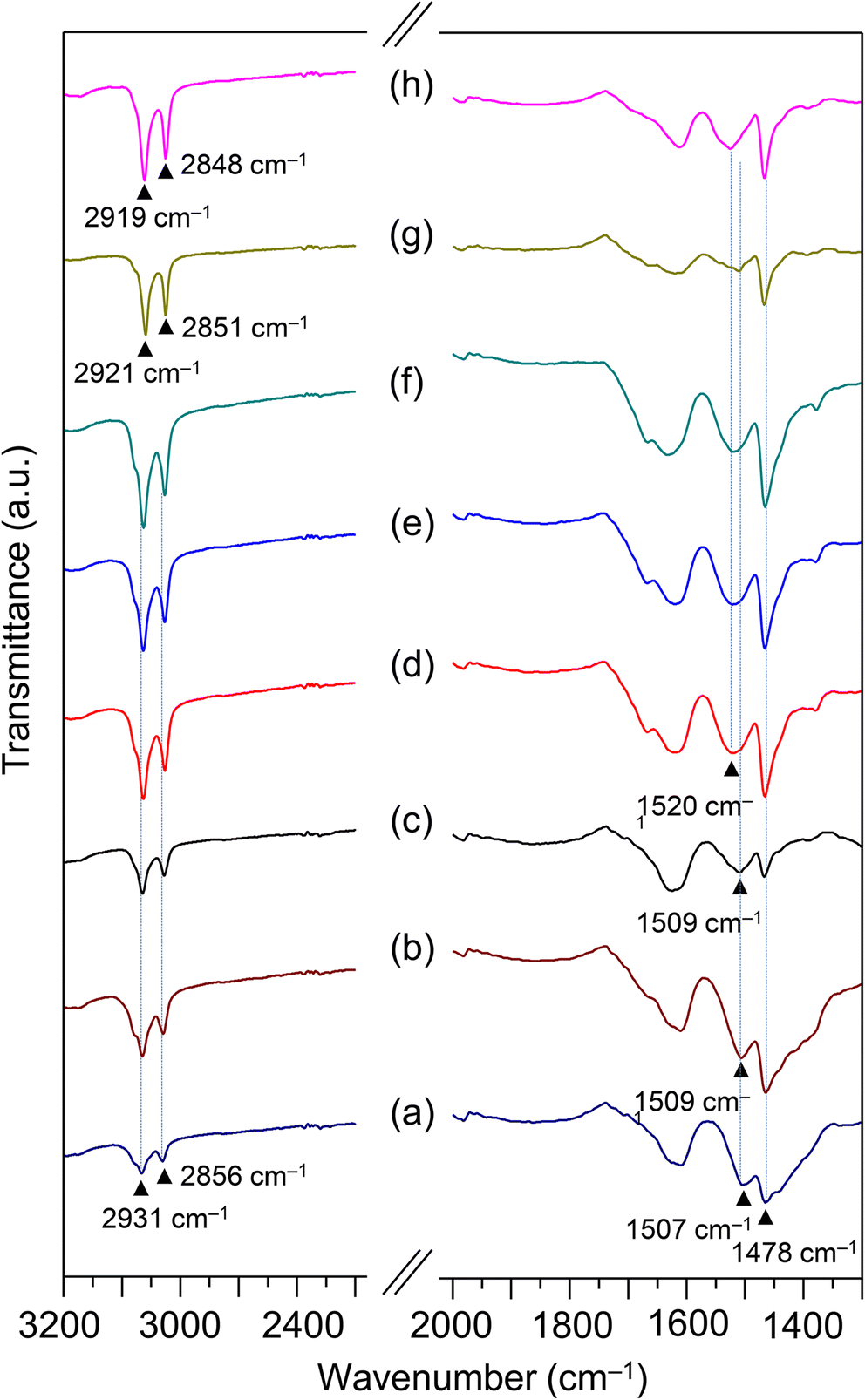
The characteristic absorption bands due to alkylamine such as –NH2 stretching (at ~3290–3380 cm–1), asymmetric and symmetric C–H stretching (at ~2850–2970 cm–1), and –CH3 bending (at ~1370–1490 cm–1) observed for pure octylamine, decylamine, dodecylamine, and octadecylamine were also seen in the FTIR spectra of all the samples excluding that of the –NH2 stretching vibration. The stretching vibrations of the hydroxyl group of magnesium (Al(Mg)OH) or aluminum (Al(Al)OH) of bentonite/T (Fig. 4) appeared at 3634 cm–1 (Piscitelli et al., Reference Piscitelli, Scamardella, Romeo, Lavorgna, Barra and Amendola2012). The asymmetric Si–O–Si stretching modes were observed at 465 and 1031 cm–1, while the Al–O–Si stretching vibrations were seen at 789 and 529 cm–1. The hydroxyl-group stretching and H–O–H bending vibrations of the adsorbed water molecules occurred at 3444 cm–1 and 1642 cm–1, respectively. This result supported the presence of montmorillonite in the bentonite.
FTIR spectra of a C8N-bentonite/T(1), b C8N-bentonite/T(2), c C10N-bentonite/T(1), d C10N-bentonite/T(2), e C12N-bentonite/T(1), f C12N-bentonite/T(2), g C18N-bentonite/T(2), and h C18N-bentonite/T(2)

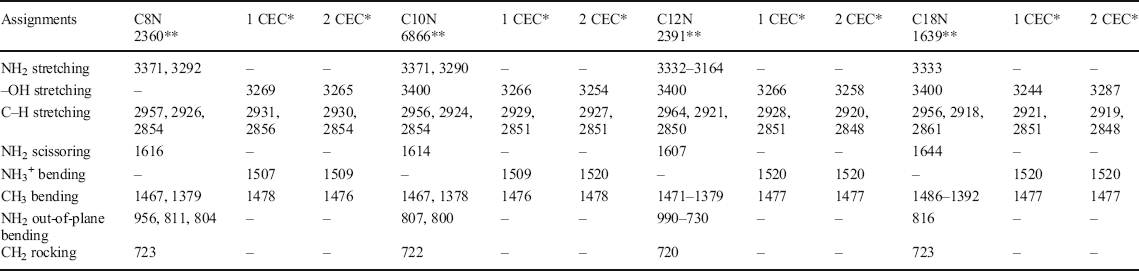
After protonation and ion-exchange reaction, the characteristic bands of the alkylammonium ions were perturbed by the absorption bands of bentonite/T, including –OH stretching (at ~3400 cm–1) and H–O–H bending vibration (at ~1640 cm–1) bands (Table 2), then, the bands in the alkylammonium-bentonite/T were observed later at ~3250–3290 and 1500–1520 cm–1. The appearance of the bands at ~2840–2930 cm–1 (assigned to C–H stretching vibration of the –CH2 groups of alkylammonium ions) indicated the intercalation of alkylammonium ions in bentonite/T. The FTIR spectra of some alkylammonium chlorides revealed bands at 1500–1600 cm–1 (Sigüenza et al., Reference Sigüenza, Galera, Otero-Aenlle and González-Díaz1981). No absorption band at ~1200–1600 cm–1 was observed for bentonite/T. The new band observed at ~1500–1520 cm–1 (assigned to –NH3 + bending mode) for all the products also confirmed that the alkylamines were protonated and intercalated as alkylammonium ions in the interlayer spaces of bentonite/T. The shift of the band at ~1390–1480 cm–1 was caused by the presence of the alkylammonium ions in a different environment, suggesting interaction between the alkylammonium ions in the interlayer spaces and the inner surface of bentonite/T (Si–CH vibration) (Piscitelli et al., Reference Piscitelli, Scamardella, Romeo, Lavorgna, Barra and Amendola2012). With increasing loading amount of alkylammonium ions, the asymmetric and symmetric C–H stretching modes (2900–3000 cm–1) of the products shifted to lower-frequency regions (2840–2930 cm–1), indicating an increase in the rigidity of the intercalated cations (high packing density and ordering) (Zhu et al., Reference Zhu, Zhu, Zhu and Xu2008). Moreover, the asymmetric and symmetric C–H stretching modes of the alkylammonium ions in bentonite/T were shown at slightly greater frequencies than those in montmorillonite/J (~10 cm–1). This confirmed the lower packing density of alkylammonium ion in bentonite/T, in agreement with the smaller CEC of bentonite/T. The FTIR data demonstrated the incorporation of alkylammonium ions in the interlayer spaces.
Wavenumbers (cm–1) of IR bands of the products and their assignments

* Amount of alkylammonium ion (x CEC)
**Number of the amines on the Spectral Database for Organic Compounds, SDBS
Thermal decomposition of the alkylammonium ions in bentonite/T was carried out in air to study the thermal behavior (Table S3). The TG-DTA data of C10N- and C12N-bentonite/T(1) and (2) are shown as an example (Fig. S2). No endothermic peak due to the melting and vaporization of the alkylammonium salt and/or alkylamine was seen in the DTA curves of the products, suggesting that most of the alkylamines were protonated and intercalated in bentonite/T and the unreacted species were absent in the products. The endothermic reactions of the products starting from room temperature, which accompanied the mass losses, were ascribed to desorption of the adsorbed water. The second mass losses were observed in the temperature range of ~170–420°C (Table S3). In the corresponding DTA curves, the exothermic peaks due to alkylammonium ions were observed in temperature ranges of 320–370°C, indicating the decomposition of alkylammonium ions in the products. With increase in the loading amount of alkylammonium ions, the mass loss shifted slightly to a lower temperature range (T onset in Table S3) because the surface of bentonite/T became more hydrophobic (Zhu et al., Reference Zhu, Zhu, Zhu and Xu2008). The shape of the exothermic peak was slightly sharp and shifted to a lower temperature with increasing loading of alkylammonium ions. This indicated that the conformation of the adsorbed alkylammonium ions was affected significantly by the environment of bentonite/T. The dehydroxylation of the structural OH of montmorillonite and the other minerals in bentonite/T was observed between 400 and 700°C (Dellisanti et al., Reference Dellisanti, Minguzzi and Valdrè2006). The exothermic peaks in the temperature ranges of 950–1050°C and 1150–1270°C were attributed to the rearrangement of high-temperature silica phases and the crystallization of mullite, respectively (Dellisanti et al., Reference Dellisanti, Minguzzi and Valdrè2006). This observation confirmed the intercalation of alkylammonium ions in bentonite/T. The difference between the decomposition temperatures of the alkylammonium ions in the interlayer spaces might be due to the weak and strong attachments between the alkylammonium ions and the inner surface of bentonite/T.
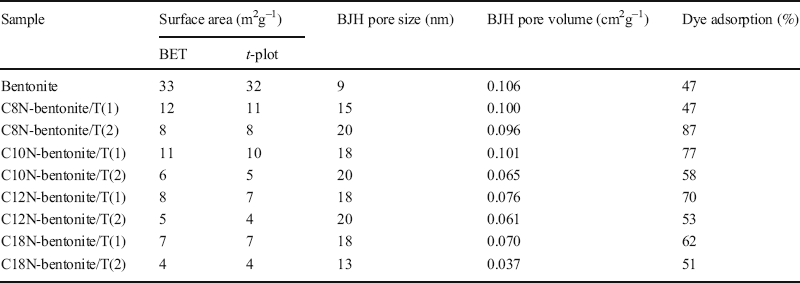
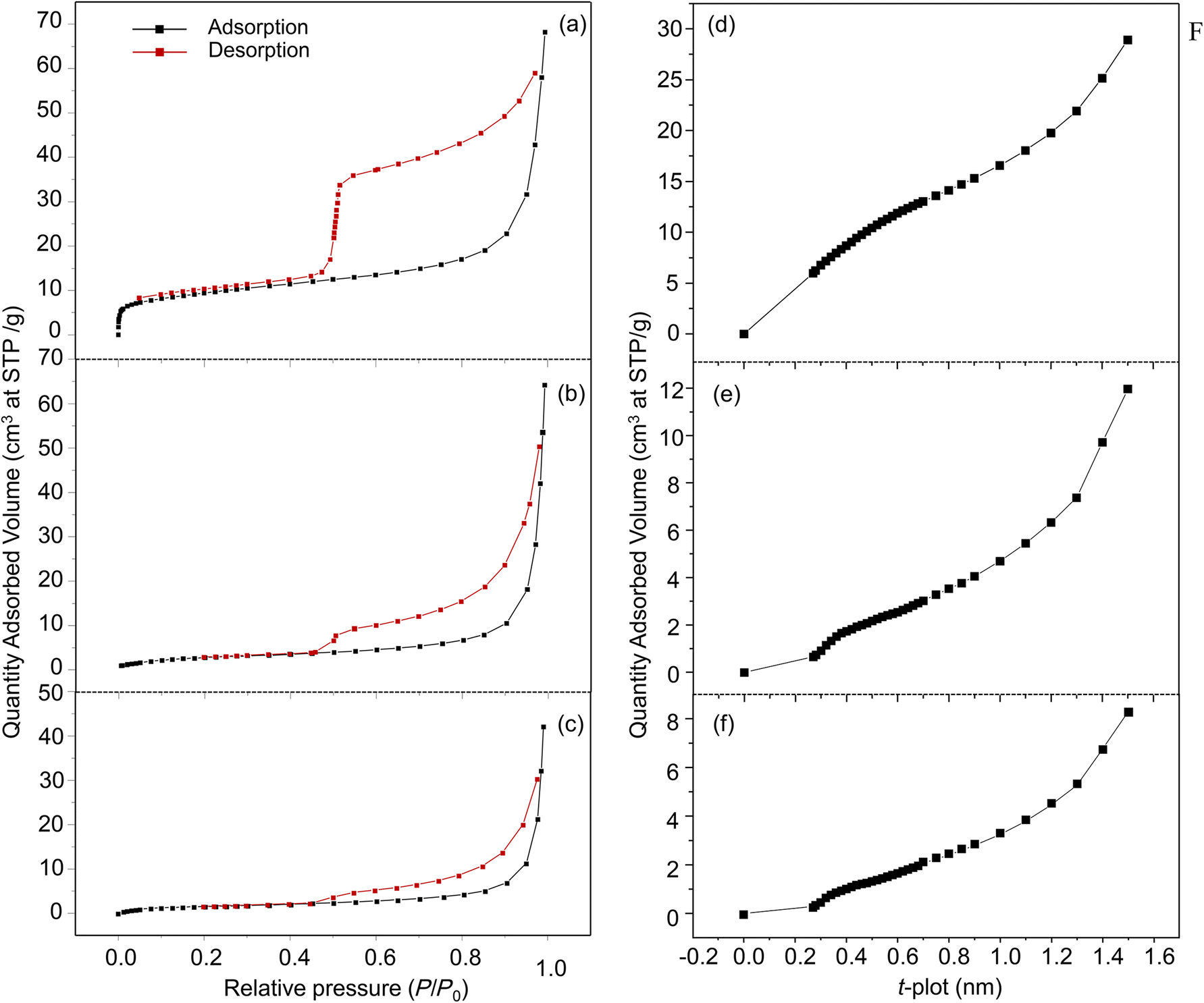
A decrease in BET specific surface area and the BJH pore volumes was observed from bentonite/T to CnN-bentonite/T(1) and (2) (Fig. 5, Table 3). The nitrogen adsorption-desorption isotherms of bentonite/T and C10N-bentonite/T(1) and (2) are shown as examples in Fig. 6. The adsorption isotherms of bentonite/T and CnN-bentonite were classified as Type II in the Brunauer, Demming, Demming, and Teller (BDDT) system (Brunauer et al., Reference Brunauer, Demming, Demming and Teller1940; He et al., Reference He, Zhou, Martens, Kloprogge, Yuan, Xi, Zhu and Frost2006a), and their hysteresis loops were similar to the H5 type in the IUPAC standard isotherm (Gregg & Sing, Reference Gregg and Sing1982; He et al., Reference He, Zhou, Martens, Kloprogge, Yuan, Xi, Zhu and Frost2006a). The large cavitation stage was due to a mesoporous volume, confirming the presence of a ‘house of cards’ structure (Lagaly & Ziesmer, Reference Lagaly and Ziesmer2003). The t-plot graphs of the products revealed the vertical line due to the capillary condensation in mesopores (Fig. 5) (Leofantia et al., Reference Leofantia, Padovan, Tozzola and Venturelli1998) and the surface areas calculated by the t-plot method were also similar to the BET method (Table 3). The average pore size calculated from the BJH desorption isotherm was ~9 nm for bentonite/T and 13–20 nm for CnN-bentonite/T (Table 3). Interestingly, the pore size increased (from bentonite/T to CnN-bentonites) with decreasing specific surface area and total pore volume (Table 3), because more adsorption sites (both in the interlayer spaces and on the external surfaces) occupied by the alkylammonium cations were accessible to nitrogen adsorption. Moreover, the increase in size (from C8N-bentonite/T to C18N-bentonite/T) and the amount of alkylammonium cations (from CnN-bentonite/T(1) to CnN-bentonite/T(2)) resulted in the change in the arrangement and the packing density of the alkylammonium cations that might block the surfaces and inhibit the adsorption of nitrogen molecules led to a decrease in the specific surface area and pore volume of the CnN-bentonite/T (He et al., Reference He, Zhou, Martens, Kloprogge, Yuan, Xi, Zhu and Frost2006a), which was consistent with a decrease in the dye-adsorption capacity, discussed below.
(a, b) BET specific surface area and (c, d) pore volume of bentonite and CnN-bentonite/T(1) (b, d), and CnN-bentonite/T(2) (a, c). STP: standard temperature and pressure

Surface analysis and R6G adsorption performance of alkylammonium-bentonite

Nitrogen adsorption-desorption isotherms of a bentonite/T, b C10N-bentonite/T(1), c C10N-bentonite/T(2), and d t-plot graphs of bentonite/T, e C10N-bentonite/T(1), f C10N-bentonite/T(2)

The effect of alkylammonium ions on the clay and on the specific surface area of the adsorbed percentage of R6G was studied (Table 3, Fig. 7). An optimum R6G adsorption of 87% was seen for C8N-bentonite/T(1); the increase in the amount of alkylammonium ion, C8N-bentonite/T(2), indicated the decrease in the dye adsorption (70%). The amount of R6G uptake increased with increase in contact time, but then remained constant after equilibrium was reached (at ~60 min for all the studies) (Fig. 7a). The dye-adsorption performance at equilibrium time decreased from 87% to 62% and from 70% to 51% for C8N-bentonite/T(1) and (2) to C18N-bentonite/T(1) and (2), respectively. Both series (CnN-bentonite/T(1) and (2)) revealed a decrease in R6G adsorption performance due to a decrease in the specific surface area, indicating that the physisorption and/or the electrostatic interaction with residual Na+ ions in/on the surface of CnN-bentonite/T. On the other hand, the smallest adsorption capacity observed for bentonite/T was thought to be due to electrostatic repulsion and/or steric effects. Meanwhile, the pH of the R6G solutions was stable at 6 indicating that the solution pH had no effect on the adsorption process. The result showed that the percentage of R6G removal was dependent on the loading amount of alkylammonium ion and on the specific surface area of the alkylammonium-bentonites.
a Adsorption curves of R6G on bentonite/T and CnN-bentonite/T, b five recycling runs of C8N-bentonite/T(1), as well as c Langmuir isotherm, d Freundlich isotherm, e pseudo-first order model, and f pseudo-second order model of R6G on C8N-bentonite/T(1)

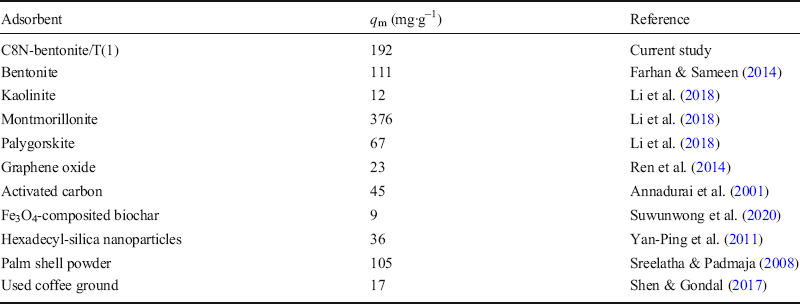
The kinetics of adsorption of R6G on C8N-bentonite/T(1) was studied. Plots using the Langmuir and Freundlich adsorption models (Fig. 7c, d) were used to explain the adsorption of R6G on the adsorbent. The pseudo-second order kinetic model (Fig. 7f) fitted the kinetic data best with a correlation coefficient (R2) > 0.99, assuming that the adsorption process was controlled by the available sites on the adsorbent and the amount of absorbate on the surface of the adsorbent. The adsorption isotherms also fitted well with the Langmuir model (Fig. 7c, Table S4), indicating that the specific adsorption of R6G on the surface of C8N-bentonite/T(1) was saturated following the monolayer adsorption process. The maximum capacity (q m) of C8N-bentonite/T(1) for R6G removal was 192 mg·g–1 (Table S4). The q m values for R6G adsorption were large compared to the other adsorbents reported previously (Table 4), proving that C8N-bentonite/T(1) is a promising adsorbent.
Comparative adsorption capacity and pseudo-second order rate constant for R6G adsorption at room temperature

After the adsorption process was recycled five times, the adsorption efficiency of C8N-bentonite/T(1) decreased by only 17% (Fig. 7b); C8N-bentonite/T(1) could, therefore, be used as an efficient absorbent because of its good stability and adsorption properties and its ability to be reused.
Conclusions
Alkylammonium ions were intercalated into the interlayer spaces of a natural Thai bentonite by ion-exchange reactions at room temperature. The alkylammonium ions appeared in various arrangements in the interlayer spaces. These differences were assumed to be induced by differences in the nature of bentonite, including cation exchange capacity, as well as the amount and chain length of the alkylammonium ions. The dye-adsorption capacity of the alkylammonium-bentonites was related to the number of alkylammonium ions and the specific surface area. The adsorption of rhodamine 6G was controlled by both the adsorbent and the absorbate. The recycling study showed that the adsorbent could be reused.
Supplementary Information
The online version contains supplementary material available at https://doi.org/10.1007/s42860-021-00145-6.
Acknowledgments
S.I. is grateful to the Materials Chemistry Research Center, Department of Chemistry, Khon Kaen University for postdoctoral support. Financial support from the National Science and Technology Development Agency, Chair Professor Grant (grant number P-17-52536), the National Research Council of Thailand (NRCT, grant no. 6100073), and the Center of Excellence for Innovation in Chemistry, Ministry of Higher Education, Science, Research and Innovation are acknowledged. The clay sample (bentonite) was provided by the Thai Nippon Chemical Industry, Thailand.
Funding
Funding sources are as stated in the Acknowledgments.
Declarations
Conflict of Interest
The authors declare that they have no conflict of interest.