In a recent article, Professor Caroline Fohlin investigates the underpricing of initial public offerings (IPOs) and seasoned equity offerings (SEOs) at the Berlin Stock Exchange between 1882 and 1892 (Fohlin 2010). One of her key conclusion is that “underwriters directly reaped profits from pricing their purchase of new issues below market value” (Fohlin 2010, p. 653). According to Professor Fohlin, German underwriters could profit from asymmetric information among issuers, underwriters, and investors by taking the spread between the price the underwriter paid to issuers and the price at which they sold off to investors (Fohlin 2010, pp. 638–39). She calls this price difference “underwriter premium.” The proxy used to measure the underwriter premium is the percentage difference between the offering price and the par valueFootnote 1 of a share (Fohlin 2010, p. 642).Footnote 2 The mean values for the IPOs included in Professor Fohlin's study may illustrate her approach. In the typical case, the issuer sells the shares to the underwriter for 100. Subsequently, the underwriter offers the shares to the first investors for 132.5; and the first market price is 142. Thus, the issuer leaves 42 percent of the value on the table, the average underwriter premium is 32.5 percent, and initial returns for the first investors are 7.2 percent.Footnote 3 This result is surprising given the findings of the modern finance literature. For example, initial returns at the U.S. stock market averaged about 15 percent between the 1970s and the 1990s and the spread taken by underwriters has been about 7 percent (Ritter and Welch 2002; Chen and Ritter 2000). Thus, if Professor Fohlin's findings are correct, in Germany during the 1880s, issuers left more money on the table, first investors earned lower initial returns, and underwriters earned a much larger premium.
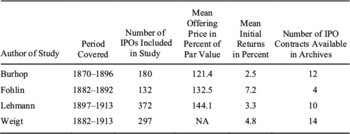
Professor Fohlin's finding of low initial returns for first investors confirms the established view from the literature. Moreover, it is also uncontroversial that the offering price was significantly higher than the par value (see Table 1). However, I provide evidence that the underwriter premium has often been shared between the underwriter and the issuer. In contrast to Professor Fohlin, who only assumes that the underwriter acquired the shares at par value from the issuer, I provide archival evidence from IPO contracts. It turns out that the acquisition price of the underwriter was on average above par. Consequently, the spread earned by the underwriter was smaller and the issuer left less money on the table.
IPOs AT THE BERLIN STOCK EXCHANGE, 1870–1913

Sources:
Burhop (2011, p. 23); Fohlin (2010, p. 646); Lehmann (forthcoming); and Weigt (2005, p. 145).
The typical IPO at the late-nineteenth-century German stock market involved several steps. In most of the cases, an already existing firm changed its legal form to become a joint stock company—usually to allow former owners to diversify their investment, to retire from business due to old age, or to raise additional funds for investment.Footnote 4 To incorporate, the owners of an existing firm transferred all assets (buildings, machinery, etc.) to a newly founded joint stock company and they received shares at par value in return. In a next step, the incorporators sold all or—in most of the cases—some of the shares to an underwriting syndicate. The underwriter syndicate subsequently offered the shares to first (outside) investors at the stock market, often at a fixed offering price.
According to the calculations presented by Professor Fohlin, the incorporators sold shares at par value to the underwriting syndicate. Therefore, the difference between the offering price and par value is considered to reflect the spread earned by the banks. One major advantage of this approach is the fact that both, the par value and the offering price, are easily observable, whereas the price actually paid by the underwriting syndicate to the incorporator is only stated in a contract between the parties involved. These contracts are only available in the issuers’ or underwriters’ archive.
First example: The Accumulatoren-Fabrik AG was established as a joint stock company with a capital of 4.5 million marks in July 1890, based on the private firm (Offene Handelsgesellschaft) Accumulatorenfabrik Tudor'schen Systems Müller & Einbeck, which was established in 1887. The joint stock company went public on 8 November 1894 in Berlin and Frankfurt. Deutsche Bank, Berliner Handelsgesellschaft, Nationalbank für Deutschland, Gebr. Delbrück, Jacob Landau, Gebr. Sulzach, and Ernst Osthaus underwrote the issue. The issue price was 140 percent, the full share capital of 4.5 million marks was admitted to the stock exchange, but only about three million marks were offered to the public (Historical Archive Deutsche Bank (hereafter HADB), file SG 32/1, Prospectus of Accumulatoren-Fabrik AG). The “underwriter spread” was 40 percent—the difference between the offering price and the par value. The files of the lead underwriter Deutsche Bank show that the banks did not acquire the shares at par value and that different banks paid different prices. The lead underwriter Deutsche Bank acquired the shares at an average price of 109.31 percent, the Berliner Handelsgesellschaft paid 112.5 percent, and the private banks included in the syndicate paid an average price of 108.65 percent (HADB, file S 0042, Letters Deutsche Bank to Berliner Handelsgesellschaft, 22 July 1890 and 26 July 1890).
Second example: Anglo-Continentale-Guanowerke AG Hamburg. The firm was incorporated as a joint stock company during October 1883, based on the established private firm Ohlendorff'sche Guanowerke. The joint stock company had a capital of 16 million marks, divided into 16,000 shares with a par value of 1,000 marks each. The owner of the private firm, Ohlendorff, received 5,248 shares for his old company and paid up the remaining share capital in cash. During the same month, Ohlendorff sold 10,000 shares to a banking syndicate at a price of 125 percent. Members of the syndicate were the Norddeutsche Bank, a large provincial bank based in Hamburg, and the Berlin-based banking house Bleichröder. During August 1888, 12,500 shares were admitted to the stock exchanges in Berlin and Hamburg and they were offered to investors at a price of 125 by a syndicate composed of Bleichröder, Norddeutsche Bank, L. Behrens (a private bank from Hamburg), and Darmstädter Bank für Handel und Industrie. For their service, the banks received a fee of 125,000 marks from the issuer (Bethmann Archive (hereafter BA), file V 665. HADB file K1/201 and file SG 2/32). Thus, the underwriter spread was close to zero.
Third example: Sürther Maschinenfabrik AG, a mechanical engineering company based in Cologne. Lead underwriter was the Cologne banking house Oppenheim, co-underwriters were the private banking houses Bethmann and Kahn. The Sürther Maschinenfabrik had a capital of 1.6 million marks divided into 1,600 shares with a par value of 1,000 marks each. The former owner of the Maschinenfabrik kept 500 shares and he sold 1,100 shares at a price of 125 percent to the syndicate. In May 1889 the syndicate offered the shares at a price of 140 percent to the public (BA, files V 568 and V 569).
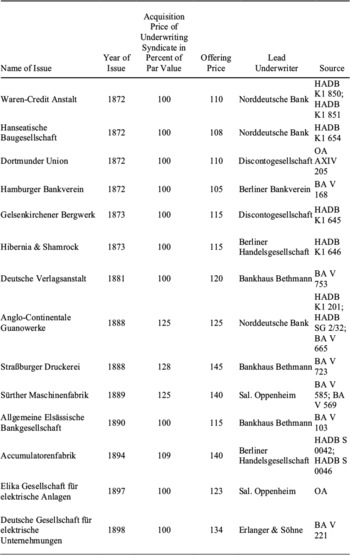
The three examples illustrate that banks paid more than par value to the issuer. To assess if this is a general pattern, the archival records of Deutsche Bank, Dresdner Bank, Commerzbank, Berliner Handelsgesellschaft, Bethmann, and Oppenheim have been screened.Footnote 5 The number of surviving underwriter contracts for IPOs is small: 22 contracts covering the period 1872 to 1914 have been discovered (see Table 2). In twelve cases, the underwriters acquired the shares at par value. Ten issues were acquired above par. Three out of four issues during the period 1882–1892 (the period covered by Professor Fohlin) were acquired above par. On average, the acquisition price was 113.4 percent (during 1882–1892: 119 percent). In all cases, the public offering price was above par and it averaged 129.9 percent (during 1882–1892: 131 percent). Thus, the mean underwriter premium was 14.6 percent. This is higher than the modern “seven percent solution,” but well below Professor Fohlin's estimate of 32.46 percent. Altogether, at the Berlin Stock Exchange around 1900, first investors’ initial returns were comparatively low, whereas underwriter premiums were relatively high.
IPO CONTRACT DETAILS, 1872–1914


Sources:
See the text.