Introduction
The change in human behaviour resulting from civilization development and the favouring of excessive food consumption and hypokinesia has led to the spread of overweight and obesity among adults, teenagers and children from industrialized countries on a scale that has been described as an epidemic of the 21st century (Flegal, Reference Flegal1999; Jolliffe, Reference Jolliffe2004; Flodmark et al., Reference Flodmark, Lissau, Moreno, Pietrobelli and Widhalm2004; Lissau et al., Reference Lissau, Overpeck and Ruan2004; Lobstein et al., Reference Lobstein, Rugny and Leach2005, Neovius, et al., Reference Neovius, Janson and Rössner2006; Binkin, et al., Reference Binkin, Fontana, Lamberti, Cattaneo, Baglio, Perra and Spinelli2010; Sardinha et al., Reference Sardinha, Santos, Vale, Silva, Ferreira and Raimundo2011; Khadilkar et al., Reference Khadilkar, Khadilkar, Cole, Chiplonkar and Pandit2011). In the work Obesity in Europe, Lobstein et al. (Reference Lobstein, Rugny and Leach2005) presented data concerning the spread of overweight and obesity among children and teenagers in different European countries. According to the data, Poland as well as France, Switzerland, Czech Republic, Hungary, Germany, Holland and Bulgaria are a group of countries where prevalence of overweight is between 10 and 20%, whereas in Mediterranean islands and countries such as Malta, Sicily, Gibraltar, Crete, Spain and Portugal it exceeds 30%. The authors of the report include England, Ireland, Cyprus, Sweden and Greece in the group of countries with overweight prevalence between 20 and 30%. However, the same studies place Poland with Great Britain, among the countries with the highest rate of overweight and obesity increase (Lobstein et al., Reference Lobstein, Rugny and Leach2005).
All research done so far indicates that overweight and obesity are determined by social and cultural factors, besides genetic ones (Bouchard & Tremblay, Reference Bouchard and Tremblay1997; Pérusse et al., Reference Pérusse, Rice, Province, Gagnon, Leon and Skinner2000; Schousboe et al., Reference Schousboe, Visscher, Erbas, Kyvik, Hopper, Henriksen, Heitmann and Sörensen2004). It is quite an obvious statement taking into account the fact that both sides of the energy balance, i.e. intake and expenditure of energy, are socially and culturally determined (Burke et al., Reference Burke, Beilin and Dunbar2001; Provencher et al., Reference Provencher, Pérusse, Bouchard, Drapeau, Bouchard and Rice2005). A general model of determining obesity by socioeconomic factors, suggested as early as in the 1970s by Stunkard (Reference Stunkard1977), assumes that socioeconomic status and obesity are positively correlated in developing societies (non-industrialized) and negatively in developed countries (in the zone of industry civilization). Generally, the model is still being realized today, and also among children (Monteiro et al., Reference Monteiro, Moura, Conde and Popkin2004; Ball & Crawford, Reference Ball and Crawford2005; Shrewsbury & Wardle, Reference Shrewsbury and Wardle2008).
The complex character of Polish political and socioeconomic changes at the end of the last century has facilitated the realization of both versions of the Stunkard model, and this is particularly visible in rural societies. In all accessible Polish works concerning children and teenagers from cities (Małecka-Tendera et al., Reference Małecka-Tendera, Klimek, Matusik, Olszanecka-Glinianowicz and Lehingue2005; Chabros et al., Reference Chabros, Charzewska, Wajszczyk, Rogalska-Niedźwiedź, Chwojnowska, Fabiszewska, Charzewska, Bergman, Kaczanowski and Piechaczek2006; Cieślik & Mrowicka, Reference Cieślik, Mrowicka, Charzewska, Bergman, Kaczanowski and Piechaczek2006; Chrzanowska et al., Reference Chrzanowska, Kozieł and Ulijaszek2007; Matusik et al., Reference Matusik, Małecka-Tendera and Klimek2007) and from rural areas (Kaczanowski &Wronka, Reference Kaczanowski, Wronka, Charzewska, Bergman, Kaczanowski and Piechaczek2006; Wilczewski et al., Reference Wilczewski, Popławska, Dmitruk, Charzewska, Bergman, Kaczanowski and Piechaczek2006) there was a trend of increasing overweight and obesity in all age groups observed in subsequent decades. An exception is the oldest group of girls, in which the prevalence of overweight and obesity has decreased (Chrzanowska et al., Reference Chrzanowska, Kozieł and Ulijaszek2007). Studies devoted to assessing the biological consequences of socioeconomic stratification of rural society in Poland started in 1967 and were repeated in 1977, 1987 and 2001. Biological measures of living conditions in the selected groups were body height, body weight and time of first menstruation in girls. The research noted an improvement in standard of living among the selected groups between 1967 and 1977, a delay in the age of menarche and inhibition of the tall-stature trend between 1977 and 1987 due to a severe economic crisis and making up for the losses after political transformation in Poland (1989) recorded in 2001 (Łaska-Mierzejewska Reference Łaska-Mierzejewska1970, Reference Łaska-Mierzejewska1995, Łaska-Mierzejewska & Olszewska, Reference Łaska-Mierzejewska and Olszewska2004, Reference Łaska-Mierzejewska and Olszewska2006, Reference Łaska-Mierzejewska and Olszewska2007).
The examinations performed in the years 1987 and 2001 are the focus of this article. Its aim is to assess the prevalence and quantity of overweight and obesity among rural Polish girls and determine the intensity and directions of the changes in these measures after 14 years. The two series of tests, as well as evaluation of the phenomena, were divided between regions of different geographical location, social structure and inhabitants’ wealth.
Methods
The study included girls aged 9–18 years living in rural areas of Poland. In 1987 the total number of girls examined was 7764 and in 2001 it was 9431. Wherever possible, both tests were conducted in the same schools.
The Polish countryside is inhabited by people of different sources of income: (1) farming families living off their farms (37% in 1987 and 30% in 2001); (2) farming and working families that have a farm but where at least one of the parents works outside the farm (21% and 23%, respectively); (3) country dwellers without their own land (41% and 47%, respectively). In 1949 an agricultural reform was introduced that aimed to nationalize farms bigger than 50 hectares in order to create state farms, and these were finally closed down in 1992 after the political and economic transformation.
Body mass index was calculated from height and weight measurements made by qualified personnel who visited individual schools; they also registered information on the timing of the beginning of menstruation, or its lack. Chronological age was determined based on differences between the examination date and date of birth.
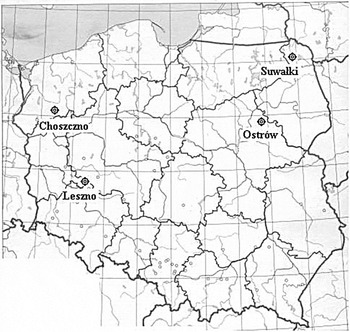
The tests were conducted in four rural regions of different geographical location, social structure and inhabitants' wealth: Choszczno, a north-west region; Leszno, a middle-west region; Ostrów Mazowiecka, a central region; and Suwałki, a north-east region (Fig. 1). The socioeconomic structure of the inhabitants of the regions will be shown in the Discussion section while presenting differences in overweight and obesity prevalence of females from each region. The protocol was conducted according to the scientific studies ethic principles stated in the Helsinki Declaration.
Location of the analysed regions on a map of Poland.

International standards elaborated by Cole et al. (Reference Cole, Bellizzi, Flegal and Dietz2000), and recommended by the International Obesity Task Force (IOTF), were used to assess overweight and obesity prevalence. The application of the IOTF standards ensured comparability of the analysed data both in time (between 1987 and 2001) and among regions. Frequencies significantly different from expected values (%) were compared in each age category using a χ2 goodness-of-fit test.
To measure the extent of child overweight the following index was assessed (Jolliffe, Reference Jolliffe2004):
 $${\rm EOW}=(1/n)\sum\nolimits_i I({\rm BMI}_i\ge f_i) [ ({\rm BMI}_i-f_i)/f_i]$$
, where n is the sample size, i refers to the child, f is the cut-off point identifying who is overweight and I is an indicator function that takes a value of 1 if the statement is true and 0 otherwise. The value of the indictor function is 1 if the child is overweight and 0 if the child's BMI is less than the cut-off point corresponding to the values of BMI≥25 kg/m2 for adults, sex- and age-specific. An advantage of the EOW index is that EOW treats BMI as a continuous variable for the overweight population, while prevalence measures view overweight as a dichotomous outcome. Expressing excessive BMI as a proportion of the overweight threshold is particularly important for children since the threshold varies by age and sex (Jolliffe, Reference Jolliffe2004). The average extent of overweight for the entire population (EOW), when combined with information about the prevalence of overweight, additionally provides insight into the extent of overweight for the overweight population (Jolliffe, Reference Jolliffe2004; Chrzanowska & Suder, Reference Chrzanowska and Suder2010).
Results
Prevalence of overweight and obesity
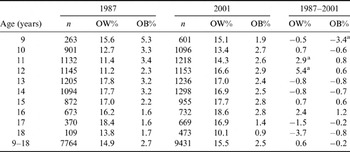
In the whole examined sample of girls, overweight prevalence amounted at 14.9% in 1987 and 15.5% in 2001 (Table 1). Obesity in both tests was almost 3%. There was a statistically significant increase in overweight prevalence over the period of research for 11- and 12-year-old girls. A decrease in overweight and obesity was observed in girls aged 9–10, 13–14 and 17–18 years. In both series of examination a similar direction of overweight change with age was observed. In 1987 the lowest overweight prevalence, at just over 11%, was found in girls aged 11 and 12, and the highest (16–18%) in groups of 13- to 17-year-olds. In 2001 the lowest percentage of overweight was found in girls aged 10 and 11 years, amounting to 13–14%, whereas the highest (17–18%) was observed between 12 and 17 years of life.
Prevalence of overweight (OW) and obesity (OB) (according to IOTF criteria) in rural girls in two series of surveys and its change between 1987 and 2001, in percentage points

a Frequencies for 2001 significantly different from those for 1987 at p<0.05 (χ2 goodness-of-fit test).
Regional differentiation of overweight and obesity prevalence
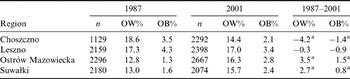
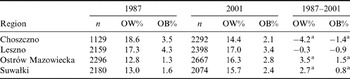
Significant differences in overweight and obesity prevalence were observed in girls from the four examined regions both in 1987 and in 2001 (Table 2). Variability in the prevalence between the two test years is also different in each of the regions.
Prevalence of overweight (OW) and obesity (OB) (according to IOTF criteria) in rural girls in two series of surveys by region and its change between 1987 and 2001, in percentage points
a Frequencies for 2001 significantly different from those for 1987 at p<0.05 (χ2 goodness-of-fit test).
In 1987 the highest overweight and obesity prevalence was registered in the area of Choszczno (19% and 4% respectively), then Leszno (17% and 4%), whereas the lowest overweight prevalence (13%) was observed in the regions of Ostrów Mazowiecka and Suwałki, with obesity amounting at 1% and 2%, respectively.
In 2001 in Ostrów Mazowiecka and Suwałki, a statistically significant increase in overweight prevalence (from 13 to 16%) and obesity (up to 3%) was noted, which is in accordance with a general tendency of increasing obesity in Poland and in the world. In the area of Leszno, overweight prevalence stayed at 17%, and obesity prevalence decreased from 4% to 3%. Quite an exceptional phenomenon is the decrease in overweight and obesity prevalence from 19% to 14% and from almost 4% to 2%, respectively, in the region of Choszczno.
Extent of overweight index (EOW)
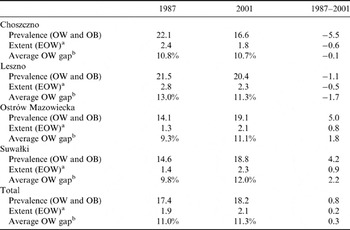
Between 1987 and 2001 the EOW index increased from 1.9 to 2.1 in the whole study sample (Table 3). Significant differences in overweight and obesity extent were observed between the examined regions that were similar to the differences in overweight and obesity prevalences. In the Choszczno region, a decrease in the extent index from 2.4 to 1.8 was noted in the examined group, as well as a lowering of overweight and obesity prevalence. In the Leszno region, the EOW fell from 2.8 to 2.3; in total overweight and obesity prevalence decreased from 21.5% to 20.4%, but this resulted from a lowering of obesity prevalence from 4% to 3%, whereas overweight prevalence stayed unchanged. This region featured high stability of both social and biological variables in the period of 1987–2001. In the regions of Ostrów Mazowiecka and Suwałki, overweight and obesity prevalence increased from 14% to almost 19% and the EOW index increased from 1.3 and 1.4 to 2.1 and 2.3, respectively, which reflects a significant increase in both the number of cases and the amount of overweight. The considerable differences between the regions found in 1987 eventually decreased in 2001 (Table 3).
Overweight (OW) and obesity (OB) prevalence, extent of overweight and the average amount by which the overweight population exceeds the overweight threshold in rural girls in two series of surveys by region and their change between 1987 and 2001, in percentage points

a EOW: the extent of overweight is measured as the average amount by which each child's BMI exceeds their age- and sex-specific overweight threshold, corresponding to the values of BMI≥25 kg/m2 for adults.
b Average overweight gap: the average amount by which the overweight population exceeds the overweight threshold, expressed as a percentage of the threshold.
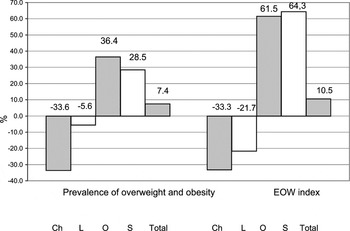
The changes in total overweight and obesity prevalence and EOW index from 1987 to 2001 are presented in Fig. 2. The results show different conclusions for an analysis of the whole study sample compared with separate analyses of each of the four regions. On the basis of the whole study population, the prevalence of overweight and obesity in total increased by 7.4% between 1987 and 2001, but the highest percentage increase of 36.4% was registered in Ostrów Mazowiecka, and the highest fall of 33.6% in Choszczno. The EOW index generally increased by 10.5%, but the highest increase, of more than 60%, was in Suwałki and Ostrów Mazowiecka, and the largest decrease of more than 30% was observed in the Choszczno region.
Percentage changes (1987–2001) in prevalence of overweight and obesity and EOW index in rural girls (Ch, Choszczno; L, Leszno; O, Ostrów Mazowiecka; S, Suwałki).

Discussion
The biological indicators of living conditions of the villagers living in the four different Polish study regions have been published elsewhere (Łaska-Mierzejewska & Olszewska, Reference Łaska-Mierzejewska and Olszewska2004, Reference Łaska-Mierzejewska and Olszewska2006, Reference Łaska-Mierzejewska and Olszewska2007). The girls living in those regions exhibited marked differences in menarcheal age, body height and body mass. Age at menarche was attained earliest in girls from the wealthiest region (Leszno), both in 1987 and 2001 (13.18 and 13.04 years respectively). They were also taller than the entire cohort by 0.14 SD. The latest age of menarche was recorded in a relatively poor region (Suwałki), at 13.88 and 13.42 years, in 1987 and 2001, respectively. The difference in age of menarche between those regions was 0.70 years in 1987, and 0.38 years in 2001. In the wealthy region, the differences in age of menarche and body height between girls from extreme categories classified by source of income (farmers, farmers–workers and landless rural families), number of children and educational status of father, were smaller than in other regions. It could be inferred that the prosperity of a population levels its developmental processes, while poverty or modest living conditions amplify and expose the differentiation. The different regions of Poland and different social groups were variously affected, both by the acute economic crisis of 1978–1989, and by the political and economic transformation (1989 until now).
The differences in biological status of Polish children, youth and adults, living in cities, towns and villages, are well documented (Łaska-Mierzejewska et al., Reference Łaska-Mierzejewska, Milicer and Piechaczek1982; Hulanicka et al., Reference Hulanicka, Brajczewski, Jedlińska, Sławińska and Waliszko1990; Bielicki & Szklarska, Reference Bielicki and Szklarska1999; Bielicki et. al., Reference Bielicki, Szklarska and Kozieł2003; Przewęda & Dobosz, Reference Przewęda and Dobosz2003).
The rural environment is usually associated with lower level of education of its inhabitants, low health consciousness, higher poverty and also difficulties with access to the medical health care system (Levine & Coupey, Reference Levine and Coupey2003; Elliott & Larson, Reference Elliott and Larson2004; Cherry et al., Reference Cherry, Huggins and Gilmore2007). Numerous studies have documented increased prevalence of overweight and obesity in the inhabitants of rural regions (McMurray et al., Reference McMurray, Harrell, Bangdiwala and Deng1999; Jackson et al., Reference Jackson, Doescher, Jerant and Hart2005; Phipps et al., Reference Phipps, Burton, Osberg and Lethbridge2006). However, determinants of their prevalence are complex and not always in one direction. The increase in overweight and obesity prevalence, as well as the quantity of such increases (EOW index) registered in two out of the four examined regions (Ostrów Mazowiecka and Suwałki), reflect tendencies commonly observed in other Polish studies and in many different countries (Wang & Lobstein, Reference Wang and Lobstein2006; Oblacińska & Jodkowska, Reference Oblacińska and Jodkowska2007). Therefore, more attention will be focused on possible causes of the lowered overweight and obesity prevalence and extent registered in the Choszczno region and relative stability of the parameters in females from the region of Leszno.
The region of Choszczno
The most probable cause of the decrease in overweight and obesity indexes in the period of 1987–2001 in Choszczno was poverty resulting from the mass unemployment that appeared after closure of the state farms in 1992 following the political and economic changes in Poland in 1989. These farms had employed rural people who did not possess their own land, and the region of Choszczno was characterized by a high concentration of such state farms. After their closure, the region experienced the highest unemployment in Poland, peaking at 30% then decreasing to 22% in 2001 (Central Statistical Office) (Łaska-Mierzejewska & Olszewska, Reference Łaska-Mierzejewska and Olszewska2007). Between the years 1987 and 2001 the increase in body height in all age groups was on average 2.9 cm (range: 1.5–4.7 cm). An increase in body mass (2 kg) took place exclusively in 12.5-year-old girls, and the average decrease in BMI amounted at –0.53 SD. The biggest lowering of BMI was registered for girls from landless rural families (Łaska-Mierzejewska & Olszewska, Reference Łaska-Mierzejewska and Olszewska2006).
A reversal in the menarche age gradient was observed in the female inhabitants of Choszczno over the study period. In 2001 farmers' and food producers' daughters matured first, then girls from farming and working families and the latest were girls from landless families. In former studies of the region, and in other places researched, the gradient was in the inverse direction (Łaska-Mierzejewska & Olszewska, Reference Łaska-Mierzejewska and Olszewska2006, Reference Łaska-Mierzejewska and Olszewska2007). Therefore, the decrease in overweight and obesity prevalence and lower average extent of overweight (EOW index) in girls from the region in 2001 as compared with 1987 probably resulted from a radical worsening of living conditions of landless family members, who constituted 61% of the whole examined sample in the Choszczno region.
Of the total 2001 sample (N=9599), the daughters of landless rural families constituted 47%, and 13.5% of these had unemployed fathers. The difference in age of menarche between girls from families of working fathers and those of unemployed ones amounted to 0.39 years, and this was statistically significant (Olszewska & Łaska-Mierzejewska, Reference Olszewska and Łaska-Mierzejewska2008).
The region of Leszno
The Leszno region featured the highest stability of prevalence and quantity of overweight in girls in comparison with the other regions. Overweight and obesity prevalence fell by just 1% and the EOW index by 0.5 (statistically insignificant). Also, the decrease in menarche age in Leszno girls during the examined period was the lowest of all studied regions (Łaska-Mierzejewska & Olszewska, Reference Łaska-Mierzejewska and Olszewska2006, Reference Łaska-Mierzejewska and Olszewska2007). Leszno is located in Wielkopolskie District, characterized by well developed industry, a high level of agriculture and efficient transport. State farms in the region were privatised instead of being closed down. This area has the highest level of wealth, as measured by household equipment, the lowest number of children in a family, and the lowest number of fathers with only basic education level. Fifty-seven per cent of the girls examined in the region belonged to landless families, but only 6% of the fathers were unemployed as it is easier to find a job here than in Choszczno or Suwałki. A biological symptom of the inhabitants' wealth was the earliest menarche age and the highest body height in both 1987 and 2001. During both study periods the smallest differences in biological parameters between socioeconomic groups were registered in the Leszno region, and also between groups with various number of children and groups of each parent's education level in comparison with the size of the differences in other regions (Łaska-Mierzejewska & Olszewska Reference Łaska-Mierzejewska and Olszewska2004, Reference Łaska-Mierzejewska and Olszewska2007).
The region of Ostrów Mazowiecka
The girls from the Ostrów Mazowiecka region were characterized by the greatest increase in overweight prevalence and amount. The social and professional structure of the region is different from that of the two above-listed regions: only 39% came from landless families and 13% of fathers were unemployed. On the basis of data from 1987, the region featured the lowest GDP per head (Social Development Report, Poland 2000). This is reflected in household equipment levels, which is the poorest of all the examined regions. In 2001 the total unemployment rate was 12%, and among the girls' fathers 13%. The examined villages are located 40–60 km away from the capital of Poland, which makes it easier to find a job in comparison with the regions of Suwałki or Choszczno.
The region of Suwałki
The increase in both prevalence and amount of overweight in Suwałki was similar to that in Ostrów Mazowiecka, but the social structure of the region differs significantly from that of the other regions. It is located in the north-east of Poland, has a more severe climate, a delayed growing season (by 2–3 weeks), and a weaker transport system. Its low level of industrialization makes it difficult to find a job. In comparison with the other regions, the inhabitants have the lowest level of education, the highest number of children in a family, the highest percentage (55%) of families living off their farms, the lowest percentage (28%) of families living off some sources besides farming, and the highest unemployment rate among fathers (22%). The girls from the region were characterized by the latest ages of menarche in 1987 and 2001 (13.88 and 13.42, respectively) (Łaska-Mierzejewska & Olszewska Reference Łaska-Mierzejewska and Olszewska2004, Reference Łaska-Mierzejewska and Olszewska2007).
Overweight prevalence and amount were probably affected by complex mechanisms acting in different directions in particular regions. A decrease in prevalence and size of overweight could have been influenced by both worsening of living conditions leading to poverty and malnutrition in children and teenagers demonstrated by the lowered value of the nutrition index, i.e. BMI (Choszczno), and the socioeconomic situation of families settled at quite a high level allowing a well-balanced diet and sufficient level of physical activity for children and teenagers providing proper physical development and correct weight-to-height proportions, like in the wealthy region of Leszno.
However, it is still unexplained why in two regions of relatively low living standard (Suwałki and Ostrów Mazowiecka) both prevalence and amount of overweight and obesity increased, while in the region of Choszczno the dramatic worsening of inhabitants' living conditions led to a significant decrease of both parameters of body fatness in the examined girls. One of the reasons might have been sudden and long-term unemployment (1992–2001), which considerably worsened the economic situation of 82% of the examined families living off their work only (landless village dwellers, 61% of the girls), or additional source of money (farming and working families, 21%). Girls from the Suwałki region had the latest menarche age in all subsequent researches from 1967 to 2001, and they were followed by those from Ostrów Mazowiecka (Łaska-Mierzejewska & Olszewska Reference Łaska-Mierzejewska and Olszewska2004, Reference Łaska-Mierzejewska and Olszewska2007). A probable cause of the phenomenon could be an unhealthy, fattening diet (Hosler, Reference Hosler2009).
An important result of this work is presentation of different conclusions based on analyses of the whole sample in comparison with analyses of each of the four examined regions separately. Analysing all the sample for 1987 and 2001 demonstrated an only 0.4% increase in overweight and obesity prevalence in rural girls, whereas assessment of the phenomenon in the four regions revealed significant independent changes. The biological effect of mass unemployment was to lower overweight prevalence, and its expansion by 33% was registered in the region of Choszczno. In the regions where excessive body mass prevalence was over 20% in 1987, there was a decrease in the number of overweight and obese girls, and inversely, in the regions with excessive body mass prevalence below 15%, an increase in overweight and obesity prevalence was registered after 14 years.
As a result, the differences among the regions found in 1987 decreased in 2001 from 8% to 4% in overweight and obesity prevalence, whereas the EOW index difference stayed at the same level of 0.5. Also, a decrease in differences in menarche age from 0.70 to 0.38 was observed (Łaska-Mierzejewska & Olszewska, Reference Łaska-Mierzejewska and Olszewska2006). Therefore, it can be concluded that the gradual equalization of living conditions in rural regions of Poland has resulted in a similar equalization of biological parameters in the youngest inhabitants of these areas.