INTRODUCTION
The accelerated spread of invasive species can have devastating effects on local species richness and associated ecosystem functioning (Vitousek, Reference Vitousek1990; Chapin et al., Reference Chapin, Zavaleta, Eviner, Naylor, Vitousek, Reynolds, Hooper, Lavorel, Sala, Hobbie, Mack and Díaz2000). Although only a small proportion of introduced species eventually become invasive, identifying and monitoring the spread of non-native species is essential to identify their potential for invasion and help to implement strategies to mitigate impacts and prevent further spread (Williamson, Reference Williamson2006; Guy & Roberts, Reference Guy and Roberts2010; Pyšek & Richardson, Reference Pyšek and Richardson2010). This is particularly important for species already known to have become invasive in other geographic regions. Coherent long-term monitoring or repeated monitoring of species is often difficult to achieve owing to lack of funding, alterations of survey techniques and differences between individual surveyors themselves. It is particularly difficult in coastal systems, which are less accessible than terrestrial systems but highly susceptible to the arrival of new species (Rilov & Crooks, Reference Rilov and Crooks2009; Seebens et al., Reference Seebens, Gastner and Blasius2013). Many coastal regions are, however, protected under national or international law, such as the European Habitats Directive and a deterioration of their conditions, owing to abundance of invasive species could result in financial sanctions (European Commission, 2017). Thus, it is of great importance that efforts are being made to monitor the spread of invasive species coherently and repeatedly.
The Pacific oyster, Crassostrea gigas, has a global distribution, following its introduction as an aquaculture species from Asia to the Americas, Australia, Africa and Europe (Eno et al., Reference Eno, Clark and Sanderson1997; Escapa et al., Reference Escapa, Isacch, Daleo, Alberti, Iribarne, Borges, Dos Santos, Gagliardini and Lasta2004; Ruesink et al., Reference Ruesink, Lenihan, Trimble, Heiman, Micheli, Byers and Kay2005). The impacts of this intertidal oyster on native ecosystems have been studied widely (Herbert et al., Reference Herbert, Humphreys, Davies, Roberts, Fletcher and Crowe2016). In Australia, wild C. gigas compete with native oyster populations in the mid and low intertidal zone (Krassoi et al., Reference Krassoi, Brown, Bishop, Kelaher and Summerhayes2008; Wilkie et al., Reference Wilkie, Bishop and O'Connor2013). In Europe, introduced C. gigas populations produced viable spatfall and have spread extensively, possibly aided more recently by increasing sea temperatures (Dutertre et al., Reference Dutertre, Beninger, Barillé, Papin and Haure2010; Rinde et al., Reference Rinde, Tjomsland, Hjermann, Kempa, Norling and Kolluru2016; Thomas et al., Reference Thomas, Pouvreau, Alunno-Bruscia, Barillé, Gohin, Bryère and Gernez2016), or adaptation of the oyster to colder water temperatures (Rohfritsch et al., Reference Rohfritsch, Bierne, Boudry, Heurtebise and Lapegue2010, Reference Rohfritsch, Bierne, Boudry, Heurtebise, Cornette and Lapègue2013). For example, C. gigas has spread over 640 ha in parts of the Dutch Wadden Sea (Kater & Baars, Reference Kater and Baars2004). Since its invasion in the Wadden Sea, macrofaunal assemblages have shifted towards an increase of sessile species. Plankton assemblage composition has also changed and there are reductions in plankton abundance, caused by the increased abundance of filter feeders, resulting in a shift from pelagic to benthic food webs (Markert et al., Reference Markert, Wehrmann and Kröncke2009; Smaal et al., Reference Smaal, Kater and Wijsman2009; Troost, Reference Troost2010). In addition, the physical habitat of the Wadden Sea mudflats has become more heterogeneous since the introduction of complex reef structures provided by the increasing spread of C. gigas (Markert et al., Reference Markert, Wehrmann and Kröncke2009; Troost, Reference Troost2010). Crassostrea gigas has also formed vast reefs along the French Atlantic coast, where it was suspected of facilitating the subsequent spread of the slipper limpet, Crepidula fornicata (Wolff & Reise, Reference Wolff, Reise, Leppäkoski, Gollasch and Olenin2002; Blanchard, Reference Blanchard2009). Although eradication of wild C. gigas settlements have been attempted, these are often unfeasible, owing to the oysters' importance as an aquaculture species and the subsequent maintained supply of propagules (Guy & Roberts, Reference Guy and Roberts2010; Herbert et al., Reference Herbert, Humphreys, Davies, Roberts, Fletcher and Crowe2016). Crassostrea gigas is a predominantly intertidal species and, therefore, it was not expected that habitats of C. gigas and the native European oyster, Ostrea edulis, usually found in the subtidal habitat, would overlap (Reise, Reference Reise1998). In Ireland, however, some records show that O. edulis does occur in intertidal habitats (Smyth & Roberts, Reference Smyth and Roberts2010). Although co-occurrence of both species within the same habitat (intertidal or subtidal) has been reported anecdotally, this has yet to be identified and described based on a robust sampling strategy.
Crassostrea gigas was first introduced in Ireland in 1965 (Steele & Mulcahy, Reference Steele and Mulcahy1999) to compensate for the loss of native oysters, O. edulis, following periods of over-fishing and disease (Went, Reference Went1962). In Ireland, the first populations of ‘wild’ C. gigas were recorded in the 1980s and since then several populations have become established on sheltered shores (Miossec et al., Reference Miossec, le Deuff and Goulletquer2009). In 2009, the first comprehensive survey designed to quantify the distribution of C. gigas in the Republic of Ireland was completed, which involved surveying 69 potentially invaded locations around the coast using a standardized sampling programme, aimed at linking environmental and anthropogenic factors to the occurrence of C. gigas (Kochmann et al., Reference Kochmann, O'Beirn, Yearsley and Crowe2013). Crassostrea gigas was identified at 18 of 69 locations and abundance varied from single individuals to well-established populations. In Northern Ireland, efforts to document the spread of C. gigas were focused on Strangford Lough and aimed at testing the effectiveness of a culling project (Guy & Roberts, Reference Guy and Roberts2010). Within Ireland no extensive C. gigas reefs have been identified to date, however, seawater temperature here is increasing (AFBI, 2015) in line with current models predicting an increase in seawater temperature of 2°C by 2100 (IPCC, Reference Pachauri and Meyer2014). Extended periods of water temperatures between 18.5–24°C can trigger spawning events of C. gigas and enhance larval survival (Syvret et al., Reference Syvret, Fitzgerald and Hoare2008; Rico-Villa et al., Reference Rico-Villa, Pouvreau and Robert2009; Dutertre et al., Reference Dutertre, Beninger, Barillé, Papin and Haure2010). Average monthly seawater temperature in the Irish Sea tends to be between 7 and 16°C (The Irish Meterological Service Online, 2016). Hence, seawater temperature may reach the threshold of 18°C for consecutive years, and lead to an increase in the proliferation of C. gigas on these shores. At the moment it is unclear whether temperature is the only factor limiting the spread of C. gigas in Ireland, therefore, continuous monitoring of the existing populations is necessary to gain a better understanding of C. gigas’ potential to become invasive here.
The aim of this study was to build on previous survey methods to monitor the distribution and potential temporal changes of C. gigas populations within Ireland and to re-evaluate its status as an invasive species (Guy & Roberts, Reference Guy and Roberts2010; Kochmann et al., Reference Kochmann, O'Beirn, Yearsley and Crowe2013). In addition, this study tested directly for the presence, and quantified the abundance, of O. edulis in the presence of C. gigas within the same intertidal zonation for the first time in Europe. Recent studies have shown potential for C. gigas to curb the recovery of O. edulis (Zwerschke et al., in review) which could hamper re-introduction attempts of O. edulis (Laing et al., Reference Laing, Walker and Areal2006; Bromley et al., Reference Bromley, McGonigle, Ashton and Roberts2016). The present survey will help to pinpoint areas of particular concern for future management implementations.
MATERIALS AND METHODS
Wild C. gigas most likely occurs in enclosed bays, estuaries or sea loughs where benthic aquaculture is currently, or was historically, present (Kochmann et al., Reference Kochmann, O'Beirn, Yearsley and Crowe2013). Based on former sampling and sightings of C. gigas between 2009 and 2011, 23 sites were re-visited across Ireland at seven different geographic locations (five sites formerly sampled in Northern Ireland by Guy & Roberts (Reference Guy and Roberts2010) and 18 by Kochmann et al. (Reference Kochmann, O'Beirn, Yearsley and Crowe2013) of which 17 were sampled in 2009 and one, Inch Island Pier had been sampled in 2011). A further 14 more sites, where current or former aquaculture activity of oysters is known, were also surveyed at four different locations in Northern Ireland (online supplementary tables: Table 1; Figure 1).
Sampling sites and abundance of wild C. gigas recorded on Irish coasts based on surveys completed in 2012–13. Densities of C. gigas are represented by different symbols on the basis of the SACFOR scale (Superabundant >100, Abundant = 10–99, Common = 1–9, Frequent = 0.1–0.9, Occasional = 0.01–0.09 and Rare <0.009 oysters m−2) (Hiscock, Reference Hiscock1996; Connor et al., Reference Connor, Allen, Golding, Howell, Lieberknecht, Northern and Reker2004). Categories of oyster density >10 m2 not present.

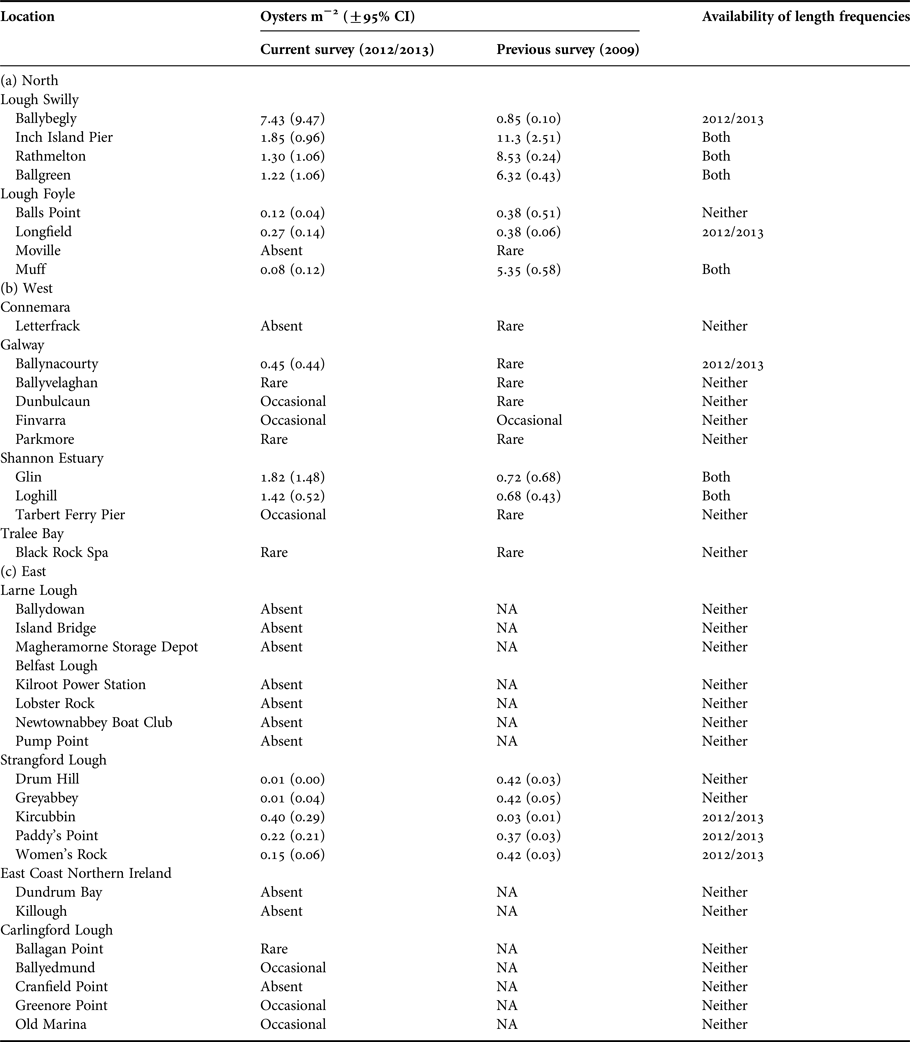
Mean C. gigas density (oysters m−2) in 2012/2013 and 2009 (Guy & Roberts, Reference Guy and Roberts2010; Kochmann et al., Reference Kochmann, O'Beirn, Yearsley and Crowe2013) ± 95% confidence intervals (CI) at 37 sites in Ireland (Figure 1). Abundance for sites with densities <1 individual per 10 m2, was classified using the SACFOR scale (Connor et al., Reference Connor, Allen, Golding, Howell, Lieberknecht, Northern and Reker2004). NA denotes sites where no information was available from previous surveys. Length frequencies are available for both (current and previous surveys), only a certain year, or neither survey.

The sampling methodology devised by Kochmann et al. (Reference Kochmann, O'Beirn, Yearsley and Crowe2013) was applied, slightly altered, to guarantee consistency across sampling events. It consisted of a 45-min timed search for oysters carried out on each shore. During each search, O. edulis and wild C. gigas density was recorded using the SACFOR-scale (Superabundant >100, Abundant = 10–99, Common = 1–9, Frequent = 0.1–0.9, Occasional = 0.01–0.09 and Rare <0.009 oysters m−2; Hiscock, Reference Hiscock1996; Connor et al., Reference Connor, Allen, Golding, Howell, Lieberknecht, Northern and Reker2004). The identification of both species was based on their morphological features (Hayward & Ryland, Reference Hayward and Ryland2008). Sightings of O. edulis were only documented when they could be clearly identified as such and were found within the same tidal zonation as C. gigas.
On shores where C. gigas density was estimated as >0.09 oysters m−2 (i.e. abundance category Frequent or above) in current or previous surveys, individual oyster length (distance between hinge to valve) and exact density m−2 was additionally quantified along randomly placed transects. To do so on shores with lower oyster densities would not have provided useful information, owing to low sampling numbers. Previous studies used different sampling designs to quantify oyster length, for example Kochmann et al. (Reference Kochmann, O'Beirn, Yearsley and Crowe2013), targeted areas of shore with the greatest density of C. gigas and used two transects of 30 × 1 m or 2 × 17 quadrats of 1 × 1 m (on mussel beds), while Guy & Roberts (Reference Guy and Roberts2010) used a stratified sampling design with 0.25 m2 quadrats spaced along a 100 m transect at pre-determined intervals. However, in the current study six smaller transects (1 × 10 m) were chosen rather than two larger transects (1 × 30 m) and each were placed randomly on the shore at mid to low tide level to be representative and incorporate variations of oyster populations on each shore (Underwood, Reference Underwood1997). Attachment substratum of oysters was also quantified for both C. gigas and O. edulis to allow a better comparison of the habitat type where both were most abundant and provide more descriptive information. GPS coordinates were taken at the beginning of the first transect and at the end of the last transect to define the size of the covered area (online supplementary table: Table 1). All surveys were completed between October 2012 and September 2013 and aquaculture activity was noted when present (online supplementary table: Table 1).
Recent recruitment of C. gigas was defined by individual oyster length. Previous studies have shown that C. gigas can grow to 20–40 mm length during their first year and 30–80 mm in their second year (Schmidt et al., Reference Schmidt, Wehrmann and Dittmann2008; Fey et al., Reference Fey, Dankers, Steenbergen and Goudswaard2009; Guy & Roberts, Reference Guy and Roberts2010). Although oyster growth rates may differ among regions (Harding et al., Reference Harding, Mann and Southworth2008), we considered that sites which contained oysters ≤30 mm had most likely had recent recruitment events (oysters which are less than 1 year old).
Data analysis
Data were normally distributed and homoscedastic for all datasets. Mean oyster density m−2 ±95% confidence intervals were calculated for sites with oyster densities >0.09 m2 to allow a more accurate comparison of densities between sites and years. No exact count measures were taken at sites with an estimated oyster densities <0.09 m−2. Here categories from the SACFOR scale represent oyster densities. To test for differences in oyster populations structure since the previous survey in 2009 (Kochmann et al., Reference Kochmann, O'Beirn, Yearsley and Crowe2013), length frequencies of individuals at each location were compared using paired Kolmogorov–Smirnov tests. Length frequency data from previous surveys were not derived from a standardized area or from a set number of individuals (e.g. 60 m2 in the current survey). The number of individual length frequencies from each site was standardized to the lowest number of individual length frequencies from the survey (current or previous) at each site. A random subsample was taken from surveys with the greater number of individual length frequencies. This was done for all locations with the exception of one site, Muff, where oyster abundance was very low in the current survey.
No length frequency data were available from previous surveys of oyster populations at Strangford Lough (Guy & Roberts, Reference Guy and Roberts2010). Therefore, we were unable to compare population structure and had to assess changes in population density based on quantitative comparison of average oyster abundance between the previous and present survey. All statistical analyses were carried out with the freeware package R 3.1.2 (R Core Team, 2016).
RESULTS
Temporal changes in the distribution and density of C. gigas
Crassostrea gigas was absent from 12 of the 37 sites surveyed between September 2012 and October 2013 (two on the east coast of Northern Ireland, three at Larne Lough, four at Belfast Lough, one in Lough Foyle, one in Carlingford Lough and one in Connemara; Figure 1, Table 1). The species was only rarely or occasionally recorded at the four sites surveyed in Carlingford Lough, at Moville in Lough Foyle, Ballyvelaghan, Dunbulcaun, Finvarrra and Parkmore in Galway Bay, Tarbert Ferry pier in the Shannon estuary and at Black Rock Spa in Tralee Bay (Table 1). Densities recorded in Strangford Lough were also low (<0.5 m−2). Greatest densities of C. gigas were recorded in Lough Swilly (1.2–8 m−2), with Ballybegly presenting the greatest maximum oyster density (24.8 m−2; Table 1). At five sites along the north coast there were notable changes in oyster densities; four with declines in densities at Muff in Lough Foyle and at Rathmelton, Inch Island Pier and Ballgreen in Lough Swilly whereas at Ballybegly in Lough Swilly densities had increased (Table 1, Figure 1). On the west coast, abundance of C. gigas generally showed little change apart from Glin and Loghill in the Shannon estuary where densities had doubled (Table 1, Figure 1). At sites sampled on the east coast C. gigas was only recorded in Strangford Lough in previous surveys. Here, declines occurred at Drum Hill, Greyabbey and Woman's Rock but with one increase at Kircubbin (Table 1).
Temporal changes in C. gigas population structure
Oyster length frequency distribution differed between 2009 and 2012 at three sites on the north coast (Muff [D = 0.93, P < 0.001], Rathmelton [D = 0.45, P < 0.001] and Inch Island Pier [D = 0.36, P < 0.001]) and one at Glin (D = 0.21, P = 0.028), on the west coast of Ireland (Figure 2). At Muff, the abundance of wild C. gigas had declined dramatically, with only a few large oysters remaining. In 2009, length frequencies at Rathmelton were skewed to the left with the greatest abundance of C. gigas in the 90–109 mm size classes, however, 3 years later the length frequency had a normal distribution, with most oysters between 60 and 89 mm, and only one oyster found within the 0–10 mm size class (Figure 2). At Inch Island Pier, length frequencies for C. gigas followed a bimodal trend in 2011 with greatest oyster abundances in size classes between 50–69 and 110–130 mm. In 2012, length frequencies for Inch Island Pier were found to be unimodal but skewed to the right and the greatest abundance of oysters was in size classes between 80–110 mm and only few oysters were found to be ≤30 mm (Figure 2). At Glin, there was a greater abundance of oysters in the 70–89 mm size classes in 2012/2013 than in 2009, yet, at both occasions length frequencies followed a normal distribution. There was no difference in length frequencies between 2009 and 2013 at Loghill (D = 0.14, P = 0.42) in the Shannon Estuary and Ballgreen (D = 0.20, P = 0.36) in Lough Swilly, however a greater range of size classes was found at Ballgreen in 2013 compared with 2009 (Figure 2).
Length frequency distribution of wild C. gigas where length frequency data were available from sites surveyed in 2009 and 2011 for Inch Island Pier (dark grey) and in 2012/2013 (light grey). Length frequency data were standardized to allow comparison between previous and recent surveys. Number of length frequencies were based on the lowest number of oysters sampled during 2009 or 2012/2013 for each site, except for Muff where oyster densities were extremely low in 2012.

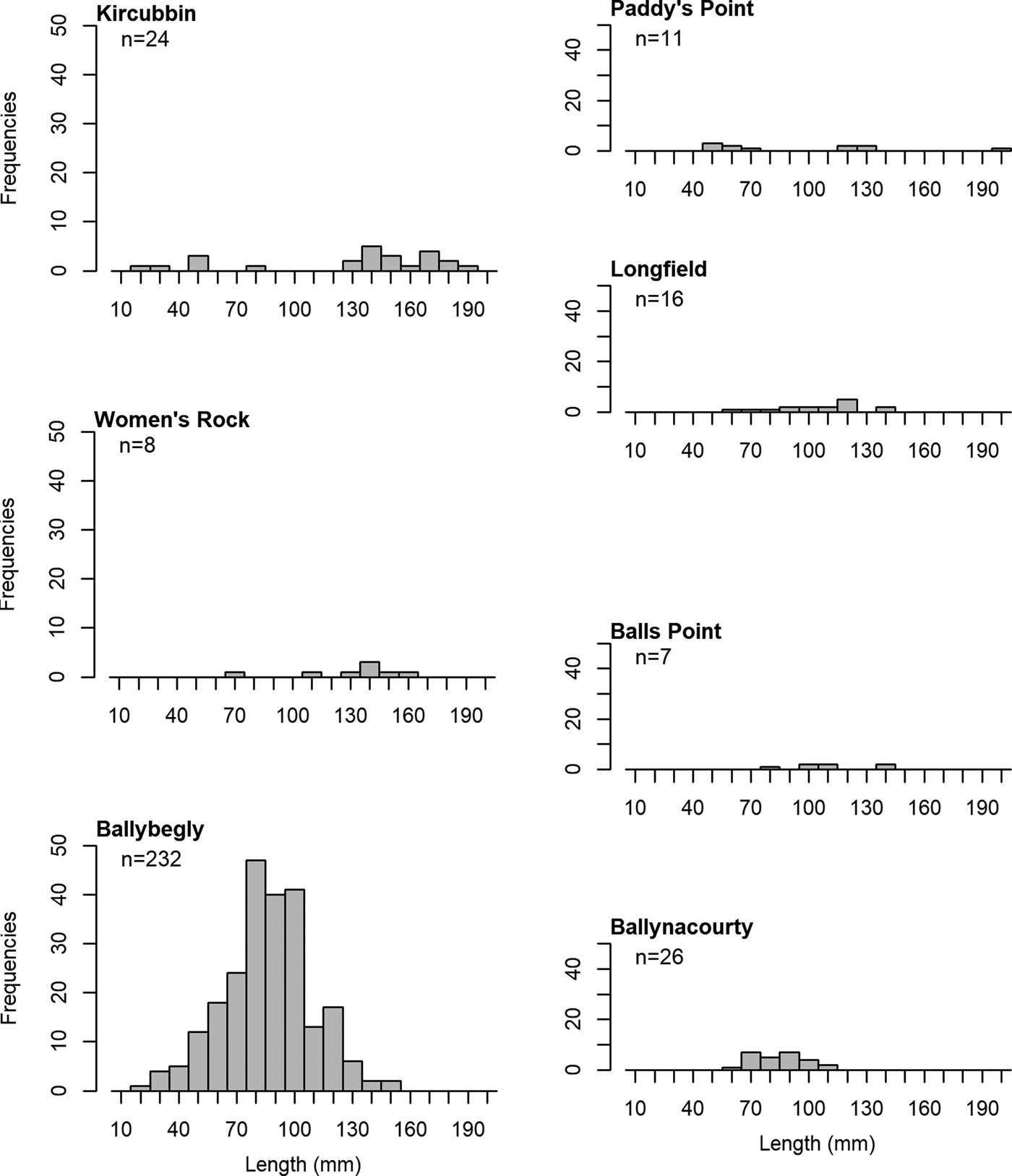
Minimum and maximum oyster length varied at sites where oyster abundances were low (Figure 3). In Strangford Lough, oyster length ranged from 18–188 mm in Kircubbin, 41–193 mm at Paddy's Point and from 68–153 mm at Women's Rock (Figure 3). For one site at Lough Foyle (Longfield), oyster length ranged from 53.5–137 mm and in Galway (Ballynacourty) from 53–108 mm (Figure 3). At Ballybegly, Lough Swilly, the smallest oyster was found to be 15 mm in length and the maximum recorded length was 149 mm.
Crassostrea gigas length frequency distribution in 2012/2013 at sites, which were surveyed in 2009, but where individual oyster sizes had not been recorded previously.

Recent recruitment of C. gigas
Small numbers of juvenile C. gigas were found at Rathmelton (N = 5); Ballgreen (N = 7); Ballybegly (N = 7) and Inch Island Pier (N = 3), Lough Swilly; and Kircubbin (N = 2), Strangford Lough.
Co-occurrence of C. gigas and O. edulis
During the survey five sites were found where C. gigas and O. edulis individuals occurred in the same transects, all of which showed comparatively low densities of O. edulis. Four of them were located in Strangford Lough (Drum Hill, Kircubbin, Paddy's Point, Women's Rock) and one in Lough Swilly (Rathmelton; Figure 4). Ostrea edulis individuals were predominantly attached to conspecifics and shells of other molluscs (including those of Littorina littorea, Mytilus edulis and C. gigas; 45.1%), as well as cobbles (6.5%) and boulders (19.4%). Of all encountered O. edulis, 29% were not attached and showed no previous sign of attachment. In contrast, only 21% of C. gigas were attached to other bivalves (including O. edulis individuals), while the majority (69.4%) were attached to boulders and only few to cobbles (4.3%). In regions where there was evidence that C. gigas proliferated naturally only 2.2% were not attached to substratum. Crassostrea gigas was also found to attach to Fucus vesiculosus (1.4%) and Sabellaria alveolata reefs (1.7%) albeit in small quantities.
Density (mean ± SD) of Ostrea edulis (light grey) and Crassostrea gigas (dark grey) at sites where both oyster co-occur within the same intertidal zonation.

DISCUSSION
The point where non-native species become invasive is specific to each ecosystem and dependent on various factors, such as temperature, predator abundance or nutrient availability (Hulme & Barrett, Reference Hulme and Barrett2013). Paradoxically, some non-native species, such as C. gigas, have established extensive wild populations in some regions, where they became invasive, yet not in other geographically close or environmentally similar areas, where only small populations with a negligible impact are present (Kochmann et al., Reference Kochmann, O'Beirn, Yearsley and Crowe2013; Hollander et al., Reference Hollander, Blomfeldt, Carlsson and Strand2015). Populations of C. gigas, for example, are thought to increase with increasing seawater temperature (Thomas et al., Reference Thomas, Pouvreau, Alunno-Bruscia, Barillé, Gohin, Bryère and Gernez2016). Yet environmental conditions are often subject to change, especially in light of climate change which results in increasing seawater temperatures in northern temperate ecosystems (Mieszkowska et al., Reference Mieszkowska, Firth and Bentley2013; Knights et al., Reference Knights, Firth and Russell2017). Therefore, it is paramount that populations of non-native species which could potentially become invasive are monitored regularly. During our survey we found evidence of both localized population reductions and expansions of C. gigas in Ireland. We further show that some regions, while subject to regular introduction of C. gigas via aquaculture pathways, do not show any signs of wild settlement. Although low, recent recruitment of C. gigas was found at several sites. Five sites were identified where C. gigas and O. edulis co-occurred intertidally, raising concern about the recovery of the native oyster.
To date, no studies within Europe have documented natural co-occurrence of C. gigas and O. edulis. This has led to the assumption that their habitats do not overlap, and that populations of C. gigas would not impact on the native oyster (Reise, Reference Reise1998). During the present survey, five sites were identified where both species co-occurred in the same intertidal zonation (habitat). At the time of writing, we are aware of low density subtidal C. gigas populations within O. edulis beds in at least two of the surveyed locations (Lough Swilly and Lough Foyle; McGonigle et al., Reference McGonigle, Cavanagh and Santiago2011; Tully & Clarke, Reference Tully and Clarke2012; Nadescha Zwerschke personal communication). Although a replacement of O. edulis by C. gigas seems to have little impact on biodiversity (Zwerschke et al., Reference Zwerschke, Emmerson, Roberts and O'Connor2016) the presence of C. gigas within O. edulis populations has the potential to hamper the recovery and re-introduction attempts of the economically valuable native oyster (Zwerschke et al., in review).
Population dynamics of C. gigas within Ireland were variable. In general C. gigas is a relatively long-lived species and can survive up to 30 years and reach sizes up to 400 mm (Nehring, Reference Nehring2006). In Ireland, evidence from oyster length frequency estimates suggest that C. gigas may not live longer than 6–7 years. Age determination of C. gigas in Strangford Lough showed that 6-year-old oysters have a mean length of 134 mm (±3.5 mm SE; Guy & Roberts, Reference Guy and Roberts2010). Based on the present study and Kochmann et al. (Reference Kochmann, O'Beirn, Yearsley and Crowe2013), the largest size class identified was 130–150 mm at most sites. Simultaneously, no increased abundance of oysters >150 mm was found during the present study, reinforcing the assumption that environmental conditions within Ireland limit the extended survival of newly recruited C. gigas. In fact, the majority of oysters do not appear to be >2–3 years old (70–90 mm), which suggests that most oysters are removed from the ecosystem after 4 years, either driven by natural mortalities or harvesting (Schmidt et al., Reference Schmidt, Wehrmann and Dittmann2008; Fey et al., Reference Fey, Dankers, Steenbergen and Goudswaard2009; Guy & Roberts, Reference Guy and Roberts2010).
A decline of C. gigas populations was identified at several sites, in Lough Swilly, Strangford Lough and Lough Foyle, and the most notable was at Muff in Lough Foyle where populations declined from 5.35 ± 0.58 oysters m−2, to 0.08 ± 0.12. A mussel bed, serving as habitat for C. gigas individuals, was largely removed before the current survey, thus also removing the majority of oysters (C. McGonigle personal communication, Loughs Agency; Kochmann et al., Reference Kochmann, O'Beirn, Yearsley and Crowe2013). Sites in Strangford Lough were part of a culling project and the reduced number of C. gigas at most sites may be indicative of its effect (Guy & Roberts, Reference Guy and Roberts2010). During surveys in Lough Swilly, C. gigas were found to be collected from the shore by local fishermen, especially at the site of Rathmelton (N. Zwerschke personal communication). Other studies already found that recreational fishing activities could lead to a decline of the target species, which may have happened to localized C. gigas populations here (Post et al., Reference Post, Sullivan, Cox, Lester, Walters, Parkinson, Paul, Jackson and Shuter2002; Lewin et al., Reference Lewin, Arlinghaus and Mehner2006). In past surveys, however, maximum oyster density was calculated by specifically targeting dense patches of C. gigas in the mid and low intertidal zone (Kochmann et al., Reference Kochmann, O'Beirn, Yearsley and Crowe2013). A non-random selection of oyster patches is not representative of the mean oyster density for the whole shore and will overestimate oyster density (Cuff & Coleman, Reference Cuff and Coleman1979; Underwood, Reference Underwood1997). The current study focused on mean oyster density on the whole shore using a more random design. This approach should yield a more accurate estimation of mean oyster density along each shore. However, when comparing densities between the years of 2009 and 2013, it must be borne in mind, that, owing to different survey techniques (maximum density (2009) and mean density (2013)), greater densities of C. gigas in 2013 will represent a true increase of oysters, while lower densities in 2013 may not necessarily represent a true decrease of oyster densities.
For conservation concerns, greatest consideration should be given to recent population expansion of C. gigas. At Ballybegly in Lough Swilly densities of C. gigas increased by a factor of 10 over 3 years. Most oysters, here, were <80 mm in length, suggesting that most of the population's expansion occurred recently between 2010 and 2013 (Guy & Roberts, Reference Guy and Roberts2010). A combination of several factors may explain why C. gigas population only increased at this site. In 2010 it was an unusually warm year, with a sustained average sea temperature of over 16°C in Lough Swilly during the summer months (The Marine Institute, 2015). Ballybegly is located in a small, shallow inlet, which may have caused seawater temperatures to rise over the threshold required for successful spawning and subsequent spatfall of C. gigas (Syvret et al., Reference Syvret, Fitzgerald and Hoare2008). Simultaneously, the greatest subtidal C. gigas populations within Lough Swilly were found not far off the affected intertidal site (Tully & Clarke, Reference Tully and Clarke2012). These oysters may have been deposited there by fishermen or were discards of aquaculture activity which uses a nearby jetty to store C. gigas before selling them (Nadescha Zwerschke personal communication). High temperatures in combination with dense subtidal assemblages of C. gigas within a sheltered shallow bay may have caused this sudden localized increase in intertidal C. gigas populations for this year.
Length frequency results also provided an immediate overview of sites where recent successful recruitment of C. gigas had occurred and helped to identify sites most vulnerable to further invasion, such as Kircubbin in Strangford Lough. Although no high density C. gigas populations were located in close proximity to the site at Kircubbin, hydrodynamic particle dispersal models of Strangford Lough predict that larvae (as simulated by particles) released on western shores, where C. gigas is cultured, may be dispersed to and settle on the eastern side of the lough, e.g. Kircubbin (Smyth et al., Reference Smyth, Kregting, Elsäßer, Kennedy and Roberts2016). Often hydrodynamic conditions within individual bays are not well known and subject to change as bottom morphology and currents may alter over time, yet these conditions are important to predict the spread of invasive species with planktonic larvae (Brandt et al., Reference Brandt, Wehrmann and Wirtz2008). These results show that C. gigas populations in Ireland can be sustained by propagule pressure from aquacultures and may, given favourable environmental conditions, colonize intertidal areas within short periods of time.
Settling C. gigas larvae cement themselves to hard substrata (Nelson, Reference Nelson1924) and become more firmly attached to the substratum as they grow (Wrange et al., Reference Wrange, Valero, Harkestad, Strand, Lindegarth, Christensen, Dolmer, Kristensen and Mortensen2009). Where oysters are not attached to the substratum, such as in Carlingford Lough, it is likely that these individuals are direct discards from local aquaculture platforms. Carlingford Lough has a long history of C. gigas cultivation (Ball et al., Reference Ball, Raine and Douglas1997; Ferreira et al., Reference Ferreira, Duarte and Ball1997), yet no evidence of successful C. gigas recruitment was found here. Ferreira et al. (Reference Ferreira, Duarte and Ball1997) seem to consider this the consequence of low temperatures within the Lough, since gamete production, but no spatfall in C. gigas had been observed in Carlingford Lough. Other reasons could include a short water residence time between 14 and 26 days and a high water flow rate between 1–9 m3 s−1 (Ferreira et al., Reference Ferreira, Hawkins, Monteiro, Moore, Service, Pascoe, Ramos and Sequeira2008). Crassostrea gigas has a pelagic larval duration of 2–4 weeks, depending on physiological and environmental conditions (Rico-Villa et al., Reference Rico-Villa, Pouvreau and Robert2009). Most C. gigas cultures are located close to the openings of the Lough, where water exchange and currents are greatest owing to tides. Colder water temperatures may limit the spawning potential of C. gigas, yet fast water exchange between the lough and the open sea may remove any pelagic larvae of C. gigas which did occur, before they can settle.
We conclude that environmental conditions within Ireland do not permit the establishment of extensive populations of C. gigas, owing to reduced spawning potential and high mortalities within 3–4 years. Five sites were identified, four in Lough Swilly and one in Strangford Lough, where there was evidence of successful recruitment albeit in low abundances during the year of the survey and which could be classified as susceptible to further invasion by C. gigas. We also pinpointed five sites where the non-native and the native oyster co-occurred. We suggest the removal of C. gigas in those areas to aid the recovery of O. edulis in line with other eradication programmes carried out previously such as in Strangford Lough (Guy & Roberts, Reference Guy and Roberts2010) and encourage the use of triploid C. gigas for aquaculture to limit further spreading potential of the oyster (Allen & Guo, Reference Allen, Guo, Levin, Angle, McIntyre and Yu1996). We recommend that these standardized surveys are continued regularly, ideally in combination with subtidal surveys to monitor further spread of C. gigas within Ireland.
SUPPLEMENTARY MATERIAL
The supplementary material for this article can be found at https://doi.org/10.1017/S0025315417001448.
ACKNOWLEDGEMENTS
We would like to thank Ciarán McGonigle as well as other staff from the Loughs Agency and many volunteers from Queen's University Belfast, especially Lawrence Eagling, who helped with the sampling effort. We would also like to thank two anonymous reviewers, whose comments greatly improved the manuscript.
FINANCIAL SUPPORT
This research was funded by IBIS, project 2859 supported by the European Union's INTERREG IV Programme managed by the Special EU Programmes Body (www.seupb.eu).