Thirteen months of ethnographic fieldwork in OffinsoFootnote 1 afforded me the opportunity to witness several family quarrels, particularly the ones between married and cohabiting spouses. It was clear that most of these disputes arose from the processes of negotiating economic roles and expectations in the domestic arena. The respective economic roles of mothers and fathers in matrilineal Asante can be described as ambiguous: while it is conventionally expected that men should provide for their wives and children, there exists an equally strong normative imperative on women to provide for the material needs of their children, and it is not always clear what exactly each of them should provide. In a context where the pooling of resources between spouses is uncommon and even undesirable for both men and women, parents often unwittingly find themselves in a contest over provisioning. When this happens, fathering and mothering become competitive rather than complementary roles.
This article addresses questions regarding the relationship between the performance of matrilineal kinship and gendered economic conduct within the household. Drawing on the experiences of two women living in an Asante town, it shows the practical ways in which gendered economic conduct is inflected by matrilineal modes of social organization. Matriliny here refers to the practice of tracing descent and belonging through the female line. Thus, children in such communities derive membership of their lineage through their mother and not their father. Although the ideal marriage residence is matrilocal/uxorilocal or duolocal, virilocal residence has become a viable alternative over the years due to external socio-economic influences as well as the practicalities of daily life. The cases discussed here indicate that the many incidences of marital conflict in Asante communities are illustrative of the underlying tensions between conjugal bonds and the bonds of the matrilineage. For both men and women, the strong ties to the maternal lineage are maintained at the expense of a fragile marital bond, and this explains why marriages in matrilineal groups have been noted to be markedly less stable, with most people having several spouses over time (Peters Reference Peters1997a; Crehan Reference Crehan1997; Blanchy Reference Blanchy2019).
For a long time, the survival of the matrilineal form of social organization, particularly in the wake of social and economic change, has been a subject of commentary for anthropologists and other commentators (Peters Reference Peters1997b: 126; Reference Peters, Grinker, Lubkemann, Steiner and Gonçalves2019: 39; Johnson Reference Johnson, Stein, Lazar, Candea, Diemberger, Robbins, Sanchez and Stasch2016). As far back as the mid-twentieth century, Margaret Read, for instance, wrongly interpreted the interactions between matrilineal (Chewa and Yao) and patrilineal (Ngoni) groups in Nyasaland as an indication of the gradual supplanting of matriliny by patriliny (Brantley Reference Brantley1997). However, in the years since then, many ethnographic examples around Africa and other parts of the world have shown that matriliny continues to shape political and socio-economic interactions in significant ways (Johnson Reference Johnson, Stein, Lazar, Candea, Diemberger, Robbins, Sanchez and Stasch2016; Peters Reference Peters, Grinker, Lubkemann, Steiner and Gonçalves2019). For instance, Sophie Blanchy's (Reference Blanchy2019) analysis of matriliny and Islam in the Comoros paints a picture of a practice that is in flux and yet has proved enduring in the face of migration and centuries-long Islamic religious influence.
In the case of the Asante of Ghana, economic and gender relations are inflected by norms of kinship that privilege maternal relations over paternal ones (see Fortes Reference Fortes, Forde and Radcliffe-Brown1950); economic values that encourage female enterprise (see Clark Reference Clark1994; Reference Clark1999); and marriage conventions that allow spouses to maintain separate economic resources (see Abu Reference Abu and Oppong1983; Boni Reference Boni2002; Tashjian Reference Tashjian, Hunwick and Lawler1996). The material in this article demonstrates the dynamic ways in which these aspects of matriliny continue to shape notions of personhood, belonging, gender and economic obligations in Asante. This shows, as Peters (Reference Peters, Grinker, Lubkemann, Steiner and Gonçalves2019: 46) has argued, that the political, social and economic practices of people across Africa are shaped by certain ‘critical distinctions’ that ‘turn on kinship, descent, and marriage’.
Female enterprise in a matriliny
Anthropologists have long engaged with the idea of the construction and transformation of the self through labour activity. Strathern, one of the foremost anthropologists to set the tone for debates about the relationship between individuals and society, has identified work as a ‘sphere of agency’ that is ‘oriented to social others’ (Reference Strathern1988: 156). Thus, for instance, a young mother in the Trobriand Islands of Papua New Guinea can, through particular acts of productive labour, successfully transform her relational position from mother to daughter or sister (Lepani Reference Lepani2015: 53). By changing her daily work activities, the young mother is able to dramatically transform her social position and seemingly reverse time to become young again, unmarried again, and childless again (ibid.).
Within Africa, there has also been ethnographic evidence to show that the very concept of personhood is significantly defined by a subject's material obligations to and claims on others (Rodima-Taylor Reference Rodima-Taylor2013: 77). For instance, Max Gluckman (Reference Gluckman1965) makes the point that the fulfilment of material obligations is central to Barotse morality. Personhood is thus manifested partially in acts of labour and material distribution that serve as the means by which social bonds are maintained (Rodima-Taylor Reference Rodima-Taylor2013: 79). For the Kuria people of Tanzania, Rodima-Taylor notes that ‘personhood is built through interacting with others in socially meaningful ways, which often entails being interwoven in diverse obligation and debt networks and accumulating potential exchange partners’ (ibid.: 90). In parts of rural Malawi where matrilineal principles shape social relations, a woman's personhood is explicitly linked to her possession of a granary and cultivable land, which enable her to establish a household of her own together with her husband and children (Englund Reference Englund2008: 40). Her relations with other women are enacted through the exchange of gifts, usually comprised of farm produce such as maize (ibid.: 41). Such material practices are woven into the daily activities of life, becoming avenues for people to assert and reassert their personhood:
A whole range of contexts and events constitutes this relational field, not only during crises but also in the casual encounters of everyday life, such as when a neighbour's or relative's children decide to take their meal at one's house. Whether or not it is objectified as a gift (mphatso), food is more than a mere means of sustenance on these occasions. Time and again, it establishes the provider as an adult capable of meeting the obligations that her or his relationships entail. (Englund Reference Englund2008: 41)
Similar observations have been made by Crehan (Reference Crehan1997) in north-western Zambia, where the matrilineal Kaonde strictly match kin hierarchies with specific obligations and reciprocities. The fulfilment of these obligations is considered by them as central to communal life (ibid.: 214). But the nurturing of relationships often takes more than material exchange. For example, for nineteenth-century Tswana people, the making of a person involved a continuous series of economic and social activities that reflected the person's status (Comaroff and Comaroff Reference Comaroff and Comaroff2001). For example, men ‘had to “build themselves up” – to constitute their person, position, and rank – by acquiring “wealth in people”, orchestrating ties of alliance and opposition, and “eating” their rivals’ (ibid.: 269). Tom Neumark (Reference Neumark2017) has also noted how the process of working on relationships sometimes requires a person to detach themselves from others as a way of caring for those relationships.
In the general Ghanaian context, women are expected to take up work outside the home, in addition to their domestic duties of childcare and nurturing (Darkwah Reference Darkwah and Harley2007). Women's contribution to household subsistence is particularly prominent in Akan communities (including Asante), where most of the activities in food cultivation are undertaken by women (Hill Reference Hill1978: 220). In the mid-twentieth century, anthropologist Meyer Fortes commented: ‘It is taken for granted in Ashanti, as in most parts of West Africa, that a woman will earn her own living or a large part of it’ (Fortes et al. Reference Fortes, Steel and Ady1947: 163). This is often necessitated by the absence of a strict requirement for pooling resources among the Asante (Clark Reference Clark1994: 334) and other Akan groups such as the Fante (Carr Reference Carr2013: 93). The situation in Asante is consistent with Polly Hill's (Reference Hill and Goody1975: 123) observation that, in West Africa, ‘husbands and wives seldom form a unified production unit’ and ‘wives invariably enjoy a large measure of economic autonomy’.
In more recent times, Gracia Clark (Reference Clark1994) brought this tradition of Asante female resourcefulness to life through her study of market traders in Kumasi Kejetia market. While operating within an environment of political and economic instability, Clark's informants were able to establish and maintain their trading activities partly because they had access to resources within the lineage – through inheritance, through the use of commonly owned lineage property, or by borrowing from other lineage members (ibid.: 330). They also leveraged their simultaneous positions in marriage (as wives) and within the natal lineage (as mothers, daughters and sisters) to bolster their autonomy and accumulation efforts (ibid.). Again, in a subsequent article, Clark (Reference Clark1999) outlined the importance of women's work to their status as mothers, to the extent that the willingness to work and provide for their children becomes one of the best ways of showing affection. In the case of my interlocutors, female enterprise is still strongly motivated by the desire to provide for the material needs of others, especially one's own biological children and members of the lineage.
The privileging of matrilineal kin relations
The Asante reckon that the origin of all kin connections is the maternal line, which is sustained through the reproductive and productive activities of women. Here, as in other places in the world, kinship is socially enacted and given meaning through the notion of biological descent. The Asante particularly emphasize biological descent through the mother's line. Even when non-biological kin are assimilated into the lineage, the members who have a biological connection to the original maternal line usually take precedence over those who are admitted through adoption or other means. Thus, the Asante origin myths speak of Ankyewa Nyame, the protohistoric great ancestress of the Oyoko clan who is said to have remarked to those members of the clan who were not biologically connected to her: ‘If you are Oyoko, then I am more Oyoko than you!’ (Wilks Reference Wilks, Friedman and Rowlands1977: 523).
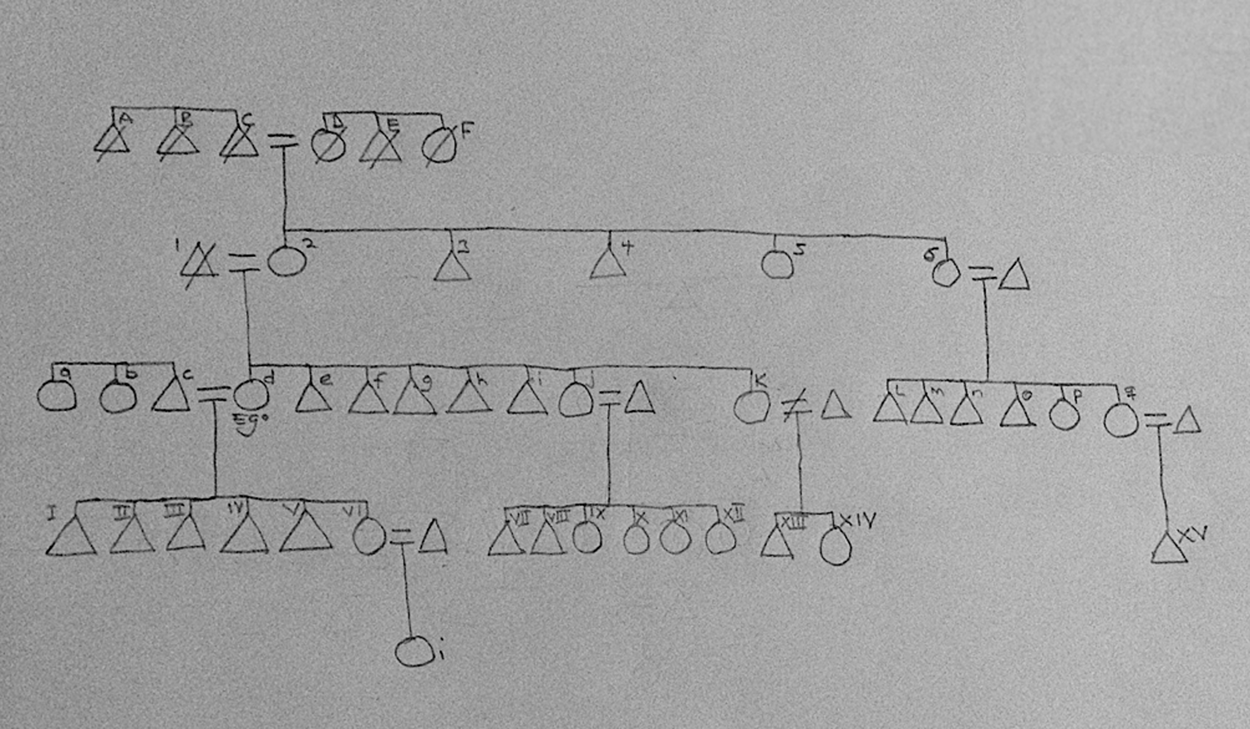
However, despite this strong emphasis on blood connection, the social construction of kinship means that, in addition to biological descent, other markers of kin connection, including what Sahlins (Reference Sahlins2011: 5) would characterize as ‘commensality, sharing food, reincarnation, co-residence, shared memories, working together, adoption, friendship, shared suffering, and so on’, remain relevant. For example, the parent–child relationship is often defined by social norms, and this makes it possible, according to Durkheim, for the child to become ‘more intimately mixed (mele) in the life of one or the other, so that it will not be the relative of the one or the other to the same degree’ (cited in Sahlins Reference Sahlins2011: 10). In Asante, the rules of matriliny ensure that both males and females identify more closely with their matrilineage. This is evident in the way in which kinship is reckoned. In the kinship diagram in Figure 1, the emphasis of Ego, a middle-aged food seller, is clearly on her relations with the members of her matrilineage.
Sample kinship diagram.

When asked to name her abusua – a term used to refer to members of the matrilineal group, as well as the more general family, including members of the conjugal unit – Ego begins her count from her mother's parents (C and D in the diagram), forgetting or deliberately neglecting to mention either her father's parents or his siblings. In contrast, her mother's siblings are clearly listed (3 to 6). Similarly, Ego's own siblings of the same mother (e to k) are described in more detail (together with their spouses and children, where applicable) than her husband's siblings (a and b). In the subsequent generations, there is no space for anyone who is not descended from Ego's mother's mother (D). Indeed, the process of tracing kin relations underlines the significance of matriliny in more ways than is immediately apparent to the eye. For instance, a cursory look at the kinship diagram would suggest an absence of polygynous marriage. But, in reality, polygyny and serial monogamy are quite common marriage practices. Because Ego's siblings who are born of her father's other wife do not belong to Ego's lineage, they are left off the list. The same goes for all other polygynous marriages.
Apart from the general sense of belonging that binds all descendants of a common womb, the visual representation of kin relations also contains an instrumental element that is not immediately apparent on diagrams like the one shown in Figure 1. The level of recognition accorded to various kin relations is a function of material exchange as much as blood connection. So, although the distribution or exchange of material resources might not determine who is considered kin, it does determine who among kin is given priority in the kinship diagram. Therefore, the repute that is accorded to women is mediated by both their productive and their reproductive contributions to the lineage. Indeed, the strongest bonds of affective and material obligation occur in the relationship between mother and child. This is why, Fortes noted half a century ago, ‘An Ashanti woman stints no labour or self-sacrifice for the good of her children’ (Reference Fortes, Forde and Radcliffe-Brown1950: 263). In return, children gain great satisfaction in building a house for their mother once they reach adulthood (ibid.).
Finally, the omission of husbands in kinship reckoning is indicative of the strength of matrilineal bonds at the expense of the conjugal union. Commentators on Asante have identified a fundamental quandary regarding the marginal role of a father/husband in a matrilineal kinship arrangement where children are reckoned to belong to the same lineage as their mother while their father belongs to a different lineage altogether (Fortes Reference Fortes, Forde and Radcliffe-Brown1950: 264). In centuries past, the father–child relationship was formalized through practices such as ntamoba, which allowed a father to demand a payment from his wife's lineage in exchange for formally relinquishing his rights in his children (see Allman Reference Allman1997 for more details). But the marginalization of the husband is still a primary source of tension in a marriage, and women often remark: ‘My husband can leave me at any time.’Footnote 2 Consequently, women feel justified in prioritizing their obligations to their children and lineage members over their obligations to husbands (Clark Reference Clark1999: 717).
The discussion in the next section illustrates the practical significance of matrilineal identity and connection in the economic choices of women in Offinso. We have already noted that, in addition to the lifetime affiliation to the matrilineal groups, women are expected to take responsibility for the material needs of the home as much as men are. This means that women – as mothers, sisters and wives – have the incentive and the normative impetus to earn a living on their own in order to meet the material needs of their dependants in the lineage, especially their children, if they have any (Clark Reference Clark1999). Furthermore, as will be seen in the examples of Asantewaa and Pomaa below, the economic separateness of spouses makes it possible for married women to keep what they earn and spend it without recourse to their husbands. But it is also important to note that the norms, values and conventions that undergird the contemporary economic choices of Asante women have encountered major external political and economic influences over the centuries.
The economic separateness of spouses
Historicizing Asante women's economic activity
Prior to the introduction of cocoa cash cropping in the twentieth century, the subsistence economy of Asante communities allowed spouses to cultivate food crops on separately owned plots provided by their respective matrilineage while using each other's labour (Tashjian Reference Tashjian, Hunwick and Lawler1996: 208). This arrangement made it possible for couples to maintain separate properties and still benefit from each other's labour (ibid.: 210). Reliance on conjugal labour in this way was the general pattern in other Akan groups, including the Fante, where couples worked together on each other's farms to provide for the needs of the conjugal household (Hill Reference Hill1978: 220). Conjugal labour was necessitated by practical factors including the method of farming (shifting cultivation), which required that new land was cleared each year, and a strict gender division of labour that prescribed separate farming tasks for males and females (Hill Reference Hill1978: 220; Tashjian Reference Tashjian, Hunwick and Lawler1996: 209). However, despite this collaborative practice, each spouse maintained separate ownership and control of their farm and its fruits (Tashjian Reference Tashjian, Hunwick and Lawler1996: 208).
Although a man had a right to his wife's labour, he did not force her to work for him and she was entitled to compensation for expending her labour on his farm (Hill Reference Hill1978: 222). Men were more likely to have absolute control of the labour of their spouses and progeny only in situations where they had taken their wives or children as pawns. This happened when a woman or her children were given by her maternal uncle or brother to her husband in exchange for a loan; the pawnage ceased when the loan was repaid (Grier Reference Grier1992: 309). Although pawnage was not limited to women, or even to human beings (Austin Reference Austin, Lovejoy and Falola2003), women were particularly valuable as pawns because of their dual utility as producers and reproducers (Grier Reference Grier1992: 312). Another strategy used by men in precolonial Asante to gain absolute control of conjugal labour was by having children with their female slaves, whose offspring they owned completely (ibid.: 313).
With the introduction of cocoa cash cropping in Asante at the turn of the twentieth century, conjugal labour became even more necessary for the success of cocoa farms (Austin Reference Austin, Lovejoy and Falola2003: 208). The gender division of labour dictated that men cleared the land while women helped with planting, nursing, harvesting and other jobs. In the early stages of the cocoa farms, women also took charge of food cultivation for the consumption of the household and to provide shade for the young cocoa plants (ibid.: 209). The cocoa farmer's reliance on his wife and children's labour was exacerbated by the abolition of domestic slavery in 1896 (Mikell Reference Mikell1992: 132) and pawnage in 1908 (Allman Reference Allman1997: 306), even though these practices – the use of women as pawns in particular – continued in some areas well into the 1940s (Mikell Reference Mikell1992: 116). Having to expend their labour on their husbands’ cocoa farms meant that women had less time to work on their own farms and to engage in other income-generating activities such as trading (Tashjian Reference Tashjian, Hunwick and Lawler1996: 211).
Despite the increased possibility of joint conjugal labour, there was no joint property ownership between spouses. Asante social arrangements continued to maintain a careful balance between joint conjugal labour and separate property ownership. This was easier to maintain in a subsistence farming economy where each spouse had access to land from their matrilineage. But with cash cropping it became more difficult to maintain the balance, especially in cases where people had to travel outside their locality to obtain land for cocoa farming (Tashjian Reference Tashjian, Hunwick and Lawler1996: 211). In such cases, while it was possible for both male and female migrants to obtain separate lands, it was usually the husband who got the land on which both of them worked (ibid.: 211; Hill Reference Hill1963: 42). It was no longer possible for both of them to own their separate plots on lineage land and reciprocate labour as they did in their own village (Tashjian Reference Tashjian, Hunwick and Lawler1996: 211). A woman's inability to obtain fair compensation for her labour on her husband's cocoa farm became a source of conflict within the household, and these conflicts contributed in no small measure to the already high divorce rate among the Asante (ibid.: 213).
Migration and cocoa farming also increased the possibility of virilocal residence. The income from cocoa made it more likely for men to establish their own homes away from the lineage dwelling (Mikell Reference Mikell1992: 127). Furthermore, the presence of patrilineal and nkramo (Muslim) migrant cocoa labourers from the northern territories exposed the Asante to different forms of domestic arrangement (ibid.: 131). Like Christianity, Islam favoured the patricentric household model and patrilineal inheritance. In the twentieth century, Asante matriliny also came up against British colonial and missionary practices. On the one hand, the colonial authorities were biased in favour of men, automatically assuming them to be household heads (ibid.: 124). This position was clearly influenced by Christian and Eurocentric views of the family. On the other hand, the colonial laws, with their preference for monogamous ordinance marriage, gave more support to women and children relative to husbands and fathers (Allman Reference Allman1997: 307). For example, the 1898 colonial marriage statute conferred on wives and children the right to inherit two-thirds of a man's property upon his death (Mikell Reference Mikell1992: 115).
It would appear, therefore, that political and economic change has had a significant effect on Asante matrilineal practice over the centuries. These influences can be seen at work in the following accounts of the experiences of Asantewaa and Pomaa. Asantewaa had migrated with her mother's sister to Offinso from Bono, another Akan area, and later moved to live with her husband in a house shared by his matrilineal kin. Pomaa also lived with her husband, but in a virilocal arrangement. Yet, the actions of both women indicate that economic separateness and individual property ownership in marriage can be used by women to strengthen their position in their own lineage and in the marital home. These accounts show that women have not simply succumbed to what appears to be men's superior earning opportunities in a modern economy. Neither have they yielded to the disadvantage of living away from their own lineages. They have rather striven in various ways to take advantage of economic separateness in order to strengthen their own position and that of their matrilineage. Therefore, the answer to the question of whether the ongoing political and economic changes have resulted in a decline of matriliny in the manner that scholars such as Murdock, Jack Goody and others feared (Douglas Reference Douglas, Douglas and Kaberry2001 [1969]: 121; see also Johnson Reference Johnson, Stein, Lazar, Candea, Diemberger, Robbins, Sanchez and Stasch2016: 6) remains a definite no.
The accounts of Asantewaa and Pomaa
Both Pomaa (aged thirty-five) and Asantewaa (aged forty-two) lived in Offinso New Town together with their husbands and children. At the time I met them in September 2016, Asantewaa was a busy yam trader while Pomaa stayed home and raised her four small children. Despite the fact that Pomaa's husband Appiah worked with a lottery company and earned a salary, she always complained that he neglected his responsibilities to her and the children. She claimed that he refused to provide her with dwa tire, the money to start a trade, or akɔhonma, the money for the daily upkeep of the family. There were rumours that he spent his money on his two girlfriends, one of whom had had a child with another man. One day in April 2017, Appiah mistakenly left 145 Ghanaian cedis (GH₵) (£26) in his clothes at home and Pomaa found it and decided to keep it for herself. When Appiah asked for the money, Pomaa feigned surprise that he had so much money and yet failed to provide for her and the children. A loud quarrel ensued but Appiah never got his money back. When the other women in the compound gossiped about this, they expressed support for Pomaa's actions. By now, word had spread in the neighbourhood that Appiah was an irresponsible husband and father.
On another occasion, rumour got to Pomaa that Appiah had won the lottery and used part of the money to rent a room for one of his girlfriends. When he came home, she confronted him about it, and they quarrelled again. A few days later, he returned home in the morning after spending the night outside and they had another loud quarrel. Pomaa asked him for money that day and he claimed not to have any. But when she searched his pockets again, she found GH₵10 (£1.79) and refused to give it back. Appiah beat her and asked her to pack her things and remove them from the house, whereupon she went to live with her mother in Amoewi, a village nearby. A week later Appiah went to plead for her to return, and they were reconciled by the elders in the lineage who advised Appiah to help his wife start a trade in order to avert further conflicts over akɔhonma or ‘chop money’. By August 2017, shortly after their reunion, Pomaa had taken up a new trade selling boiled peanuts on the streets.
The proximity of her matrilineal kin meant that Pomaa had a place to seek refuge when her husband drove her away, and it was with their support that she got Appiah to give her the money to start her trade. In Asante communities, the norms of matrilineal descent create the expectation that women will receive support from members of their mother's lineage even after they have married and gone off to live with their husbands. The norms of matrilineal kinship even permit duolocal marriage residence where married women can choose to continue living with their maternal kin (Clark Reference Clark1994: 336; Hill Reference Hill and Goody1975: 120). This option remains available to women even though some of my interlocutors chose to live with their husbands.
Pomaa's determination to start her own trade stemmed from her recognition that it was imperative for her to earn her living independently and to contribute to the material well-being of her children. Repeatedly picking her husband's pocket was her way of signalling to him that he would only find peace by helping her to set up her own income-generating activity. This way, as her lineage elders emphasized, she would not bother herself with searching his pockets. The solution to their quarrels was for each of them to earn and retain their resources separately. Pomaa's behaviour was consistent with the sentiments of Beatrice Duncan's (Reference Duncan2010: 304) interlocutors in cocoa farming communities, who stressed the transactional aspect of marriage and the need for women to make economic gains from marriage. Thus, being a woman was not just about reproducing the matrilineage, but also about producing the resources to sustain its members.
Asantewaa's situation was similar to Pomaa's in the sense that she too received little material support from her husband, and she was just as willing to make an independent living. When she first moved to Offinso from the Bono area north of Asante, she lived with her mother's sister, who operated a school canteen. This became her first job, which she did until she met her husband and began having children. At this point she realized that the money she was making as a cook was inadequate for her family's upkeep, so she started trading on her own. In the beginning she would take yams from another trader on credit and sell them herself. After selling, she would pay the debt and keep the profit. After a while she started buying the yams on her own and eventually got a bank loan to buy in larger quantities for resale to other traders. The bulk of the yams was bought by retailers at the Abofour market and she brought the rest of it home to sell on a table by the road in front of her house.
Her union with Kweku Sarpong was of the sort described as mpena awareɛ (lover marriage), defined as ‘marriage by mutual consent or a fairly long-term lover relationship’ (Abu Reference Abu and Oppong1983: 157). Such unions are generally governed by conventions that suppose that the couple will remain exclusive, that the man will provide for the woman's material needs, and that the marriage rites will be performed when there is a pregnancy (ibid.). In Asantewaa's case, the rites had not been performed despite the fact that they had had four children already. The acceptance of such unions is further indication of the fragility of the conjugal bond in this context. When I met them, Kweku Sarpong had recently lost his job as a taxi driver and now only cultivated a small piece of land. In essence, the behaviour of Kweku Sarpong was very similar to that of Appiah. He was constantly accused of neglecting his duties and spending his money on other women. But Asantewaa did not seem too concerned by any of this. She went about her job of trading and raising their four children as if nothing bothered her. In her utterances, she even seemed to accept male authority in household matters:
The man is the head of the family. We women are helpers, just that we have loud voices and we sometimes disobey our men, but they are really in control of everything. They provide the money and decide what food we should cook for them so that there is peace in the house.Footnote 3
Her use of language here indicates that this statement was not meant as a description of her personal situation but rather a generalized articulation of normative gender expectations. Also, being the leader of the women's group in church, her public utterances were shaped by Christian teachings about ideal gender roles that emphasized the authority of a man as head of the household. But the greatest betrayal of her words was her own behaviour, which was a complete negation of what she preached. During her quarrels with Kweku Sarpong, it was the man who was usually the loudest and had the propensity to take matters outside the home. If her statement indeed represented ideal gender roles, then her own actions constituted an inversion of those roles. She was the quieter of the two, provided the money, decided what to cook, and controlled everything while cavalierly dismissing his public antics.
On his part, Kweku Sarpong complained to anyone who would lend a sympathetic ear, especially his classificatory sister Awo Serwaa. But even she did not always see things his way. One time when he complained about Asantewaa's laxity as a parent and the children's lack of discipline, Awo said nothing in reply. Sitting nearby, I had expected Awo to offer her support to her brother, and when I asked her about it later, she told me that her brother had no basis to complain because it was Asantewaa who provided for the children. Moreover, under matrilineal principles, Sarpong had little control over the children's affairs since they belonged to their mother's lineage. It was their mother's brother (wɔfa) who served as their legal guardian (Fortes Reference Fortes, Forde and Radcliffe-Brown1950), or ‘male mother’ as some put it (Clark Reference Clark1999: 721). Asantewaa understood this well and did not seem bothered by her husband's claims that she had turned the children against him. She justified her actions as follows:
Among us Akan, when a man has children, it is said that he has had children for the woman's side. When a woman has children, she has given birth to abusua [lineage] … So, with these my children, if I am going somewhere, I can take them with me because that is the agyapadeɛ [wealth] I got [from the marriage].Footnote 4
Having her children on her side was advantageous for Asantewaa. As she herself expressed it, the children provided her with both tangible and intangible benefits. In an intangible sense, motherhood and control of her children gave her a sense of achievement, status and pride in extending her own lineage. This ability to extend the matrilineal group is considered the most valued attribute of female children (McLeod Reference McLeod and Goody1975: 112) and gives meaning to the popular adage ‘men bring money to the lineage, and women bring children’ (Clark Reference Clark1999: 723). In addition to the status and recognition gained from being able to extend the lineage, she derived tangible material benefits from having her children on her side. She made use of the children's labour in her yam trade and also received the gifts that came from the suitors of her older daughters. Indeed, the mobile phone that she used was given to her by Frema, her daughter. Kweku Sarpong was oblivious of this fact, and instead accused Asantewaa of giving the children mobile phones. Frema herself confided in me that her father was clueless about the things that went on between the children and their mother. It seemed that the close-knit mother–children unit collaborated among themselves in a manner that left Kweku Sarpong isolated. For a woman like Asantewaa, keeping her children on her side became a form of ‘wealth in people’ (Guyer Reference Guyer1993: 243) in both a material and a non-material sense, as her own statement above indicates.
This sentiment was not lost on Kweku Sarpong, and his own pronouncements betrayed the fact that his isolation was the root of all his complaints and outbursts. In his opinion, Asantewaa and the children disrespected him because they considered other people outside the conjugal unit as more important than him. He thought that the children and their mother disregarded him because they received support from these people and did not need him for anything. My own relationship with him got off to a rocky start when he saw that I was eating lunch with a group of my friends who included two of his oldest children. He accused me of being one of those people who encouraged his wife and children to defy him. I tried to explain to him that this was not my intention, and that, as a researcher, sharing meals with my friends was my way of building rapport and catching up on gossip. But my explanation failed to assuage his anger, and he threatened to harm me if our paths crossed again.
In his many public complaints against his wife, Kweku Sarpong was often quick to stress that he needed no help from anybody in order to provide for his family. These public pronouncements were meant to dispel any perceptions that he was irresponsible. Unfortunately for him, his audience often knew better, and his noisy displays tended to expose him to further ridicule, even from his own wife and children. One time, after such a rant, the other women in the compound, including Awo, all spoke up against him. Instead of being upset about the resources that Asantewaa was able to mobilize outside the marital home, they told him that he should rather be grateful that other people were helping to provide the things that he could not provide for his family.
Asantewaa's leverage in the household was augmented by her apparent alliance with her children, which ensured that whenever there was a quarrel they took her side against their father. Eventually, when she made the decision to leave her husband, she rented her own room and moved out with all her children, in accordance with the popular proverb: ‘You can get a new husband, but not a new brother’ (Clark Reference Clark1999: 723). Her ‘brother’ here stood for her abusua (her children and other matrilineal kin). And she did get a new ‘husband’ shortly afterwards. Leaving Kweku Sarpong was made easier by the fact that their union was an mpena awareɛ, and this further illustrates the weakness of the conjugal bond when compared with the sibling bond.
Admittedly, the likely alignment of interests between women and their dependent children in opposition to husbands or fathers is not limited to matrilineal settings but has been noted in the literature on households in Africa and South Asia in general (Agarwal Reference Agarwal1997: 27). In some places, the mother–child group is regarded as the most basic unit of social organization, with ‘its own name, space, property and rights to other resources vested in more inclusive organizations such as the compound or lineage’ (Guyer and Peters Reference Guyer and Peters1987: 207). Despite this, it is important to note that in matrilineal settings such as Asante, the bonds between women and their children are especially strong because they constitute the foundation of the lineage. One of my interlocutors, Afriyie, a charcoal seller, described the unwitting process by which children come to depend on their mother more than their father:
For us Asante, when children wake up in the morning they go to their mother for food or money. The money might have come from their father, but they do not know this. All they know is that it is their mother who gives them money.Footnote 5
Therefore, the bonds of matrilineal kinship that bind women and their children also generate strong material obligations between them. The fulfilment of material obligations in turn reinforces the bonds of matriliny. In contemporary times, one of the ways in which resourceful mothers demonstrate their worth to their children is through the payment of school fees. Conventionally, it is the duty of a father to ensure the training of his children (especially sons) in a vocation that will get them set up for life (Allman Reference Allman1997: 308). In present times, this usually means that the father pays the children's school fees. However, in situations where the father is negligent or unable to bear the cost of school, a resourceful mother is obliged to fill that role. For most of the women in my sample who generated their own income, investment in the education of their children was one of the major uses to which they put their resources. Some of them admitted that they took out loans from credit institutions specifically for this purpose. Being traders who handled small amounts of money every day, they found it difficult to save enough for the bulk sums demanded by the schools at the beginning of every term. The loans provided them with the sums needed to settle the school bills and repay the lending institutions in weekly instalments. When they spoke of the good life, they looked forward to when their educated children would return to support them in their old age.
Although this article has emphasized the economic separateness of Asante couples, it is important to note that cooperation or joint economic pursuit is not completely alien in matrilineal communities. Peters (Reference Peters1997a: 204) has noted that married couples in matrilineal groups in Malawi usually form the primary unit of agricultural production. More recently, Duncan (Reference Duncan2010) has also written about the cooperative labour practices between cocoa farming couples in matrilineal communities in southern Ghana. There are similar examples in this present sample, of husbands actively supporting the economic ventures of their wives. In one case, the man, Agya Osei, joined his wife Frimpomaa to sell in the market after he lost his farmland. The village chief, in whom rights to all unoccupied land in the village were vested, had decided to reallocate it for building purposes. This usually happens when a man has moved to settle in another village where his lineage has no land. Similarly, Frema Akoto, a second-hand clothes seller, also worked with her husband on his farm and kept him informed of her own trading activities: ‘When I bring in new stock, we sit down together to do the calculations and try to determine how much profit we can expect to make after selling.’Footnote 6
Matriliny and women's autonomy in the conjugal home
The question of the extent to which matriliny enhances the power or autonomy of women has engaged anthropologists for a long time (Johnson Reference Johnson, Stein, Lazar, Candea, Diemberger, Robbins, Sanchez and Stasch2016: 3, 4). Although there is as yet no evidence of complete social and political domination by women anywhere, the ethnographic evidence points to the fact that women in matrilineal groups have better access to lineage resources and more self-determination in the realm of marriage when compared with those in patrilineal groups (Peters Reference Peters, Grinker, Lubkemann, Steiner and Gonçalves2019: 41). Duncan (Reference Duncan2010: 302), for instance, has underscored the point that, whereas women in matrilineal communities maintain access to lineage land after marriage, their counterparts in patrilineal societies do not have such access because they, together with their children, are considered to be members of their husbands’ lineages. Polly Hill (Reference Hill1978: 221) has also hypothesized that women in matrilineal societies, because of their stronger land rights, have a higher tendency to stay unmarried or refuse to remarry after a divorce or spousal death than women in patrilineal societies. In the words of Tashjian (Reference Tashjian, Hunwick and Lawler1996: 213), ‘the ability of Asante women to divorce with few social, psychic, or material costs stood them in good stead’.
Like Asantewaa, most of the market women in my sample used microcredit from banks and microfinance institutions to supplement their trading capital. Even though the formal financial institutions that provided loans to these women were not part of the matrilineal structure, the influence of matriliny was reflected in the loaning process. Most of the lending institutions demanded at least one guarantor for each loan applicant, and the officers, adopting a Eurocentric neoliberal view of the family, usually recommended that husbands perform this function. However, for both married and unmarried women, it was sometimes more convenient to ask a brother to fill this role rather than the husband. My interlocutors explained this to me as a way of safeguarding their work against husbands who might be tempted to sabotage their economic activities. These were not just empty premonitions; they were often backed by stories of such conflicts between husbands and wives circulating around town. Men such as Kweku Sarpong were left frustrated by the fact that they had no way of disciplining their wives economically.
Within loan groups and mutual savings and lending associations, the principles of matriliny permeated the credit and debt arrangements that women made among themselves. In these close-knit groups, women sometimes referred to one another as sisters, mirroring the bond of solidarity that usually exists among uterine sisters in the matrilineal group. On the strength of the sibling bond, Fortes wrote: ‘Next to the bond between mother and child none is so strong as that between siblings by the same mother’ (Reference Fortes, Forde and Radcliffe-Brown1950: 273). In a material sense, the solidarity between siblings is thought to be unbreakable, for when it comes to siblings ‘you can deny them nothing’ (ibid.). One time, when speaking about how she managed her losses, Asantewaa told me: ‘You can take some yams from your sister [nua] to sell, return her money to her and use the little profit from it to pay for the loss. You cannot be ashamed of a loss.’ In this statement, the ‘sister’ being referred to was not a biologically connected sibling, but rather fictive kin acquired through friendship and long-term cooperation. In this way, the women in the group shared a sense of expectation and obligation, much like what existed among uterine sisters.
In closing, it is important to clarify that Asante women's relative access to lineage resources is not completely unfettered by gender bias. As Clark admits, women still suffer a disadvantage with regard to the size of their share of lineage resources:
The negotiability and contingency so prominent in Asante lineage and marital obligations means that Asante women are not flatly excluded from access to capital resources, but this does not result in their gaining access on equal terms to their brothers or husbands. (Clark Reference Clark1994: 334)
Despite this, however, it is possible to argue that women's economic practices would differ in places where the social values discourage separateness and economic independence of spouses. Women in such contexts would more likely be inclined to ‘invest considerable time and effort in maintaining their marriages, in strengthening the cooperative dimension of cooperative-conflict, seeking separation only in exceptional circumstances’ (Kabeer Reference Kabeer1999: 460). But in places where autonomous economic activity is encouraged, women are able to pursue their own interests, even at the risk of divorce. Allman (Reference Allman1996: 204) reports similar sentiments expressed by Asante women who lived in the early twentieth century, some even electing to put off marriage to seek economic autonomy. As Allerton (Reference Allerton, Astuti, Parry and Stafford2007: 17) shows for Manggarai women in Indonesia, gaining access to productive resources or income sources can make it possible for women to live without depending on a husband. In such contexts, remaining unmarried gives women even more control over their economic resources and stronger rights in the resources of their natal kin groups (ibid.: 12).
Conclusion
In this article, the engagement with the gendered processes of negotiating economic roles has thrown up key issues regarding the significance of matrilineal principles in the lives of contemporary Asante women. The matrilineal mode of reckoning kinship gives women a place of significance in social and political affairs. At the same time, women's central position in the lineage comes with a responsibility, like that of men, to engage in economic activity for the sustenance of the lineage which they reproduce. And finally, economic separateness in the conjugal home allows women to generate income with minimal interference from husbands. Although separateness excludes women from their husbands’ economic resources, it offers them an opportunity to pursue their economic aspirations and expend their self-acquired resources independently. In other words, there is no rule of thumb that private ownership and economic inequality must favour only men. Women are capable of working themselves into a position of advantage. But, as also shown here, the economic aspiration of women sometimes engenders marital conflict, further exposing the tenuousness of the conjugal bond in the face of matrilineal ties.
Taken together, these factors indicate that matriliny, as a mode of reckoning belonging and its associated economic and social practices, continues to shape the lives of women in contemporary Asante communities. Thus, despite the challenges posed by major political and economic change over the centuries, matrilineal practices have proven themselves dynamic and flexible. In the past, the challenges of conjugal labour and the paradoxical father–child relationship were mitigated through practices such as pawnage and ntamoba. Similarly, duolocal marriage continues to provide a balance, allowing both men and women to maintain ties and proximity with their own matrilineages after marriage. Even those who end up in virilocal marriages are not deterred from striving to earn an independent living for themselves and their children.
Acknowledgements
My gratitude goes to my interlocutors in Offinso for sharing their lives with me and for allowing me to write about them. I am grateful to the anonymous readers of the journal for their meticulous and insightful comments that have helped improve the article. Also, to my PhD supervisors Kate Skinner and Maxim Bolt for reading and commenting on earlier drafts of this article.