Introduction
Initially characterized as a childhood disorder, attention deficit hyperactivity disorder (ADHD) often persists into adulthood (Faraone et al. Reference Faraone, Biederman and Mick2006b). Although some symptoms tend to decline with age, inattentive symptoms are most enduring (Biederman et al. Reference Biederman, Mick and Faraone2000). Adult ADHD mirrors pediatric ADHD in psychiatric co-morbidities, functional impairments and neuropsychological deficits (Faraone et al. Reference Faraone, Biederman, Spencer, Wilens, Seidman, Mick and Doyle2000). Follow-up studies of pediatric ADHD cohorts and also of adults receiving de novo diagnoses of ADHD in adulthood both similarly suggest that affective (37–59%), anxiety (47%), substance abuse (16–47%) and antisocial personality (13%) disorders are all common psychiatric co-morbidities, at greatly elevated rates compared to non-ADHD adults (Biederman et al. Reference Biederman, Faraone, Spencer, Wilens, Norman, Lapey, Mick, Lehman and Doyle1993b, Reference Biederman, Faraone, Monuteaux, Bober and Cadogen2004; Murphy & Barkley, Reference Murphy and Barkley1996; McGough et al. Reference McGough, Smalley, McCracken, Yang, Del'Homme, Lynn and Loo2005; Faraone et al. Reference Faraone, Biederman, Doyle, Murray, Petty, Adamson and Seidman2006a, Reference Faraone, Biederman, Spencer, Mick, Murray, Petty, Adamson and Monuteauxc, Reference Faraone, Wilens, Petty, Antshel, Spencer and Biederman2007; Kessler et al. Reference Kessler, Adler, Barkley, Biederman, Conners, Demler, Faraone, Greenhill, Howes, Secnik, Spencer, Ustun, Walters and Zaslavsky2006; Barkley et al. Reference Barkley, Murphy and Fischer2007; Satterfield et al. Reference Satterfield, Faller, Crinella, Schell, Swanson and Homer2007). Co-morbidity rates vary largely as a function of ascertainment methods; as a general rule, clinically based samples have more psychiatric co-morbidity than population-based samples.
Adults with ADHD also have significant functional impairments in their quality of life (Barkley, Reference Barkley2002). For example, Murphy & Barkley (Reference Murphy and Barkley1996), in their assessment of the psychological and adaptive functioning of 172 adults with ADHD, found that the adults with ADHD had more psychological distress and physical health problems, changed jobs more often, reported more marital problems and were fired nearly twice as often as the control group. Similarly, using the Social Adjustment Scale, Biederman et al. (Reference Biederman, Faraone, Spencer, Wilens, Norman, Lapey, Mick, Lehman and Doyle1993a) reported on the social functioning of 147 adults with ADHD. Functional impairments in work, social/leisure, family and relationship domains characterized adults with ADHD relative to control participants. Able et al. (Reference Able, Johnston, Adler and Swindle2007) classified 752 adults with ADHD symptoms as assessed with the Adult ADHD Self-Report Scale (ASRS). Despite not having a diagnosis, adults with high levels of ASRS symptoms had more functional impairments in work, family and social domains and reported having a lower quality of life across all domains of the Adult ADHD Quality of Life Scale.
Similar to pediatric ADHD (Frazier et al. Reference Frazier, Demaree and Youngstrom2004), a meta-analysis suggested that adults with ADHD perform less well than controls on measures of intellectual function (Bridgett & Walker, Reference Bridgett and Walker2006). Adults with ADHD also perform less well on measures of academic achievement (Biederman et al. Reference Biederman, Petty, Fried, Fontanella, Doyle, Seidman and Faraone2006b; Bridgett & Walker, Reference Bridgett and Walker2006; Faraone et al. Reference Faraone, Biederman, Doyle, Murray, Petty, Adamson and Seidman2006a). Although there is evidence in the pediatric ADHD literature that ADHD can exist in the context of a high IQ (Antshel et al. Reference Antshel, Faraone, Stallone, Nave, Kaufmann, Doyle, Fried, Seidman and Biederman2007, Reference Antshel, Faraone, Maglione, Doyle, Fried, Seidman and Biederman2008), we know of no attempts to assess the validity of ADHD in adults with a high IQ.
Asserting the validity of ADHD in adults with a high IQ has clinical significance, educational relevance and potential implications for the workplace. For example, the American Disabilities Act (ADA) of 1990 asserts that ADHD is a psychiatric disability and educational accommodations such as additional time on examinations like the Law School Admission Test or the Medical College Admission Test may be granted to adults with ADHD. As a function of their high IQ, adults with ADHD may be less likely to have executive function deficits (Mahone et al. Reference Mahone, Hagelthorn, Cutting, Schuerholz, Pelletier, Rawlins, Singer and Denckla2002), considered by some to be a central and defining feature of ADHD (Barkley, Reference Barkley1997). Given that the diagnosis of ADHD in higher education settings is rapidly becoming a contentious issue (Harrison et al. Reference Harrison, Edwards and Parker2007; Sullivan et al. Reference Sullivan, May and Galbally2007), the diagnosis of ADHD in an adult with a high IQ may therefore be more controversial in light of ADA-related accommodations. In this way, the diagnosis of ADHD in an adult with a high IQ mirrors the significant controversy that exists in the pediatric literature (Webb & Latimer, Reference Webb and Latimer1993; Lind & Silverman, Reference Lind and Silverman1994; Gallagher & Harradine, Reference Gallagher and Harradine1997; Baum et al. Reference Baum, Olenchak and Owens1998; Leroux & Levitt-Perlman, Reference Leroux and Levitt-Perlman2000; Hartnett et al. Reference Hartnett, Nelson and Rinn2004; Webb et al. Reference Webb, Amend, Webb, Goerss, Beljan and Olenchak2005).
The aim of the present study was to examine empirically the validity of an ADHD diagnosis in adults with a high IQ and to evaluate their associated clinical features. To assess the validity of ADHD in adults with a high IQ, we applied Robins & Guze's (Reference Robins and Guze1970) criteria for determining the validity of a psychiatric disorder. They introduced the idea that the validity of a diagnosis derives not from a single test but from a pattern of converging evidence regarding clinical correlates, family history, treatment response, laboratory studies, course and outcome. In this work we sought to address two of these criteria: clinical correlates and family history. We reasoned that, if ADHD is an appropriate diagnosis in an adult with a high IQ, patterns of psychiatric co-morbidities, functional impairments and familial ADHD should parallel those reported in the average-IQ ADHD adult population. Based on previous research in ADHD adults unselected for IQ, we postulated that: (1) high-IQ adults with ADHD would be more impaired in social functioning and report poorer quality-of-life ratings compared to IQ-matched control participants; (2) high-IQ adults with ADHD would show increased rates of ADHD-associated psychiatric co-morbidities; and (3) high-IQ adults with ADHD will have higher levels of familial ADHD and will have had higher rates of retrospectively reported academic impairment in childhood.
Method
Subjects
Males and females between the ages of 18 and 55 years were eligible for the study. We excluded potential subjects if they had major sensorimotor handicaps (deafness, blindness), psychosis, inadequate command of the English language or a full-scale IQ <80. No ethnic or racial group was excluded. We used two ascertainment sources to recruit ADHD subjects: clinical referrals to Psychiatric Clinics at the Massachusetts General Hospital (MGH) (clinical subsample; n=185) and advertisements in the greater Boston area (community subsample; n=16). We recruited all potential non-ADHD subjects through advertisements in the greater Boston area.
A three-stage ascertainment procedure was used to select the participants. The first stage was the subject's referral (for ADHD subjects) or response to media advertisements (for ADHD and comparison subjects). The second stage confirmed (for ADHD subjects) or ruled out (for comparison subjects) the diagnosis of ADHD by using a telephone questionnaire. The questionnaire asked about the symptoms of ADHD and questions regarding study inclusion and exclusion criteria. The third stage confirmed (for ADHD subjects) or ruled out (for comparison subjects) the diagnosis with face-to-face structured interviews with the individuals. Only subjects who received a positive (ADHD subjects) or a negative (comparison subjects) diagnosis at all three stages were accepted. After receiving a complete description of the study, the subjects provided written informed consent, and the institutional review board granted approval for this study. Initial reports from this sample have been published (Faraone et al. Reference Faraone, Biederman, Doyle, Murray, Petty, Adamson and Seidman2006a, Reference Faraone, Biederman, Spencer, Mick, Murray, Petty, Adamson and Monuteauxc, Reference Faraone, Wilens, Petty, Antshel, Spencer and Biederman2007).
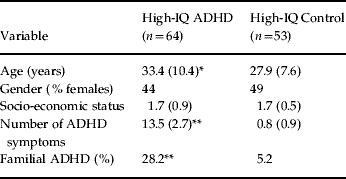
We operationalized high IQ in a similar fashion to the approach adopted by Lovecky & Silverman (Reference Lovecky and Silverman1998) in their report to the National Institutes of Health (NIH) ADHD Consensus Conference Panel. Similar to their report, we categorized high IQ as ⩾120. As shown in Table 1, this operationalization resulted in 64 high-IQ adults with ADHD and 53 high-IQ control participants. No ascertainment differences existed between high-IQ and average IQ adults with ADHD (χ2=0.31, p=0.580). Thus, high-IQ adults with ADHD were ascertained in a fashion similar to average-IQ adults with ADHD; comparable percentages of both ADHD groups were clinically/community referred.
Participant characteristics
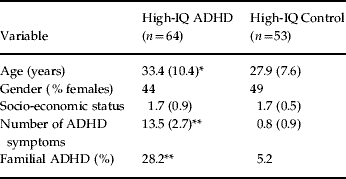
ADHD, Attention deficit hyperactivity disorder; familial ADHD, percentage of first-degree relatives with ADHD.
* p<0.01, ** p<0.001.
Assessment measures
We interviewed all subjects with the Structured Clinical Interview for DSM-IV (SCID; First et al. Reference First, Spitzer, Gibbon and Williams1997) to assess psychopathology supplemented with modules from the Schedule for Affective Disorders and Schizophrenia for School-Age Children Epidemiologic Version adapted for DSM-IV (K-SADS-E; Orvaschel, Reference Orvaschel1994) to cover ADHD and other disruptive behavior disorders. The structured interview also included questions regarding academic tutoring, repeating grades and placement in special academic classes. Initial diagnoses were prepared by the study interviewers and were then reviewed by a diagnostic committee of board-certified psychiatrists or licensed psychologists. The diagnostic committee was blind to the subject's ascertainment group and all non-diagnostic data (e.g. cognitive functioning). Diagnoses were made for two points in time: lifetime and current (past month).
Family members of the proband subjects were interviewed separately using the SCID for adults and the K-SADS-E for children. Only first-degree family members (e.g. children, parents) were interviewed. We conducted direct interviews with the subjects and indirect interviews with their mothers (i.e. the mothers completed the interview about their offspring). We combined data from direct and indirect interviews by considering a diagnostic criterion positive if it was endorsed in either interview.
The interviewers had been instructed to take extensive notes about the symptoms for each disorder. These notes and the structured interview data were reviewed by the diagnostic committee so that the committee could make a Best Estimate diagnosis as described by Leckman et al. (Reference Leckman, Sholomskas, Thompson, Belanger and Weissman1982). Definite diagnoses were assigned to subjects who met all diagnostic criteria. Diagnoses were considered definite only if a consensus was achieved that criteria were met to a degree that would be considered clinically meaningful. By ‘clinically meaningful’ we mean that the data collected from the structured interview indicated that the diagnosis should be a clinical concern due to the nature of the symptoms, the associated impairment and the coherence of the clinical picture.
Two subtests from the Wechsler Adult Intelligence Scale 3rd edition (WAIS-III; Wechsler, Reference Wechsler1993), Vocabulary and Block Design, were used to estimate general cognitive abilities. Validity coefficients for the Vocabulary and Block Design scores relative to the full form are 0.88 for Verbal IQ and 0.83 for Performance IQ (Sattler, Reference Sattler2001). Both Vocabulary and Block Design have good psychometric properties with reliability and validity quotients both reported to be above 0.90 (Sattler, Reference Sattler2001).
Academic achievement was assessed with the Wide Range Achievement Test – revised edition (WRAT-R; Jastak & Wilkinson, Reference Jastak and Wilkinson1984). The reading and mathematics portions were used in the current project. The WRAT-R provides a screening measure of the individual's reading (pronouncing single words out of context) and arithmetic skills (solving written computations). The test–retest reliability coefficients for reading and arithmetic are 0.96 and 0.94 respectively (Jastak & Wilkinson, Reference Jastak and Wilkinson1984).
Quality of life was assessed with the short-form version of the Quality of Life Enjoyment and Satisfaction Questionnaire (Q-LES-Q; Endicott et al. Reference Endicott, Nee, Harrison and Blumenthal1993). The Q-LES-Q is a 16-item self-report instrument that evaluates enjoyment and satisfaction in various areas of daily functioning, including physical health, work, social relationships, family, and general activities. Each item is scored using a five-point Likert scale (1=very poor; 5=very good), where higher scores indicate greater enjoyment and satisfaction. The Q-LES-Q is a commonly used and a well-validated tool with good test–retest reliability and high internal consistency (Bishop et al. Reference Bishop, Walling, Dott, Folkes and Bucy1999; Schechter et al. Reference Schechter, Endicott and Nee2007).
The Social Adjustment Scale Self-Report (SAS-SR; Weissman & Bothwell, Reference Weissman and Bothwell1976) quantifies social functioning using seven major areas: work/school, social and leisure, family outside of the home, primary relationship, parental role, family unit, and financial status. There are a total of 54 questions and each item is rated on a five-point scale, where higher numbers represent greater impairment in social functioning. The SAS-SR has been shown to be a valid measure of functional status and is widely used both clinically and in academic research (Weissman et al. Reference Weissman, Olfson, Gameroff, Feder and Fuentes2001).
Statistical analyses
We first compared the two high-IQ groups of subjects on potentially confounding demographic variables. Next, we compared clinical and community referrals in our high-IQ ADHD group on all of our dependent variables of interest; these analyses were completed to determine the extent to which are two high-IQ ADHD groups were comparable. Documenting comparability allows the reader to generalize the results of our study to the broader high-IQ adult ADHD population. Finally, our primary analyses comparing high-IQ ADHD and high-IQ control groups used logistic regression for binary outcomes, and ordinal logistic regression for ordinal outcomes.
SPSS 16.0 for Windows (SPSS Inc., Chicago, IL, USA) was used for all statistical analyses, with significance set at α=0.05. Data analyses were not corrected for multiple comparisons.
Results
The groups did not differ on estimated IQ, socio-economic status or gender. However, the groups differed on participant age; the mean age in the adult ADHD group was significantly greater than that of the control participants. Thus, age was entered as a covariate in all subsequent models. Demographic and background data are presented in Table 1.
Of our 64 high-IQ ADHD participants, seven were community referred and 57 were clinically referred. With the loss of statistical power, no subgroup analyses (clinically versus community referred) reached significance: effect sizes (η2) for the subgroup analyses ranged from 0.00 to 0.06, all small in magnitude (Cohen, Reference Cohen1988). Thus, community and clinical referrals were comparable across all dependent variables of interest, providing rationale for combining both ascertainment sources into one high-IQ ADHD group.
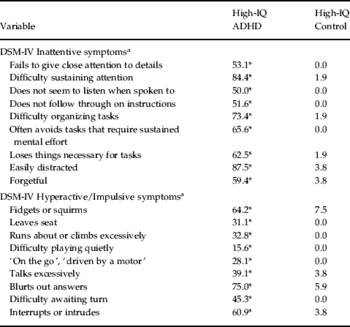
ADHD symptom distributions are detailed in Table 2. In our high-IQ ADHD group, the Combined (n=35) and Inattentive (n=26) subtypes were both more prevalent than the Hyperactive/Impulsive subtype (n=3).
Participant percentage of attention deficit hyperactivity disorder (ADHD) symptoms

a Percentage meeting DSM-IV (APA, 1994) criteria as occurring ‘often’ or ‘very often’.
* p<0.001.
Hypothesis 1: functional impairments
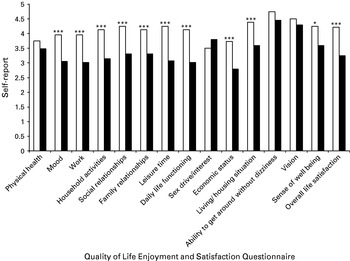
Quality-of-life data, assessed with the Q-LES-Q, are presented in Fig. 1. Several domains of the Q-LES-Q were rated by adults with ADHD as lower than controls. Significant group differences at the p<0.001 level emerged for most Q-LES-Q scales. Sense of well-being was significant at the p=0.035 level. Physical health (p=0.343), sex drive/interest (p=0.224), ability to get around without dizziness (p=0.264), and vision (p=0.428) did not significantly differing between the two groups.
Results of the Quality of Life Enjoyment and Satisfaction Questionnaire (Q-LES-Q). □, Control; ▪, ADHD. * p<0.05, *** p<0.001.

Social adjustment data, assessed with the SAS, are organized based upon functional domains. Occupationally, although high-IQ adults with ADHD were not more likely to miss work than high-IQ controls (Wald χ2=2.17, p=0.140), high-IQ adults with ADHD reported being less able to do their work well (Wald χ2=11.12, p<0.001), more ashamed of their work (Wald χ2=8.81, p=0.003), and less likely to find work interesting (Wald χ2=10.51, p<0.001). However, high-IQ adults with ADHD were not more likely to have arguments with co-workers (Wald χ2=1.41, p=0.234).
SAS Spare Time activities were also rated as lower in high-IQ adults with ADHD; high-IQ adults with ADHD reported being less likely to connect with friends in the past month (Wald χ2=7.76, p=0.005), talk with friends about their feelings/problems (Wald χ2=6.18, p=0.013), and were more likely to have their feelings hurt by friends (Wald χ2=4.21, p=0.040), feel lonely (Wald χ2=7.26, p=0.007) and feel bored (Wald χ2=15.80, p<0.001). Conversely, high-IQ adults with ADHD were just as likely as controls to go out socially with others (Wald χ2=3.85, p=0.050), spend time on hobbies/interests (Wald χ2=0.13, p=0.723), get in arguments with friends (Wald χ2=0.85, p=0.356), and feel shy/uncomfortable with others (Wald χ2=1.51, p=0.219).
SAS Family Functioning was also rated as lower in high-IQ adults with ADHD in the following domains: more arguments with family members (Wald χ2=5.11, p=0.024), less likely to talk about feelings with family members (Wald χ2=8.18, p=0.004), more likely to avoid contact with family members (Wald χ2=12.20, p<0.001), less interested in children's activities (Wald χ2=3.86, p=0.049), more likely to behave in a passive–aggressive fashion towards a family member (Wald χ2=5.05, p=0.025), disappoint a family member (Wald χ2=8.54, p=0.003) and have a family member disappoint them (Wald χ2=8.39, p=0.004). High-IQ adults with ADHD were equally likely to depend on relatives for assistance (financial, advice, etc.) (Wald χ2=0.12, p=0.730).
Finally, compared to high-IQ controls, high-IQ adults with ADHD reported having more speeding tickets [F(2, 114)=19.19, p<0.001, η2=0.28] and automobile accidents [F(2, 114)=33.98, p<0.001, η2=0.40]. High-IQ adults with ADHD were also more likely to have ever been arrested (Wald χ2=7.24, p=0.007). Of those participants who had been arrested, however, there were no group differences in the number of total arrests [F(2, 19)=0.26, p=0.619, η2=0.01].
Hypothesis 2: psychiatric co-morbidities
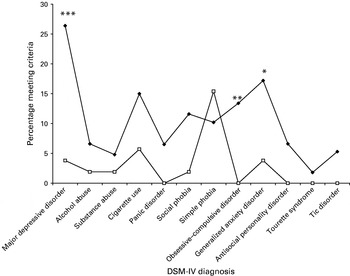
As shown in Fig. 2, major depressive disorder (Wald χ2=13.88, p<0.001), obsessive-compulsive disorder (Wald χ2=10.66, p=0.005) and generalized anxiety disorder (Wald χ2=6.25, p=0.020) diagnoses were higher in high-IQ adults with ADHD. All other psychiatric co-morbidities including antisocial personality disorder (Wald χ2=3.20, p=0.166), substance abuse (Wald χ2=0.75, p=0.386) and alcohol abuse (Wald χ2=2.77, p=0.250) did not differ between the two high-IQ groups. Finally, although not a psychiatric co-morbidity, the two groups did not differ in the percentage who smoked cigarettes (Wald χ2=2.72, p=0.256).
Psychiatric co-morbidity (SCID). —□—, Control; —◆—, ADHD. * p<0.05, ** p<0.01, *** p<0.001.

Hypothesis 3: familial ADHD, psychiatric disorders and academic impairment
ADHD was more prevalent in first-degree relatives of adults with ADHD relative to controls (χ2=36.6, p<0.001). As shown in Table 1, 28% of the first-degree relatives of high-IQ adults with ADHD met diagnostic criteria for ADHD. In the IQ-matched sample of non-ADHD adults, only 5% of the first-degree relatives met diagnostic criteria for ADHD, which is consistent with the prevalence in the general population.
Several psychiatric disorders were more common in first-degree high-IQ ADHD family members compared to high-IQ control family members. Obsessive-compulsive disorder (χ2=14.36, p<0.001), generalized anxiety disorder (χ2=9.62, p<0.001), social phobia (χ2=8.03, p<0.001) and major depressive disorder (χ2=7.42, p<0.001) were all more common in ADHD proband first-degree relatives. No other psychiatric disorder prevalence rates emerged in first-degree high-IQ ADHD and control families.
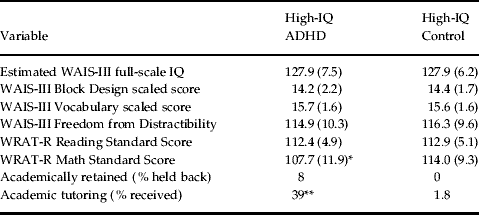
Finally, academic attainment in mathematics was different between groups: control participants had higher levels of achievement [F(2, 114)=7.00, p=0.001, η2=0.11]. No differences in reading attainment were observed [F(2, 114)=1.41, p=0.249, η2=0.02]. Despite having a high IQ, adults with ADHD were more likely to have received academic tutoring in the past (χ2=11.5, p<0.001). Table 3 presents a summary of the psychological test data.
Psychological test data
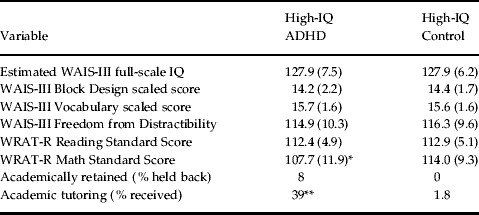
ADHD, Attention deficit hyperactivity disorder; WAIS-III, Wechsler Adult Intelligence Scale – 3rd edition (Wechsler, Reference Wechsler1993); WRAT-R, Wide Range Achievement Test – Revised edition (Jastak & Wilkinson, Reference Jastak and Wilkinson1984).
* p<0.01, ** p<0.001.
Exploratory analyses
Diagnosing ADHD among high-IQ students in higher education settings is particularly controversial because of its implications for disability determination. Therefore, we recomputed the statistical tests using only participants under age 25. We consider this exploratory because of the low numbers of subjects in this age group (n=23 high-IQ ADHD; n=24 high-IQ controls). Owing to these small sample sizes, none of the significant findings from the full sample were significant in the younger sample. However, the trends were the same as those reported in the full study population (detailed results available on request).
Discussion
Compared to IQ-matched controls, adults with ADHD reported lower quality-of-life ratings and also significant functional impairments across a variety of occupational, social and family domains. In this way, these data suggest that adults with a high IQ and ADHD are as functionally impaired as the pediatric high-IQ ADHD population (Antshel et al. Reference Antshel, Faraone, Stallone, Nave, Kaufmann, Doyle, Fried, Seidman and Biederman2007, Reference Antshel, Faraone, Maglione, Doyle, Fried, Seidman and Biederman2008). Higher familial ADHD prevalence rates (28.2%) were also found in our adult high-IQ ADHD group, at levels similar to what has been reported in the average-IQ ADHD population (25%) (Hawi et al. Reference Hawi, Segurado, Conroy, Sheehan, Lowe, Kirley, Shields, Fitzgerald, Gallagher and Gill2005). Taken together, we consider that these data further support the diagnostic validity of ADHD in the high-IQ population.
Compared to non-ADHD high-IQ adults, those with ADHD and a high IQ had significantly higher rates of major depressive disorder and generalized anxiety disorder. These rates are within the range of previously reported findings in ADHD adult populations (Biederman et al. Reference Biederman, Faraone, Spencer, Wilens, Norman, Lapey, Mick, Lehman and Doyle1993b; McGough et al. Reference McGough, Smalley, McCracken, Yang, Del'Homme, Lynn and Loo2005; Faraone et al. Reference Faraone, Biederman, Doyle, Murray, Petty, Adamson and Seidman2006a; Kessler et al. Reference Kessler, Adler, Barkley, Biederman, Conners, Demler, Faraone, Greenhill, Howes, Secnik, Spencer, Ustun, Walters and Zaslavsky2006). We also found higher rates of obsessive-compulsive disorder in the ADHD group. We found a higher rate (13.6%) than Kessler et al. (Reference Kessler, Adler, Barkley, Biederman, Conners, Demler, Faraone, Greenhill, Howes, Secnik, Spencer, Ustun, Walters and Zaslavsky2006) (2.7%) but pediatric samples have shown equally high rates (30%) and the association between obsessive-compulsive disorder and ADHD has been well established (Geller et al. Reference Geller, Biederman, Faraone, Cradock, Hagermoser, Zaman, Frazier, Coffey and Spencer2002, Reference Geller, Petty, Vivas, Johnson, Pauls and Biederman2007). The over-representation of obsessive-compulsive disorder in our high-IQ ADHD sample is interesting and could suggest that having high intelligence and a clear understanding of potential consequences, in the context of impulsivity and lack of executive control, may infer a stress that in turn would lead to obsessive-compulsive disorder symptoms.
By contrast, other psychiatric co-morbidities did not differ between groups. Most notably, adults with ADHD and a high IQ were not more likely to have substance abuse disorder, alcohol abuse or antisocial personality disorder than controls. Although this may be a function of low statistical power, it is also significant to note that (a) these psychiatric co-morbidities are commonly reported in studies of adult ADHD at far higher prevalence rates (Biederman et al. Reference Biederman, Faraone, Spencer, Wilens, Norman, Lapey, Mick, Lehman and Doyle1993b; Faraone et al. Reference Faraone, Biederman, Doyle, Murray, Petty, Adamson and Seidman2006a, Reference Faraone, Wilens, Petty, Antshel, Spencer and Biederman2007; Kessler et al. Reference Kessler, Adler, Barkley, Biederman, Conners, Demler, Faraone, Greenhill, Howes, Secnik, Spencer, Ustun, Walters and Zaslavsky2006) and (b) our high-IQ ADHD prevalence rates were lower than national epidemiological rates for cigarette use (22.5%) (Lasser et al. Reference Lasser, Boyd, Woolhandler, Himmelstein, McCormick and Bor2000); substance abuse and alcohol abuse disorders (9.3%) (Grant et al. Reference Grant, Stinson, Dawson, Chou, Dufour, Compton, Pickering and Kaplan2004) and also antisocial personality disorder (3%) (Moran, Reference Moran1999) are at or below epidemiological prevalence rates. Both of these findings suggest that IQ may be a protective factor with respect to antisocial and substance use co-morbidities. For example, Masten et al. (Reference Masten, Hubbard, Gest, Tellegen, Garmezy and Ramirez1999) investigated whether intellectual functioning, as measured by IQ, has a protective role. They followed an urban sample of 205 youth over 10 years in conditions of high versus low psychosocial adversity to determine whether IQ and/or parenting plays a protective role for psychosocial functioning. When faced with large amounts of adversity, high-IQ children had better conduct (less disruptive, aggressive or antisocial behavior) compared to low-IQ children. The results of Masten et al. (Reference Masten, Hubbard, Gest, Tellegen, Garmezy and Ramirez1999) and our data seem to support the hypothesis that intellectual functioning may serve as a protector with regard to antisocial behaviors.
Studies of IQ and alcohol abuse have produced conflicting results. Some groups have reported a lower risk in high-IQ populations and others have reported no such association (Mortensen et al. Reference Mortensen, Sorensen and Gronbaek2005; Batty et al. Reference Batty, Deary and Macintyre2006). Still others have reported an association between low IQ and disinhibitory psychopathology including alcoholism, social deviance, antisocial behaviors and conduct problems (Nigg et al. Reference Nigg, Hinshaw, Carte and Treuting1998; Poon et al. Reference Poon, Ellis, Fitzgerald and Zucker2000; Finn et al. Reference Finn, Mazas, Justus and Steinmetz2002; Finn & Hall, Reference Finn and Hall2004; Barker et al. Reference Barker, Seguin, White, Bates, Lacourse, Carbonneau and Tremblay2007). Some have speculated that individuals with a low IQ may have more difficulty cognitively balancing the benefits of immediate rewards with long-term negative outcomes, whereas individuals with a higher IQ may better consider long-term consequences (Finn & Hall, Reference Finn and Hall2004). Thus, further research is needed not only to replicate our findings but also to study the extent to which having a high IQ may serve to insulate against antisocial outcomes.
Another noteworthy finding that emerged in our results is that, despite their high IQ, adults with ADHD were significantly more likely to have needed academic tutoring in the past compared to high-IQ controls. Studies among adult ADHD populations have consistently found that ADHD is associated with the need for academic tutoring and other indices of school failure (Biederman et al. Reference Biederman, Faraone, Spencer, Wilens, Norman, Lapey, Mick, Lehman and Doyle1993b, Reference Biederman, Faraone, Spencer, Mick, Monuteaux and Aleardi2006a, Reference Biederman, Petty, Fried, Fontanella, Doyle, Seidman and Faraoneb; Barkley et al. Reference Barkley, Fischer, Smallish and Fletcher2006). Our results replicate this finding among high-IQ adults with ADHD. This is of clinical significance, as these individuals may be overlooked as candidates for academic tutoring merely because of their heightened intelligence.
Within the last 10 years the number of post-secondary students reporting symptoms of ADHD has increased significantly (DuPaul et al. Reference DuPaul, Schaughency, Weyandt, Tripp, Kiesner, Ota and Stanish2001), possibly a function of the educational accommodations associated with an ADHD diagnosis (Harrison et al. Reference Harrison, Edwards and Parker2007) and/or in an effort to obtain stimulant medication as a study aid (Barrett et al. Reference Barrett, Darredeau, Bordy and Pihl2005) or recreational substance (Babcock & Byrne, Reference Babcock and Byrne2000; McCabe et al. Reference McCabe, Knight, Teter and Wechsler2005; Teter et al. Reference Teter, McCabe, Cranford, Boyd and Guthrie2005). Although functional impairment is clearly required for making a valid DSM-IV ADHD diagnosis (Gordon et al. Reference Gordon, Antshel, Faraone, Barkley, Lewandowski, Hudziak, Biederman and Cunningham2006), high-IQ adults may be less likely to demonstrate significant academic impairments; for example, our data suggest that academic attainment is solidly average in both reading and mathematics. Thus, these domains may be impaired relative to their own IQ but not when compared to the general population. However, our data also suggest that other functional domains (e.g. occupational, social, family, etc.) are impaired in high-IQ ADHD. These data highlight the importance of differentiating between ADHD as a DSM-IV diagnosis and ADHD as a reason for claiming disability under the ADA. Our data clearly support the validity of ADHD as a DSM-IV diagnosis in high-IQ adults but caution that further work-up is needed to determine whether education accommodations for high-IQ ADHD adults are warranted under ADA guidelines.
Our findings must be considered in the light of some methodological limitations. Although we controlled statistically for age differences, the ADHD group was significantly older than the non-ADHD group. In addition, participants with ADHD were predominantly recruited through clinical referrals; although we reported fairly small effect sizes between clinically and community-referred adults with ADHD, we still do not know to what degree our findings will generalize to samples of non-referred adults with ADHD in the community. Furthermore, rather than administering a full WAIS battery, an abbreviated intelligence battery was included. Given the aims of this report, ideally a full WAIS protocol would have been administered to enable a more detailed analysis of the profiles. Nonetheless, there are strong associations between the abbreviated and full Wechsler battery (Sattler, Reference Sattler2001). Our results may have been different if we had operationalized a high-IQ in a different fashion (e.g. a full-scale IQ ⩾115 or a full-scale IQ ⩾130). Importantly, we only had a small sample of young adults, the group for which academic accommodations is most relevant.
Despite these methodological shortcomings, our data suggest that high-IQ adults with ADHD have the same psychiatric co-morbidities and functional impairments as have been reported in the average-IQ ADHD population. Thus, clinicians diagnosing high-IQ patients should consider the diagnosis of ADHD if symptoms of the disorder and a history of childhood onset are present. In light of the growing debate over ADHD diagnoses in post-secondary settings, further research should continue to assess the extent to which ADHD is a valid diagnosis in the high-IQ population.
Declaration of Interest
None.