


Would public financing of campaigns or a ban on interest-group contributions improve the welfare of the average voter? Many reformers think the answer is yes. For example, after the 2000 elections, Common Cause President Scott Harshbarger said:
[T]here is widespread dissatisfaction with how campaigns are funded in this country. … [The current] system is a gravy train for Members of Congress—and a meal ticket for special interests, many of whom want something in return.1
Quoted in a Common Cause Campaign Finance Study dated November 14, 2000. Viewed on December 2, 2002 at http://www.commoncause.org/publications/nov00/111400wl.htm
Empirical study of such claims is inherently difficult, but it seems reasonable to suppose that the proposals politicians offer are heavily shaped by the agendas of campaign contributors; why else would they contribute?
As the surveys by Austen-Smith (1997) and Morton and Cameron (1992) emphasize, the existing theoretical literature contains little work that can address these concerns about voter welfare. For example, Baron (1994), Grossman and Helpman (1996), and others have studied the influence of contributions on policy outcomes, but they do not model voters at the level of preferences and beliefs. Although this may be an appropriate modeling choice for work that focuses on bargaining between interest groups and politicians, such black-box modeling has several significant costs. First, the costs and benefits of a policy are typically defined in terms of the affected actors' preferences. And the costs and benefits to voters should be a prime consideration in evaluating electoral regulation. But in the black-box models, these costs and benefits do not appear at all. Thus, moving beyond these models is important for thinking about the welfare effects of the policy reforms mentioned at the beginning. Second, taking explicit account of the voters' preferences allows us to study how their behavior changes as policy changes. In particular, the black-box models ignore the possibility that the relationship between campaign spending and votes may itself be a function of the campaign finance system (see Stratmann 2002 for empirical evidence that such dependence is important). This point is related to a critique that several scholars have raised about the common-sense argument: if voters are rational, they will realize that campaign expenditures are funded by interest groups, and will infer that an advertising candidate has made promises that are harmful to voters. Black-box modeling rules this out a priori, even though changes in this relationship may be an important channel for the effects of public financing.
This paper contributes to the theoretical understanding of the welfare effects of campaign finance. I construct a formal model to evaluate the claim that public financing or contribution limits can improve voter welfare. A start at modeling campaign contributions with rational voters has been made by Austen-Smith (1987), Coate (2004a, 2004b), Gerber (1996), and Prat (2000, 2002). The model advances this literature by explicitly considering the effects of an incumbency advantage.
In the model, candidates raise money from interest groups to finance campaigns that inform voters about their ideologies. In exchange for these funds, candidates promise to do favors for the groups if they win the election. These favors are costly to voters, who will vote for an advertising candidate only if the information is favorable enough to outweigh the promised favors. Thus, voters face a tradeoff when they consider campaign finance reform: advertisements provide them with valuable information, but at the cost of favors to the special interest groups who fund the ads. A ban on spending means completely avoiding both the cost and the benefit. A publicly funded system keeps the beneficial communication (and even increases it) while replacing the costs of favors with the costs of raising the public funds. The main results of this paper examine the tradeoffs implied by these policies.
The primary novelty of the paper is the examination of how these tradeoffs are affected by an incumbency advantage. Because interest groups only get favors if their candidate wins the election, the advantaged incumbent gets a further advantage in fundraising. Accounting for the interaction of this asymmetry and the voters' endogenous responses to advertising turns out to be a critical element in evaluating the effect on voter welfare of reforms like public financing of campaigns. Furthermore, this interaction means that the empirical spending-votes relationship has implications for the possibility of welfare improving policy changes.
The main results flow from the fact that equilibria with advertising can exist only when the incumbency advantage is not too large. This observation can help understand the empirical literature on the impact of campaign spending on election outcomes, and serves as the basis for comparisons of different election regulatory regimes in terms of voter welfare. I first consider a ban on fundraising, and show that such a policy improves welfare if the incumbency advantage is sufficiently large. I next consider partial public financing, in the form of matching funds. Such a policy improves voter welfare when the incumbency advantage is small enough that there would be advertising absent the policy, but it can reduce welfare by introducing advertising when the incumbency advantage is close to absolute.
CONCEPTUAL ISSUES IN MODELS OF CAMPAIGN FINANCE
Any model of campaign finance must deal with several conceptual issues. Here I outline these issues and discuss the choices I make in this paper.
First, a model must make an assumption about what motivates the contributors. The empirical literature offers two possibilities: favor-induced contributors, who contribute in exchange for promises of policy favors; and ideology-induced contributors, who contribute to help ideologically sympathetic candidates win. The empirical literature is inconclusive about the relative importance of these two types of contributors. Ansolabehere, de Figueiedo and Snyder (2003) summarize the large literature showing that contributions do not help predict Congressional roll-call votes once ideology is taken into account. They argue that this suggests favor-induced contributions are not very important. However, focusing exclusively on roll calls may give a distorted view of Congressional activity (Hall 1996). Hall and Wayman (1990) find that contributions do predict member participation at the committee level. Gordon and Hafer (2005) find that firms that make large donations are both less compliant with regulations and less monitored by the bureaucracy, suggesting that donations may induce members of Congress to interfere in regulatory oversight. Given the inconclusive empirical picture, it makes sense for theoretical work to explore the implications of both types of contributors. I focus on the favor-induced case not because policy-motivated contributions are unimportant, but to isolate the implications of favor-induced contributions for voter welfare.
Second, a model with rational voters must explain why campaign spending increases the vote share of a candidate. Like much of the existing literature, this paper focuses on informational explanations: the campaign allows the voters to learn more about the candidates. Consistent with this theoretical idea, Coleman and Manna (2000) find that campaign spending leads voters to know more about the candidates and improves their ability to locate candidates on ideological scales.
There are two main mechanisms for this informational effect. The first, pioneered by Gerber (1996) and further developed by Part (2002),2
Also see Potters, Sloof, and van Winden 1997.
Again, both approaches probably capture important parts of the reality of campaign advertising. Furthermore, in both cases the voter faces a similar tradeoff, at least in models of favor-induced contributions. In both cases, a voter who sees an ad draws a good inference (moderate policy/high valence) and a bad inference (promised favors). Although there is an interesting difference between getting verifiable information about the good quality and the more subtle equilibrium learning in the Gerber–Prat model, the fundamental tradeoff is similar. The key to the welfare results about contribution bans is that the bargaining between the candidate and the interest group leads the cost of favors to outweigh the benefit of the good information, at least for certain levels of the incumbency advantage. This fact should be robust to a model in which the good inference is endogenous. On the other hand, public financing would have no value in a model of indirectly informative advertising—there's no signal if the election regulator hands out funds to everyone. Thus a nontrivial policy problem of public financing arises only with directly informative advertising.
Third, a model must decide whether to allow for candidate asymmetries. Coate (2004a, 2004b) and Prat (2002) study models with symmetric candidates. This means there can be no incumbency advantage. But one of the main complaints made by reformers is that contributor-based financing enhances the incumbency advantage, so this is a major oversight. Gerber (1996) and Prat (2000) study models with incumbents, but they allow only one player to take nontrivial actions (the challenger in Gerber and the incumbent in Prat). In contrast, I allow for incumbency effects working through reputations, while treating the two candidates symmetrically in terms of their possible actions. Allowing for strategic symmetry and reputational asymmetry at the same time is important for linking the discussion with concerns about the role of campaign funds in sustaining the incumbency advantage and for determining whether such a link is problematic from a social welfare perspective.
Fourth, a model must make an assumption about the strategic sophistication of the voters. As is standard in formal theory, I assume that the voters are fully rational. Thus, the model assumes that voters understand that campaign messages are funded by contributions from groups who expect favors in return. Are voters really that sophisticated? The fact that candidates who do not accept money from political action committees make a point of emphasizing that fact in their campaigns suggests that at least some voters will look more favorably on them if they have not made deals with interest groups.4
Stratmann (2002) shows that campaign spending is more effective in legislative elections in states that limit the level of interest-group contributions.
THE MODEL
Policies and Preferences
A community will hold an election to choose a representative. There are two candidates, L and R, with a generic candidate denoted by i∈{L, R}. The wining candidate chooses a policy
. Candidates have preferences over these policies represented by −|x−xi|, where xi is i's ideal policy. The candidates represent parties that are internally heterogeneous—in particular, each party has moderate members, with ideal policy
, and extremist members, with ideal policy
, where
. To focus on the impact of asymmetries in candidate reputations, the rest of the model will be as symmetric as possible. In particular,
for k=m, e.
In addition to choosing policy, the representative can provide “favors” to citizens. She can direct these favors to the voter or to an organized interest group.5
Throughout, the candidates take feminine pronouns and the voters take masculine pronouns.
The electorate is summarized by a representative voter, whose preferences over policy are represented by −|x|. Candidates cannot commit to policies before the election, so the voter anticipates that the winner will choose her ideal policy. Let
and
, and let
be the gain in the voter's payoff from switching from an extreme to a moderate winner. From now on, refer to types of candidate by the utility they give to the voter, so moderates are type
, and extremists are type
.
The voter gets a payoff of −|xw|−t, where w is the winner of the election and t is the level of favors w has promised to interest groups. In addition to these basic payoffs, the voter gets a preference shock ε between the campaign and the election. This represents an additional benefit to electing candidate L. The shock is distributed according to some absolutely continuous, strictly increasing distribution F on
. This distribution is symmetric, so F(y)=1−F(−y), and it has mean 0.
The preference shock can have several causes. There could be a scandal that makes one candidate less attractive to the voters. Similarly, bad news about the health of one candidate could affect the election. Alternatively, the shock could be a “partisan swing” that changes the ideal point (or the identity) of the median voter.
For the most part, I focus on results that hold for any shock distribution. However, I will occasionally make an additional assumption—in particular, some of the results will rely on the shock being close to 0 with high probability. In this case, I will say that F is concentrated around zero. (A formal definition is given in the appendix.) Substantively, this means that the preference shock is small relative to the voter's ideological preferences.
Candidates would rather win than lose.6
A tie can happen only if the preference shock is exactly equal to the difference in payoffs that the voter gets from L's package of policy and promised favors and from L's package of policy and promised favors. Because the distribution of ε is absolutely continuous, this has probability zero.
Prior Beliefs and Signals
Because the parties are internally heterogeneous, the voter is uncertain about the preference of the candidates. The voter's prior beliefs are that
with probability pi. Candidate L is the incumbent, so pL∈[1/2, 1] and pR=1/2.
The voter believes that the incumbent is more likely to be moderate because of selection effects in repeated elections. A candidate is an incumbent precisely because she has won elections in the past. Presumably, this means that the voters observed favorable information about the candidate in past campaigns. Furthermore, voters get some information about an incumbent by observing outcomes while she is in office. If this information is not favorable, the candidate is likely to lose a subsequent election. This type of selection argument is formalized in Ashworth (2005) and Zaller (1998), and is shown to be an empirically important part of the incumbency advantage in Gowrisankaran, Mitchell, and Moro (2003).
In contrast to the voter, each candidate knows her own ideology. Some of this information is hard information, which can be verifiably shown to the voters. For example, an incumbent might have information about her votes on key bills or a record of sponsoring moderate legislation. The challenger might also have relevant information, for example, being a member of moderate organizations within the party, such as the Democratic Leadership Council. Furthermore, either candidate can advertise that she has been endorsed by groups that represent moderate voters.7
See Grossman and Helpman (1999) for a theory of endorsements.
Formally, I model this by giving each candidate a signal si∈{s, [empty ]}, where [empty ] means no information. The signal s is good news about her preferences, with likelihoods

and

Candidates can reveal information only about themselves. This is not crucial for the analysis—because voters only care about the difference between the two candidates, negative ads about an opponent are just as valuable as positive ads. This observation strengthens the case for assuming verifiable information, because it is often observed that negative ads contain more hard information than positive ads.
Fundraising
The voter is “rationally ignorant,” and will not bear any cost to learn about the candidates. Candidates must buy access to information channels that voters cannot ignore, such as television advertising or direct mail. This costs c∈(0, (1/4)Δ). Ads can report the candidate's signal, but cannot lie. Given this, all ads are of good signals. The restriction to c<(1/4)Δ ensures that completely symmetric candidates will be able to mount campaigns. Substantively, it means that moving from a randomly selected candidate (who is equally likely to have either ideology) to a moderate for sure is more valuable to the voter than the cost of a campaign in which both candidates advertise.
Candidates have no wealth of their own to use in campaigns, so they must turn to interest groups for contributions. These groups have enough wealth to finance the campaign, and are motivated by the promise of favors a winning candidate can provide. If a group finances the campaign and gets favors worth t, its payoff is t−c.
Candidates decide strategically whether or not to raise funds and advertise. Candidate i's decision is described by a function ai: {s, [empty ]}→{0, 1}, where 0 means she does not seek funds and 1 means she does. A candidate has no incentive to advertise the bad signal, because revealing the bad signal cannot improve the voter's beliefs about the candidate's ideology and requires making promises to an interest group, which makes the candidate even worse in the eye of the voter. Thus, ai([empty ]) will equal 0. I will sometimes say that “i mounts a serious campaign” if ai(s)=1. If the candidate seeks funds, she can verifiably reveal her signal during bargaining.8
The assumption that the signal is verifiable both in the campaign and in bargaining is stronger than needed. So long as the signal is verifiable in the campaign, a candidate with the bad signal has no incentive to approach an interest group for funds. I thank an anonymous referee for pointing this out.
Each candidate can make a take-it-or-leave-it offer to one interest group, and any group deals with at most one candidate. The assignment of all of the bargaining power to the candidate reflects the large number of potential donors who would like favors.
If she decides to raise funds, candidate i must choose how many favors to offer. Describe this choice with a function
, where ti(ai) is the offer. Assume that ti(0)=0. Notice that the offers are made before the candidates learn the signal of their opponent. This means candidates cannot signal that their opponent is weak simply by advertising.
Posterior Beliefs
The voter observes neither the offer to the interest group nor the true ideology before voting, but does observe the signal if the candidate advertises it. If candidate i advertises, the voter believes the offer was τi. The voter also believes that candidate i is moderate with probability μi(ai).
Given the signal, Bayes's rule can be used to calculate the posterior probability that a candidate is moderate. The signal cannot be faked, and the probability that an extremist gets the good signal is zero, so the voter believes that candidate i is moderate, with probability
if candidate i advertises the signal si=s. This holds on and off the equilibrium path. If the voter knew that candidate i received no signal, his posterior belief that she is moderate would be

However, the voter will not always know that the candidate has no signal, because the candidate might decide not to advertise even a good signal. Thus, the voter's belief that candidate i is moderate given no ad, μi(0), is determined in equilibrium.9
Notice that
is the conditional probability based on the realized signal, whereas μi(ai) is the voter's conditional probability based on what the candidate reveals.
Timing and the Definition of Equilibrium
The timing is as follows:
- Nature chooses θi and si for i=L, R.
- Candidates offer contracts to interest groups.
- Contributors accept or reject the contracts.
- Candidates reveal information if they have funding.
- The voter chooses the winner of the election.
I look for perfect Bayesian equilibria. Such an equilibrium is a tuple 〈π, {ai, ti, τi, μi}i=L,R〉, where π(aL, aR) is the probability that L wins the election given the advertising choices aL and aR. In an equilibrium, π is derived from optimal voting behavior given the beliefs τ and μ. The candidates choose ai and ti to maximize their payoffs given the strategies of the interest groups and the other candidate, and the predicted voting behavior. The voter's beliefs μ follow from the ai and Bayes's rule, if possible, and τi=ti(1) if ai(s)=1.
PRELIMINARY RESULTS
The main results of this paper depend on a characterization of equilibria with advertising by one or both candidates. The first steps in deriving that characterization are to understand equilibrium in the voting and fundraising stages of the game.
Voting Behavior
In the election, the voter chooses the candidate who offers him the greatest expected utility. Recall that μi is the posterior probability that candidate i is moderate, and that τi is the voter's expectation of the favors i promised to interest groups. Given this, the voter's expected utility if candidate i wins is

up to the realization of ε. This simplifies (up to a constant) to

where
. Thus, the voter prefers L to R if and only if

or

This event has probability

It is clear that the expected utilities μiΔ−τi will play a crucial role in the analysis. Call μiΔ−τi the voter's assessment of candidate i.10
This idea of assessment is different from the concept used in the definition of sequential equilibrium.
To fully characterize the voting rules, the beliefs, μi and τi, must be specified. On the equilibrium path, these will follow from Bayes's rule and the voter's (correct) belief about the fundraising stage. Off the path, however, there is more freedom to set the beliefs.
Fundraising
The voting rule determines the probability that a candidate wins, and thus determines the true value of promised favors—the more likely is victory; the greater is the expected value of a given promise. Thus, a candidate can get away with promising fewer favors the more confident are contributors that she will win. The first Lemma makes this observation more precise.
Define ρL(τL, τR) by

where the dependence of π on the τ is made explicit. Similarly, define ρR(τL, τR) by

So ρi is the probability that i wins the election given that she advertises the good signal, −i's advertising decision is given by a−i, and the voter believes that the promised favors are τi.
Lemma 1
If candidate i makes an offer to the interest group and it is accepted on the equilibrium path, then it is

Proofs of this and all subsequent results are in the appendix.
Lemma 1 says that the interest group always breaks even in expectation. This is an intuitive result given the assignment of all bargaining power to the candidate. The interest group will accept any offer of at least ti, whereas the candidate wants to minimize the level of favors she promises when she tries to mount a campaign. Because the candidate makes a take-it-or-leave-it offer, she offers exactly ti. Because this promise is decreasing in the probability that the candidate will win the election, this fundraising process will magnify any preexisting incumbency advantage by creating an additional incumbency advantage in fundraising. I will show next that this has important implications for which candidates raise funds in equilibrium.
Who Gets Funds?
With the results on voting and bargaining in hand, it is straightforward to determine when candidates will try to raise money for a campaign. Because a candidate makes this decision strategically, she will raise funds and advertise whenever doing so leads to a greater expected utility than she would get otherwise. With office-motivated candidates, this means that a candidate will mount a campaign if doing so increases her probability of winning.
Consider candidate L. (The same considerations govern R's decision making.) Recall that L's probability of winning if she advertises is

If she does not advertise, then she wins with probability

She will mount a campaign if and only if the first expression is greater than the second. This observation leads to the following result.
Lemma 2
If candidate i has a good signal, she will advertise it if and only if Δ−τi≥μi(0)Δ; that is, if and only if doing so leads the voter to have a better assessment of her.
Notice that the assessment of i is compared to μi(0). This will equal the prior belief about ideology only in case the voter expects the good type of candidate i to not advertise, even when she has a good signal. If the candidate is expected to advertise a good signal, then μi(0) is strictly less than the prior probability that the candidate is moderate.
To understand the intuition of the lemma, think through L's incentives. (The incentives of R are symmetric.) Candidate L always has a strict incentive to raise the voter's assessment of her. Releasing information has two effects on the voter's assessment: the signal causes the voter to revise his belief that L is moderate, but the voter also infers from the ad that L promised τL to the interest group. L will advertise only if the first effect dominates the second.
Notice that all campaigns in the model are mounted by moderate candidates who have the good signal, because advertising the bad signal is strictly dominated. If extremists got the good signal with some probability strictly between 0 and q, the qualitative results would not change. Even though some extremists would mount campaigns, a candidate with the good signal would still be better (in expectation). Thus, the voter would still prefer a candidate with the good signal even at some cost in promised favors. All of the results go through unchanged in this case.
Although the primary use of these preliminary results is to study the comparative statics of the equilibrium, it's worth pausing to discuss some empirical evidence directly related to Lemmas 1 and 2. Snyder (1990) models campaign contributions as the purchase of contingent claims on favors and shows that the value of campaign contributions will equal the expected value of favors promised to the contributor. This is essentially the result of Lemma 1. Snyder tests this result on data from open-seat House elections. He finds strong support for a specification that assumes the equation holds for close races, whereas candidates who face token opposition decline to raise funds from investment-oriented contributors. Lemma 2 provides a justification for the decision of strong candidates to bypass fundraising—they know that their prior reputation is strong enough already. This decision by strong candidates to bypass campaigning will be a crucial step in the next section's analysis.
EQUILIBRIA WITH ADVERTISING
All of the tools are now in place to characterize equilibria in which both candidates advertise good signals. Such an equilibrium can exist only if the incumbent's reputation is not too strong. This fact is the key to the model's ability to match the stylized facts about campaign spending in elections.
In an equilibrium with advertising along the path of play, several conditions must be simultaneously satisfied. First, the voter's beliefs about the promised favors must equal the actual promises. Second, the voter's beliefs about the ideology of a candidate who does not advertise must be derived by Bayesian updating on the assumption that the candidate's signal is [empty ]. Denote these beliefs by

and

Finally, the candidates must both want to advertise the good signal, given that the voter's assessment will be based on these beliefs. The next result says that these conditions can all be satisfied if, and only if, the candidates are sufficiently close to being evenly matched.
Proposition 1
(i) If the incumbent's reputation p is close enough to 1/2, then there is an equilibrium in which each candidate advertises whenever she has a good signal.
(ii) There is an incumbent reputation p*<1, such that there is no equilibrium in which the incumbent advertises if her reputation is stronger than p* (,p>p*).
(iii) Assume that F is concentrated around zero. Then there is an incumbent reputation
, such that there is no equilibrium in which the challenger advertises if the incumbent's reputation is stronger than
(
).
When the incumbent's reputation is close to 1/2, there are levels of favors such that both candidates are attractive to the voter if they advertise the good signal. Because the voter will find either candidate attractive if she advertises, the interest groups are eager to deal with the candidates and are willing to accept the low offers of favors.
Things are different when the incumbent's reputation is close to 1. First consider the incumbent. Her incentive to advertise is driven by her concern about the adverse inference the voter would draw if he saw no ad. The reputation of an incumbent with the good signal is always greater if she advertises than if she does not. However, the difference,
, decreases to 0 as p converges to 1. For large p, the voter has so much a priori faith in the ideology of the incumbent that he gives substantial benefit of the doubt to the incumbent when there is no ad. The cost to the incumbent of the campaign, tL, on the other hand, can never be less than c, because the interest group must be promised at least this much to break even. For great enough p the benefit of advertising,
, is less than the cost, tL, and the incumbent will deviate from a profile that calls on her to advertise. Thus, no such profile can be an equilibrium.
The situation for the challenger is a bit different. Her benefit from advertising,
, does not depend on p. But her cost, tR, does depend on p. This is because the interest group knows that the incumbent is more attractive the higher is p, and this makes an investment in the challenger less likely to pay off. Indeed, if p is close enough to 1, then even an incumbent who does not advertise has a better assessment than an advertising challenger. If the noise term in the probabilistic voting is not too variable, this will force the challenger to offer very large transfers to the interest group to make a deal acceptable. Rational expectations means the voter understands that such a challenger has made large promises to the interest group, so he will shy away from her in the voting booth. Thus, no such profile can be part of an equilibrium, because the challenger would have an incentive to deviate and not advertise.
Observable Implications
If campaigns are consistent with one of the equilibria characterized above, what will be found by an empirical worker who observes the actions of all of the players but does not observe the prior on incumbent ability? It turns out that a definitive statement that incumbents are more likely to win if they advertise or if they do not advertise is impossible (not conditioning on p). This is because the probability of winning is greatest for incumbents with reputations better than p* (who do not advertise), second greatest for incumbents with lower reputations who do advertise, and least for incumbents with low reputations who do not advertise. Thus, spending by the incumbent indicates a moderate-strength incumbent. The probability of winning conditional on not spending is a convex combination of the first and third of these probabilities, so choosing the weights appropriately allows us to make it greater than or less than the probability conditional on spending. This fact means that the model can account the empirical regularity that cross-sectional analyses that do not condition on incumbent quality show that challenger spending is associated with better electoral performance, but incumbent spending is unrelated to success. (See the discussion in chapter 3 of Jacobson 2001, which summarizes the extensive empirical literature initiated by Jacobson 1978.)
Because the point is about incumbents, it can be formalized most simply by looking at equilibria in which only the incumbent advertises. After this development, I briefly comment on how the idea extends to equilibria in which challengers also advertise.
When only the incumbent advertises, the result of Proposition 1 can be sharpened.
Proposition 2
There exists a
strictly between
and 1, such that there is an equilibrium with only the incumbent advertising if and only if
.
Now consider p and p′, such that
, and assume that the incumbent advertises the good signal for
.11
This corresponds to the most informative equilibrium, a common refinement in informational models.

The first inequality follows from Bayes's rule, and the second inequality follows from the monotonicity of
in p. The equality follows from the definition of
and the continuity of
. The last inequality follows from the monotonicity of
and the fact that an equilibrium with advertising at p′ can only exist if the voter's assessment of an advertising candidate is better than his assessment of a candidate who does not advertise. (The argument never refers to out of equilibrium beliefs, so holds for all equilibria at p.)
I have demonstrated the result in the case where the challenger never advertises. The idea carries over to the case of both candidates advertising, although there are some complications to the argument. A key to the proof of Proposition 2 is that tL is constant in p. When the challenger advertises as well, this is no longer true, so it is possible that the set of p for which there is an equilibrium with the incumbent advertising is not connected. Even in that case, however, the best type of incumbent will be one who does not advertise, because p>p*. Similarly, the worst type of incumbent will also be one who does not advertise, because p is close to
and the candidate does not have the good signal.
In part, this analysis formalizes the idea that the level of spending is endogenous. Erikson and Palfrey (2000) show that incumbents who are expected to win handily do spend less, on average (see, in particular, their figure 3). Several researchers have tried to deal with this endogeneity issue, without reaching a consensus about the size of the effect of spending (see Green and Kranso 1988, Levitt 1994, Gerber 1998, and Erikson and Palfrey 1998, 2000). Recently, Gerber (2004) conducted field experiments that suggest endogeneity is not the whole story in interpreting the data. By randomly directing spending that was already budgeted by the campaigns, Gerber was able to estimate the return to a dollar of spending. His findings were similar to Jacobson's original findings: the returns were very low for incumbents, but higher for challengers.
The model also sheds light on these findings.12
Gerber presents an interesting alternative theoretical account.
will be close together for incumbents who are expected to win handily but still plan to advertise. Importantly, the one incumbent Gerber studied who faced stiff competition (in a primary challenge) had significantly higher returns to spending. The challenger that Gerber studied was expected to be competitive and had relatively high returns to spending.
Interestingly, this finding is in line with Jacobson's original suggestion that incumbent spending is subject to decreasing returns. Advertising in prior campaigns has revealed to the voter that the incumbent has high ability. Conditional on this high ability, the previous results imply that spending has low effectiveness. The next section shows that the same forces leading to this low effectiveness of spending may create the space for beneficial policy interventions.
POLICY
From the voter's perspective, campaigns have costs and benefits. A campaign provides valuable information to the voter, but at the cost of favors to interest groups. Equilibrium considerations are sensitive to this tradeoff—the equilibrium has no campaigns if the cost of favors is great enough relative to the informational benefits. Does the equilibrium strike the right balance between these two effects? If not, can voter welfare be improved by a ban on contributions or by a system of partial public financing?
There are two distortions that lead the decentralized equilibrium away from efficiency. First, candidates are too eager to mount campaigns. The candidates care only about winning, so they will engage in costly advertising just to change the identity of the winner. The voter does not care about the identity of the winner but only that the winner is moderate. This difference opens up the possibility that a ban on advertising can enhance voter welfare. Second, the voter considers the cost of favors while voting, even though the cost of the ads have already been paid. This leads the voter to strictly prefer a publicly financed campaign system that finances the same candidates as the decentralized system.
A Ban on Contributions
I start by considering the simplest possible policy—an outright ban on contributions. Under such a policy, the voter foregoes both the benefits of improved information and the costs of favors. It turns out that this change is beneficial for some parameter values—there is a sense in which candidates are too eager to mount campaigns. In particular, when a candidate is indifferent between advertising, or not advertising, then the voter is strictly better off if she does not advertise. This implies that the voter is willing to forego the information in the marginal ad if he could also forgo the favors that paid for it.
Proposition 3
Assume that the incumbent's reputation is such that any advertising candidate is close to indifferent about advertising. Then a ban on fundraising raises the voter's welfare.
This is a corollary of Proposition 5, so a direct proof is omitted.
A candidate is indifferent about advertising exactly when the voter is indifferent between a moderate candidate who has promised favors and an extreme candidate who has not. (If the voter were not indifferent, the candidate would strictly prefer the option leading to more voter support.) This means that both the extreme and the moderate candidate must offer the voter a payoff of
, the payoff to a candidate with no signal. Because not getting the signal is bad news about the candidate's ideology, this payoff is less than piΔ, the payoff the voter would get from the candidate without any information at all.13
Why would a candidate advertise when doing so leads the voter's assessment of her to be lower with probability 1? Recall that the candidate's incentive to advertise is driven by the adverse inference the voter will draw if he expects an ad and does not see one. In an equilibrium that features advertising, the candidate advertises to separate from the type [empty ] candidate. The fact that advertising may lead the assessment to be less than piΔ does not matter—no candidate can have μi=pi in an equilibrium with advertising.
Notice that the condition for the voter to benefit from a ban, that the candidate be close to indifferent between advertising and not, is also the condition leading to low measured effectiveness of campaign spending. Thus, the model suggests a way of linking observable facts about campaign spending and the desirability of regulation.
Of course, a ban does not always raise voter welfare. Recall that the cost is low enough that, when the incumbent's reputation is close enough to 1/2, the value of the information outweighs the cost of favors. This motivates a search for richer policy options, like the partial public financing system considered next.
Public Financing
A more complicated alternative to the decentralized system of campaign finance studied above is a publicly funded system. One important difference between such a system and the one I have been studying is that the set of candidates who get funds may be different. I postpone considering this to highlight a more subtle welfare effect. In the decentralized system, the cost of advertisements is imposed on the voters ex-post, in the form of favors provided by the winner to interest groups. In a publicly financed election, by contrast, the costs are borne ex-ante as taxes. This difference in the timing of costs to the voter changes his optimal voting decision. This change leads to a welfare improvement when moving to a publicly financed system.
Specifically, I consider a system in which the election regulator pays for some fraction of the campaign, provided that the candidate can raise the rest on her own. The public funds are collected as lump-sum taxes on the voter. An α-publicly-financed system is one in which taxes pay for fraction α of the cost, with 1−α raised from interest groups. The election is held after taxes are collected and ads are shown, but before favors are provided. For 0<α<1, this corresponds to a system of matching funds. When α=1, this is pure public financing, whereas it is the decentralized system when α=0.14
There is a slight complication when α=1—do candidates without the good signal get funded? For any α<1 this is not a problem, because the interest group will not fund them. Treat α=1 as the limit policy as α→1, so only candidates with good signals are funded. Notice that funding candidates with the bad signal would lower voter welfare.
Proposition 4
Consider a district that has a serious campaign when α=0. The voter is strictly better off ex ante with any α>0 than with α=0. If the equilibrium transfers are decreasing in α, the voter's payoff is strictly increasing in α.
The intuition for this result is simple. The ex-ante-expected cost of campaigns is identical under the two systems—an advertising candidate promises favors worth
, and the public contribution is worth αc. The total expected cost to the citizen is
, for any value of α. At the election stage, the voter ignores the publicly funded part of the costs, as they have already been paid at that point. The interest group funds are not ignored, because the voter can avoid these costs by voting for the other candidate. Because the voter's ex ante policy payoff is greatest when he completely ignores the cost while voting, and the ex-ante expected costs are the same, his overall payoff is greater when more of the campaign is publicly financed. Although the voter could follow the same election strategy in the decentralized game, he will not—he will discriminate in favor of the candidate who has promised fewer favors. The voter cannot commit to replicate the strategy he would follow under public financing because he will be tempted ex-post to avoid candidates who have promised favors.
Notice that the fact the voter ignores the publicly funded part of the cost of the campaign at the election stage is not an assumption—rather it is an implication of rational behavior. These costs are included in calculations of the voter's overall welfare from the policy, because they are paid for with taxes. But at the point of the election, those taxes are irrelevant—they have already been paid. To take them into account would be to commit the sunk cost fallacy.
If the bargaining between the candidate and the interest group left rents to the group, the benefits of public financing would be even greater. In that case, the α-publicly-financed system with α>0 would have lower expected cost, in addition to reducing the distortion studied here.
The second claim of the proposition extends the first result to rank matching rates, showing that more public financing is better (for districts with active campaigns). This extension relies on the assumption that the equilibrium transfers are decreasing in α. Although this is an intuitive condition, it does not necessarily hold in every equilibrium—the decrease in the cost funded by interest groups might lower one candidate's promised favors so much that the other candidate has to offer more favors, to offset a lower probability of winning. The assumption on transfers is that these second-order effects do not outweigh the first-order force toward reduction of the transfers. When the condition on transfers is satisfied, the degree of distortion in decision making at the election stage is monotonically related to α.
This result does not say that the voter would prefer any public financing scheme to the unregulated equilibrium. After all, the voter also cares about the costs of the campaign, both the taxes he pays to cover the public financing and the favors given to the interest groups. Thus, he cares about which candidates would be funded under the public scheme. As shown in the previous subsection, candidates have an incentive to mount campaigns even when the cost exceeds the informational benefit to the voter. This remains true in the context of partial public financing. The next result extends this intuition to the case of α<1, and identifies conditions under which public financing actually reduces voter welfare.
Proposition 5
The voter is strictly better off if a candidate switches from advertising to not advertising if:
- the candidate is indifferent about advertising, or
- the incumbent is moderate for sure (p=1) and the shock distribution is concentrated around 0.
This result identifies two conditions under which public financing reduces voter welfare. First, consider the case where the public funding covers only a small fraction of the campaign, so that the logic of Proposition 1 forces one candidate to not advertise at incumbent reputations greater than some p*<1. Then, when the incumbent's reputation is just shy of p*, a candidate is willing to advertise even though the cost reduces voter welfare. This means that the public financing has shifted to a greater level of the incumbent's reputation the potential harm identified in Proposition 3, but not eliminated it.
Second, consider the case where public financing is sufficiently generous that candidates are willing to advertise for all values of p. If the preference shock is not too important relative to the candidates' ideology, then voter welfare is reduced by public financing for p close to 1. This is because, for such values of p, the incumbent is almost certainly moderate, and paying the cost of campaigns to identify the low-probability event that the challenger is more moderate than the incumbent is not worth it for the voter.
Thus, raising the publicly financed part of the campaign can raise or lower voter welfare, depending on the incumbent's reputation. If the district would have a campaign regardless of the policy change, then the policy increases welfare. On the other hand, an increase in public financing will lead to an increase in costs to the voter that are not justified by the value of the information for other parameter values.
Finally, it's instructive to compare these results to Coate's (2004b) result that there is always a system of matching funds that leads to a Pareto improvement. His result relies on the assumed continuous scale of advertising. A limit on contributions combined with matching funds can be constructed so that the expected cost of the campaign is reduced without affecting the probability that a moderate candidate is elected. The results here differ in two ways. First, I show that public financing can improve welfare even if it does not reduce the total cost of the campaign. When the voter believes that the two candidates have promised different levels of favors, the voter is biased in favor of the one who has promised less. Public financing leads the voter to treat the candidates more symmetrically, and that raises the voter's ex-ante welfare. Furthermore, here public financing can increase the expected cost of the campaign, by creating equilibria with advertising for parameters that would not support such equilibria absent public financing. This effect, which creates the possibility that public financing reduces voter welfare, cannot show up in Coate's framework because he studies symmetric candidates.
CONCLUSION
This paper studies campaign finance in a system where candidates promise favors to interest groups in exchange for funds used to communicate their ideologies to voters. In the model, interest groups only get favors if their candidate wins the election. This leads them to demand more favors from candidates with less chance of winning, so incumbents have an advantage in fundraising. This incumbency advantage can be so great that the challenger is completely foreclosed from mounting a campaign. This entry deterrence story seems to line up nicely with the reformers' claims from the introduction: the incumbent's advantages in fundraising deter serious challengers, leading to an enhanced incumbency advantage in votes. Because this arises in a model that explicitly accounts for the preferences and beliefs of the voters, I can ask about the welfare consequences. Would a benevolent social planner increase the access of challengers to funding? It turns out that the optimal policy is quite sensitive to the degree of the incumbency advantage. When the incumbent is sufficiently far ahead, a ban on contributions can improve welfare. When the election is likely to be competitive, shifting from interest group financing to public financing can improve welfare. However, public financing will typically lead to an excessive increase in the likelihood of campaigns. Explicitly accounting for the voters' preferences and beliefs was crucial for deriving these results.
As discussed in the first section of the paper, these results were derived under a specific set of assumptions. A complete evaluation of campaign finance reform must account for variations in these assumptions. This paper already illustrates the importance of allowing the candidates to be asymmetric. Several additional extensions need to be studied.
First, some contributors are motivated to affect the ideology of the winner rather than to win favors. Coate (2004a) studies informative advertising in this context. Candidate types are endogenous, and parties are motivated to choose moderate candidates, because they are more attractive to donors. In that context, contribution limits redistribute welfare from moderate voters to interest group members. To fully evaluate matching funds, his model would have to be extended to include richer policy options.
A complete policy evaluation requires that these two models be integrated to assess the overall impact of matching funds on voter welfare. This paper and the prior literature identify several effects of campaign finance reforms on the welfare of moderate voters: some that are positive and some that are negative. Future work should identify conditions under which the positive effects outweigh the negative ones, and find out whether these conditions are met in actual elections.
Another important question for future work is the impact of alternative models of belief formation by the voters. The current model uses the standard Bayesian model to explicitly model these beliefs. But this choice is not forced by the decision to build a microfounded model. An interesting task for studies of campaigns (and campaign finance in particular) is to build explicit models of elections in which the voters are subject to cognitive biases. For example, how would confirmatory bias or failure to condition on not observing ads affect the optimal policy? Questions like these set an exciting agenda for future research.
APPENDIX
Proofs
Before giving the proofs, I give a formal definition of the idea that F is concentrated around 0. Say that a cdf Fn is admissible if Fn is strictly increasing, continuous, and symmetric about 0, and let δ0 denote the point mass at 0. If
is any property, say that
holds for F concentrated around zero if, for any sequence of admissible cdfs {Fn} converging in distribution to δ0, there is a finite N, such that n>N implies that the property holds when the shock is distributed according to Fn. Less formally, this means that any admissible cdf that is “close enough” to δ0 has property
. Notice that this definition does not require the property to hold for δ0, because it may hold only for cdfs that satisfy some property of the Fn that is lost in the limit, such as continuity.
Several properties of convergence in distribution will be useful below. First, {Fn} converges in distribution to δ0 if and only if Fn(x)→0 for all x<0 and Fn(x)→1 for all x>0. Second, if {Fn} converges in distribution to δ0, then
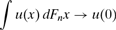
for all continuous functions u.
Proof of Lemma 1
The payoff to a group that funds a campaign in exchange for promised favors t is

The group will accept the offer if and only if this payoff is at least 0, so t must be at least ti. The candidate will never offer t>ti, because she could offer ti−ε and still know her offer would be accepted, for small enough ε. Because this lowers the promised favors without changing the probability that i will win, she strictly prefers the lower offer.
Proof of Lemma 2
Substitute the definition of π into the expressions for ρL and
to see that the probability L wins if she mounts a campaign is

Similarly, if she does not mount a campaign, then she wins with probability

I will show that the first term of the first expression dominates the first term of the second expression if and only if Δ−τL≥μL(0)Δ, and that the second term of the first expression dominates the second term of the second expression if and only if Δ−τL≥μL(0)Δ. This will establish the proposition.
Consider the first terms. Notice that

if and only if

if and only if

if and only if

A similar calculation establishes the result for the second terms, and then an analogous argument establishes the result for candidate R.
Proof of Proposition 1
The following conditions must hold for advertising by both candidates to be an equilibrium. Lemma 1 and correct beliefs imply that

and

In an equilibrium in which both candidates advertise good signals, the voters believe that the signal was si=[empty ] if i does not advertise. Thus, the beliefs must be

and

If neither candidate has an incentive to deviate, then

and

Now I prove the proposition.
(i) I will find a symmetric equilibrium for the case where p=1/2. Consider the map ϕ: [0, Δ/(2−q)]→[0, Δ/(2−q)] given by t[map ]c/ρL(t, t). If t* is a fixed point of ϕ, then it is an equilibrium for each candidate to advertise the good signal and to offer the interest group t* in favors. To see this, notice that
when p=1/2. Because t*≤Δ/(2−q) by construction,
, which is the incentive compatibility condition for L. R's incentive compatibility condition follows by symmetry. Finally, the breakeven condition for the interest groups is satisfied by construction.
All that's left is to show that ϕ has a fixed point. The map ϕ is continuous because ρ is continuous and strictly positive. Next I show that ϕ maps [0, Δ/(2−q)] to itself. Fix some t∈[0, Δ/(2−q)]. Then

which implies that ϕ(t)=c/ρL(t, t)≤2c≤Δ/(2−q). Thus, Brouwer's theorem implies that ϕ has a fixed point.
For the next two parts, observe that ti=c/ρi(tL, tR)>c, where the inequality is strict because F is strictly increasing on
.
(ii) L will deviate from the candidate equilibrium if

which implies that she will surely deviate if

The left-hand side of this inequality is continuous in p and converges to 0 as p→1. Furthermore, when p=1/2,
, so
when p=1/2. Thus, the intermediate value theorem implies that there is a p*<1, such that

Because
is strictly increasing in p, this implies that
for all p>p*.
(iii) By case (ii), it is sufficient to establish the result for the case where L does not advertise. R will deviate from the candidate equilibrium if

Because L is not advertising,

Furthermore,
, so
. Putting all of this together, R will deviate if

If p is close enough to 1, then this inequality is satisfied for F concentrated around zero. Consider the map p[map ](Δ/(2−q))F((1−p)Δ−c). Because F is continuous, this map is also continuous. As p→1,

Now let Fn be a sequence of continuous and strictly increasing cdfs that converge in distribution to the point mass at 0. Because convergence in distribution is equivalent to pointwise convergence of the cdf at continuity points of the limit distribution, Fn(x)→0 for all x<0. Thus, there is an N such that n>N implies

Furthermore, at p=1/2, advertising is incentive compatible:

where the first inequality follows from (1/2)Δ−c>0, and Fn symmetric about 0. The intermediate value theorem implies that there is a
such that

Because tR>c and Fn is strictly increasing,

Thus,
for all
. Because the sequence {Fn} was arbitrary, this means that inequality 1 is satisfied for large p and F concentrated around 0.
Proof of Proposition 2
If only the incumbent advertises, then transfers must satisfy

The RHS is a continuous function of t. I claim that this map takes
into itself. To see this, consider some
. Then
, so

Thus, Brouwer's theorem implies that there is a solution to the equation. Because the RHS does not depend on p, the set of fixed points does not vary with the incumbent's reputation.
Let

Because the function is continuous, the set of fixed points is closed and
is itself a fixed point. Thus, advertising and promising
will be part of an equilibrium as long as

At
, the LHS is greater than Δ/2 and the RHS is less than Δ/2, so the inequality is satisfied. As p increases to 1, the LHS stays the same, but the RHS increases to 1. Thus, there is a
such that the inequality is satisfied if and only if
.
Proof of Proposition 4
I will show that the payoff to having only candidate R advertising in equilibrium is strictly less than the payoff to a policy that funds α of R's advertising from tax dollars. Then I will comment on how a slight modification of the proof can cover the other possible cases.
The ex-ante payoff to the voter in an equilibrium in which only R advertises is

The term −(1/2)qαc represents the publicly funded part of the cost of ads (which is paid for with a tax on the voter), whereas the cost to the voter of the interest-group-funded part of the cost of ads is reflected in the tR(α). Let ε*(α)=(1−p)Δ−tR(α), the value of the preference shock for which the voter is indifferent between the two candidates when R advertises. Rewrite the payoff as

The first term equals

which is equal to

Thus write the overall ex-ante payoff as

Notice that the cost is independent of α. Ex-ante welfare is affected by α only through the expected policy payoffs. These policy payoffs are maximized at α=1—in that case, ε*=(1−p)Δ, so the voter always picks the candidate promising the greatest policy benefit. In any other case, there is positive probability that the voter will choose the candidate offering less policy payoff to avoid the ex-post cost of favors.
Now assume that tR is decreasing in α, and consider two matching rates α′>α. Notice that tR(α′)<tR(α) implies

Thus, the electoral decisions are the same except for ε in the interval (ε*(α), ε*(α′)), where only under the policy α′ is the winner the candidate with the greatest policy payoff. Thus, the voter's ex-ante payoff is greater under α′.
The argument for an initial equilibrium in which only L advertises is identical, mutatis mutandis. If both candidates advertise in the initial equilibrium, then proceed as follows. First, apply the above argument to show separately that public financing for R increases the voter's payoff conditional on L having the good signal and conditional on L having the bad signal. Then use a similar argument to show that, conditional on R having public financing, that public financing for L increases the voter's payoff conditional on both the good signal for R and the bad signal for R. This chain of inequalities proves the result.
Proof of Proposition 5
First I prove part 1. The voter's ex-ante welfare in an equilibrium in which both candidates advertise good signals is

Again, the publicly funded portion of the cost is (1/2+p)qαc, while the interest group portion is captured by τL and τR. Assume that one candidate, say R, is just indifferent about advertising. This implies that
. The voter's ex-ante welfare if the planner stops R from advertising is

It remains to show that
.
It's clear that the voter benefits from not paying the expected tax
. It remains to show that this gain is not offset by losses in the rest of his payoff.
Consider first the event that L has the good signal. The voter's indifference about advertising implies
, so

Because
,

with a strict inequality for

Because F is strictly increasing, the voter is better off without R's advertising in the event that L advertises. A similar argument applies to the event that L does not advertise. Thus,
.
Now I prove part 2. Fix p, and let the taste shock equal 0 with probability 1. Then, with no campaign, the voter gets pΔ. With a campaign by both candidates, the voter gets
at cost
. As p→1, the net benefit,
. Because the expected cost stays bounded away from 0 (and is in fact increasing), for p close enough to 1, the cost outweighs the benefits. Because the voter's payoff is continuous in ε, for a sufficiently small weak neighborhood, the benefit of the campaign is still less than the cost.
I received helpful comments and suggestions from Susan Athey, Ethan Bueno de Mesquita, Chuck Cameron, Jeff Frieden, Amanda Friedenberg, Adam Meirowitz, Becky Morton, and Jim Snyder, and from participants at the MIT Theory Lunch, the Harvard Political Economy Research Workshop, and the Stony Brook Game Theory Festival.



Comments
No Comments have been published for this article.