Introduction
Nasal obstruction has many causes and is a cardinal symptom of a variety of conditions by way of congestion; these causes include anatomical obstruction, septal deviation, nasal trauma, hypertrophy and hyper secretion. Nasal congestion may be allergic or non-allergic; however, treatment options are similar. Whether the treatment is pharmacological or surgical, the target points remain the inferior turbinate and the nasal septum.
A modification of Vidian neurectomy, addressing the posterior nasal nerves, has recently begun to regain popularity, based on cryoablation of the posterior nasal nerve, which was first introduced in 1983 by Terao et al.Reference Terao, Meshitsuka, Suzaki and Fukuda1 Posterior nasal nerve ablation can be achieved endoscopically by cryosurgery or laser ablation.Reference Chang, Song and Hwang2,Reference Krespi, Wilson and Kizhner3 Resection of the posterior nasal nerve reflects the physiological elimination of the parasympathetic stimulus to the inferior turbinate as induced by ipratropium, significantly improving both rhinorrhoea and nasal obstruction. The posterior nasal nerve is targeted blindly by addressing the posterior wall of the middle turbinate, thus allowing the procedure to be performed in the office setting or by non-contact laser ablation under direct vision, with sustainable results.
The nasal swell body is an anterior septum structure that can be seen on endoscopic examination, but with a poorly understood function. It is located slightly above the nasal valve, with a size of about 2 × 3 cm. It has been found to be thicker in allergy prone patients; some hypothesise that it plays a regulatory role in nasal airflow and humidification, but it could also be the reaction to nasal obstruction whether due to increased turbulence or increased nasal secretions.Reference Wotman and Kacker4 This is logical given that, histologically, it contains more venules than mucinous secretory glands.Reference Delank, Keller and Stoll5 The nasal swell body is a mostly neglected structure when nasal obstruction is addressed, despite its size and location. Hence, it would seem prudent to ablate or remove it, to relieve nasal obstruction. The nasal swell body, therefore, may be an ideal target for the focused relief of nasal obstruction, in conjunction with inferior turbinate ablation, when an aggressive procedure under general anaesthesia is less desirable.
Treatment for nasal obstruction accompanied by rhinorrhoea on functional and anatomical bases has been limited to submucous septal resection with inferior turbinectomy. Therefore, we tried to examine an alternative approach involving ablation of the nasal swell body with the inferior turbinate in conjunction with ablation of the posterior nasal nerve.
Materials and methods
A retrospective chart review of patients presenting with nasal obstruction or nasal congestion in the past three years (September 2017 to September 2020) was performed under institutional review board approval. This retrospective study examined the outcomes only. Appropriate International Classification of Diseases 10th revision codes (codes R09.81, J30.9, J30.0, J34.3 and J34.2) were matched with Current Procedural Terminology codes (CPT®; a medical code set used to report medical, surgical, and diagnostic procedures and services), allowing appropriate matching of the procedure with the diagnosis.
Patients were treated in the office when possible, and in the ambulatory surgery centre when anatomical exposure was poor or according to patients’ preference.
The following complications were assessed during follow up: laser surgery related complications, pain, crusting, epistaxis and infections. Medication usage prior to and following the procedure was also recorded.
The Total Nasal Symptoms Score and visual analogue scale (VAS) pain score were recorded for some of the patients. The Total Nasal Symptoms Score was chosen to measure symptom severity and outcome. The Total Nasal Symptoms Score is a sum of scores that evaluates the severity of symptoms of nasal congestion, sneezing, nasal itching and rhinorrhoea. It was collected at 30 and 90 days following the procedure. The VAS, which measures pain intensity, is measured using a four-point scale (no pain, mild and tolerable pain, moderate but still tolerated pain, and severe pain), with a maximum score of 10.
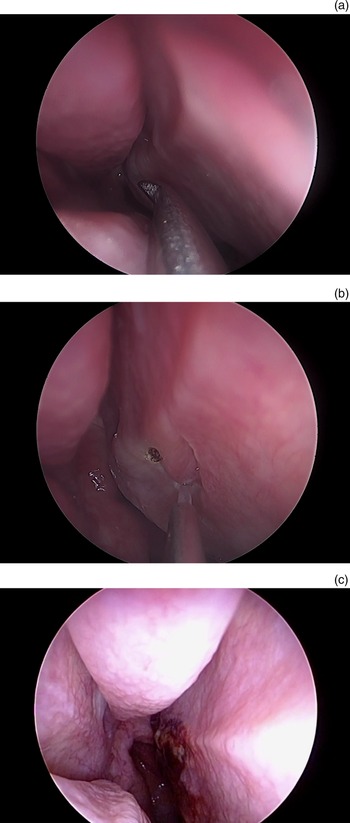
Two types of procedures were performed, using a diode 940 nm laser (Epic-S; Biolase, Irvine, California, USA) activated at a 5 W power setting, with a long, malleable, disposable fibre tip, used in a non-pulsed continuous mode. The first type of procedure included interstitial and contact reduction of the nasal swell body and inferior turbinate; the second type included non-contact posterior nasal nerve ablation with nasal swell body and inferior turbinate contact reduction. Mucosal blanching represents the end of treatment following about 10–15 seconds for posterior nasal nerve ablation. Two laser tips are required for the posterior nasal nerve and nasal swell body and inferior turbinate, while one tip is sufficient for the nasal swell body and inferior turbinate. Nasal swell body ablation is shown in Figure 1.
Endoscopic views of nasal swell body ablation: (a) prior, (b) during and (c) a week after the ablation. (a) Endoscopic view of secondary (posterior) septal swell body obstructing the airway. Note that choana is poorly visualised. A flat instrument is used to palpate, confirm and determine the amount of soft tissue swelling. (b) Diode laser ablation of a secondary septal swell body. An interstitial, submucosal method of ablation was utilised. A 100 mm long fibre was used to gain access to the posterior nasal cavity. (c) Endoscopic view of the operative site 10 days post-operatively. The airway was significantly improved, with a fully exposed choana. Note minimal bruising of the mucosa without crusting.

Results
A total of 242 patients were identified. Anatomical exposure and patients’ preference were the two main factors driving the decision to perform a procedure under anaesthesia at the ambulatory surgery centre. Eighteen per cent of patients were treated in the office. All patients underwent nasal swell body reduction with inferior turbinate reduction; 150 patients also underwent posterior nasal nerve ablation.
No laser surgery related complications were observed. The office-based procedure resulted in a VAS pain score of 1.5 out of 10. Overall, an 80 per cent reduction in medication use was noted at 90 days post-operatively. The Total Nasal Symptoms Score decreased from 9 (out of a maximum of 12) pre-operatively to 2.4 at 90 days post-operatively (a 73 per cent reduction). The rhinorrhoea score decreased from 2.6 (out of 3) to 1.2 (54 per cent reduction) and the congestion score decreased from 2.7 (out of 3) to 0.5 (81 per cent reduction). Crusting, epistaxis and infections were minimal, and resolved within two weeks.
Discussion
Most commonly, the surgical solution for nasal obstruction requires a visit to the ambulatory centre or the hospital. When the obstruction is anterior, as with most nasal swell body and inferior turbinate obstructions, contact ablation allows a higher proportion of patients to be treated in the office setting, as well as some posterior nasal nerve and nasal swell body and inferior turbinate patients.
The alternatives to the described posterior nasal nerve method include cryoablation of the posterior nasal nerve (e.g. using the ClariFix™ cryosurgical tool; Arrinex, Redwood City, California, USA), which can be used solely to address the posterior nasal nerve, and radiofrequency devices. Radiofrequency probes differ in cost and, unlike cryoablation, can be used to treat only the nasal swell body and inferior turbinate. All methods keep the tissue temperature low, with temperatures of 60–70°C for laser, 80–110°C for radiofrequency and less than 0°C for cryosurgery. The lower temperature ensures less peripheral damage with reduced crusting.Reference Delank, Keller and Stoll5
The rationale of addressing the nasal swell body is strengthened by the following findings. A radiological study by Arslan et al., comparing computed tomography findings, showed the nasal swell body size to be most commonly between 10 and 15 mm (range, 8–20 mm). Hence, the nasal swell body is large enough to cause obstruction and merits reduction.Reference Arslan, Muderris and Muderris6 Maran and Lund found that the nasal swell body constricts the inlet of the nose by approximately 2 mm and causes a disruption in respiration.Reference Maran and Lund7 Delank et al. reported an improvement of 43 per cent in respiratory values when the nasal swell body was shrunk by applying oxymetazoline.Reference Delank, Keller and Stoll5
• Previous procedures for nasal obstruction ranged from a single target approach (posterior nasal nerve cryoablation) to a highly technical method (Vidian neurectomy)
• The laser is a single power modality capable of targeting functional and anatomical factors that contribute to nasal obstruction congestion
• Nasal swell body/inferior turbinate reduction with posterior nasal nerve ablation, with its low pain and minimal complications, deserves greater attention
• The near-infrared laser coupled to a malleable long versatile fibre tip can perform ablation and superficial coagulation tasks without obstruction
• The procedure is simple enough to be considered as part of available in-office procedures
Posterior nasal nerve ablation has recently regained popularity. Direct anatomical identification of the posterior nasal nerve was previously technically challenging and Vidian neurectomy carried the morbidity of dry eyes.Reference Takahara, Takeno, Hamamoto, Ishino and Hirakawa8 As no clear identification of the nerve is performed, the results of the newly introduced posterior nasal nerve ablation technique are measured in terms of quality of life. Sustained results are reported at 90 days post procedure.Reference Kompelli, Janz, Rowan, Nguyen and Soler9
The overall reduction in Total Nasal Symptoms Score supports the concept of addressing anatomical obstruction in conjunction with the reduction of nasal secretions, regardless of allergic or non-allergic status. The laser offers a single effective tool for tackling nasal obstruction and secretions, with anatomical exposure and patient convenience being the deciding factors of treatment outside of the office setting.
Our study is limited by its retrospective, single-arm design. In addition, not all patients had Total Nasal Symptoms Score recorded. Some of our assumptions (preference for location of treatment, tissue heating for different technologies possibly allowing use of a Bovie electrosurgical device, non-separation between allergic and non-allergic causes, and so on) merit further studies.
Competing interests
None declared