INTRODUCTION
Neglect refers to a failure to report, respond, or orient to stimuli on the contralesional side of space that cannot be accounted for by primary sensory or motor deficits (Halligan, Cockburn, & Wilson, Reference Halligan, Cockburn and Wilson1991; Heilman, Watson, & Valenstein, Reference Heilman, Watson, Valenstein, Heilman and Valenstein2003; Robertson & Halligan, Reference Robertson and Halligan1999). It is a common consequence of unilateral brain damage and found to be more prevalent and severe following right hemisphere (RH) than left hemisphere (LH) lesion (Halligan et al., Reference Halligan, Cockburn and Wilson1991; Weintraub & Mesulam, Reference Weintraub and Mesulam1988). In patients with RH stroke the reported incidence of neglect varies from 13% to 82% depending largely on the type of tests used (Bowen, McKenna, & Tallis, Reference Bowen, McKenna and Tallis1999). Neglect may encompass several modalities, including vision, audition and touch, but most scientific attention has focused on visual neglect (Robertson & Halligan, Reference Robertson and Halligan1999).
Several studies indicate that the presence of neglect following a stroke predicts poor functional recovery and difficulties in activities of daily living (ADL; Buxbaum et al., Reference Buxbaum, Ferraro, Veramonti, Farne, Whyte and Ladavas2004; Cherney, Halper, Kwasnica, Harvey, & Zhang, Reference Cherney, Halper, Kwasnica, Harvey and Zhang2001; Gillen, Tennen, & McKee, Reference Gillen, Tennen and McKee2005; Jehkonen, Laihosalo, & Kettunen, Reference Jehkonen, Laihosalo and Kettunen2006). Neglect impairs working ability and the capacity for independent living. The degree of neglect may vary from mild to severe, and it is typically most severe during the acute phase of stroke (Robertson & Halligan, Reference Robertson and Halligan1999). In severe cases, the neglect behavior can be observed directly in the patient’s everyday activities (Mesulam, Reference Mesulam2000; Robertson & Halligan, Reference Robertson and Halligan1999). Patients with left neglect may collide with objects on their left side, fail to eat from the left side of the plate, attend to persons only on their right side, and dress only the right side of their body. In mild cases, the symptoms are often less obvious and, therefore, more difficult to identify. However, even mild neglect-related symptoms, such as slowness in attending to the contralesional hemispace (Schendel & Robertson, Reference Schendel and Robertson2002), can cause difficulties in more complex everyday activities like wheelchair maneuvering (Webster et al., Reference Webster, Roades, Morril, Rapport, Abadee and Sowa1995). Furthermore, visual neglect is a definite obstacle for driving (Tant, Reference Tant2002).
One of the most widely used test batteries in research and the clinical assessment of neglect is the Behavioural Inattention Test (BIT), which comprises six conventional paper-pencil subtests (BITC) and nine behavioral subtests (Jehkonen, Reference Jehkonen2002; Wilson, Cockburn, & Halligan, Reference Wilson, Cockburn and Halligan1987). The BIT has been proven to be a valid and reliable method for assessing visual neglect (Wilson et al., Reference Wilson, Cockburn and Halligan1987). However, the traditional quantitative evaluation based on BITC is not sensitive enough to identify more subtle forms of left neglect, where patients initially orient toward the right side of space, but are then able to reorient to the left (Jalas, Lindell, Brunila, Tenovuo, & Hämäläinen, Reference Jalas, Lindell, Brunila, Tenovuo and Hämäläinen2002; Samuelsson, Hjelmquist, Naver, & Blomstrand, Reference Samuelsson, Hjelmquist, Naver and Blomstrand1996; Taylor, Reference Taylor2003). These patients tend to start the cancellation tasks from the right side of the task sheet, but also manage to search for targets on the left and thus score above the conventional neglect criteria. The tendency to initially orient attention to the right and start cancellation from the right, known as rightward orienting bias (Kinsbourne, Reference Kinsbourne and Jeannerod1987), has found to be an essential characteristic of patients with left visual neglect (Butler, Lawrence, Eskes, & Klein, Reference Butler, Lawrence, Eskes and Klein2009; Jalas et al., Reference Jalas, Lindell, Brunila, Tenovuo and Hämäläinen2002). Furthermore, Azouvi et al. (Reference Azouvi, Samuel, Louis-Dreyfus, Bernati, Bartolomeo and Beis2002; Azouvi, Bartolomeo, Beis, Perennou, Pradat-Diehl, & Rousseaux, Reference Azouvi, Bartolomeo, Beis, Perennou, Pradat-Diehl and Rousseaux2006) found that the starting point (SP) of cancellation tasks is the most sensitive paper-and-pencil method for evaluating left visual neglect. Studies on healthy (H) subjects indicate that, in contrast to neglect patients, H subjects tend to start cancellation tasks mainly from the left, although not entirely consistently (Jalas et al., Reference Jalas, Lindell, Brunila, Tenovuo and Hämäläinen2002; Schwartz, Adair, Na, Williamson, & Heilman, Reference Schwartz, Adair, Na, Williamson and Heilman1997). It is necessary then to examine in more detail the normal variation in SPs of cancellation tasks to determine when the patient’s start performance indicates pathological inattention.
The aim of this study was to compare how healthy controls and RH infarct patients with and without left neglect differ in their SPs in three BIT cancellation tasks. Furthermore, we aimed to define the guideline value for normal SP for each of the three BIT cancellation tasks to differentiate the performance of patients with subclinical inattention from that of H subjects.
METHODS
Subjects
The patient group consisted of 70 patients with first-ever RH infarct. In total, 1451 stroke patients who were consecutively admitted to Tampere University Hospital as emergency cases from June 2005 to January 2008 were screened for inclusion in this study. Patients with LH stroke (n = 276), brain stem or cerebellar stroke (n = 57), transient ischemic attack (n = 200), cerebral hemorrhage (n = 139), other neurological diagnosis (n = 137), previous stroke (n = 185), significant cerebral atrophy in computed tomography (CT; n = 92), traumatic brain injury (n = 6), substance abuse (n = 21), psychiatric disorder (n = 20), age over 80 years (n = 144), left-handedness (n = 5), native language other than Finnish (n = 4), and inability to participate in neuropsychological examination (n = 95) were excluded. Informed consent was obtained from all selected patients before inclusion in the study. The study was approved by the Ethical Committee of Tampere University Hospital. All patients underwent a neurological, a neuroradiological (CT) and a neuropsychological examination at the acute phase according to standard methods of treatment. Neuropsychological assessment was conducted on average 4 days after onset (range, 1–10 days). The patients were divided into two groups according to the presence of left-sided visual neglect.
The healthy control group comprised 44 healthy volunteers who were drawn from local pensioners’ clubs and from among the researchers’ acquaintances. All subjects were right-handed and aged between 30 and 80 years. Subjects with previous or current neurological or psychiatric disorders were excluded from the study. All subjects underwent a neuropsychological examination. The possible presence of general cognitive decline was evaluated with the Mini Mental State Examination (MMSE; Folstein, Folstein, & McHugh, Reference Folstein, Folstein and McHugh1975), using the score of 24 as cutoff for exclusion from the study. All participants were blind to the hypotheses of the study.
Methods
The presence of left visual neglect was assessed using the six conventional subtests of the Behavioral Inattention Test (BITC; Jehkonen, Reference Jehkonen2002; Wilson et al., Reference Wilson, Cockburn and Halligan1987). Neglect was defined as present if the patient scored at or below the cutoff level in at least two of the subtests. The cutoff point was selected on the basis of Wilson et al. (Reference Wilson, Cockburn and Halligan1987). During assessment, each task sheet was placed in front of the subject in line with the midsagittal plane. The subject was not allowed to move the sheet while performing the task. In all tasks, except representational drawing, an arrow indicated the location of the median line on the stimulus sheet. All subjects conducted the tasks in the same order and there was no time limitation for completing the tasks. The six subtests and their instructions are described in detail below.
The line cancellation task consists of 40 lines randomly spaced on an A4-sized landscape sheet, with 18 target lines on both sides of the task paper. Four central lines are used as examples and marked by the examiner and are not scored (maximum score 36, cutoff point 34). The letter cancellation task includes 40 target letters (E, R) among 130 non-target letters on an A4-sized landscape sheet (maximum score 40, cutoff point 32). The letters are arranged in five rows, each containing 34 items. Two additional letters (E & R) beneath the actual stimulus rows serve as examples and are not scored. The star cancellation task consists of 56 targets (small stars) and 75 non-targets (big stars, words, and letters) randomly spaced on an A4-sized landscape sheet. Two of the most centered target stars are used as examples and marked by the examiner and are not scored (maximum score 54, cutoff point 51). In these three cancellation tasks, the subjects were instructed to search and mark all the targets on the stimulus sheet. The examiner illustrated the task by marking the example targets on the sheet. The three cancellation tasks were scored on the basis of the crossed targets (i.e., failure was based on the omissions).
The figure and shape copying involves two separate tasks. Figure copying consists of three simple figures—a star, a cube, and a daisy—located on the left side of an A4-sized portrait sheet. Shape copying includes a group of three geometric shapes on an A4-sized landscape sheet. In figure copying, the subjects were instructed to copy three figures from the left side of the task sheet to the boxes on the right side of the sheet. In shape copying, the task was to copy geometric shapes from the stimulus display to a separate blank sheet. In both tasks, scoring was based on the completeness of the drawings (i.e., no omissions of any major components of the drawing) (maximum score 4, cutoff point 3). The line bisection contains three landscape 20.4-cm lines spread in a staircase manner across an A4-sized landscape sheet. The subjects were instructed to estimate and mark the centre of each of the three horizontal lines. Scoring of this subtest was based on the extent of deviation from the true centre of each line (maximum score 9, cutoff point 7). The representational drawing includes three blank A4-sized landscape sheets. The subjects were to draw three drawings: a clock face with numbers, a man or a woman, and a butterfly, to the three separate sheets. Scoring was based on the relative completeness of the drawings (maximum score 3, cutoff point 2).
SP was recorded in three BITC cancellation tasks: line, letter, and star cancellation. After the patient had completed the task, the examiner marked the SP on the task sheet and measured the distance between the SP and the median line of the stimulus sheet in centimeters. The distance was expressed as a negative value if the SP was located on the left side and as a positive value if it was located on the right side of the sheet (possible ranges: line cancellation −13.4 – +13.2 cm; letter cancellation −12.4 – +12.2 cm; star cancellation −11.8 – +14.0 cm).
In the neurological examination, the degree of stroke severity, hemiparesis and hemianopia was assessed with the National Institute of Health Stroke Scale (NIHSS; Goldstein, Bertels, & Davis, Reference Goldstein, Bertels and Davis1989). The degree of stroke severity was based on the NIHSS sum score (range: 0–34; 0 = no defect, 34 = severe stroke). Hemiparesis was evaluated separately for leg and arm and scored on a scale from 0 to 4 (0 = no motor defect, 4 = severe motor defect). These scores were then summed to create a range from 0 to 8. Visual field deficit was scored as present (1) or absent (0). Functioning in basic ADL was evaluated using the Barthel Index (BI; range: 0–100, 0 = dependent, 100 = independent; Mahoney & Barthel, Reference Mahoney and Barthel1965). The CT scans were analyzed by the neuroradiologist to verify that the infarct was strictly unilateral and right-sided, and to ensure that there was no significant cerebral atrophy. A more detailed description of the radiological data was beyond the scope of this study. In the neuropsychological examination, the general cognitive status of H subjects was assessed with the MMSE (range, 0–30; 0 = severe cognitive impairment, 30 = normal cognitive functioning).
Data Analysis
Nonparametric methods were chosen because of the small sample sizes and the skewed distribution of variables. Differences in continuous variables between the two patient groups were analyzed using the Mann-Whitney U test. Comparisons between all three groups (the two patient groups and the H subject group) were carried out using the Kruskal-Wallis analysis of variance. Multiple pairwise comparisons were conducted using the Mann-Whitney U test with Bonferroni corrections. Differences in categorical variables were analyzed with the χ2 test.
The guideline value for normal SP was defined separately for each cancellation task. Guideline values were assessed by receiver operating characteristic (ROC) curve analyses. To differentiate normal versus neglect-related SP, SPs for the H subjects (SPH) were compared with SPs for the N+ patients (SPN+) for each task. In ROC analyses, sensitivity, specificity and areas under the curve (AUC) were calculated. Guideline values were selected on the basis of the ideal combination of sensitivity and specificity (i.e., the best sensitivity associated with the best specificity).
Analyses were performed using the Statistical Package for the Social Sciences version 13 for Windows. For all analyses the level of statistical significance was set at .05.
RESULTS
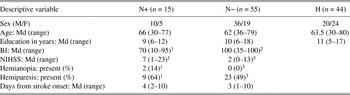
The patient group consisted of 46 males and 24 females. The median age was 62 years (range, 30–79 years) and median years of education 10 (range, 6–18 years). Fifteen patients met the diagnostic criteria of visual neglect (N+ group), while 55 did not (N− group). The group of 44 healthy subjects (H) included 20 males and 24 females. Their median age was 63.5 years (range, 30–80 years) and median years of education 11 (range, 5–17 years). The median MMSE-score was 28.5 (range, 25–30).
The subject characteristics for each group are presented in Table 1. The N+, N−, and H groups did not differ significantly according to sex (χ2(2) = 4.56; p = .102), age (χ2(2) = 0.15; p = .926), or years of education (χ2(2) = 5.51; p = .064). Patients in the N+ group had more severe stroke (NIHSS; U = 97.00; p < .001) and were more dependent in basic ADL (BI; U = 100.50; p < .001) than patients in the N− group. The two patient groups did not differ significantly according to hemiparesis (U = 145.00; p = .118) or days from stroke onset (U = 321.00; p = .182).
Subject characteristics in the neglect (N+), non-neglect (N−), and healthy control (H) groups

Note
H = healthy control group; N− = non-neglect group; N+ = neglect group; Md = median; BI = Barthel Index score (range 0–100); NIHSS = National Institute of Health Stroke Scale score (range 0–34).
1 Data for one patient missing.
2 Data for nine patients missing.
3 Data for eight patients missing.
Analyses of the SPs
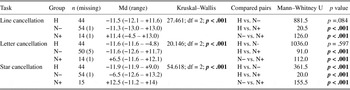
The median and the range of SPs in the three cancellation tasks for all three groups are presented in Table 2. The Kruskal-Wallis test showed significant differences between all three groups in their SPs in each cancellation task. More detailed analyses using multiple pairwise comparisons revealed that the N+ group differed significantly from the N− group and from the H group in all cancellation tasks. The N− group differed significantly from the H group only in the star cancellation task, but a tendency toward significance was also found in the line cancellation task. In each task, the N+ group tended to start the cancellations mainly from the right side of the task sheet, while both the N− group and the H group initiated their cancellations primarily from the left, slightly more so in the H group. Among N+ patients, 80% of the patients showed initial rightward bias in their SPs (i.e., started 2 to 3 tasks from the right). Initial leftward bias was seen in 80% of the N− patients and in 95% of the H subjects.
Median and range of starting point locations in the three cancellation tasks and comparisons between the healthy control (H), non-neglect (N−), and neglect (N+) groups

Note
H = healthy control group; N− = non-neglect patients; N+ = neglect patients; Missing = missing data; Md = median.
Guideline Value for Normal SP
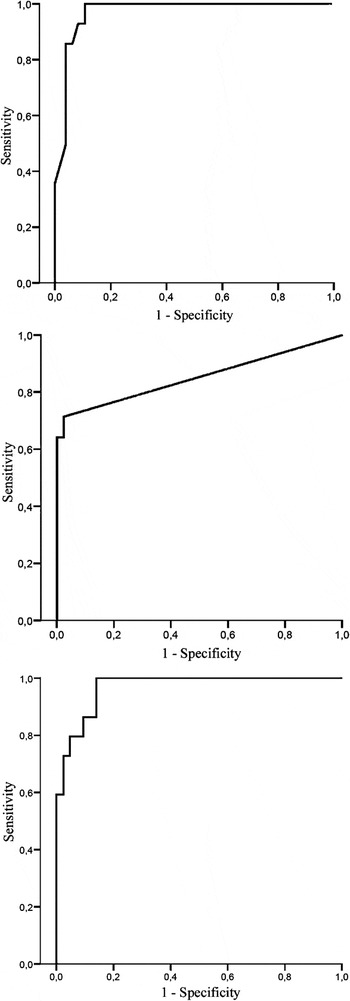
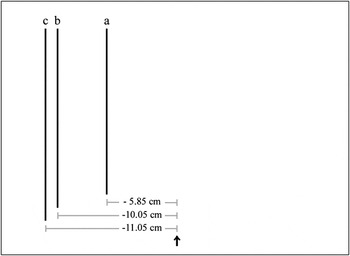
Table 3 shows the ROC analyses of SPH versus SPN+ for the three BIT cancellation tasks. In the ROC analysis of SPH versus SPN+ for the line cancellation task, AUC was 0.967 (Figure 1a). The ideal pair of sensitivity (100.0%) and specificity (89.0%) was found with a cutoff < −5.85 cm as the guideline value for normal SP. This means that all left-sided SPs located further than −5.85 cm from the median line were defined as normal in the line cancellation task (Figure 2). In the ROC analysis of SPH versus SPN+ for the letter cancellation task, AUC was 0.852 (Figure 1b). The ideal pair of sensitivity (71.4%) and specificity (98.0%) was found with a cutoff < −10.05 cm as the guideline value for normal SP. Thus, all left-sided starts located further than −10.05 cm from the median line were considered normal in the letter cancellation task (Figure 2). Finally, in the ROC analysis of SPH versus SPN+ for the star cancellation task, AUC was 0.970 (Figure 1c). The ideal pair of sensitivity (93.3%) and specificity (86.4%) was found with a cutoff < −11.05 cm as the guideline value for normal SP. Accordingly, all left-sided SPs located further than −11.05 cm from the median line were defined as normal in the star cancellation task (Figure 2).
(a) Receiver operating characteristic curve: starting points (SPs) for healthy (H) subjects versus SPs for visual neglect (N+) patients (SPH vs. SPN+) for line cancellation task. (b) Receiver operating characteristic curve: SPs for H subjects versus SPs for N+ patients (SPH vs. SPN+) for letter cancellation task. (c) Receiver operating characteristic curve: SPs for H subjects versus SPs for N+ patients (SPH vs. SPN+) for star cancellation task.

Guideline values for normal starting point in three Behavioural Inattention Test (BIT) cancellation tasks: (a) cutoff line in line cancellation task, (b) cutoff line in letter cancellation task, and (c) cutoff line in star cancellation task. In each task, starts located left from the task-specific cutoff line are referred to as normal.

ROC analyses of SPs for H subjects vs. SPs for N+ patients (SPH vs. SPN+) for the three cancellation tasks

Note
ROC = receiver operating characteristic; SP = starting point; H = healthy; N+ = visual neglect; AUC = area under the curve; CI = confidence interval; Cutoff = cutoff of guideline value for normal starting point (starts located left from the cut-off are referred to as normal).
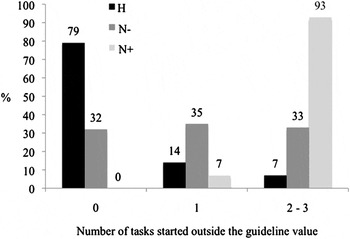
Figure 3 shows the proportions of N+, N−, and H subjects starting (a) none, (b) 1, and (c) 2 to 3 cancellation tasks outside the guideline value for normal SP. In H group, a moderate proportion of subjects started one of the tasks outside the guideline value. It was exceptional for H subjects to initiate most (2 to 3) tasks outside the guideline value but typical for N+ patients. One-third of the N− patients started most of the tasks outside the guideline value for normal SP.
Proportions of visual neglect (N+), no visual neglect (N−), and healthy (H) subjects starting (a) none, (b) 1, and (c) 2 to 3 cancellation tasks outside the guideline value for normal starting point.

Original Omission-Based Criteria versus Guideline Value for Normal SP
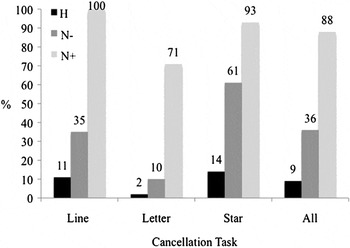
In the N+ group, the patients failed (i.e., scored at or below the original cutoff level defined by Wilson et al. Reference Wilson, Cockburn and Halligan1987) in 67% of all cancellation tasks and started 88% of all cancellation tasks outside the guideline value for normal SP. In the N− group, the patients failed in 5% of all cancellation tasks and started 36% of all cancellation tasks outside the guideline value for normal SP. In the H group, the subjects failed in 5% of all cancellation tasks and started 9% of all cancellation tasks outside the guideline value for normal SP. Figure 4 shows the task-specific proportions of starts outside the guideline value for normal SP in each group.
Task-specific proportions of starts outside the guideline value for normal starting point in the visual neglect (N+), no visual neglect (N−), and healthy (H) groups.

DISCUSSION
This study set out to examine how H controls and RH infarct patients with and without left neglect differ in their SPs in three BIT cancellation tasks. Based on the performance of H controls, we defined a guideline value for normal SP in each of the three BIT cancellation tasks. Our results revealed that H subjects started the tasks primarily from the left margin of the sheet, although there were also a few right-sided starts. Consequently, H subjects showed a strong, yet not entirely consistent tendency to orient initially toward the left side of space, which is in line with previous studies (Jalas et al., Reference Jalas, Lindell, Brunila, Tenovuo and Hämäläinen2002; Schwartz et al., Reference Schwartz, Adair, Na, Williamson and Heilman1997).
To get a deeper understanding of the H subjects’ SP performance, we defined task-specific guideline values for normal SP by measuring the exact locations of the H subjects’ starts in three BIT cancellation task. The guideline values were defined as follows: left-sided starts with a distance from the midline of more than 5.85 cm in line cancellation, more than 10.05 cm in letter cancellation and more than 11.05 cm in star cancellation, were considered normal. Although most of the H subjects started all three cancellation tasks within the guideline value, it was not uncommon to start one task outside the guideline value; this was the case in 14% of the subjects. It appears then that one SP outside the guideline value is not a pathological sign, but it can also be seen in healthy individuals. Starting more than one of the tasks outside the guideline value, on the other hand, does seem to indicate pathological inattention, because this was exceptional among H subjects (7%), but highly typical among N+ patients (93%).
As a group, the N+ patients were clearly rightward biased in their SPs, as has been reported earlier (Jalas et al., Reference Jalas, Lindell, Brunila, Tenovuo and Hämäläinen2002; Samuelsson et al., Reference Samuelsson, Hjelmquist, Naver and Blomstrand1996). Of interest, however, there were three N+ patients who did not show initial rightward bias when they started the cancellations. A similar result was seen in the study of Jalas et al. (Reference Jalas, Lindell, Brunila, Tenovuo and Hämäläinen2002), in which one N+ patient was actually leftward biased in his SP. When the N+ patients’ tendencies to start cancellations were examined relative to the guideline value for normal SP, a clear majority of the N+ patients started at least two of the three tasks outside the guideline value. These findings support the conclusion that starting more than one task outside the guideline value indicates pathological inattention.
We found that although the N− group showed a tendency to start the tasks more often from the left side of the sheet, this tendency was less pronounced than in the H group. In addition, we discovered a subgroup of N− patients (20%) who showed a rightward bias when starting the cancellation tasks. This result is in line with earlier findings (Jalas et al., Reference Jalas, Lindell, Brunila, Tenovuo and Hämäläinen2002; Samuelsson et al., Reference Samuelsson, Hjelmquist, Naver and Blomstrand1996). Furthermore, we found that 33% of the N− patients in our study started more than one task outside the guideline value for normal SP, probably indicating a presence of mild pathological inattention that was not detected with conventional methods.
As this study set out to examine the SPs in three BIT cancellation tasks and visual neglect was diagnosed partly using the same subtests, this may raise the question as to whether there might be dependence between dependent variable (starting point) and independent variable (failure in cancellation tasks). However, the SP and failure in the task (i.e., number of omissions) are not dependent on each other. First, just as it is possible for H subjects to start cancellations from the right (for example, in our study 5%), so it is also possible for N+ patients to start from the left (in our study 22%). Previous studies have reported similar findings (e.g., Jalas et al., Reference Jalas, Lindell, Brunila, Tenovuo and Hämäläinen2002; Schwartz et al., Reference Schwartz, Adair, Na, Williamson and Heilman1997). Second, the SP measures the initial orienting of attention whereas the omissions measure the left space totally neglected. Usually, neglect patients initially orient their attention rightward. Therefore, they typically start cancellation from the right margin and proceed leftward on the task sheet. It then depends on the severity of left neglect how many targets eventually are omitted. The point is that, regardless neglect severity, the SP is usually on the right, and not as much to the left as it could be (i.e., the leftmost target identified). Even patients with mild or residual neglect, who manage to find most or all targets from the left, do not seem to start from as left as they could. Therefore, the SP and the omissions (i.e., failure in the task) are not dependent on each other.
Our study clearly demonstrates the clinical value of SP analysis over conventional methods of assessment in BIT cancellation tasks. N+ patients started the tasks outside the guideline value for normal SP more often than failed in cancellation tasks according to the original omission-based criteria (Wilson et al., Reference Wilson, Cockburn and Halligan1987). In the N− group the number of starts outside the guideline value was much higher than the number of failed cancellation tasks. Healthy subjects rarely started outside the guideline value or failed in the cancellation tasks. SP analysis, therefore, seems to be more sensitive in detecting mild or residual left inattention than an analysis of omissions.
The three BIT cancellation tasks differed in their sensitivity of detecting mild inattention. Statistically significant differences in the SPs between the H and the N− groups were seen only in star cancellation, but there was also a tendency toward significance in line cancellation. In letter cancellation, these differences were not found. In addition, the N+ patients’ tendency to start cancellations from the right was not as evident in the letter cancellation task as it was in the star and line cancellations. When assessing the task-specific guideline values for normal SP, the results of our ROC analyses (SPH vs. SPN+) showed that the sensitivity of the guideline value was greater in line and star cancellations than in letter cancellation. In both patient groups, the proportions of starts outside the guideline value were higher in star and line cancellation tasks than in letter cancellation. These findings indicate that the letter cancellation task is less sensitive in detecting initial rightward orienting bias than the star and the line cancellations. This is supported by earlier results (Jalas et al., Reference Jalas, Lindell, Brunila, Tenovuo and Hämäläinen2002; Samuelsson et al., Reference Samuelsson, Hjelmquist, Naver and Blomstrand1996). One possible explanation for this difference in sensitivity is that performance of the letter cancellation task may resemble reading and thus serve as a cue that directs the patient’s attention toward the left (Riddoch & Humphreys, Reference Riddoch, Humphreys and Jeannerod1987; Samuelsson et al., Reference Samuelsson, Hjelmquist, Naver and Blomstrand1996). Another explanation is based on the observation by Mesulam (Reference Mesulam2000) that neglect patients’ search performance is less efficient and less orderly when the targets on the sheet are arranged randomly, as in the line and the star cancellations, than when they are presented in a structured and systematic way, as in the letter cancellation. Consequently, the inability of N+ patients to use orderly search strategies when the targets are randomly organized may explain why line and star cancellations more effectively bring out the neglect symptoms than does letter cancellation based on systematically structured targets.
The current study provides new and more detailed information about healthy subjects’ starting behavior in BIT cancellation tasks, which is essential for the accurate determination of differences between normal and left neglect-related starting performances. We identified task-specific guideline values for normal SPs, which are necessary and important for clinical work when assessing mild or residual visual inattention. Because of the relatively small sample size and the nature of the test, we were unable to establish any fast normative values. It should also be noticed that the generalizability of our results may be undermined by the small number of neglect patients in the sample. However, our findings concerning both the patient groups and the healthy controls are consistent with previous studies (Jalas et al., Reference Jalas, Lindell, Brunila, Tenovuo and Hämäläinen2002; Samuelsson et al., Reference Samuelsson, Hjelmquist, Naver and Blomstrand1996; Schwartz et al., Reference Schwartz, Adair, Na, Williamson and Heilman1997), which increases the reliability of the results. Although neglect has been found to be more prevalent and severe following RH lesion than left hemisphere (LH) lesion (Halligan et al., Reference Halligan, Cockburn and Wilson1991; Weintraub & Mesulam, Reference Weintraub and Mesulam1988), the studies of Odgen (1985) and Beis et al. (Reference Beis, Keller, Morin, Bartolomeo, Bernati and Chokron2004) indicate that right neglect may be as common as left neglect in the acute stages of stroke. In our ongoing study, we are examining both RH and LH patients to gain a broader view of the neglect syndrome and particularly of the characteristics of right neglect.
Some clinical recommendations can be made based on the results of this study. First, a subgroup of N− patients showed initial rightward bias in their SPs, indicating the presence of mild neglect that was not detected with conventional methods. To make the clinical assessment of neglect more sensitive to this mild but significant symptom, a qualitative evaluation of SPs should be included in the neuropsychological assessment of neglect. Second, clinical evaluations of SPs could use task-specific guideline values for normal SP. According to these guideline values, left-sided SPs more than 6 cm from the midline in the line cancellation, 11 cm in the star cancellation, 10 cm in the letter cancellation task, can be interpreted as normal. Starting at least two of the BIT cancellation tasks outside the guideline value can be considered as a clinically pathological performance. Third, as line and star cancellations appeared to be more sensitive than letter cancellation in detecting symptoms of mild neglect, at least these two BIT cancellation tasks should be included in any test battery designed to assess the presence of neglect.
ACKNOWLEDGMENTS
There are no conflicts of interest or sources of financial support.