Introduction
Preterm birth occurs during a period of rapid fetal growth and nutrient accumulation. Currently, the intrauterine environment and early postnatal life are generally accepted as important determinants of the risk of cardiovascular disease (CVD) in adulthood.Reference Skogen and Overland 1 , Reference Barker, Gluckman and Godfrey 2 Although the exact mechanisms underlying this association are unknown, abnormalities in serum lipid metabolism have been suggested as a potential cause of these associations.Reference Barker, Martyn and Osmond 3
Lipid metabolism is a highly important subject in the field of neonatal nutrition because lipids are the main structural components of cell membranes and, therefore, affect growth and development. The fetal lipoprotein profile differs considerably from the adult profile as a result of low lipoprotein synthesis, attributed to immature hepatic function, and the absence of intestinal lipid absorption in the former. In the fetus, the major plasma lipoprotein is high-density lipoprotein (HDL), whereas in an adult, low-density lipoprotein (LDL) is the major component.Reference Dolphin, Breckenridge and Dolphin 4 , Reference Lane and McConathy 5 Serum lipoprotein profiles in childhood are predictive of those in adulthood,Reference Webber, Srinivasan and Wattigney 6 , Reference Fuentes, Notkola and Shemeikka 7 and evidence suggests that this association with adult levels might originate at birth.Reference Fonnebo, Dahl and Moe 8 , Reference Bastida, Sanchez-Muniz and Cuena 9
Several lipoprotein ratios or ‘atherogenic indices’ have been defined in an attempt to optimize the predictive capacity of the lipid profile. The total cholesterol (TC)/HDL cholesterol (HDLc) and LDL cholesterol (LDLc)/HDLc ratios are indicators of risk and have been associated with a greater predictive value than those of the isolated parameters, when used independently.Reference Millan, Pinto and Munoz 10 The major apolipoprotein present in HDL is apolipoprotein-A1 (apoA1), which provides structural stability to the spherical molecule. In contrast, apolipoprotein-B (apoB) constitutes most of the protein content of LDL. The apoB/apoA1 ratio is therefore also of great value for detecting the atherogenic risk and is often more useful than the TC/HDLc and LDLc/HDLc ratios.Reference Millan, Pinto and Munoz 10 The LDL/apoB ratio correlates well with LDL size and has been used as a marker of LDL atherogenicity.Reference Campos, Genest and Blijlevens 11
Both animal and human studies have demonstrated the roles of the essential trace elements such as copper (Cu) and zinc (Zn) in atherogenesis and carcinogenesis.Reference Chisolm and Steinberg 12 , Reference Craig, Poulin and Palomaki 13 Several studies reported associations of high serum Cu and low serum Zn levels with risk factors for CVDReference Reunanen, Knekt and Marniemi 14 , Reference Leone, Courbon and Ducimetiere 15 and type 2 diabetes mellitus.Reference Naka, Kaneto and Katakami 16 , Reference Ferdousi and Mia 17 KlevayReference Klevay 18 hypothesized that coronary heart disease (CHD) is predominantly a disease of Zn and Cu metabolic imbalances, and is principally attributable to Cu deficiency. In fact, Cu deficiency increases serum cholesterol levels by modulating cholesterol levels via cholesterol biosynthesis,Reference Yount, McNamara and Al-Othman 19 and both metals regulate the enzyme Cu/Zn superoxide dismutase. On the other hand, excess Cu levels have also been associated with an increased risk of CHD.Reference Reunanen, Knekt and Marniemi 14
Although many genetic and environmental factors besides trace elements are known to affect the fetal lipid and apolipoprotein profiles of preterm infants, limited information is available to link these lipid and apolipoprotein profiles with Cu or Zn concentrations in later life. Therefore, the present study measured selected trace elements, lipids and apolipoprotein levels soon after birth in preterm infants in order to assess the effects of the relationship between Cu and Zn levels on atherogenic indices.
Materials and methods
Study population
A pilot study was conducted in the neonatal intensive care unit (NICU) of Juntendo University Hospital, Tokyo, Japan. Singleton preterm infants [gestational age (GA) of 32–35 weeks] who were born at our hospital between April 2010 and June 2012 were recruited. Infants with major congenital abnormalities or metabolic disorders, as well as those born to women with diabetes mellitus, gestational diabetes, chronic hypertension, intrauterine infections, and the presence of fever (>37.8°C) or elevated C-reactive protein levels (⩾2.0 mg/dl) before delivery were excluded. We evaluated 45 preterm infants (19 female, 26 male) who were admitted during the study period. GA was estimated from the mother’s last menstrual period and confirmed using fetal ultrasound measurements. The mothers’ ages ranged from 24 to 44 years, and none were vegetarian. Pregnancy-induced hypertension was defined as a blood pressure >140/90 mmHg, diagnosed after 20 weeks of gestation. Sex and GA-independent standard deviation (s.d.) scores or percentiles for anthropometric parameters at birth were calculated via comparison with the Japanese standard birth-weight (BW) curve.Reference Itabashi, Miura and Uehara 20 A small-for-GA (SGA) infant was defined as a BW and birth height below the 10th percentile. This study was approved by the Institutional Review Board of Juntendo University Hospital (11-467), and prior written informed consent was obtained from the infants’ parents.
Biochemical measurements
Infants were subjected to the heel lance procedure soon after admission to the NICU (within 20 min postpartum and before the first glucose infusion or first feeding). Blood samples (~600 μl) were collected in BD Microtainer® brand tubes (Franklin Lakes, NJ, USA) containing a clot activator (Ref no. 365967). The samples were immediately centrifuged at 6000 g and 4°C for 90 s, after which the separated serum was stored at 80°C until assayed. Cu and Zn levels were measured by atomic absorption spectrometry. TC and triglyceride (TG) levels were measured enzymatically. LDLc and HDLc levels were measured directly using a homogeneous assay, and apoA1 and apoB levels were determined via immunoturbidimetric assay using a Hitachi Automatic Analyzer LABOSPECT008 (Hitachi High-Technologies Corporation, Tokyo, Japan).
Statistical analyses
Results are presented as means±s.d. Correlation between variables were evaluated using Spearman’s rank correlation coefficient analysis. After a simple regression analysis, stepwise multiple regression analysis was conducted with Cu and/or Zn levels as the dependent variable. Threshold significance values for selection and retention of covariates in the stepwise selection procedure were 0.05 and 0.10, respectively. All statistical analyses were performed using JMP statistical software, version 12.0 (SAS Institute Inc., Cary, NC, USA). A P value <0.05 was considered to indicate statistical significance.
Results
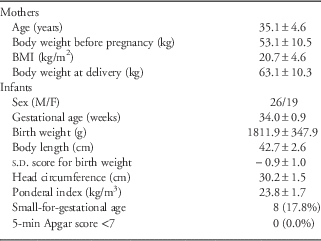
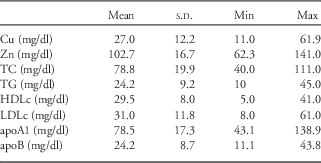
The clinical characteristics and anthropometric indices of the mothers and infants included in this study are summarized in Table 1. In total, eight (17.8%) SGA infants were included. Table 2 summarizes the TC, TG, HDLc, LDLc, apoA1, apoB, Cu and Zn levels in preterm infants shortly after birth. The mean GA and BW of the 45 infants were 34.0 weeks and 1811.9 g, respectively.
General characteristics of the subjects

BMI, body mass index; F, female; M, male; s.d., standard deviation.
Data are presented as means±s.d. or number (percentage) of subjects.
Lipid and apolipoprotein concentrations in preterm infants shortly after birth

Cu, copper; Zn, zinc; TC, total cholesterol; TG, triglyceride; HDLc, high-density lipoprotein cholesterol; LDLc, low-density lipoprotein cholesterol; apo, apolipoprotein; s.d., standard deviation; min, minimum; max, maximum.
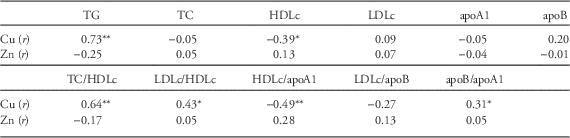
The results of correlation between the lipid, apolipoprotein, Cu and Zn levels and the GA, BW and s.d. score for BW are shown in Table 3. Both TG and Cu correlated negatively with the BW and s.d. score for BW (P<0.01). Table 4 presents the results of correlation between the levels of lipids and apolipoproteins, atherogenic indices and levels of Cu and Zn. The Cu level correlated positively with the TG level and TC/HDLc, LDLc/HDLc and apoB/apoA1 ratios, and negatively with the HDLc level and HDLc/apoA1 ratio. However, the Zn level did not correlate with any of these indices.
Correlation between lipid, lipoprotein, apolipoprotein and trace element concentrations, gestational age, birth weight and s.d. score for birth weight

TG, triglyceride; TC, total cholesterol; HDLc, high-density lipoprotein cholesterol; LDLc, low-density lipoprotein cholesterol; apo, apolipoprotein; Zn, zinc; Cu, copper; s.d., standard deviation.
r Values indicate Spearman’s rank correlation coefficients.
**P<0.01.
Correlation between lipids, lipoproteins, apolipoproteins, atherogenic indices and trace elements

TG, triglyceride; TC, total cholesterol; HDLc, high-density lipoprotein cholesterol; LDLc, low-density lipoprotein cholesterol; apo, apolipoprotein; Cu, copper; Zn, zinc.
r Values indicate Spearman’s rank correlation coefficients.
*P<0.05, **P<0.01.
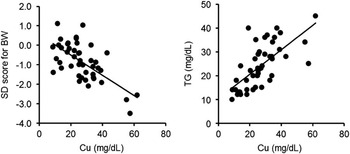
In a stepwise multiple regression analysis to evaluate the influences of a range of variables, including BW, s.d. score for BW, TG, HDLc, TC/HDL, LDL/HDL, HDL/apoA1 and apoB/apoA1, the Cu level was found to be significantly and independently influenced by the TG level (adjusted R 2=0.46, P<0.001) and s.d. score for BW (adjusted R 2=0.58, P=0.001) (Table 5; Fig. 1).
Relationship between copper (Cu) levels and standard deviation (s.d.) score for birth weight (BW) and triglyceride (TG) levels at birth.

Stepwise multiple regression of copper levels

s.d., Standard deviation; TG, triglyceride.
Discussion
To our knowledge, this is the first study to assess the relationship of serum Cu and Zn levels with atherogenic indices based on measured lipid and apolipoprotein levels in blood samples collected from preterm infants immediately postpartum. The results indicate that Cu levels correlated significantly with TG levels and various atherogenic indices. This result was similar to the findings of a study by Bastida et al.Reference Bastida, Vaquero and Veldhuizen 21 However, our stepwise multiple regression analysis indicated that of the measured serum factors, only the TG level was a significant independent determinant of the Cu level.
The highly significant relationship observed between Cu and TG likely reflects the parallelism between the progressive increase in serum TG and serum Cu levels.Reference Yount, McNamara and Al-Othman 19 , Reference Bastida, Sanchez-Muniz and Cuesta 22 A previous cross-sectional study observed a positive association of umbilical cord serum Cu concentrations with TG levels, but not with TC or LDLc levels.Reference Bastida, Vaquero and Veldhuizen 21 Wells et al.Reference Wells, Navas-Acien and Apelberg 23 also reported a positive association of Cu levels with TG levels in the umbilical cord sera of full-term newborns. Although both animal and human studies have suggested a potential role for Zn in lipoprotein metabolism, no significant effects of Zn on serum lipid and lipoprotein levels were observed in this study. Furthermore, a significant correlation was observed between the Cu levels and s.d. score for BW. Similarly, a recent study of full-term infants also found the highest umbilical cord Cu levels in the SGA group.Reference Bermudez, Garcia-Vicent and Lopez 24 We note that in the present study, the serum Cu level correlated positively with various atherogenic indices, including the TC/HDLc, LDLc/HDLc and apoB/apoA1 ratios, but negatively with the anti-atherogenic HDLc fraction. Although previous work suggests that atherosclerosis may originate during the fetal period and that both genetic and environmental factors can influence the cord blood lipid profile,Reference Cohen 25 this hypothesis remains inconclusive.
The following were identified as limitations of the present work: an inability to eliminate the influences of maternal lipid and trace element metabolism, and a failure to evaluate the maternal TC, TG, lipoprotein, apolipoprotein, Cu and Zn levels before delivery. Previous studies of placental lipid and trace element transfer have found that maternal cholesterolReference Woollett 26 and trace elementsReference Bermudez, Garcia-Vicent and Lopez 24 can cross the placenta; accordingly, cholesterol and trace element concentrations in maternal serum can affect concentrations in neonates.Reference Bermudez, Garcia-Vicent and Lopez 24 , Reference Bansal, Cruickshank and McElduff 27 However, this influence appears to be limited, as fetuses can synthesize the required levels of cholesterol under conditions of low-circulating maternal cholesterol.Reference Woollett 26
In conclusion, the results of the present study suggest that intrauterine growth restriction and TG levels at birth influence Cu levels at birth in preterm infants. Further research is needed to evaluate the association of Cu levels and neonatal atherogenic indices with the future development of CVD.
Acknowledgments
None.
Financial Support
This work was supported in part by Grants-in-Aid for Scientific Research (22791039) from the Japanese Ministry of Education, Culture, Sports, Science and Technology.
Conflicts of Interest
None.
Ethical Standards
The authors assert that all procedures contributing to this work comply with the Ethical Guidelines for Clinical Studies by the Japanese Ministry of Health, Labour and Welfare and with the Helsinki Declaration of 1975, as revised in 2008, and has been approved by the the Institutional Review Board of Juntendo University Hospital.