Metrical inscriptions from Roman Britain are rare.Footnote 136 Though the reading and interpretation of the text on a fragmentary and broken pot base from East Farleigh, Kent, remain uncertain at several points, the authors believe that it may be (in part at least) a metrical graffito, showing clear similarities with two previously found at Binchester, Co. Durham.
Given that we do not commonly find inscribed objects in British rural excavations,Footnote 137 it is all the more impressive that lightly incised writing was identified during the washing of ceramic on site in East Farleigh in 2010. The pot base was found in excavations of Building 5 of a group of Roman buildings, which has been excavated by the Maidstone Area Archaeological Group (MAAG) since 2005.Footnote 138 The village is located on the south side of the river Medway about two miles upstream from Maidstone. Interest in the site began in the 1830s when a Roman building, then referred to as a villa, was discovered and its plan published.Footnote 139 Work by the MAAG team has so far uncovered five Roman-period buildings and two large ditches. The team do not believe that the structures should necessarily be interpreted as a Roman villa, though the nature of the site has not yet been firmly determined. The site has produced relatively high numbers of inscribed objects for a Romano-British rural site, including several sherds of pottery of various types, a lead tablet and part of a glass vessel,Footnote 140 none of which appears to be closely related to the pot base under analysis here.
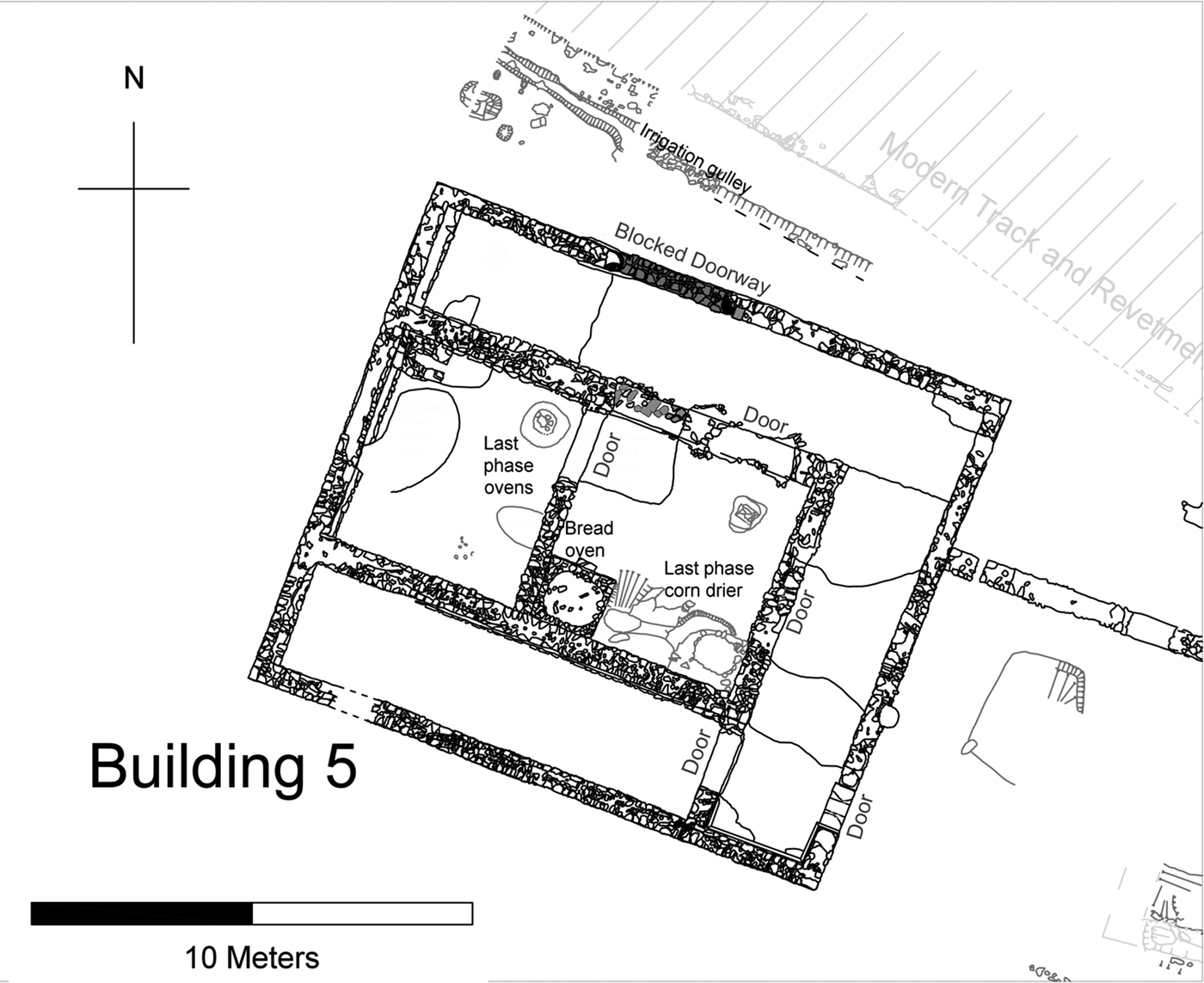
Building 5, oriented roughly east–west, measures c. 13 by 11.5 m and comprises two rooms surrounded on three sides by a c. 2.5 m-wide corridor (fig. 26).Footnote 141 It was probably built in c. a.d. 250. The walls of the two rooms are thicker than the outer corridor wall, suggesting that the central section may have risen above the corridor. These two rooms contained several ovens, querns and a furnace, leading archaeologists to suggest that the building ‘ended its life as a kitchen’.Footnote 142 The earlier function of the building remains unclear, though it is possible that it may originally have been a ‘Romano-Celtic’ temple. The rolled-up lead tablet, found in 2009 in the collapsed stone of the western wall, may support this interpretation. It was inscribed in capitals with a list of Celtic and Latin names. The medium, the fact that it had been rolled and the deliberate inversion and reversal of letters suggest it was a ‘curse tablet’. Another significant find from Building 5 was a hoard of 154 coins; those that could be identified were local copies of coins from the House of Constantine.
Plan of Building 5, East Farleigh. (Drawn by Albert Daniels and Stephen Clifton)

The inscribed pot base, semi-circular and measuring c. 136 by 41 mm in its largest dimensions, comes from the same structure. Associated finds included two bracelets, hairpins, a late Roman strap-end and three coins, all dating to the end of the first half of the fourth century.Footnote 143 Analysis of the strokes in the ceramic indicates that the pot base had been inscribed before firing. The fabric and form suggest that the vessel was probably produced in north Kent, in a medium sandy reduced fabric additionally tempered with occasional dark grains and larger fragments, a fabric consistent with Thameside/Upchurch grey ware.Footnote 144 It is similar to the black burnished ware flat-based dishes or bowls dating from the second quarter of the second to late third century a.d.Footnote 145
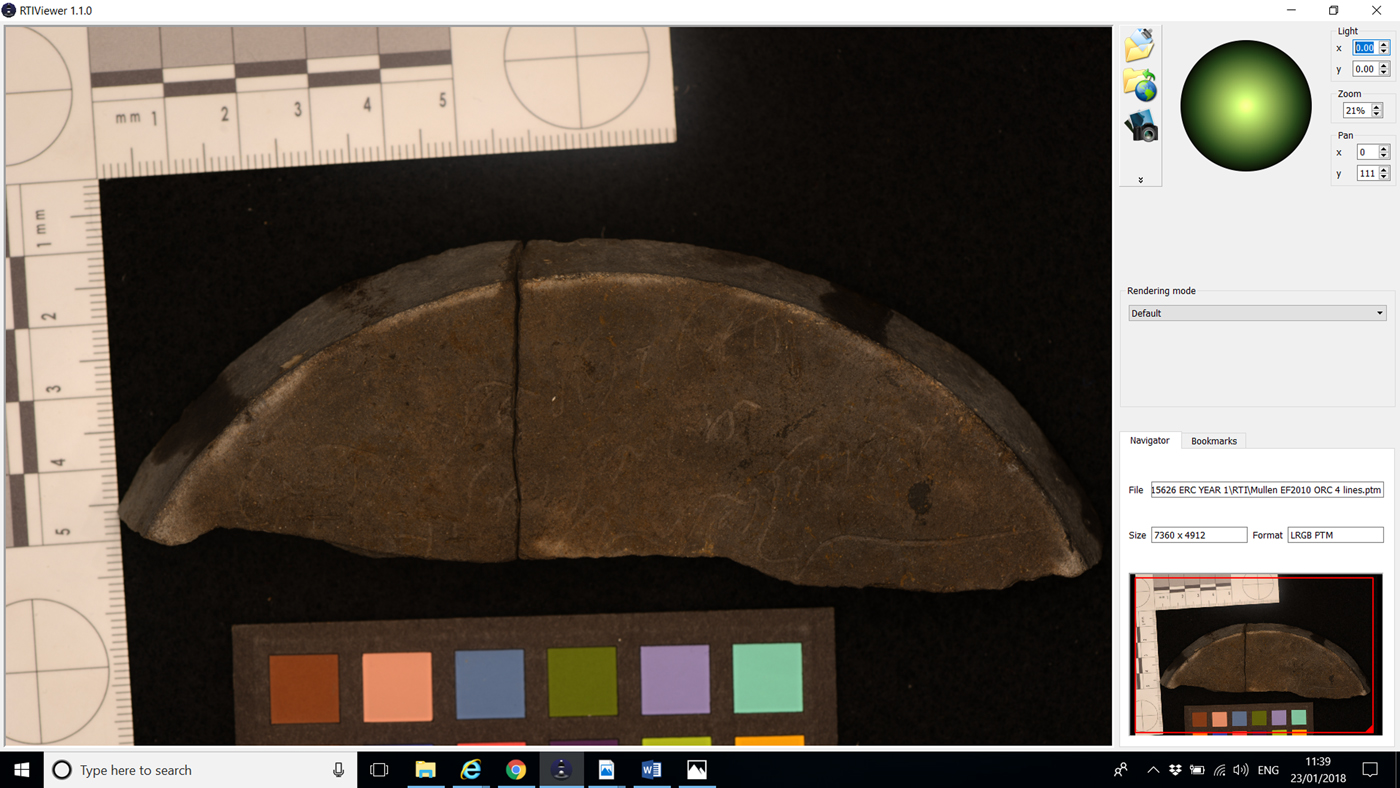
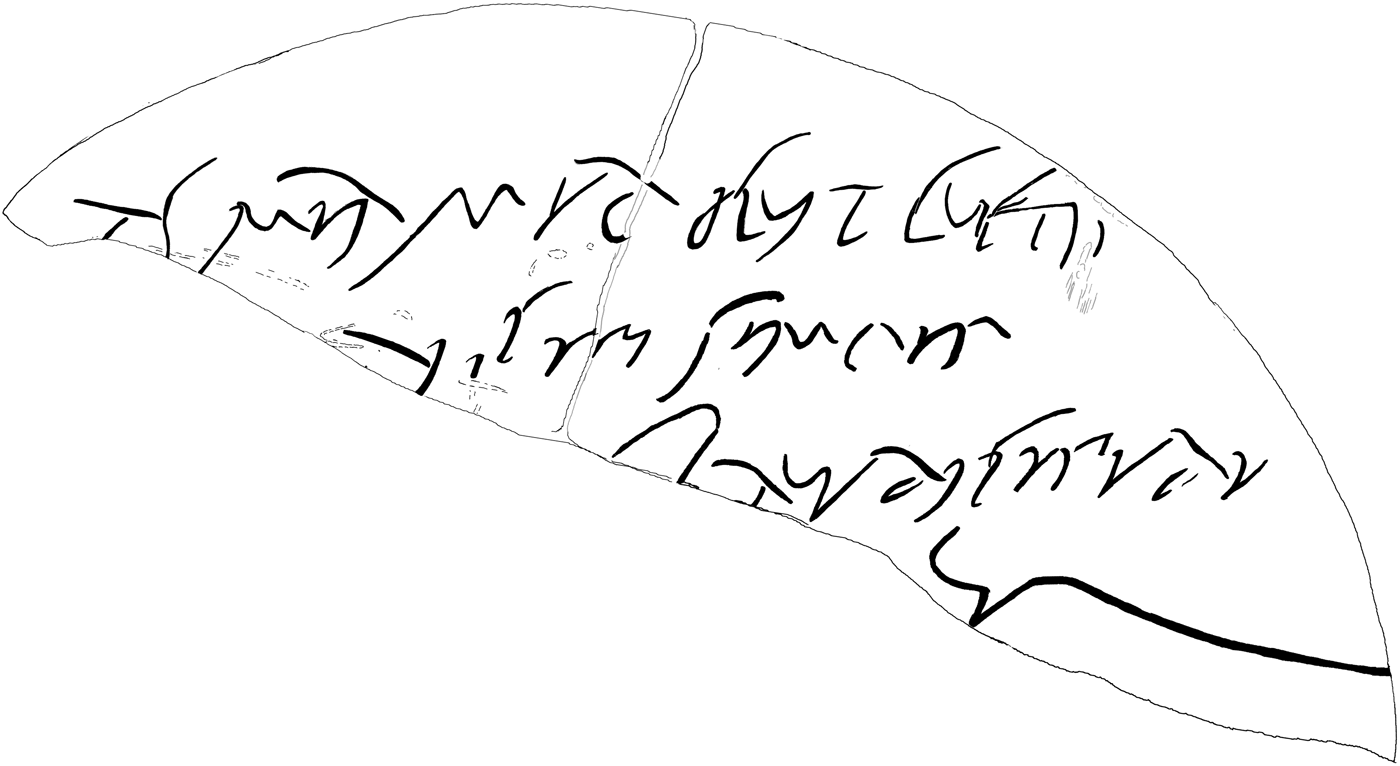
The inscribed text is difficult to read since the incisions are not deep and form relatively small letters which can be easily confused with the patina and accidental scratches. The reading process was facilitated through the use of the ‘Superdome’ Reflectance Transformation Imaging machine at the Centre for the Study of Ancient Documents at the Ioannou Centre in Oxford in 2017. The resultant files allow manipulation of light effects on the object and magnification, which enhances the ability to distinguish marks (fig. 27). fig. 28 is a drawing of the text as we perceive it. Our edition of the text, tentative translation, line-by-line commentary and interpretation follow.
My training has taught me always to speak [?politely] to everyone; … to say ‘greetings’ …
The text is written in Old Roman Cursive (ORC). It is unclear exactly how much of the original remains, but, if the first two lines form a dactylic hexameter only three or four letters may be missing at the start of the second line. The nature of the break of the object, which runs diagonally from the beginning of the first line to much further into the fourth line, suggests that several letters may be missing from the third and fourth lines. The flourish at the end of line 4 may suggest that the text ended here, but we cannot be sure.
Screenshot of the RTI scan of the object, showing default settings.

Drawing of the authors’ interpretation of the writing.

Line 1
The first line of the text begins with two uncertain letters which we have transcribed as as. The middle of the line we relatively confidently read as mea me docuit ‘my … has taught me’. The end of the line may read cunctis. After the u, the writer may have felt space was short, so wrote n and then c almost on top of it. We have to assume that at the end of the line the final s, against the edge, either has lost, or never had, its upper stroke. The reading cunctis is supported by the graffito on the Binchester tile, which offers several textual commonalities (RIB II.5 2491.146) (see below). cunctis is found extensively in Latin literature (TLL s.v. cunctus), and commonly in verse authors, including the elegists. It seems likely that this would probably not have been a common word in vernacular British Latin, indeed Adams suggests that the term was not ‘in everyday educated use during the early Empire’ and may ‘even have been without real currency in ordinary speech from an earlier period onwards’.Footnote 146 The appearance of cunctis would therefore support the poetic interpretation of the piece.
Line 2
If we have the first three and a half feet of a hexameter line in line 1, then in the missing section at the beginning of line 2 we expect the second half of a fourth foot, either a long or two shorts, perhaps bene. The fifth foot probably contains dicere, whose opening letter and final two letters are read with some caution. The i of dicere is comparatively small. The first letter, whose bold diagonal belongs to either a d or an a does not have the loop in the right position to complete the d. The line we see nearly joined to it on the right may be an intrusion from the line below (part of the third line which is missing), perhaps an h or an l, but this interpretation is uncertain as it would mean an unexpectedly elevated or tall letter in the third line. The sixth foot reads semper. The space left at the end of the second line may support the view that the text is metrical and that the author chose to start the next portion of text after the hexameter on the following line.
Line 3
Line 3 may contain part of a pentameter, if the text is written in elegiac verse. But this interpretation poses some problems. A long de would be impossible at the end of the line, so perhaps this takes us only to the third foot, though this seems unlikely given the layout of the text (the line would have begun half way across the base) and the awkwardness of the separation of preposition and complement. dicere provides a dactyl, and the preceding aue possibly part of one, but cl is our best guess at interpreting the preceding extant couple of letters, which then throws some doubt on aue, since no Latin words end in cl. Alternatively we may have part of a hexameter line here which runs on into line 4, or even a section in prose. The fragmentary state of the evidence does not allow any certainty.
Line 4
Line 4 seems to ends with a bold -us and a flourish of the writing implement. It may well be the signature of the author, if we consider it to be the masculine termination of a personal name. Anything else preceding it, for example the continuation of a possible pentameter from line 3, has been lost.
The text may be metrical, or partly metrical, but cannot be fully understood given its fragmentary state. Its apparently poetic nature is of interest for Romano-British studies, given the relative lack of verse material from the province. The interest is heightened when the comparison with the Binchester material is made. Roman Binchester (Vinovia) has provided us with several graffiti on ceramic, including two with metrical fragments:
1. RIB II.5 2491.146 (i); Schumacher Reference Schumacher2012, 185–91 no. 18 (b); Kruschwitz Reference Kruschwitz2015, 36–7, 66. Part of a tegula in two conjoining pieces,Footnote 147 170 x 180 x 35 mm, found on the site of the praetorium in 1977 and 1978 in the backfill of the excavations of 1878–9. Currently in the Bowes Museum, Barnard Castle (inv. no. 1977.121). Inscribed in capitals ante cocturam.
The text was originally thought to be missing the first syllable of the second line (by haplography with te in the first). Schumacher's re-examination stated that the letters were ligatured such that t, i and b were tightly combined into a monogram.Footnote 148 However, though <ti > probably should be restored at this point, the authors cannot follow Schumacher's identification of the monogram, at least not based on the photograph supplied in Schumacher's text. It would be a very unusual palaeographic form for this script, perhaps unparalleled in Britain. armea has baffled commentators, who have been reluctant to opt for an otherwise unknown woman's name. It is possible that it could be Germanic in origin.Footnote 149 It is perhaps most likely, however, to be a form of ar(s) mea (see below), perhaps featuring an error in a written source circulating at Binchester which has been copied out by the Roman writer.
2. RIB II.5 2491.146 (ii) Schumacher Reference Schumacher2012, 185–91 no. 18 (a); Kruschwitz Reference Kruschwitz2015, 36–7, 66. Part of a brick, 292 x 241 x 38 mm, found on the site of the praetorium. Currently in the Museum of Archaeology, Durham. Inscribed in capitals ante cocturam.
This text offers only the first part of the hexameter in No. 1 and in larger letters. It is uncertain whether the authors of the two texts are the same, not least because the modern drawings of each have been made by different draftsmen. The impression formed by commentators is that the texts have not been produced by the same hand, since the larger letters of the shorter text seem more self-consciously stylish, incorporating multiple serifs, and the two hands employ quite different forms of letters, e.g. the letter A. If we are correct about the interpretation of armea as a mistake for ar(s) mea, then the author of this text may be following the same source text as the author of No. 1.
The similarities between the metrical Binchester text: armea me docuit recte <ti > bi dicere cunctis and the new text from Kent: []ạṣ mea me docuit cuṇc̣tiṣ … ḍiceṛẹ semper are striking. We find essentially the same opening and the collocation of dicere and cunctis in each. One possibility to consider is that perhaps the opening letters should be taken as the same in each, i.e. that there are no missing letters at the beginning of the Kent offering, and that we should perhaps here too read armea. In this case perhaps the same previously unknown woman's name may derive from an unknown common exemplar. However, if we stick to the palaeographically preferable reading for Kent, as mea, another interpretation gains traction. It might be possible to argue that both as mea and ar mea can be restored as ars mea. In that case we would have a non-standard linguistic form at East Farleigh (the cluster rs is sometimes reduced to s in Latin)Footnote 150 and perhaps a slip of a pen at Binchester (possibly in a source text). Although asserting two different mistakes for ars mea is not completely satisfactory, it appears to be the best solution available for the interpretation of these attestations. ars has a range of meaning in Latin but in this context ‘training’ works well: what exactly this training might be, whether rhetorical, scribal, amatory or something else entirely, is unstated.
It is possible that the production of all three pieces is the result of knowledge of the same or similar poetic output which may have been circulating in Britain at some point between the first and third centuries a.d.Footnote 151 The date of the Binchester texts is hard to pin down given the unstratified context from which they came, but they may date to either the late first or the third century a.d. given the periods of occupation of the fort.Footnote 152 The text from Kent may (though need not) date to after a.d. 250, when the building in which it was found was constructed, though no later than the third century, given the form of cursive Latin employed (ORC). Our texts may have no direct relationship with, but possibly evoke, Propertian verse, perhaps through an intermediary author whose work is no longer extant.
The link to these Propertian lines has been made consistently by commentators on the Binchester tiles, and it is clear that the Propertian formula of Amor (or a woman through love) who has taught (docuit) the author (me) to do something was taken up in epigraphic compositions, most famously in the graffiti from Pompeii.Footnote 153
One of the texts from Pompeii, found twice, once with an authorial tag, combines both Propertian and Ovidian verse (Amores 3.11b.35), not in an act of direct repetition, but of creativity:Footnote 154
It is possible that we have something similar in our texts from Britain, a British(?) author inspired by Propertius and, perhaps, Ovid, if ars mea is correct,Footnote 155 which is then taken up and copied out and/or creatively adapted in Binchester and Kent.
Another common influence we might consider adding to the literary mix would be Martial's epigrams, and, in particular, 14.73 where a parrot has taught himself to say ‘Caesar haue’.
In this little two-line elegiac metrical offering we do not have the exact me docuit phrase, but we are in a context of learning and find that the verb dicere is common to both the epigram and the British texts and, more strikingly, the phrase dicere … (h)aue is in Martial's text and perhaps, with different word order, in Kent. Recently Cosh has suggested that the famous inscription on the Lullingstone villa mosaic,Footnote 156 also from Kent, may involve a parody of one of Martial's apophoreta (14.180), adding ‘a third, and perhaps more important, influence’Footnote 157 to the standard Vergilian and Ovidian citations.Footnote 158 Martial's apophoreta are ‘take-away presents’, couplets supposedly attached to Saturnalia gifts named in the heading, for example a parrot in 14.73 and Europa picta in 14.180. It is not impossible that our bowl with its inscription was commissioned as a gift for the Saturnalia celebrations, which were widespread and long-lasting across the Empire.
The precise relationship of these British texts to extant Latin verse or to it via a no-longer extant common literary source is probably irrecoverable in the current state of evidence. The copying out, twice, of parts of the same text at Binchester might imply some kind of writing exercise, akin to the Vergilian examples we have from military contexts all over the Empire,Footnote 159 including Britain, though the East Farleigh example might simply indicate that this text was appreciated and well disseminated. There is nothing about the text that lends itself particularly to a writing exercise and the context of the Kentish find, an apparently experienced hand on the base of a vessel produced in north Kent and found on a rural site, perhaps a Romano-Celtic temple, does not obviously suggest an educational context. The precise function of the text from Kent, and the details of the British literary environment, remain elusive.
ACKNOWLEDGEMENTS
This output received funding from the European Research Council (ERC) under the European Union's Horizon 2020 research and innovation programme under grant agreement No. 715626. The authors are grateful to Albert Daniels for permission to publish this graffito; to Elizabeth Blanning for her advice on the site; to the team at the Centre for the Study of Ancient Documents, Oxford; to Edward Biddulph (Oxford Archaeology) for his analysis of the pottery; to Jim Adams for philological insights; and to the anonymous reviewer.