A well-functioning representative democracy relies on citizens’ capacity to process, evaluate, and react to the information that political parties generate through their behavior. It enables voters to hold incumbents accountable and identify where parties stand on policy issues (Adams Reference Adams2012). In parliamentary democracies, membership in a coalition government constitutes a potential source of information about a party’s ideology. Indeed, parties tend to choose coalition partners with similar ideologies and therefore the decision to join a coalition constitutes a cue into the party’s policy position (Martin and Stevenson Reference Martin and Randolph2001; Glasgow et al. Reference Glasgow, Golder and Golder2012).
This paper analyzes whether a party’s decision to enter a coalition changes voters’ perceptions of where the party stands on issues. It builds on previous work by Fortunato and Stevenson (Reference Fortunato and Stevenson2013) who show that coalition partners tend to be perceived to be close on a left–right dimension. It is also motivated by more recent research that has expanded the analysis to other policy issues (Adams et al. Reference Adams, Ezrow and Wleizen2016) and has examined the relative impact of coalition membership for junior and senior coalition partners (Fortunato and Adams Reference Fortunato and Adams2015).
We argue that entering a coalition does not always change voter perceptions of the party’s policy position. We identify a key condition that needs to be met for voter attitudes to shift: the party’s decision must be at odds with voters’ priors about the party. Specifically, the party must choose to form a coalition that is not the one that voters perceived to be the ideologically closest option. Otherwise, if the party chooses the coalition that voters already identified as the most ideologically congruent choice, the party’s action confirms voters’ beliefs and voter opinions do not change.
We follow three complementary strategies to test this empirical prediction. We first analyze the effect of joining a coalition using party-level data on the left–right reputation of political parties in five coalition-prone Western European countries. We also leverage individual panel data from Norway to show how the effect of joining a coalition cabinet depends on each voter’s prior opinion. Finally, we take advantage of the random ordering in which survey respondents are contacted to compare the issue placement given to the British and German liberals right before and right after joining a government coalition. All three types of empirical evidence support our argument: a coalition member’s perceived position only changes when the party joins a coalition different from the one that voters considered to the ideologically closest option among all viable alternatives. Otherwise, voter perceptions remain unchanged.
Our paper makes a novel contribution to the literature on the impact of coalition membership on voters’ attitudes (Bargsted and Kedar Reference Bargsted and Kedar2009; Duch et al. Reference Duch, May and Armstrong2010; Fortunato and Stevenson Reference Fortunato and Stevenson2013; Fortunato and Adams Reference Fortunato and Adams2015; Adams et al. Reference Adams, Ezrow and Wleizen2016; Spoon and Kluver Reference Spoon and Klüver2016). We advance this line of research by proposing an explicit theoretical mechanism to explain why coalition formation can modify voter opinions about parties in the cabinet that highlights the importance of the alternatives they had (Indridason Reference Indridason2011). Such mechanism generates heterogeneous expectations that are borne out by the data. The scope of our argument, moreover, is broad since it can be applied beyond coalition formation processes. Empirically, we examine our hypothesis using several different types of data, including an explicit causal identification strategy by taking advantage of a quasi-experimental test.
Our paper has important implications for democratic theory and party politics. We show that an elite-driven process like that of forming a new government has consequences for mass politics. Voters observe the new cabinet and update their opinion of where parties stand accordingly, either confirming or adjusting their previous perceptions. Hence, even if multi-party governments tend to reduce the clarity of responsibility (Powell and Whitten Reference Powell and Whitten1993), we show that coalition partners are, at least, held accountable for their decision to join the executive. This is good news for democratic politics, as it suggests that citizen attitudes toward parties are responsive to a core dimension of party behavior like the decision to form a government. Political parties, moreover, must incorporate the consequences for voter perceptions in their calculus to join a cabinet or not, since entering a government may affect the party’s ideological image. Parties therefore face a trade-off: in cases where participation in a coalition may damage a party’s policy reputation, seeking office now can undermine the pursuit of votes in the future (Müuller and Strøm Reference Müller and Strøm1999; Fortunato Reference Fortunato2017; Sagarzazu and Klüver Reference Sagarzazu and Klüver2017).
Argument
There is a renewed interest among political scientists in the question of how voters form and update their beliefs about where parties stand on policy issues (Adams et al. Reference Adams, Ezrow and Somer-Topcu2011; Adams Reference Adams2012; Fernandez-Vazquez Reference Fortunato2014). Dalton and McAllister (Reference Dalton and McAllister2015) show that, even though parties’ left–right reputations tend to be rather stable, changes in citizens’ perceptions of party positions are more common in fragmented systems. In parliamentary democracies, the choice of coalition partners is a potential source of information about a party’s policy position. Joining a coalition government is an observable decision with tangible consequences for policy outcomes (e.g. Bräuninger Reference Bräuninger2005; Cusack Reference Cusack1997; Iversen and Soskice Reference Iversen and Soskice2006; Klingemann et al. Reference Lachat1994). In addition, there is consistent evidence that parties prefer coalition partners that have similar ideological positions (Martin and Stevenson Reference Martin and Randolph2001; Glasgow et al. Reference Glasgow and Golder2012). Hence, the choice of coalition partners constitutes an informative signal of where the party stands ideologically. Recent work has provided evidence that joining a multi-party cabinet can have consequences for voter perceptions about the party. Fortunato and Stevenson (Reference Fortunato and Stevenson2013) show that coalition partners tend to be perceived to be ideologically close. Adams et al. (Reference Adams, Ezrow and Wleizen2016) extend this finding to the issue of European integration and Fortunato and Adams (Reference Fortunato and Adams2015) show that coalition agreements matter more for the perceived placement of junior partners than for the Prime Minister’s party. The effect of coalition behavior on perceived party placements has also been recently documented for signals indicating preferred would-be partners in case a coalition forms after elections (Falcó-Gimeno and Muñoz Reference Falcó-Gimeno and Muñoz2017). We take these findings as the starting point to make a general argument about the effect of coalition formation on voter opinions of where parties stand.
Despite the remarkable degree of stability in the formation of coalitions following elections, we find many instances in which parties change coalition partners from one term to the next (Armstrong and Duch Reference Armstrong and Duch2010).Footnote 1 Moreover, while voters tend to have a solid knowledge of the composition of their current government, they find it hard to recall the coalition choices parties made in the past (Fortunato and Stevenson Reference Fortunato and Stevenson2013; Fortunato et al. Reference Fortunato and Stevenson2014). Therefore, there is a clear potential for current coalition behavior to affect voters’ view of parties’ positions.
We argue, though, that entering a coalition does not always change voter opinions about the party: even if the decision provides information about the party, such information may not change voter perceptions. This paper identifies the condition under which joining a coalition cabinet changes voters’ perceptions about where the party stands. If the party’s decision is consistent with voters’ opinions about the party, the choice will reinforce voters’ priors and thus will not alter voter beliefs. Voters only change their perceptions when the choice of coalition partners is at odds with their initial opinions about the party. In that case, voters’ beliefs adjust in line with the party’s decision.Footnote 2
The following example illustrates the logic of our argument. Take a party that has the option of entering either a coalition L or a coalition R. The party decides to join the L cabinet. This signals that the party is ideologically closer to L than to R.Footnote 3 Voter perceptions, however, only change if voters initially believed that the party was closer to R than to L. Otherwise the revealed preference for L only reinforces prior beliefs and does not change opinions. Hence, the empirical prediction that we test is the following:
Hypothesis: A party’s decision to join a coalition government is more likely to change voter perceptions of where the party stands on policy issues if voters believed that there was an ideologically closer alternative coalition that the party could have chosen instead.
To test this prediction, we combine three complementary empirical strategies. We first take a broad cross-country across time approach to analyze the impact of joining a coalition government in five European parliamentary democracies between 1979 and 2011. Our second strategy exploits differences in perceptions across voters. Using panel data from Norway, we compare the effect of joining a coalition between voters who thought that the coalition was the most ideologically congruent choice and those who did not. Finally, we take advantage of the random ordering in which survey participants are contacted to evaluate whether there are differences in opinions among respondents interviewed immediately before and immediately after the coalition forms.
A cross-country test of the argument: The case of five West European countries from 1979 to 2011
This section presents a cross-country empirical test of our argument. While the argument about the effect of coalition membership on voter perceptions applies to any policy dimension, this cross-country test focuses on parties’ left–right reputations for reasons of theoretical relevance and data availability. The left–right dimension provides a good summary of European party positions on economic and social issues (Benoit and Laver Reference Benoit and Laver2012) and it is a relevant predictor of voting decisions (Van der Eijk et al. Reference Wlezien2005; Lachat Reference Lachat2008). From a pragmatic point of view, survey data on parties’ left–right positions are available for several European countries over a long period of time. Indeed, among all European countries that have frequent coalition governments, we center our attention on those with a long-standing tradition of including left–right placement items in their election study questionnaires: Norway, Sweden, Denmark, Germany, and the Netherlands.Footnote 4
The outcomes of interest are voter perceptions of party positions following the formation of a new cabinet. We operationalize voter perceptions of a party’s left–right position as the average left–right placement given to that political party among the whole sample of respondents. The two main data sources we use are the European Voter Database (EVD), a collection of European national election studies, and the Comparative Study of Electoral Systems (CSES).Footnote 5 We draw the survey data from post-election waves to maximize the probability that, by the time the survey is fielded, it is already clear which government has formed or is likely to form.Footnote 6 The countries and years included in our dataset are listed in Table 1.
Countries Included in the Analyses and Years in Which Post-election Surveys Where Conducted

For each party-year pair, we compute the variable Position t+1, which denotes the average left–right placement given to the party in the post-election survey. Position t, in turn, reflects the average placement in the previous post-election survey. To give an example, for German parties in 2009, Position t+1 refers to the average party placement in the 2009 post-election survey, while Position t captures the placement in the 2005 post-election wave. Both variables range from 0 to 10, where 0 indicates a far left position and 10 a far right one.
We test our hypotheses using the change in a party’s average left–right placement as our dependent variable: The variable Update takes the difference between the latest post-election placement (Position t+1) and the placement in the previous post-election survey (Position t).Footnote 8 This variable returns how far to the right (positive values) or to the left (negative values) the average voter perception of the party has changed. It ranges from −10 (leftmost shift) to 10 (rightmost shift). Membership in the government that forms after the election is indicated by the dummy variable Party Status, which equals 1 if it enters the government and 0 otherwise.
In order to test the argument in the paper, we define a dichotomous variable, Alternative, which takes the value of 1 if the party does not join the coalition that voters considered to be the ideologically closest option. To elaborate this dummy variable, we first identify the set of viable cabinets that can form after each election. Taking all the potential governments, we estimate a model of government formation following glasgow (Glasgow and Golder Reference Glasgow and Golder2015).Footnote 9 For each formation opportunity, we rank each potential government according to the predicted probability of formation and define the set of viable cabinets as the decile of potential governments with the highest probability of forming.Footnote 10 For instance, in the government formation opportunity of Sweden 1994, a total of 127 governments were hypothetically possible. After estimating the formation model, we categorized as viable the 13 governments with the highest formation probability.Footnote 11
Second, we calculate the perceived left–right position of every viable coalition by using Gamson’s law (Gamson Reference Gamson1961). Applied to policy formation, Gamson’s law entails that the policy position of a government can be equated to the seat-weighted average of the policy positions of the members of the coalition.Footnote 12 As a robustness check, we replicate our analysis estimating a coalition’s overall left–right position as the unweighted average of all coalition partners’ positions. This alternative operationalization does not affect the empirical findings.Footnote 13 These estimates of the perceived position of each possible coalition allow us to define the viable coalition that voters consider to be the ideologically closest option. If the party joins such coalition, the variable Alternative takes the value of 0. If the party chooses a coalition different from the one voters considered as the ideologically logical choice, Alternative equals 1.
Finally, since the effect of joining the government depends on the ideological leaning of the cabinet that forms, we specify the variable Distance RG, defined as the perceived ideological distance between the party and the government that forms, measured before the election.Footnote 14 Positive values of Distance RG indicate that the government is perceived to be more right-leaning than the party, while negative values imply otherwise.
With these data, we estimate the following empirical model:
 $$\eqalignno{ \widehat{{Update}}{\equals} & \beta _{1} {\plus}\beta _{2} Distance_{{{\rm RG}}} {\plus}\beta _{3} PartyStatus{\plus}\beta _{4} Alternative \cr &\quad {\plus}\beta _{5} PartyStatus \; {\asterisk} \; Alternative \cr &\quad {\plus}\beta _{6} Distance_{{{\rm RG}}} \; {\asterisk} \; PartyStatus \cr &\quad {\plus}\beta _{7} Distance_{{{\rm RG}}} \; {\asterisk} \; Alternative \cr &\quad {\plus}\beta _{8} Distance_{{{\rm RG}}} \; {\asterisk}\; PartyStatus \; {\asterisk} \; Alternative $$
The variable Party Status captures the effect of entering the government on the party’s left–right reputation. It is interacted with Distance RG since the information provided by the decision to join the cabinet depends on the government’s overall left–right position. To test the theoretical argument, we also interact PartyStatus with Alternative. This allows to compare the impact of government participation between the scenario where the argument predicts a change in voter perceptions (Alternative=1) and the one where it predicts stability (Alternative=0).To facilitate the interpretation of the results of a regression equation with a triple interaction, we present marginal effects at different values of our key moderating variable as well as predicted changes in the dependent variable (Brambor et al. Reference Brambor, Willam and Golder2006).Footnote 15
Table 2 presents a first test of the argument. It displays the effect of joining a cabinet that is located one standard deviation to the right of the party in two scenarios: (1) when the party confirms voters priors by joining the coalition that voters considered to be the ideologically closest option (Alternative=0) and (2) when the party chooses a cabinet that is not the one that voters considered to be the most ideologically congruent choice (Alternative=1). The cell entries in the “Marginal Effect” column report the estimated shift in the perceived left–right position of the party. Positive values indicate that voters shift their placement of the party to the right. Negative values, on the other hand, imply that voters place the party closer to the left.
Marginal Effect of Entering a Government Depending on Whether the Party Joins the Option that Voters Consider to be the Ideologically Closest Alternative. Scenario: The Government Is One Standard Deviation to the Right of the Focal Party

Marginal effects and standard errors in their respective columns. Marginal effect computed for a value of Distance RG equal to one standard deviation to the right in the distribution of that variable, i.e. 2.85 units on the 0–10 left–right scale. *p<0.05.
These estimates show that, when the party confirms voters priors by choosing the coalition that is considered to be the ideologically closest (Alternative=0), entering that coalition has no discernible effect on perceptions of parties’ left–right positions. Even if the coalition is one standard deviation away in ideological distance, i.e. 2.85 units to the right on a 0–10 scale, voter perceptions barely change. In contrast, when the party does not select the coalition that voters considered to be the most ideologically congruent option (Alternative=1), voter opinions about the party change significantly: The party’s average placement shifts 0.4 units towards the position of the coalition that it has joined. In addition, we can reject the null hypothesis of no change. Joining a coalition that is 1 point away in a 0–10 scale, thus, barely moves the perception of the party if this was the most ideologically proximate but it does significantly shift its left–right placement if it was not the most proximate choice: there is around a 15 percent reduction in the perceived distance between the party and its coalition partners under these circumstances. This is a substantively large change when compared to the generally strong stability in European parties’ left–right images (Dalton and McAllister Reference Dalton and McAllister2015)Footnote 16 and more than triples the effect of changes in parties’ declared left–right placements in their manifestos on voters’ perceptions of the parties’ positions (Adams et al. Reference Adams, Ezrow and Somer-Topcu2011).
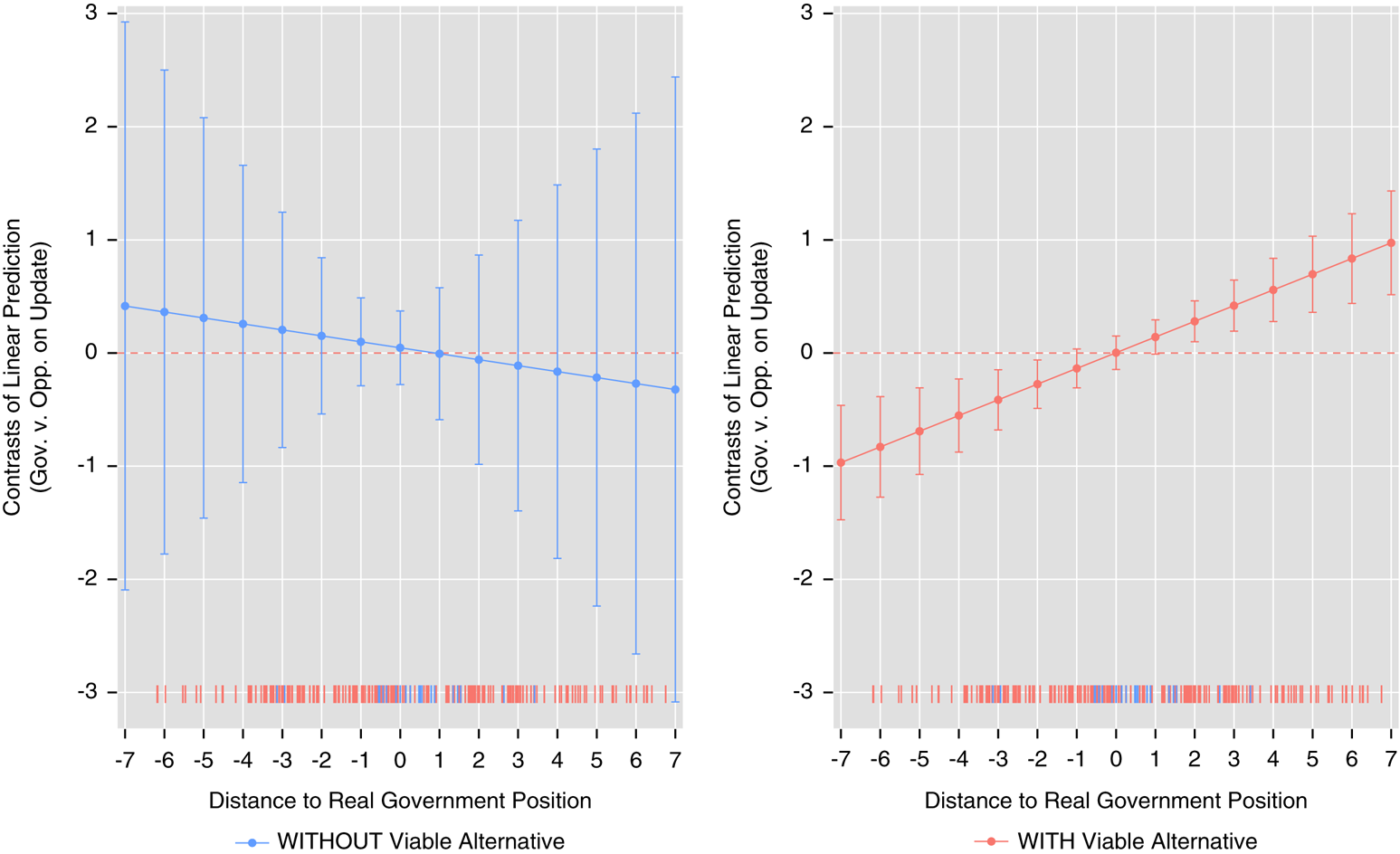
Figure 1 provides a full comparison of the effect of entering a cabinet in each scenario. It reports the predicted shift in the party’s left–right image as a function of the distance between the party and the government that forms (Distance RG). Positive values on the horizontal axis indicate that the government has a more right-wing reputation than the party and vice versa. On the vertical dimension, positive values indicate that the party’s perceived position shifts to the right. The left-hand plot refers to a context where the party confirms voters priors by joining the coalition that voters perceived to be the most ideologically congruent choice among the viable alternatives. The plot on the right, in turn, reflects the change in perceptions when the party does not choose the coalition that voters perceived to be the most ideologically congruent option.
Predicted change in a party’s left–right reputation after joining the government. 95% confidence intervals.
Note: The left plot displays the predicted shift in the average left–right placement for a party that confirms voters’ priors by choosing the coalition that was perceived to be ideologically closest among the viable alternatives. The right plot refers to a party whose choice is at odds with voters priors. The horizontal axes indicate the left–right distance between the coalition that forms and the focal party.

The predicted shifts show that the decision to join a coalition does not always change voter perceptions about the party. If the party chooses the coalition that voters perceive to be the most congruent option (left plot), the effect of joining the cabinet is minimal, in the opposite direction, and we cannot reject the null hypothesis of no effect at all. In contrast, when the party’s decision is at odds with voters priors (right plot), entering the government reshapes voters’ perceptions: forming a coalition that is more right-wing than the party makes voters shift their opinion about the party to the right, and vice versa. While the predicted shifts are not statistically different across the two scenarios, the empirical results still offer the following conclusion: Joining a cabinet that is not the one voters considered to be the ideologically closest option changes voter opinions about the party. On the other hand, if the party’s decision confirms voters’ priors, government participation does not have consequences for the party’s reputation.
The same empirical pattern emerges in several robustness tests. First, we have analyzed whether results change if we adopt a different definition of what constitutes a viable potential government. We show that defining viable alternatives as the set of all minimal winning coalitions does not alter results. Second, we have checked whether the empirical pattern holds if we do away with Gamson’s Law when computing the overall ideological position of a coalition. Using the unweighted arithmetic mean so that all coalition partners contribute equally to the overall coalition position does not change results. This finding suggests that the empirical pattern reported above is not driven by larger parties contributing more to the estimated position of coalition governments. In addition, we use a simulation-extrapolation approach (Lederer and Küchenhoff Reference Lederer and Küchenhoff2006; Benoit et al. Reference Benoit, Laver and Mikhaylov2009) to confirm that our findings are not an artifact of measurement error. Finally, we have tested the hypothesis using a regression model in levels instead of in first differences. In this model, the outcome variable is defined as the party’s average left–right placement after the election instead of the change in placement. The same empirical pattern emerges using this alternative model specification. The evidence from these robustness checks is reported in the Supporting Information.
Individual panel data evidence: the case of the Center Party in Norway 2005
The previous empirical analysis offers party-level evidence on how joining a coalition changes the party’s left–right reputation. The same aggregate trend, however, is consistent with multiple patterns of individual-level changes. Our argument predicts a different response to a party’s decision to enter the government depending on each voter’s prior beliefs about the party. In other words, the same party decision can have different consequences for two voters with diverging initial opinions about the party. For a voter who already thinks that the cabinet joined is the ideologically closest option that the party had, the party’s decision corroborates the voter’s perception of where the party stands. Hence, this voter has no reason to change her opinion about the party. In contrast, for a voter who thought that there was an ideologically closer alternative to the cabinet chosen, the party’s decision is inconsistent with her prior belief and therefore drives her to adjust her opinion about where the party stands.
In this section, we use individual-level panel data to exploit variation in voters’ prior opinions and offer further evidence in support of the argument. We focus on the government formation process in Norway in 2005 for two main reasons. First, following the 2005 election, the Norwegian Center Party (Senterparteit) had the choice between two viable potential coalitions.Footnote 17 It could form a left-leaning coalition with the Norwegian Labor Party (DNA)Footnote 18 and the Socialist Left Party (SV).Footnote 19 Alternatively, the Center Party could join a right-leaning cabinet with the Conservative Party (H), the Christian Democratic Party (KrF), and the Liberal Party (V)—plus the participation or implicit aquiescence of the Progress Party (FrP).Footnote 20 Second, while some voters perceived that the Center Party was closer to the right-leaning coalition, others considered that the left-leaning cabinet was the most ideologically consistent option. Hence, whatever the Center Party’s final decision, it confirmed some voters’ priors and spurred others to adjust their beliefs. The Center Party eventually decided in favor of the left-leaning cabinet. This choice was not a matter of political survival but the expression of an ideological preference: The party “concluded that its goals were more attainable with new allies on the left” (Allern and Aylott Reference Allern and Aylott2009, 273). Hence, this case is a good candidate to test whether or not the choice of coalition partners (left or right-leaning) affects voters perceptions of where the party stands on the left–right scale. According to our argument, the Center Party’s choice will change the perceptions of voters who had thought that the party was closer to the conservative coalition. On the other hand, it predicts no opinion change among citizens who already thought that the Center Party was closer to the left-leaning parties.
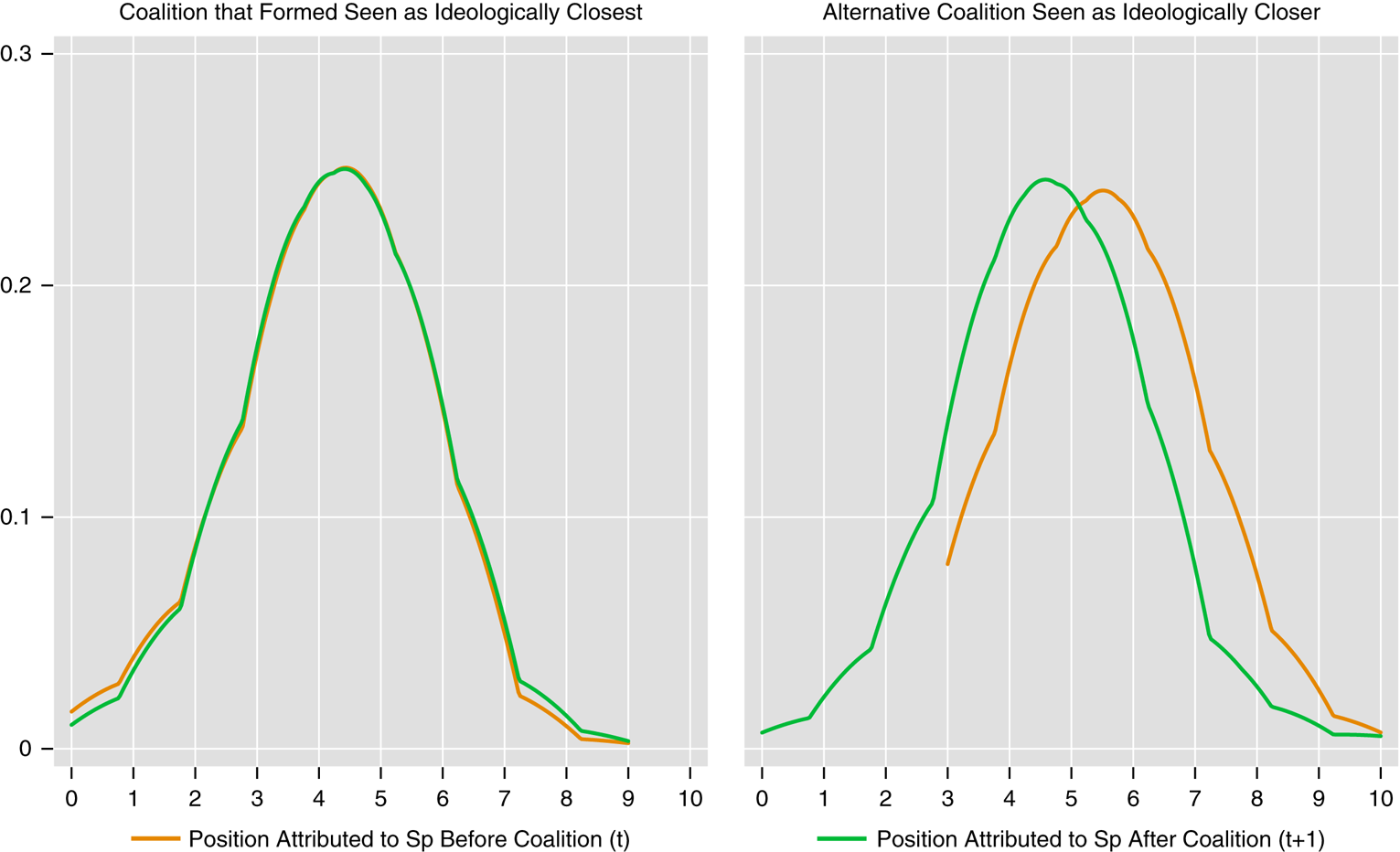
To test this empirical implication, we employ a panel survey from the Norwegian Election Study (2001–2005). This study consists of a pre-election wave in 2001 and a post-election one in 2005.Footnote 21 From 2001 to 2005 (before and after the formation of the left-leaning coalition), the average left–right position attributed to the Center Party moved slightly to the left, from 4.44 to 4.34. Using panel data allows us to identify which voters in particular changed their perceptions. Figure 2 shows the distribution of the position attributed to the Center Party (Sp) in 2001 (t) and after the 2005 elections (t+1) for two groups of respondents. The panel on the left refers to citizens who considered in 2001 that the Center Party was ideologically closer to a left-leaning coalition.Footnote 22 Hence, for this group the Sp’s choice of partnering with the Labor and Socialist parties was consistent with their prior opinions about the party. The second group (right panel) is composed of respondents who thought that the Sp was closer to the center–right coalition. Our argument implies that only voters in this second group will shift their perception of the Sp toward the position of the coalition that formed. This is precisely what we see in Figure 2: while the pre- and post-coalition distributions on the left-hand panel overlap almost perfectly, the post-coalition (t+1) density in the right-hand side panel has clearly shifted to the left of the initial t curve.Footnote 23
Distribution of left–right placements attributed to the Norwegian Center Party (Sp) before (t) and after (t+1) forming a left-leaning coalition. The left panel portrays the opinions of those who already in 2001 considered that the party was ideologically closer to a left coalition. The right panel reports the perceptions of those who initially believed that a right-leaning coalition was the most ideologically consistent choice.

Table 3 shows that the difference in the average update across these two groups is statistically significant. The group who thought that the right-leaning coalition was a more ideologically congruent alternative subsequently shifted its opinion 0.8 points toward the left. By contrast, those for whom the Sp had chosen the ideologically closest option did not change their perception. For this group, the average update is only 0.09 toward the right and it is not statistically significantly different from zero.
Mean Comparison T-Test of Update for Two Groups

In the Supporting Information, we show that the pattern of perception changes that we find is not a mechanical consequence of the fact that those who perceived that the left-leaning coalition was the most ideologically congruent choice also tended to place the party further to the left than those who had thought that the right-leaning alternative was the closest option. We also rule out the alternative explanation that the change in opinions about the Center Party responded to an objective shift in party manifestos.
The timing of survey responses as a natural experiment: The British and German liberals
As a final test of the theoretical argument, we adopt a quasi-experimental identification strategy to ensure that the estimated effect of joining the government is driven by the coalition formation itself and not by any other factor. For that purpose, we take advantage of the random ordering in which survey respondents are interviewed to compare the issue placement given to a political party immediately before and after it joins a coalition government. Fielding a public opinion survey takes time and a new government may form while a post-election wave is being administered, which allows to classify respondents according to whether they completed the questionnaire by the time the new cabinet was announced or not. We leverage the fact that the timing in which respondents are contacted is orthogonal to their political predispositions to identify whether forming a coalition changes perceptions of where the party stands.Footnote 24 Hence, our strategy is to compare the average perception of the party among respondents interviewed immediately before and those contacted immediately after the coalition announcement.
We examine two cases for which our theory has opposite predictions, the British Liberal Democrats in 2010 and the German Free Democratic Party in 2009. These two parties faced a similar strategic choice as they could choose between two alternative viable coalitions: the Liberal Democrats could partner with either the Conservative Party or with Labor (and some minor parties), and the German Free Democrats could either select the Christian Democratic Union or join a cabinet with both the Socialdemocratic Party and the Left Party. The key difference is that, while the German liberals chose the option that most citizens considered to be the ideologically closest—a coalition with the Christian Democrats—, the British liberals chose the Conservatives even though most voters at the time thought that Labor had more similar issue stances. Hence, the argument predicts a shift in the issue reputation of the British Liberal Democrats but no change for the German Free Democrats.
The British Liberal Democrats after the 2010 Election
For the first time in 36 years, the 2010 British general election did not provide any party with a parliamentary majority. Two viable options were on the table:Footnote 25 a government between the Conservatives and the Liberal Democrats, and another between the latter and the Labor Party with the support of other minor parties. Before the Liberal Democrats eventually chose to ally with the Conservative Party, most British citizens considered that the Liberal Democrats were closer to Labor. Table 4 presents the perceived issue placements of all three major British parties before the coalition formed and reports the percentage of citizens who thought that the Liberal Democrats were closer to the Conservative Party than to Labor. Only a minority of respondents perceived the Conservatives to be the most ideologically similar choice. The decision of the Liberal Democrats was thus at odds with (most) citizens’ priors about the party, and therefore the argument predicts that (most) voters adjusted their beliefs accordingly.
Pre-coalition Average Issue Placements and Percentage of Respondents that Considered that the Liberal Democrats Were Closer to a Coalition with the Conservatives

Data sources: (a) 2010 pre-election British Election Study internet survey and (b) pre-election British Election Study face-to-face survey.
We test our claim using the post-election wave of the British Election Study Internet Panel.Footnote 26 Out of 13,356 respondents, 84 percent were interviewed before the coalition was announced (May 11th) and the remaining 16 percent afterward.Footnote 27 The post-election questionnaire included a 0–10 issue scale regarding the trade-off between fighting crime and protecting individual rights where 0 indicates a “tough on crime” position. With these data, we compare the average perception of the Liberal Democrats between those interviewed before and those contacted after the coalition agreement is announced.
The evidence supports our prediction (Table 5). The perceived position of the Liberal Democrats shifts closer to the Conservative Party: respondents interviewed after the coalition is announced see the Liberal Democrats as tougher on crime than those contacted immediately before. To ensure that this shift is driven by the formation of a coalition and not part of a trend common to all parties, we run a placebo test to check whether the perceived position of other parties also changes. As can be seen in Table 5, issue placements are not significantly different for either the Labor Party or the Conservatives. Hence, the formation of the cabinet changes perceptions about the party that made a choice that was not consistent with most voters’ priors, but not about the other cabinet member or the main opposition party.
Average Party Placement Before and After the Coalition Forms

Note: Issue: trade-off between fighting crime and protecting individual rights. One-tailed difference in means t-test. Alternative hypothesis: after coalition, liberal placement is closer to the “tough on crime” endpoint.
t-test: *p<0.05.
The German Free Democratic Party in 2009
In contrast with the British Liberals, our argument predicts no update in voter perceptions regarding the German Free Democratic Party (FDP) in 2009. While the FDP could also choose between two alternative multiparty cabinets, one with the Christian Democrats (CDU/CSU) and another with both the Social Democratic Party (SPD) and The Left, it opted for the coalition that most voters considered to be the ideologically consistent choice (CDU/CSU and FDP). Table 6 indicates that, before the coalition formed, most citizens already thought that the FDP was closer to a coalition with the CDU/CSU. Hence, choosing a cabinet with the Christian Democrats was consistent with most voters’ priors, and hence the argument predicts no significant change in the average placement of the party.
Pre-coalition Average Issue Placements and Percentage of Respondents that Considered that a Coalition with CDU/CSU Was Ideologically Closer

Data source: Pre-election wave 2009 German Longitudinal Election Study (GLES).Footnote 28
The analysis reported in Table 7 supports this prediction. Respondents contacted after the coalition agreement was announced do not have statistically different opinions about the position of the Free Democrats on any of the four issues included in the questionnaire.Footnote 29 Thus, joining a coalition government did not change the policy reputation of the FDP.
Average Placement of the German Free Democratic Party Before and After the Coalition Is Announced

Note: German Longitudinal Election Study, post-election wave. One-tailed difference in means t-test. Alternative hypothesis: post-coalition FDP placement is closer to the CDU/CSU position.
t-test: *p<0.05.
Taken together, the examples of the British Liberal Democrats and the German Free Democrats offer additional support for our argument that joining a multiparty government only changes perceptions of a party’s policy preferences when voters thought that the party had an ideologically closer viable alternative.
Discussion
In this paper, we have analyzed how a party’s decision to join a coalition government influences voter perceptions of where the party stands ideologically. We have proposed an argument that identifies the condition under which the party’s decision changes voter perceptions. It posits that voters only adjust their beliefs when the party’s decision conflicts with their prior opinions about the party. All three types of empirical evidence we leverage—time-series cross-section, panel, and quasi-experimental—offer support for our claim: they show that joining a multi-party cabinet does not always change voter perceptions of the party’s position. If the party enters the coalition that voters already considered to be the most ideologically congruent choice among the viable alternatives, voter opinions do not shift. In contrast, when voters thought that the party could have joined a more ideologically consistent coalition than the one it actually chose, the party’s decision has important consequences for voter opinions about the party.
In this paper, we have identified a general pattern of differences in the impact of coalition governments. Future work could extend this research agenda to analyze whether individual-level traits modulate the effect of coalition formation on citizens’ opinions. It is plausible to expect, for example, that voters interested in politics will be the most responsive to party decisions to join a cabinet since they are the most likely to become aware of these party decisions (Delli Carpini and Keeter Reference D Carpini and Keeter1996; Prior Reference Prior2005, Reference Prior2007). At the same time, political predispositions can introduce biases in information processing that might moderate the impact of coalition agreements on citizen opinions (Zaller Reference Zaller1992). We thus believe our paper can spur relevant new research on the consequences of party behavior for individual attitudes.
Our findings also provide a theoretical mechanism and offer evidence for why participation in a coalition may have consequences in the upcoming election. Joining a cabinet may change voter perceptions of what the party stands for and thereby induce partisan sorting along ideological lines (Levendusky Reference Levendusky2009; Adams et al. Reference Adams, Ezrow and Leiter2012). This could help explain why coalition partners tend to lose votes in the next election (Stevenson Reference Stevenson2002; Nannestad and Paldam Reference Nannestad and Paldam2003; Fortunato Reference Fortunato2017) or even why the formation of certain coalitions is associated with a decline in support for democracy (Singh and Thornton Reference Singh and Thornton2016). Indeed, our argument generates the testable prediction that, everything else equal, the electoral repercussions of cabinet participation will be larger for a party who had alternative options that voters considered to be more ideologically similar. Note also that, while it has been argued that multi-party governments reduce the clarity of responsibility and undermine retrospective voting (Powell and Whitten Reference Powell and Whitten1993; Tavits Reference Tavits2007), our evidence indicates that cabinet partners are at least held accountable for their coalitional choices through shifts in their ideological reputation. Such electoral consequences of coalition participation feed into the calculations of party elites. Insofar as changes in voter opinions about the party can damage the party’s electoral prospects, party officials face a dilemma between obtaining office benefits now and incurring vote losses in the future (Müller and Strøm Reference Müller and Strøm1999).
The robust empirical support for our general argument has implications beyond government formation processes. Our theoretical approach helps explain why voting decisions on legislation can have consequences for party reputations (Hetherington Reference Hetherington2001; Grynaviski Reference Grynaviski2010; Harbridge and Malhotra Reference Harbridge and Malhotra2011). Legislators have at least two possible choices: to pass new legislation or to keep the status quo, and therefore their roll-call votes can help reveal their ideological preferences (Clinton et al. Reference Clinton, Jackman and Rivers2004; Poole and Rosenthal Reference Poole and Rosenthal2007; Clinton Reference Clinton2012). Among all roll-call votes, moreover, our argument predicts that voter opinions are more likely to change when the legislator makes a decision that is at odds with its previous image. These are the votes that, according to our logic, legislators should invest the most in explaining to their constituents (Grimmer Reference Grimmer2013). The explanation we propose also helps account for the finding that government decisions can dilute the ideological brand of incumbent parties and lead to their breakdown (Lupu Reference Lupu2014). The Latin American cases that Lupu studies are examples of parties that apply policies that diverge sharply from their ideological reputations, precisely the scenario where our argument predicts that citizen opinions are most likely to change.
In conclusion, the broad implication of this paper is that voters are responsive to elite behavior in a consistent and predictable way. This is in line with work that has examined the consequences of incumbent actions on voter attitudes other than citizens’ perceptions of party positions. The “thermostatic model” that Wlezien and Soroka propose, for instance, suggests that citizens systematically react to incumbent policy decisions by shifting their preferences in the opposite direction (Wlezien Reference Wlezien1995; Soroka and Wlezien Reference Spoon and Klüver2010). Similarly, consistent reactions have been reported regarding voting behavior: the “policy balancing” literature shows how citizens tend to support parties with opposite policy positions to the incumbent in the subsequent election (Alesina and Rosenthal Reference Alesina and Rosenthal1989, Reference Alesina and Rosenthal1995; Paldam and Skott Reference Paldam and Skott1995). Hence, our paper contributes to the broader literature that maps the consequences of elite political behavior for mass attitudes.
Supplementary Material
To view supplementary material for this article, please visit http://dx.doi.org/10.1017/psrm.2018.63
Acknowledgments
We would like to thank James Adams, Indridi Indridason, Michael Laver, and Randy Stevenson for their helpful comments and advice. We also thank our anonymous reviewers for their feedback and the participants in the political science seminar series of Vanderbilt University, the University of Barcelona, and the University of Vienna, and in the 2014 EPSA General Conference, the 2014 Conferencia de Doctores Miembro and Former Research Fellows of the Juan March Institute, and 2014 the JCPOP, where previous versions of this paper were presented. Support for this research was provided by the Spanish Ministry of Economy and Competitiveness, through the research grant CSO2013-42262-P, and the Serra Húnter Programme of the Catalan Government.