INTRODUCTION
Echolalia, broadly defined as the repetition of the speech of others, is one of the defining features of autism spectrum disorders (American Psychiatric Association, 2000) and one that has been noted since the first description of childhood autism by Kanner (Reference Kanner1943).
Autism echolalia has been associated with sameness, an inward orientation, and a limited repertoire of communicative actions. Although Kanner acknowledged that echolalia was sometimes used functionally, to offer an affirmative response to the interlocutor, his overall characterization was that it is a dysfunctional phenomenon, governed rigidly and obsessively by asocial preoccupations (Kanner, Reference Kanner1943; see also Carluccio, Sours & Kalb, Reference Carluccio, Sours and Kalb1964; Rutter, Reference Rutter1978).
The present study offers a contextualized examination of autism echolalia, via a fine-grained analysis of the interactional matrix of echolalic behavior. Our investigation augments functional descriptions of echolalia by considering the linguistic environments in which echoes are used to achieve interactional outcomes. We illuminate the ways in which the autistic child uses echoes to respond systematically and in an orderly way to specific courses of action, as well as how others respond to echoes within those different interactional sequences.
Echolalic behaviors are usually separated into two categories on the basis of the temporal latency between the original utterance and its subsequent repetition (Prizant, Reference Prizant1983; Schuler, Reference Schuler1979). Immediate echolalia ‘refers to utterances produced immediately following or a brief time after the production of a model utterance’, whereas delayed echoes are ‘utterances repeated at a significantly later time’ (Prizant, Reference Prizant1983: 297). Although two different mnemonic processes have been implicated in the two types of echolalia (i.e., short-term echoic memory for immediate echolalia and long-term memory for delayed echolalia; Fay, Reference Fay1983), both behaviors have been traditionally considered as lacking comprehension of the repeated utterance and as devoid of communicative intent.
Early research on echolalia developed along two main strands. One aimed to discriminate autism echolalia from other forms of echolalia, including so-called normal or developmental echolalia; the second analyzed the echoic behavior of children with autism in terms of its meaning and function to the child. The first strand of research indicated that the frequency of echolalia in the speech of children with autism is greater than in children with mental retardation or dysphasia, or in those who are developing typically (Bartak, Rutter & Cox, Reference Bartak, Rutter and Cox1975; Cunningham, Reference Cunningham1968; Shapiro, Roberts & Fish, Reference Shapiro, Roberts and Fish1970; Wolff & Chess, Reference Wolff and Chess1965). Comparisons with repetitive speech of typically developing children also revealed autistic echolalia's greater adherence to the segmental and suprasegmental features of the source and its persistence within the child's communicative repertoire (Fay, Reference Fay1967, Reference Fay1969; Fay & Schuler, Reference Fay and Schuler1980; Shapiro et al., Reference Shapiro, Roberts and Fish1970).
In a study of fourteen autistic children, based on structured interviews with their mothers and observation of each child in a school setting, Wolff and Chess (Reference Wolff and Chess1965) advanced a functional classification of the children's utterances, within which they distinguished between non-communicative and communicative repetition. Repetitive utterances with communicative intent included requests and commentaries. Wolff and Chess used quantitative aspects of the children's speech – the total number of different words recorded and the average length of utterance – to make comparisons with data available on speech in typically developing children. They found that the children with autism in the study were greatly delayed in their language development. The extent of the language delay correlated with the severity of autistic impairment, and repetition emerged as ‘the most striking feature of the children's language’ (Wolff & Chess, Reference Wolff and Chess1965: 39): at equal levels of language development (in length of utterance and variety of words used), the language of children with autism was significantly more repetitive. The authors also found that the ratio of original to repetitive speech was more highly correlated with clinical status than the ratio of communicative to non-communicative speech. This finding led the authors to suggest that ‘repetition rather than failure to communicate may be the more basic abnormality’ (Wolff & Chess, Reference Wolff and Chess1965: 39).
The second strand of research began to discern the cognitive and interactional functions that echolalic behavior serves for children with autism. Prizant argued that form cannot always be taken to demonstrate the absence or presence of a communicative attempt because ‘it is possible that, due to specific linguistic deficits, autistic persons must often rely on utterances “borrowed” from others in order to express their needs and intentions, even though the internal structure (i.e., semantic–syntactic relationships) of such utterances may not be analyzed or fully comprehended’ (Prizant, Reference Prizant1983: 299). Employing a methodologically innovative approach that included videotaping the participants' spontaneous interactions in the home and in school settings, and analysis of non-verbal behavior in relation to the echoic utterance, Prizant and colleagues identified as many as seven functions of immediate echoes in four children with autism (Prizant & Duchan, Reference Prizant and Duchan1981) and fourteen functions for delayed echolalia in three children (Prizant & Rydell, Reference Prizant and Rydell1984; see also Dyer & Hadden, Reference Dyer and Hadden1981, for another influential functional account of delayed echolalia). These include functions with clear communicative intent and evidence of comprehension, such as affirmation, request, or protest. But Prizant also showed that echoes could serve non-communicative yet cognitively significant functions such as self-regulatory prompting to direct motor behavior, or as a processing aid and rehearsal strategy (Prizant & Duchan, Reference Prizant and Duchan1981; Prizant & Rydell, Reference Prizant and Rydell1984). While acknowledging the functionality of echolalia, even when it was not interactive or did not present evidence of comprehension, Prizant and associates' categorical differentiations still noted the dimension of automaticity, particularly in the characterization of immediate echoes as indiscriminate and ‘non-focused’ (Prizant & Duchan, Reference Prizant and Duchan1981: 246).
More recent research, produced in natural settings and primarily informed by work in Conversation Analysis (Sacks, Reference Sacks1992; Sacks, Schegloff & Jefferson, Reference Sacks, Schegloff and Jefferson1974), has further contributed to deepening our understanding of the communicative valence of autism echolalia (Dobbison, Perkins & Boucher, Reference Dobbison, Perkins and Boucher2003; Local & Wootton, Reference Local and Wootton1995; Stribling, Rae & Dickerson, Reference Stribling, Rae and Dickerson2007; Tarplee & Barrow, Reference Tarplee and Barrow1999; Wootton, Reference Wootton1999). The principal aim of studies informed by Conversation Analysis has been to discern the interactional function that echolalia might achieve for the child with autism and his interlocutors. Through the analysis of sequential position, pitch contour, latency of onset, and tempo of delivery, these studies have revealed variability that calls into question the assumed lack of processing and communicative intent behind immediate and delayed echoes.
In a case study of spontaneous interaction between a three-year-old child on the autism spectrum and his mother, Tarplee and Barrow (Reference Tarplee and Barrow1999) found that the child used delayed echoing, specifically utterances from a cartoon video, in a sequence's initial position (rather than in response to his mother's prompt) and systematically accompanied the echoic utterances with a gaze toward his mother. In addition to trying to obtain a response from his interlocutor, the child preferred to use these delayed echoes to elicit a specific kind of response, namely as an exact repetition of the echo itself: when the mother failed to provide such a reply, the child did not attend to her response and recycled his opening echo until she offered an exact repetition. In Tarplee and Barrow's study, delayed echoing thus emerged as a resource the child could use to engage the interlocutor within a specific kind of sequence – i.e., child-initiated reciprocal echoing. Such sequences were confined to scripted and formulaic utterances but produced sustained and synchronic dyadic exchanges. Furthermore, Tarplee and Barrow observed that the child's mother herself deployed cartoon echoes to retrieve her son from states of abstraction and detachment from interactional concerns. The mother solicited echoic responses from her child and treated them as appropriate and communicative.
Further insights into the interactional significance and context sensitivity of autism echolalia have been offered by Wootton in case studies of echoing, both immediate (Local & Wootton, Reference Local and Wootton1995) and delayed (Wootton, Reference Wootton1999), in an eleven-year-old boy with autism. Through a sophisticated phonetic and sequential analysis of immediate echoes, Local and Wootton (Reference Local and Wootton1995) have demonstrated that even the most functionally opaque form of repetition, which they called unusual echolalia, not only presented distinctive linguistic, rhythmic, and prosodic characteristics but also tended to occur in response to specific interactional moves. By being produced in specific places within discernible courses of action, even those echoes that seemed unambiguously ‘parasitic and autonomic’ and were routinely treated by the interlocutors as ‘empty and non-meaningful’ (Local & Wootton, Reference Local and Wootton1995: 178) no longer could be assumed to be indiscriminate automatic reactions.
Similarly, Wootton's study of delayed echoing showed that the child's echoes were highly synchronized with surrounding talk, thus demonstrating that he was closely monitoring the behavior of his interlocutors. Specifically, they occurred at moments when the child's interlocutors had indicated their intention to end the interaction. In addition, and to us particularly illuminating, Wootton's analysis revealed the systematic ways in which the child uttered his echoes with distinctive segmental and suprasegmental features. In other words, the child constructed his delayed echoes to be perceived by his interlocutors as significantly different from his communicative talk. Thus, while delayed echoes in Wootton's focal child represented a significant and non-communicative preoccupation, they nevertheless indicated contextual and interactional sensitivity on the part of the echoic child.
The orderliness and context sensitivity of echolalic responses were also shown in an experimental study of a child with autism's immediate verbal imitation (Violette & Swisher, Reference Violette and Swisher1992). Violette and Swisher involved the child in four experimental conditions. These conditions were designed to evaluate the effect of linguistic and social input on the subject's echolalic responses. The authors found that the child was differentially responsive to the experimental conditions and that a higher rate of immediate verbal imitation occurred ‘in response to unknown lexical words presented with a high degree of directiveness’ (Violette & Swisher, Reference Violette and Swisher1992: 139). This result indicated that the child's echolalic responses were sensitive to linguistic and social input.
The present study is situated in the tradition of qualitative research informed by Conversation Analysis (Sacks et al., Reference Sacks, Schegloff and Jefferson1974; Wootton, Reference Wootton1997) and interactional linguistics (Wells, Corrin & Local, Reference Wells, Corrin and Local2008; Wells & Local, Reference Wells and Local2009; Wells, Peppé & Goulandris, Reference Wells, Peppé and Goulandris2004). We examined echolalia, both immediate and delayed, in the spontaneous communication of a six-year-old child with autism. Specifically, we aimed to show that the child configures echoes in various ways using a range of segmental and suprasegmental features that mark them as alterations of the model utterance or as revoicing of another's utterance. To date, no study of autism echolalia has analyzed echoes as appropriation and revoicing or has questioned the assumption that the child with autism is unable to highlight the borrowed status of the source material, whether by aligning with or distancing him/herself from it.
METHOD
The child participant
The child, ‘Aaron’, was aged 5;10 at the time he was video-recorded. He lives with his parents in a small town in an affluent county in Northern California. Both parents are native speakers of American English, which is the predominant language used at home. Aaron's father has an intermediate command of Mandarin and on occasion teaches Mandarin words to his child.
Aaron was diagnosed with autism at age three. The diagnosis was obtained at an autism and neurology clinic affiliated with the medical center of a prominent university in Northern California. His parents had begun wondering about his behavior when he was approaching his first birthday. At that time they noticed that Aaron's motor activities were not progressing (notably, he had not started crawling), and he often looked disoriented or lost. When he was 1;6, Aaron was given a ‘possible’ diagnosis of Pervasive Developmental Disorder – Not Otherwise Specified (PDD-NOS). Before being diagnosed with PDD-NOS (beginning at 1;1), Aaron underwent physical and speech therapy; after the diagnosis he began receiving more specific interventions: Floortime from 1;10; Applied Behavioral Analysis (ABA) therapy from 2;6; and Pivotal Response Training (PRT) shortly after being officially diagnosed with autism. At the time of data collection Aaron was receiving one-on-one tutoring (mainly Floortime) 10 hours per week while also attending regular kindergarten.
Although no intelligence test was administered to Aaron when he was diagnosed with autism or later on, our observation did not find evidence of significant cognitive delay: he was able to read, write, and do arithmetic at a level comparable to and even higher than that of typically developing children of his age.
His parents reported to us that Aaron's verbal communication was developmentally delayed. He was only babbling until well beyond 1;6. His later language development was characterized by echolalia. Our observations, at the time of data collection, attest that Aaron was verbal and overall engaged in social interaction. His linguistic productivity, however, as measured by the Mean Length of Utterance (MLU) calculation, was delayed: Aaron's MLU was 3·22 (range 1–10), which corresponds to Brown's stage early four (35–37 months of age; Brown, Reference Brown1973). The MLU was calculated for spontaneous speech, more specifically one hundred utterances from the first week of video-recording, while Aaron was interacting with his parents and tutor. The first author of this article and a research assistant independently coded utterances (spontaneous/echoic) and calculated the MLU. The agreement between the two coders was substantial both for the utterance coding (92·2%) and the MLU (98·5%).
Aaron demonstrated difficulties at a pragmatic level too, despite his propensity to initiate conversational exchanges with his familiar interlocutors and his responsiveness to others' initiations. His repertoire of communicative moves – that is, the range of strategies that Aaron deployed in interacting verbally with familiar interlocutors – was rather limited. The conversational resources exhibited by normally developing children of his age (Ninio & Snow, Reference Ninio and Snow1996) were rare in Aaron, specifically assessments, accounts, requests for explanation, and narrations.
Data corpus and analytic procedures
We examined the child's verbal interactions with parents, tutors, and other family members as they engaged in habitual and spontaneous activities in the home setting. These activities included meals, personal hygiene, play, music lessons, and bedtime preparations. The activities were video-recorded biweekly for one month. Every week, the first author of this article and/or a research assistant visited Aaron and his family in their home once during a weekday, in the afternoon or evening, and once on a weekend day, in the morning or early afternoon. When possible (e.g., during meals, music lessons, and tutoring sessions), the researcher placed the video-camera on a tripod, turned it on, and left the room. Each visit lasted between three and five hours, but no more than two hours of video-recording were obtained on each visit (Aaron's solitary activities such as silent reading, piano playing, and video game playing were not video-recorded).
The home visit was also an occasion for informal exchanges between the researcher and Aaron's parents: these conversations often focused on Aaron's daily life and characteristics. The information gathered during these informal exchanges with the parents that was considered useful for the scope of the study was written down and submitted to Aaron's parents for confirmation of its accuracy and their consent to use it. Aaron's parents also provided a comprehensive history of their child's life and diagnosis in a scheduled meeting with the researcher during the first week of data collection.
A total of about 16 hours of video-recording were obtained. The video-recorded data were fully transcribed employing Conversation Analysis transcription conventions (adapted from Atkinson & Heritage, Reference Atkinson and Heritage1984; see ‘Appendix’).
The researchers independently identified all sequences where the child exhibited echoing behavior. The agreement between the two coders was 98·6%. Rather than isolating each echo from its context of occurrence, we considered the conversational sequence or course of action in which it occurred (hence the reference to echolalia episodes rather than echo occurrences). We have excluded from the analysis sequences that both of the researchers did not code as echolalia episodes. Sixty-eight echolalia episodes were thus selected.
For the analysis of the echolalia episodes we employed an integrated methodology that combines linguistic, discourse, and acoustic analyses. At the linguistic level we considered what lexical and syntactic elements were the objects of the child's echoic utterances and whether repetition occurred verbatim or with variation. At the discourse level, we examined when echoes occurred – that is, whether they were immediate or delayed – and the syntactic and pragmatic relationships between the turn that included (or was entirely constituted by) the echolalic behavior, and the turns that preceded and followed it. In addition, we considered pitch range and contours, and timing of utterances to evaluate the role of prosody, tempo, and voice quality in echoic utterances. This analysis was impressionistic, but we employed the software Praat (Boersma & Weenink, Reference Boersma and Weenink2007) to determine pitch values for focal echoes and to obtain visual representations of intonation and temporal characteristics for selected utterances central to the analysis of the data extracts.
In line with Conversation Analysis, we approached the analysis inductively (Hopper, Reference Hopper, Roger and Bull1989; Wootton, Reference Wootton1994). Furthermore, rather than assuming the child's communicative behavior as broadly constrained by underlying linguistic ability, we examined it as inextricably linked to the particular interactional sequence in which the child was engaged.
RESULTS
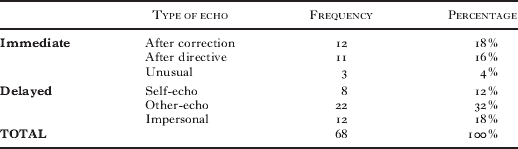
Employing sequential position, and segmental and suprasegmental characteristics as analytics, we found that echoes were related to a range of functions as well as a variety of stances and interpersonal positionings. The types of echo found in our data corpus and their distribution are shown in Table 1.
Types and distribution of echoes

Table 1 presents two kinds of echolalia, immediate and delayed. Immediate echoes are further distinguished by the sequential context in which they occur: after corrections, after directives, or in indiscernible sequential positions. Delayed echoes are distinguished on the basis of ownership: self-echoes, other-echoes, and impersonal echoes. These typological distinctions are further discussed in the following sections.
Unpacking immediate echoes
In our data corpus we found twenty-six sequences in which Aaron produced immediate echoes. The first author of this article and a research assistant independently identified immediate echolalia and delayed echolalia episodes. We agreed on all but six sequences, with the disagreement related to the uncertain identification of the source of delayed echoes and/or the close repetition of those echoes. The sequences that were not concordantly coded were discussed and consensus was reached after discussion.
All immediate echolalia sequences except three were uttered in one of two discernible sequential contexts: (1) a didactic format, in which the adult corrected and/or modeled speech and the child offered a repeat of the appropriate expression; and (2) after a directive, which the child attempted to divert or negotiate. We identified twelve and eleven such sequences respectively. In both contexts the immediate echo was produced with perceivable suprasegmental modifications. Furthermore, in both contexts the adult interlocutor treated the echo as a meaningful response, with a clear communicative intent. And frequently (21 of 23 immediate echo sequences), after the immediate echo was taken up by the interlocutor, the child added to it an original component, thereby putting forth another turn in the conversational exchange.
In what follows we offer an illustration of these two contexts in which immediate echoes occurred. We discuss the remaining three occurrences at the end of this section.
In the spirit of creating as many instructional opportunities as possible for Aaron, the parents often recruited him in didactic interactions or interjected corrective feedback within the course of an ongoing activity. In these didactic sequences, the adult corrected and/or modeled speech and the child offered a repeat of the appropriate expression. As such, the immediate echo constituted a satisfactory conversational move both formally and functionally.
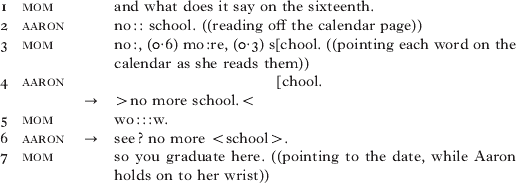
Example 1 is extracted from an interactional segment in which Mom and Aaron are in the kitchen. Aaron is on Mom's lap. The two are looking at a calendar and Mom is prompting Aaron to read off the future events they have scheduled:

Aaron's decoding response (line 2) is not fully accurate, and Mom addresses the child's mistake by pronouncing all of the written words (i.e., ‘no more school’) with careful articulation and pausing between words (line 3). Aaron then repeats the phrase correctly (line 4).
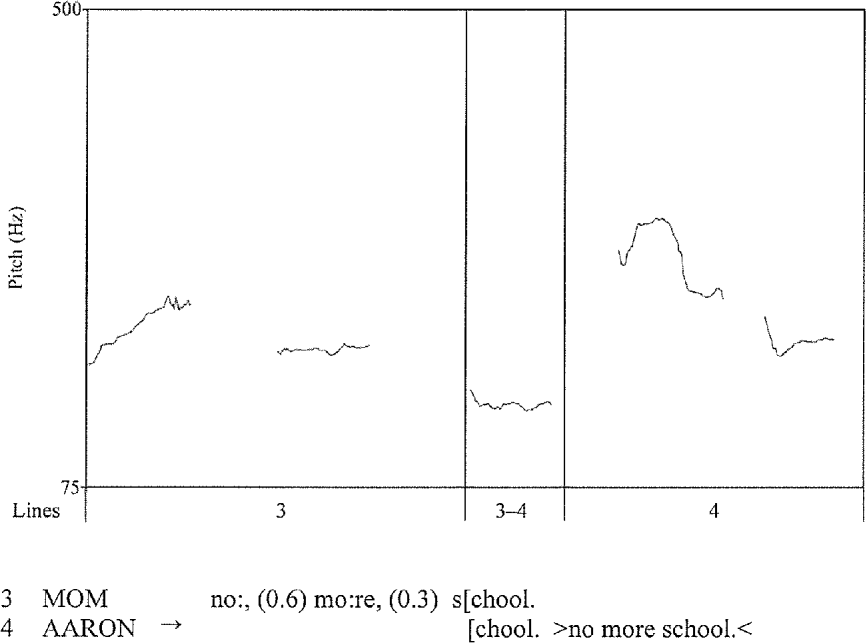
The child's repetition is uttered noticeably more quickly than the mother's model (1·57 seconds vs. 3·40 seconds; see Figure 1). This modification in tempo of delivery is a marker of appropriation. In other words, in echoing his mother's utterance with a tempo of his own, Aaron both acknowledges Mom's correction and displays that he has appropriated it. Mom seems satisfied with Aaron's response and next delivers an assessment, in line 5, that offers a shift out of the didactic frame (‘wo:::w’ is not an evaluation of Aaron's correct decoding but a comment on the content being decoded). Aaron follows with another repetition (line 6), prefacing it with the directive ‘see’ as an original component. In addition, the echoic part presents further suprasegmental variation: the last word, ‘school,’ is uttered noticeably more slowly than the preceding words and at a higher pitch than Aaron's first repeat, in line 4 (about 220 Hz vs. 180 Hz). In this way Aaron's appropriation of those words is further emphasized. Mom then offers a topically related comment, ‘so you graduate here.’ (line 7), with the initial conjunction ‘so’ marking its link with Aaron's preceding turn. She then reorients their attention to reading the calendar.
Pitch plot of model utterance and immediate echo (example 1).

This first kind of immediate echo was thus produced in response to the interlocutor's prompt to repeat, and as an appropriate reply to it. As such, it is more fruitful to approach it as one constituent part of an interaction rather than as an isolated move of the child. In this sense, these immediate imitative repetitions were an indication of the adult interlocutor's concern with obtaining a correct linguistic output from the child. Within this rather constraining format Aaron managed to convey his own voice via segmental and suprasegmental modification of the model utterance.
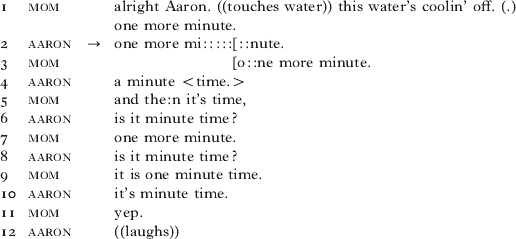
The second context in which we found Aaron's production of immediate echoes can be characterized as one in which the child was directed to carry out an action or to end an activity in which he was engaged. Usually, though not always, the directives pointed Aaron toward activities he preferred not to perform, and Aaron attempted to divert or postpone them through negotiation. As an illustrative example, consider a sequence taken from a bath interaction. Baths are usually lively and playful events for Aaron and Mom. The child is in the bathtub, the mother sits on the floor near him, and they talk and play with objects together. Example 2 is extracted from the end of one such playful bath.
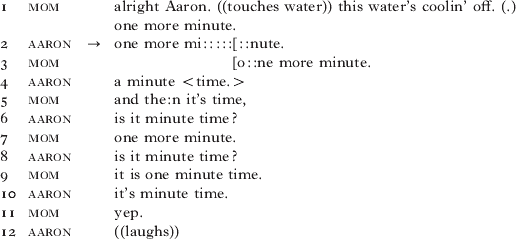
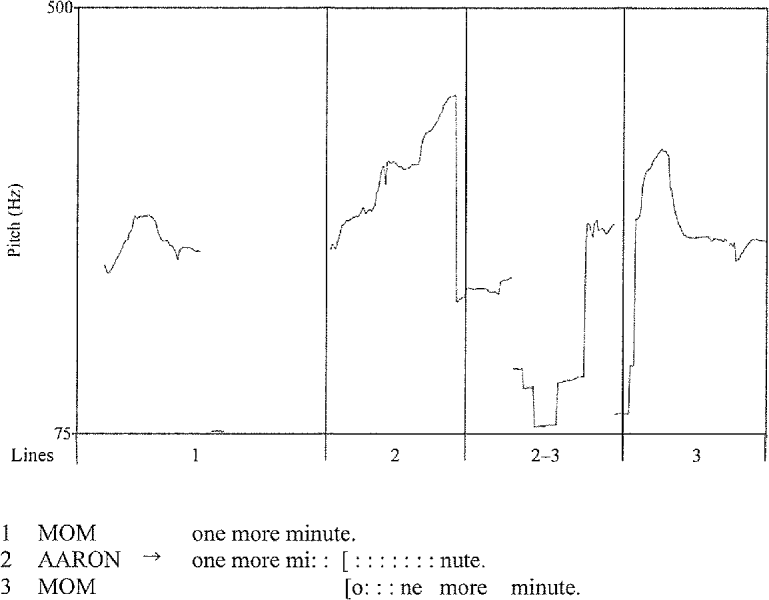
After Mom's notification that his bath is almost over, Aaron utters an immediate echo (line 2). The child's repeat presents conspicuous modifications in tempo, phonation, and pitch contour: Aaron's ‘one more minute’ is slower than Mom's (2·26 seconds vs. 0·9 seconds), the first syllable of the last word is considerably stretched, and the prosodic contour does not match the flat prosody of the model utterance (see Figure 2). It seems to us that Aaron's manner of echoic speech here achieves a subtle pragmatic goal – that is, prolonging the bath beyond the time dictated by Mom: Aaron repeats his mother's notification as if in agreement, but stretches it out, as if by doing so he is also stretching the ‘minute’ he was given. Interestingly, Mom follows with a repetition herself (line 3), partially in overlap with Aaron's repeat and phonetically modified in that she stretches the first word of the utterance. Aaron's echo is thus treated by Mom as communicative and negotiative. Aaron's subsequent turns (lines 4, 6, and 8) build on and creatively modify the initial notification. Mom responds to them quickly (lines 5, 7, and 9). Where Aaron seems to be playfully manipulating Mom's notification by dawdling to gain some more time in the bathtub, the mother uses modified repeats to demonstrate commitment to the time limit she set for Aaron.
Pitch plot of model utterance and immediate echo (example 2).
In summary, in these two examples we saw immediate echoes produced in two different sequential environments, with noticeable modifications in prosody and tempo from the model utterance, treated by the interlocutor as communicative, and then further elaborated by the child, most frequently also with the addition of segmental components. These echoes have emerged as accomplishing different interactional goals and positioning the child as a competent interlocutor, capable of accepting the interlocutor's corrective prompts as well as pursuing his own lines of action.
The remaining three instances of immediate echolalia found in our data occurred in three different contexts: one was produced after an assessment, another after a question, and a third after a descriptor. All three were faithful to the model utterance in prosody and duration; none of them were reproduced with an original component; and none of them were taken up by the interlocutor. These phonetic, intonational, segmental, and sequential characteristics correspond to those that Local and Wootton associated with ‘unusual echoes’ – that is, immediate repeats that are functionally opaque and have ‘a parasitic and autonomic feel’ (Local & Wootton, Reference Local and Wootton1995: 178). We will comment on the three unusual echoes in the discussion.
Unpacking delayed echoes
Delayed echoing is a more elusive phenomenon for study than immediate echolalia because the utterance or stretch of talk that is repeated is, by definition, temporally removed from the present (Prizant, Reference Prizant1983; Prizant & Rydell, Reference Prizant and Rydell1984; Schuler, Reference Schuler1979). By analyzing voice quality and pitch, however, we were able to identify delayed echoes even when the source of the repetition was not included in the corpus of our video-recorded data. Furthermore, delayed echoes were often repeated, so the temporal breadth of the data corpus allowed us to document multiple repetitions of the same utterance over different periods of time. In addition, Aaron's parents were able to provide us with further information about the history of the delayed echoes that featured prominently in our data corpus.
We identified forty-two delayed echolalia episodes. In line with the work of Wootton (Reference Wootton1999) and Tarplee and Barrow (Reference Tarplee and Barrow1999), and in keeping with the analytic procedure employed for unpacking immediate echoes, we examined the segmental and suprasegmental features of delayed echoes as well as the sequential contexts in which they occurred. On these bases we observed that delayed echoes could be differentiated according to ownership, i.e., whose voice the repeated utterance or stretch of talk animates. Delayed self-echoes were self-repetitions, often of utterances that pertained to topics of the child's predilection. Delayed other-echoes animated another's voice, specifically the utterances of the interlocutor with whom the child was interacting. Delayed impersonal echoes articulated rules and normative guidelines; as such, they expressed the voice of authority rather than any particular personal voice. The first author of this article and a research assistant independently coded delayed echolalia episodes according to the ownership criterion and obtained full agreement on them. We found eight delayed self-echo episodes, twenty-two delayed other-echo episodes, and twelve delayed impersonal-echo episodes.
Each kind of echo discerned by this organizing principle presented distinctive syntactic and acoustic features, was situated in particular sequential environments, produced specific interactional outcomes, and carried different psychodynamic valences. All of the delayed echoes, however, were highly formulaic in their presentation, recurring with minimal variation and no original components. In what follows we present an analysis of one episode of each kind of delayed echolalia.
Delayed self-echoes
Delayed self-repetitions usually reproduce utterances that express a child's preoccupation with such things as germs, bugs, and time. Because they were so pervasive, Aaron's delayed self-echoes were often perceived by family members and other caregivers not solely as distinctive features of the child's linguistic output but as a manifestation of his personality and lifeworld: ‘this is his thing’ and ‘he says it all the time, it's his trademark’ were comments made by Aaron's parents in discussing their child's echolalia.
Our analysis revealed that delayed self-repetition was both frequent and orderly: we detected it in interactional episodes in which Aaron and his interlocutor seemed to be pursuing divergent aims and activities. More specifically, the child produced delayed self-echoes when his interlocutors asked him to do something he preferred not to and some degree of tension had mounted. In these sequences the echo typically diffused, redirected, or alleviated tension, usually by eliciting laughter and often, subsequent language play. Indeed, delayed self-echoes were always delivered at a relatively high pitch, with a noticeable alteration in voice quality (specifically with a smiling or ‘croaky’ voice), and were often preceded and followed by giggles. They thus directed the interlocutor's focus toward some other object, even if only temporarily, and even if that object happened to be the strangeness or inappropriateness of the echo itself.
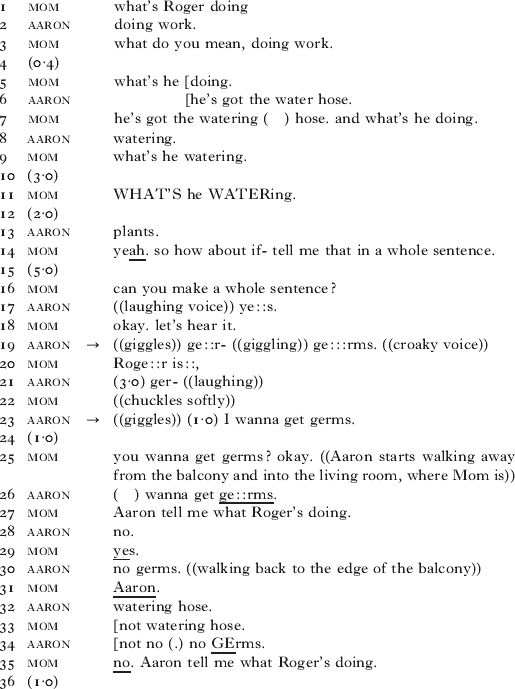
Consider the following episode (example 3). After looking through a telescope from the balcony, Mom went to sit on a sofa in the adjacent living area, while Aaron looked down at the yard, where the gardener, Roger, was working. Mom's goal in this episode was to get her son to tell her, in a complete and grammatically correct sentence, what the gardener was doing. Though Aaron provides informative responses to her inquiries, Mom refuses to accept his responses as adequate because they are not fully developed grammatically and descriptively. The persistence with which she pursues the desired response leads to a verbal struggle between herself and her son, in which Aaron deploys delayed echolalia in response to her linguistic prompts, for the purpose of sidestepping her agenda.
To attest to Aaron's deliberate and self-conscious utilization of delayed echolalia in this segment, we point to his consistent demonstration that he has the knowledge and the ability to comply in an appropriately informative way. Crucially, in circumventing of his mother's wishes, Aaron does not resort to complete unresponsiveness. Instead, he uses his echoic responses to frustrate his mother's goal for a remarkably long period of time (approximately three minutes, though we do not see the conclusion of this exchange in example 3) before finally acquiescing.
Aaron demonstrates his full understanding of his mother's request with his very first response to her question (line 2). Interestingly, Aaron's response does not describe the gardener's work in detail, but instead answers his mother's question at a more general level. Rather than offering a description of the gardener's ongoing actions, Aaron collapses them under the broader label of ‘work’, indicating an understanding that the gardener is performing an occupational and therefore social role, carrying out a responsibility that he has in relation to the child's family. In addition, by commenting on the gardener's behavior in this general way, Aaron indicates that this behavior is common knowledge, routine, and unremarkable. Nevertheless, his mother insists on more concrete details, dismissing his response as uninformative (lines 3 and 5).
Aaron's subsequent responses, on the contrary, are apparently not general enough. Both of his following answers to Mom's question contain the opposite level of detail – describing Roger's actions in a concrete rather than general way. Despite his mother's insistent interrogation, Aaron seems to be tolerant of these queries, answering them without much resistance for several turns. As frequently happens with Aaron, however, the pedantic mode is not sustainable for long stretches of time and inevitably begins to break down. In this sequence, this turning point occurs when the mother explicitly asks Aaron to produce a grammatically complete sentence (lines 14 and 16).
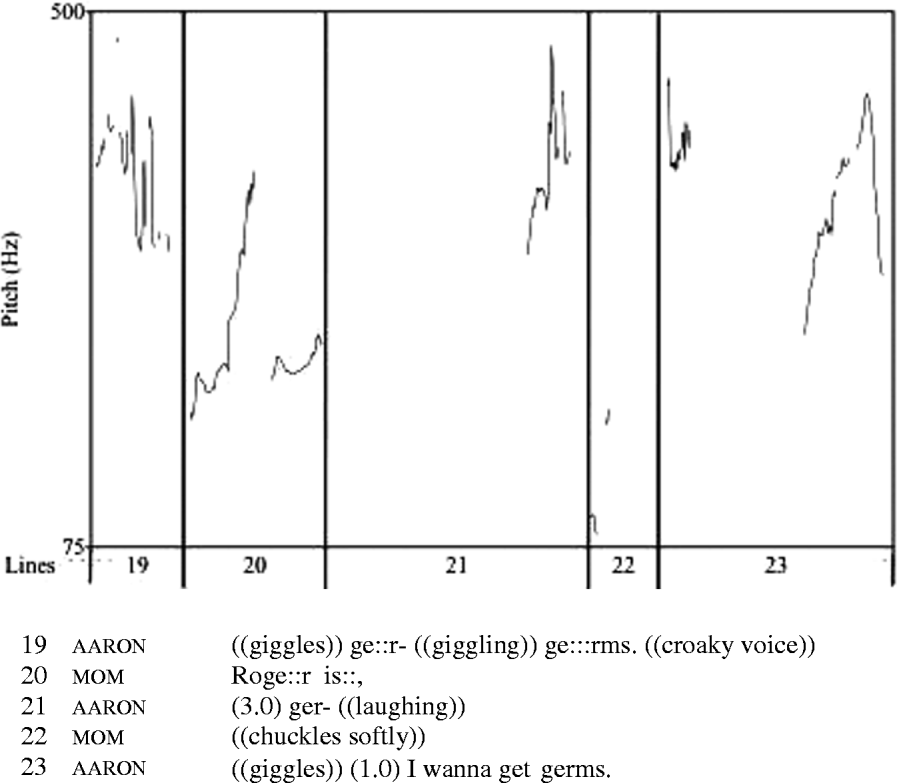
One way in which Aaron displayed resistance to didactic and pedantic formats was through a sort of linguistic diversion, which prototypically was put forward by means of delayed self-echoes. In example 3, when Mom prompts Aaron to utter the whole sentence the child giggles and then produces two delayed self-repeats ‘ge:::rms’ in line 19, and ‘I wanna get ↑germs’ in line 23. The first self-repeat is uttered with croaky voice, and both echoes are produced with high pitch (around 370 Hz the first and 340 Hz the second; see Figure 3). Germs were a topic of enduring fascination for Aaron, often discussed in playful banter with his parents during bath time and meals. Though it is arguable that the comment is distantly related to the subject at hand (gardening), the utterances in lines 19 and 23 are more readily recognizable as contextually odd and out-of-place. However, rather than being considered inherently withdrawal-oriented, we would argue that they are more appropriately interpreted as distracters or topic shifters, strategically deployed by the child to escape an undesirable course of action and recruit his interlocutor in one of more interest to the child. Thus, their usage was not so simple as to be contained by the definition of non-communicative by-products of a mental disengagement, nor were they unequivocally aimed at distancing the child from his interlocutor. Instead, they were negotiative in nature – they communicated a stance toward the current conversational activity, and projected a possible alternative. In doing so, the child asserted his own authority as an interactional partner in directing the flow of conversation. In this case, Aaron shows his disinterest in his mother's questioning by proffering the alternative activity of talking about germs. His accompanying non-verbal behavior during these turns is crucial – where he had been previously standing at a physical distance from his mother, immediately upon her uptake of his laughing initiation (line 23), he turns to walk into the living room where Mom is sitting and physically reorients toward her. When shortly after that Mom reiterates her question, ‘Aaron, tell me what Roger's doing’ (line 27), his face falls, he averts his gaze, and turns around as if to return to the balcony, but not before answering her request with a firm ‘no.’
Pitch plot of delayed self-echo (example 3).
We do not discuss the rest of the episode here. It suffices to say, however, that the negotiation unfolds for several more turns, with the mother attempting to retrieve Aaron within the didactic format while conceding from time to time to her son's playful echoic diversions.
Delayed other-echoes
Another form of delayed echolalia identified in our data consisted of Aaron's repetition of utterances by his interlocutor. Aaron borrowed the words of his conversational partner and indicated that he had done so primarily through phonetic and deictic means, without overtly quotative forms. Thus, delayed other-echoes were a complex form of repetition, one that instantiated not only appropriation of words but especially of voice. As such, they can be thought of as ventriloquizations (see Tannen, Reference Tannen2007, for a thorough discussion of ventriloquization as a discourse strategy).
The interactive value of this form of echolalia was further evidenced by its pragmatics: the proffer of a ventriloquization consistently solicited a response from the interlocutor, preferably an acknowledgment of the correctness of the other-echo. In addition, nineteen out of twenty-two delayed other-echoes occurred within stretches of interaction in which the linguistic agenda was flexible enough to welcome forms of engagement such as language- and role-play. (The remaining three occurred during brief procedural sequences – that is, routine activities such as brushing teeth, and the delayed echo reproduced/anticipated the interlocutor's typical bits of instruction pertaining to the activity.)
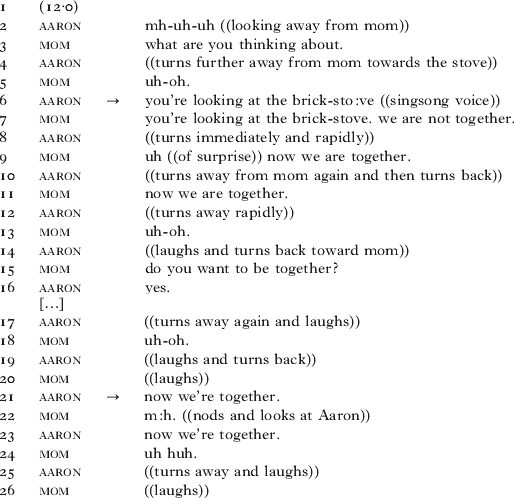
As an illustration we examine an episode from a dinner that Aaron and his mother are having together (example 4). Mom has been attempting to make small-talk with her son about the events of the day, but Aaron has offered no or minimal responses. After another of Mom's open-ended prompts, Aaron produces an echoic utterance that, while not actually answering his mother's question, is responsive to its implicit re-engagement aim. In fact, by way of ventriloquized rejoinder the child avoids simple acquiescence and binds Mom to an echolalic communicative plane, where she repeats herself:
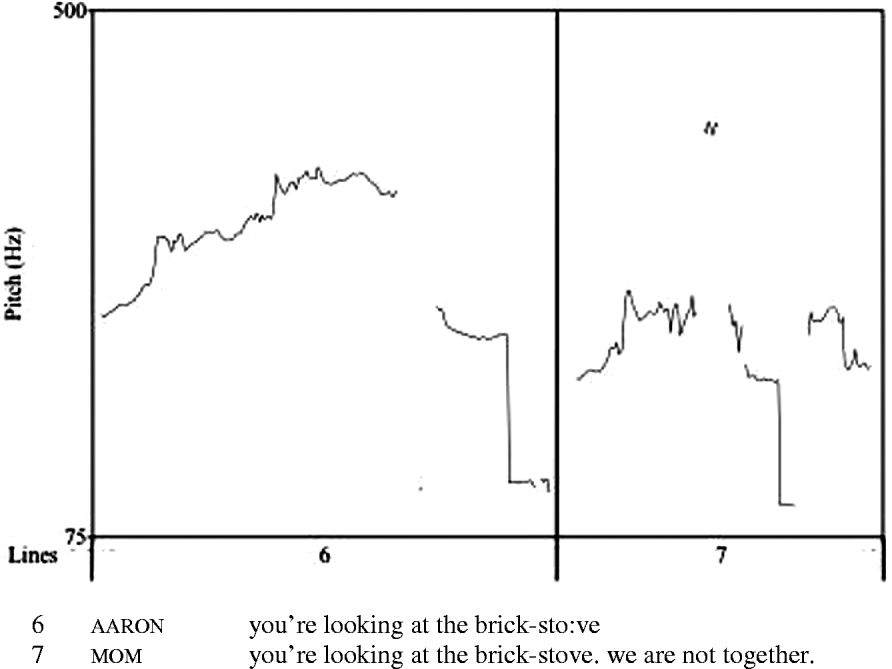
After a 12-second silence, in which Aaron progressively turns his torso and gaze away from his mother and then mumbles at low volume, Mom proffers a question (line 3, ‘what are you thinking about.’) that she frequently uses to reorient her son's attention when he seems to be disengaged from their dyadic exchange. Aaron responds with a delayed other-echo (line 6) that ventriloquates another of Mom's typical re-engagement devices, this one specifically related to a playful interactional format of rapid shifts between withdrawal and engagement. Typically, Aaron's interlocutor establishes the format by noting aloud that the child is not making eye-contact or facing him/her. The opening phrase usually deployed is: ‘Uh-oh. you're/Aaron's looking at the ___,’ uttered with a very distinct prosody and voice quality (notably elongated vowels and sing-song voice) and frequently followed by another phrase, ‘we are not together’, with the same suprasegmental characteristics. The playful exchange then unfolds with Aaron turning to face his interlocutor (who signals his/her satisfaction with the expression ‘now we are together’) before abruptly turning away again, thereby triggering another round of the same exchange.
Aaron's echoic utterances in lines 6 and 21 are prosodically and pronominally marked as re-animations of Mom's voice and familiar expressions. They are produced with a sing-song voice and a prosodic contour similar to Mom's typical re-engagement device. As such, these echoes establish a backward link with their source. At the same time, however, the child's ventriloquizations are anticipatory: they tell in advance what Mom would likely have said next. Indeed, in both cases the mother confirms that Aaron was right; the first time by repeating Aaron's echo herself, with a sing-song voice and remarkably similar prosodic contour (see Figure 4), and adding the next typical phrase (‘we are not together’, line 7); the second time assenting, verbally and gesturally (line 22). Aaron's laughter and repeated initiations of new rounds of the game attest to his pleasure in ventriloquizing his mother and having her confirm that his guess was correct.
Pitch plot of delayed other-echo (example 4).
Thus, what superficially could be labeled as delayed echolalia emerged here as complex layering of voices and processing of another's perspective. Ventriloquization offered the child the possibility of making conjectures about the other and submitting them to that very other, for ratification or revision. Framing delayed other-echoes as ventriloquizations also provides a new perspective on the much-discussed phenomenon of pronoun reversal in children with autism (e.g., Bartak & Rutter, Reference Bartak and Rutter1974; Fay, Reference Fay1979; Oshima-Takane & Benaroya, Reference Oshima-Takane and Benaroya1989), in that it acknowledges the usefulness of maintaining the pronouns used by the original speaker. Such preservation, when combined with changes in prosody and voice quality, suggests deliberate crafting of those utterances as quotations.
A final comment is that through the act of repeating each other and the back-and-forth motion between them, the two players of this language game attained a noteworthy level of emotional closeness and interactional attunement: ‘being together’ was enacted through action and speech, in particular repetitions, on both a literal and a figurative level.
Delayed impersonal echoes
A third form of delayed echolalia identified in our data consists of the repetition of rule statements, namely normative guidelines for proper conduct frequently employed by adult interlocutors to control or rectify the child's (mis)behavior. Although in stating a rule Aaron repeated formulations that he had heard from his caregivers, he did not mark such statements as belonging to anyone in particular; unlike delayed other-echoes, impersonal echoes were not uttered with prosodic modifications that approximate the source voice. In fact, it could be argued that in the contexts we investigated, rule statements voiced the family ethos, not any individual author or source.
We found delayed impersonal echoes to be located in negatively valenced interactions, usually directly following a reprimand or behavioral correction of some sort. In these circumstances the imbalance of authority between the adult and the child became the most salient feature of the exchange.
The following excerpt is taken from a dinner interaction. Aaron and Dad have begun eating while Mom is still moving around in the kitchen, bringing things to the table. Aaron has already been receiving numerous directives from his parents to modify his table manners.
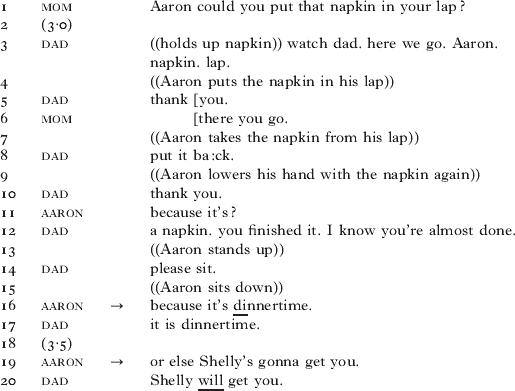
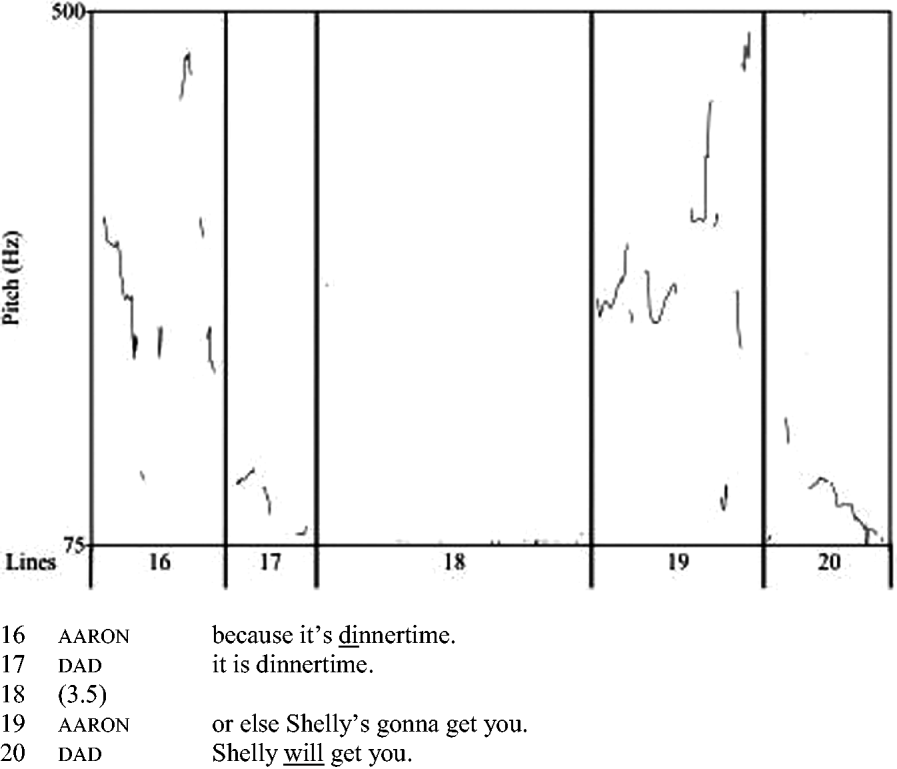
Aaron first complies with both his parents' instructions to place the napkin on his lap, but then, seemingly about to stand up and leave the room, puts it back on the table. His move is noticed by his father, who immediately issues another corrective directive (line 8). Aaron complies, and the father acknowledges this (lines 9 and 10 respectively). At this point Aaron formulates an appendor question (‘because it's?’, line 11), a cloze procedure format that extends the father's imperative and prompts the father to complete it. Dad does not ignore Aaron's initiation, but he appears to misunderstand the intention behind it, responding as if Aaron's turn referred to the literal item being discussed (‘a napkin’), and then shifting to encouragement as a means of maintaining his son's cooperation (‘you finished it. I know you're almost done’). Next the child stands up and his father immediately directs him to sit. At this point Aaron utters the correct answer to his own question (line 16), showing that the intended goal of his appendor was the reformulation of the household rule underlying the directives just issued, one that indeed the parents frequently employ to accompany behavioral directives (e.g., ‘Aaron come and sit, it's dinnertime’, ‘it's dinnertime, turn off the computer and wash your hands’). The norm statement is uttered with accentuated raising and then downward intonation and a slower tempo, typical of cloze procedure (see Figure 5). The same suprasegmental features characterize Aaron's second delayed impersonal echo in the sequence, ‘or else Shelly's gonna get you,’ in line 19.
Pitch plot of delayed impersonal echo (example 5).
Aaron's impersonal echoes are interesting in many ways: first, they responded to behavioral directives (‘put it back’ and ‘please sit’), which in themselves would not require a verbal reply. Second, they were syntactically shaped not only as dependent on the father's utterances but also as progressing from them, with the casual conjunction because in the first instance and the contrastive form or else in the second. In this way Aaron cast his father's demands as part of common family practice rather than something arbitrarily imposed by Dad. Thus, delayed impersonal echoes changed the relational balance by countering the father's authority: behavioral compliance was displaced by an abstract standard, of which Aaron displayed awareness.
The way the father responded to the child's rule statements offers additional evidence for this interpretation and the idea that Aaron deployed delayed impersonal echoes when he was subjected to a particularly strict behavioral control and the interlocutor was exercising authority over him. In both cases Dad ratified Aaron's formulations via modified repeats rather than exact repetition or other affirmative forms (Stivers, Reference Stivers2005): in the first instance he dropped the causal conjunction and expanded the copula contraction, placing emphasis on the copula itself. In the second occurrence he dropped the conjunction again and changed the verb tense. As such, the father's subtly modified repetition of his son's statements had a double-edged quality, expressing both that he was aligned with Aaron on the rule's relevance and validity and that the authority to formulate (and modify) norms was ultimately his.
The prosodic features of Aaron's and his father's utterances mirror the discrepancy between their pursuits. As illustrated in Figure 5, there is a noticeable difference in prosodic contour between father's and child's turns: Aaron's accentuated raising and downward intonation is followed by his father's flatter downward contour. Comparatively, the prosodic features of Aaron's and his mother's turns in Example 4 are quite similar, thus mirroring the attunement in purpose and emotion between the two.
DISCUSSION
In this article we have examined the different forms of echoic utterances produced by a child with autism and the interactional trajectories in which they were embedded (see Table 1). Our corpus contains both immediate and delayed echoes.
The majority of immediate echoes occurred either in a didactic format in which the adult corrected the child's speech, or following a directive in which the adult attempted to modify the child's behavior. Common to both types of immediate echolalia was a perceivable suprasegmental modification and the addition of an original component. When acquiescing to a didactic correction, Aaron introduced segmental and prosodic variations that suggest an attempt to reappropriate the model utterance. In the case of behavioral directives, the child produced marked segmental and suprasegmental modifications of the directive to signal his rebellion against the demanded course of action. These two types of immediate echolalia presented different sequential valences: while immediate repetitions after didactic corrections were the appropriate and expected response to the adult's move, those that followed behavioral directives were unsolicited, and in fact constituted an attempt to elude the adult injunction. A third and rare type of immediate echo we observed in Aaron's speech was ‘unusual echolalia’ (Local & Wootton, Reference Local and Wootton1995), which was faithful in prosody and form to the model utterance, did not respond systematically to any particular kind of parental move, and was not taken up by the interlocutor.
Delayed echoes were divided into three types based on the utterance's ownership: self-echoes, other-echoes, and impersonal echoes. All delayed echoes were highly formulaic, reoccurring with minimal variation across different instances.
Delayed self-echoes, which reproduced idiosyncratic phrases pertaining to the child's favorite topics, were pronounced by the child with notable alterations in voice quality. Such distinctive acoustic characterization marked their incongruity with the conversational context in which they were embedded. We argued that these echoes were produced as linguistic distractions, designed to redirect the adult interlocutor's attention from a non-preferred course of action toward more engaging topics.
Delayed other-echoes, by virtue of their segmental and suprasegmental features, were often identifiable as belonging to the interlocutor to whom the child directed them. The interlocutor ratified them as appropriate ventriloquization, and playful exchanges ensued, with a high degree of attunement within the dyad.
Delayed impersonal echoes, which were repetitions of rule statements, followed behavioral directives in tension-filled exchanges. They did not present prosodic modifications that approximated a source voice, and we argued that they expressed an impersonal authoritative stance. Delayed impersonal echoes were subsequently repeated by the adult with segmental and suprasegmental modifications of his/her own, in an attempt to claim ownership.
Clearly, echolalia is a salient feature of Aaron's speech. A contextually situated look at the echoic utterances generated by the child revealed the nuanced ways in which Aaron used echoes to position himself in relation to his interlocutors. Our findings are in agreement with previous research on the communicative functionality of immediate echoes (Prizant & Duchan, Reference Prizant and Duchan1981; Violette & Swisher, Reference Violette and Swisher1992) by demonstrating that Aaron used segmental and suprasegmental modulation of his repetitions to indicate processing and appropriation of his interlocutor's conversational moves. In addition, this research contributes to a novel conceptual framework for the situated analysis of autistic echolalia (Local & Wootton, Reference Local and Wootton1995; Tarplee & Barrow, Reference Tarplee and Barrow1999; Wootton, Reference Wootton1999), the ownership criterion, which elucidates Aaron's propensity to use echoic utterances to communicate various emotional and epistemic stances. We argue that in exploiting the subtleties of voice, the child was able to mobilize echoes as a powerful and flexible resource that could distance him from or affiliate him with his interlocutor in equal measure.
The ownership of an utterance was the primary substrate on which Aaron built his own stance: Aaron's echolalia cannot be characterized solely in terms of the traditional parameters of accuracy and temporal relationship with respect to the model utterances, but is best captured in its complexity in terms of voicing. In other words, Aaron did not simply repeat utterances; rather, he animated voices. This distinction acknowledges the child's agency and creativity related to echo production. We suggest that the ownership criterion, which encompasses not only the substance of what is said and who it is ostensibly directed to, but also the manner in which it is spoken, constitutes an analytic lens that can enhance our capacity to understand the complex interactional work that children with autism can accomplish through echo usage.
Although we would argue that our interpretive framework elucidates the communicative value of many of Aaron's echoes, we do not go so far as to assert that every instance of autism echolalia is communicative, even in a comparatively high-functioning child such as Aaron. We indeed found a small number of instances of echolalic behavior that showed no clear audience or communicative function. Although these ‘unusual echoes’, to use Local and Wootton's (Reference Local and Wootton1995) term, were not absent from Aaron's speech, we believe our findings offer a persuasive argument for the child's ability and propensity to act on an understanding of the interactional ramifications of his echolalic utterances. Even the estranging characteristics that Wootton (Reference Wootton1999) associated with non-communicative echoes could be mobilized by Aaron to accomplish specific interactional goals (see especially the negotiative distraction we discussed in relation to example 3, i.e., the self-echo ‘germs’).
Common to Aaron's distractive self-echoes and Tarplee and Barrow's cartoon echoes (Tarplee & Barrow, Reference Tarplee and Barrow1999) is the echo's attempt to mobilize a specific response from the interlocutor: in Tarplee and Barrow's case a reciprocal echo from the mother, and in Aaron's case an immediate attentional orientation to the topical divergence. In both cases the predictability of the interlocutor's response allows the child to guide the conversation in his desired direction.
Beyond self-repetition, Aaron seemed aware of the assertive and stance-taking potential that was offered him when he repossessed the words of another while borrowing, modifying, or effacing their voice. Whether the child was ventriloquizing another for entertainment and intimacy, or depersonalizing or reclaiming a rule used by an adult to challenge its deployment, these subtle modulations of ownership were clear indicators of the child's desire and ability to express his voice. In addition, Aaron's parents were highly attuned to the conversational trajectories launched or opposed by these modulated repeats and responded to them in regular and predictable ways.
Echolalia was thus revealed as an interactional phenomenon. It both fulfilled communicative goals and emerged as a by-product of discernible interactional sequences. Ipso facto, with this study we invite a reconsideration of echolalia as a feature of atypical language development. As an interactional phenomenon it cannot be solely considered a manifestation of an individual child's proclivity or (dis)ability. Rather, as an interpersonal outcome it also indicates the interlocutor's communicative disposition toward the child and the forms of communicative involvement that he/she projects for the child to take up. In highlighting this social dimension of echolalia we also demonstrated that echolalia is singularly well suited to accomplishing specific conversational goals.
Many facets of autism echolalia that we could not explore in our study deserve investigation. While quantitative studies have attested to the pervasiveness of echo behaviors in children with autism (e.g., Cantwell, Baker & Rutter, Reference Cantwell, Baker and Rutter1978; Tager-Flusberg & Calkins, Reference Tager-Flusberg and Calkins1990) and its higher incidence in more severely affected subjects (e.g., Wolff & Chess, Reference Wolff and Chess1965), fine-grained qualitative case studies have revealed great variability within this population in language ability and echo functionality (e.g., Local & Wootton, Reference Local and Wootton1995; Stribling et al., Reference Stribling, Rae and Dickerson2007; Tarplee & Barrow, Reference Tarplee and Barrow1999; Wootton, Reference Wootton1999). Indeed, autism is a multifaceted disorder, ‘heterogeneous in the expression of both defining and associated symptoms’ (Tager-Flusberg, Reference Tager-Flusberg2004: 76). Further analysis of within-group individual differences is thus in order.
Tager-Flusberg has advocated such an approach (Tager-Flusberg, Reference Tager-Flusberg2004), and with her associates she has embarked on a series of quantitative studies exploring the heterogeneity of language abilities among children with autism (Kjelgaard & Tager-Flusberg, Reference Kjelgaard and Tager-Flusberg2001; Tager-Flusberg & Joseph, Reference Tager-Flusberg and Joseph2003). These studies have identified different language subtypes among children with autism that are not fully determined by the subjects' broader cognitive abilities. We believe that additional and complementary insights on the heterogeneity of language and communicative behavior in autism can be gained through studies informed by Conversation Analysis and interactional linguistics. These studies can show how a phenomenon typically assumed to be univocally symptomatic of an impairment, such as echolalia, can in fact take on a variety of meanings and functions across and within subjects. Furthermore, while the work of Tager-Flusberg and associates on individual differences in language functioning is oriented toward advancing our understanding of the genetic and neurobiological bases of autism (Tager-Flusberg, Reference Tager-Flusberg2004), fine-grained analyses of the interactional circumstances in which key autistic symptoms, such as echolalia, manifest hold great promise for illuminating the intricate relationship between autism disorders and contextual factors. The potential implications for intervention programs that focus on participation framework, interactants' mutual attunement, and interpersonal dynamics rather than the individual child's isolated skills or impairments are also significant (see also Stribling et al., Reference Stribling, Rae and Dickerson2007).
A deeper understanding of autism echolalia can also be gained through longitudinal studies. To our knowledge, there is no longitudinal research published on autism echolalia – with the exception of Fay's (Reference Fay1967) study documenting the salience and resilience of echoic utterances, and Tager-Flusberg and Calkins' (Reference Tager-Flusberg and Calkins1990) study, which found that imitative speech was neither longer nor grammatically more complex than spontaneous speech (both studies spanned one year). The multifunctional and sophisticated deployment of echoes exhibited by Aaron in our study prompts speculation about possible developmental trajectories in which repetitive speech does not recede but evolves, gaining in complexity and context sensitivity.
Despite the small size and scope of our study, we believe that this article offers a perspective on autism echolalia that requires us to listen attentively to things that are said again and again, rather than to dismiss them as insignificant. Our hope is that within these repeats the child with autism's voice can be heard, not simply echoing but continually appropriating, repurposing, and negotiating.
APPENDIX – Transcription conventions
Notational conventions employed in the transcribed excerpts include the following: