1 Introduction
The most frequent surface position for sentential negation in earlier stages of English was after the verb, as in the following example:
(1) John came not.
Constructions of this sort first became the norm in late Middle English, when postverbal not came to replace preverbal ne (e.g. Fischer Reference Fischer and Blake1992: 280–5; Breitbarth Reference Breitbarth2009), and were gradually overtaken in Early Modern English by constructions involving periphrastic do (e.g. Warner Reference Warner, Kemenade and Vincent1997; Rissanen Reference Rissanen and Lass1999: 245), giving rise to the familiar modern type:
(2) John did not come.
Constructions of the type seen in (2) soon came to predominate in most prose works. By the period 1840–1914, Haeberli & Ihsane (Reference Haeberli and Ihsane2016: 521) found that these constructions comprised 94.8 per cent of the negatives found in their sample, with some of the remaining cases possibly involving superficially similar instances of constituent negation. Likewise, the latest relevant examples identified by Denison (Reference Denison and Romaine1998: 195) date from the nineteenth century. The persistence of constructions such as (1) within Present-day English is seldom considered as a possibility. Such constructions are largely ignored by synchronic corpus-based studies of negation such as Tottie (Reference Tottie1991) and Anderwald (Reference Anderwald2002), while works of a more theoretical orientation mention them only to describe them as obsolete (Lightfoot Reference Lightfoot2006: 96) or as having been lost (Kroch Reference Kroch1989: 222), or simply to present them as starred (e.g. Warner Reference Warner1993: 4; Roberts & Roussou Reference Roberts and Roussou2003: 19), often without further comment.
Despite their relative infrequency, constructions of the sort seen in (1) continue to be produced by speakers of Present-day English. The Hansard Corpus (Alexander & Davies Reference Alexander and Davies2015), which will be used as the primary data source for the present study, includes examples such as the following:
(3) Perhaps the Foreign Secretary is at the moment recalling him. We know not. Let us hope that he does. (C-1971 Davis (C))Footnote 2
(4) Whatever hon. Members may say against me, or for me, I care not. (C-1974 Lewis (L))
(5) If that is the Conservatives’ philosophy, I like it not. (C-1980 Dewar (C))
(6) Fear not! the Government welcome this little Bill […]. (L-1986 Bootle_W (C))
(7) Believe me, I jest not. (L-1992 Marsh (C))
(8) It matters not whether we have previous convictions. (L-1999 Alexander (L))
The possibility must be considered of whether the constructions seen in these examples are merely fossils representing a syntactic pattern that is no longer productive; however, their infrequency relative to periphrastic negative constructions of the sort seen in (2) is not in itself sufficient to establish that this is the case. A more detailed investigation of the role of postverbal negation in contemporary usage has the potential to establish their status and the syntactic basis of their coexistence with other forms of negation. As will be seen, there is evidence to suggest that postverbal negation still enjoys a real, if limited, productivity.
2 The diachronic syntax of negative constructions
The decline of postverbal negation in Early Modern English was part of a broader series of changes affecting verbal syntax. The most prominent manifestation of these changes was the spread of do-support in a pattern whose general form has been known since the work of Ellegård (Reference Ellegård1953): the forms with do gained ground first in questions, then in negative declaratives, and subsequently in imperatives (for further review see Warner Reference Warner, van Kemenade and Los2006). In addition to this variation on the basis of clause type, speakers’ choice among forms with and without do seems to have been influenced by lexical and stylistic factors, as well as idiolectal factors (Nurmi Reference Nurmi1999: 141–62; Mazzon Reference Mazzon2004: 76–9). Most syntactic analyses agree in interpreting the rise of do-support as related to the loss of verb movement, the movement of the verb to a higher location from its base position (in V). The unmarked negative constructions before and after such a change may be represented syntactically in general terms such as these:
(9) (a) [XP John [X came] [NegP not [Neg[VP [V t]]]]]
(b) [XP John [X did] [NegP not [Neg[VP [V come]]]]]Footnote 3
Variation exists among different accounts in the position to which the verb is said to move and in the nature and motivation of the changes that took place. Some authors (e.g. Warner Reference Warner, Kemenade and Vincent1997) present these changes in terms of a relatively simple binary model, in which the verb originally moved to a generalized inflection head I and was later restricted to V, while others adopt a more complex structure in which the verb originally moved to a specific tense head T (e.g. Roberts & Roussou Reference Roberts and Roussou2003). More recent accounts often suggest that the surface order seen in postverbal negatives such as (1) was produced by a diachronically evolving series of movement patterns, in which the verb originally moved to C and later to the lower head T (Biberauer & Roberts Reference Biberauer, Roberts, Biberauer, Holmberg, Roberts and Sheehan2010), and perhaps thence to the still lower head Asp (Han & Kroch Reference Han and Kroch2000). A similar range of views is apparent in the triggers suggested for these changes. Among the factors that have been proposed are the loss of verbal inflection, which may have eliminated some of the cues providing learners with evidence of verb movement (e.g. Biberauer & Roberts Reference Biberauer, Roberts, Biberauer, Holmberg, Roberts and Sheehan2010), changes in the syntax of mood features in imperative constructions (Han & Kroch Reference Han and Kroch2000) and changes in the availability of word-order evidence from adverbial constructions (Haeberli & Ihsane Reference Haeberli and Ihsane2016); these factors may have operated either singly or in combination.
The differences existing among the different models of diachronic syntactic change have implications for their interpretation of later examples of postverbal negation and their predictions of what is required for such constructions to exist. In an analysis such as that of Kroch (Reference Kroch1989, Reference Kroch1994), this difference in rate is interpreted as the result of competition between a grammar in which it was possible to form constructions of all these types without do and one in which do was mandatory in all environments; variation existed because the latter grammar prevailed at different rates in different environments. One prediction made by a grammar competition analysis, whether as formulated by Kroch or in some comparable terms, is that the coexistence of constructions with and without do was inherently unstable, and that one type would prevail over the other within a relatively short period of time. In an alternative interpretation, the hybrid state in which do-support is required in questions, but in which postverbal negation is used in negative declaratives, is seen as the output of a single grammar, in which the verb can only be raised to an aspect head Asp. According to such an analysis, additional factors operated to produce further development towards the present-day system, such as the loss of M-to-T movement for mood features (Han & Kroch Reference Han and Kroch2000) or the development of overt aspectual markers (Haeberli & Ihsane Reference Haeberli and Ihsane2016); however, in the absence of such factors, a grammar with the verb in Asp could potentially have remained stable for a longer period. It will be seen in section 5 below that these analyses for the rise of do-support differ in their compatibility with different syntactic analyses of postverbal negation in Present-day English.
3 Methodology
For data on the contemporary use of postverbal negation, the source chosen was the Hansard Corpus, which includes the full text of the published proceedings of the British Parliament from 1803 to 2005. The Hansard Corpus is especially suitable for these purposes because it provides a substantial quantity of data from within a single genre and discourse context, and constitutes an unusually rich resource for data on the higher registers of spoken English. Only the portion of the corpus spanning the years from 1901 to 2005 has been used in the present study, including data from both the House of Commons and the House of Lords. As the focus of the present study is on establishing the contemporary productivity of postverbal negation, data from the nineteenth century have been excluded; the nineteenth century is also better represented than the twentieth in previous research (e.g. Nakamura Reference Nakamura and Iyeiri2005; Varga Reference Varga2005; Haeberli & Ihsane Reference Haeberli and Ihsane2016). Any subsequent references to ‘the Hansard Corpus’ should be understood as referring only to this portion of the full Hansard Corpus.
As the Hansard Corpus is not syntactically annotated, it was necessary to employ selective search techniques in order to identify relevant data. In postverbal sentential negation, a lexical verb is modified semantically by a following not; however, the relationship between this type of construction and the surface strings occurring in the text is far from straightforward.
(10) (a) They knew not the facts.
(b) They knew not these facts but those facts.
(c) They knew the facts not.
Sentence (10a) contains an example of postverbal sentential negation; sentence (10b) contains a superficially similar but syntactically and semantically different example of constituent negation, while (10c) contains a genuine but superficially different example of postverbal sentential negation. Since Hansard Corpus searches must be based on the surface order of constituents, it was necessary to find a search pattern that would identify as many genuine examples as possible, while minimizing the number of irrelevant ‘false positives’. The approach adopted was to search for all occurrences in which a lexical verb (as defined in the corpus's CLAWS7 tagging system) was followed by the lexeme not, with or without the intervention of a personal pronoun, and in which not was followed in turn by a conjunction, a relative pronoun or adverb, or a punctuation mark. The search results were then manually reviewed in order to eliminate any remaining cases of constituent negation, as well as all constructions involving let or the ‘semi-modals’ dare and need. One implication of this approach is that none of the sentence types seen in (10) has been included in the data.
Although the search techniques employed in the present study are not exhaustive, the use of a selective approach provides certain methodological advantages. By way of illustration, a sample search for any lexical verb followed by not and a relative or punctuation mark returns 532 results from the years 1950–9, of which the majority are not true instances of postverbal negation.Footnote 4 In contrast, a search for all sentences in the same period in which a lexical verb is followed directly by not, with no further constraints, returns 18,661 results, including irrelevant forms. Even these results would not include all potential forms of postverbal negation; they would include sentences such as (10a) and (10b), but not sentences such as (10c). An exhaustive enquiry into postverbal negation would require a substantially different methodological approach, involving not just the automated querying of corpus data, of the sort for which the online corpus interface is designed, but the manual review of large portions of the continuous text of Hansard. Until a work of this scale can be undertaken, a non-exhaustive study such as this nevertheless has the potential to provide valuable data. So long as the sampling procedures employed are constant across all time periods, there will be no diachronic distortion of the data, and it will be possible to obtain an accurate picture of postverbal negation and its development at least for a specific subset of constructions.
One methodological issue particularly relevant to postverbal negation is the exclusion of quotations from or allusions to external texts, especially those of an earlier period. The null hypothesis regarding postverbal negation, as reflected in the works discussed in section 1, is that any contemporary examples of such constructions are merely syntactic fossils, representing the syntax of a previous stage of the language rather than the output of any productive process. In order to evaluate the current productivity of these constructions, it is therefore essential to eliminate from the data any examples that could plausibly be interpreted as fossils of this sort; with such examples excluded, the significance of any productive use that can be identified will be more robust than it would otherwise be.
(11) (a) They know not what they do.Footnote 5
(b) They knew not what they were doing.
(c) They knew not.
The approach adopted here is to exclude not only direct quotations from earlier English sources, such as (11a), but utterances such as (11b) that retain a substantial degree of formal parallelism to an external source, despite minor differences such as a change in tense. However, sentences such as (11c), whose only resemblance to a quotation such as (11a) consists in the choice of lexeme, have been included; their exclusion would essentially lead to the elimination of most examples involving a verb existing in Early Modern English. Conscious allusion and spontaneous production are no doubt best understood as representing opposite poles of a continuum, rather than constituting a simple, binary distinction, and therefore an element of subjective judgement necessarily exists in determining how individual examples should be classed. Nevertheless, the criteria described above have been adopted as the best means of providing a usable quantity of data while avoiding any potentially misleading inflation of the figures used to establish productivity.
As described above, cases of constituent negation have been excluded from the data wherever possible; nevertheless, there are a small number of potentially ambiguous examples. In these cases there is insufficient syntactic evidence from the surface form of these sentences to determine which of the potential underlying structures was intended by the speaker. Semantic criteria have therefore been adopted to help identify cases of constituent negation. In potentially ambiguous cases, sentences have been classed as constituent negation if the event or state denoted by the main verb is asserted to have taken place. This criterion correctly identifies syntactically unambiguous cases of constituent negation, such as the following:
(12) The Agency is established by this order, which says not that these functions will be transferred to it but that they may be transferred. (C-1976 Moyle (L))
This example asserts that the order does say something; all that is negated is one of two possible things said. The same semantic test can also be applied to cases in which it is less clear whether the syntactic structure involves constituent negation:
(13) Miners’ free concessionary coal concerns not what it costs the employer; it concerns the benefit the miners receive […]. (C-1975 Ridley (L))
In (13), the pragmatic force of the utterance is not to deny that anything is concerned, but rather to specify what is concerned. This force would remain the same whether the intended syntactic structure involved constituent negation, with ellipsis of an alternative that is expressed instead in the following sentence, or whether it involved sentential negation. It can be seen that a construction with unambiguous sentential negation (Miners’ free concessionary coal does not concern what it costs the employer …) would have the same effect; constructions of this sort are described by Anderwald (Reference Anderwald2002: 33–4) as ‘raised’ negation. Although examples such as (13) may or may not have been intended by the speaker as constituent negation, the evidence is not sufficient to preclude the former possibility, and they have therefore been excluded from the data.
4 Results
4.1 Postverbal negation
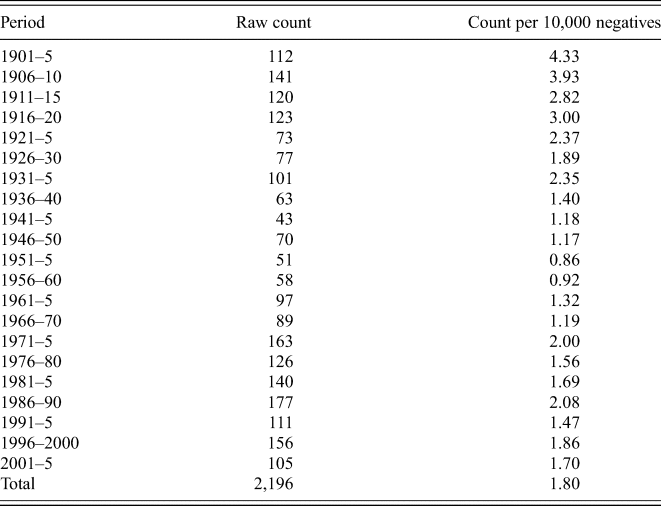
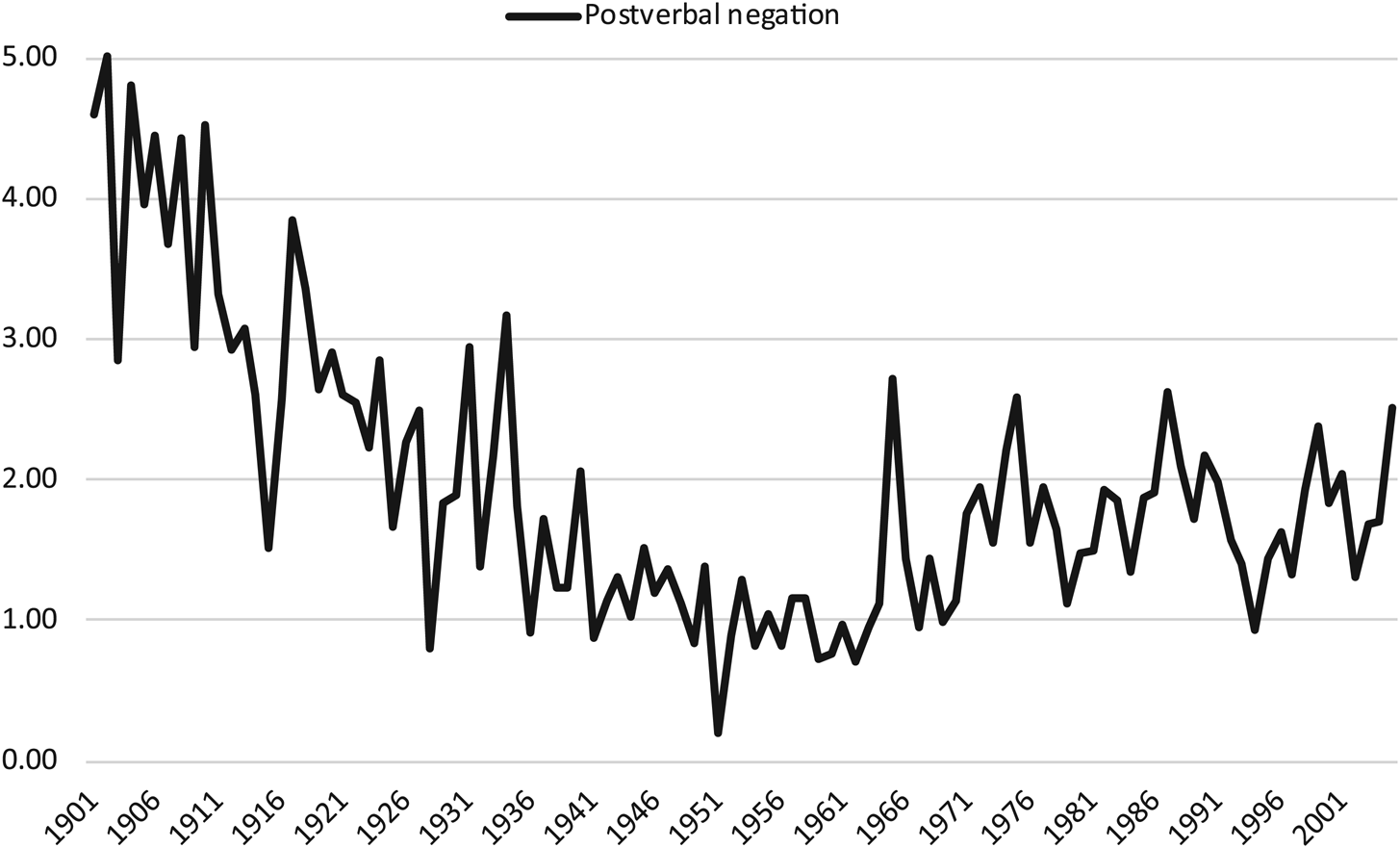
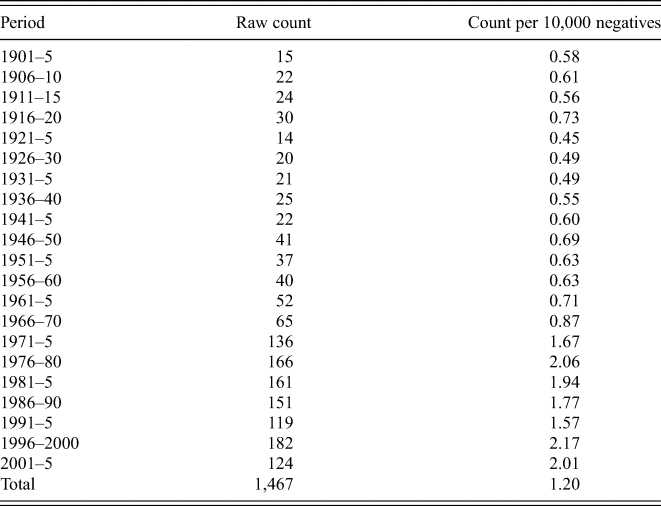
The distribution of postverbal negation within the corpus can be seen in table 1. In order to correct for any fluctuation in the size of the corpus from year to year, the frequency of postverbal negation is given both as a raw count and as a ratio to every 10,000 occurrences of the lexeme not.Footnote 6 Diachronic trends in the relative frequency of postverbal negation can be seen more clearly in figure 1.
Postverbal negation (token count)

Postverbal negation (relative frequencies)

As figure 1 shows, postverbal negation declines over the first half of the twentieth century, but then undergoes something of a resurgence. In the second half of the century, although the height of the highest peaks remains relatively constant, the depth of the troughs tends to decrease. It can be seen from this figure that a considerable degree of fluctuation exists from year to year; in order to establish the significance of trends within this fluctuation, and to determine whether the quantity of the data is sufficient to allow meaningful conclusions to be drawn, the data were subjected to statistical analysis. The sample was divided into two periods, and each portion was analysed using Spearman's test, to determine whether there was a significant positive or negative correlation within that period between position in time and frequency of postverbal negation. In each case a significant correlation was found, a negative correlation from 1901 to 1950 (-0.848, p < 0.01) and a positive correlation from 1951 to 2005 (0.593, p < 0.01). Although postverbal negation was in decline throughout the first half of the twentieth century, this trend was then reversed, and postverbal negation subsequently underwent a significant increase in its use. It should also be noted that these trends are primarily quantitative in nature; no other changes have been observed in the nature of examples drawn from different time periods.
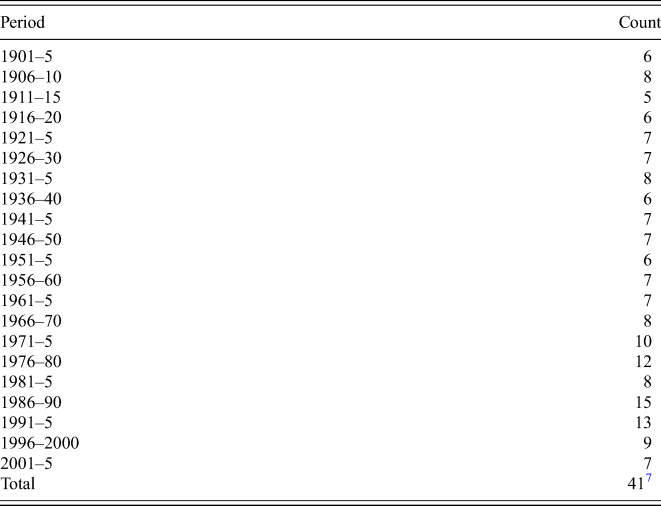
Table 2 shows the number of different verb lexemes occurring with postverbal negation. It can be seen that the number of lexemes found in any one period is generally small, in both the first and second halves of the sample. However, at a broader level there has been an increase in lexical diversity; there are only 7 lexemes restricted to the first half of the sample, while there are 25 that occur only in the second half.
Postverbal negation (lexeme types)

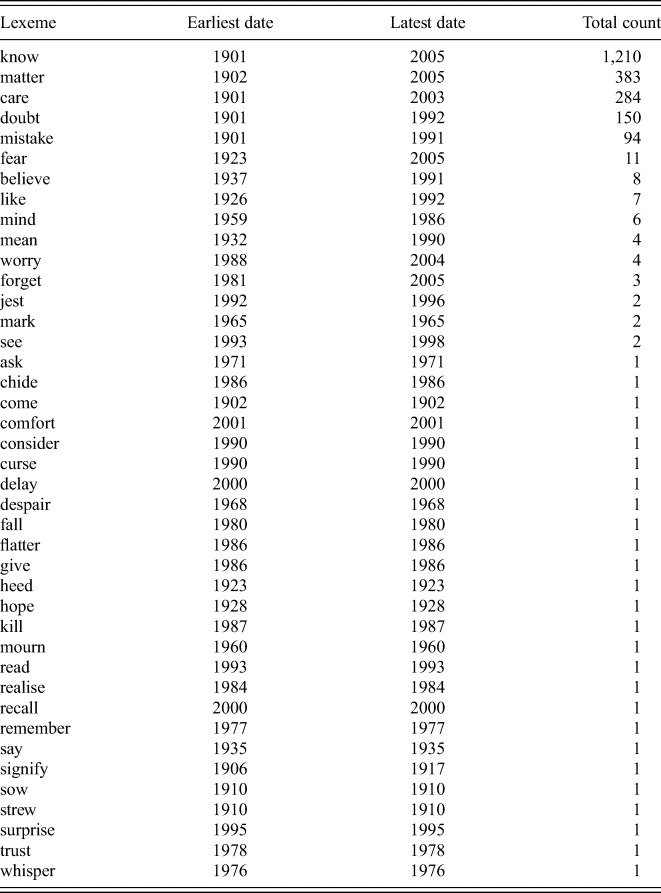
It can be seen from table 3 that postverbal negation is especially frequent with certain verbs, such as know. Postverbal negation has been correlated to different extents with different lexemes from the time when it first began to be supplanted by forms with do; for example, Rydén (Reference Rydén1979) found that do-support took longest to become obligatory for verbs denoting mental states and speech acts. However, postverbal negation in the present sample also occurs with verbs outside these categories, such as delay, and even within these semantic categories a wide range of lexemes can be observed. Although there are certain collocations in which postverbal negation is especially frequent, the possibility of extending it freely to other environments still seems to exist. This might militate against interpreting postverbal negation in terms of lexical restriction, such as the analysis proposed by Varga (Reference Varga2005), to account for its distribution in the early nineteenth century; instead, there would be a closer parallel to the eighteenth-century situation described by Rissanen (Reference Rissanen and Lass1999: 245), in which postverbal negation occurred most frequently with specific verbs such as mistake, but could also be observed with less usual verbs such as degenerate. It should also be noted that because of the relative infrequency of postverbal negation in Present-day English, the earliest and latest attestations in table 3 may not necessarily reflect genuine diachronic change in the language; for example, the absence of doubt not after 1992 need not imply that this verb can no longer be used with postverbal negation. Despite the sparseness of the record, though, the general trend seems to be one of increasing expansion beyond the collocations that have been the strongest bastions of postverbal negation.
Lexeme distribution

4.2 Syntactic archaism in questions
The data shown above would seem to suggest that postverbal negation enjoys a real, if limited, productivity within Present-day English. One question arising from this phenomenon concerns the syntactic relationship between these contemporary examples and the postverbal negatives prevalent in Early Modern English. It was seen in section 2 that postverbal negation, as a surface pattern, can potentially correspond to more than one type of syntactic structure, and that the grammars producing these structures may differ in the extent to which they can produce questions, negative imperatives and negative declaratives without do-support. Accordingly, additional data have been sought to clarify the similarity of Present-day English to the stages observed in the earlier development of the language.
In order to identify questions involving direct inversion of the auxiliary verb, without the use of auxiliary do, searches were performed on the same subset of the Hansard Corpus used above. Unlike negative constructions, there is no specific lexeme such as not by which such questions can be identified, and the absence of syntactic annotation in the corpus makes it necessary to find some indirect means of identifying relevant forms. Accordingly, searches were performed only for the three lexemes occurring most frequently with postverbal negation: care, know and matter. Sentences were identified in which any finite form of matter was followed by the most probable subject pronoun, it, or in which care was followed by any subject pronoun. In the case of know, similar searches would result in a large number of false positives in which the word sequence in question spanned a clause boundary (e.g. I knew they agreed); instead, a search was performed for sentences in which know was preceded by an interrogative object pronoun.Footnote 8 After the remaining false positives were manually excluded, the searches for these three lexemes resulted in only 14 results throughout the entire corpus, with the latest example occurring in 1957.
(14) What cared he whether city treasurers and accountants, people who had spent their lives in this kind of thing, had made estimates? (C-1957 Mitchison (C))
In the case of know, no relevant forms at all were identified. Table 4 shows a comparison of forms with and without do for the remaining two verbs, in questions and in negatives, across the entire period from 1901 to 1959:
Interrogative and negative constructions

In these figures, the same restrictions on subjects and objects have been made in all cases (e.g. matter only with the subject it), in order to make a valid comparison possible between interrogative and declarative constructions. Despite these restrictions, sufficient data are available to allow for meaningful comparison of the two types, as shown by the presence of statistically significant differences in frequency between interrogative and declarative constructions (care: χ2(1) = 4.778, matter: χ2(1) = 4.766; p < 0.05 in both cases using Fisher's Exact Test). The data from these two verbs show that there is no necessary correlation between the productivity of postverbal negation and the productivity of questions without do-support, even if questions of this type should prove to be more frequent with other verbs. Moreover, the complete absence of any interrogative examples after 1957 seems suggestive; these constructions do not appear to have participated in the sudden rise in productivity that occurred for postverbal negation around this time. It should also be noted that little evidence exists from other sources to suggest that questions without do-support are productive in Present-day English (e.g. inter alia Denison Reference Denison and Romaine1998; Han & Kroch Reference Han and Kroch2000). If no evidence to the contrary is forthcoming from a preliminary investigation of the Hansard Corpus, there may be little need for further work to substantiate the existing consensus.
4.3 Postverbal negation in imperatives
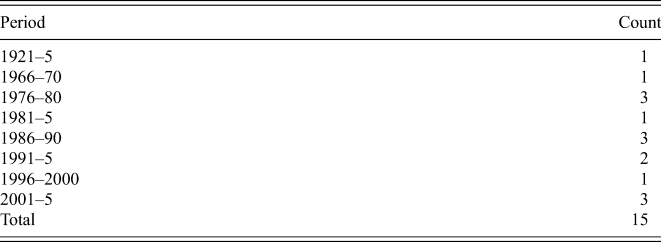
As discussed in section 2, there was a stage in the development of the English verbal system at which postverbal negation was more frequent in imperatives than in declaratives. Data on the relative distribution of imperatives and declaratives within the Hansard Corpus may therefore be useful in determining how closely the present-day situation reflects earlier stages of the language. The tables in section 4.1 show combined totals for imperatives and declaratives together. When they are separated, it can be seen that the proportion of imperatives is very low: only 15 examples in the entire corpus, or 0.68 per cent of all postverbal negatives. Their diachronic distribution can be seen in table 5.
Postverbal negation in imperatives

Most of these examples occur in the later portions of the corpus, in contrast to the pattern of decline seen in the previous section for questions.
(15) Forget not, my Lords, that when we had an Empire we governed over 30 per cent. of the known mineral resources of this world. (L-1977 Evans (L))
It will be seen below that this provides some support for the hypothesis that contemporary postverbal negation represents a new phenomenon. Nevertheless, the total number of imperatives with postverbal negation remains very low in all periods. One possible explanation for this scarcity is that imperatives of any sort are rare in the Hansard Corpus. To test this, a rough estimate of the number of negative imperatives with do-support was obtained by searching for all sentences beginning with the words ‘do not’, and 9,551 such results were identified. It was found that imperatives with postverbal negation represent 0.16 per cent of negative imperatives, whereas in section 4.1 it was shown that postverbal negation in all environments constitutes only 0.018 per cent of all negatives formed with not; the higher relative frequency for imperatives might seem to suggest that postverbal negation is especially favoured in this environment. One possible factor to be borne in mind is that the count of imperatives with do-support is not exhaustive; the true figure would include imperatives with other sentence-initial elements, and imperatives with postverbal negation would therefore constitute a smaller proportion of the whole. However, if the observed difference, of nearly a factor of 10, were due to this alone, it would mean that negative imperatives with sentence-initial ‘do not’ were in the minority. Further research may be necessary to identify whether this difference is an artefact of sampling or whether speakers consistently differentiate between imperative and declarative sentences in their use of postverbal negation.
5 Postverbal negation in context
5.1 The status of postverbal negation in Present-day English
The data presented above show that postverbal negation has undergone a recent rise in productivity; however, there remains the question as to the linguistic basis of the observed phenomena. If speakers of Present-day English are able to accommodate such constructions within their linguistic systems, this accommodation may potentially be interpreted in terms of lexical change or of syntactic change. A change of the former type that could account for contemporary examples of postverbal negation is a lexical split, so that Present-day English now possesses two lexemes of the form not; one not is a specialized negative marker, associated with a specific syntactic head such as Neg, while the other is an adverb that can be adjoined to a verb phrase in the same way as any other adverb. According to such an analysis, (16a) and (16b) would therefore be syntactically parallel:
(16) (a) John comes not.
(b) John comes seldom.
Such a development, as a reviewer observes, would be an example of degrammaticalization. Diachronic change in language often takes place along a grammaticalization cline (e.g. Hopper & Traugott Reference Hopper and Traugott1993: 7), from independent, semantically rich forms towards forms characterized mainly in terms of their role in the grammatical system; change in the contrary direction, while well attested in some instances, tends to be less frequent (Norde Reference Norde2009). A lexical split of the sort described above, in which the new not is added to the large open class of adverbs, would fall into the latter category.
Another potential interpretation of contemporary examples of postverbal negation is in syntactic terms. Under such an analysis, there would be only one lexeme not; postverbal negation would occur when the verb was raised to a higher position than not in the syntactic structure. As discussed in section 2, such an interpretation would not be equally compatible with all syntactic analyses of the English verbal system. An analysis in which postverbal negation was necessarily correlated with the presence of questions without do-support (e.g. Kroch Reference Kroch1989) would be difficult to reconcile with the observed data, in which the latter decline while the former increase. However, the data would be more compatible with analyses proposing a grammar in which the verb raises to Asp, and therefore cannot be moved to sentence-initial position for questions, while still being able to precede not. The main task facing any syntactic analysis involving verb-raising would be to explain how postverbal negation could coexist with the far more frequent negative constructions with do-support. Authors such as Kroch (Reference Kroch1994) have proposed that any such syntactic variation is the result of speakers’ switching between separate, complete grammars; alternatively, various proposals have been made for ways in which syntactic optionality can be accommodated within a single grammar (e.g. Henry Reference Henry1998; Biberauer & Richards Reference Biberauer, Richards and Boeckx2006). In either case, the spontaneous emergence of such syntactic variability would be a situation with few clear parallels.
There may be few empirical criteria available for selecting among the different potential analyses. The scarcity of questions without do-support is a phenomenon which it is possible to account for in either lexical or syntactic terms; in the former case, the new lexeme not would be irrelevant to question formation, while in the latter case, postverbal negation would involve verb raising only to a relatively low head. The primary diagnostic for verb movement used by Haeberli & Ihsane (Reference Haeberli and Ihsane2016) is adverb placement, but the relevant adverbs are seldom attested in the Hansard Corpus data on postverbal negation. In the absence of any decisive empirical criterion, it is suggested here that the lexical hypothesis is the most parsimonious. A syntactic explanation would require learners either to acquire a separate grammar or to reconstruct an existing one in order to accommodate a greater degree of optionality, on the basis of constructions occurring quite infrequently in their input. A lexical explanation, while involving a typologically infrequent process of degrammaticalization, only requires speakers to add a single item to their lexicon. Such an explanation also accounts easily for the predominance of certain verbs in postverbal negation. The new adverb not, like any other lexeme, would have the potential to enter into collocations with other lexemes, and the verbs that have historically had the strongest association with postverbal negation would be the most likely candidates to enter into these new collocations. In this way, a high degree of surface continuity could be preserved in spite of changes in the underlying structure.
5.2 Causes of change
The question also remains as to why postverbal negation continued to decline until the middle of the twentieth century and only then underwent a resurgence. There is some evidence to suggest that this resurgence is part of a broader phenomenon involving other changes in the surface patterns of negation. As discussed in section 3, surface strings in which not immediately follows the verb can also be produced by constituent negation, and examples such as (13) illustrate the existence of contexts in which the semantic distinction between sentential negation and constituent negation is largely neutralized. One possibility is that sentences of this sort provided a potential locus for reanalysis; a structure in which not originally modified another constituent can be reinterpreted as one in which it modifies the verb itself. Such reanalysis would be especially favoured by sentences such as (17), in which a negated constituent is followed by a positive alternative in a separate clause, rather than in the same clause:
(17) It means not that we have to refer every little detail to a body sitting in some place which nobody can get at, but it means that we can have the advantage of the local knowledge and the personal touch to which hon. Members opposite rightly attach considerable importance. (C-1928 ----- (C))
It is possible that a sentence of this sort was originally meant as constituent negation, with resumption of the verb in a new sentence as a form of anacoluthon. However, to hearers who were aware of postverbal sentential negation as a possibility, it could be interpreted as easily in these terms.
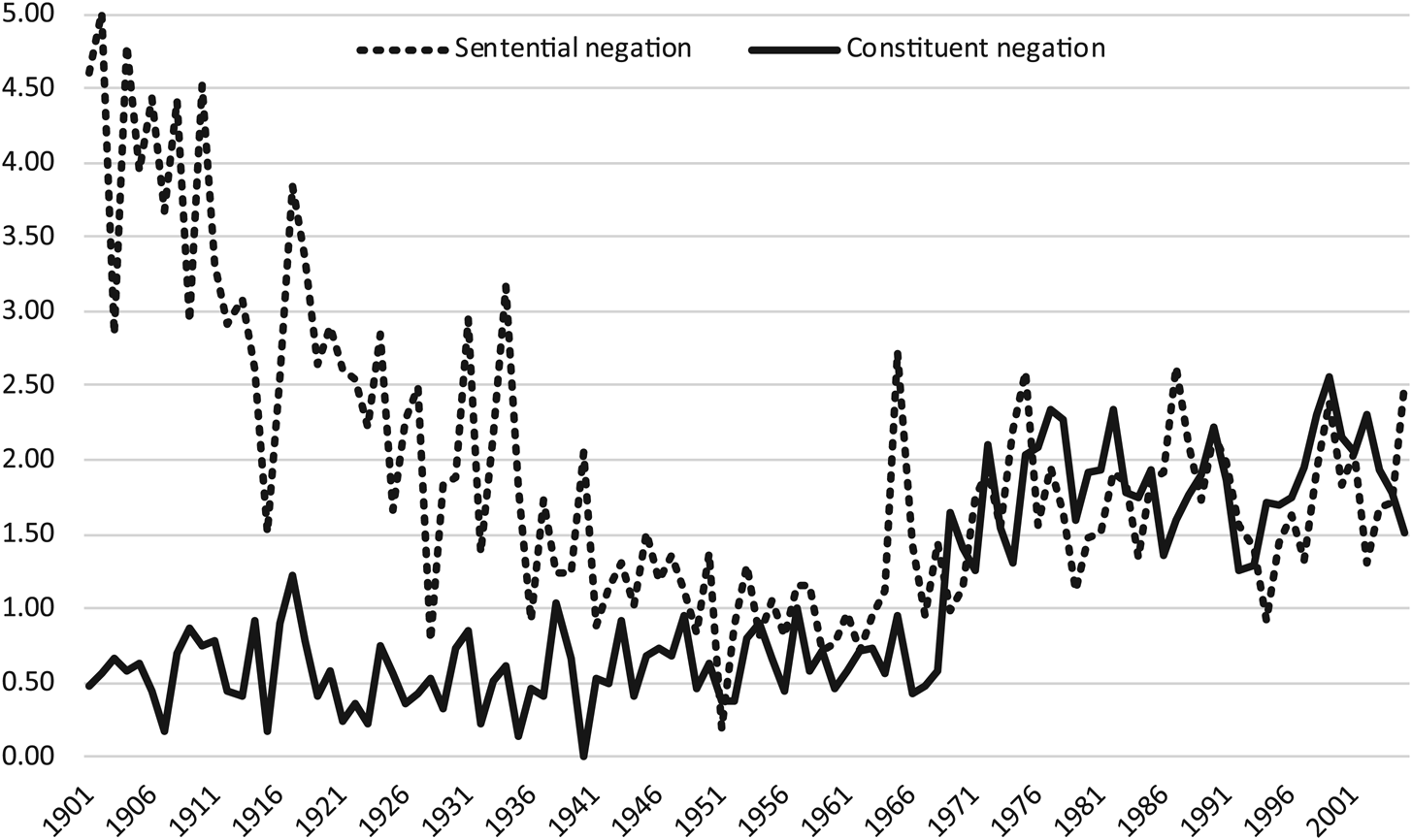
Data from the Hansard Corpus, as shown in table 6, were used to test this hypothesis as well. Searches were performed using the same parameters as those used to identify postverbal sentential negation, but here only examples of constituent negation were counted. It can be seen that there is a continual increase in constituent negation in which not immediately follows the verb from the beginning to the end of the entire sample. The variation in the first half of the twentieth century is not statistically significant (Spearman's correlation coefficient 0.012, p > 0.05), but there is a significant increase in the period from 1951 onward (0.723, p < 0.01). However, this increase seems to begin slightly later than the increase in postverbal sentential negation (see figure 2).
Constituent negation (token count)

Constituent and sentential negation

Figure 2 contrasts the distribution of comparable forms of constituent negation with the previously seen distribution of postverbal sentential negation. It will be seen that constituent negation is usually the less frequent of the two until it undergoes a sudden increase at the end of the 1960s; this might suggest that reanalysis of the sort discussed above was not the primary factor in the rise of postverbal sentential negation. However, it is possible that both constructions may have been affected by some broader trend involving the stylistics of negative constructions; such a trend might operate on multiple aspects of the language to increase the frequency of surface constructions corresponding to a desired type. Even if such a broader trend existed, its ultimate causes would still remain obscure; further research is necessary to clarify the origin of these changes in negation.
5.3 Postverbal negation beyond the Hansard Corpus
The data presented above have been drawn exclusively from the Hansard Corpus; they therefore represent only a single genre and a single, relatively circumscribed mode of discourse. It may therefore be asked what evidence there is for the productivity of postverbal negation outside the parliamentary sphere. A search was also performed, using the same parameters, within the British National Corpus (BNC Consortium 2007), allowing a much broader range of genres and contexts to be included; this identified a total of 137 tokens across 83 texts. These include examples such as (18)–(20), which are all drawn from popular periodicals in contexts without any other apparent signs of deliberate archaism.
(18) 40 escalators out of service over the 270 stations, but fret not; it's estimated that all will have been repaired by 1996. (AAV 952)
(19) Such is the informality of this unique little island that it matters not who you are or what you have. (K4T 9953)
(20) With great foresight, the scientists operating this marine 0898 line had also brought a tape of a large male whale – saying what, we know not […]. (K5K 39)
Postverbal negation is undoubtedly the more marked form relative to negation with do-support, and it is most likely to be employed by speakers wishing to make use of a marked form for various stylistic purposes. For example, a sentence such as (20) may represent an intention to exploit the construction's high-register associations for jocular effect. However, examples such as (19) can also be found, in which the use of postverbal negation seems less self-conscious and in which it is more difficult to assign so specific a stylistic value to the choice of construction. Despite the existence of stylistic variation, the postverbal negation in (18)–(20) appears to be syntactically and semantically comparable to the previous examples from the Hansard Corpus. The most parsimonious assumption would seem to be that all these examples share the same syntactic and lexical basis, and that the various members of the speech community who share this construction are able to exploit the potential that it offers in different ways and to different extents. It should be noted, though, that the British National Corpus provides a relatively small number of examples, from a much shorter span of time than the Hansard Corpus; it is therefore difficult to determine to what extent the diachronic trends observed in the Hansard Corpus are reflected elsewhere.
6 Conclusion
Postverbal negation, in which a finite lexical verb is negated by a following not without the use of an auxiliary such as do, is usually described as ungrammatical in Present-day English. Any apparent exceptions to this generalization have been implicitly or explicitly ascribed to isolated archaisms preserving syntactic fossils incompatible with normal usage. In order to test the validity of this generalization, the Hansard Corpus was searched for examples of postverbal negation. As an exhaustive search of this corpus was not methodologically practicable, a more restricted search was performed; examples of postverbal negation were identified for verbs used intransitively or absolutely, or verbs with a clausal or pronominal object, while other types of object such as nominal phrases were excluded. However, as the received consensus is that there are no environments in which postverbal negation is currently productive, an increase in its use in any environment would be unexpected. Such an increase was in fact found by the present analysis. For the subset of constructions being analysed, postverbal negation underwent a conspicuous increase in productivity during the second half of the twentieth century; the quantity of data obtained from the Hansard Corpus was sufficient to obtain statistically significant results and preclude the possibility that this increase was due to chance. Moreover, although certain collocations are especially prevalent, postverbal negation is found with a wide range of verbs and construction types.
The hypothesis proposed here to account for this development is of a lexical split. As a result of this split, contemporary examples of postverbal negation involve a new lexeme not, which has the syntactic properties of an ordinary adverb rather than being tied to a specific syntactic position such as a Neg head. Such an analysis is compatible with the resurgence of postverbal negation in negative declaratives and imperatives, without any decrease in the dependence upon do-support of other constructions, such as questions. The increase in postverbal negation may be part of a broader trend favouring the appearance of surface forms in which a verb is followed by not, a development seen also in stylistic trends involving constituent negation. The persistence of postverbal negation as an archaism may have given rise to its new role as a productive participant in such trends.
A number of questions remain for future research on postverbal negation. As described above, the non-exhaustive search methods used can identify only a subset of all potential environments for postverbal negation. Two scenarios are therefore possible: either the trends observed in the data reflect developments affecting the language more broadly, as hypothesized here, or else the data reflect the behaviour of a discrete group of constructions whose behaviour with regard to negation is exceptional. Further research has the potential to establish which of these scenarios are correct. It would also be desirable to examine data from a broader range of texts; as the data from the British National Corpus show, the relative infrequency of these constructions would make it necessary to use as large a corpus as possible in order to obtain a meaningful number of examples from different types of text. Moreover, a conclusive explanation is still lacking for the ultimate cause of the observed changes in English negation; the inclusion of additional variables might help to identify some of the factors responsible for this development. Although many details are still unclear, the present study reveals a picture of postverbal negation in Present-day English substantially different from anything envisioned in previous work on this topic. It is hoped that the data shown here will provide a starting point for the recognition and understanding of a phenomenon whose existence is often actively denied.