

Introduction
Washington had too many theories for Vietnam and too little knowledge of it.Footnote 1
In the aftermath of the wars in Iraq and Afghanistan, as it became apparent to policy-makers and social scientists that the United States of America's efforts to foster Western-style, liberal democracies had failed, schools of interpretation emerged to compare the American nation-building experience in the Middle East to an earlier one in Asia, also deemed a fiasco: Vietnam.Footnote 2 The voluminous Vietnam War scholarship has explored the multiple facets of the United States of America's involvement, paying attention to its initial nation-building phase and commitment to Ngô Đình Diệm's Republic of Vietnam. Despite realizing from the inception the regime's many weaknesses (nepotism, corruption, inflexibility, and so on), the United States of America persisted in its support until the fateful 1963 coup. This denouement and the subsequent quagmire have provided a further impetus to reassess American understanding of the phenomenon, primarily to avert future American foreign policy failures, but also, for some, to justify its intervention in the eyes of history.
Early American knowledge regarding its Ngô ally was derived from encounters between Westerners (predominantly Americans) and those Vietnamese who worked for the Republic of Vietnam (RVN, a.k.a. First Republic) and from the countless hours listening to Diệm's monologues. It was fundamentally shaped by the works of Diệm's apologists and critics: Bouscaren, Fall, Scigliano, Shaplen, and so on.Footnote 3 The sum of this knowledge, disseminated through adroit manipulation of the mass media, forged a narrative built on faulty premises. As Seth Jacobs has demonstrated, the lobby known as the American Friends of Vietnam (AFV) contributed to a wide-ranging ‘gulling’ of the American public opinion through its management of the Western press.Footnote 4 Most of the presumed ‘Vietnamese’ sources regarding the RVN stemmed from the regime's Western-language, American-inspired propaganda organs, especially its Ministry of Information and Psychological Warfare.Footnote 5 As Edward Miller and Tuong Vu have observed, the ‘America-centric quality of most Vietnam War scholarship’ may have created an assessment gap in accurately appraising the regime and led to ‘Orientalist’ characterizations.Footnote 6 To redress the situation, a few American scholars with more sophisticated linguistic and cultural training have attempted to decipher Diệm by adopting a Vietnam-centred, culturally sensitive approach based on Vietnamese-language sources. They have repositioned him away from the Manichean dichotomy of either ‘saviour of democracy’ or ‘mandarinal autocrat’, from being viewed either as a ‘Confucian mandarin’ or as ‘a Westernized, modernist’ politician, and closer to a depiction of Diệm as an active agent of his destiny and as a man bridging two worlds. Ngô Đình Diệm—the president, his family, his Republic—has been recast in a more central, nuanced, and even positive light, as he was shown to be neither profoundly Confucian nor completely Westernized, but rather a politician who epitomized both. Philip Catton, for example, argues that Diệm was not ‘an old-fashioned “Oriental” despot’, but, along with his brother, Nhu, could be considered as ‘conservative modernizers’.Footnote 7 Jessica Chapman, for her part, notes that Diệm ‘navigated the country's transition from its traditional past and colonial administration to independence in the midst of an ongoing quest for modernization and national reunification’, borrowing ideas about democracy from the West while still deeply committed to the ancient Confucian concept of thiên mệnh/mandate of Heaven.Footnote 8 Edward Miller contends that the Western, colonial, modern context of French Indochina should be taken into account, as Diệm's ‘ideas about governance, politics and society were not holdovers from Vietnam's ancient past; rather, they were formed in his encounters with interwar European and Vietnamese discourses about modernity, progress, and revolution’.Footnote 9 Nevertheless, this newer, Diệm-centred scholarship tends to investigate the Ngô Đình Diệm phenomenon within a tightly constrained chronology of 1954–63, without recognizing the dysfunctionality of such a segmented timeline and the fact that the Ngô family's deep roots into an imperial and colonial past had bound the main characters lastingly together at the personal, symbolic, and political levels long before the United States of America's intervention.
Both the American nation-building practitioners such as Wesley Fishel and his Michigan State University Group (MSUG) as well as the cultural historians based their arguments on the denial of the centrality of resilient historical experiences in nation-building, ‘all the old habits of thinking and acting, the set patterns which do not break down easily and which, however illogical, are a long time dying’.Footnote 10 In the Vietnamese case, these scholars have ignored the imperial residues and the colonial matrix that still gripped the First Republic's president. While the nation-builders castigated Vietnam's traditional framework and values as obsolete and irrelevant, the culturalists assumed that the nation that the Diệm regime attempted to build was that of modern formulation with roots into a recent past of events but several decades long. Both schools err in not considering the resilience of traditions as reflections of an enduring Vietnamese mentalité. Furthermore, these works fail to reveal the regime's internal thinking and convictions as to how it conceived the nation it was ‘building’ and how this entity may have diverged from its sponsor's views. Such cultural and political gaps had undermined the American foreign policy vis-à-vis this ‘proving ground of democracy in Asia’ from the outset and contributed to setbacks throughout Asia and the world.Footnote 11
This article challenges the existing scholarship, arguing that our understanding of Ngô Đình Diệm or rather of the Ngô family and of its supporters understood as an entity must be based on a longer durée approach to comprehend the indelibility of the past in the construction of the Ngô Republic.Footnote 12 It contends that, since the Ngô and their followers had shaped the Republic into an entrenched bastion of patrimonic power, of personal, faith-based relationships, and of shared traditions, no Western-introduced concept of democracy or notions of freedom and rule of law could alter it fundamentally but could serve only as the ‘emperor's new clothes’.Footnote 13 Furthermore, it will contest the notion of ‘modernity’ regarding the Diệm's phenomenon, as it aims to demonstrate that Diệm was intrinsically of unbending Confucian tradition and deep religious convictions, who perceived himself as the chí sĩ (determined leader) of his people descended from the glorious heroes of past centuries.Footnote 14
Even if the West had been a passing inspiration, even if Diệm's American handlers may have suggested some of the publicly espoused political formulations, in the end, Diệm, his family, and loyal retainers made their own present following an internal rationale reflective of their history, society, and culture. In the early days of the Republic, not only the Ngô, but also their supporters, had their own understanding of how ‘to build a nation’ (kiến thiết quốc gia), which did not necessarily concur and indeed often conflicted with their American patrons’ visions. As the Ngô family affirmed its power in what critics called gia đình trị (family rule), their original supporters, one by one, were to be shed along the road to omnipotence, to be replaced by an all-encompassing patrimonic entity—the Ngô nation—in which the actors not directly related to the Family were rendered powerless and banished to the antipodes.
This article introduces another dimension that differs from but builds on previous Diệm's scholarship by focusing on symbols, rituals, and ceremonies. As Gabriella Elgenius remarks, ‘symbols and ceremonies are markers of nation building’. They ‘are introduced, adopted, altered, . . ., contested, abolished and re-established during pivotal times of nation-making’.Footnote 15 In the case of the First Republic, they marked a Ngô nation that appeared outwardly ‘republican’ and ‘modern’, but at heart carried core values and practices inherited from a deeply rooted dynastic and Confucian legacy. It will examine the practice of public commemorations in Vietnamese history within a longer timeframe, moving from ‘these two poles of time, the instant and the longue durée’, from the pre-colonial and colonial past to the First Republic's present, with, as its point of reference, its National Day: 26 October 1956. It will focus on the preparations and organization—what historian Maurice Agulhon called the ‘folklore of a regime’—of the first anniversary of this freshly invented entity as a reflection of Diệm's intentions.Footnote 16 It will follow the decisions made at the level of the presidency as they radiated to the ministries that implemented them. Eventually, the ensuing commemorations— ‘modern’ in their manifestations but traditional in their symbolic messages—were early portents of the nature of the nation that Diệm and his followers intended to construct, as they staked their claim of ‘successor territory’, inheritor of the Vietnamese millennial legacy in opposition to the ‘falsehood’ created north of the 17th parallel.Footnote 17
This article will open a window into the quốc gia/nation as envisioned by the Ngô and will demonstrate how starkly ‘traditional’ their core conceptions were. It will do so by turning to scores of Vietnamese archival documents that have been neglected by scholars, who may have considered them as inconsequential, pertaining as they did to the domain of ceremonies—and thus may have permitted themselves—in the words of Sean Wilentz—to ‘interpret power in mechanistic and reductionist ways’.Footnote 18 It is hardly the first to examine Asian societies in terms of ritual politics. Catherine Bell, for instance, has shown that, within the context of ancient China, public ritual performances held a pivotal role, combining politics with cosmology, performance with sacredness. For his part, Takashi Fujitani has demonstrated the centrality of political rituals in the creation of the modern Japanese state.Footnote 19 Thus, political rituals, ceremonies, commemorations, and pageantry form the foundation of deeply ritualistic civilizations such as those of China, Japan, and Korea. Vietnam, gravitating in the Sinic world, carried a long-standing ritualistic patrimony that merged, on the one hand, ‘the conventional folklore of the populace—that is, [with] the rites, symbols, customs, beliefs, and practices, that made up the life of the common people’ and, on the other hand, ‘the homogenized, official culture fostered by the state’.Footnote 20
The ancient patrimony
Scholars have defined national days as constituting ‘celebrations and/or commemorations of historic events related to the foundation of the nation-state’.Footnote 21 It has been de rigueur for a modern nation state to celebrate the anniversary of its founding via a National Day, which commemorates a significant historical event or accentuates a foundational mythology. Its selection sends a symbolical message, as it carries with it values emblematic of that nation's spirit, culture, history, and determined future path. National Days’ ‘significance lies . . . in what they tell us about social, cultural and political processes’.Footnote 22 Thus, its choice is part of a politics of memory determined by varied forces that make up the national fabric. For example, France considers the Fourteenth of July as the founding day of its republic that had ended the monarchy in the 1789 Revolution.Footnote 23 For Eric Hobsbawm, Bastille Day, first commemorated in 1880, had transformed ‘the heritage of the Revolution into a combined expression of state pomp and power and the citizens’ pleasure’.Footnote 24 In conquering Vietnam, France would foist this republican festive legacy on the dominated peoples as a display of its military and civilizational superiority.
However, prior to the French colonization of the empire of Đại Nam, in the Vietnamese culture as well in monarchical state practices, there had been ancient holiday-festivals (lễ hội) and public rituals that involved the entire society ‘communing’ in the same experience based on common cultural beliefs. Thus, practised since the fifteenth century, there was the imperial annual ritual of lễ tế Nam Giao performed in public by the emperor, Thiên Tử/Son of Heaven, followed in this by the entire court to bring blessings to the realm and its subjects.Footnote 25 Its organization and performance were minutely regimented, with the emperor's gestures and oral recitations during the event regulated by the Ritual Master. Along the route, villagers set up altars with incense and fruit offerings and bowed deeply as the imperial procession approached. At the village level, there were the innumerable festivals to honour the tutelary spirits or Thành Hoàng (Spirits of Ramparts) of each community that were celebrated at the communal houses (đình). All the public rituals followed a lunar calendar adapted to the cycles of seasons and to the practice of Sino-Vietnamese animistic, Confucian, and Buddhist beliefs.Footnote 26 Unifying this mosaic of festivals and celebrations and given Vietnam's history of repeated invasions from China, there was a tradition issued from and observed by the people, but which was reinforced by the monarchy, of commemorating heroes and heroines who had defended the homeland against invaders. As Benoit de Tréglodé explains: ‘the historical hero offered Vietnamese dynasties a way to politically unify their territorial space.’Footnote 27 The Trưng Queens (First Century CE) and Trần Hưng Đạo (Thirteenth Century CE) became highly ranked heroic figures on whom the monarchy conferred a ‘national deity’ status. The monarchical state also founded or approved the construction of local temples dedicated to their worship in the Red River Delta. The approximate day understood to be that of their victory (or sacrifice) became a ‘traditional’ day to be celebrated by the local community.Footnote 28 These public ritualistic practices created an enduring reflexional template that would readily receive nineteenth-century French Republican imports as well as subsequent twentieth-century national commemorations.
When the French conquered Đại Nam, among the measures enforced by the colonial authorities to undermine Vietnamese culture was the imposition of the French Republican calendar of celebrations on the indigenous ones. Starting from the 1870s, the French forced the Republican culture of commemorations imported from the métropole first on the colony of Cochinchina, and later in the protectorates of Tonkin and Annam. They included the July Fourteenth National Day, Victory Day on 11 November, and the ‘Fête du Patriotisme’ or Joan of Arc commemoration on the second Sunday of May.Footnote 29 Numerous decrees reaffirmed the calendar of fêtes publiques with all their Second-Empire features: Catholic masses, military parades with brass bands, maypole games, fireworks, boat races, bals populaires, and sports competitions were organized for colonized peoples’ edification. Mandarins’ attendance and observance were de rigueur alongside French officials. Eventually, France's commemorative practices became so integrated into the Vietnamese popular imagination as to render them ‘traditional’ public celebrations of twentieth-century Indochina. They created a public space that commingled both state solemn rituals and people's ludic celebrations and habituated the colonized to accept the invented tradition of a ‘National Day’ as quintessential to any modern state's public rituals. Equally, under the French Catholic Church's pressure, a Catholic calendar of saints’ days and celebration of fetes such as Easter, Assumption, and so on were also officially observed, albeit mostly within French colonial and Vietnamese Catholic milieus.Footnote 30
The ‘invention of patriotic tradition’: Khải Định, Decoux, Trần Trọng Kim, Bảo Đại
From the 1880s, Vietnamese monarchical power was slowly eroded as the ruler became a figurehead put on ceremonial display, hemmed in by the French Résident who appeared by his side in all public activities. And yet, Emperor Khải Định (1916–25), considered the most servile of them all, attempted an experiment that bridged modernity and tradition, fusing East and West, even though it was only meant to regild the crumbling imperial image in the eyes of disillusioned subjects.Footnote 31 Apparently inspired by the Fourteenth of July National Day, Khải Định revived on a grand scale a Vietnamese imperial day: the ‘Celebration of National Restoration’.Footnote 32 Previously, it had marked Emperor Gia Long's enthronement or lễ tiến tôn (1 June 1802) following the unification of the empire. Court records describe how, on that day, marked by drum cadences and rhymed by the sounds of the imperial orchestra, with incense swirling in the air, with civil and military mandarins in their high-court robes aligned left and right, the Golden Book, which recorded the name of each new ruler, was brought to the Outer Court. The newly ascended ruler in his gold-embroidered Dragon robes encircled by a jade belt, and his Nine Dragon headdress, made offerings to Heaven and proclaimed the dynasty's founding. At the Temple of Imperial Ancestors, the emperor announced to the ancestral spirits this momentous event, taking his ‘dynastic name of Gia Long to unify’ North and South, and bestowing a general amnesty on those who had been condemned for petty crimes and exempting the population from taxation.Footnote 33 The whole court made its obeisance as the mandarins kowtowed. Outside of the Imperial Citadel, the population followed suit. Nine artillery salvos were fired. Successive emperors continued the practice of marking their new reign by conducting strictly regulated commemorative rituals.Footnote 34
Khải Định's revival on 10 June 1919 followed prescribed imperial rituals and offerings to Heaven and Earth and to the ancestral spirits. But, by then, these rituals had to integrate colonial strictures such as the presence of French representatives, music, marching bands, and so on. This imperial ‘National Day’, promoted by the Huế court, was celebrated throughout the protectorates of Tonkin and Annam as a public holiday—though not in Cochinchina, a colony. The ‘Celebration of National Restoration’ continued until Emperor Bảo Đại's abdication in 1945. Significantly, this imperially invented and French-inspired tradition, interrupted by the Pacific War, was renewed under the French-sponsored, Bảo Đại-led State of Vietnam in 1949. Thereafter, the Republic of Vietnam (1955–63) would ‘recycle’ its symbolic matrix into its politics and administrative practices.
During the Pacific War, under the diarchic Franco-Japanese occupation (1940–45), Indochina was permitted to commemorate an indigenous ‘National Day’. Governor General Jean Decoux implemented a Pétainist strategy that encouraged the revival of Indochinese ‘patriotism’.Footnote 35 He allowed it to express itself in many ways, including parades, youth movements, and public celebrations.Footnote 36 The commemorations of national heroes such as the Trưng Queens, for the first time celebrated along with Joan of Arc, figured prominently among Decoux's patriotic revival measures.Footnote 37 The commemorations followed a pageantry of Catholic masses, public singing of rousing French anthems—in this case, the Marseillaise but also the Pétainist Maréchal Nous Voilà—and sporting events. Decoux's dangerous game was, however, disrupted by Japan's March 1945 coup, which facilitated the creation of a Vietnamese government under Trần Trọng Kim. From March to July 1945, this government attempted the erasure of colonial symbols but continued to employ Decoux's apparatus of mass and youth mobilizations. Thus, a new flag and anthem were created and an attempt to replace the French colonial nomenclature by an indigenous one was begun, with ‘Vietnam’ becoming the official reference to the country.Footnote 38 Kim's government was ephemeral, but several of its measures to affirm independence were to be taken up by successive incarnations, including the French-instigated State of Vietnam and its successor, the American-supported Republic of Vietnam.
In the aftermath of the Second World War, France attempted to regain its colonial empire by countering the rise of independence movements in its Indochinese Union. To neutralize the Việt Minh's nationalist appeals, France recalled to office, though not to his throne, ex-emperor Bảo Đại. The 8 March 1949 Elysees Agreement between France and Bảo Đại proclaimed the ‘independence’ of an Associated State of Vietnam within the French Union. Subsequent decrees, in July 1949, granted, in principle at least, Quốc Trưởng (Chief of State) Bảo Đại full legislative and executive powers.Footnote 39 From 1949 to 1954, the Bảo Đại solution proved ineffective in rallying popular support. However, the ceremonial manifesting-the-nation aspect of the State of Vietnam continued the legacy of the Trần Trọng Kim's government, as the French-imposed national holidays were replaced by Vietnamese ones, while the colonial mechanics of public commemoration such as military brass bands, public speeches, youth demonstrations, and so on were retained. Bảo Đại even revived Emperor Khải Định's imperial-nationalistic commemoration of the ‘Celebration of National Restoration’ with full ‘solemnity and desirable pomp’ throughout the territory.Footnote 40 Reports from provinces in the Mekong Delta affirmed that the ‘National Restoration Day’ was dutifully celebrated, that the national flag—three blood-red stripes on an imperial yellow background—was flying everywhere, with the new national anthem sung by all.Footnote 41 In a move that revived the imperial past, it was decided that the official ceremonial attire for public servants should be the silk tunic and turban formally worn by the Nguyễn court's mandarins.Footnote 42 Symbolically, the State of Vietnam merged Nguyễn-dynastic festivals, French-instigated colonial commemorations, and Vietnamese-inspired nationalistic ones, creating a rich and variegated fabric into which the Ngô would weave their own symbolic vision.
Conflicted loyalties, contesting faiths
During the 1930s and 1940s, the Ngô brothers began to gather followers, who were overwhelmingly northern and Central Vietnamese in their origins, and Catholic in their religion. Some, like Trần Chánh Thành, had participated in the Việt Minh government but left to follow Ngô Đình Diệm. Others such as Trần Kim Tuyến or Đỗ Mậu had been early supporters and went on to serve in important positions within the Diệm Administration.Footnote 43 The few southerners such as Hùynh Văn Lang were, like the others, full of hope when they answered the call to serve the new prime minister in the summer of 1954.Footnote 44 These men coalesced around the Ngô family's sons, especially Diệm and Nhu, and would serve them, some loyally to the end in 1963, others with mounting disappointment leading to flight or dissent.
Ngô Đình Diệm was from a Catholic family of Central Vietnam, whose father, Ngô Đình Khả, had trained in the French missionary seminaries in Huế and in Penang.Footnote 45 Khả had worked for years for the French colonial authorities as an interpreter prior to being promoted into the imperial Administration.Footnote 46 Much has been made about the fact that Diệm ‘was not educated abroad or in a completely Western school’ to demonstrate his ‘authentically Vietnamese’ roots; in fact, he had followed the same intellectual and religious path as his father's in the local French-founded missionary schools and seminaries.Footnote 47 After graduating from the Hậu Bổ (Mandarinal Training School) in Huế in circa 1922, he started his career as a French-appointed administrator in a number of districts in Central Vietnam, earning a reputation for ruthless efficiency in combatting dissidents, until he was plucked out of anonymity thanks to Catholic familial connections to be appointed minister of interior under Bảo Đại in 1933.Footnote 48 He navigated the rigid court culture of French-dominated, imperial Huế, patronized in this journey by the powerful Catholic Prime Minister Nguyễn Hữu Bài, his godfather and in-law through matrimonial alliance.Footnote 49 Thus, from the inception, his worldview had been profoundly influenced by Vietnam's imperial and colonial past.Footnote 50 For Diệm, traditional symbols were regarded as fundamentally integral to a national ethos, especially the nationhood symbolism of historical heroes and state rituals long considered as expressions of imperial power. Modern and specifically Western concepts that supposedly inspired him later were simply utterances meant for an external audience.
According to Vũ Ngự Chiêu, during the Franco-Japanese occupation, the Ngô family switched allegiance from the French to the Japanese patron, as they had felt slighted by the former, who favoured Phạm Quỳnh, Bảo Đại's prime minister.Footnote 51 The Ngô’s support for the Japanese, along with their backing of Prince Cường Để and founding of a political party (Đại Việt Phục Hưng or Restoration of Great Viet), led the French Sûreté to crack down on the brothers on 12 July 1944, with Diệm escaping to Saigon under Japanese protection. During the post-1945 years, Diệm danced the ‘pas de deux with the Việt Minh’ while setting up anti-communist networks and re-establishing ties with Bảo Đại, then residing in Hong Kong.Footnote 52 It all came to naught, as, by August 1950, with the Việt Minh out to assassinate him, Diệm left the country in search of external support in Europe and the United States of America, stopping in Japan to visit his former patron, Cường Để.Footnote 53 There, Diệm's activities were closely monitored by American diplomats, and ‘one of their principal sources of information’ was Wesley Fishel—a professor of political science who also served as an officer in ‘the Military Intelligence Section of the General Headquarters of the Far East Command’. In his reports, Fishel was initially impressed by Diệm but soon found him to be ‘vague and general in his comments’, leading him to conclude that Bishop Thục was ‘the driving force behind Diệm’.Footnote 54 Fishel maintained contact with the Ngô family and was among their first American supporters within the ‘Vietnam Lobby’.
Among the Western-educated Ngô brothers, Nhu chose the secular path of the Ecole des Chartes, from which he graduated in 1938; he returned to Indochina to work at the Hà Nội and Huế Archives from 1939 to 1942.Footnote 55 During these years, Nhu founded a network of Catholic organizations, some of which were to form the core of his Cần Lao Nhân Vị Cách Mạng Đảng (Revolutionary Personalist Labor Party), dubbed Cần Lao.Footnote 56 A report by the local French Sûreté agent to Admiral Decoux, dated 18 August 1944, indicated that the agent had had regular exchanges with Nhu, who reported conversations with his brothers, Khôi and Diệm. Nhu attested to Khôi's loyalty, ‘sworn on the cross’, toward France, since Khôi owed France his ‘bowl of rice’. In contrast, Nhu reportedly qualified Diệm's anti-French incitation as being ‘culpable and blindly extreme’.Footnote 57 When the Democratic Republic of Vietnam offered Nhu the position of ‘director of the Archives and National (formerly Central) Library in Hanoi’ in September 1945, he accepted but, recognizing imminent danger, sought refuge in Catholic seminaries on his southern flight. It was in the Đà Lạt seminary that Nhu explored Jacques Maritain and Emmanuel Mounier's philosophy.Footnote 58 The resulting doctrine, chủ nghĩa Nhân Vị (Personalism)—an amalgamation of Vietnamese culture, East Asian traditions, French Catholicism, and ‘Marxian economic analysis’—provided Cần Lao with its ideological foundation. To the degree that it could be described as presenting a coherent worldview, it advocated an authentic Vietnamese culture stressing ‘humanistic values’, an equitable government of ‘true freedom of religion’, and a governmentally supervised economy of ‘sharing’.Footnote 59 While Diệm was in exile in Europe and in the United States of America, Nhu was preparing the political foundation necessary to catapult his brother to power by founding a weekly paper, Tạp Chí Xã Hội (Social Review), in Saigon, by crisscrossing the country to mobilize Catholic support, and by founding the Công Nông Chánh Đảng (Workers and Peasants Party).Footnote 60
In the aftermath of the Geneva Accords, Diệm, appointed prime minister by Bảo Đại, returned from Paris to Saigon on 25 June 1954, officially entrusted with the mission of forming a government. By 5–6 July, the newly coalesced Cabinet included many of Diệm's early and Catholic followers from northern and Central Vietnam. A notable exception was the southern-born Buddhist Nguyễn Ngọc Thơ, who was appointed secretary of interior in July 1954.Footnote 61 Thơ, whom Diệm considered ‘the most brilliant administrator in South Vietnam’, became vice president of the new Republic in December 1956 and served in this capacity alongside President Diệm until the 1963 coup. Thơ provided a veneer of regional and religious balance, but his influence on major political decisions was limited, especially during the 1963 Buddhist Crisis.Footnote 62 Ngô Đình Nhu's father-in-law, Trần Văn Chương, who had been minister of foreign affairs in Trần Trọng Kim's government, was appointed secretary of state and later ambassador to the United States of America.Footnote 63 Chương's brother, Trần Văn Đỗ, the State of Vietnam's representative at the 1954 Geneva Conference, was named secretary of foreign affairs.Footnote 64 Trần Chánh Thành became secretary of state and of information and youth. He headed the regime's mass movement, Phong Trào Cách Mạng Quốc Gia (National Revolutionary Movement), as well as the legislative committee in charge of drafting the Republic's Constitution; he also spearheaded the Anti-Communist Denunciation Campaign in 1955 (phong trào tố Cộng diệt Cộng).Footnote 65
Reshuffling his Cabinet several months later, additional family members were appointed, including Nguyễn Hữu Châu, husband of Trần Lệ Chi, Madame Nhu's sister, and who became secretary of the interior. Justifying his reliance on family members and Central Vietnamese, Diệm told Fishel that he mistrusted ‘wily’ northerners and despised ‘lazy’ southerners.Footnote 66 As William Henderson and Wesley Fishel commented, ‘Diem tended to rely heavily on members of his family and close personal friends’, even though ‘the persons in this cluster shifted from time to time’, as they undercut each other and/or were ‘shunted aside for various reasons’.Footnote 67
Reinventing a new patrimony, constructing a modern nation?
As Mona Ozouf observed of the French Revolution, ‘whenever the regime changes, the festival calendar had to be rearranged. New festivals were created . . . and objectional reminders from the preceding regime were eliminated’.Footnote 68 As it assumed power, the Ngô regime faced apparently insurmountable obstacles posed by Bảo Đại as well as by religious-political organizations such as the Hòa Hảo and the Cao Đài, and the Bình Xuyên gangsters.Footnote 69 Diệm first turned against his former patron by organizing the 1955 referendum (Trưng cầu dân ý), asking the people of southern Vietnam ‘whether or not the Emperor Bảo Đại should be deposed and replaced as head of State by M. Ngo Đình Diem, the Prime Minister’.Footnote 70 Recognized by the United States of America, the referendum allowed Ngô Đình Diệm, in a public ceremony on 26 October 1955, to ‘solemnly proclaim that the State of Viet-Nam is a Republic’.Footnote 71
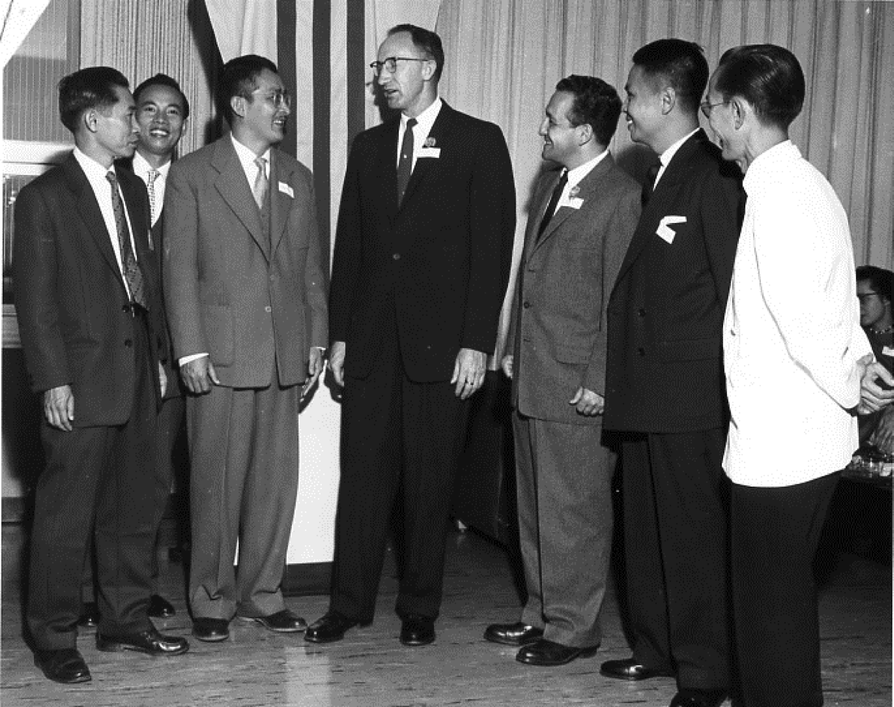
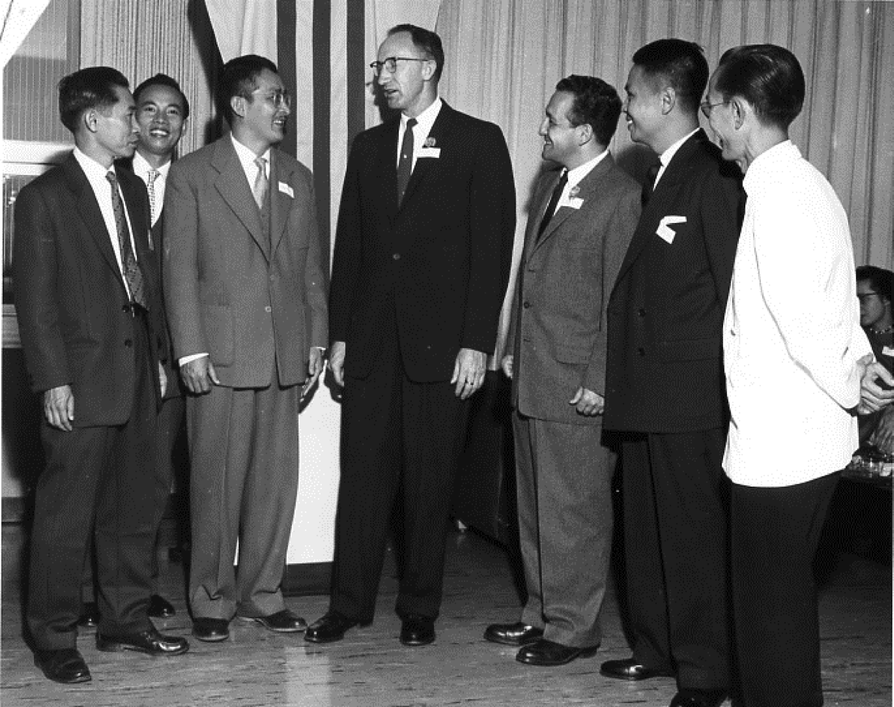
A group of officials with the Michigan State University Vietnam Advisory Group celebrating Vietnamese Constitution Day. The men are standing and talking in a circle. The caption on the reverse of the photograph reads: ‘Dean Taggart and Dr. Fishel speaking with a group of Vietnamese, Constitution Day Celebration, October 26, 1958–unidentified, Dr. Le Dinh Chan, Dean Taggart, Dr. Fishel, Mr. Tho, and Mr. Thoi.’
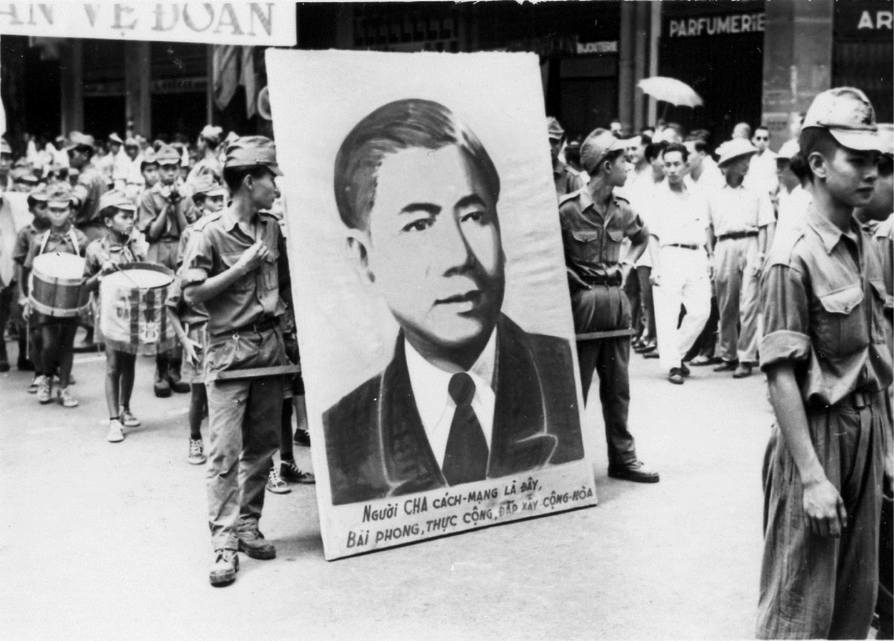
Photograph showing an Independence Day parade in process. A young band walks behind a large picture of President Ngo Dinh Diem with the caption: ‘Nguoi cha cach mang la day bai phong thuc cong dap xay cong hoa.’
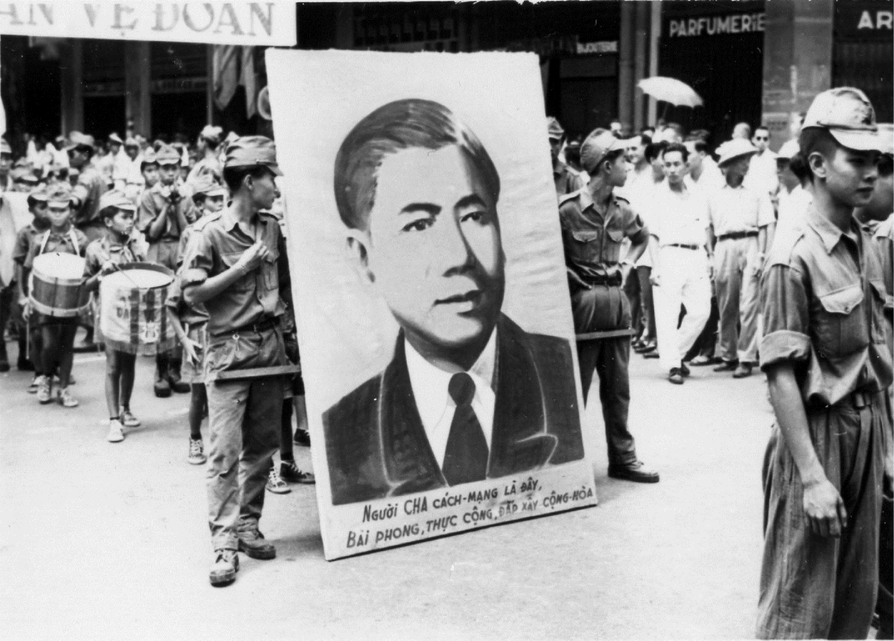
As he was determined to replace incompatible, colonial relics with representations of a recently independent, newly created quốc gia (nation), Ngô Đình Diệm proclaimed on 1 March 1955 the official calendar of National Days of Viet Nam, which did not differ much from the Bảo Đại's State of Vietnam's.Footnote 72 But, regarding the October 1955 referendum celebrations, the president stipulated that they were to be held ‘at churches, temples, of all religions . . . to thank the Almighty (Ơn Trên, literally, “Blessings from Above,” a Catholic expression), to pray for the Republic of Vietnam to be a lasting one and for the people to be safe’ and that particular emphasis be placed for the ceremonies at ‘the Holy Mother Cathedral in Saigon [that] should be especially magnificent’.Footnote 73 Subsequently, the Ceremonies Office requested directives from the president regarding the organization of Memorial Day (Lễ Tưởng Niệm Liệt Thánh, derived from France's Fête des Morts) on 2 November 1955. It remarked that ‘this year, the government has regained independence . . . and thus, it is no longer foreigners who oversee the organization but on the contrary, it should be through directives of the national government’. It suggested tentatively that the celebrations begin with a Mass at the Holy Mother Church, conducted concurrently at the Protestant church and at the mosque, to be presided over by a representative of the government at the level of secretary (of foreign relations, for example) and by the mayor of Saigon. After the Masses, representatives of foreign delegations and of the government could, if they wished, participate in a Buddhist ceremony celebrated at the Zoological Garden.Footnote 74 In short, public commemorations should be organized primarily in Catholic churches, with obligatory attendance for top-level officials; afterwards, public servants would have the option of attending a Buddhist ceremony. It was suggested that the Department of Information, headed by Trần Chánh Thành, should inform the ministries and military headquarters of the presidential displeasure that ‘people in numerous places have not yet understood that with the Referendum, a new era for Vietnam has begun’.Footnote 75 In order to mark the ending of French rule and the founding of the Republic by Ngô Lãnh Tụ (Ngô The Leader), their offices should organize a far-ranging celebration ‘among the populace, penetrating villages, schools, organizations, and military units’. A suggested programme would emphasize the meaning of the referendum, the president's proclamation, and support for him. Such suggestions were repeated numerous times throughout the year and into 1956, with increasing involvement by President Diệm himself.Footnote 76
In 1956, the Diệm regime, tightening its hold on Vietnamese society, issued Ordinance Nos 6 and 47, which made support for Communism a capital offence.Footnote 77 It enforced land reform through Ordinance No. 57 and imposed forced assimilation on the Chinese community via Ordinance Nos 48 and 53.Footnote 78 It concurrently modified the official calendar, decreeing 26 October the ‘National Day’, to be marked by a whole-day holiday.Footnote 79 It granted half-days off to honour two Catholic celebrations (Ascension and Assumption) and full days off for the Trần Hưng Đạo, Confucius, All Saints’ Day, and Christmas celebrations; there was only one full Buddhist holiday, Vesak (Thích-Ca Thành-Đạo), for the entire calendar year.Footnote 80 With Madame Nhu's involvement, the ceremony of Memorialization of the Trưng Queens became an obligatory event for all officials starting from 1955, with their statues replacing the colonial ones at Mê Linh Square in 1962.Footnote 81 President Diệm delivered a speech on 18 March 1956, Trưng Queens celebration, exhorting citizens and especially women ‘to exterminate the invaders and the Vietnamese Communist traitors . . . to liberate the north and the millions of people suffering under the domination of the red devils’.Footnote 82 Moving on the same day to the Cao Đài Holy See in Tây Ninh, which had but recently been raided by the government, forcing its ‘living saint’, Phạm Công Tắc, into Cambodian exile, Diệm delivered a starker speech.Footnote 83 He declared that his government ‘does not show any preferential treatment towards any religion nor discriminate against any religious beliefs. However, for morals (đạo lý) to propagate among the people, righteous leaders must preserve moral order’. He went on to affirm that ‘righteous morals (đạo phải) are extinguished in the atheist Communist regime. . . . The government's mission is to maintain order, promoting the good and punishing the bad; only then can religion be protected and freedom be asserted’.Footnote 84
As he strengthened his rule, President Diệm paid more attention to its public manifestations, notably that of celebrations, issuing directives via his brother-in-law, Nguyễn Hữu Châu, charged with transmitting his orders. The latter conveyed the presidential displeasure over the fact that ‘the celebrations . . . had often been proposed and organized in a hasty manner, resulting in his Excellency's dissatisfaction on two counts—principles of ceremony and details of the programme’. Thus, ‘1) Each time that you intend to organize any ceremony, please draft a fully detailed programme, 2) Afterward, in an audience with the President, you will present your intentions and the programme so that the President will have the opportunity to discuss and consider them with you’.Footnote 85 The tightening of the screws manifested itself through a minute inspection of every detail, as
the President desires that the programme of ceremony be approved by his Excellency at least one week prior to the day of ceremony. 3) In the programme, if there is a scheduled speech then the President wishes that at least 4 to 5 days prior, you present to him drafts of speeches to be read.Footnote 86
Each department that organized an event could present drafts adapted to ‘the circumstances and meaning’ of the event, but that had to be vetted by the presidency, which was responsible for the official text. Drafts should be short (no more than four minutes), concise, and practical, and employ language simple enough for people to understand and remember. It was decided that the new republic should adopt for its national anthem and flag those of the defunct State of Việt Nam.Footnote 87
In search of viable heroes
In Vietnamese history, national heroes, considered as guardian spirits, ‘are seen as moral core of the nation and as having a role to play in meeting present-day challenges’.Footnote 88 They were viewed as ‘a sort of barometer of patriotic virtues . . . connected to this nation by a filial link. . . . The heroic figure distilled the essence of the national character. There was no patriotism without heroes, nor heroes without patriotism’.Footnote 89 Among its first official acts as inheritor of that past, the Republic went in search of its own heroes.
The Cabinet's agenda on 20 August 1956 listed as a priority the president's decision to celebrate 26 October—when the Constitution was to be proclaimed—as the National Day of the Republic of Vietnam. On that most festive occasion, ‘there should be a solemn three-day celebration during which the achievements of heroes and fallen soldiers who were meritorious in combating invasion will be evoked’.Footnote 90 The Department of Foreign Affairs was put in charge of an Inter-Ministerial Committee that was to search ‘for fallen heroes who had fought against invaders . . . in order for their accomplishments to be cited with the nation (citation à l'Ordre de la Nation) [in French in the text]’. Significantly, many of the names cited were figures linked to the Ngô family, for instance, Prince Cường Để and Phan Bội Châu.Footnote 91 In the provinces, villages, and schools, there were to be ‘receptions to welcome descendants of patriotic soldiers who died fighting invaders’ and reading of texts evoking their accomplishments. Tombs of heroes were to be cleared of debris, renovated, and guarded by local militia on the eve of the National Day. Upon presidential order, all civil servants should wear ‘the national dress’ (quốc phục)—a black turban and a long blue silk tunic. Borrowings from the French tradition included receptions for foreign delegations and civil servants, troop reviews, boat races, theatre, and fireworks, but also ‘Masses’ to be celebrated at churches and pagodas, with the latter accorded lower priority. At the same meeting, the Cabinet also approved ‘the draft . . . proposing to punish criminals who act against external national security’.Footnote 92
Meanwhile, the Department of Education was tasked with the drafting of heroic biographies for the upcoming National Day, in accordance with the directives provided by Ngô Đình Nhu, who made the final decisions. Throughout, we see Nhu's constant imprint, accepting, revising, or rejecting, pencilling in blue his remarks down to the most minute details. Subsequently, provincial authorities submitted names of heroes who had fought against invaders; some were rejected as lacking national reputation, others (civil servants, village officials) because they had fallen ‘in the course of their duty’ rather than while fighting invaders to save the country.Footnote 93
Finally, the official ‘List of National Heroes and Heroines Representative of the Indomitable Spirit of the Vietnamese People’ included 42 names, among them legendary figures such as the Trưng Queens and Trần Hưng Đạo. Significantly, the forty-second one was that of Ngô Đình Diệm's elder brother, Ngô Đình Khôi, described as follows:
He was a mandarin of integrity, who dedicated himself to defending the rights of the people and of the land, and to fighting the colonial policy of repression and exploitation. When the Việt-Minh took over, he was well aware of the Communists’ cruel policy and unflinchingly opposed the Doctrine of the Three Nos.Footnote 94 Consequently, he was killed at the Hiền Sĩ Mountain, district of Phong-Điền (Thừa Thiên Province) around 1945.Footnote 95
In the turmoil of summer 1945, Khôi, Diệm's eldest brother, former governor of Quảng Ngãi, was executed along with his son, Huân, a former tax collector and interpreter for the Japanese consulate in Huế, and buried in an unmarked grave in Annam. Their remains were identified in February 1956 by the Ngô family—thanks to a network of informants set up in Central Vietnam by Ngô Đình Cẩn. They were given a solemn state funeral attended by the highest members of the Cabinet, a military honour guard following the flag-draped coffins, to the accompaniment of the national anthem, and reinterred in the Phú Cam family cemetery in Huế.Footnote 96 Khôi's was the only name that was mentioned as being a victim of the communists. Officially classified as a hero, Khôi was given a national commemoration, enhancing the myth of the living Ngô family members as the descendants of a long line of martyrs who died fighting for the country. In fact, Khôi had devotedly served the French for decades, working his way to the position of provincial governor. Subsequently, with French power eclipsed by that of Japan, he switched sides, throwing his support behind Prince Cường Để, incurring the wrath of French authorities, who forced him to resign in 1943.Footnote 97
As the National Day approached, presidential directives rained upon the ministries, the province chiefs, mayors, and so on, reminding them to collect historical documents related to the fallen heroes, to locate their tombs to be renovated, and to contact their descendants.Footnote 98 Religious leaders were also ‘reminded’ to adhere to a strict schedule of bell tolling beginning with the Catholic churches from 5:45 to 5:50 a.m., with Buddhist pagodas and other temples to follow at 5:50.Footnote 99 Three bishoprics (Vĩnh Long, Cần Thơ, Saigon) were instructed to ensure that all the churches in the region toll their bells at exactly the appointed time.Footnote 100 Nguyễn Hữu Châu instructed the mayors of Saigon and Cholon, as well as the provincial and city heads, that there were to be solemn prayers for national heroes at churches, memorial sites, temples, and pagodas on the morning of 26 October 1956.Footnote 101 The presidency also emphasized the fact that, until the National Day, all citizens should ‘daily pray for the national unification and for the Republic's future to be ever radiant’.Footnote 102
Pomp and circumstances
President Diệm, through directives, repeatedly addressed the matter of the official dress. These stated that all had ‘to attend the Heroes Memorialization service in national dress’, defined as ‘a blue tunic and black turban’.Footnote 103 In the villages, ‘members of the administrative councils were allowed to wear the customary black tunic and turban [, but] everyone should be dressed formally and properly’.Footnote 104 The same directive went to the National Assembly, conveying in a softer tone that the president wished its members to follow suit. Invitations were sent out to all foreign delegations to attend on the ‘First Anniversary of the Founding of the Republic of Vietnam’. The presidency communicated the text of the ‘Oration for the Heroes’ to be declaimed by officials of all regions on the National Day. It recited heroic feats by ‘Children of the Lạc Hồng quadri-millennial race’, by anti-French heroes and so on but, lest listeners miss the point, the oration adjured: ‘We find ourselves [here] today thanks to our forebears/We are grateful to them, and thus we memorialize them/. . ./The entire people elected the President/He who had wandered overseas, tasting in turn sweetness and bitterness/Now he rightfully leads the citizens, a helmsman steering steadily.’Footnote 105
The carefully orchestrated programme for the National Day opened with the ‘Oration’, followed by the president's arrival and reviewing of the troops to the strains of the national anthem. Diệm's proclamation of the Constitution was succeeded by his address to all the forces in his capacity as president and commander-in-chief. He congratulated them for their ‘impeccable and martial performance on the National Day of 26 October 1956’, praising them for being ‘worthy of the valorous martial tradition of the race’. Diệm adjured them that, since an entire, dedicated nation had supported it, the Army must, in return, ‘manifest the inherent qualities of the ideal soldier: Loyalty, Propriety, Faithfulness, Courage, Humbleness, to strengthen the Republic, protect the Constitution, and instill in the people an unshakeable belief in the glorious future of the Fatherland’.Footnote 106
Reports began pouring in on the second day of the celebrations about what had been accomplished, reassuring the president that everything had been done per his directives. One hints at the not-so-subtle message of presidential religious priorities. The secretary for justice, Nguyễn Văn Sĩ, reported that he had represented the president at a Buddhist service for the fallen heroes conducted at the Phước Hòa Pagoda.Footnote 107 Also in attendance, he noted, were magistrates, prosecutors, the ambassador of Japan, and lower-level civil servants and military officers.Footnote 108 The ceremony took place in the late afternoon and lasted one hour, unlike the lengthy Catholic pomp of the morning attended by the president and the diplomatic corps. The message was clear: Buddhism was considered by the head of state as a secondary religion. The ceremony was covered in the foreign press, especially by American newspapers, where Diệm, ‘the little president’, was widely praised for his accomplishments on the Republic's first anniversary. One article probed more deeply, however, noting that ‘today in South Vietnam there is a big push under way to deify Diem to his people. Trained cheer leaders direct the crowds’.Footnote 109
Likewise, discordant notes began to appear in this otherwise perfectly choreographed commemoration. A letter from the chairman of the National Assembly, Trần Văn Lắm, protested the perceived disrespect shown to its representatives. It reminded the president that, although the National Day commemorated the ‘birth of the Constitution’, its deputies encountered numerous difficulties, were in some cases prevented by the police from reaching the stands, and, for those who did make it, were seated in the rear. The letter complained that utter silence greeted its chairman as he arrived at the ceremony, and the proper ‘ritual pomp’ to which his position entitled him was lacking. Similar incidents took place in the provinces, the letter claimed.Footnote 110 Another participant, General Trần Văn Đôn, noted the Ngô brothers’ displeasure when then-Colonel Dương Văn Minh, fresh from victories against the Bình Xuyên and Hòa Hảo, was publicly hailed as ‘a hero of our people’, as he led the military parade on that day.Footnote 111
The years thereafter
In 1957, Diệm travelled extensively throughout Asia and was the honoured guest of the Eisenhower Administration. The American press, fuelled by the Harold Oram public relations firm's campaign, praised Diệm as ‘Vietnam's Man of Iron’, extolling the fact that ‘Diem has added a strongly spiritual . . . note to his definition of “democracy”’ and remarking glowingly about his ‘deep religious bent’.Footnote 112 Catton and Masur have written that the regime's propaganda machine projected to the world an image of Diệm as a liberally minded, culturally open, modernizing Asian leader, with his own Asian culture policy that supported the revival of ‘Confucianism, Buddhism, and popular culture’.Footnote 113 John Donnell, a witness, noted that, from 1956 onward, Confucius-related events were on the rise and increased in scale, from anniversary celebrations to association foundings to literature competitions, in schools and at sports events, with the president delivering speeches and his brother, Nhu, declaring Confucian temples to be part of the ‘national cultural patrimony’.Footnote 114 However, beneath that culturally festive façade, there was a darker current dominated by a policy of increasing cultural and religious selectivism, with Catholicism playing a dominant role. 1959 was officially declared a Marian Year with countrywide celebrations, with the Cathedral at La Vang officially recognized as a national shrine.Footnote 115 It culminated in the dedication of ‘South Vietnam . . . to the Immaculate Heart of Mary’, with Diệm leading a national pilgrimage to La Vang, ‘promoted to a basilica minor in 1961’.Footnote 116 Meanwhile, the attempt to associate the Ngô nation with an unbroken past and millennial symbols of heroic resistance was integrated into the state's commemorative matrix of ‘Vietnamese nation-construction’ with the Ngô family and Diệm as national symbols. By then, many of the Ngô family's early supporters had left the regime—and the country—among them Trần Chánh Thành and Nguyễn Hữu Châu.Footnote 117 With the rise in influence of the Nhu couple, Thành lost his status as a member of the ‘inner circle’ and joined the ranks of ‘golden exiles’, formerly trusted aides who were increasingly populating Republic of Vietnam embassies in developing countries. Madame Nhu later referred to him as a ‘crypto-coco’—by which she apparently meant a communist sympathizer—and always harboured suspicions about his loyalty.Footnote 118 Meanwhile, Châu, her now estranged brother-in-law, in his communications with American officials, expressed frustration at the nefarious role played by the Ngô family and the omnipotent Cần Lao. He spoke of the ‘general demoralization of the administration’, as it was widely believed that ‘sycophancy and slander . . . were the tools by which one achieved power and prestige’.Footnote 119 Catton explained the Republic's factional in-fighting as legacies of ‘traditions of court intrigue’ and ‘colonial politics [that] positively encouraged the suspicion of others’.Footnote 120 American ‘nation-builders’, including the teams from Michigan State University, equally suffered. Diệm terminated its contract in 1962, and Fishel, increasingly critical of the regime, was forced to leave Vietnam. In a subsequent letter to MSU President John Hannah, Fishel harshly denounced the ‘evil influences’ of Nhu and his ‘Borgia-like’ wife but blamed Diệm himself as the main factor in preventing the teams from achieving their goals.Footnote 121
Conclusion
In its early phase, the Republic's leaders, free of the colonial domination but deeply imbued by French practices, were uncertain about how to build a nation, and how to define and express it symbolically in a manner befitting the Vietnamese legacy. They peered into a pre-colonial and anti-French past and found familiar national beacons easily recognizable in the heroes who had opposed invaders. But, beyond these well-known figures, who should be honoured? What criteria should be used to define a ‘national hero’—one that could replace Joan of Arc but appeal to the peasants of the former Annam and Cochinchina, now the Republic of Vietnam? Even though the memories of ‘fallen local and regional heroes’ were carefully honoured, these heroes had to be ‘immaculate’, untainted by any suspicious political associations, with moral standards suiting the Ngô vision. As one of the 42 national heroes, Khôi was deemed to be a symbolic portend of the Ngô nation to come. This heroic memorialization of a family member was part of an all-encompassing campaign to leave an indelible imprint on the Vietnamese ethos through a process that Đỗ Mậu termed quốc gia hóa or ‘nationalization’ of family celebrations. The patrimonic ritualization, which included the ‘President's Patron Saint's Day’ on 21 June 1956 and the President's Sixtieth Birthday, both celebrated nationwide, reached a crescendo in 1961 with festivities for the Ngô matriarch, which parroted centuries-old imperial longevity traditions. Thus, Khả’s widow received a sumptuous ‘Nonegarian Celebration’ attended by numerous military and civilian delegations and the highest Cabinet members, who flocked to Huế, eager to show their devotion to the Ngô family, with full prostrations before the matriarch as before the monarchs of old, while the Department of Interior organized a lavish Thanksgiving Mass at the Saigon Cathedral.Footnote 122
The 1956 National Day's organization and symbolism manifested an autocratic urge to control everything: the speeches, the chronological order of religious ceremonies nationwide, even the sartorial minutia for attendees. As the Republic sank further into the quagmire and Ngô rule became more rigid, patrimonic, and dictatorial, the search for national identity would be folded within an all-encompassing Ngô nation defined by the cult of Diệm and expressed in staunch Catholic and anti-communist terms. Contrary to Catton and Miller's arguments that Diem set out ‘to build a version of a modern nation rather than create a copy of the precolonial past’ and that his ‘ideas about governance, politics and society were not holdovers from Vietnam's ancient past’, symbolically, the Ngô nation built by the brothers was indeed a relic of the past, albeit one swathed in the ‘emperor's new clothes’.Footnote 123 Kathryn Statler, analysing the process through which the United States of America displaced colonial France, argues that the former had in the process constructed a neo-colony by replacing French values with American culture, imprinting it on the Vietnamese population through its nation-building agencies and programmes.Footnote 124 This formulation presupposed that the ‘South Vietnamese’ on whose behalf the United States of America was to nation-build were ‘essentially malleable and their history and culture were relegated to a seemingly irrelevant past’.Footnote 125 In a word, the Vietnamese below the Seventeenth Parallel were considered as tabula rasa—without past and culture—like clay that American nation-builders’ initiatives might shape into modern citizens, suffused with democratic values, defined solely by their loyalty to a modern Vietnamese nation state. Suffice only to provide them with the tools necessary for building a viable state that would dispense capitalist economic development and democratic values following ‘American standards, culture, and language’. The deus ex machina selected by Washington to carry out this programme was a man believed to be the ‘saviour of democracy’ simply because of the American perception of Diệm as an anti-communist nationalist and a willing puppet. This perception gave little weight to the fact that he and his family issued from an intransigently devout Catholic family of Central Vietnam—legendary for being a bastion of deep-seated imperial tradition and culture—with a past mired in mandarinal administrative experience and willing collaboration with occupying forces, be they French or Japanese.
Among those who attempted to explicate the Republic's downfall, Philip Taylor contends that Diệm's ‘authoritarian leadership attempted to achieve unity by suppressing ideological alternatives to its paternalistic rule’ by forcing a uniform Vietnamese identity on highland peoples as well as on the Chinese diaspora, and by suppressing the dissenting political-religious organizations distinctive of the frontier culture of the Mekong Delta such as the Hòa Hảo and Cao Đài.Footnote 126 A devout Catholic, Diệm had an abhorrence for all non-Catholic, animistic beliefs and practices considered as tà đạo (heterodox)—the definition that, ironically, the Vietnamese monarchs had once applied to Catholicism. Karin von Hippel, for her part, writing about ‘democracy by force’, has pointed out that, overall, ‘nation building really means state building’, namely the construction of ‘a government that may or may not be democratic, but preferably is stable’—a statement that aptly describes the American nation-building experience in Vietnam.Footnote 127 In this sense, the American officials used the term ‘nation-building’ misleadingly, since, in the case of the Vietnamese republic, America focused rather on ‘state-building’ as it attempted to construct a functioning government through the establishment of modern, Western institutions on remnants of a French-created colonial state. A Pentagon Papers commentator did not err in describing Ngô Đình Diệm as follows: ‘despite extensive travel and education in the West, and despite his revolutionary mien, he remained what he had been raised: a mandarin of Imperial Hue, steeped in filial piety, devoted to Vietnam's past, modern only to the extent of an intense, conservative Catholicism.’Footnote 128 To this day, much of the physical infrastructure that the United States of America constructed south of the 17th parallel is still functional and highly regarded in reunified socialist Việt Nam. But America failed to impose its vision of a Vietnamese nation, as, to do so, it would have required a longue durée approach that would have been inconceivable and a cultural understanding capable of transcending its own cultural and political Cold War framework. It would also have needed a genuine ‘national hero’ worthy of its trust and that of the southern Vietnamese.
 , its director Dr Trȁn Đình Hằng, and its members for many enriching conversations on Việt Nam in general and on the cultural landscape of Hu