1 Introduction
In Computational Linguistics (CL), the past decade has witnessed an emergent research topic—semantic change computation, exemplified in works such as Sagi, Kaufmann, and Clark (Reference Sagi, Kaufmann and Clark2009), Michel et al. (Reference Michel, Shen, Aiden, Veres, Gray, Team, Pickett, Hoiberg, Clancy, Norvig, Orwant, Pinker, Nowak and Aiden2011), Rohrdantz et al. (Reference Rohrdantz, Hautli, Mayer, Butt, Keim and Plank2011), Jatowt and Duh (Reference Jatowt and Duh2014), Mitra et al. (Reference Mitra, Mitra, Maity, Riedl, Biemann, Goyal and Mukherjee2015), Frermann and Lapata (Reference Frermann and Lapata2016), Hamilton, Leskovec, and Dan (Reference Hamilton, Leskovec and Dan2016), Tang, Qu, and Chen (Reference Tang, Qu and Chen2016), Dubossarsky et al. (Reference Dubossarsky, Grossman and Weinshall2017) and others. The surge of interest in the topic is attributed to developments both inside CL and outside of it. Within CL, the availability of large scale diachronic language data and the technological developments in Word Sense Induction (Lin Reference Lin1998; Navigli Reference Navigli2009; Navigli and Ponzetto Reference Navigli and Ponzetto2012; Nasiruddin Reference Nasiruddin2013) have provided automatic means to access information of words’ semantics in corpora, and have thus paved the way to empirical investigation of regularities and mechanisms of semantic change. Outside CL, developments in Internet technologies, the web-based social media in particular, have accelerated the change of language (Crystal Reference Crystal2006). New words and new usage of words are popping up in web-based communications.
The emergence of the research topic is not surprising, given the fact that semantic change has interested both the academic circle and the general public for a long time. Based on the observations that language is always changing (Hale Reference Hale2007 : 3) and that language is a dynamic flux (Beckner et al. Reference Beckner, Ellis, Blythe, Holland, Bybee, Ke, Christiansen, Larsen-Freeman, Croft and Schoenemann2009; Massip-Bonet Reference Massip-Bonet, Massip-Bonet and Bastardas-Boada2013; Mantia, Licata, and Perconti Reference Mantia, Licata and Perconti2017), linguists have put forward different theories and models to explain rules and regularities in semantic change, such as the Diachronic Prototype Semantics (Geeraerts Reference Geeraerts1997, Reference Geeraerts, Blank and Koch1999), the Invited Inference Theory of Semantic Change (Traugott and Dasher Reference Traugott and Dasher2002) and semantic change based on metaphor and metonymy (Sweetser Reference Sweetser1990; Heine, Claudi, and Hünnemeyer Reference Heine, Claudi and Hünnemeyer1991). The knowledge of semantic change also interests the public because people need to be aware of such change in their daily language use. A large number of websites and books are devoted to etymology studies (Jatowt and Duh Reference Jatowt and Duh2014).
Although no published research is available on how knowledge of semantic change might impact on the performance of Natural Language Processing (NLP) systems at the moment, the potentials are great (Jatowt and Duh Reference Jatowt and Duh2014; Mitra et al. Reference Mitra, Mitra, Maity, Riedl, Biemann, Goyal and Mukherjee2015). Researchers have realized that ‘understanding how words change their meaning over time is key to models of language and cultural evolution’ (Hamilton et al. Reference Hamilton, Leskovec and Dan2016). Semantic change computation deals with dynamic semantics, including the phenomenon of polysemy, a perennial challenge in NLP. A better understanding of polysemy should help improve any NLP task that involves semantic processing. For instance, applications for semantic search can increase the relevance of query results by taking into account new word senses (Mitra et al. Reference Mitra, Mitra, Maity, Riedl, Biemann, Goyal and Mukherjee2015; Yao et al. Reference Yao, Sun, Ding, Rao and Xiong2017). In addition, knowledge of trends and tendencies obtained by semantic change computation, including the knowledge obtained by Culturomics (Michel et al. Reference Michel, Shen, Aiden, Veres, Gray, Team, Pickett, Hoiberg, Clancy, Norvig, Orwant, Pinker, Nowak and Aiden2011), is essential in NLP tasks. Semantic change computation also plays a role in social computing such as determining the diachronic change of popularity of brands and personalities at different times (Yao et al. Reference Yao, Sun, Ding, Rao and Xiong2017).
This paper reviews the literature by proposing a framework that identifies five core components in semantic change computation: diachronic corpora, diachronic word sense characterization (DWSC), change modelling, evaluation and data visualization. The state-of-the-art of each component is expounded in the paper, together with relevant insights and findings from theoretical linguistics and cognitive linguistics. It is our hope that a systematic review that integrates both theoretical and computational legacy could benefit research in the future.
2 Framework of semantic change computation
Theoretical studies of semantic change address three subtopics: semasiology, onomasiology and path of semantic change (Geeraerts Reference Geeraerts1997 : 25–26; Traugott and Dasher Reference Traugott and Dasher2002 : 25–26). In semasiology, the linguistic form is kept constant, and the focus is on the development of polysemy. Onamasiology, instead, is focused on developments of linguistic representations of particular semantic domains such as COLOR and INTELLECT. The third subtopic concerns paths of change across conceptual structures, as evidenced by particular semasiological changes.
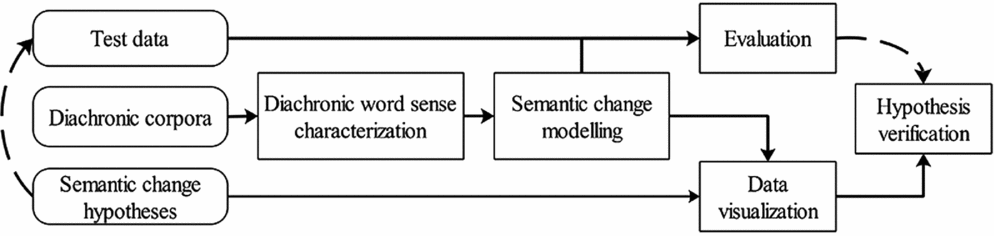
Current literature on semantic change computation is mainly devoted to semasiology because linguistic forms can be conveniently identified in corpora and thoroughly investigated. Onomasiology poses a challenge in semantic change computation because it is more difficult to formalize a semantic domain and obtain comprehensive information of the domain in large scale unannotated corpora. As for studies of paths of semantic change, they are based on onomasiology and semasiology. As such, we present a framework in Figure 1 that summarizes research paths that most studies in the literature take, which mainly concerns semasiology.
Framework of semantic change computation.

Figure 1 shows that the field is still at the initial stage, focused on testing and verifying general hypotheses proposed in theoretical studies of semantic change. The beginning component in the framework is Semantic change hypotheses. Several regularities and rules of semantic change have been addressed in the literature, such as the detection of novel senses (Erk Reference Erk2006; Lau et al. Reference Lau, Cook, McCarthy, Newman and Baldwin2012; Frermann and Lapata Reference Frermann and Lapata2016), categorizations of semantic change (Mitra et al. Reference Mitra, Mitra, Maity, Riedl, Biemann, Goyal and Mukherjee2015; Tang et al. Reference Tang, Qu and Chen2016), correlation between semantic change and frequency (Hamilton et al. Reference Hamilton, Leskovec and Dan2016; Dubossarsky et al. Reference Dubossarsky, Grossman and Weinshall2017) and correlation between semantic change and polysemy (Hamilton et al. Reference Hamilton, Leskovec and Dan2016).
The framework illustrates two paths to Hypothesis verification, indicated by the arrows in the figure. Beginning with Semantic change hypotheses, one path proceeds directly to Hypothesis verification with information obtained from Semantic change modelling (SCM), using visualization tools (Hilpert and Gries Reference Hilpert and Gries2009; Rohrdantz et al. 2011) and mathematical reasoning (Hamilton et al. Reference Hamilton, Leskovec and Dan2016; Dubossarsky et al. Reference Dubossarsky, Grossman and Weinshall2017). The other path recasts hypothesis verification as categorization tasks. It first exemplifies hypotheses by constructing evaluation data that contain semantic change categories, such as sense shift, sense narrowing and sense broadening and then evaluate methods of SCM with respect to the evaluation data. Finally, the evaluation results are used to verify the hypotheses. Most studies in the literature follow this path, although the scales of data and categories of semantic change under investigation vary in these studies.
Both paths in the framework rely on the following two essential components in semantic change computation: DWSC and SCM. The component of DWSC gathers diachronic semantic information of words from corpora. It generally involves the following two steps: (1) inducing word senses from corpora with unsupervised methods, such as clustering; (2) summarizing and transforming word sense representations so that sensible comparison can be computationally conducted among different time intervals.
The component of SCM uses computational models to interpret hypotheses of semantic change with information gathered from DWSC. The types of computational models to be used in the component depend on how the concept change is metaphysically understood. Section 5, in this paper, distinguishes two types of metaphysical understanding of change: Cambridge Change and McTaggart Change, and expounds their corresponding computational models. The intrinsic nature of the hypothesis under investigation should also be considered in choosing computational models. For instance, semantic change categorization can be modelled with machine learning tools such as Support Vector Machine (Tang et al. Reference Tang, Qu and Chen2016) and correlation between semantic change and frequency can be modelled with linear regression (Hamilton et al. Reference Hamilton, Leskovec and Dan2016).
The rest part of the paper reviews state-of-the-art of the five components in the framework, namely Diachronic corpora, DWSC, SCM, Evaluation and Data visualization.
3 Diachronic corpora
Diachronic corpora provide empirical resources for semantic change computation. The construction and choice of diachronic corpora involve factors, such as size, balance and representativeness of texts in particular. As argued in Sinclair (Reference Sinclair and Wynne2005), only those elements of corpora that have been designed to be independently contrastive should be contrasted in a study. For semantic change computation, only those corpora that are designed to be informative of semantic change should be used, and only those semantic aspects that are contrastive in the corpora should be studied.
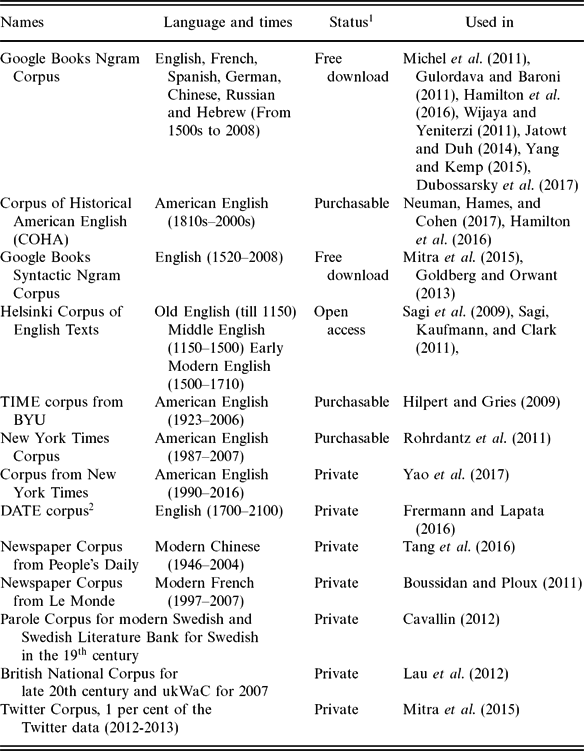
Table 1 lists most of the corpora used in the literature of semantic change computation. The most frequently used corpus is the Google Books Ngram Corpus (Lin et al. Reference Lin, Michel, Aiden, Orwant, Brockman and Petrov2012), due to its size, range of time, types of languages included in the corpus and public availability. The corpus has been available at http://books.google.com/ngrams since 2010. Its 2012 Edition is obtained from more than 8 million books, or over 6 per cent of all books ever published in history. The corpus consists of ngrams (n ⩽ 5) of the following format:
 $$\begin{equation*}
{\rm {ngram}}\;{\rm {TAB}}\;{\rm {year}}\;{\rm {TAB}}\;{\rm {match\_count}}\;{\rm {TAB}}\;{\rm {volume\_count}}\;{\rm {NEWLINE}}
\end{equation*}$$
Diachronic corpora in semantic change computation

1Four types of status are identified: Free download, Open access, Purchasable and Private. Free-download corpora can be freely downloaded. Open-access corpora are free but require registration. Purchasable corpora can be purchased. Private corpora are corpora compiled by the authors and are not available to the public.
2The corpus is compiled by collocating documents from (1) the COHA, (2) the training data provided by the DTE task organizers (http://alt.qcri.org/semeval2015/task7/index.php?id=data-and-tools) in SEMEVAL 2017 and (3) the portion of the CLMET3.0 CORPUS.
The Google Books Syntactic Ngram Corpus is based on the English portion of the ngram corpus but is annotated with part of speech (POS) information and parsed with a dependency parser.
Nevertheless, Google Books Ngram Corpus has its limitations. With the corpus, the biggest window size for observation in WSI is ±4, so it is not suitable for semantic change occurring in long distance dependency. In addition, language variation factors such as genre types and social events can neither be directly studied with the corpus, which is unfortunate because social factors play significant roles in semantic change (Labov Reference Labov1994; Hollman Reference Hollman, Culpeper, Katamba, Kerswill and McEnery2009). Corpora like COHA, Helsinki Corpus of English Texts and those corpora compiled from newspapers are better candidates for studies of social factors in semantic change. One more disadvantage is that the corpus is mainly representative of formal language because it is built from books, not spoken language.
Table 1 also shows that the most studied language is English, including British English and American English. Other languages studied in the literature are Chinese, French and Swedish. Although statistical techniques might be universally applicable to all languages, the patterns of semantic change might differ in different languages because language change is motivated by pragmatics (Traugott and Dasher Reference Traugott and Dasher2002), which is part of the culture, and semantic change is part of language change.
4 Diachronic word sense characterization
Diachronic corpora are generally not annotated with word sense information. Therefore, DWSC is needed to automatically capture comparable semantic state-of-affairs of target words (named global semantics in this paper) at different time intervals from slices of diachronic corpora. It can be performed in one or two steps. Two-step DWSC involves (1) specifying sense instances, namely the senses of target words in sentences and (2) computing global semantics of target words that contains information such as types of senses and prevalence of senses. One-step DWSC directly obtains global semantics of one time interval or all the time intervals using one statistical model. For instance, the SCAN model proposed in Frermann and Lapata (Reference Frermann and Lapata2016), which is a Bayesian model of sense change based on topic modelling, simultaneously obtains comparable global semantics of words for all time intervals.
This component is closely related to Word Sense Induction (WSI). Many techniques that are based on distributional semantics (Harris Reference Harris1954; Weaver Reference Weaver, Locke and Booth1955; Firth Reference Firth1957; Bullinaria and Levy Reference Bullinaria and Levy2012; Levy, Goldberg, and Dagan Reference Levy, Goldberg and Dagan2015) are also used in semantic change computation to induce word senses in diachronic corpora. Word context provides important information not only for WSI, but also for detecting semantic change (Sagi et al. Reference Sagi, Kaufmann and Clark2009). Therefore, the global semantics of target words is often represented by word vectors, which could be high-dimensional sparse vectors or low dimensional vectors.
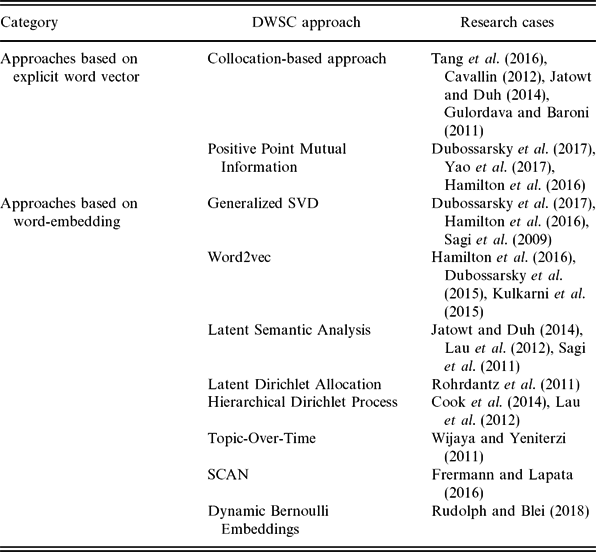
However, DWSC differs from WSI in that global semantics obtained from different time intervals should be comparable. Accordingly, this paper has opted for categorizing approaches to DWSC into two groups: approaches based on explicit word vectors that are directly comparable and approaches based on word-embedding that require alignment to make word vectors comparable. They are detailed in Table 2 and in this section.
Summary of DWSC approaches

4.1 Approaches based on explicit word vectors
The approaches falling into this group use explicit word vectors to characterize the state-of-affairs of word senses. In an explicit word vector, each cell in the vector corresponds to association strength between the target word and a context word, namely a word occurring in the context of the target word. The context word can be identified in different ways. It can be a collocate of the target word. For instance, Tang et al. (Reference Tang, Qu and Chen2016) represent a sense instance with a tuple c = (w t,w m), in which w t is the target word and w m is the noun co-occurring with the strongest association strength with w t within a window size of ±9. In Cavallin (Reference Cavallin2012), the context word is a noun or a verb that forms verb-object relation with the target word. Mitra et al. (Reference Mitra, Mitra, Maity, Riedl, Biemann, Goyal and Mukherjee2015) use bigram relationship to specify the context word.
Within this group, various methods are proposed to obtain global semantics of the target word. In Tang et al. (Reference Tang, Qu and Chen2016), the global semantics of w t is summarized as the Average Mutual Information (Entropy) of all possible senses in the corpus, as denoted below:
 $$\begin{eqnarray}
{\zeta ^{{w_t}}} &=& \left[ {\begin{array}{@{}*{1}{c}@{}}C\\
{P\left( C \right)} \end{array}} \right] = \left[ {\begin{array}{@{}*{1}{c}@{}}{c_1},\ {c_2}, \ldots ,{c_i}, \ldots {c_n}\\
{p\left( {{c_1}} \right),\ p\left( {{c_2}} \right),\ \ldots ,p\left( {{c_i}} \right), \ldots p\left( {{c_n}} \right)} \end{array}} \right]\nonumber \\
& =& H\left( C \right) = - \sum \nolimits _{i = 1}^n {p\left( {{c_i}} \right)\log p\left( {{c_i}} \right)}
\end{eqnarray}$$
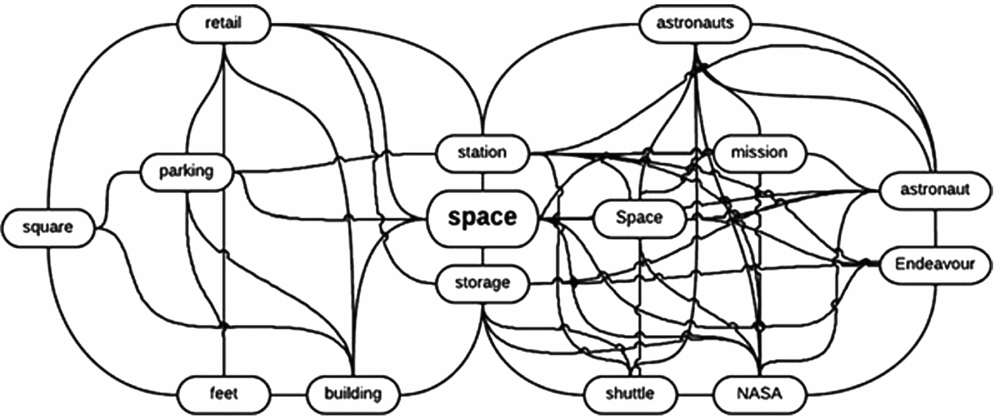
Word co-occurrence network for the word space (Mitra et al. Reference Mitra, Mitra, Maity, Riedl, Biemann, Goyal and Mukherjee2015).

Positive Point Mutual Information (Bullinaria and Levy Reference Bullinaria and Levy2007; Bullinaria and Levy Reference Bullinaria and Levy2012) is also used in the literature to obtain global semantics. With this approach, the global semantics of the target word is obtained by computing the Point Mutual Information (PMI) I(w c; w t) = log(p(w c|w t)/p(w c)) between the target word w t and words in its context w c. It is called Positive PMI because only those w c with I(w c; w t) > 0 are kept. According to Bullinaria and Levy (Reference Bullinaria and Levy2012), keeping those with I(w c; w t) > 0 helps keep the words co-occurring more frequently with the target word and get rid of those with low frequency.
The major advantage of using explicit word vectors for global semantics is that these vectors are conveniently interpretable and directly comparable across different time intervals. Nevertheless, because the dimensions of these vectors are often very high, the problem of data sparseness cannot be avoided, which may lead to poorer performance compared with word-embedding approaches.
4.2 Approaches based on word-embedding
Approaches based on word-embedding map high-dimensional word vectors to low-dimensional vectors to obtain global semantics. According to the scope of co-occurrence considered in the operation, these approaches can be further divided into two subtypes: those relying on topic modelling and those relying on local word context.
The approaches relying on topic modelling such as Latent Semantic Indexing (LSA) (Deerwester et al. Reference Deerwester, Dumais, Furnas, Landauer and Harshman1990) and Latent Dirichlet Allocation (LDA) (Blei, Ng, and Jordan Reference Blei, Ng and Jordan2003) use co-occurrences of words within one document to characterize word semantics. Take LDA as an example. The main idea of LDA is that documents are represented as random mixture over latent topics where each topic is characterized by a distribution over words (Blei et al. Reference Blei, Ng and Jordan2003). This idea could be summarized by the following equation:
 $$\begin{equation}
p\left( {w|d} \right) = p\left( {w|t} \right)*p(t|d)
\end{equation}$$
Topic modelling can be extended to incorporate time to model the evolution of topics over time, represented by models such as Topic-Over-Time model (TOT) (Wang and Mccallum Reference Wang and Mccallum2006) and dynamic topic models (Blei and Lafferty Reference Blei and Lafferty2006). TOT is used in Wijaya and Yeniterzi (Reference Wijaya and Yeniterzi2011) for DWSC. It is a time-dependent extension of LDA that parameterizes a continuous distribution over time associated with each topic. By thus doing, the topics also take on information of time.
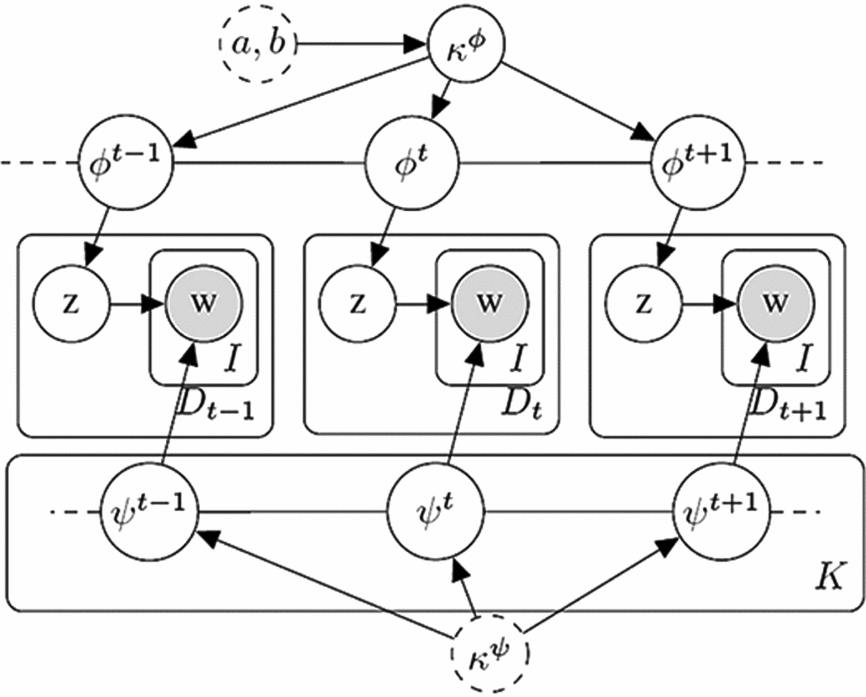
The SCAN model proposed by Frermann and Lapata (Reference Frermann and Lapata2016) is a dynamic Bayesian topic model, described in Figure 3. For each target word, a SCAN model is created that represents the word’s meaning with two distributions: a K-dimensional multinomial distribution over word senses ϕ and a V-dimensional distribution over the vocabulary ψk for each word sense. As a generative model, SCAN starts with a precision parameter κϕ, a Gamma distribution with parameters a and b that controls the extent of meaning change of ϕ. A three time step model involves the generation of three sense distributions ϕt − 1, ϕt and ϕt + 1, at times <m >t-1, t < /m > and t + 1. The sense distribution at each time generates a sense z, which in turn generates the context words for the target word. Simultaneously, for each time of <m >t-1, t < /m > and t + 1, the word-sense distributions ψk, t − 1, ψk, t and ψk, t + 1 are generated, each of which also generates the context words for the target word. The prior is an intrinsic Gaussian Markov Random Field which encourages smooth change of parameters at neighbouring times. The inference is conducted with blocked Gibbs sampling.
Three time step SCAN model (Frermann and Lapata Reference Frermann and Lapata2016).

Word embedding techniques that rely on local context of target words include Word2vec (Mikolov et al. Reference Mikolov, Sutskever, Chen, Corrado and Dean2013), generalized SVD, Glove (Pennington, Socher, and Manning 2014) and Dynamic Bernoulli Embeddings (Rudolph and Blei Reference Rudolph and Blei2018) etc. The scope of context is restrained within a window size. For instance, the objective of the Skip-Gram model is to maximize the average log probability of the following:
 $$\begin{equation}
\frac{1}{T}\sum \nolimits _{t = 1}^T {\sum \nolimits _{ - c \le j \le c,j \ne 0} {\log p({w_{t + j}}|{w_t})} }
\end{equation}$$
Word vectors obtained through embedding techniques such as generalized SVD, Word2vec and Glove cannot be directly used for DWSC. Different from explicit word vectors obtained by PPMI, these techniques map original stochastic distributions of words to lower dimensions, which will preclude comparison of the same word across time (Hamilton et al. Reference Hamilton, Leskovec and Dan2016). Therefore, word vectors of different time intervals obtained through these techniques have to be aligned to become comparable. Various approaches are proposed for the purpose. Based on the assumption that word vector spaces are equivalent under linear transformation and that meanings of most words do not shift over time, Kulkarni et al. (Reference Kulkarni, Alrfou, Perozzi and Skiena2015) adopt a linear transformation  ${W_{t\prime \mapsto t}}( w ) \in {\mathbb {R}^{d \times d}}$ that maps a word vector ϕt to ϕt′ by solving the following optimization problem:
 $$\begin{equation}
{W_{t\prime \mapsto t}}\left( w \right) = {\rm {arg}}\;{\rm {mi}}{{\rm {n}}_W}\sum \nolimits _{{w_i} \in k - NN\left( {{\phi _t},\left( w \right)} \right)} {\left| {\left| {{\phi _{t\prime }}\left( {{w_i}} \right)W - {\phi _t}\left( {{w_i}} \right)} \right|} \right|_2^2}
\end{equation}$$
 ${W^{( t )}} \in {\mathbb {R}^{d \times | V |}}$ as the matrix of word embeddings learned at year t, the research aligns the matrices by optimizing the following equation:
 $$\begin{equation}
{R^{\left( t \right)}} = {\rm {arg}}\;{\rm {mi}}{{\rm {n}}_{_{{Q^T}Q = I}}}{\left| {\left| {Q{W^{\left( t \right)}} - {W^{\left( {t - 1} \right)}}} \right|} \right|_F}
\end{equation}$$
 ${R^{( t )}} \in {\mathbb {R}^{d \times d}}$ and || · ||F are the Frobenius Norm. The solution can be obtained with an application of SVD.
Similar to TOT model, there are approaches that combine local-context word embedding with time. Yao et al. (Reference Yao, Sun, Ding, Rao and Xiong2017) proposed a diachronic word embedding model that integrates the word embedding learning process and the alignment operation by solving the following joint optimization problem:
 $$\begin{eqnarray}
&&{\min _{U\left( 1 \right), \ldots ,U\left( T \right)}}\frac{1}{2}\sum \nolimits _{t = 1}^T \left| {\left| {Y\left( t \right) - U\left( t \right)U{{\left( t \right)}^T}} \right|} \right|_F^2 + \frac{\lambda }{2}\sum \nolimits _{t = 1}^T \left| {\left| {U\left( t \right)} \right|} \right|_F^2 \nonumber \\
&&\quad +\, \frac{\tau }{2} \sum \nolimits _{t = 2}^T {\left| {\left| {U\left( {t - 1} \right) - U\left( t \right)} \right|} \right|_F^2}
\end{eqnarray}$$
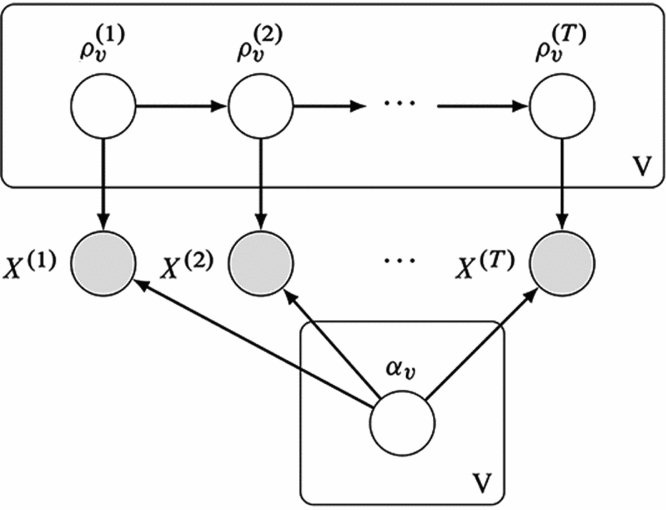
Graphic representation of a dynamic embedding for text data in T time intervals, X (1),. . ., X (T) (Rudolph and Blei Reference Rudolph and Blei2018).

There are also word-embedding-based studies that make use of both topic modelling and local word-context information, such as the semantic density model proposed in Sagi et al. (Reference Sagi, Kaufmann and Clark2009). This study first obtained word vectors by applying Latent Semantic Indexing (Deerwester et al. Reference Deerwester, Dumais, Furnas, Landauer and Harshman1990) on a term-term matrix of size 40,000 × 2,000 (40,000 words as vocabulary, 2,000 words as content words) filled with weighted co-occurrence counts of words, resulting in a reduced 40,000 × 100 matrix with each item in the vocabulary associated with a 100-dimension vector. Given a target word w t, the instance sense of w t is the context vector which is the normalized sum of the vectors associated with the words occurring with w t in the instance sentence within the window size ±15. The global semantics of w t is denoted by the density or the average pairwise similarity of the instance senses collected from the given corpus. The similarity of two instance senses is measured by cosine similarity.
The above review shows that many WSI techniques have already been used for DWSC. However, the state-of-the-art of WSI is not fully exploited in the literature of semantic change computation. There is currently no comprehensive comparison of these WSI approaches to DWSC, partly due to the fact that there is no large scale evaluation data available for the purpose. Further research is needed to understand the nature of these techniques. In addition, the literature also shows that not all WSI techniques are tested in semantic change computation, particularly those graph-based WSI techniques (Véronis Reference Véronis2004; Agirre and Soroa Reference Agirre and Soroa2007; Korkontzelos and Manandhar Reference Korkontzelos and Manandhar2010; Marco and Navigli Reference Marco and Navigli2013) that are reported to achieve state-of-the-art performance in Word Sense Disambiguation evaluation tasks. Moreover, while word-embedding models used in the current literature generally associate each word with a single embedding, the use of multisense embedding models (Kintsch Reference Kintsch2001; Reisinger and Mooney Reference Reisinger and Mooney2010; Li and Dan Reference Li and Dan2015; Liu et al. Reference Liu, Liu, Chua and Sun2015; Cao et al. Reference Cao, Huang, Ji, Chen and Li2017) is not yet explored in DWSC.
5 Semantic change modelling
DWSC gathers global semantics of target words at each time interval. How the global semantics of different time intervals is used to interpret and testify hypotheses of semantic change is the task of the component SCM. Semantic change is a type of change. The prerequisite of semantic change computation is to clarify how change is metaphysically defined. Different metaphysical understandings of change cover different phenomena of semantic change and require different techniques in SCM.
5.1 Metaphysical understandings of semantic change
The literature has reported two types of metaphysical understanding of change: Cambridge Change (Geach Reference Geach1969 : 71–72; 1979; Mortensen Reference Mortensen2016) and McTaggart Change (Broad Reference Broad1938 : 297). The definition of Cambridge Change is given as follows:
An object O is said to ‘change’ . . . if and only if there are two propositions about O, differing only in that one mentions an earlier and the other a later time, and one is true and the other false. (Geach Reference Geach1979 : 91)
Many ordinary thoughts of change such as change of color from ‘red’ to ‘blue’ and change of weather from ‘hot’ to ‘cold’ are of this type. It implies an intrinsic difference at two points along the dimension of time. The metaphysical understanding of McTaggart Change originates from John McTaggart, which is defined below:
The thing changes from q1 to q2” is completely analyzable into a statement of the kind “There is a certain series of successive events so interrelated that it counts as the history of a certain thing [X], e1 and e2 are two successive adjoined phases in this series and e1 has Q in the form q1, while e2 has Q in the form q2 . . . (Broad Reference Broad1938 : 297).
In McTaggart’s view, a change occurring at two points of time does not constitute a change. It establishes itself as a change when two successive events have different qualities. Both Cambridge Change and McTaggart Change agree that different qualities lead to change. They differ in how persistent the quality difference lasts. Cambridge Change is justified so long as the difference is detected at two distinctive points of time, while McTaggart Change maintains that change is determined should the difference exist in the successive course of time, but not just two slices of time.
Whether to adopt Cambridge Change or McTaggart Change in studies of semantic change relates to an important concept in language—convention. A conventionalized regularity is a regularity known and accepted at communal level and observed in almost any instance where the regularity applies (Lewis Reference Lewis1969 : 42). Because Cambridge Change considers only two points in the course of time, the semantic change based on such metaphysical understanding does not consider the course of time and therefore does not take convention into serious consideration. McTaggart Change, however, is based on events happening in the course of time and therefore incorporates conventionalization in its study.
Correspondingly in lexicography, convention serves to distinguish two types of semantic change: institutionalization and topicalicality (Fischer Reference Fischer1998 : 16). Institutionalization refers to the process by which a semantic change is integrated into language norm and becomes a convention, while topicality refers to the phenomenon that a word is used in connection with current affairs for a short period. For instance, Landau (Reference Landau2001) discussed the example chat group and speculated that the phrase may disappear in a couple of years with development of technology. Therefore, the phrase chat group is more of topicalicality than of institutionalization. From this perspective, Cambridge Change and McTaggart Change cover different semantic change phenomena. Cambridge Change covers both topicalicality and institutionalization, while McTaggart Change has a narrower scope and mainly concerns the institutionalization process that involves conventionalization.
Studies in theoretical semantic change generally adopt McTaggart Change as the metaphysical understanding of semantic change (Andersen Reference Andersen, Breivik and Jahr1989; Traugott and Dasher Reference Traugott and Dasher2002; Fortson Reference Fortson, Joseph and Janda2008). In the literature of semantic change computation, both Cambridge Change and McTaggart Change are adopted.
5.2 Computation models based on Cambridge change
Semantic change computation based on Cambridge Change mainly relies on similarity comparison. Given ζt1 and ζt2 as the global semantics of the target word w at time t 1 and t 2, the semantic change of w is indicated by the similarity measure as follows:
 $$\begin{equation}
\theta = {\rm {Similar}}\left( {{\zeta _{t1}},\ {\zeta _{t2}}} \right)\
\end{equation}$$
 $$\begin{equation}
\cos \left( {{\zeta _{t1}},\;{\zeta _{t2}}} \right) = \frac{{{\zeta _{t1}}\cdot {\zeta _{t2}}}}{{\left| {{\zeta _{t1}}} \right|\left| {{\zeta _{t2}}} \right|}}
\end{equation}$$
 $$\begin{equation}
{\rm {Nov}}\left( w \right) = \frac{{{\zeta _{t2}} - {\zeta _{t1}}}}{{{\zeta _{t1}}}}
\end{equation}$$
Illustration of centroid-based distance (Abridged from Dubossarsky et al. (Reference Dubossarsky, Tsvetkov, Dyer, Weinshall and Grossman2015))

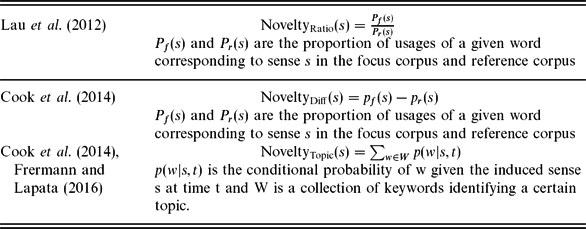
Cambridge Change can be used to detect novel senses. Researchers have proposed various ways to compute sense novelty on the basis of the ratio of sense distribution, as shown in Table 4.
Various ways to compute sense novelty

The major concern facing Cambridge-Change-based models is conventionality. Comparison of global semantics of two time intervals can answer the question whether a semantic change occurs or not, but it cannot tell whether the change has been conventionalized. Mitra et al. (Reference Mitra, Mitra, Maity, Riedl, Biemann, Goyal and Mukherjee2015) showed that the comparison method flagged 2,498 candidates with new semantic senses, but only 537 of them had been observed to be stable.
5.3 Computation models based on McTaggart Change
The models based on McTaggart Change rely on time series to investigate semantic change. Most studies in the literature fall into this group, as seen in Frermann and Lapata (Reference Frermann and Lapata2016), Yang and Kemp (Reference Yang and Kemp2015), Hilpert and Perek (Reference Hilpert and Perek2015), Jatowt and Duh (Reference Jatowt and Duh2014), Wijaya and Yeniterzi (Reference Wijaya and Yeniterzi2011), Tang et al. (Reference Tang, Qu and Chen2016) and many others. There are generally two ways to construct the time series. One way is to use the explicit global semantics of words obtained from corpora to form a time series, as follows:
 $$\begin{equation}
\xi _{1,n}^w = \left[ {{\zeta _{{t_1}}},\ {\zeta _{{t_2}}},\ {\zeta _{{t_3}}},\ \ldots ,\ {\zeta _{{t_n}}}} \right]
\end{equation}$$
 $$\begin{equation}
\xi _{1,n}^w = [\Delta \left( {{\zeta _{{t_2}}},{\zeta _{{t_1}}}} \right),\;\Delta \left( {{\zeta _3},{\zeta _{{t_1}}}} \right), \ldots ,\;\Delta \left( {{\zeta _{{t_n}}},{\zeta _{{t_1}}}} \right)\rbrace
\end{equation}$$
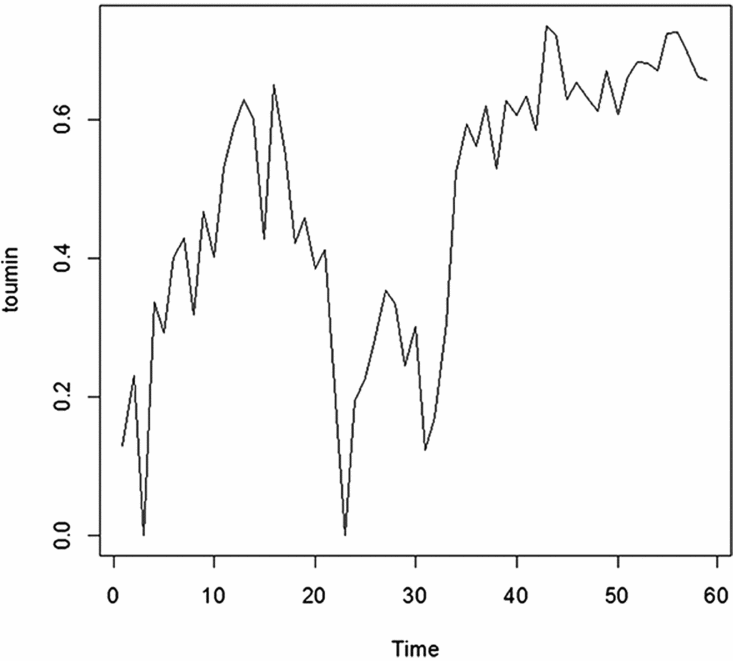
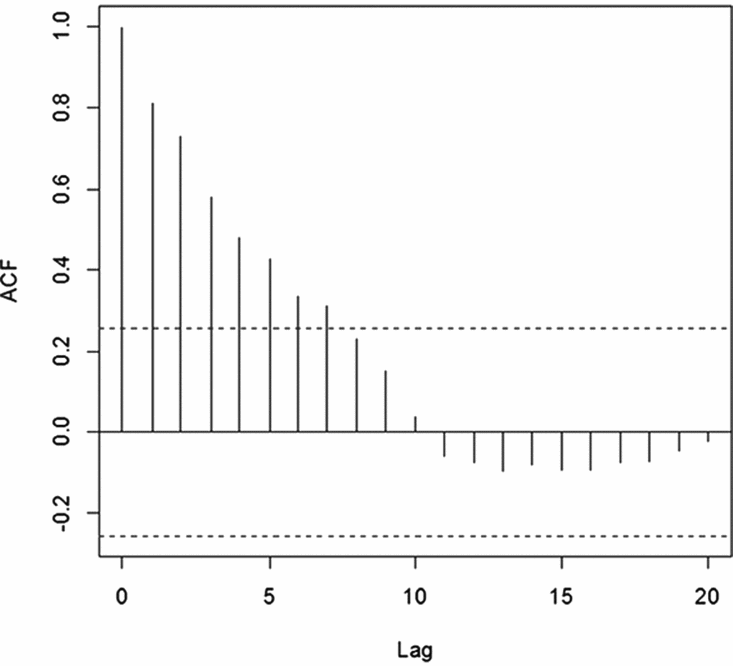
With McTaggart Change, it is possible to apply analyzing techniques of time series to semantic change computation. For instance, Sample Autocorrelation Function (sample ACF)Footnote 3 can be used to assess whether there is a trend of change in the time series and whether the trend consists of different stages. For illustration, given the time series data for the Chinese word tou 51ming 35 from Tang et al. (Reference Tang, Qu and Chen2016) in Figure 5Footnote 4, the absolute values of sample ACF in Figure 6 show two sequences of decay from year lag 0 to 10 and from 13 to 20, indicating a change consisting of two stages.
Time series data for the Chinese word tou 51ming 35.

Sample ACF with 0 ⩽ lag ⩽ 20 of the time series in Figure 5 with boundary  $\pm 1.96/\sqrt{59}$. Data with Sample ACF below
 $\pm 1.96/\sqrt{n}$ (n is the number of data) is considered to contain no trend, since 1.96 is the 0.975 quantile of the standard normal distribution (Brockwell and Davis Reference Brockwell and Davis2002: 20).

Compared with Cambridge-Change-based models, the models based on McTaggart Change incorporate conventionality in semantic change computation, which enables more elaborated studies such as semantic change categorization.
As discussed in Section 4, different methods are used to obtain global semantics in DWSC. The global semantics obtained by these methods possesses different statistic nature and provides for different types of categorization. The global semantics obtained with LSA (as in Jatowt and Duh (Reference Jatowt and Duh2014)), PPMI (as in Hamilton et al. (Reference Hamilton, Leskovec and Dan2016) and Dubossarsky et al. (Reference Dubossarsky, Grossman and Weinshall2017)), or Skip-Gram model (as in Yao et al. (Reference Yao, Sun, Ding, Rao and Xiong2017) and Hamilton et al. (Reference Hamilton, Leskovec and Dan2016)) does not distinguish between word senses. Although differences obtained by contrasting global semantics of different time intervals can be used for semantic change detection, it does not tell whether the scope of word usage has increased or decreased. Therefore, global semantics of this nature cannot be used for more granulated categorization such as sense broadening and sense narrowing.
If the global semantics of a word contains information of different senses of target words, such as the entropy used in Tang et al. (Reference Tang, Qu and Chen2016) or word vectors obtained with LDA (Rohrdantz et al. 2011; Lau et al. Reference Lau, Cook, McCarthy, Newman and Baldwin2012), TOT (Wijaya and Yeniterzi Reference Wijaya and Yeniterzi2011) and SCAN (Frermann and Lapata Reference Frermann and Lapata2016), machine learning techniques can be used to identify semantic change categories such as sense broadening, sense narrowing, pejoration, amelioration, even metaphorical and metonymic change. For instance, Tang et al. (Reference Tang, Qu and Chen2016) discussed how to make use of curve fitting and Support Vector Machine to identify semantic change categories.
It is odd that models of semantic change are not much discussed in the literature, although many studies have adopted the McTaggart-Change-based approaches. One model, namely the S-Shaped Curve, is detailed in Tang et al. (Reference Tang, Qu and Chen2016). The S-Shaped Curve is defined by the logistic function below:
 $$\begin{equation}
\zeta = \frac{{{e^{k + st}}}}{{1 + {e^{k + st}}}}
\end{equation}$$
In addition, conventionality is also not much discussed in the literature, although the McTaggart-Change-based models enable such investigation. A new word usage gains its status as a novel sense only when it is conventionalized as well as being frequently used. Tang et al. (Reference Tang, Qu and Chen2016) discuss the issue very briefly by proposing to compute the conventionality of a word sense with the following:
 $$\begin{equation}
{\rm {Conventionality}}_s^T = {\rm {AveragePrevalence}}\left( {s,T} \right) \times {\rm {DiaSpan}}\left( {s,T} \right) \times {\rm {DiaDensity}}\left( {s,T} \right)
\end{equation}$$
In sum, the McTaggart-Change-based approaches to semantic change use time series to model semantic change. Although more information is available with the approaches, there is still a need to explore how semantic change should be modelled and how computational models relate to those hypotheses proposed in theoretical linguistics.
6 Evaluation and construction of evaluation data
In the component of Evaluation in the framework, general measures such as precision, recall and F-score can be adopted to evaluate the performance of semantic change computation models. The main challenge in the component is the construction of evaluation data. Although the past decade has witnessed the trend from case studies to use of evaluation data in the literature, several issues remain to be solved, including the categories of semantic change and principles of data collection.
The studies of semantic change serve different purposes. To explore the principles of semantic change, or to construct linguistic knowledge resources, it might require in-depth analyses of semantic change phenomena, including changes occurring to individual senses, conventionality of senses, prevalence of senses and even motivations of semantic change. On the other hand, NLP applications are mainly concerned with detection of novel senses and dynamic update of lexical knowledge. Therefore, different types of evaluation data are needed to meet different interests.
6.1 Categories of semantic change
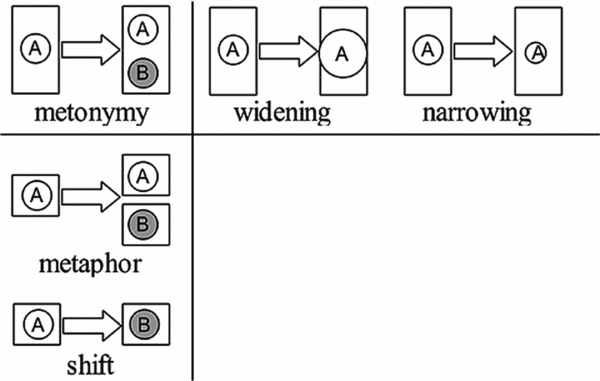
In theoretical linguistics, there are different categorization schemes of semantic change (cf. Geeraerts (Reference Geeraerts1983), Blank and Koch (Reference Blank, Koch, Blank and Koch1999), Bloomfield (Reference Bloomfield1933) and many others). The categorization scheme proposed in Bloomfield (Reference Bloomfield1933) is one of the most popular schemes. We propose to formalize this scheme in terms of denotation change, as illustrated in Figure 7. In five of the six categories in the figure, the original sense of the word is retained. The original sense can be widened (thus, the category of widening) or narrowed (thus, the category of narrowing). New senses can be added to the word. The added sense can be of the same semantic domain (thus, the category of metonymy) or of different domains (thus, the category of metaphor). The category of semantic shift specifies the cases in which a new sense is substituted for its original one. Along with the sense substitution, the emotional colouring of the word might be changed from commendatory to derogatory (thus, the category of pejoration) or from derogatory to commendatory (thus, the category of amelioration).
Schematic diagram of semantic change categories for theoretical exploration.

The phenomena of widening and narrowing are discussed in most studies, such as Sagi et al. (Reference Sagi, Kaufmann and Clark2009) and Gulordava and Baroni (Reference Gulordava and Baroni2011). Novel senses, namely the birth of lexical senses are discussed in details in Erk (Reference Erk2006), Lau et al. (Reference Lau, Cook, McCarthy, Newman and Baldwin2012), Mitra et al. (Reference Mitra, Mitra, Maity, Riedl, Biemann, Goyal and Mukherjee2015), Frermann and Lapata (Reference Frermann and Lapata2016), Tang et al. (Reference Tang, Qu and Chen2016) and others. Pejoration and amelioration are dealt with in Jatowt and Duh (Reference Jatowt and Duh2014). Using words from SentiWordNetFootnote 5 as constitutes in context, Jatowt and Duh (Reference Jatowt and Duh2014) conduct case studies of aggressive, propaganda and fatal in Google Books Ngram Corpus and show that aggressive has undergone amelioration and that fatal and propaganda have undergone pejoration. Semantic shift is discussed in Wijaya and Yeniterzi (Reference Wijaya and Yeniterzi2011), with examples such as gay and awful. Detection of semantic change motivated by metonymy and metaphor is discussed in Tang et al. (Reference Tang, Qu and Chen2016).
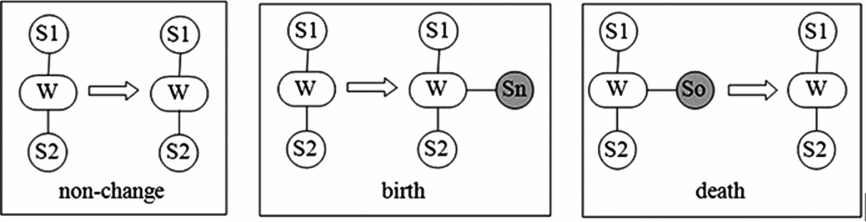
The studies of semantic change can also add the ability of time awareness to NLP systems and help improve performance in disambiguating word senses. Along this track, one possible categorization scheme is proposed in Mitra et al. (Reference Mitra, Mitra, Maity, Riedl, Biemann, Goyal and Mukherjee2015). The research proposed four types of semantic change based on change in semantic clusters: split, join, birth and death. Because splitting one cluster into two and joining of two clusters are more of the results of clustering algorithm than of semantic change, we propose to modify the category schema into three categories: nonchange, birth and death, as illustrated in Figure 8.
Schematic diagram of semantic change categories for NLP (adapted from Mitra et al. (Reference Mitra, Mitra, Maity, Riedl, Biemann, Goyal and Mukherjee2015)).

6.2 Methods of evaluation data collection
Large-scale evaluation of meaning change is notoriously difficult (Frermann and Lapata Reference Frermann and Lapata2016). This explains the reason why many studies in semantic change computation have opted for case studies, and why there exist no standard evaluation data in the field. However, researchers have made efforts to collect and construct evaluation data in their studies. Two methods are identified in the literature: rating-based data collection and dictionary-based data collection.
6.2.1 Rating-based data collection
Gulordava and Baroni (Reference Gulordava and Baroni2011) reported constructing an evaluation data of hundred words from the American English portion of Google Books Ngram. The hundred words are selected from 10,000 randomly picked mid-frequency words in the corpus and are rated by humans. During the rating process, human raters were asked to rank the resulting list according to their intuitions about the change of the word in the last 40 years on a 4-point scale (0: no change; 1: almost no change; 2: somewhat change; 3: changed significantly). Although the average of pair-wise Pearson correlations of the 5 participants was 0.51, the reliance on rating could be problematic due to the age and personal experience of the participants.
6.2.2 Dictionary-based data collection
Dictionaries, particularly those dictionaries that have published different editions over history, might be the most reliable source for evaluation data collection. For instance, the Oxford English Dictionary constitutes a good source, because it has three editions: the first edition beginning in 1928, with supplementary volumes added in later years; the second edition in 1989; the third edition is on the wayFootnote 6. Dictionaries are reliable because their compilation process is often prudent, during which more than one lexicographer participates in gathering evidence to support their decisions whether to include or exclude word senses.
Several studies in the literature collect evaluation data by referring to dictionaries. Rohrdantz et al. (Reference Rohrdantz, Hautli, Mayer, Butt, Keim and Plank2011) used 2007 Collins Dictionary for senses of words in later times and English WordNet (Fellbaum Reference Fellbaum1998) and 1987 Longman Dictionary for earlier senses of words. The research conducted case studies of browse, surf, messenger, bug and bookmark, finding the meanings of these words extended along the time. Mitra et al. (Reference Mitra, Mitra, Maity, Riedl, Biemann, Goyal and Mukherjee2015) used dictionaries for both manual and automatic evaluation. For manual evaluation, they used New Oxford American Dictionary as the gold and manually checked sixty-nine words against the dictionary, obtaining a precision of 60 per cent for the birth category and a precision of 57 per cent for the split/join category. For automatic evaluation, the research used WordNet 3.0 for reference. A sense mapping is constructed to map senses of clusters to senses of synsets in WordNet. Since the research models semantic change on the basis of Cambridge Change, the 1,090–1,953 data are compared with data of other periods such as 1954–1972, 1973–1986 and 1987–1995. The range of precision is between 30 per cent and 65 per cent for birth, split and join. In constructing a dataset of diachronic sense differences, Cook et al. (Reference Cook, Lau, McCarthy and Baldwin2014) made use of two editions of Concise Oxford Dictionary: the 1995 Thompson Edition and the 2005 Soanes and Thompson Edition. They first identified a number of lemmas by selecting words whose entries contain words such as code, computer, internet, network, online, program, web and website. Tang et al. (Reference Tang, Qu and Chen2016) used fourteen dictionaries to compile an evaluation data that contain 197 Chinese words. Among the dictionaries used in the research, ten are new word dictionaries and four are general dictionaries.
7 Data Visualization
Semantic change computation often involves data that are large, complex and multi-dimensional, as it deals with words in large numbers and the dimension of time. Researchers have opted for data visualization for better illustration, description and exposition of semantic change, exemplified by Hilpert and Gries (Reference Hilpert and Gries2009), Hilpert and Perek (Reference Hilpert and Perek2015), Michel et al. (Reference Michel, Shen, Aiden, Veres, Gray, Team, Pickett, Hoiberg, Clancy, Norvig, Orwant, Pinker, Nowak and Aiden2011), Rohrdantz et al. (Reference Rohrdantz, Hautli, Mayer, Butt, Keim and Plank2011), Heylen et al. (Reference Heylen, Wielfaert, Speelman and Geeraerts2015), Benito et al. (Reference Benito, Losada, Therón, Seltmann and Wandl-Vogt2016) and others.
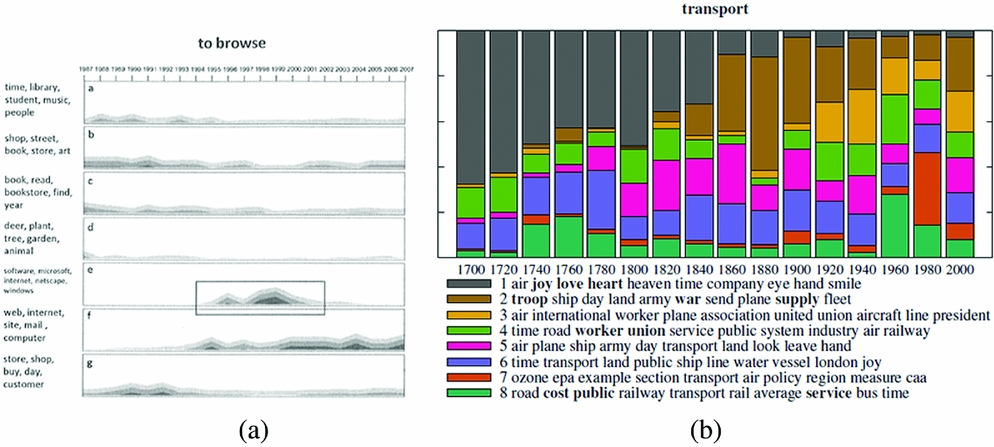
A common visualization method is to plot different senses over time, as illustrated in Figure 9 where the senses are represented by terms obtained with topic modelling. Figure 9(b) differs from Figure 9(a) in that Figure 9(b) also shows the percentage of the senses (therefore the prevalence of the senses) of the word at each time interval, making it more convenient to observe semantic changes such as broadening, narrowing, semantic shift, pejoration and amelioration. In Figure 9(b), the topic of ‘air, joy, love, heart . . .’ is gradually detached from the word transport, indicating people’s attitude towards transport changes from pleasant to neutral, which is a process of pejoration.
Sense distribution over time. (a) Retrieved from Rohrdantz et al. (Reference Rohrdantz, Hautli, Mayer, Butt, Keim and Plank2011). (b) Retrieved from Frermann and Lapata (Reference Frermann and Lapata2016).

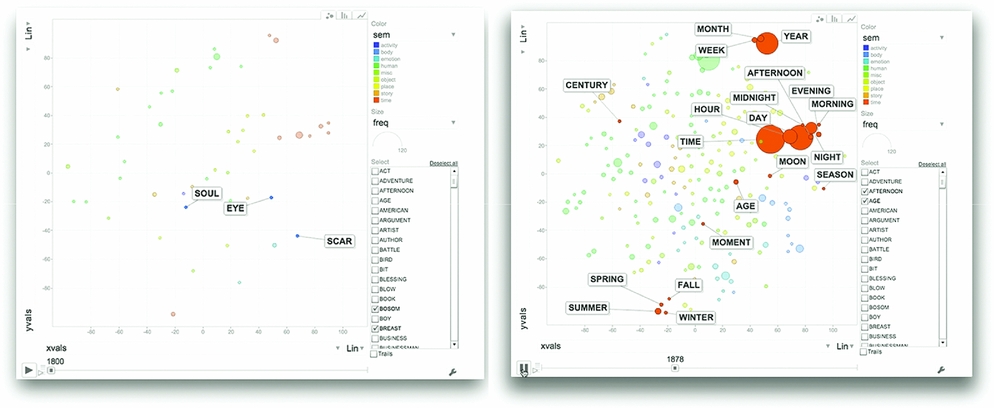
Hilpert and Perek (Reference Hilpert and Perek2015) introduce a visualization method that animates scatterplots over time to explain semantic change of the construction ‘many a NOUN’, as depicted in Figure 10. The spots in the scatterplot stand for nouns found in the construction, plotted according to their mutual semantic distances. The spot size indicates the frequency of the noun found in the construction and the colours indicate different semantic categories. With the animated scatterplots, it is easy to see that the construction gradually acquires popularity by collocating with more words, particularly words in the semantic domain TIME. Heylen et al. (Reference Heylen, Wielfaert, Speelman and Geeraerts2015) also proposed to use scatterplot for semasiological and onomasiological analyses, which requires clustering the spots and coding those of the same cluster in the same colour.
Animated scatterplots (Hilpert and Perek Reference Hilpert and Perek2015).

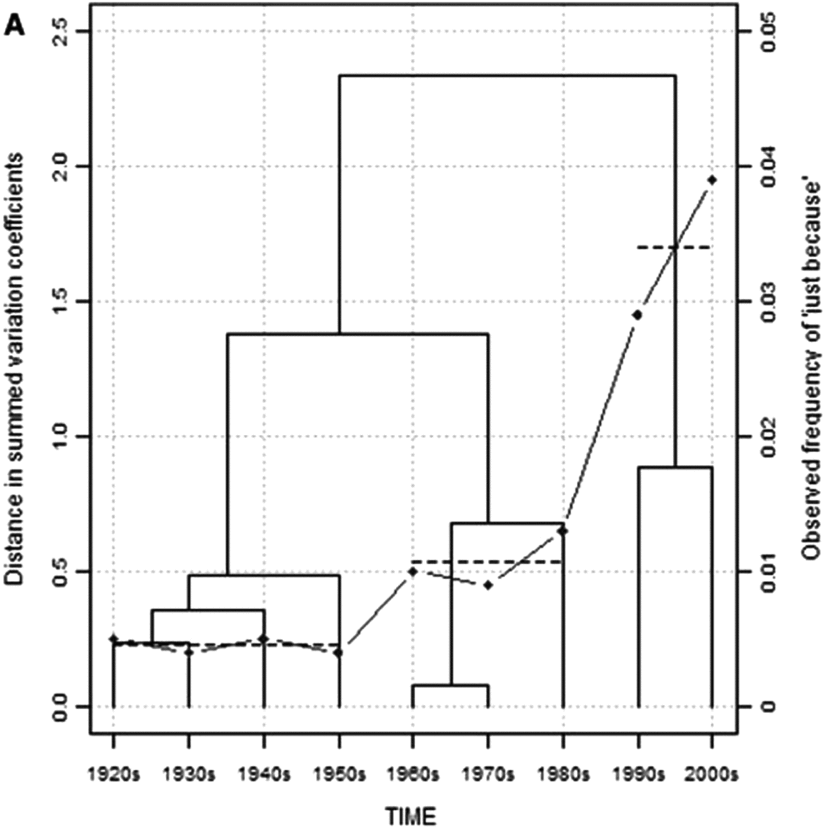
Hilpert and Gries (Reference Hilpert and Gries2009) introduce a visualization technique for detecting and showing specifically different stages of semantic change based on variability-based neighbour clustering (VNC). VNC is essentially a hierarchical clustering, but it takes into account the temporal ordering of the data. By imposing the rule that merge should be performed only when data points are immediately adjacent, VNC obtains a dendrogram that shows distances among larger clusters. As denoted in Figure 11, the plot shows substantial distances among three large clusters, indicating three stages in the diachronic development.
VNC dengrogram (Hilpert and Gries Reference Hilpert and Gries2009).

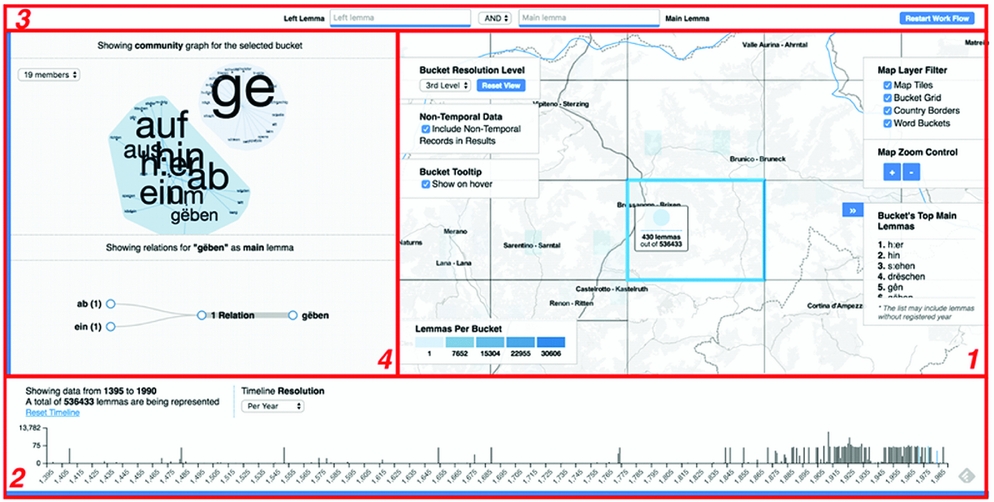
To help with compilation of historical dictionaries, Benito et al. (Reference Benito, Losada, Therón, Seltmann and Wandl-Vogt2016) introduce an interactive spatio-temporal visual analysis tool with an interface depicted in Figure 12. By searching lemmas in the text search bar (View No. 3), users will obtain three types of information: the spatial distribution of corresponding lemmas over a map (View No. 1), network of relationships among the lemmas in question and other lemmas (View No. 4), and the temporal distribution of the lemmas along the timeline (View No. 2). In addition, by selecting a portion of the timeline in View No. 2, users can browse corresponding spatial information on the map (View No. 1) and possibly an updated network information in View No. 4, if this function is supported in the system. With the tool, users can discover cultural issues associated with a language and their diachronic changes through means of visualization.
Interface of spatio-temporal visual analysis tool. View No. 1 is spatial projection, View No. 2 is temporal projection, View No. 3 is textual search bar and View No. 4 is network analysis (Benito et al. Reference Benito, Losada, Therón, Seltmann and Wandl-Vogt2016).

8 Conclusions
Meanings of words are in the state of eternal change. Researchers in both theoretical linguistics and CL have long been aware of the phenomena, but only in the last decade were researchers able to study semantic change in large scale corpus with computational approaches. The field is still very much in its initial stage. The framework presented in the paper summarizes current approaches in the field, showing that most studies are focused on testifying hypotheses proposed in theoretical linguistics. The issues discussed in the field, such as categorization of semantic change, the relationship between frequency and semantic change, and the relationship between polysemy and semantic change have long been discussed in theoretical studies. The models of semantic change, such as the S-Shaped Curve, are also proposed in theoretical studies. However, semantic change computation possesses advantages that cannot be obtained in the past. It can gather evidence of semantic change on a large scale and provide advanced data visualization techniques. From this perspective, the studies in semantic change computation are expected to not only testify extant hypotheses and rules of semantic change, but uncover new rules and regularities. Recent studies such as Hamilton et al. (Reference Hamilton, Leskovec and Dan2016) and Dubossarsky et al. (Reference Dubossarsky, Grossman and Weinshall2017) represent such a trend.
This review also shows that there is no systematic application of semantic change computation techniques in NLP tasks, although researchers all consent to the potentials of semantic change knowledge in these tasks. In the studies, brief discussions of NLP application are often found in introductions or conclusions. For instance, Mitra et al. (Reference Mitra, Mitra, Maity, Riedl, Biemann, Goyal and Mukherjee2015) propose in their conclusions that novel sense detection can be used to enhance semantic search by increasing the efficiency of word sense disambiguation. In addition, current studies of semantic change computation are more focused on languages in history while NLP applications are more interested in modern and contemporary language use. One piece of evidence for this observation lies in the use of Google Books Ngram corpus. The corpus spans hundreds of years and is often studied with decades as time interval. However, semantic change can happen within years, or even months. For instance, Tang et al. (Reference Tang, Qu and Chen2016) show that the metaphorical semantic change of tou 51ming 35 (a Chinese word) becomes highly conventionalized within two or three years. To meet the demand of NLP tasks, more research should be directed to short-term semantic changes instead of long-term ones.
The literature has proposed various approaches to DWSC and change modelling. Initial comparison has been conducted to show the merits and demerits of these approaches. For instance, Hamilton et al. (Reference Hamilton, Leskovec and Dan2016) show that Skim-Gram Model and generalized SVD perform differently on different corpus, and PPMI is noticeably worse than the two approaches. But the evaluation data used in the research is small (less than forty words). Comprehensive comparison on large scale evaluation data is still needed to validate discoveries in these studies. In addition, there seems to be a tendency to integrate different steps in DWSC into one model, as evidenced in the Bayesian model SCAN (Frermann and Lapata Reference Frermann and Lapata2016), the Topics-Over-Time model (Wang et al. 2006) and the model based on word embedding (Yao et al. Reference Yao, Sun, Ding, Rao and Xiong2017). This tendency also awaits further justification.
Semantic change is one of the most evading topics in studies of language change. But, recent advances in the field of semantic change computation show that it is possible to address the issue with computational approaches, and to testify rules and mechanisms of semantic change, and even to uncover new rules and mechanisms.