INTRODUCTION
The family Ephippidae, commonly known as spadefishes, comprises eight genera (Nelson, Reference Nelson2006) and 15 valid species (Eschmeyer & Fong, Reference Eschmeyer and Fong2014), mostly inhabiting coastal waters around reefs, up to a depth of 30 m (Nelson, Reference Nelson2006). The genus Platax is the most speciose, while the genus Tripterodon is monotypic (Jawad et al., Reference Jawad, Al-Mamry and Al-Shogebai2012). The maximum length attained by Tripterodon orbis is 750 mm (Fischer & Bianchi, Reference Fischer and Bianchi1984; Heemstra & Heemstra, Reference Heemstra and Heemstra2004), with common lengths reaching 300 mm. They feed on rock and coral-dwelling organisms and their flesh is edible (Froese & Pauly, Reference Froese and Pauly2014).
The species had earlier been reported from the Western Indian Ocean (Somalia, Kenya, south to Algoa Bay, South Africa), from the Red sea and from the eastern Indian Ocean (Andaman and Nicobar Islands, and Sri Lanka) (Froese & Pauly, Reference Froese and Pauly2014). Indrasenan (Reference Indrasenan1960) had also reported the occurrence of Tripterodon orbis from Rameswaram Island, in the Gulf of Mannar, south-east coast of India. However, this is the first occurrence of the species at Visakhapatnam along the north-east coast of India, a significant extension of its distribution from the southern to the northern region, along the Bay of Bengal.
MATERIAL AND METHODS
On 13 December 2013, one specimen (Figure 1) was collected from a gill net operating at depths between 40 and 70 m, about 20 km north of Visakhapatnam Fishing Harbour (Figure 2). The specimen was identified as Tripterodon orbis based on diagnostic characters described by Smith (Reference Smith, Smith and Heemstra1986). Measurements were taken using a digital Vernier calliper to the nearest 0.1 mm and were expressed as a percentage of the standard length (SL). The morphometric and meristic data of the recorded species were compared with the holotype (Playfair & Gunther, Reference Playfair and Günther1867). The identified specimen (whole fish) was initially fixed in 10% formaldehyde and later preserved in 70% ethanol, after a thorough washing. The specimen was deposited in the National Marine Biodiversity Referral Museum at the Central Marine Fisheries Research Institute, Kochi (Accession No. GB 31.60.5.6).
African spadefish, Tripterodon orbis Playfair, 1867 at Visakhapatnam.

Capture location (orange star) of Tripterodon orbis Playfair, 1867 along the north-east coast of India.
RESULTS AND DISCUSSION
SYSTEMATICS
Order PERCIFORMES, Bleeker, 1939
Family EPHIPPIDAE
Genus Tripterodon Playfair, 1867
Species Tripterodon orbis Playfair, 1867
MATERIAL EXAMINED
Single specimen of Tripterodon orbis (gill net, Visakhapatnam, water depth 40–70 m), coll. by P.R. Behera, 13 December 2013.
Fin formula: D IX, 21; P 18; V I, 5; A III, 16; C 17; L. lat. 52; L. trans. 11/28
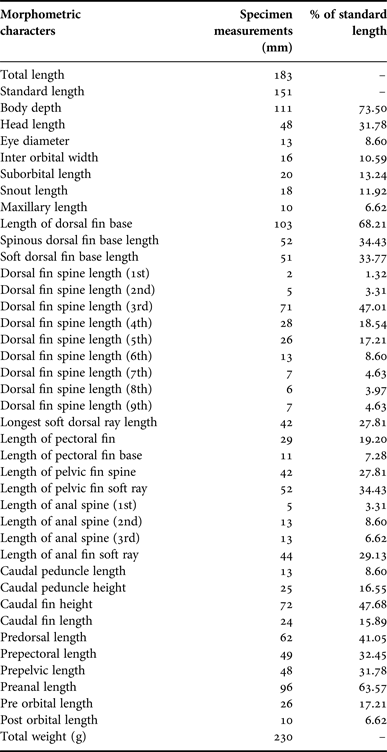
The body is compressed and greatly elevated and the upper profile is strongly curved. The upper profile descends from the origin of the dorsal fin to the snout very abruptly, forming a rather prominent protuberance between the eyes. The greatest height of the body is below the fifth dorsal spine (60.7% SL) and the length of the head is about 26.2% of SL. The eye is situated high up in the head, with diameter about 72.2% of the snout length and occupying 27.1% of the head length. Mouth is small, slightly protractile and terminal with thick lips. The mouth gape is small, with the upper maxillary positioned vertically from the posterior nostril. The interorbital space is concave. Top of head is without scales. There are five series of scales on the cheek. The posterior limb of the preoperculum is naked and the entire operculum is covered with scales. In the upper jaw, there are four and in the lower jaw, there are three series of large, broad, flat, moveable, tricuspid teeth.
The dorsal spines are very broad and flat, and rather feeble. The first and second dorsal spines are minute, while the third, fourth and fifth are formed into long filaments, which are about 47.0, 18.5 and 17.2% of the head length. The sixth is equal to the diameter of the eye; the seventh and eighth are short with lengths progressively decreasing. The ninth, which is regarded as belonging to the soft portion, is shorter than the sixth. All these spines are inserted in and are received within a deep scaly sheath. The soft portion of the spines is scaly and the length of its base is greater than that of the spinous portion. The caudal fin is emarginated. The anal fin is elevated, while its edge is emarginated. The anal fin spines are short, strong and rather remote from each other. The second and third spines are nearly equal in length and their soft portion is covered with scales. The third anal ray is longer than the longest of the dorsal. Pectoral fin is obtusely pointed, and much shorter than the ventral. Ventral fin is long, the first ray being produced into a filament, which reaches to the anal. Detailed morphometric and meristic characters of the species are presented in Table 1.
Morphometric measurements of Tripterodon orbis landed at Visakhapatnam.
The colour of the body is silvery grey, with about nine indistinct darker cross bands. The first (through the eye) and the second (from the top of the interparietal crest, passing over the superior angle of the operculum and root of the pectorals) bands are more distinct than the others. Caudal and dorsal fins are yellowish, while pelvic and anal fins are blackish.
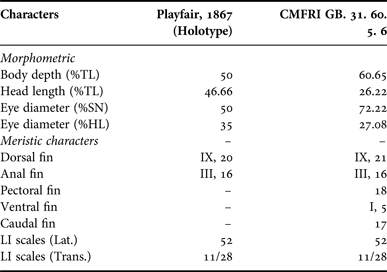
The present record matches well with the earlier description of the same species from Oman waters (Jawad et al., Reference Jawad, Al-Mamry and Al-Shogebai2012). This species differs from Ephippus orbis in its body shape being more oblong, the presence of large and tricuspid teeth, its large eye diameter, measuring half the distance from mouth to eye, its scaleless head top and by the presence of nine indistinct vertical bars. It differs from species belonging to the Drepanidae family in having a short pectoral fin, a non-protrusible mouth, and long 3rd and 4th dorsal fin spines. It differs from the members of the family Scatophagidae in having three anal spines and in having a vertical head profile (Fischer & Bianchi, Reference Fischer and Bianchi1984). The morphometric and meristic characters of the specimen agree well with earlier descriptions reported by previous authors, albeit with slight variations in a few of the characters (pectoral fin count, LI scales and proportion of eye diameter to interorbital space), which could be attributed to the differing geographic locations (Table 2).
Comparison of the morphometric and meristic characters of Tripterodon orbis from Visakhapatnam with the holotype. TL, total length; SN, Snout length; HL, Head length; Lat., Latitudinal; Trans., Transeverse.
The occurrence of T. orbis has previously been reported from the Andaman and Nicobar Islands (Froese & Pauly, Reference Froese and Pauly2014) and from Rameswaram Island in the Gulf of Mannar, south-east coast of India (Indrasenan, Reference Indrasenan1960). The present occurrence from the waters of Visakhapatnam indicates a northward range extension of the distribution of the African spadefish, from the Gulf of Mannar and the Andaman and Nicobar Islands in the southern Bay of Bengal to Visakhapatnam in the northern Bay of Bengal. However, subsequent landings of the species are required for confirming their true range of extension. Similarly, an increase in the distribution range from the southern to the northern latitudes along the east and west coast of India in the last couple of decades has been recorded for Indian oil sardine and Indian mackerel (Vivekanandan et al., Reference Vivekanandan, Rajagopalan, Pillai and Aggarwal2009). A similar range extension of distribution from the south to the north region along the Bay of Bengal has previously been reported for Pacific Gregory, Stegastes fasciolatus (Behera et al., Reference Behera, Muktha and Shubhadeep2014). This broadening in distribution could be attributed to the rising water temperatures along the east coast of India, which are increasing by 0.04°C each decade (Vivekanandan et al., Reference Vivekanandan, Rajagopalan, Pillai and Aggarwal2009). The sea surface temperature has shown a progressive increase in the Bay of Bengal since the 1950s, resulting in changes/shifts in fish communities of the area (Vivekanandan et al., Reference Vivekanandan, Rajagopalan, Pillai and Aggarwal2009). With gradual warming, the waters of the northern Bay of Bengal are now conducive for the survival of a wide range of species, as evident in the present study and as reported by previous authors (Vivekanandan et al., Reference Vivekanandan, Rajagopalan, Pillai and Aggarwal2009; Behera et al., Reference Behera, Muktha and Shubhadeep2014).
ACKNOWLEDGEMENTS
The authors are grateful to the Director of the Central Marine Fisheries Research Institute, Kochi for his constant support and encouragement. The authors are greatly indebted to Dr (Mrs) Muktha Menon, for critically reviewing the literary sections of this manuscript.