The many advances in the medical care of patients with congenital heart disease in the past few decades have resulted in an increased survival. Owing to this, the prevalence of adults living with congenital heart disease is increasing. This population is estimated to increase by 5% per year and currently consists of more adults than children.Reference Brickner, Hillis and Lange 1 The focus of attention has shifted from pure survival to long-term morbidity (sequela), quality of life, and their determinants.
Several studies have reported on the short- and long-term outcome of quality of life in congenital heart disease patients. Although some studies reported impairments of specific quality of life scales, other studies indicated that overall quality of life was comparable to that seen in the general population.Reference Immer, Althaus, Berdat, Saner and Carrel 2 , Reference Saliba, Butera and Bonnet 3 A study by Moons et alReference Moons, Van Deyk and De Bleser 4 showed even better scores in congenital heart disease than the general population. Diminished quality of life has also been reported, especially in the domain of physical functioning.Reference Jefferies, Noonan, Keller, Wilson and Griffith 5 – Reference Simko and McGinnis 7
The use of biomarkers in congenital heart disease is gaining more attention, with brain natriuretic peptide and N-terminal pro-B-type natriuretic peptide being the most prominent biomarkers. These objective markers have shown to be of diagnostic and prognostic value as they are related to severity and prognosis in patients with heart failure due to acquired heart disease. Reference Bettencourt, Azevedo, Pimenta, Frioes, Ferreira and Ferreira 8 – Reference Maeda, Tsutamoto and Wada 11 In two recent systematic reviews by Eindhoven et al,Reference Eindhoven, van den Bosch, Boersma and Roos-Hesselink 12 , Reference Eindhoven, van den Bosch, Jansen, Boersma and Roos-Hesselink 13 an overall increase in brain natriuretic peptide levels was seen in more complex congenital heart disease. Unfortunately, the prognostic value of individual brain natriuretic peptide levels is still under debate, because differences exist between types of congenital heart disease and lack of prospective studies.
Until now, little is known about the relationship between objective measurement of brain natriuretic peptide levels and subjective measurement of quality of life in patients with congenital heart disease. Prior research on brain natriuretic peptide levels and quality of life in patients with congestive heart failure showed no correlation.Reference Luther, McCullough and Havranek 14 Hence, both markers seem to have independent value in evaluating present clinical status and in predicting long-term functioning.
In this study, our aim was to assess the cross-sectional association between N-terminal pro-brain natriuretic peptide levels and subjective quality of life as measured with the Short-Form Health Survey-36, a generic health status questionnaire, in a cohort of patients with congenital heart disease.
Materials and methods
Inclusion criteria
Patients who had undergone corrective open heart surgery between 1968 and 1980 were enrolled in the study. This included all consecutive patients who underwent corrective open heart surgery for atrial septal defect, ventricular septal defect, pulmonary stenosis, tetralogy of Fallot, or transposition of the great arteries in the Erasmus Medical Center and were younger than 15 years at the time of surgery.
Previous follow-up investigations on this cohort were undertaken in 1990/1991 and in 2000/2001. Patients’ baseline characteristics, medical and psychosocial results have been reported in detail previously.Reference Utens, Verhulst and Erdman 15 , Reference van Rijen, Utens and Roos-Hesselink 16
The target population of our third follow-up, conducted in 2010 and 2011, consisted of the 412 patients who participated in the previous two follow-ups. We excluded 39 patients, of whom 10 had died – causes: six cardiovascular, three unknown, and one accident), one had undergone heart transplantation, and 28 patients were lost to follow-up. Of the 373 eligible patients, 102 refused to participate in this third follow-up because of practical reasons, such as work, distance to hospital, resulting in a response rate of 73%.
Patients were approached uniformly and invited to visit the hospital for extensive cardiac and psychological examination. A cardiologist performed cardiac and medical examination during their visit. The health status questionnaire was completed during the hospital visit. Owing to practical reasons – work, children – 20 patients completed the questionnaires at home. If patients had trouble reading or understanding, the questionnaire was administered verbally.
Laboratory testing
After at least 30 minutes of rest, peripheral venous blood samples were obtained from all participants. Plasma and serum were separated immediately after blood sample collection and N-terminal pro-brain natriuretic peptide and creatinin levels were measured. N-terminal pro-brain natriuretic peptide levels were determined using the Elecsys system (Roche Diagnostics, Basel, Switzerland). The Elecsys system cut-off value of normal N-terminal pro-brain natriuretic peptide level is ≤14 pmol/L.
Subjective health status
Health status was assessed using the 36-item Short-Form Health Survey.Reference Ware and Sherbourne 17 The 36-item survey consists of 36 items with standardised response choices that contribute to eight health status domains, that is, physical functioning, role physical functioning, role emotional functioning, mental health, vitality, social functioning, bodily pain, and general health. Scale scores are obtained by summing the items together within a domain, dividing this outcome by the range of scores, and then transforming the raw scores to a scale from 0 to 100.Reference Ware and Sherbourne 17 A higher score on the 36-item survey subdomains represents better functioning. A high score on the bodily pain scale indicates freedom from pain. Previous use of the Dutch version of the 36-item survey has shown good reliability and validity.Reference Aaronson, Muller and Cohen 18
Informed consent
The research protocol was approved by the institutional ethics committee and complies with the 1975 Declaration of Helsinki. Before participating, all patients signed informed consent.
Statistical analysis
Baseline characteristics of the study population are presented as proportions for categorical variables and as means±standard deviations for continuous variables. Patients were analysed as a total sample and as subgroups. Patients with corrected atrial septal defect, ventricular septal defect, and pulmonary stenosis were classified as simple congenital heart disease – unless they had complications such as severe ventricular dysfunction – whereas patients with tetralogy of Fallot or transposition of the great arteries (Mustard repair) were classified as moderate to complex congenital heart disease.Reference Warnes, Liberthson and Danielson 19 Group differences were examined using the χ2 test (Fisher’s exact test if appropriate) for nominal variables, whereas one-way ANOVA was used for continuous variables. Univariable linear regression models were used to examine the association between continuous N-terminal pro-brain natriuretic peptide levels and continuous 36-item survey scores.
Multivariable models were used to correct for potential confounder effects of N-terminal pro-brain natriuretic peptide levels, such as age, sex, body mass index, renal function, and left ventricular function. Owing to small numbers, multivariable models for subgroups were limited to adjust for age and sex. Two-dimensional echocardiography was used to assess left ventricular function – for patients with transposition of the great arteries, this was the systemic right ventricle – with “eyeballing”, which was categorised into good, reasonable, moderate, or poor functioning. All statistical analyses were performed using SPSS for Windows 20.0 (SPSS Inc., Chicago, Illinois, United States of America).
Results
Patient population
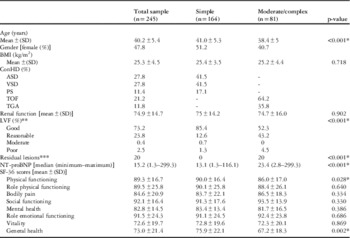
Of the 271 eligible patients in this third quality of life cohort, 20 patients had no N-terminal pro-brain natriuretic peptide measurements because of practical reasons – filled in questionnaires at home – and were excluded from further analysis. There was one patient who visited the outpatient clinic who refused blood sampling. Of the remaining 250 patients, five questionnaires were excluded because of incomplete answers – three because of mental retardation and two refused. Therefore, the final analyses were performed on 245 patients (47.8% female; mean age 40.2± 5.4 years, range [30–56] years). In Table 1, the median N-terminal pro-brain natriuretic peptide and the mean 36-item survey scores are presented. Patients with complex disease were younger, had a worse left ventricular function, higher N-terminal pro-brain natriuretic peptide levels, and lower 36-item survey scores on physical functioning and general health (Table 1). No residual lesions were found in the simple congenital heart disease patients. On the contrary, 20 patients with a complex malformation had residual lesions (Table 1).
Baseline characteristics.

ASD=atrial septal defect; BMI=body mass index; ConHD=congenital heart disease; LVF=left ventricular function; NT-proBNP=N-terminal pro-brain natriuretic peptide; PS=pulmonary stenosis; SD=standard deviation; SF-36=36-item Short Form Health Survey; TGA=transposition of the great arteries; TOF=tetralogy of Fallot; VSD=ventricular septal defect
* Statistical significance with p≤0.05
** Echocardiography was performed in 225/245 (92%) patients
*** Residual lesions: baffle leakage (n=1), baffle obstruction (n=8), residual ASD (n=0), residual VSD (n=0), moderate/severe tricuspid insufficiency (n=16), or moderate/severe pulmonary stenosis (n=11). If a patient had multiple residual laesions (that is, baffle obstruction and severe tricuspid insufficiency), this was counted as 1
N-terminal pro-brain natriuretic peptide and health status in all congenital heart disease
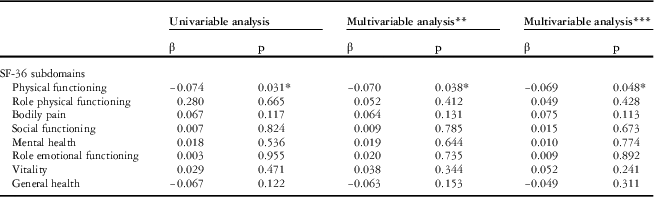
Univariable regression analyses with N-terminal pro-brain natriuretic peptide were executed for each of the eight health status subdomains. N-terminal pro-brain natriuretic peptide levels showed a significant inverse association with the subdomain physical functioning (β=−0.74, p=0.031), whereas no significant association was found in the other seven subdomains (Table 2). This association with physical functioning remained significant after adjusting for age and sex (β=−0.070, p=0.038) and age, sex, body mass index, left ventricular function, and renal function (β=−0.069, p=0.048).
Association between NT-proBNP and SF-36 domains in all ConHD patients.

ConHD=congenital heart disease; NT-proBNP=N-terminal pro-brain natriuretic peptide; SF-36=36-item Short-Form Health Survey
* Statistical significance with p≤0.05
** Adjusted for age and gender
*** Adjusted for age, gender, body mass index, left ventricular function, and renal function
Simple versus complex congenital heart disease
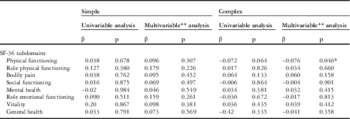
In a second model, the eight health status subdomains were analysed separately for type of congenital heart disease – simple versus complex. In univariable analysis, no association was seen between N-terminal pro-brain natriuretic peptide levels and the eight subdomains in both the simple and the complex congenital heart disease groups. After adjusting for the socio-demographics age and sex, a significant inverse association with physical function was found (β=−0.076, p=0.046; Table 3) in the complex group, whereas no significant relation was seen on the other seven subdomains. The difference was seen in the tetralogy of Fallot subgroup as compared with the transposition of the great arteries subgroup (β=−0.090, p=0.012 versus β=0.002, p=0.982, respectively). The subdomains in the simple group showed no relation with N-terminal pro-brain natriuretic peptide (Table 3).
Association between NT-proBNP and SF-36 domains in ConHD subgroups.

ConHD=congenital heart disease; NT-proBNP=N-terminal pro-brain natriuretic peptide; SF-36=36-item Short-Form Health Survey.
* Statistical significance with p≤0.05
** Adjusted for age and gender
Discussion
The relationship between biomarkers and quality of life in congenital heart disease patients is not well known. This is the first study that focused on the relationship between N-terminal pro-brain natriuretic peptide levels and quality of life in the specific population. Previous studies have mainly been conducted in patients with congestive heart failure, where N-terminal pro-brain natriuretic peptide already is an established marker of prognosis and severity of disease. Our results show that higher levels of N-terminal pro-brain natriuretic peptide are associated with lower scores on the 36-item survey on the subdomain physical functioning, but not with the other seven subjective health domains. In addition, we showed that this relation was found only in complex congenital heart disease patients, but not in simple congenital heart disease.
The general assumption that congenital heart disease patients have lower quality of life is a misconception for patients who underwent repair of their congenital heart disease. However, this is not true for patients who could only be palliated. Several studies have found an equivalent or even better subjective health status in patients who have undergone repair, as compared with healthy counterparts.Reference Immer, Althaus, Berdat, Saner and Carrel 2 – Reference Moons, Van Deyk and De Bleser 4 However, in patients who had merely palliative surgery, a diminished psychosocial outcome has been found.Reference Popelova, Slavik and Skovranek 20 Objective measures most often relate to severity of disease, although results differ among the various types of congenital heart disease.Reference Kamphuis, Ottenkamp and Vliegen 6 , Reference Warnes, Liberthson and Danielson 19 However, the severity of disease does not necessarily reflect lower quality of life scores.Reference Moons, Van Deyk, De Geest, Gewillig and Budts 21 The contradictory results found on quality of life scores could be attributed to different outcomes used and methodological flaws.Reference Moons, Van Deyk, Budts and De Geest 22
Some studies report that physical limitations will not be reflected on generic health status questionnaires. A study by Kamphuis et alReference Kamphuis, Ottenkamp and Vliegen 6 showed a weak correlation between objective physical indices and related domains of subjective health status and health-related quality of life. Limited exercise capacity usually does not hamper patients with congenital heart disease in their daily activities, and rigorous activities are most often not undertaken.Reference De Bleser, Budts and Sluysmans 23 It seems that most of the congenital heart disease patients learn to cope with their physical limitations and, if present, adapt their way of living and expectations.
It is evident that more complex congenital heart disease results in lower performance on exercise capacity.Reference Kempny, Dimopoulos and Uebing 24 Negative correlations between plasma brain natriuretic peptide levels and exercise testing have been reported. Trojnarska et alReference Trojnarska, Gwizdala and Katarzynski 25 showed a negative correlation between brain natriuretic peptide and oxygen uptake during cardiopulmonary testing in a heterogeneous group of congenital heart disease patients. These results were consistent in other reports.Reference Cheung, Lam, Chiu, Chau, Cheung and Cheung 26 , Reference Norozi, Buchhorn and Bartmus 27 In addition, when a 6-minute walk test was conducted, a negative correlation between N-terminal pro-brain natriuretic peptide levels and 6-minute walking distance was observed.Reference Iversen, Jensen, Jensen, Vejlstrup and Sondergaard 28 Not all studies support these results, as in Fontan patients no direct relation was observed between brain natriuretic peptide levels and exercise capacity by peak oxygen consumption.Reference Lechner, Schreier-Lechner and Hofer 29 , Reference Motoki, Ohuchi, Miyazaki and Yamada 30 A possible direct association between increase in plasma brain natriuretic peptide levels and decrease in exercise capacity has never been supported by reports. Although in most congenital heart disease patients diminished physical functioning is not reflected on overall generic quality of life scores, it could be helpful to pay attention specifically to the physical functioning subscale (subdomain). Both elevated levels of brain natriuretic peptide and diminished physical functioning should trigger clinical awareness on possible early deterioration of patients’ cardiac function, and further evaluation of exercise performance can be considered.
A previous study in patients with heart failure showed no relationship between N-terminal pro-brain natriuretic peptide changes over time and short-term changes in health status.Reference Luther, McCullough and Havranek 14 Furthermore, a report by Hogenhuis et alReference Hogenhuis, Jaarsma, Voors, Hillege, Lesman and van Veldhuisen 31 demonstrated that N-terminal pro-brain natriuretic peptide levels correlate more with cardiac function than parameters that reflect physical functioning on quality of life scales. Hence, previous results on the relation between quality of life and brain natriuretic peptide are scarce. No firm conclusions can be drawn when comparing these results with other cardiac diseases.
The use of biomarkers is still limited in congenital heart disease. Whereas elevated levels of N-terminal pro-brain natriuretic peptide correlate with long-term functioning and mortality in heart failure patients, not many long-term (prospective) studies have been conducted in congenital heart disease patients. The systematic reviews by Eindhoven et alReference Eindhoven, van den Bosch, Boersma and Roos-Hesselink 12 , Reference Eindhoven, van den Bosch, Jansen, Boersma and Roos-Hesselink 13 give a clear picture of the evidence until now. The use of the biomarkers is most often limited to short-term changes – that is, peri-operative – and most studies were not designed to evaluate natriuretic peptides. Therefore, our finding that N-terminal pro-brain natriuretic peptide is related to physical functioning is of interest and a first step in this field, which has yet to be explored. It is evident that larger, prospective studies are needed to evaluate the use and predictive value of biomarkers in congenital heart disease.
A first limitation of this study is the small number of patients per diagnosis in the current study sample. Recent studies have clearly shown that N-terminal pro-brain natriuretic peptide levels differ between types of congenital heart disease.Reference Eindhoven, van den Bosch and Ruys 32 , Reference Popelova, Kotaska, Cerny, Prokopova and Rubacek 33 Therefore, conclusions in subgroup analyses should be drawn with caution. A second limitation is the cross-sectional design. Prospective results, especially long-term, could give a better understanding of changes in both N-terminal pro-brain natriuretic peptide levels and quality of life in congenital heart disease patients. Third, outcomes of this cohort of relatively older patients, all operated before 1980, may not be generalisable to the current population of congenital heart disease patients undergoing cardiac surgery. Medical treatment and support has drastically changed over the past decades with improved outcomes.
In conclusion, the current study shows an association between cross-sectionally assessed N-terminal pro-brain natriuretic peptide levels and quality of life – assessed with a generic health status questionnaire – on the subdomain physical functioning, predominantly in complex congenital heart disease patients. No association was found between N-terminal pro-brain natriuretic peptide and the seven other subdomains.
Acknowledgement
None.
Financial Support
This work was supported by an Internal Grant from the Erasmus Medical Center to J.O. Younge
Conflicts of Interest
None.