Introduction
Psychopathy is a form of personality pathology characterized by distinctive affective and interpersonal traits along with persistent behavioral deviancy (DeLisi, Reference DeLisi2009; Hare & Neumann, Reference Hare and Neumann2008; Patrick et al., Reference Patrick, Fowles and Krueger2009). To reconcile different conceptualizations of psychopathy, Patrick et al. (Reference Patrick, Fowles and Krueger2009) have developed a triarchic model that encompasses three bio-behavioral trait domains: boldness, meanness, and disinhibition. Boldness is the combination of stress immunity, fearlessness, and social dominance, and is theorized to correspond to the low pole of the bio-behavioral dimension of threat sensitivity. Meanness is defined by callousness, interpersonal antagonism, and aggression, and is conceptualized as the low pole of the bio-behavioral dimension of affiliative tendencies. Disinhibition is characterized by difficulties with emotion regulation and impulse control, representing the low pole of the bio-behavioral dimension of inhibitory control.
These three trait domains were developed as open constructs that can be operationalized using a variety of assessment methods, and are theoretically surrounded by distinct nomological networks (Patrick & Drislane, Reference Patrick and Drislane2015; Sellbom, Reference Sellbom and DeLisi2018; Somma et al., Reference Somma, Borroni, Drislane, Patrick and Fossati2019). Specifically, the triarchic model was developed to facilitate embedding within the developmental psychopathology literature that boldness, meanness, and disinhibition have different etiological precursors, trajectories of change over time, and associated outcomes (Patrick et al., Reference Patrick, Fowles and Krueger2009; Patrick, Reference Patrick2022). Yet, only recently, progress in the assessment of the triarchic domains in adolescence has made it possible to pursue the developmental aims of the triarchic model of psychopathy (Bertoldi et al., Reference Bertoldi, Perkins, Tuvblad, Oskarsson, Kramer, Latzman, Baker, Raine and Patrick2021; Garofalo et al., Reference Garofalo, Weller, Kirisci and Reynolds2021; Somma et al., Reference Somma, Borroni, Drislane and Fossati2016). The transition from adolescence to adulthood represents an especially interesting time span to uncover differential pathways and correlates because the manifestation of psychopathology tends to become more differentiated as people grow older (Murray et al., Reference Murray, Eisner and Ribeaud2016).
Research on personality development posits that personality traits change across the lifespan due to both physiological maturation and environmental influences (Caspi & Roberts, Reference Caspi and Roberts2001; Funder, Reference Funder1991). Generally, scholars have proposed a characterization of normative changes in personality traits related to psychological regulation directed towards maturity and growth from adolescence into early adulthood (Blonigen et al., Reference Blonigen, Carlson, Hicks, Krueger and Iacono2008; McGue et al., Reference McGue, Bouchard, T, lacono, Lykken, Plomin and McClearn1993; Roberts & Mroczek, Reference Roberts and Mroczek2008; Vaidya et al., Reference Vaidya, Latzman, Markon and Watson2010) and this maturation may impact on the development of psychopathic traits in the transition to adulthood (McCuish & Gushue, Reference McCuish and Gushue2022)(Blonigen et al., Reference Blonigen, Carlson, Hicks, Krueger and Iacono2008; McGue et al., Reference McGue, Bouchard, T, lacono, Lykken, Plomin and McClearn1993; Roberts & Mroczek, Reference Roberts and Mroczek2008; Vaidya et al., Reference Vaidya, Latzman, Markon and Watson2010). However, individuals often vary greatly in developmental trajectories, which may be obscured when interpreting mean-level changes at an aggregate level (Roberts et al., Reference Roberts, Caspi and Moffitt2001, Reference Roberts, Walton and Viechtbauer2006; Robins et al., Reference Robins, Fraley, Roberts and Trzesniewski2001; Vaidya et al., Reference Vaidya, Gray, Haig and Watson2002). On a given trait over time, some individuals may be relatively constant, others may increase, while still others may show decreases (Mroczek & Spiro, Reference Mroczek and Spiro2003; Vaidya et al., Reference Vaidya, Gray, Haig, Mroczek and Watson2008). Against this background, the present study leveraged triarchic psychopathy scales (Brislin et al., Reference Brislin, Drislane, Smith, Edens and Patrick2015, Reference Brislin, Venables, Drislane, Blonigen, Iacono, Tellegen, Edens and Patrick2017) data based on the Multidimensional Personality Questionnaire (MPQ; Tellegen, Reference Tellegen1982) to examine longitudinal trajectories and correlates of boldness, meanness, and disinhibition across three waves of data from age 16 to age 22.
Developmental correlates of boldness, meanness, and disinhibition
Even though psychopathy has been primarily studied in adult populations, a growing body of research has extended the conceptualization and study of psychopathy to include its downward extension to childhood and adolescence (Andershed et al., Reference Andershed, Kerr, Stattin, Levander, Blaauw and Sheridan2002; Lynam, Reference Lynam1997; Salekin & Frick, Reference Salekin and Frick2005; Somma et al., Reference Somma, Andershed, Borroni, Salekin and Fossati2018). This approach holds great promise as it allows potentially identifying targets for interventions that can prevent the full-blown manifestation of psychopathy in adulthood (Frick et al., Reference Frick, Ray, Thornton and Kahn2014). The developmental literature has focused mainly on the construct of callous-unemotional traits (Frick & White, Reference Frick and White2008), which is largely akin to the triarchic construct of meanness and, as such, represents one of the dimensions that make up the broader psychopathy construct (Andershed et al., Reference Andershed, Colins, Salekin, Lordos, Kyranides and Fanti2018; Patrick et al., Reference Patrick, Fowles and Krueger2009).
The triarchic model of psychopathy holds as one of its most important tenets that its three trait domains follow partly distinct developmental pathways and may contribute to different outcomes (Bertoldi et al., Reference Bertoldi, Perkins, Tuvblad, Oskarsson, Kramer, Latzman, Baker, Raine and Patrick2021; Patrick et al., Reference Patrick, Fowles and Krueger2009). Assessment of the triarchic model trait domains from adolescence into adulthood allows researchers to pursue the conceptual aim of examining individual differences in stability and change for each trait domain. Efforts of this kind can have important practical implications because the triarchic model trait domains can combine to different extents to form distinct manifestations of psychopathy (e.g., with selected elevations in boldness and disinhibition versus selected elevations in meanness and disinhibition; Patrick, Reference Patrick2022; Sellbom & Drislane, Reference Sellbom and Drislane2021). Therefore, knowledge of the potentially distinct patterns of correlates that characterizes trajectories of boldness, meanness, and disinhibition throughout development can inform clinical understanding of different constellations of psychopathic trait domains. To the extent that boldness, meanness, and disinhibition represent trait domains that – individually – cut across diagnostic spectra, this knowledge may be leveraged by psychopathology research more broadly (Krueger et al., Reference Krueger, Hobbs, Conway, Dick, Dretsch, Eaton, Forbes, Forbush, Keyes, Latzman, Michelini, Patrick, Sellbom, Slade, South, Sunderland, Tackett, Waldman and Waszczuk2021; Patrick, Reference Patrick2022).
Both theoretical (Patrick et al., Reference Patrick, Fowles and Krueger2009; Patrick & Drislane, Reference Patrick and Drislane2015) and empirical work (Bertoldi et al., Reference Bertoldi, Perkins, Tuvblad, Oskarsson, Kramer, Latzman, Baker, Raine and Patrick2021; Dotterer et al., Reference Dotterer, Waller, Cope, Hicks, Nigg, Zucker and Hyde2017; Green et al., Reference Green, Palumbo, Shishido, Kesner and Latzman2020; Kyranides et al., Reference Kyranides, Fanti, Sikki and Patrick2017) have provided evidence for differential developmental precursors and correlates of the triarchic model trait domains. For instance, low levels of affective and behavioral inhibition have been linked with the emergence of meanness and disinhibition, resulting in different manifestations such as insecure attachment (for meanness) and emotion dysregulation (for disinhibition). Meanness and disinhibition are also considered more susceptible to negative parental and environmental (e.g., neighborhood disadvantage) influences compared to boldness. In contrast, dispositional fearlessness has been linked to the emergence of both boldness and meanness, with the former representing a more adaptive and the latter a more maladaptive manifestation of a fearless temperamental disposition. Further, boldness has been associated mostly with adaptive correlates (e.g., low levels of traumatic experiences, negative affectivity and internalizing symptoms, secure attachment, social adjustment), although associations with maladaptive (e.g., narcissism, aggression) correlates have also been reported (Brislin et al., Reference Brislin, Drislane, Smith, Edens and Patrick2015; Eisenbarth & Garofalo, Reference Eisenbarth and Garofalo2021; Garofalo et al., Reference Garofalo, Weller, Kirisci and Reynolds2021). Conversely, meanness and disinhibition tend to be more consistently associated with maladaptive correlates, with meanness more prominently related to externalizing features of predatory nature (e.g., callousness, proactive aggression) and disinhibition with a broader array of dysfunctional correlates spanning internalizing and externalizing symptoms, including aggression and substance use, as well as cognitive and affective deficits, and social problems (Eisenbarth & Garofalo, Reference Eisenbarth and Garofalo2021; Kyranides et al., Reference Kyranides, Fanti, Sikki and Patrick2017; Patrick & Drislane, Reference Patrick and Drislane2015; Patrick, Reference Patrick2022).
Trajectories of boldness, meanness, and disinhibition
In addition to having distinct etiological precursors, the triarchic psychopathy trait domains may also have distinct degrees of stability and change over time. This kind of information can be invaluable to identify those traits that are more amenable to change and to improve early identification of those most at risk of poor outcomes in adulthood (Bertoldi et al., Reference Bertoldi, Perkins, Tuvblad, Oskarsson, Kramer, Latzman, Baker, Raine and Patrick2021). Generally, psychopathic traits tend to be moderately stable in the transition from adolescence to adulthood (Loney et al., Reference Loney, Taylor, Butler and Iacono2007; Neumann et al., Reference Neumann, Wampler, Taylor, Blonigen and Iacono2011). Because studies on the developmental course of the triarchic trait domains is only recently emerging, we also borrowed from studies that have focused on conceptually similar operationalizations of psychopathic traits (e.g., Blonigen et al., Reference Blonigen, Hicks, Krueger, Patrick and Iacono2006). Taken together, some previous studies have shown a relatively higher degree of stability for boldness and disinhibition compared to meanness (Bertoldi et al., Reference Bertoldi, Perkins, Tuvblad, Oskarsson, Kramer, Latzman, Baker, Raine and Patrick2021; Blonigen et al., Reference Blonigen, Hicks, Krueger, Patrick and Iacono2006). Other studies have shown that traits more closely linked to both meanness and disinhibition tend to follow a similar pattern and to decline more than boldness traits (Garofalo et al., Reference Garofalo, Weller, Kirisci and Reynolds2021; Neumann et al., Reference Neumann, Wampler, Taylor, Blonigen and Iacono2011; Ray, Reference Ray2018). To the extent that meanness and disinhibition correspond largely to the antagonistic and disinhibited spectra of the broader externalizing super-spectrum (respectively), these findings are also consistent with the preponderance of evidence supporting the largely similar developmental trajectories of antagonistic and disinhibited externalizing spectra (Krueger et al., Reference Krueger, Hobbs, Conway, Dick, Dretsch, Eaton, Forbes, Forbush, Keyes, Latzman, Michelini, Patrick, Sellbom, Slade, South, Sunderland, Tackett, Waldman and Waszczuk2021). Finally, a recent study based on the Dunedin Multidisciplinary Health and Development Study, examined the stability of MPQ-based triarchic psychopathy scales from age 18 to 26 (Veltman et al., Reference Veltman, Poulton, Patrick and Sellbom2023): they found strikingly similar stability over this 8-year period (r range = .59.62).
Investigating average starting levels and longitudinal trajectories of boldness, meanness, and disinhibition is an important first step, but does not account for the heterogeneity that may characterize individual trajectories (e.g., Pardini & Loeber, Reference Pardini and Loeber2008). Thus, an important endeavor would be to identify sub-groups of individuals who differ in their starting levels and developmental trajectories to obtain a more nuanced understanding of the developmental course of psychopathic traits. To date, we are aware of no studies that have examined different patterns of stability and change of psychopathic traits adopting a triarchic model perspective, but relevant findings can be drawn from the psychopathy literature more broadly. Few studies (e.g., Hawes et al., Reference Hawes, Byrd, Gonzalez, Cavanaugh, Bechtold, Lynam and Pardini2018; Lee & Kim, Reference Lee and Kim2020; Salihovic et al., Reference Salihovic, Özdemir and Kerr2014) have investigated trajectories of change in psychopathic traits from adolescence into early adulthood and results were consistent in reporting evidence for “high-stable” trajectories of individuals who would show high levels of psychopathic traits across the different time points. There was also consistent evidence of decreasing trajectories, albeit these groups varied in their starting levels across studies (e.g., with only high-decreasing trajectories reported, or only moderate-decreasing trajectories, or both). Two out of three studies also reported a low-stable group (Hawes et al., Reference Hawes, Byrd, Gonzalez, Cavanaugh, Bechtold, Lynam and Pardini2018; Lee & Kim, Reference Lee and Kim2020), whereas only one study found evidence of a group that showed increases in psychopathic traits (Hawes et al., Reference Hawes, Byrd, Gonzalez, Cavanaugh, Bechtold, Lynam and Pardini2018). These findings were fairly consistent when examining psychopathy at the total score level, or at the subscale level. Taken together, studies that have investigated group-based trajectories of psychopathic traits emphasize the importance of looking jointly at starting levels and trajectories of psychopathic traits, as it can provide incremental information over the examination of starting levels and trajectories separately. Yet, it is worth mentioning that the previous studies that examined subscales of psychopathy scales were based on the Youth Psychopathic Traits Inventory (Andershed et al., Reference Andershed, Kerr, Stattin, Levander, Blaauw and Sheridan2002), which is an operationalization more aligned with the meanness and disinhibition traits of the triarchic model, with limited if any coverage of boldness (Patrick & Drislane, Reference Patrick and Drislane2015). Hence, drawing inferences on trajectories of boldness proves more difficult based on previous studies. However, boldness is considered theoretically a relatively more stable disposition that is less susceptible to environmental influences (Patrick et al., Reference Patrick, Fowles and Krueger2009). In addition, research on negative emotionality, whose low pole is a component of boldness, has showed variability in developmental trajectories, with the majority (around 40%) of people showing a decrease in negative emotionality over time (Donnelan et al., Reference Donnellan, Conger and Burzette2007), potentially suggesting an increase in boldness traits. In contrast, extraversion (which is also a characteristic of boldness) tends to decrease with age (Robins et al., Reference Robins, Fraley, Roberts and Trzesniewski2001; Vaidya et al., Reference Vaidya, Gray, Haig and Watson2002) which would point to decreases in boldness as well, although it should be noted that individual differences in pattern of change over time have been documented for both negative emotionality and extraversion (Scollon & Diener, Reference Scollon and Diener2006).
Adult outcomes associated with distinct trajectories of boldness, meanness, and disinhibition
An important next step beyond identifying different trajectories of stability and change in psychopathic traits is to examine their impact on adult outcomes in order to identify groups at higher risk and to clarify the importance of prevention efforts targeted for specific outcomes of interest, in line with the previously reported differential correlates of the triarchic trait domains. By and large, the studies described above revealed that stable trajectories of moderate to high psychopathic traits were those more consistently associated with unfavorable outcomes, most notably in terms of externalizing behavior (Hawes et al., Reference Hawes, Byrd, Gonzalez, Cavanaugh, Bechtold, Lynam and Pardini2018; Y. Lee & Kim, Reference Lee and Kim2020; Salihovic et al., Reference Salihovic, Özdemir and Kerr2014). This is consistent with studies that linked higher starting levels (positively) as well as a decreasing slope on average (negatively) with maladaptive outcomes and criminal justice involvement (Bergstrøm & Farrington, Reference Bergstrøm and Farrington2021; Salekin, Reference Salekin2008; Virtanen et al., Reference Virtanen, Latvala, Andershed, Lichtenstein, Tuvblad, Colins, Suvisaari, Larsson and Lundström2020). There was, however, less consistency as to whether high-decreasing or low-increasing groups were more at risk for maladaptive outcomes in the externalizing domain (Hawes et al., Reference Hawes, Byrd, Gonzalez, Cavanaugh, Bechtold, Lynam and Pardini2018; Salihovic et al., Reference Salihovic, Özdemir and Kerr2014). Only one study to date has examined the impact of group-based trajectories of psychopathic traits on adult outcomes. Hawes et al. (Reference Hawes, Byrd, Gonzalez, Cavanaugh, Bechtold, Lynam and Pardini2018) reported that adolescents showing chronically high levels of psychopathy were at the highest risk to manifest higher levels of adult psychopathy, criminal offending, and aggression. However, these associations with adult outcomes were similar to those of youth following an increasing trajectory in psychopathic traits. In contrast, youth on a decreasing trajectory manifested lower levels of maladaptive adult outcomes.
These previous studies pioneered a developmental approach to the study of change in psychopathic traits and its impact on adult outcomes, but were largely silent regarding distinct developmental pathways and associated outcomes for the different domains of the triarchic model of psychopathy. More broadly, examinations of adult outcomes beyond the externalizing domain have been limited. Recently, Veltman et al. (Reference Veltman, Poulton, Patrick and Sellbom2023) examined concurrent and predictive association of MPQ-based triarchic psychopathy scale with external correlates spanning across internalizing and externalizing spectra. They found that boldness and disinhibition had relations with internalizing symptoms (depression, anxiety, neuroticism) with opposite sign (negative and positive, respectively) both concurrently and prospectively, while meanness was largely unrelated to internalizing symptoms. Further, only disinhibition had significant and positive associations with various indices of alcohol and substance use both concurrently and prospectively. Finally, meanness and disinhibition had similar patterns of associations with increased levels of convictions, variety of crimes, and self-reported delinquency, whereas boldness was significantly and positively related to variety of crimes (both concurrently and prospectively) and self-reported delinquency (concurrently) but not with convictions. Of note, the magnitude of these associations was smaller for boldness than for meanness and disinhibition (Veltman et al., Reference Veltman, Poulton, Patrick and Sellbom2023).
The present study
Against this background, the present study leveraged data from a large sample of at-risk youth whose scores on triarchic psychopathy dimensions could be obtained through reconfiguration of the MPQ (Tellegen, Reference Tellegen1982) scales (Brislin et al., Reference Brislin, Drislane, Smith, Edens and Patrick2015, Reference Brislin, Venables, Drislane, Blonigen, Iacono, Tellegen, Edens and Patrick2017; Garofalo et al., Reference Garofalo, Weller, Kirisci and Reynolds2021; Veltman et al., Reference Veltman, Poulton, Patrick and Sellbom2023). In this sample, we sought to examine the heterogeneity of developmental trajectories for boldness, meanness, and disinhibition across three waves of data from late adolescence (age 16) to young-adulthood (age 22) using a growth-mixture model approach (GMM; Muthén & Muthén, 2000). In addition, we validated emerging profiles of change in each dimension examining putative developmental precursors and adult outcomes. Due to the availability of data consistent with the conceptual work on the triarchic model, we specifically included both environmental (i.e., neighborhood disadvantage) and parental (i.e., parental substance use disorder) risk factors to predict the different trajectories of psychopathic traits. In addition, we examined both externalizing (i.e., violent behavior and antisocial personality disorder) and a more general index (i.e., including internalizing symptoms and social problems) of adult maladjustment (“overall problem index”) as outcomes of the different trajectories of psychopathic traits. Because of the exploratory nature of both the study and the GMM analyses, we did not make any hypotheses regarding the number of classes recovered. However, based on past research during this age range, we might at least expect to recover trajectory classes which may show persistently high levels of meanness and disinhibition, which may subsequently be related to greater problematic behaviors (Hawes et al., Reference Hawes, Byrd, Gonzalez, Cavanaugh, Bechtold, Lynam and Pardini2018; Bjork & Pardini, Reference Bjork and Pardini2015; Weller et al., Reference Weller, Parker, Reynolds and Kirisci2021), and might be contrasted with trajectories that start at high levels, but decrease from adolescence to emerging adulthood (Bergstrøm & Farrington, Reference Bergstrøm and Farrington2021; Moffitt, Reference Moffitt, Cicchetti and Cohen2006 Salekin, Reference Salekin2008; Virtanen et al., Reference Virtanen, Latvala, Andershed, Lichtenstein, Tuvblad, Colins, Suvisaari, Larsson and Lundström2020).
In terms of adult psychopathology outcomes, a key distinction among the triarchic dimensions is that meanness and disinhibition, but not boldness, should be more aligned with – and potential precursors of – adult antisocial personality disorder (Garofalo et al., Reference Garofalo, Weller, Kirisci and Reynolds2021; Krueger et al., Reference Krueger, Hicks, Patrick, Carlson, Iacono and McGue2002; Wall et al., Reference Wall, Wygant and Sellbom2014). In turn, it was expected that trajectories of meanness and disinhibition may differ from trajectories of boldness in their association with antisocial personality disorder in adulthood, with important implications for intervening in youth more at risk to develop antisocial personality disorder. In contrast, based on previous cross-sectional findings (Brislin et al., Reference Brislin, Drislane, Smith, Edens and Patrick2015; Garofalo et al., Reference Garofalo, Weller, Kirisci and Reynolds2021; Howard, Reference Howard2017; Gray et al., Reference Gray, Blumenthal, Shuker, Wood, Fonagy and Snowden2019) it was expected that also boldness trajectories should be predictive of violence more broadly, suggesting a key distinction between the prediction of violent behavior as opposed to the formal diagnosis of antisocial personality disorder. Finally, further distinctions may emerge with respect to adjustment and internalizing symptoms across trajectories of the three triarchic domains, with boldness associated with better and meanness and disinhibition associated with worse outcomes in these domains (e.g., Veltman et al., Reference Veltman, Poulton, Patrick and Sellbom2023).
Method
Participants
The original data set consisted of 775 children and their families, who were recruited into a longitudinal study of the etiology of substance abuse in adolescence (Tarter & Vanyukov, Reference Tarter and Vanyukov2001). Families were selected based on the SUD status of the biological father of a 10-12 year old child. Fathers were either (1) SUD+, defined as current or past DSM-III-R diagnosis of SUD consequent to illicit use of substances other than alcohol (n = 344), (2) SUD-, those fathers who had no current or past SUD or any other psychiatric diagnosis (n = 350), or (3) SUD-, but with a current or past psychiatric diagnosis (n = 81). Families were excluded if the father had a neurological disorder, schizophrenia, or uncorrectable sensory incapacity or if the child had a neurological injury which required hospitalization, IQ < 80, chronic physical disability, uncorrectable sensory incapacity, or psychosis. Although parents and children were assessed at several timepoints in this broader study, we only consider data from four waves: baseline assessment, when both parents and 10–12 year old child were enrolled into the project (T1; M age = 11.41, s.d. = .92; N = 775), and then approximately at age 16 (T2; M age = 16.09, s.d. = .45; N = 627), age 19 (T3; M age = 18.82, s.d. = .48; N = 585), and age 22 (T4; M age = 21.89, s.d. = .42; N = 497). Specifically, we used predictors assessed at T1, outcomes assessed at T4, and MPQ-Tri trajectories from T2 to T4. Attrition in this study was not progressive; that is, participants who missed an assessment could participate in subsequent waves. We report attrition-related analyses in the Online Supplementary Information. Child participants in the overall sample consisted of 70.7% males, 75.5% Caucasian, 21.8% African American, 2.7% Other /did not report). Participants were compensated for their time at the end of each assessment at a rate comparable to the U.S. minimum wage. The study was approved by the Institutional Review Board at the University of Pittsburgh.
Measures
Multidimensional Personality Questionnaire-tri (MPQ; Tellegen, Reference Tellegen1982)
The original version of the MPQ was administered to participants at each time point relevant to the current study, including 300 dichotomous (yes = 2/no = 1) items. For the present study, we only used the 54 items that form Brislin et al.’s (Reference Brislin, Drislane, Smith, Edens and Patrick2015, Reference Brislin, Venables, Drislane, Blonigen, Iacono, Tellegen, Edens and Patrick2017) MPQ-Tri scales (see Garofalo et al., Reference Garofalo, Weller, Kirisci and Reynolds2021 for full list of the item numbers, as well as the corresponding MPQ scale and subscales, and detailed psychometric analyses of these scales across assessments in this sample).
Covariates
At T1(when participants were 10-12 years old), the following covariates were assessed, in addition to demographic information (i.e., sex).
Parental SUD status
Parental SUD was included based on its longitudinal associations with a related index of psychological dysregulation, the Transmissible Liability Index, which includes some content overlap with the MPQ-Tri Meanness and Disinhibition scales (Vanyukov et al., Reference Vanyukov, Kirisci, Moss, Tarter, Reynolds, Maher, Kirillova, Ridenour and Clark2009; Weller et al., Reference Weller, Parker, Reynolds and Kirisci2021). Parental SUD + status was measured by the number of parents who met DSM-III-R criteria for a SUD, as assessed by an expanded Structured Clinical Interview for DSM-III-R (SCID; Leckman et al., Reference Leckman, Sholomskas, Thompson, Belanger and Weissman1982).Footnote 1 Collectively, 31.4% of the sample had one parent with SUD + diagnosis, and 18.4% with two SUD + parents.
Neighborhood disadvantage
We used Ross and Mirowsky’s (Reference Ross and Mirowsky2001) measure of neighborhood disadvantage as proxy for global environmental factors not solely limited to household socioeconomic status. This index represents a metric of neighborhood-based economic disadvantage, rather than any one participant’s family own personal disadvantage level. Enrolled families’ addresses were geocoded and matched to census tracts for either the 1990 or the 2000 U.S. Census, based on year of project recruitment. Census data from each tract representing the (1) rate of households living below the poverty level (POV), (2) the proportion of families with children with mother only as head of household (MHH), (3) the rate of owner-occupied housing units (OOH), and (4) the rate of adults over age 24 with college degrees (COL) living within the census tract were matched to family addresses. The neighborhood disadvantage variable was represented as [(POV*0.1)+(MHH*0.1)] − [(OOH*0.1)+(COL*0.1)]/4. The higher the value, the greater the degree of neighborhood disadvantage. A constant was added to make zero the origin point.
Outcomes
We used the following outcomes, which were measured at T4 (age 22):
Antisocial Personality Disorder (ASPD) Symptoms
ASPD symptoms were assessed using an interview based on the Structured Clinical Interview for the Diagnostic and Statistical Manual of Mental Disorders-IV (DSM-IV) Axis II Disorders (SCID-II; First et al., Reference First, Gibbon, Spitzer, Williams and Benjamin1997). Trained masters’ level research associates conducted the SCID-II interviews; then, a diagnostic case conference with two psychiatrists or a psychiatrist and psychologist reviewed the diagnostic case files with the research assistants to make the diagnostic determination. The ASPD interviews produces a symptom count rating of the seven criteria for ASPD included in the DSM-IV (which remained unaltered in the current version of the DSM, i.e., DSM-5).
Drug Use Screening Inventory (DUSI)-Absolute Problem Density Profile
The DUSI- Absolute Problem Density Profile is a checklist that contains several indices of maladjustment related to substance use or other problematic areas, developed in the CEDAR data set based on self-reported questions to items contained in the DUSI (Tarter, Reference Tarter1990). Specifically, dichotomous (yes/no) items inquire about problems in the following areas: substance use, behavioral problems, health status, psychiatric disorders, social competence, family system, school performance, work adjustment, peer relationships, and leisure/recreation. For each problem domain, affirmative responses are summed to produce a total score; the ABS domain scores can also be averaged to obtain an overall index of problematic aspects.
Self-reported violence
A self-reported index of violence was also available at T4, based on the Andrew Scale of Severity and History of Offenses (Andrew, Reference Andrew1974). This scale originally consisted of 65 dichotomous (yes/no) items inquiring about engagement in different type of behavior that was punished by the law at the time when the scale was developed. As such, it includes items that would be anachronistic and even discriminatory nowadays (e.g., homosexuality). For the present study, we used only an index that consisted of 21 items inquiring about self-reported violent behaviors (e.g., violent outbursts, fights, assaults, attempted murder).
Data analytic plan
Analyses were conducted using MPlus version 8.7 statistical software (Muthén & Muthén, Reference Muthén and Muthén2017). The main analyses involved conducting a series of growth mixture models (Muthén & Muthén, 2000) for each MPQ-Tri trait domain. For all models, we used full information maximum likelihood (FIML) to estimate parameters to address missing data. FIML provides unbiased parameter estimates when data are at least missing at random, which was the case in the current study (Little’s MCAR χ 2 (27) = 31.37, p = .26, for all Tri-P variables across the three timepoints). As a default in the MPlus software for maximum likelihood estimators in GMM, FIML uses all the available information and incorporates incompJohnsonlete data into the likelihood function, and most frequently provides essentially equivalent results to multiple imputation in a more straightforward way (Lee & Shi, Reference Lee and Shi2021). With respect to class enumeration, we first tested the unconditional GMM for each of the MPQ-Tri trait domains (i.e., Boldness, Meanness, and Disinhibition) across the three time points using varying numbers of profiles within two different variance–covariance matrix specifications. These are (1) class-invariant unrestricted matrix, in which variances and residual covariances of the variables are estimated but constrained to be equal across classes (MPlus default; Muthén & Muthén, Reference Muthén and Muthén2017), and (2) class-varying unrestricted matrix, which allows for the free estimation of variances and residual covariances (Johnson, Reference Johnson, Cameron and Schell2021; Masyn, Reference Masyn and Little2013). After specifying the variance-covariance structure, we tested models with incrementally larger number of classes. We selected the best-fitting model based on inspection of AIC, BIC, and sample-size adjusted BIC (SABIC) fit statistics, Lo-Mendell-Rubin Likelihood tests, and bootstrapped Likelihood-Ratio tests of competing models (starting from a single class model). We also took into consideration the interpretability of the recovered trajectory classes based on theoretical considerations, and the number of respondents assigned to the smallest class, which we set the cutoff value as = > 10% (Rindskopf, Reference Rindskopf2003). We then compared the model fit statistics for the best fitting models across the different specifications to arrive at the final unconditional model for each trait domain. Once the latent class models were selected for each trait domain, covariates were considered for these models. We first identified potential covariates for inclusion via an initial automatic Bolck–Croon–Hagenaars (BCH) method which tests significant mean differences across trajectory classes (Asparoutiov & Muthén, Reference Asparoutiov and Muthén2021). Retained covariates were included in the conditional model as direct paths to class membership (via multinomial regression). The associations between outcomes and latent class membership were tested using the automatic BCH procedure. GMM analyses were initially run with 1000 sets of random start values and models were run again with 2000 sets of random starts to ensure the best log likelihood was obtained and replicated. We set a standard significance threshold for p < .05 for all tests.
Results
Correlations across time
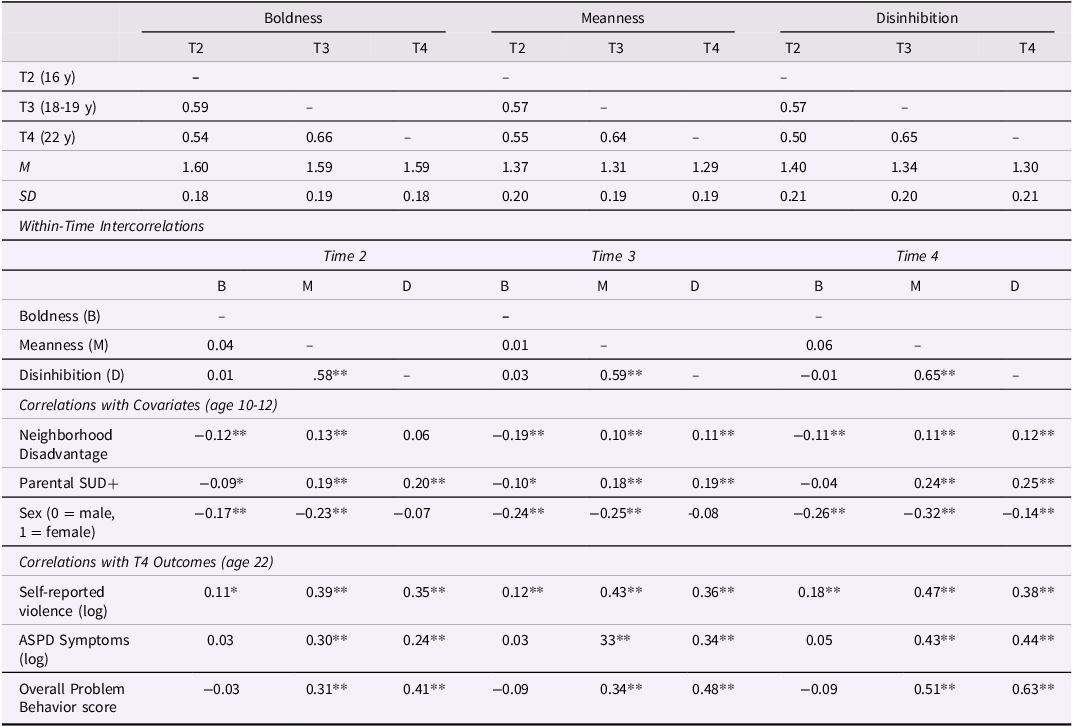
Table 1 shows the correlations for each of the MPQ-Tri trait domain scores across time points. These results demonstrate moderate to strong stability across the three time points for all three traits. Additionally, correlations for each trait domain showed stronger associations between successive assessments, with the strongest correlations between T3 (age 19) and T4 (age 22). We also examined the intercorrelations within-time for the MPQ-Tri trait domains observed scores. MPQ-Boldness largely was not associated with either MPQ-Meanness or Disinhibition. However, Meanness and Disinhibition scores were moderately correlated across all time-points.
Longitudinal and cross-sectional associations for the multidimensional personality questionnaire-triarchic scales, covariates, and outcomes

Note. Mean ages for time-points are as follows: T1 M age = 11.41; T2 M age = 16.09; T3 M age = 18.82; T4 M age = 21.89. All correlations in the top half of the table significant at p < .001.
*p < .05. **p < .01
Correlations with covariates
Table 1 also reports the correlations between the MPQ-Tri scores and the covariates. The pattern of correlations was generally robust across time. Specifically, males were more likely to report higher boldness and meanness across time points, and more disinhibition at T4. Additionally, the number of SUD + parents were significantly associated with higher MPQ-Meanness and Disinhibition scores across all time-points, with little differences in magnitude between the two trait domains within wave. In contrast, parental SUD status was weakly associated with T2 and T3 Boldness, but not at T4. Finally, we found that neighborhood disadvantage was weakly associated with greater disinhibition and meanness, and lower boldness across all time-points.
Correlations with outcome measures
Next, we examined the correlations between outcome indicators and the MPQ-Tri scales. Consistent with our hypotheses, MPQ-Disinhibition and Meanness scores were positively associated with all three indicators of maladaptive behaviors across all time points. Notably, the correlations for MPQ-Disinhibition were significantly stronger in magnitude than for MPQ-Meanness for the overall problem behavior indexFootnote 2 , but not for ASPD symptoms or self-reported violence. Conversely, our results revealed that boldness was positively, but weakly, associated with self-reported violence, but not the other behavioral indicators.
Unconditional models
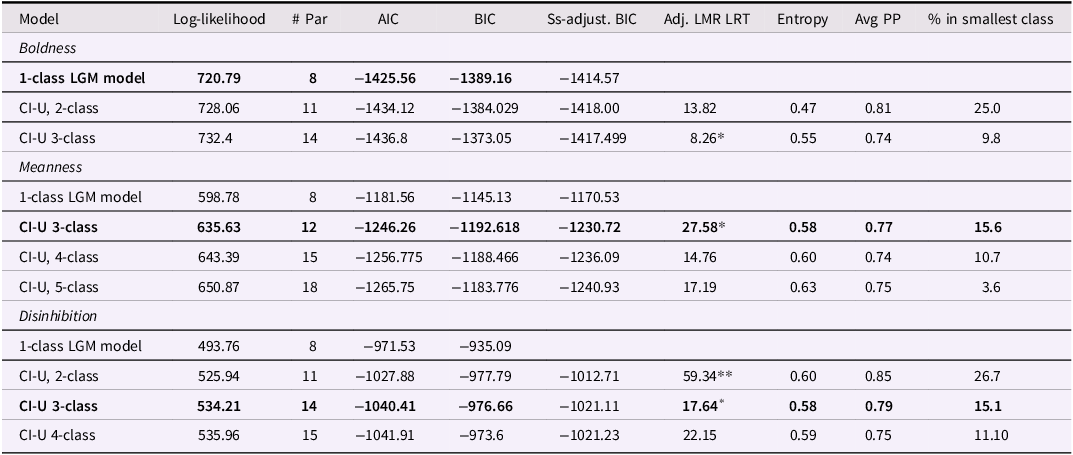
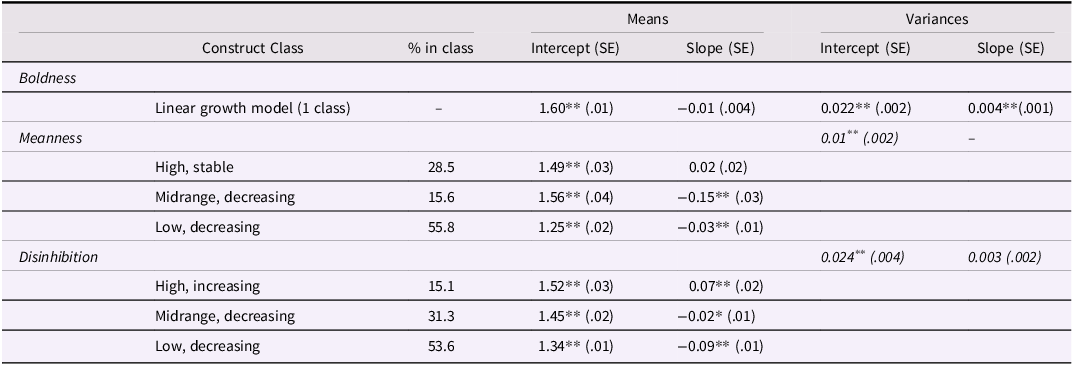
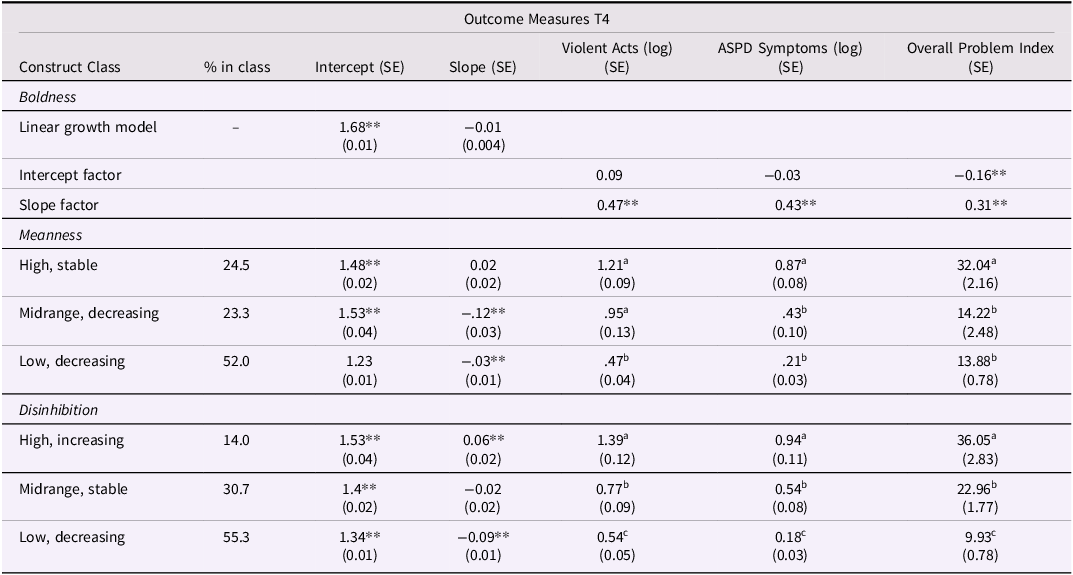
Our first goal was to determine the number of classes for each MPQ-Tri scale in unconditional models (see Table 2 for model fit comparisons, and Table 3 for slope and intercept values for each trajectory class).
Fit indices for competing unconditional growth mixture models

Note. *p < .05. **p < .01. LGM = Latent Growth Model. CI-U = Profile invariant, unrestricted model LMR = Lo-Mendell-Rubin LRT test; AvgPP = Overall average probability of most likely latent class membership. Best models from each variance covariance specification reported. Class-varying variance-covariance structure models yielded non-positive definite matrixes, even though the best log-likelihood value was replicated. This warning indicates that either the level of variation is too low, or the sample size too small, to estimate more than 1 trajectory group with this classification. Thus, we do not report the results from those models.
Intercept and slope estimated means and variance for unconditional latent class growth analysis models

Note. *p <.05. ** p <.01.
Boldness
Inspection of the model-fit statistics suggested that no multi-class model provided a better fit than a linear growth model (i.e., 1-class solution). The trajectory was rather stable over time, not showing significant change in the overall trajectory from age 16 to 22, B = 10.81, p < 0.01 and −0.12, p = 0.10, for the intercept and slope factors, respectively. As such, when testing the effects of covariates, and the degree to which variability in the growth factors account for variance in outcomes, we adopt a simpler modeling strategy.
Meanness
Model testing with the class-invariant, non-diagonal variance covariance structure found that best log-likelihood was replicated in all models. However, the analyses produced a non-positive definite matrix warning, pointing to the estimate of the slope variance in models with three classes and greater. Thus, we proceeded by constraining the slope variance to zero for these models. Additionally, we increased the number of starts to 5000 for the 4- and 5-class to replicate the best log-likelihood. The 2-class model from the class-varying, non-diagonal structure also replicated the best log-likelihood. However, non-positive definite error messages were produced, even with 5000 random starts. Given that models with this specification have more parameters than its class-invariant, non-diagonal counterpart, non-convergence, and errors may be more likely to occur (Johnson, Reference Johnson, Cameron and Schell2021).
BIC values favored a 3-class model, whilst the SABIC favored the 4- and 5-class models. However, because the smallest class in the 5-class model had 3.8% membership, we focused on the 3- and 4-class models as potential models. Both models included a high meanness class which remained stable across assessments (28.5% and 10.8% in the 3- and 4-class models, respectively) and a class with low levels of meanness which decreased over time (55.8% and 46.9%). Whereas the 3-class solution recovered a class that reported high meanness which decreased over time (15.6%), the 4-class model recovered a mid-high range, stable meanness class (22.9%), in addition to the mid-range decreasing group in the 3-class model (19.5%). Although both models fit well, we ultimately selected the 3-class model because (a) the adjusted LRT test was not significant for the 4-class model and (b) the drop in SABIC from the 3- to 4- class model was smaller than the drop between the 2- and 3-class model. Thus, to reiterate, the final unconditional model for MPQ-Meanness consisted of three distinct trajectory classes: (a) a high, stable class, (b) a low, decreasing class, and (c) a class which reported high meanness at 16, but whose meanness decreased over time.
Disinhibition
We again found that the best log-likelihood was replicated in all models tested with the class-invariant, non-diagonal variance-covariance specification. Similar to MPQ-Meanness, we received non-positive definite errors when testing 4-class models and beyond for MPQ-Disinhibition, and subsequently constrained the slope variance to zero for those models. Moreover, model tests with the class-varying, non-diagonal specification also produced non-positive definite errors, despite many random starts. Our model comparison process indicated that a 3-class solution was the most plausible for MPQ-Disinhibition, with the SABIC favoring the 3-class model and the LRT test was significant at p < .05. The three classes can be characterized as (a) a group with low levels of disinhibition which decreased over time (53.6%), (b) a group with mid-range reported disinhibition at age 16, which decreased over time (32.9%), (c) a high-disinhibition group which became more disinhibited across assessments (15.1%).
Conditional models
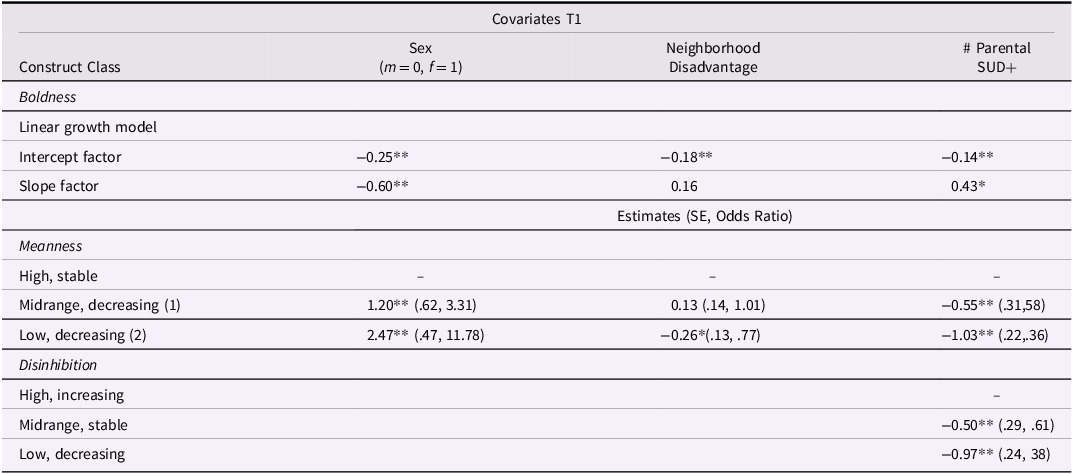
Next, we fit conditional models to examine the degree to which (a) our selected covariates were associated with latent class membership for each MPQ-Tri scale model, and (b) the degree to which the latent class accounted for variance in the outcomes of interest. Direct paths from the covariates to growth factors were initially included in each analysis. Conditional model results are displayed in Table 4.
Growth mixture model-based conditional model regression results predicting delinquency trajectory class membership

Note. T1 M age = 11.41; For Boldness, standardized parameter estimates for the direct paths from covariates to both intercept and slope factors are presented. For Meanness and Disinhibition, value represents odds ratio derived from the multinomial regression part of the GMM. Reference class was set as the group with the highest reported levels of the trait.
*p < .05. **p < .01
Boldness
We first examined the degree to which neighborhood disadvantage, parental SUD, and child’s sex predicted the growth factors for MPQ-Boldness. Greater intercept values were associated with fewer SUD + parents, lower neighborhood disadvantage, and being male. Sex was inversely associated with the slope growth factor indicating that female participants tended to show greater decreases in MPQ-Boldness over time compared to male participants. With respect to outcomes, the intercept only was significantly inversely associated with overall problem behaviors. However, the slope factor also was positively associated with violent events and greater ASPD symptom counts, in addition to the overall problem behavior index.
Meanness
The initial BCH procedure revealed that class membership was associated with differences in all three covariates. Specifically, the high, stable class was predominately male (90.5% vs. 76.1% and 58.7% for the midrange-decreasing and low-decreasing classes, respectively), overall χ 2 = 44.58, p < 0.001). The mean number of SUD + parents were significantly different across classes, overall χ2 = 19.59, p < 0.001. However, this effect was isolated to differences between the high-stable class and the the low, decreasing class only. Neighborhood disadvantage significantly differed across classes, overall χ 2 = 8.03, p =.018, with the effect again due to differences between the low-decreasing, M = 2.31, SE = 0.08, and high stable classes, M = 2.63, SE = 0.13. The conditional model was fit and the associations between class and outcomes were examined.
With respect to outcomes, MPQ-Meanness trajectory class membership largely predicted the outcomes in a linear manner, with greater meanness indicating more problem behavior (see Table 5). Specifically, the high meanness class reporting the most ASPD symptoms and overall problem behavior at T4 than both the low-meanness and mid-range classes. Similarly, the high stable and high-decreasing meanness classes reported significantly more violent acts than the low, decreasing class.
Class-specific mean estimates for growth factors and behavioral outcomes

Note. T4 M age = 21.89. Because a linear growth model fit best for MPQ-Tri Boldness estimates, standardized parameter estimates for both intercept and slope factor, are presented for outcomes. **p < .001. Values with different alphabetical superscripts indicate significant mean differences across classes at p < = .01, based on automatic BCH procedure.
Disinhibition
Of the covariates, only parental SUD + status significantly differed across classes with the initial BCH procedure, χ 2 = 28.39, p < 0.01. Children in the low-decreasing Disinhibition trajectory class had fewer parents with SUD + status than those in the other two classes. There were no significant differences between the high-increasing and midrange classes, χ2 = 1.59, p = 0.207. The multinomial logistical regression aspect of the model which regressed class membership on parental SUD + status, confirmed these results. With the high, increasing class as the reference group, children in the low-decreasing Disinhibition trajectory class had fewer parents with SUD + status, whereas parental SUD + status did not significantly predict class membership in the high-disinhibition class. In the conditional model, compared to the unconditional model, the slope of the midrange class was no longer significant, albeit it had negative sign. The high-increasing disinhibition trajectory class reported the highest levels of overall problems, violent acts, and ASPD symptoms, compared to the midrange and low-decreasing trajectory classes. Further, the midrange trajectory class was higher on these outcome measures than the low-decreasing disinhibition class.
Joint class membership analyses between meanness and disinhibition
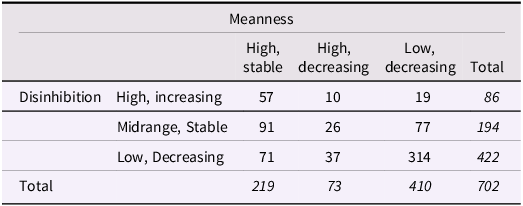
As a final step, given the conceptual and empirical overlap between meanness and disinhibition, we explored the degree to which trajectory class membership for meanness and disinhibition co-occurred with each other, and whether joint membership resulted in differences in our outcomes. As shown in Table 6, individuals who were in the low, decreasing class for one trait were also more likely to be in the low, decreasing class for the other (74.4% and 76.6% for disinhibition and meanness, respectively). Similarly, for those who were in the high, increasing disinhibition class were also more likely to be in the high-stable meanness class (66.3%). However, this pattern was less apparent for those in the high, stable meanness class (26%). Instead, they were split between the midrange, stable (41.6%) or low-decreasing (32.4%) disinhibition classes.
Joint membership counts for meanness and disinhibition trajectory classes

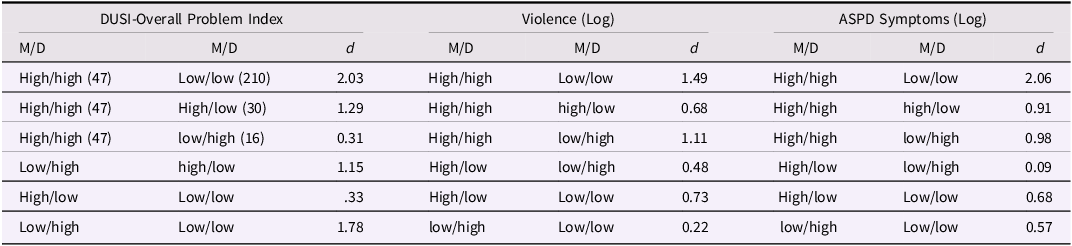
We then tested the degree to which joint membership was associated with differences in the three outcomes in a MANOVA, given the dependent variables were correlated (mean r = .47). Because uneven cell sizes when considering all nine possible combinations were a potential concern, we used the Pillai’s Trace multivariate test which is more robust to uneven cell sizes and heterogeneity of variances, compared Wilks’ λ. We found significant effects for both meanness and disinhibition trajectory class membership on the combined dependent variables, Pillai’s Trace = 0.084, F (6, 714) = 5.22, p < 0.001 partial η2 = 0.044 for Meanness, and Pillai’s Trace = 0.18, F (6, 714) = 11.49, p < 0.001, partial η2 = 0.089. The interaction effect was not significant, Pillai’s Trace = 0.03, F (12, 1074) = .85, p = .60. Thus, this analysis found no evidence for multiplicative effects between class memberships but instead suggests that both trajectory memberships contribute to variance in the outcomes in an additive mannerFootnote 3 . To further illustrate, we calculated Cohen’s d effect size estimates for the joint memberships of the linear contrasts (i.e., high and low classes only; see Table 7). As expected, those who belonged to the most persistently high levels of both meanness and disinhibition showed the strongest effect sizes compared to membership in both low-level classes. These effects were .25 to 1 standard deviation greater than only belonging to either the high-stable meanness or the high-increasing disinhibition trajectory class, relative to joint low-level class membership for both traits. Further, comparing the effect sizes of the high/high joint class membership with the different high/low configurations (i.e., high Meanness and low Disinhibition vs. low Meanness and high Disinhibition) revealed interesting differences. Specifically, being in the high Disinhibition class seemed relatively more important (i.e., yielded a stronger effect size) to score higher on the overall problem index, whereas being in the high Meanness class seemed more important (i.e., yielded a stronger effect size) to score higher on violent behavior, and the two were comparably important to score higher on ASPD symptoms (i.e., yielded comparably strong effect sizes).
Effect size estimates comparing high and low joint memberships of meanness and disinhibition

Note. Sample size for joint groups in parentheses. M = Meanness, D = Disinhibition.
Discussion
The present study aimed to better conceptualize heterogeneity in the development of psychopathic traits from adolescence to young adulthood. To this end, we leveraged longitudinal MPQ data to investigate whether distinct trajectory classes of triarchic psychopathy trait domains exist, and to what degree that this heterogeneity may be associated with both antecedent factors and important outcomes, spanning parental, environmental, internalizing, and externalizing variables. Our results provide evidence that developmental patterns characterized by high levels of Meanness and Disinhibition, which remain stable or increase over time, were associated with greater maladaptive outcomes, such as antisocial behavior and work and family problems into young adulthood. Conversely, those who report lower levels of these traits, which declined over time, were the least likely to experience such problems.
As suggested by past research (e.g., Bertoldi et al., Reference Bertoldi, Perkins, Tuvblad, Oskarsson, Kramer, Latzman, Baker, Raine and Patrick2021; Blonigen et al., Reference Blonigen, Hicks, Krueger, Patrick and Iacono2006; Garofalo et al., Reference Garofalo, Weller, Kirisci and Reynolds2021; Patrick et al., Reference Patrick, Fowles and Krueger2009; Patrick & Drislane, Reference Patrick and Drislane2015; Veltman et al., Reference Veltman, Poulton, Patrick and Sellbom2023), we showed that, on average, Boldness, Meanness, and Disinhibition showed moderate-to-strong stability over time. Further, Meanness and Disinhibition showed strong within-time correlations with one another, while Boldness was largely orthogonal to the other trait domains. Men scored higher than women on all three trait domains at each time point, with the exception of Time 4 (age 22) Disinhibition scores. By and large, these results are in line with theoretical expectations and prior studies (e.g., Bertoldi et al., Reference Bertoldi, Perkins, Tuvblad, Oskarsson, Kramer, Latzman, Baker, Raine and Patrick2021; Blonigen et al., Reference Blonigen, Hicks, Krueger, Patrick and Iacono2006; Patrick et al., Reference Patrick, Fowles and Krueger2009; Patrick & Drislane, Reference Patrick and Drislane2015), although we did not find substantial differences in rank-order stability between Boldness and Meanness or Disinhibition. A similar finding was reported by Veltman et al. (Reference Veltman, Poulton, Patrick and Sellbom2023) who also used MPQ-Tri scales and measured their stability from age 18 to age 26.
In terms of bivariate associations with the covariates and outcomes included in the present study, results were strikingly consistent across time points. Among the covariates (assessed between the ages of 10-12 and therefore before the MPQ-Tri assessment), the number of parental SUD + parents were positively associated with Meanness and Disinhibition, and less strongly and less consistently with Boldness. Similarly, neighborhood disadvantage was positively related to Meanness and Disinhibition but negatively related to Boldness. For the outcomes (assessed at age 22), Meanness and Disinhibition had consistent associations with all maladaptive outcomes (violence, ASPD symptoms, and overall problem index). Specifically, Disinhibition showed the strongest associations with overall problem index, whereas associations with violence and ASPD symptoms were comparable for Meanness and Disinhibition. Finally, Boldness was only related to self-reported violence scores and was unrelated to ASPD symptoms and overall problem index. Taken together, these findings were also consistent with expectations (e.g., Brislin et al., Reference Brislin, Venables, Drislane, Blonigen, Iacono, Tellegen, Edens and Patrick2017; Dotterer et al., Reference Dotterer, Waller, Cope, Hicks, Nigg, Zucker and Hyde2017; Garofalo et al., Reference Garofalo, Weller, Kirisci and Reynolds2021; Kyranides et al., Reference Kyranides, Fanti, Sikki and Patrick2017; Patrick & Drislane, Reference Patrick and Drislane2015; Veltman et al., Reference Veltman, Poulton, Patrick and Sellbom2023) and support the notion that Boldness is (a) less impacted by negative environmental influences and (b) less associated to maladaptive outcomes compared to Meanness and Disinhibition. The association between Boldness and self-reported violence is however meaningful as it suggests that also Boldness may be related to increased risk of violent behavior and therefore harm to others (see Brislin et al., Reference Brislin, Drislane, Smith, Edens and Patrick2015; Garofalo et al., Reference Garofalo, Weller, Kirisci and Reynolds2021; Howard, Reference Howard2017; gray et al., Reference Gray, Blumenthal, Shuker, Wood, Fonagy and Snowden2019), while being unrelated to other symptoms of internalizing or externalizing disorders. These findings parallel and extend Veltman et al.’s (Reference Veltman, Poulton, Patrick and Sellbom2023) findings who reported – in a slightly older sample – concurrent but not prospective associations between boldness and self-reported delinquency as well as concurrent and prospective associations between boldness and variety of crimes committed over an 8-year timespan.
The main contribution of our study consisted in the examination of trajectory classes of each triarchic psychopathy trait domain and their correlates. We found evidence that the triarchic personality traits may not only differ in developmental patterns, but also in the degree of heterogeneity in these trajectories. For instance, our Boldness findings were consistent with prior conceptual and empirical work (e.g., Bertoldi et al., Reference Bertoldi, Perkins, Tuvblad, Oskarsson, Kramer, Latzman, Baker, Raine and Patrick2021; Blonigen et al., Reference Blonigen, Hicks, Krueger, Patrick and Iacono2006), suggesting negligible variability in the trajectories that participants followed over time; in fact, a simple linear model was the best fit to the data suggesting that participants were well represented as one single class that showed relative stability from age 16 to age 22, as indicated by a non-significant slope. The non-significant slope may be due to the embedment, within Boldness, of emotional stability and extraversion (Miller et al., Reference Miller, Lamkin, Maples-Keller and Lynam2016; Shou et al., Reference Shou, Sellbom and Xu2018), which tend to decrease and increase with age, respectively. The stability and negligible variability in Boldness trajectories may be consequential for our understanding of the development of psychopathic traits: in fact, this pattern of stability and limited variability appears to support that Boldness represents a temperamental liability to psychopathic personality, whereas patterns of change in overall levels of psychopathy across development hinge upon trajectories of Disinhibition and Meanness, which are described below in more detail.
In contrast to Boldness, we recovered three trajectory classes for Meanness and Disinhibition. For Meanness, consistent with previous studies, this solution included an high-stable class (e.g., Hawes et al., Reference Hawes, Byrd, Gonzalez, Cavanaugh, Bechtold, Lynam and Pardini2018; Lee & Kim, Reference Lee and Kim2020; Salihovic et al., Reference Salihovic, Özdemir and Kerr2014) which included roughly 28% of the total sample. A comparable proportion of participants also fell into a class characterized by high starting levels of Disinhibition, which increased over time (see Hawes et al., Reference Hawes, Byrd, Gonzalez, Cavanaugh, Bechtold, Lynam and Pardini2018 for similar results). Also consistent with previous studies was the finding of two decreasing trajectories, which in our case started with low levels (roughly 45-55% of the sample) or midrange levels (roughly 30-36% of the sample) of Meanness and Disinhibition. When looking at joint class membership between Meanness and Disinhibition, we found that individuals in the low-level classes converged to a substantial extent. Similarly, individuals in the high-increasing Disinhibition class were also more likely to be in the high-stable Meanness class. In contrast, those in the high-stable Meanness class were approximately equally distributed in the different Disinhibition classes, suggesting potentially different variations of psychopathic meanness as accompanied or not by high levels of disinhibition traits. Overall, this pattern appears to show a non-reciprocal overlap between Meanness and Disihibition.
This heterogeneity in development across the three triarchic traits were not only associated with both antecedent parenting (Parental SUD + status) and environmental variables (neighborhood disadvantage), but also were associated with differences in outcomes which have been implicated with psychopathic traits. Starting (i.e., intercept) levels of Boldness were negatively related to parental substance use disorder, neighborhood disadvantage, and the overall problem index, in line with correlational findings discussed above. Female participants showed lower initial levels of Boldness, and a relatively greater decrease in Boldness compared to male participants. Interestingly, relatively smaller decreases in Boldness were associated with more SUD + parents, violence, ASPD symptoms, and overall problem index. This finding was novel and requires further scrutiny; it seems to show that, net of Boldness’ overall stability and lack of association between Boldness and maladaptive correlates, those individuals who tend to remain more stable (i.e., decrease less) in Boldness from age 16 to age 22 are those more likely to report problems across the board. If replicated in further studies, this finding may therefore suggest that it is not the level, but a deviation from normative developmental trends, that is problematic in relation to Boldness.
Although the pattern of bivariate associations was very similar for Meanness and Disinhibition – something that has raised concerns about their operationalization in the MPQ-Tri (e.g., Garofalo et al., Reference Garofalo, Weller, Kirisci and Reynolds2021) – associations of the trajectory classes with external correlates and outcomes revealed a few noteworthy distinctions alongside expected similarities (e.g., Bergstrøm & Farrington, Reference Bergstrøm and Farrington2021; Hawes et al., Reference Hawes, Byrd, Gonzalez, Cavanaugh, Bechtold, Lynam and Pardini2018; Lee & Kim, Reference Lee and Kim2020; Salekin, Reference Salekin2008; Salihovic et al., Reference Salihovic, Özdemir and Kerr2014; Virtanen et al., Reference Virtanen, Latvala, Andershed, Lichtenstein, Tuvblad, Colins, Suvisaari, Larsson and Lundström2020). First, there was a gradient of severity such that there were higher levels of three outcomes – self-reported violence, ASPD symptoms, and overall problem index – moving from the low-decreasing to the high-stable/high-increasing trajectory classes, suggesting that individuals falling in each class differed significantly from the other two classes in prospective risk for violent behavior, ASPD symptoms, and overall psychopathology spanning internalizing and externalizing spectra (Blonigen et al., Reference Blonigen, Hicks, Krueger, Patrick and Iacono2006; Patrick, Reference Patrick2022). One previously mixed finding that we could not address concerned comparisons between low-increasing and high-decreasing trajectory classes (Hawes et al., Reference Hawes, Byrd, Gonzalez, Cavanaugh, Bechtold, Lynam and Pardini2018; Salihovic et al., Reference Salihovic, Özdemir and Kerr2014), which we did not identify in our sample. Second, parental SUD + status was significantly less prevalent in the low-decreasing classes. For Meanness, there was also a significant distinction between mid-decreasing and high-stable trajectories, suggesting that relative differences in parental substance use disorder may be more discriminating for Meanness than Disinhibition traits over time. That is, the prevalence of parental SUD + status would similarly characterize both midrange and high Disinhibition classes, whereas individuals in the high-stable Meanness trajectory had significantly higher prevalence of parental substance use disorder than the midrange-decreasing class. Third, levels of neighborhood disadvantage significantly differed among Meanness trajectory classes but did not among Disinhibition trajectory classes. Taken together, these findings tentatively suggest that environmental influences may better discriminate trajectories of Meanness than Disinhibition. Finally, Meanness classes showed significant difference with regard to biological sex, with men more represented in classes with higher levels of Meanness, whereas no sex differences emerged for Disinhibition classes. This finding is consistent with the possibility that sex differences are more pronounced for antagonistic compared to disinhibited forms of externalizing (Sica et al., Reference Sica, Perkins, Joyner, Caudek, Bottesi, Caruso, Giulini, Ghisi and Patrick2021; Somma et al., Reference Somma, Borroni, Drislane and Fossati2016).
Follow-up exploratory analyses examined the impact of joint class membership across the Meanness and Disinhibition trajectories. This impact was additive rather than interactive, as shown by significant main effects and pairwise comparisons, alongside non-significant interaction effects. These findings suggest that belonging to high trajectory classes for both Meanness and Disinhibition conferred the greatest risk across internalizing and externalizing domains. This is consistent with premises of the triarchic model (Patrick & Drislane, Reference Patrick and Drislane2015), according to which individuals high on Disinhibition are considered psychopathic if they also score high on Meanness or Boldness. Further, belonging to the high Meanness trajectory class conferred relatively higher risk for externalizing (violence) while belonging to the high Disinhibition trajectory class conferred relatively higher risk for internalizing (overall problem index), and belonging to either class conferred comparable risk in terms of ASPD symptomatology. Taken together, also these findings corroborated joint and distinct correlates of Meanness and Disinhibition.
Limitations and future directions
The present study is among the first of its kind but is not exempt from limitation; these are discussed here as they represent directions for future research. The reliance on archival data allowed us to leverage an incredibly rich source of data that would require massive resources to gather, but naturally, we were limited by the original study design. Future research could build upon this study, including measures that could have broadened the scope of outcomes investigated. Relatedly, because these data were collected decades earlier, their generalization to current or future generations should be made with caution, although there are no obvious conceptual reasons to expect differences in trajectory classes of personality traits and their correlates. Another limitation concerns the focus on a relatively short time frame (6 years) that did not extend into adulthood as well as the lack of assessments dating back earlier in the development to directly investigate putative precursors or prospective outcomes. Finally, because the triarchic model conceptualizes psychopathy as a configuration of elevated traits across its domains, future studies may follow up on our exploratory examination of joint trajectories of Meanness and Disinhibition investigating joint patterns of change on the three dimensions of the triarchic model of psychopathy, for instance relying on parallel process latent growth curve models.
Conclusions
These limitations notwithstanding, the present study had several important strengths, such as the multi-method assessment over several years and the reliance on a large sample with an over-representation of at-risk individuals. Taken together, the present study showed meaningful differences between Meanness and Disinhibition, and more pronounced differences between them and Boldness, with respect to trajectory classes over time, and associations with potential precursors and outcomes. These findings can help refine theories of the development of psychopathic traits and can inform early identification and prevention of individuals at risk. To the extent that Boldness, Meanness, and Disinhibition are embedded within broader hierarchical frameworks of psychopathology (e.g., Mullins-Sweatt et al., Reference Mullins-Sweatt, Bornovalova, Carragher, Clark, Corona Espinosa, Jonas, Keyes, Lynam, Michelini, Miller, Min, Rodriguez-Seijas, Samuel, Tackett and Watts2022), the present findings can also be leveraged for both conceptual and practical applications in the broader field of psychopathology.
Supplementary material
The supplementary material for this article can be found at https://doi.org/10.1017/S0954579424001639.
Acknowledgements
The authors gratefully acknowledge the support from the Center for Education and Drug Abuse Research, and especially Steve Knopf and Ralph Tarter. This research was supported in part by the National Institute on Drug Abuse (P50 DA05605, R01 DA033322). The views expressed are those of the authors and do not necessarily represent the views of these funders.
Competing interests
The authors declare none.