French society in the late seventeenth century was obsessed with the display and interrogation of character. François de La Rochefoucauld's maxims about the legibility of appearances, while written over three hundred years ago in a culture seemingly distant in so many ways from the present, still resonate with our own experiences of judging character and performing identity: ‘To establish oneself in the world, one does everything one can to appear established in it’ (‘Pour s'établir dans le monde, on fait tout ce que l'on peut pour y paroistre étably’); ‘The custom we have of disguising ourselves to others to obtain their esteem makes us ultimately disguise ourselves from ourselves’ (‘La coûtume que nous avons de nous déguiser aux autres, pour acquerir leur estime, fait qu'enfin nous nous déguisons à nous-mesmes’).Footnote 1 In La Rochefoucauld's time, the display and interrogation of character seemed to dominate nearly every available artistic outlet, from state portraits of the king and his ministers, to ballets de cour, to tragédies en musique and especially to literature – plays, novels, biographies, memoirs, satires and literary portraits. This preoccupation with character was perhaps heightened by the model set by Louis XIV, who dedicated great energy and attention to the presentation of a kingly image that would secure his authority both at home and abroad.Footnote 2 Under the king, one's social and political livelihood depended upon the ability to control one's own and to read others' caractères – a term generally defined in Jane Stevens's study of the meanings and uses of caractère in the seventeenth and eighteenth centuries as ‘the symbolic relationship between an observed phenomenon and the larger, more complex meaning for which it stood … as well the essential nature of a human being as it is revealed in outer signs’.Footnote 3 The simplicity of this definition, however, betrays uses and applications of the term that were anything but simple, especially as regards human character, the significance of outer signs and the determination of what precisely constituted one's ‘essential nature’.
The instability of ‘essential nature’ in this era can be traced in part to the very conditions that made its definition so intriguing and so critical – namely, a social system deeply invested in public image. Under such a system, the study of people became both a necessity and an art. A skilled reader of men could advance far with the knowledge of others' character and motivations. In The Court Society Norbert Elias describes this skill not as ‘“psychology” in the scientific sense, but [as] an ability, growing out of the necessities of life at court, to understand the make-up, motives, capacities and limits of other people. One must see how these people meticulously weigh the gestures and expressions, carefully fathom the intention and meaning of each of their utterances.’Footnote 4 It follows then that the ability to deceive observers could be as powerful as the ability to read caractère, making for extensive social dissimulation. This kind of deception is a frequent subject for author Jean de La Bruyère. In the sixth edition of his popular and oft revised and reprinted Les caractères ou Les moeurs de ce siècle, a companion text to his translation of the classic characters of Theophrastus, La Bruyère explains:
Un homme inégal n'est pas un seul homme, ce sont plusieurs: il se multiplie autant de fois qu'il a de nouveaux goûts et de manières différentes; il est à chaque moment ce qu'il n'était point, et il va être bientôt ce qu'il n'a jamais été; il se succède à lui-même. Ne demandez pas de quelle complexion il est, mais quelles sont ses complexions; ni de quelle humeur, mais combien il a de sortes d'humeurs. Ne vous trompez-vous point? est-ce Euthrycrate que vous abordez? aujourd'hui quelle glace pour vous! hier il vous recherchait, il vous caressait, vous donniez de la jalousie à ses amis: vous reconnaît-il bien? dites-lui votre nom.
An inconsistent man is not one man, he is several: he multiples himself as many times as there are new tastes and manners. At each moment he is what he was not, and he will soon be what he has never been; he succeeds himself. Don't ask what sort of person he is, but what sorts of persons; nor what his humor is, but how many humors he has. Aren't you mistaken? Is that Euthrycrate you approach? Today, how cold he is to you! Yesterday he was looking for you, he was caressing you, you were making his friends jealous; does he recognize you? Tell him your name.Footnote 5
For La Bruyère, as for La Rochefoucauld, a social climate that privileges appearance and behaviour as indicators of ‘essential nature' in fact makes this nature nearly indiscernible.
The issue extended beyond social commerce to moral philosophy.Footnote 6 As the title of La Rochefoucauld's collection – Réflexions, ou sentences et maximes morales – indicates, the issue of character was in large part a moral issue, for it dealt with virtue and what later moralists would describe as personal authenticity. While many in the seventeenth century generally understood that ‘essential natures’ were ‘finite in number’, and that individuals ‘were understood by some kind of classification … on the basis of external signs’,Footnote 7 others advanced an idea of ‘essential nature’ as being unique to each individual, an idea firmly in place by the time Jean-Jacques Rousseau made his famous claim in his 1782 autobiography, ‘I am not made like any that I have seen; I venture to believe that I was not made like any that exist. If I am not more deserving, at least I am different’ (‘Je ne suis fait comme aucun de ceux que j'ai vus; j'ose croire n'être fait comme aucun de ceux qui existent. Si je ne vaux pas mieux, au moins je suis autre’).Footnote 8 However, Rousseau's contemporary Denis Diderot problematized such moral authenticity by raising the example of the actor in his Paradoxe sur le comédien (written 1770–1778; published 1830). He writes that the man who utters anything other than the ‘cry of his heart’ (‘cri de son coeur’), ‘who moderates this cry or forces it is no longer himself, but an actor in performance’ (‘au moment où il tempère ou force ce cri, ce n'est plus lui, c'est un comédien qui joue’). And yet he claims further that ‘extreme sensibility makes middling actors; middling sensibility produces the multitude of bad actors; and in complete absence of sensibility is the possibility of the sublime actor’ (‘c'est l'extrême sensibilité qui fait les acteurs médiocres; c'est la sensibilité médiocre qui fait la multitude des mauvais acteurs; et c'est le manque absolu de sensibilité qui prépare les acteurs sublimes’).Footnote 9 Thus the most convincing outward displays of sensibility arise in cases where there is no genuine sensibility as motivator.
Though these arguments date from a full century after La Rochefoucauld, radical individuality as opposed to character typology and the problem of the actor were already objects of discussion at the turn of the eighteenth century. Roger de Piles's theories on artistic genius provide an early commentary on the unique character of man:
Il y a une chose, qui est le Sel des Desseins, & sans laquelle je n'en ferois que peu ou point du tout de cas, & je ne puis la mieux éxprimer que par le mot de Caractére. Ce Caractére donc consiste dans la maniére dont le Peintre pense les choses, c'est le Cachet qui le distingue des autres, & qu'il imprime sur ses Ouvrages comme la vive image de son Esprit.
There is one thing which is the Salt of Designs, and without which I would value them only little or not at all, and I cannot better express it than by the word ‘Character’. This Character then consists in the manner in which the Painter thinks things, it is the Stamp which distinguishes him from the others, and which he imprints on his Works like the living image of his Mind.Footnote 10
This idea of authenticity extended also to discussion of the moral implications for acting on stage and in daily life in tracts from the querelle du théâtre. Footnote 11 Further, moral considerations of character abounded in popular literary genres, wherein authors exposed false public façades and reputations, and directed moral critiques at a social system dependent upon appearance. According to Paul Bénichou, author of the landmark Morales du grand siècle (1948), literature was ‘the crucible in which our direct experience of life and society is elaborated philosophically, but without loss of immediacy’.Footnote 12 Nor was the written word the only medium through which to engage in the study of character.Footnote 13
The musical portraits collected in François Couperin's four books of pièces de clavecin (1713, 1716–1717, 1722 and 1730) may also be understood as musical studies of character. While David Fuller explains in his study of musical character pieces from the late seventeenth century that prior to Couperin, ‘pieces bearing proper names, so far from being portraits, cannot be shown to have any musical connection with their titles at all’,Footnote 14 Couperin expressly intended his works to function as character portraits. As he explains in the Preface to his Première Livre de Pièces de Clavecin:
J'ay toûjours eu un objet en composant toutes ces pièces: des occasions différentes me l'ont fourni, ainsi les Titres répondent aux idées que j'ay eües; on me dispensera d'en rendre compte: cependant, comme parmi ces Titres il y en a qui semblent me flater, il est bon d'avertir que les pièces qui les portent sont des espèces de portraits qu'on a trouvé quelques fois assés ressemblans sous mes doigts, et que la plûpart de ces Titres avantageux, sont plûtôt donnés aux aimables originaux que j'ay voulu representer, qu'aux copies que j'en ay tirées.
I have always had an object when composing all of these pieces; different occasions have furnished them to me. Thus the titles correspond to ideas that I have had; I may be excused for not rendering an account of them. However, since among these titles there are some that seem to flatter me, it is well to point out that the pieces that bear them are kinds of portraits, which have sometimes been found good likenesses under my fingers, and that most of these flattering titles are given to [should be regarded as being the property of?] the amiable originals that I have tried to represent, rather than to [of?] the copies I have drawn from them.Footnote 15
While Couperin's Preface indicates that many (‘all’?) of the pièces from this first collection were composed as portraits, their subjects are, at least for modern scholars, by no means readily discernible, given the ambiguity of their titles and the sometimes obscure relationship between title and score. Nor is interpretation easier in any of the subsequent three livres. If clavecinistes of Couperin's own time had the advantage of contemporaneity, they were probably at times as puzzled as modern scholars seeking to unlock the mysteries of the titles.Footnote 16 Discerning the true identity of Couperin's sitters was, in many ways, as fraught an endeavour as reading appearance in Couperin's France. The most recent efforts in this enterprise come from Jane Clark and Derek Connon, who follow in the footsteps of Wilfrid Mellers, Pierre Citron, Philippe Beaussant, David Tunley, David Fuller, Olivier Baumont and Bertrand Porot among others.Footnote 17 All seek clues from Couperin's personal history (what little is known) and the rich cultural and physical environments of the period, often reaching different determinations as to meaning and significance.
Many have also noted connections between La Bruyère and Couperin and surmised varying degrees of the author's influence on the composer. Fuller suggests in his study of the relationship between literary portraits and titled musical pièces of the period that, in regards to La Bruyère, it ‘is difficult to believe that literary models did not have some influence on Couperin's art of musical portraiture’.Footnote 18 Citron proposes that a meeting between the two (as well as with Jean de La Fontaine) could have taken place and ponders whether the portraits from the first book of harpsichord works were written ‘if not with the advice, at least with the knowledge of the moraliste’.Footnote 19 Baumont describes the collections of harpsichord music as ‘the musical equivalent of the Mémoires of Saint-Simon or the Les Caractères of La Bruyère: a subjective, biased mise en scène of Versailles and its actors’,Footnote 20 while Clark and Connon link Couperin with La Bruyère by describing the pièces de clavecin as ‘revolutionary musical caractères’.Footnote 21 Beaussant identifies La Bruyère's acerbic humour in Couperin's Les Fastes de la Grande et Ancienne MxStrxndxsx (book II, number 11).Footnote 22 Such connections are bolstered by the presence of La Bruyère's Les Caractères in Couperin's personal library.Footnote 23 Yet none of these authors explored whether and how Couperin's music might have contributed to the popular moralism of La Bruyère and his contemporaries. After all, portraits of all kinds were locations for the moral criticism of character.
Reading the pièces de clavecin within the literary context of popular moralism, I argue that Couperin's portraits contributed to this discourse in a medium that offered a means to extend the scope and power of social criticism in ways unavailable to moralistes employing only the written word. First I define how authors of the period assessed character by looking at popular works of moral literature collected in Couperin's library. Then I explore how certain of Couperin's pièces de clavecin might have advanced critiques of social dissimulation similar to and at times even more penetrating than literary critiques by virtue of the medium of musical performance. A first level of critique comes in the scores and titles that resist concrete identification. A second level of critique arises in musical performance, because reading these works may invite yet another impersonation of identity by the harpsichordist who realizes the score. I explore how these multiple levels of critique constitute a meta-critique of the performance of assumed identities in a series of case studies of individual pièces from the four books that especially problematize character and identity through their apparent portrayal of men and women assuming false identities. In ‘Moral Lessons at the Theatre’ I examine three works that rival their literary-dramatic models: La Fine Madelon and La douce Janneton (IV, 20), which seem to depict an actress and her theatrical role in Jean-Baptiste Molière's Les précieuses ridicules, and La Pateline (I, 4), which probably portrays the disingenuous and dissembling Patelin of popular theatre. In ‘Picaresque Heroes and Passacailles’ I show how L'amphibie (IV, 24) problematizes the notion of a stable identity inherent in French picaresque literature. Finally, in ‘The Universal Masquerade’ I argue that Les Folies françoises, ou les Dominos (III, 13) ultimately reveals that the moralistes’ aim to expose the truth of character is flawed because there is no ‘self’ behind the social mask.
The Literary Context: Couperin's Library
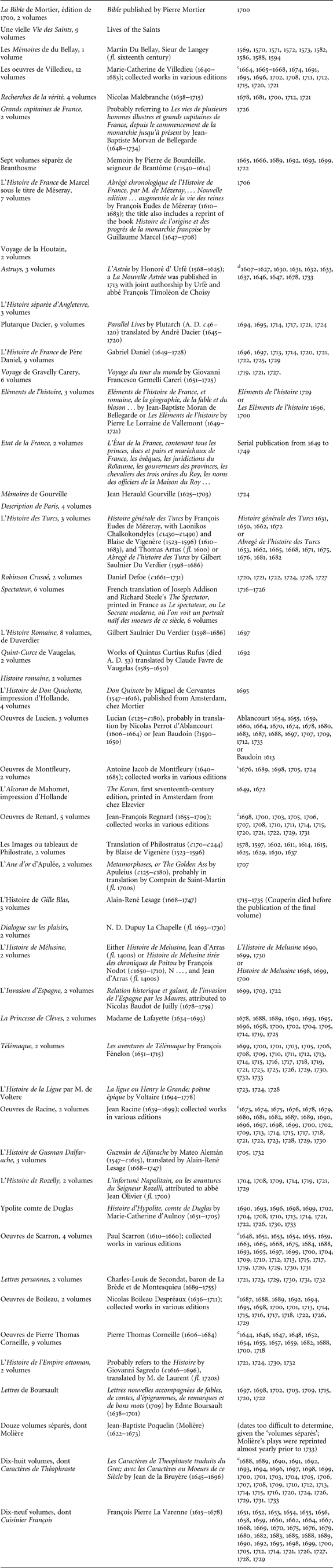
Couperin's library, catalogued in the inventory made upon his death, is as good a place as any to launch an examination of popular moral discourse in the early eighteenth century.Footnote 24 It was, according to Marcel Benoit, the library of an honnête homme,Footnote 25 notable for its size and breadth – it includes philosophy, biographies, histories, novels, memoirs, satires and plays, as well as a handful of sacred texts (see Appendix). Though an examination of moralistic commentary in works from the library cannot prove that Couperin ‘wrote’ similar criticisms in his own compositions, it does raise intriguing connections between Couperin's literary and musical worlds.Footnote 26 It seems that in this literary world, as in the larger literary world of late seventeenth- and early eighteenth-century France, a central concern was the moral study of character.
As mentioned above, most of the books in Couperin's library are not philosophical works per se. Only Nicolas Malebranche's De la recherche de la vérité – a reconciliation of the philosophy of Descartes with traditional Christian beliefs – stands out in the library as a conventional philosophical treatise. Though character is not its primary focus, the author dwells periodically on morality and the integrity of character as such issues pertain to what masquerades as truth. He singles out deceiving scholars who appear more learned than they are and dishonest men who pretend to virtue, as in his chapter on ‘The Inclinations; or, The Mind's Natural Impulses’, in which Malebranche explains that ‘men not only desire actually to possess knowledge and virtue, honors and riches, they exert all their efforts so that people will at least believe they truly possess them. And if it can be said of them that they put themselves to less trouble to appear rich than really to be so, it can also be said that they often take fewer pains to be virtuous than to appear so’ (‘les hommes ne désirent pas seulement de posséder effectivement la science & la vertu, les dignitez & les richesses; ils sont encore tous leurs efforts afin qu'on croye au moins qu'ils les possedent véritablement. Et si l'on peut dire qu'ils se mettent moins en peine de paroître riches que de l'estre effectivement, on peut dire aussi qu'ils se mettent souvent moins en peine d'être vertueux que de la paroître’).Footnote 27
Truly virtuous men, on the other hand, were often the subjects of ancient Roman biographers whose writings figured importantly in Couperin's collection. Interestingly, their biographies function more as moral character studies than as narrative histories of famous men, a fact not lost on translator André Dacier, who advertised his eight-volume edition of Plutarch's Parallel Lives as a necessary body of work not because of its age or prestige but by virtue of its focus on classical models of morality.Footnote 28 Plutarch eschews historical detail to privilege detailed character studies:
je ne ferai d'autre Preface à cet Ouvrage que de prier ceux qui le liront, que s'ils trouvent que je n'ai pas exposé toutes ces grandes actions dans un grand détail, & avec une extrême & scrupuleuse exactitude, & que je les ai abregées pour la plûpart, & n'en ai donné qu'une espece de sommaire, ils ne viennent pas me chicaner sur cela, car je n'écris pas une Histoire, mais des Vies. Et ce n'est pas toûjours dans les exploits les plus éclatans & les plus signalés que paroissent le plus la vertu, ou le vice de ceux qui les executant, mais souvent la moindre petite action, une simple parole, un jeu, font beaucoup mieux connoître les moeurs des hommes que les combats les plus sanglans, les batailles rangées, & les prises de Villes. Comme donc les Peintres, qui font des portraits, recherchent sur tout la ressemblance dans les traits du visage, & particulierement dans les yeux, où éclatent les signes les plus sensibles des moeurs & du naturel, & negligent les autres parties, il faut qu'on me permette de même de rechercher dans l'ame les principaux traits, les traits les plus marqués, afin qu'en les rassemblant je fasse de la vie de ces grands hommes un portrait vivant & animé, & qui leur ressemble, laissant à d'autres le détail des sieges, des batailles, & de toutes ces autres grandes actions.
I beg my readers not to hold it against me if I have not managed to work in every single one of the famous acts reported of these men, but rather have cut them short. The reason is that I am writing Lives, not Histories, and the revelation of excellence or baseness does not always occur in the most conspicuous acts. Rather, some little thing, a witticism or a joke, often displays a man's character more clearly than battles with thousands of casualties, huge military formations, or sieges of cities. Just as painters carefully reproduce the face and the elements that contribute to the expression, where character is revealed, and pay little attention to other parts of the body, in the same way you must allow me to explore the indicators of the soul and to use these to portray each life while I leave the great accomplishments and the battles to others.Footnote 29
Plutarch's Roman contemporary Quintus Curtius Rufus likewise offered moral character studies, in which, according to seventeenth-century translator Claude Favre de Vaugelas, ‘we shall find that the affairs of the world are not conducted by chance, but that fortune is oftentimes guided by the wit and genius of men, and that their happiness is never of long continuance if Virtue forsakes them’ (‘d'où l'on pourra reconnoistre que ce n'est point le hazard qui conduit les choses du monde, mais que bien souvent la Fortune se regle par l'esprit des hommes, & que la Felicité n'est jamais de longue durée, quand la vertu l'abandonne’).Footnote 30 Modern biographers such as Jean-Baptiste Morvan de Bellegarde in turn modelled their studies on those of the ancients. In his Les Vies de plusieurs hommes illustres et grands capitaines de France Bellegarde offers expansive essays on great figures from French history, from Joan of Arc to Cardinal Richelieu, that progress from historic deeds to musings on the moral qualities that make the subjects worthy of Bellegarde's esteem.Footnote 31
The study of character, especially as regards the practice of reading and misreading appearance, is also a recurring theme across fictional genres in Couperin's collection. Ironically, using fiction to advance moral discourse means that these writings both critique and perpetuate artifice and simulated identities. Literary historian Joan DeJean describes this trend as reflecting ‘a simultaneous attempt, on the one hand, to develop techniques that foreground interiority and complex notions of subjectivity and, on the other, to fracture identity’.Footnote 32 Fictional works contributed greatly to moral discourse by, in the words of Alain-René Lesage, engaging readers to ‘find characters and lessons of morality hidden beneath pleasant images’ (‘trouve des caractères et des leçons de morale cachées sous des images riantes’).Footnote 33
In picaresque works owned by Couperin – L'Ane d'Or, Guzman d'Alfarache, Gil Blas, L'Infortuné Napolitan and the novels of Paul Scarron – authors consider issues of character and morality as their protean heroes traverse diverse and corrupt social milieus riddled with pretenders and deceivers. French readers relished the fusion of high adventure with social critique inherent in the picaresque in Lesage's translation of Guzman and in his own original picaresque novel, Gil Blas, both of which figure in Couperin's collection. In an especially memorable passage in the latter, a ‘wise’ fellow-servant explains how careful observation revealed the duplicity of his master and in turn inspired his own calculated dissimulation: ‘I perceived that he wanted to pass for a person of great sanctity: I pretended to be his dupe; that costs nothing. I did more, I imitated him, and acting in his presence, the same farce that he plays before others, I deceived the deceiver, and am, by degrees, become his factotum’ (‘Je m'apperçus qu'il vouloit passer pour un saint personnage. Je feignis d'en être la dupe. Cela ne coûte rien. Je fis plus. Je le copiai; & jouant devant lui le même rôle qu'il fait devant les autres, je trompai le trompeur, & je suis devenu peu à peu son factoton’).Footnote 34 Though Lesage set the novel in Spain, this depiction of social deception was a thinly veiled critique of the duplicity of his own society and was, according to Richard Bjornson, ‘appreciated as a satiric “roman à clef”’.Footnote 35
The nouvelle historique, like the picaresque tale, also afforded the opportunity for popular moral critique, as evidenced in the quasi-picaresque Hypolite, comte de Douglas by Marie-Catherine d'Aulnoy, and the works of Madame de Villedieu and Madame de Lafayette. In Hypolite, Aulnoy tells the history of two unfortunate lovers whose misadventures force them into multiple masquerades, even leading the heroine to disguise herself (quite successfully) as a male pilgrim, thereby emphasizing the power of appearances and exposing a social system that privileges such deceptions. Analogous episodes fill the fictions of Madame de Villedieu.Footnote 36 In her pseudo-autobiography, Mémoires de la vie de Henriette-Sylvie de Molière, the heroine composes a series of letters that seek to rescue a slandered reputation and prove her true virtue, explaining ‘however my enemies may have chosen to interpret them, appearances, which often deceive, are all that was ever criminal in my conduct’ (‘que de quelque façon que mes Ennemis les ayent voulu interpreter, l'aparence qui trompe souvent a fait tout le crime de ma conduite’).Footnote 37 Of others whose deceptions concealed immorality rather than virtue, she wrote hopefully of a time ‘when people will no longer be so liable to judge others to be as criminal as themselves, for their behavior will no longer be so corrupt or so criminal’ (‘où les hommes ne pourront plus juger si criminellement par eux-mêmes de leurs semblables; parce qu'ils n'auront plus de moeurs si corrompuës ni si criminelles’).Footnote 38 Given that Villedieu populates her nouvelle historique with real historical figures from the French court of the later seventeenth century, the pointedness of such a remark cannot have been lost on her readers. Similarly, Madame de Lafayette's La Princesse de Clèves, though set at the court of Henry II, serves as an apt foil for her own era's culture of deception. The title character – virtuous, honest, naive, new to the court – is early advised, ‘if you judge by appearances in this place … you will frequently be deceived: what you see is almost never the truth’ (‘si vous jugez sur les apparences en ce lieu-cy … vous serez souvent trompée: ce qui paroist n'est presque jamais la vérité’).Footnote 39
In Couperin's library, truth also appears to be stretched in the memoirs by Pierre de Bourdeille, seigneur de Brantôme, and Jean Hérault Gourville, which take the form not of autobiography, but of character profiles of royal courtiers along with the authors’ attitudes towards them. Brantôme's catalogue of the illustrious men and women he came to know during the sixteenth-century French Wars of Religion was, according to Charles Sorel, ‘something very audacious in which the moods and actions of the famous men of the last century are artlessly portrayed’ (‘quelque chose de très hardy et où les humeurs et les actions des hommes fameux des derniers siècles soient naïvement dépeintes’).Footnote 40 Gourville's memoirs detail the author's dealings in some of the most memorable scandals of the seventeenth century, casting him as real-life picaresque hero whose adventures bring him in touch with a wide range of historical ‘characters’, except that unlike many French picaros such as Gil Blas and Henriette-Sylvie, Gourville has little if any moral compass; this fact is not lost on La Bruyère, who profiles Gourville (renamed Aristarque) as a man who has never done good, despite public proclamations to the contrary.Footnote 41
While the heroes of most fictions in Couperin's library ultimately serve as models of virtue, antiheroic deceivers abound in his collection of satires by Lucian, Nicolas Boileau-Despréaux and Montesquieu. Inspired in part by Lucian, seventeenth-century authors knew well that satire provides an apt means for exposing false appearances; Boileau-Despréaux wrote some eleven satires in which he argues that rank is no measure of virtue, that the men who present themselves as wisest are most foolish, that ‘modest’ women are typically anything but, and that honour is more often performed than possessed:

Whether satire or novel, poem, drama or comedy, Boileau-Despréaux argued in L'art poétique that the role of all literature is to teach the reader to love virtue. He therefore greatly esteemed many of the dramatists of the period, including Pierre Corneille, Jean-François Regnard and Molière. So too did Couperin, who possessed a rich collection of dramatic works by Corneille, Molière, Regnard, Jean Racine, Antoine Jacob de Montfleury and Paul Scarron.Footnote 43 Tragedians presented specimens of ideal morality pulled from ancient myth and history while comedians portrayed the unquestionable pretensions and questionable morals of modern men and women.
The literary representation of models of moral integrity and honesty – both good and bad – is often but one part of the potential moral impact of a work, for the greatest works of period literature were those that encouraged reflective contemplation, in which readers ‘let rise an echo, a kind of resonance between life and reading, between the world we live in, as we live or as we desire to live, and that in which, by reading, we live’.Footnote 44 Moral literature especially encouraged this self-reflexive mode of reading by inviting readers to cast onto themselves the same critical eye they cast onto the page or stage. As La Bruyère explains, the public ‘may regard at its leisure this portrait I have made of it from life, and if it recognizes in itself some of the faults I mention, correct itself’ (‘il peut regarder avec loisir ce portrait que j'ay fait de luy d'aprés nature, & s'il se connoît quelque-uns des défauts que je touche, s'en corriger’).Footnote 45 Though La Bruyère makes the reading of moral literature and its transformation of readers seem casual, literary historian David Posner identifies a covert coercive dimension to La Bruyère's popular texts:
If the reader is to s'en corriger, he must perforce do so from an interpretive standpoint outside the world represented, and ironized, in the text. However, as will be seen, not only is that standpoint nowhere to be found within the text proper, but the text tends to prove above all the impossibility of locating, much less occupying, any such extra-textual interpretive space. We will find instead that the text enacts and demonstrates nothing so much as the persuasive success of this play of putatively false surfaces, since – in the absence of any privileged interpretive position – those surfaces cannot ultimately be distinguished from what they pretend to be.Footnote 46
Thus at the same time as the moral character study invites reflective interpretation, it frustrates and ultimately impedes such interpretation to privilege the very social system it purports to critique. Harriet Stone advances a similar reading of La Bruyère and Molière, arguing that ‘to know the mask is to know that meaning originates in representation, which sets in place a classification scheme only to obscure it …. [In] calling attention to the model in this way, the text propels the subject into a signifying space that eludes the model's capacity to identify it’.Footnote 47
Many of Couperin's musical portraits invite a similarly self-reflective and often frustrating or frustrated engagement with the musical text. First the harpsichordist must carefully read the title in order to identify the character performed in the work. Though this step seems the simplest, the opacity of many of Couperin's titles – not unlike the thorny brevity of a maxim – makes the subject of the musical portrait difficult if not impossible to discern. Couperin's students may have been privy to the composer's revelation of identities behind some of the titles, but even for other harpsichordists living in the first decades of the eighteenth century, contemporaneity could not guarantee the certainty of any given interpretation. This problematizes the issue of character by predisposing the performer to misidentification and misunderstanding, a likelihood he or she also faces when endeavouring to discern character in a social system that privileges appearances. Having decided upon an interpretation of the title – even erroneously – the harpsichordist must then contemplate how the subject is rendered in the score, reading expressive markings, tempo, allusions to dance, texture, key, ornaments and more to take in the ‘portrait’ in all of its richness. In the process, the harpsichordist may also reflect on his or her own character just as he or she does for the character of the pièce, a process that opens up the player to both contemplation and moral instruction.
In performance, the harpsichordist is then invited to portray the subject of the pièce, a portrayal that may be approached by analogy to the performance of a theatrical role. Performance, in multiple senses of the word, is essential for realizing musical portraits collected in Couperin's pièces de clavecin. Couperin himself seems to have prioritized performance as central to the intelligibility of his portraits by claiming that his own realizations had ‘sometimes been found good likenesses under my fingers’. However, he only hinted at what set his performances apart in his treatise L'Art de toucher le Clavecin (1716). One clue may reside in the distinction between ‘mesure’ (the notated rhythm) and ‘cadence’, a term referring to sensitive rhythmic flexibility achieved primarily by the aspiration and suspension:
Cadence … est proprement L'ésprit, et L'âme qu'il y faut joindre. Les Sonades des Italiens ne sont gueres susceptibles de cette Cadence. Mais, tous nos airs de violons, nos Pièces de Clavecin, de violes, &c. dèsignent. Et semblent vouloir exprimer quelque sentiment. Ainsi, n'ayant point imaginés de signes; ou caractères pour communiquer nos idées particulières, nous tâchons d'y remèdier en marquant au commencement de nos pièces par quelques mots, comme, Tendrement, Vivement &c, à-peu-près, ce que nous voudrions faire entendre.
Cadence is, properly, the spirit and soul which must be added to [measure]. The Sonatas of the Italians are hardly ever susceptible to this expression. But all of our airs for the violin, our pieces for the harpsichord, the viols, etc., are so designed and seem to require this sentiment. Thus, not having devised any signs or characters for communicating our particular ideas, we strive to remedy this by writing words like ‘tenderly’, ‘quickly’, etc. at the beginning of our pieces.Footnote 48
Couperin's choice of the words ‘ésprit’ and ‘âme’ to describe the subtlety of cadence seems to suggests that the realization of ‘assés ressemblans’ (see the passage from the Première Livre de Pièces de Clavecin above) involves identification of and with the subjects of Couperin's musical portraits.Footnote 49 A convincing performance of a portrait then entails performance of an assumed identity. Whereas La Bruyère's texts deny readers an objective interpretative position outside the play of surfaces his character sketches critiqued, Couperin's musical texts may be understood to be much more coercive, setting up harpsichordists to perform characters that are not their own.
The combination of title, score and performance lends a fascinating dimension of meta-critique to Couperin's musical portraits. The multiple layers of performance in the realization of a musical portrait may yield a critique distinct from that of any novel or essay, though the latter were often ‘performed’ in the sense that they were read silently or aloud. Staged professional dramas, like musical portraits, also invite multiple layers of performance from actors, but were generally not as accessible to such a wide base of performers as was the musical portrait.Footnote 50 A musical character sketch can function as a powerful articulation of moral discourse because it compels players to engage in provocative and productive explorations of multiple dimensions of performance and identity. This is especially true of musical portraits in which the subjects seem already to be performing an identity not their own. As the following studies of selected character sketches from the pièces de clavecin will show, a musical work can provide a complex form of critique through musical performance of a social performance of identity that in turn may obscure the identity of the performer.
Moral Lessons at the Theatre
Molière claimed moral instruction as his object in Le tartuffe, stating that ‘the finest strokes of high moral philosophy are less powerful, most often, than those of satire; and nothing reproaches most men more effectively than a painting of their faults’ (‘les plus beaux traits d'une sérieuse morale sont moins puisants, le plus souvent, que ceux de la satire; et rien ne reprend mieux la plupart des hommes que la peinture de leurs défauts’).Footnote 51 Throughout his works, Molière turned his satirical pen on contemporary French society to craft theatrical character portraits that would expose how his contemporaries employed money, manners and appearance to mask low origins or base morals. The theatrics of Molière's characters were closely allied to the theatrics of seventeenth-century life. Larry Norman explains that in the seventeenth century ‘social intercourse becomes theatrical performance, and conversation, theater. Indeed, the word “theater” applies at the same time to any space subjected to the public's conscious gaze. The theater is simply a place where one is seen, whether one is an actor on stage or simply a participant in the parade of Paris's leisurely life.’Footnote 52 Yet try as they might, most of Molière's characters ultimately prove comically unable to be anything other than what they are. These social ‘actors’ thus become objects of ridicule meant to teach audiences moral lessons about pretensions.
In Les précieuses ridicules (1659), Molière offered his first such moral lesson to the French public by presenting the folly of two provincial pretenders, Magdelon and Cathos.Footnote 53 Having made themselves over entirely in the image of the aristocratic précieuse, adopting her clothing, cosmetics, excessively figurative language and haughty mannerisms, the girls reject the advances of two young suitors. Chagrined, the young men resolve to ‘put on a play that will make [the girls] see their folly and to teach them to become a bit better acquainted with their world’ (‘joüerons tous deux une pièce, qui leur fera voir leur sottise, & pourra leur apprendre à connoitre un peu mieux leur monde’).Footnote 54 They disguise their servants as sophisticates from the capital and instruct them to court the girls. The central comedy emerges from the ridiculously poor job each ‘actor’ does of affecting a class and lifestyle above his or her own. At the end of the play, the young men, after having used the girls’ own methods to teach them a lesson about social deception, expose Magdelon and Cathos for their pretence.
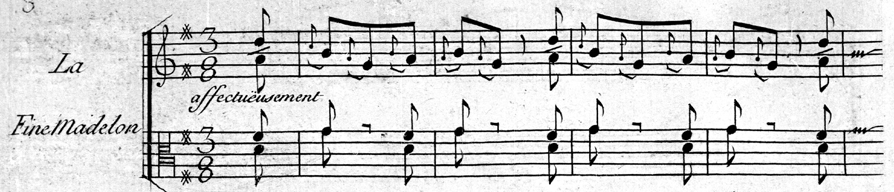
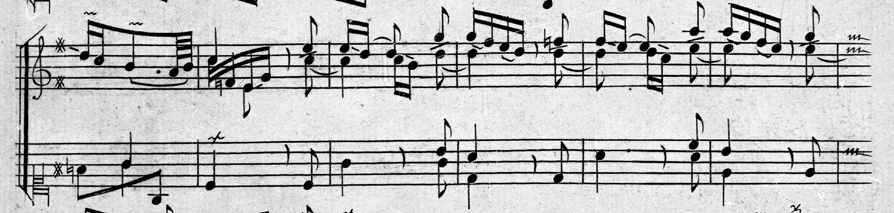
Clark and Connon identify the subjects of Couperin's La Fine Madelon (IV, 20) and La douce Janneton (IV, 20) as Magdelon from Les précieuses and the actress Jeanne de Beauval, a member of Molière's troupe. This attribution is not definitive, but is suggested by the fact that upon joining the troupe Beauval took over the roles of Madeleine Béjart, who originated the role of Magdelon.Footnote 55 Further support for the attribution takes the form of musical ‘affectations’ that may correspond to the affectations of Molière's Madelon. From the tierce coulée that begins the piece, nearly every right-hand note in the first eight bars is decorated in what might be a musical equivalent to the exaggerated language adopted by the young girl (Figure 1).Footnote 56 Moreover, the piece is broken up with aspirations, marked with commas in the score, which Couperin describes in the Preface to the Troisième livre as ‘nearly imperceptible’ (‘presque imperceptible’) except to ‘persons of taste’ (‘les personnes de goût’), or the imagined ideal audience for Magdelon's theatrics (Figure 2).Footnote 57
François Couperin, La Fine Madelon, bars 1–4, from Quatrième livre de pièces de clavecin (Paris: l'Auteur, Boivin, le Clerc, 1730), 8. Bibliothèque Nationale de France (VM7-1868). Used by permission
La Fine Madelon, bars 19–24
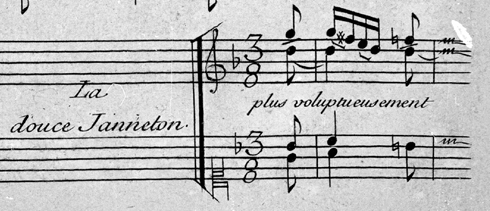
La Fine Madelon might be nothing more than a straightforward portrait, were it not for the fact that it is immediately followed with La douce Janneton. Janneton mirrors Madelon not only in its key – it is in the parallel minor to Madelon's D major – but also in its melodic contours and ornamentation. The opening two bars of Janneton come from a sequence in the second half of Madelon, albeit with a new minor-mode harmonization with frequent downbeat dissonances that contrasts with the brightness of the original (Figure 3).
François Couperin, La douce Janneton, bar 1, from Quatrième livre de pièces de clavecin (Paris: l'Auteur, Boivin, 1730), 9. Bibliothèque Nationale de France (VM7-1868). Used by permission
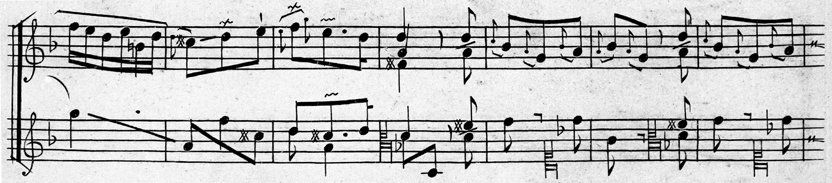
The B section of Janneton is more loosely related to the previous piece, but its sequences of descending stepwise melodies mirror the contours of the parallel section in Madelon. The minor-mode restatement of the opening material from Madelon at the close of Janneton provides the most definitive instance of musical mirroring (Figure 4). Here the left hand reaches over the right in the treble to play single harmonic notes as accompaniment, an effect that creates a different texture than in the original – seeming almost disembodied by virtue of the absent bass. Janneton ends with this empty-sounding allusion, this shadow of the stage persona, which, because of the vibrancy with which she came to life in Madelon, emerges as more ‘embodied’ than the actress who played her.
La douce Janneton, bars 21–27
The performance of these two pièces adds yet further layers of complexity to the portrait by requiring the performer to ‘act’ both roles at the keyboard. The score prescribes most elements of the roles to be played through the notes on the page and the carefully annotated ornaments. Yet as Couperin reminds players in L'Art, a good performance requires more than a flawless execution of the score; cadence involves identification of and with the ‘spirit and soul’ of a work, aided by performance indications at the beginnings of pieces. In the case of La Fine Madelon and La douce Janneton, however, these indications do not translate easily to musical execution, requiring interpretation and exposing the player to another possibility of misreading beyond that of the title. Does Madelon's ‘affecteusement’ mean ‘affectionately’ or ‘affected’?Footnote 58 And how does one play ‘plus voluptueusement’?Footnote 59 The detailed prescriptiveness of these performance directions combine with their opacity both to compel and frustrate the musical performance of character.
A further level of critique emerges from Couperin's directions for the sequencing of the pieces. At the end of Janneton appears the directive that ‘the two pieces are to be played alternately’ (‘ce deux Pièces se joüent alternativement’) in an ABA sequence beginning and ending with the fictional figure of Madelon. While Couperin often composed ‘paired portraits’ in which he linked sitters by casting the musical portraits in multiple parts marked ‘première’ and ‘seconde partie’, and so on, to be played in succession,Footnote 60 nowhere else in the four livres does Couperin expressly link two independent pièces.Footnote 61 Moreover, the performance direction seems to privilege Magdelon over Jeanne de Beauval. The fictional Magdelon effectively dominates her real counterpart, suggesting a connection to period anxieties about the theatre and the morality of actors advanced by the abbé Pérugier, who held that actors who perform secret intrigues on stage were inclined to ‘become accustomed and learn to conduct them [similarly] elsewhere as well’ (‘s'accoûtument et apprennent à les mieux conduire ailleurs’).Footnote 62 This was a special concern, given that most actors of the time, including Jeanne de Beauval, specialized in a character type or even a single role.Footnote 63 One wonders if a pièce might be suspected of transforming its player as a role potentially transformed its actor. At the very least, diligent practice integrates the musical and physical demands of Couperin's portraits with the musical sensibilities and physical capabilities of the player.
While the meta-theatre of Molière's Les précieuses ridicules entails dramatic role-playing in which multiple characters pretend to stations above their own, the meta-theatre of Brueys's L'avocat Patelin (1706), evidently portrayed by Couperin in La Pateline (I, 4),Footnote 64 involves multiple roles played by a single protagonist. The antihero of Brueys's play, adapted from the beloved fifteenth-century farce Monsieur Pierre Pathelin, is a crafty if unlettered lawyer whose shabby appearance keeps him out of work.Footnote 65 Patelin uses costume and skilful role-playing to swindle merchants and clients alike into believing him to be both a better man and a better lawyer than he truly is. By masquerading as a gentleman he obtains fabric on credit to make himself look the part of a successful lawyer. He acts as a madman when the bill comes due, and pretends to be a great scholar of law to discredit the draper who comes to collect on him. The character's many deceptions were so well known that period speakers transformed his name into the verb ‘pateliner’, meaning to ‘win a person over by address and flattery, persuade them to gain their confidence, while at the same time mislead them’ (‘gagner une personne par adresse & par flatteries, la persuader qu'elle gagne, lors qu'on la trompe’).Footnote 66
Even more than the original, Brueys's adaptation dwells often on concerns about the intersection of appearance, class, profession and character. Patelin's initial threadbare appearance hinders not only his job prospects, but also, as he reflects, the prospect of his daughter's marriage: ‘The world judges people by their costume. I confess that mine is all wrong for Henriette, and I have purposely set out to remake [or clothe] myself today’ (‘Le monde juge gens par les habits; j'avouë que ceux que je port sont tort à Henriette; & j'ai fait dessein de me mettre aujourd'hui un peu proprement’).Footnote 67 Of course, Patelin's makeover is only a temporary masquerade designed to serve his immediate ends; but so too are the masquerades perpetrated by Patelin's victims, each of whom in turn deceives their deceiver by employing the same skilful cunning.Footnote 68
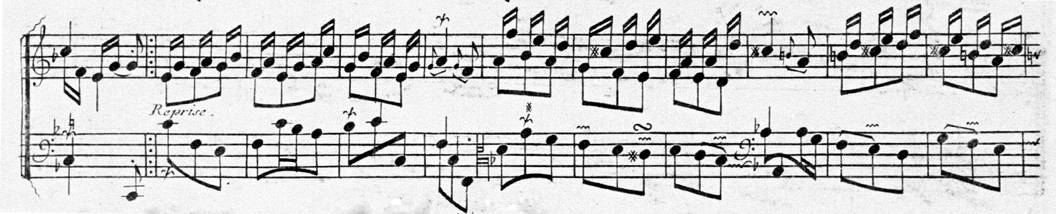
Couperin's musical portrait of La Pateline seems to highlight Patelin's inconstancy and ability to mislead and manipulate (‘pateliner’). This binary piece begins with a moderately paced melody in quavers marked ‘gracieusement’ (Figure 5) and antecedent and consequent four-bar phrases that provide a satisfying sense of balance; this may be Patelin at his most charming. Then, in a kind of musical makeover, the opening of the second half reverses the roles for right and left hand and shifts to the relative minor (Figure 6).Footnote 69 To execute the inversion the harpsichordist must, like Patlin, effect a physical and mental transformation as he or she reorients the hands. While such an inversion is not a unique compositional device, especially for an organist such as Couperin, it is exceptional in the first five ordres of the first livre and seems to be employed expressly to evoke a musical equivalent of pateliner. Footnote 70 The left-hand ‘melody’ is not particularly melodic; frequent leaps make it sound almost like a bass line. Whereas an exact inversion could reaffirm the identity of the original theme, this inversion becomes another rival identity; the modulation to the relative minor only reinforces the difference of the inversion. The texture rights itself several phrases later (bar 43) but is not as harmonically stable as at the start, tonicizing C major after only a brief return to F major. Immediately thereafter, the music shifts back to the inversion and the relative minor (bar 49). As in other binary pieces such as La Fine Madelon, a full return of the opening material appears to begin in bar 57 but proves to be only two bars in duration. The remainder of the piece alternates irregularly between the original texture and its inversion, tonicizing C major and D minor, and shifting the focus and physical orientation of the harpsichordist. Only a two-bar cadence at the end of the piece prevents the work from ending in its inverted texture and on its relative minor (bar 75). In score and performance, then, instability seems to be the most stable thing about Couperin's Patelin.
François Couperin, La Pateline, bars 1–11, from Première livre des pièces de clavecin (Paris: l'Auteur, le sieur Foucaut, 1713), 55. Bibliothèque Nationale de France (RES F-76). Used by permission
La Pateline, bars 24–34
Picaresque Heroes and Passacailles
Couperin himself once played Patelin in an episode of assumed identities related to the first trio sonata composed in France. He explains the ruse in the Preface of Les nations (1726):
Connoissant L'âpreté des françois pour Les nouveautés-étrangeres, sur toutes-choses, et me Déffiant de moy-même, je me rendis, par un petit mensonge officieux, un très bon Service. Je feignis, qu'un parent que j'ay, effectivement, auprés du Roy de Sardaigne, M'avoit envoyé une Sonade – d'un nouvel Auteur italien: Je Rangeai les Lettres de mon Nom, de façon que cela forma un Nom italien que je mis à la place. La Sonade fut devorée avec empressement; et j'en tairay L'apologie. Cela cependant M'encourageà[,] j'en fis d'autres; et mon Nom italiénisé M'attira, Sous le Masque, de grands applaudissemens.
Knowing how avid the French are for foreign novelties, and doubting myself, I rendered myself a favour through a little white lie. I pretended that a relative of mine that I really do have, who is with the King of Sardinia, had sent me a sonata by a new Italian composer. I arranged the letters of my name so that they formed an Italian name, which I gave instead. The sonata was eagerly devoured and I will make no apology. However, that encouraged me. I wrote others and my Italianized name brought me, beneath the mask, great applause.Footnote 71
The humorous confessional style Couperin adopts has unmistakable similarities to the style of the first-person narration of many picaresque heroes, especially Gil Blas, whose narrative reads as a series of confessions and explanations of social dissimulation. Like Gil Blas, who explains away his deceptions by presenting compromising circumstances that invite or even require disguise, Couperin justifies the subterfuge by explaining how tastes at the time veritably demanded and indeed celebrated this white lie. And like Gil Blas, Couperin seems to maintain that he, in a way, upheld a degree of personal and artistic integrity by incorporating these earlier ‘Italian’ works virtually unchanged into Les nations; name-change aside, he was and is Couperin.Footnote 72 Similarly, Gil Blas retains his fundamental goodness, despite the fact that in each of the four books of Gil Blas, Lesage brings his hero to the brink of losing himself in the disguise, and of betraying both his virtue and the readers who have believed in him. Gil remains at his core uncorrupted, a model of true virtue in a world of false virtue.Footnote 73 According to literary historian Ulrich Wicks, ‘his protean adaptability serves him as it does any other picaro, but he is not subject to that instability of being … ; he is basically the honnête homme about whom and to whom the French moralists were writing’.Footnote 74
The protean flexibility of the French picaro resonates particularly well with Couperin's L'amphibie (IV, 24). Couperin's chosen title seems to evoke the picaro, for both amphibians and picaros possess the ability to adapt to nearly any situation. The earliest use of the term ‘amphibie’ to refer to social adaptability appears to be Antoine Furetière's Le roman bourgeois (1666), which introduces ‘an amphibious man, who was a lawyer in the morning and in the evening a courtier; he wore a robe in the morning to plead [a case] or to hear [an argument], and in the evening he wore large guns and gold tassels to appeal to the ladies’ (‘un homme amphibie, qui estoit le matin advocat et le soir courtisan; il portoit le matin la robe au palais pour plaider ou pour écoûter; et le soir il portoit les grands canons et les galands d'or, pour aller cajoller les Dames’).Footnote 75 While Furetière's use appears to be more pragmatic than critical, referring to the multiple duties of a working courtier, La Bruyère used the term pointedly to critique the ambitious courtier: ‘There are some men at court so covetous that they catch hold of any rank or condition to reap its benefits … they are amphibious’ (‘L'on remarque dans les cours des hommes avides qui se revêtent de toutes les conditions pour en avoir les avantages … ils sont amphibies’).Footnote 76 A 1702 Satyre des moeurs et des abus du tems (Satire of the Customs and Abuses of the Times) takes the critique yet further:
The amphibian was thus, like the picaro, a chameleon that changed appearance as often as he changed environs. Whether an amphibie's true virtue endured through his disguises and adventures as did the virtue of the French picaro, however, is decidedly less clear.
Couperin's L'amphibie offers an ideal form for the study of ‘amphibious’ character traits of picaros and other deceivers because of its ever-shifting surface of musical variations. Marked ‘mouvement de passacaille’, L'amphibie bears traits of the passacaille and also of the rondeau, but like the amphibian resists generic categorization, a fact that has inspired most readings of the pièce.Footnote 78 In this, L'amphibie closely resembles the Chaconne L'inconstante from Elisabeth Jacquet de la Guerre's Suite No. 2 of the Pièces de clavessin (1687). Jacquet de la Guerre employs the hybrid form of the chaconne en rondeau and explores the ‘inconstancy’ of the title through frequent shifts in mode and even key, moving from D major to D minor, and in one couplet to B minor. The opening refrain is not designated as a ‘refrain’ but functions as one, returning in between the five couplets of the chaconne (bars 13, 25, 37) and ending the chaconne (bar 65). Its returns are for the most part unchanged, with the exception of an elegant quaver bass transition between couplet and refrain. One return (bar 37) differs from the opening refrain, with falling quaver figures that subdivide the crotchets of the original refrain, but the original returns to close the chaconne. The key and character changes are inconstant but the refrain returns intact.
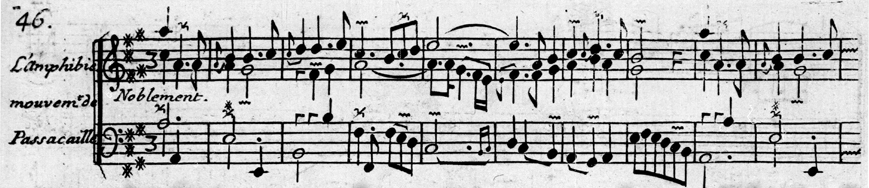
Read against the Jacquet de la Guerre, L'amphibie seems decidedly less regular (more amphibious) in its form. There is no refrain, though the harmonic progression outlined in the first eight-bar progression, appropriately marked ‘Noblement’, does function as a ground bass for all subsequent variations (Figure 7). But if one interprets the title not as a reflection on genre, but in light of the moral dimensions of ‘amphibious’ behaviour, the work can be understood to explore dangers of deception. The couplets of L'amphibie then seem to suggest both the changeability of the amphibian and the tenuously stable identity beneath. Some couplets are markedly similar – the third and fourth share the strongly profiled dotted rhythm of the opening but vary its melodic and bass contours (bars 19–40). Other couplets obscure the connection to the ground in order to destabilize the harmonic foundation of the piece through modulation and harmonic sequences.Footnote 79 In the extended section in the parallel minor (bars 65–124) a falling harmonic sequence diverts the music to C major (bars 78–85). The return from the minor is even more unstable, for the first cadential arrival on an A major chord in some sixty bars is immediately reinterpreted to prepare a modulation to D (bars 120–124), such that the key signature for A returns but A does not. At the same time, the music reinforces overarching similarities between opening and couplet and between distant couplets themselves. Extended dotted rhythms connect interior episodes in both the major and minor mode sections of the piece (bars 49–54, 73–101) while also relating to the dotted rhythms of the theme. The connection between dotted episodes is made even more concrete when the exact rhythmic profile and arpeggiated octave ascent in the right hand from an episode beginning in bar 96 periodically return in the left-hand bass line (bar 116, 120 and 124), demonstrating not only cyclic connections but also textural inversions, though each appearance outlines a different triad (C, E, A and D).
François Couperin L'amphibie, bars 1–10, from Quatrième livre des pièces de clavecin, 46
These similarities and differences play upon the muscle memory of the harpsichordist (and the aural memory of the listener), inviting a physical recollection but then subverting exact repetition. Also subversive are striking shifts in tempo and expression between certain episodes. In the course of L'amphibie, Couperin indicates eight different expressive marks – ‘Noblement’ (bar 1), ‘Coulé’ (bar 49), ‘Gaiëment’ (bar 56), ‘Modérément’ (bar 65), ‘Vivement’ (bar 73), ‘Affectueusement’ (bar 102), ‘Marqué’ (bar 116) and ‘Plus marqué’ (bar 124) – requiring the harpsichordist to determine how to shift style, tempo and character for each. In all previous passacailles and chaconnes, Couperin indicated no more than one such change in musical character.Footnote 80 Jacquet de la Guerre indicated none. All of these departures and connections, inherent in the variation-type structure, can be understood in light of the title to play upon the subtlety of similarity and difference – how a thing such as a musical couplet (or perhaps a behaviour or personality trait) can be like another or markedly different. On the one hand, these similarities seem to indicate the inherent stability of identity symbolized by the theme; on the other, differences (even within similarities) problematize that stability and threaten to subsume similarity entirely.
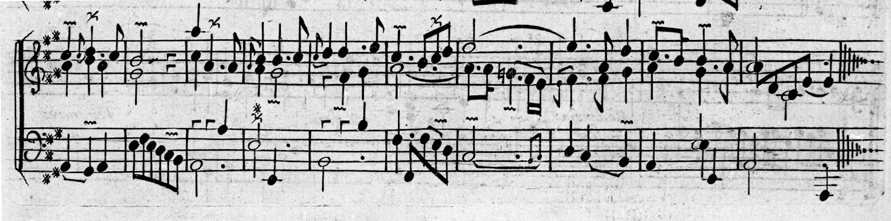
Whereas Jacquet de la Guerre's L'inconstante returns to its stable refrain, just as the French picaresque narrative of Gil Blas invariably restores the hero to himself, shedding disguise and deceit for truth and virtue, the same may not be so easily said for the hero of L'amphibie. At first glance, the piece seems to enact a similar restoration, when at the end of the variations the score shifts back to the opening material, here indicated ‘Noblement’ as at the start (bar 131). This reprise is without precedent in Couperin's other passacailles. While elsewhere he employs a passacaille en rondeau form, in none of his through-composed passacailles does he compose a return of the opening material.Footnote 81 This return, with all of its original nobility, reminds the harpsichordist of the fundamental character that is concealed within the various musical ‘disguises’ donned in each episode. However, it becomes evident that the character of the return is ambiguous. There is one glaring difference between the opening and its final return – a G♮ replaces a G♯ in the last phrase of the theme (compare bar 5 in Figure 7 and bar 143 in Figure 8). Whereas the picaresque hero retains possession of his fundamental integrity, Couperin's L'amphibie does not. This may contradict the enduring nobility of French picaros such as Gil Blas by suggesting that musical variations, like duplicitous disguises, ultimately corrupt.
L'amphibie, bars 137–146
The Universal Masquerade
Despite (or perhaps because of) the danger of disguise, the masquerade ball was a popular entertainment in the period, for costumes and masks allowed men and women to disrupt the simple equation of exterior with interior and explore an identity other than their own. As innocent as this diversion seems, the masquerade ball was a common fixture of moral and even political critiques during the period and well after.Footnote 82 As Terry Castle explains in Masquerade and Civilization,
The masked assemblies of the eighteenth century were in the deepest sense a kind of collective meditation on self and other, and an exploration of their mysterious dialectic …. The true self remained elusive and inaccessible – illegible – within its fantastical encasements. The result was a material devaluation of unitary notions of the self, as radical in its own way as the more abstract demystification of the writings of Hume and the eighteenth-century ontologists.Footnote 83
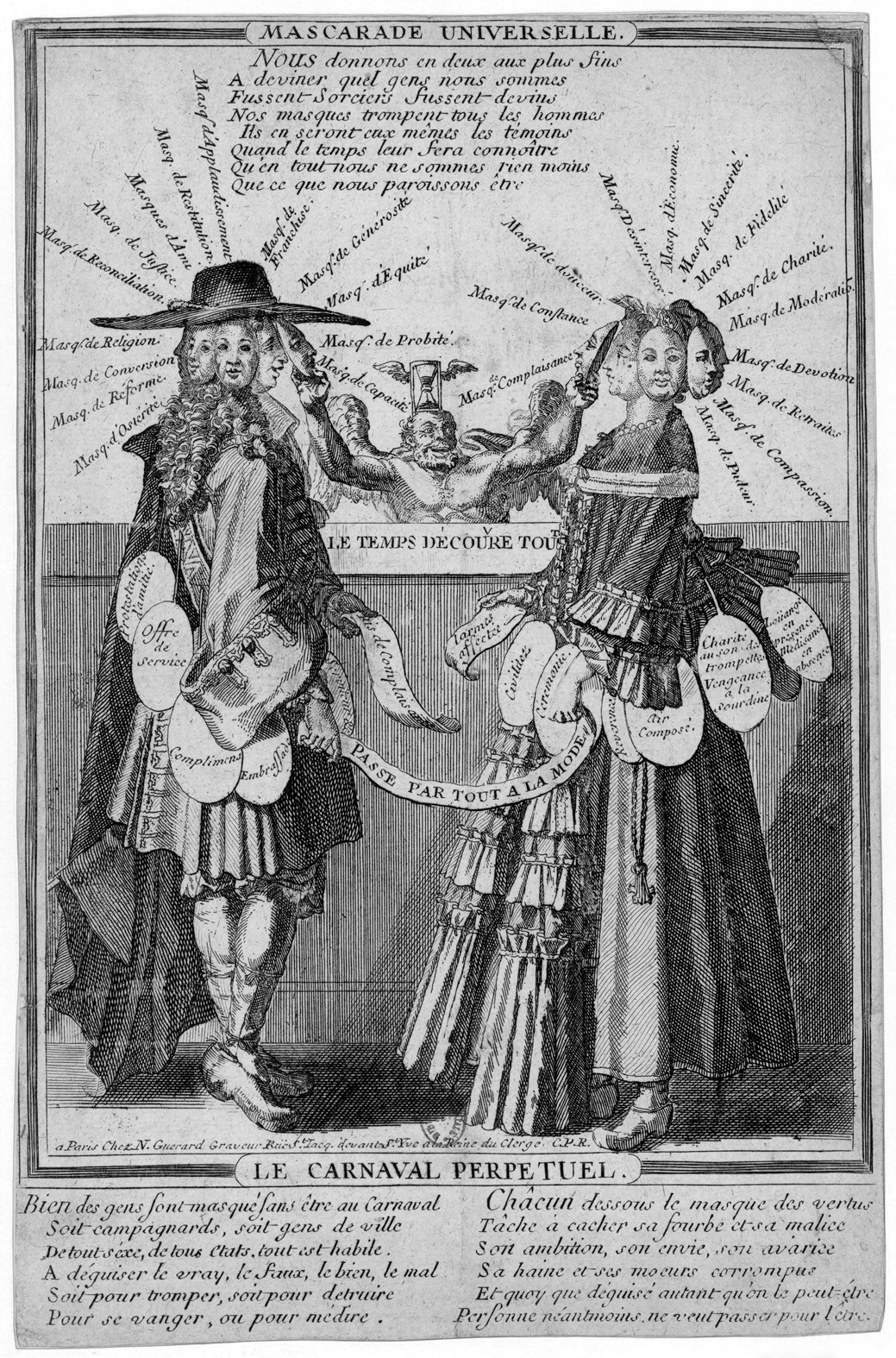
Castle ascribes to the masquerade, which was on one level a diverting pastime not unlike a good novel or an amusing play, a quasi-philosophical status in its ability to undermine the concept of a unified self. For the same reason, La Bruyère and his contemporaries used the mask and the masquerade as a metaphor in their exploration of the integrity of character or lack thereof: ‘[N**] borrows his manners from one profession, and from another his dress; he goes masked the whole year, though he does not conceal his face; he appears at court, in town, and elsewhere, always under a certain name and in the same disguise. We know what he is, and we recognize his face’ (‘[N**] emprunte ses moeurs d'une profession, & d'un autre son habit; il masque toute l'année, quoy qu'à visage decouvert; il paroît à la Cour, à la Ville, ailleurs, toûjours sous un certain nom & sous le même déguisement. On sçait quel il est, & on le reconnoît à son visage’).Footnote 84 The masquerade of everyday life is likewise the theme of a widely circulated engraving by Nicolas Guérard (c1648–1719), Le carnaval perpétuel: mascarade universelle (c1700), depicting a man and woman concealed behind multifaceted masks and multipart costumes (Figure 9).Footnote 85 The masks denote such traits as ‘Compassion’, ‘Fidelity’, ‘Sincerity’, ‘Generosity’ and ‘Religion’, while the clothing is a confusing patchwork of fabrics and styles indicating different classes and professions. The verses at top and bottom speak of deception and disguise, the former concluding that ‘we are nothing less than we appear to be’. The true faces revealed by the allegorical figure of Time are barely distinguishable from the masks themselves.
Nicolas Guérard, ‘Le carnaval perpétuel’ (Paris: chez N. Guérard, c1700). Bibliothèque Nationale de France (RESERVEFOL-QB-201(75)). Used by permission
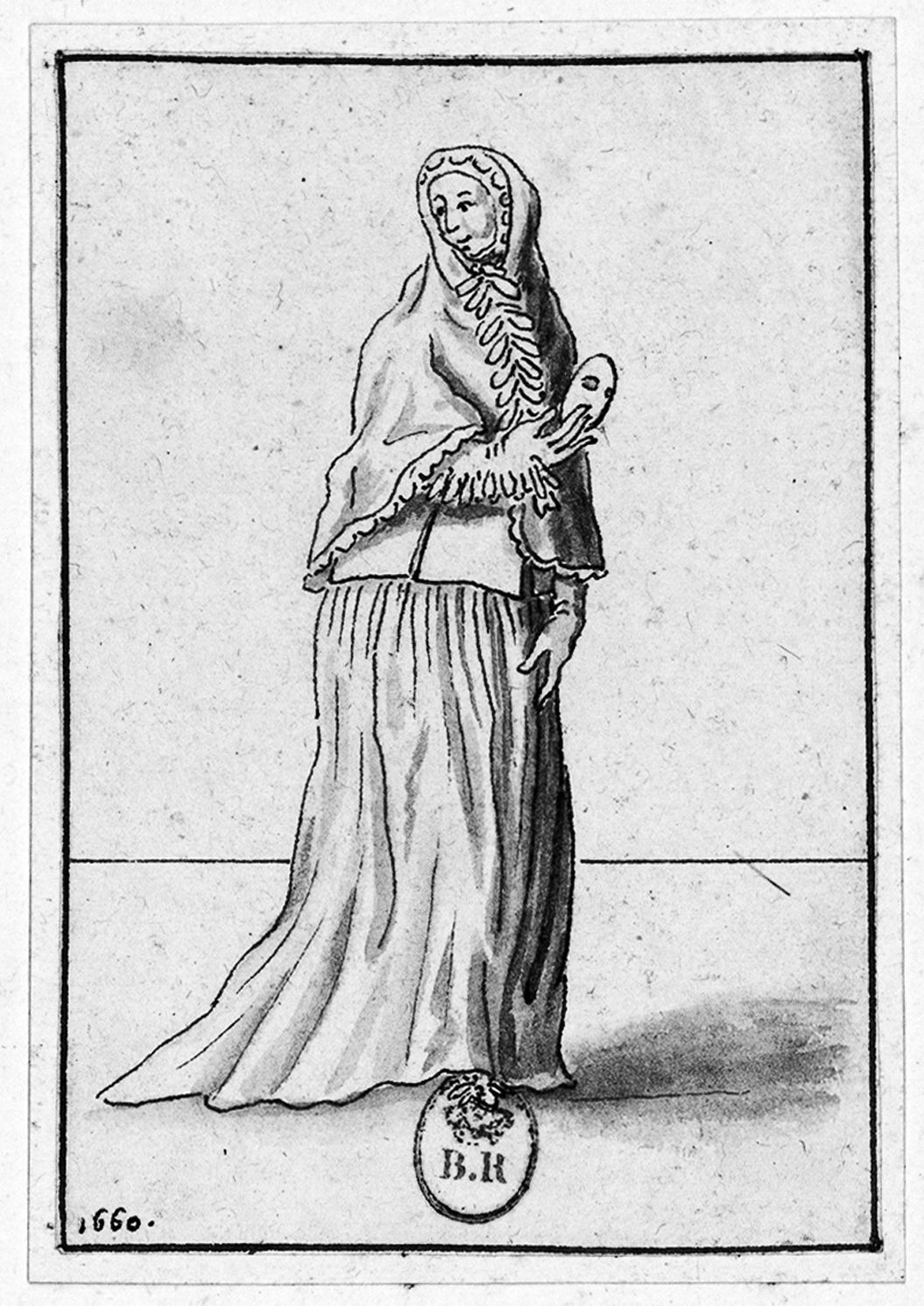
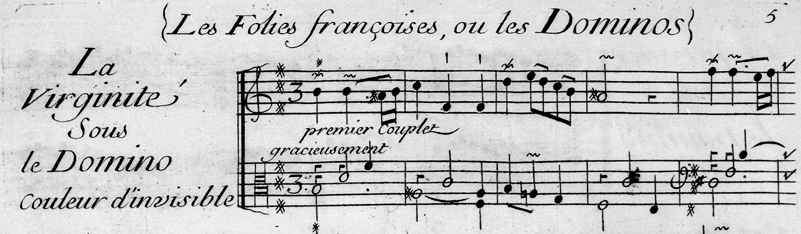
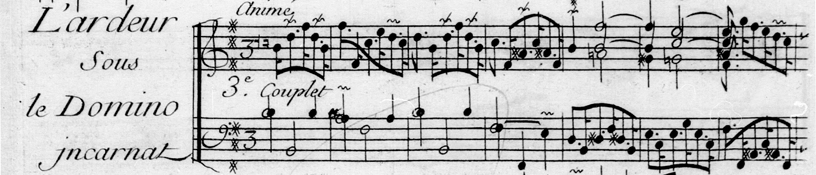
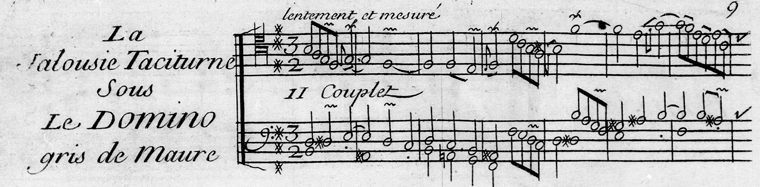
Couperin's suite within a suite Les Folies françoises, ou les dominos (III, 13), also explores masking, the passions and the relationship of exterior to interior in what is perhaps the most poignant example of the composer's musical moral criticism. The titles of the twelve couplets in Les folies refer to figures at a masked ball, each concealed head to foot by the costume of the Domino – a mask and hooded cloak (Figure 10). Couperin's Dominos represent different generic character traits evoked by a title and reinforced by a symbolic choice of costume colour. Each Domino is set to music as an independent and discrete couplet based on the harmonic sequence of the first Domino, La Virginité Sous le domino couleur d'invisible (Virginity in the Invisible Domino; Figure 11). The full collection of Dominos also includes La Pudeur Sous le Domino couleur de Roze (Modesty in the Pink Domino), L'ardeur Sous le Domino Incarnat (Ardour in the Flesh-Coloured Domino; Figure 12), L'esperance Sous le Domino Vert (Hope in the Green Domino), La Fidélité sous le Domino Bleu (Fidelity in the Blue Domino), La Perseverance Sous le Domino Gris de lin (Perseverance in the Flax-Grey Domino), La Langueur Sous le Domino Violet (Languor in the Violet Domino), La Coqueterie Sous diferens Dominos (Coquetry in the Dominos of Different Colours), Les Vieux galans et les Tresorieres Suranées Sous des Dominos Pourpres et feüilles Mortes (Old Gallants and Pensioned-Off Courtiers in Purple Dominos and Dominos the Colour of Dead Leaves), Les Coucous Benevoles Sous les Dominos jaunes (Benevolent Cuckoos/Cuckolds in Yellow Dominos), La Jalousie Taciturne Sous Le Domino gris de Maure (Taciturn Jealousy in the Dove-Grey Domino; Figure 13) and La Frenésie, ou le Desespoir Sous Le Domino noir (Frenzy, or Despair, in the Black Domino). Formally, the couplets comprise variations on the folia, a structure based on successive variations upon a ground bass and related to the passacaille and chaconne. As its ground bass, Les Folies employs what is itself a variation on the then popular folies d'espagne.Footnote 86 Variations on the folia first appeared in France in the early 1670s in publications for guitar by Francesco Corbetta, for lute by Jacques Gallot and for oboe band by Jean Baptiste Lully. A second resurgence came with the publication of Arcangelo Corelli's variations in his Op. 5 sonatas (1700) and Marain Marais's variations in his second book of pièces for viol (1701), with Jean Henri D'Anglebert's monumental variations having been published in the interim in 1689. By and large, these variation sets emphasize display of technical (and compositional) virtuosity. In contrast, Couperin's folies suggest a motivation other than technical display.
‘Une dame en domino’ (Paris: c1700). Bibliothèque Nationale de France (Bouchot, 1273). Used by permission
Les Folies françoises, ‘La Virginité’, bars 1–5, from Troisième livre de pièces de clavecin (Paris: L'Auteur, Boivin, 1722), 5. Bibliothèque Nationale de France (VM7-1866). Used by permission
Les Folies françoises, ‘L'ardeur’, bars 1–7
Les Folies françoises, ‘La jalousie’, bars 1–7
Reading Les Folies against many of the novels in Couperin's library, Citron interprets the piece as a psychological narrative of a heroine in love. He ventures a comparison between Les Folies and Les Petits âges (II, 7), the latter of which ‘under its innocent appearance, leads from la muse naissante, and l'enfantine, to l'adolescente and finally to Délices, which seems to resemble Les Folies françaises at the point at which the heroine abandons the Domino couleur d'invisible de la Virginité’’.Footnote 87 For Citron, ‘the psychological subtlety of Folies Françaises … makes one think of the Carte du Tendre’ (‘la subtilité psychologique des Folies Françaises … fera penser à la Carte du Tendre’).Footnote 88 Mellers likewise reads the couplets as psychologically expressive, describing them with evocative terms such as ‘emotional range’, ‘ponderous’ and ‘tragic passion’.Footnote 89 More recently, music theorist Caitlyn Snyder has closely studied pattern, variation and metaphoric mapping to explore just how the Folies express emotions, virtues and emotional development. In their momentary impressions and deep structure, she argues, the couplets express nuanced and realistic psychological characterizations.Footnote 90
Couperin's titles seem transparent in their meaning. They present easily identifiable virtues and character types (with coucous bénévoles understood to signify cuckolds rather than birds), abetting a ‘life-like’ performance based on identification of and with the subjects. The latter seem likewise to be readily readable. Performance directions, ornamentation and even range invite psychological interpretation in light of the titles. For example, in the third couplet, the crisp dotted rhythms, pincés and arpeggios that burst forth in the treble out of the harmonies implied by the bass line all seem appropriate to the ‘animé’ tempo of the third couplet, but in light of the title, L'ardeur, they suggest passionate enthusiasm. Similarly, the title La jalousie can give new meaning to the bass register, descending lines and double trills of the eleventh couplet, hinting at an inward-turning and bristling jealousy. Identifying with the ‘spirit’ and ‘soul’ of each variation in performance only amplifies the psychological reality of the Folies (Figures 12 and 13).
Yet as real as these psychological studies of virtue seem, they too are masks, a fact that defamiliarizes the seeming psychological reality of Couperin's portraits. Couperin's Les Folies, like Guérard's Carnaval (Figure 9), enacts a universal masquerade in which the musical depictions of character traits replace Guérard's masks. But whereas Guérard depicts a woman and man beneath the costumes, there is no stable identity behind Couperin's Dominos because Virginité is just like all of the other Dominos: she wears a mask and cloak and is a ‘premier couplet’. Virginité may function similarly to the opening of a passacaille or chaconne in that it lays out the harmonies for Couperin's modified folia progression, but it is treated differently from similar opening passages in the passacaille from the eighth ordre (II) and the chaconne La favorite from the third ordre (I), both of which leave the opening sequence unmarked and follow immediately with ‘1er couplet’, ‘2e couplet’ and so on.Footnote 91 Because La Virginité is designated as the ‘premier couplet’, there appears to be no original or originating sequence; since Les Folies employs a newly composed progression, the ‘original’ cannot even be presumed to be the folies d'espagne. What functions as such is already a ‘couplet’ just as Virginity is already a mask, if an invisible one. In fact, the ‘invisibility’ of the Virginité may have a double meaning, for Antoine Furetière defines the term in his Dictionnaire universel as referring to both what is hidden from the senses as well as that which is deliberately obscured: ‘it is also said of those that live a hidden life, who do not want to be seen’ (‘se dit aussi de ceux qui menent une vie cachée, que ne veulent pas estre veux’).Footnote 92
Though Couperin's pièces de clavecin have never been considered contributions to popular moral discourse of the period, many not only share critical strategies with contemporary literature, but also make particular use of the medium of musical performance to extend such critiques as made by literary moralists. By blurring the boundary between the performance of identity and the performance of a musical work, they problematize not just unitary identity, but also the similarities and distinctions between presentation and critique, self and other, and musical performance and performance of identity. Or perhaps I have simply misread, misinterpreted the signs, or fallen victim to mistaken identity or even deliberate deception. While Citron describes Couperin's ‘mystifications’ as ‘Voltairian’ or ‘Stendahlian’, or as pertaining to the ‘précieux’ taste for enigmatic portraiture, and Fuller likens them to an ‘in joke’ that we are no longer in on,Footnote 93 it seems to me that these pitfalls that thwart interpretation are the same that faced readers of character engaged in the social commerce of Couperin's time (and, to some degree, in our own). These works, and perhaps even all of Couperin's character portraits, expose the failings of a social order based upon inauthentic performances of identity by inviting misreading of titles and misinterpretation of pieces, while at the same time providing no escape from this flawed order. And just as there is no privileged position outside or above the play of masks and truths, there is no privileged position for the performer. He or she must necessarily perform an assumed character.
It is ironic (or perhaps fitting), then, that Couperin's portraits would become synonymous with the aristocratic culture they so often appear to critique. Less than one hundred and fifty years later critics would hear only a delightful play of surfaces in French repertoire of the early eighteenth century. In her study of early-music performance in nineteenth-century France, Katherine Ellis explains that at mid-century, ‘critical responses were mixed, alternately lauding and condemning the French repertory for its picturesque and decorative character. Both were markers of a rococo prettiness and, concomitantly, a lack of gravity.’Footnote 94 Thus critic and pianist Charlotte De Malleville could liken Couperin's Le Moucheron (II, 6) to ‘a far-off echo of the art of olden times, lulling one with sweet memories of the past’ (‘un echo lontain de l'art rétrospectif qui vous berce des suaves souvenirs du passé’) but describe the wider repertoire (collected in the Trésor des pianistes) as decorous and tedious ‘with its gruppetti, its mordents, its style stuffed full of imitations’ (‘avec ses gruppetti, ses mordents, son style continuellement serré d'imitations’).Footnote 95 Similarly, a 1968 Clavier magazine tribute to Couperin critiques the repertoire for its perceived lack of depth in a comment that, in an amusingly ironic way, resonates strongly with the imagery of Guérard's Carnaval perpétuel and Couperin's Les Folies: ‘The ornaments are so bothersome, and afterward what have you got?’Footnote 96
For many listeners and players, Couperin's music has become attached so strongly to a seemingly superficial courtly world that the pièces de clavecin are predominantly understood only to communicate and reinscribe the decorativeness of a time long past. Yet other repertoires from the era have recently received revisionist treatment by scholars who have uncovered coded political critique and social commentary in works once understood to have participated unreservedly in the fabrication of flattering representations of the king and court life.Footnote 97 Though this revisionist reading of certain of Couperin's pièces de clavecin focuses predominantly on moral critique, one might argue that a critique of the social system upholding absolutism is tantamount to a political critique as well. Reading Couperin in this light, moreover, casts a shadow on the more seemingly straightforward of Couperin's portraits, those depicting his students and other luminaries of court and urban society in the period. Though Couperin claimed that ‘most of these flattering titles are given to [should be regarded as being the property of?] the amiable originals that I have tried to represent’, one cannot help but wonder if the music could be understood as decidedly less flattering than the titles themselves. Venturing these kinds of readings is perilous given the difficulty of ascribing meaning to instrumental music, but this same difficulty could prove a virtue in encoding potentially subversive messages such as a moral condemnation of ancien-régime society. In the end, by inviting and resisting interpretation at every level, from the meaning of the titles to the possible political significance of the pièces, these works make us think about whether then, as even now, we are all participants in a universal masquerade.
Appendix Couperin's Library