INTRODUCTION
The family Kyphosidae comprises 42 species, 12 of them belonging to the genus Kyphosus Lacepède, 1801. In the Atlantic Ocean only two kyphosid species occur: the yellow sea chub, Kyphosus incisor (Cuvier, 1831), and the Bermuda sea chub, Kyphosus saltatrix (Linnaeus, 1758). This species, previously known as K. sectator, is a relatively common species in the western subtropical and tropical Atlantic, present along the west coast of Africa, from Morocco to at least the Gulf of Guinea (Desoutter, Reference Desoutter, Hureau and Monod1973; Tortonese, Reference Tortonese, Whitehead, Bauchot, Hureau, Nielsen and Tortoneose1986). This species is also present in the Mediterranean, with only six occurrences reported: three records off the Ligurian, Tyrrhenian and Adriatic coasts of Italy (Doderlein, Reference Doderlein1884; Ariola, Reference Ariola1904; see also Dulčić & Ahnelt, Reference Dulčić and Ahnelt2006) and more recently off Mallorca Island (Merella et al., Reference Merella, Massutí and Deudero1998), Algeria (Hemida et al., Reference Hemida, Kanoun, Golani, Ben Souissi, Guélorgeto and Capapé2004) and French Riviera (Francour & Mouine, Reference Francour and Mouine2008).
The Bermuda sea chub is a pelagic inshore species, commonly found in shallow waters ranging between 1 and 30 m depth, on sandy, rocky or grassy bottoms and around coral reefs; juveniles are normally found below or among floating objects, such as Sargassum weeds (Tortonese, Reference Tortonese, Whitehead, Bauchot, Hureau, Nielsen and Tortoneose1986), or in deeper waters forming small schools. This species feeds primarily on benthic macroalgae, but also on some invertebrates, namely small crustaceans and molluscs that colonize the algae (Desoutter, Reference Desoutter, Hureau and Monod1973; Tortonese, Reference Tortonese, Whitehead, Bauchot, Hureau, Nielsen and Tortoneose1986).
MATERIALS AND METHODS
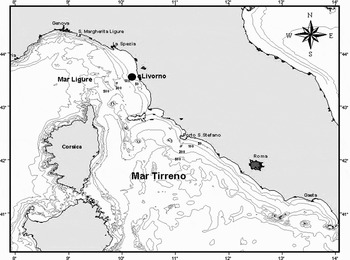
The specimen was caught by a recreational spear fisherman in August 2009, at the Meloria Banks (42°05′N 011°00′E), approximately six miles west of the harbour of Livorno (eastern Ligurian Sea) (Figure 1). The specimen was swimming alone, above a shallow rocky bottom (~5 m depth) covered by Posidonia oceanica and photophilic algae. The specimen was given to the Centro Interuniversitario di Biologia Marina ed Ecologia Applicata, where it was identified and analysed. The specimen was submitted to morphometric and meristic analyses. The total length (TL) and the wet weight were measured to the nearest 0.5 cm and to the nearest 0.5 g, respectively. Sex and maturity stage were determined by the macroscopic observations of the gonads.
Record location of Kyphosus saltatrix in the Ligurian Sea.

RESULTS
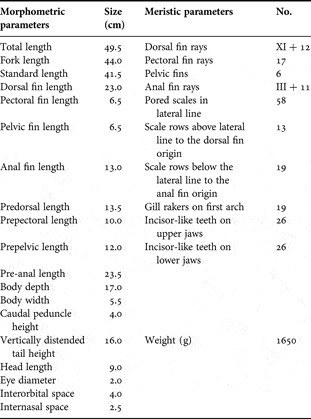
The morphometric and meristic data of the specimen are listed in Table 1. The specimen was a mature female.
Morphometric and meristic data of the specimen caught.

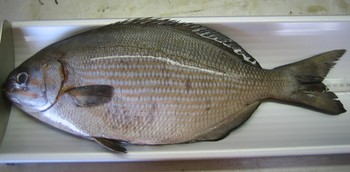
The body colour was grey, with dull longitudinal yellowish stripes on body and two dull yellow horizontal bands on head, both beginning on snout, the lowermost running under the eye to edge of the preopercle; the upper part of the opercular membrane was blackish (Figure 2). The head profile in front of and above the eyes was characterized by a distinct lump.
Kyphosus saltatrix caught in the eastern Ligurian Sea.

These characteristics are in agreement with the description of the species provided by Carpenter (Reference Carpenter and Carpenter2002).
Table 2 summarizes the records of Kyphosus saltatrix in the Mediterranean Sea.
Summary of the records of Kyphosus saltatrix in the Mediterranean Sea.

DISCUSSION
A biodiversity change and enrichment of the north-western Mediterranean fish fauna is taking place, probably due to a global warming process (Vargas-Yánez et al., Reference Vargas-Yánez, Moya, Tel, García-Martínez, Guerber and Bourgeon2009). Records of tropical species in the north-western Mediterranean continue to increase, as recently confirmed in the Ligurian Sea by the first Mediterranean finding of Kyphosus incisor (Orsi Relini et al., Reference Orsi Relini, Costa and Relini2010), as well as by other records in adjacent Tyrrhenian waters (Ligas et al., Reference Ligas, Sartor, Sbrana, Sirna and De Ranieri2007).
While the hypothesis of the presence of self-sustaining populations of some exotic species, such as Sphoeroides pachygaster, is accepted now (Ragonese et al., Reference Ragonese, Caltagirone and Jereb2001), the presence of K. saltatrix in the Mediterranean has been formerly considered accidental, due to the scarce records described. Nevertheless, since the huge number of specimens caught along the Algerian coasts reported by Hemida et al. (Reference Hemida, Kanoun, Golani, Ben Souissi, Guélorgeto and Capapé2004), the presence of Mediterranean populations of K. saltatrix could also be hypothesized. In fact, it is worth recognizing that the discovery of species far from their traditionally known distribution areas could be due not only to recent introductions or migrations, but also to the increase of scientific exploration effort, as well as to the use of new sampling techniques, which allow investigation of otherwise inaccessible bottoms and habitats (Quignard & Tomasini, Reference Quignard and Tomasini2000).
A complete knowledge on the Mediterranean fish fauna and its evolution is still far from being achieved: the presence of the Bermuda sea chub in the north-western Mediterranean, as well as other recently recorded species, should be further investigated and monitored. In this context, the contribution provided by fishermen, both professional and recreational, should be considered fundamental.
ACKNOWLEDGEMENTS
The authors would like to thank Mr Riccardo Montalbano, who provided the specimen, and Professor Lidia Orsi Relini for her precious suggestions and help in the search for literature.