Introduction
Knockdown resistance (kdr) in insects is caused by reduced sensitivity of the nervous system to pyrethroid insecticides and to DDT (Busvine, Reference Busvine1951; Soderlund & Knipple, Reference Soderlund and Knipple2003). The target site for pyrethroids is the α subunit of the voltage-gated sodium channel encoded by the para gene (Williamson et al., Reference Williamson, Martinez-Torres, Hick and Devonshire1996). In susceptible insects, pyrethroid insecticides selectively affect the dynamics of sodium channel inactivation (Soderlund & Bloomquist, Reference Soderlund and Bloomquist1989) leading to paralysis and death. In resistant individuals, mutations in the binding pocket render the sodium channel insensitive to pyrethroids (Davies & Williamson, Reference Davies and Williamson2009). Point mutations leading to amino acid substitutions within this subunit have been associated with knockdown resistance in more than twenty species of insect, including cockroach, aphids, mosquitoes, beetles, thrips, fleas, hornflies, houseflies, leafminers, whiteflies and moths (Heckel, Reference Heckel, Goldsmith and Marec2008; Davies & Williamson, Reference Davies and Williamson2009 and table 2 therein).
The first knockdown resistance mutation to be discovered was in the kdr strain of housefly (Williamson et al., Reference Williamson, Martinez-Torres, Hick and Devonshire1996). It is a point mutation, also referred to as kdr, that causes a change from leucine to phenylalanine (CTT→TTT) at amino acid residue 1014 in the Vssc1 sodium channel α subunit, and is designated L1014F. This change occurs in transmembrane segment 6 of domain II of this long protein (the designating code here, and throughout the manuscript for all species, refers to the amino acid position number in the housefly protein (Smith et al., Reference Smith, Hyeock Lee, Ingles, Knipple and Soderlund1997) (GenBank Accession X96668: Williamson et al., Reference Williamson, Martinez-Torres, Hick and Devonshire1996).
A second mutation in the housefly gene, M918T, was associated with very high levels of resistance and is referred to as super-kdr (Williamson et al., Reference Williamson, Martinez-Torres, Hick and Devonshire1996). The mutation at position M918 is an ATG-ATC substitution and is located in the middle of the IIS4-S5 linker (Williamson et al., Reference Williamson, Martinez-Torres, Hick and Devonshire1996). This mutation has been observed in Musca domestica (Williamson et al., Reference Williamson, Martinez-Torres, Hick and Devonshire1996), the horn fly, Haematobia irritans (L.) (Jamroz et al., Reference Jamroz, Guerrero, Kammlah and Kunz1998) and Myzus persicae (Anstead et al., Reference Anstead, Williamson and Denholm2005) and has not been found independently of kdr (Anstead et al., Reference Anstead, Williamson and Denholm2005: the M918 T mutation likely occurred in a copy of the gene that already harboured the L1014F mutation). When the M918 T mutation was introduced alone to the Drosophila para gene, it provided little protection from the action of DDT (Usherwood et al., Reference Usherwood, Vais, Khambay, Davies and Williamson2005).
The first strong evidence for the knockdown resistance mechanism, nerve insensitivity, was demonstrated in diamondback moth, Plutella xylostella (L.), using a pyrethroid-resistant strain from Taiwan and an electrophysiological assay (Schuler et al., Reference Schuler, Martinez-Torres, Thompson, Denholm, Devonshire, Duce and Williamson1998). In this strain, mutation L1014F is associated with a second mutation, T929I (Schuler et al., Reference Schuler, Martinez-Torres, Thompson, Denholm, Devonshire, Duce and Williamson1998). T929I is a threonine to isoleucine mutation (ACC→ATC) that occurs in the middle of segment 5 in domain II and is located 11 amino acids downstream of the position where in the housefly the M918 T mutation (super-kdr) occurred. Schuler et al. (Reference Schuler, Martinez-Torres, Thompson, Denholm, Devonshire, Duce and Williamson1998) suggested that this mutation may function in a similar manner to super-kdr and so has been referred to as super-kdr-like. As a single mutation expressed in oocytes, it causes a low level of resistance to pyrethroids (Vais et al., Reference Vais, Williamson, Devonshire and Usherwood2001) and a high level of resistance to DDT (Usherwood et al., Reference Usherwood, Davies, Mellor, O'Reilly, Peng, Vais, Khambay, Field and Williamson2007); but, when present in the same copy of the gene as L1014F, it is thought to produce additive or synergistic enhancement of pyrethroid resistance (Soderlund & Knipple, Reference Soderlund and Knipple2003; Vais et al., Reference Vais, Atkinson, Pluteanu, Goodson, Devonshire, Williamson and Usherwood2003).
In a fenvalerate selection experiment with P. xylostella, Tsukahara et al. (Reference Tsukahara, Sonoda, Fujiwara, Nakasuji and Tsumuki2003) found evidence of an association between the two mutations (L1014F and T929I) and resistance to pyrethroids, though the resistance mutations also occurred at low frequency in non-selected susceptible strains. To complicate matters, in Drosophila, mosquitoes and several Lepidoptera, there is alternate splicing in which either exon 18a or 18b (P. xylostella nomenclature of Sonoda et al. (Reference Sonoda, Tsukahara, Ashfaq and Tsumuki2008b)) may be utilized in the mature protein. This exon contains the region encoding T929; and, in a resistant strain of P. xylostella from Korea, exon 18b harbours the T929I mutation while exon 18a encodes the unchanged T929 (Sonoda et al., Reference Sonoda, Igaki, Ashfaq and Tsumuki2006). This is likely to result in two alternate copies of the protein being produced in a moth – in the susceptible strain both exons encode threonine (Sonoda et al., Reference Sonoda, Tsukahara, Ashfaq and Tsumuki2008b).
The exact relationships between these different mutations, the mutant combinations, nerve insensitivity and resistance are not fully understood but have been investigated in several species. For example, Forcioli et al. (Reference Forcioli, Frey and Frey2002), working with the western flower thrips, Frankliniella occidentalis (Pergande), found no clear association between the kdr mutation, various mutations at position T929I and resistance to pyrethroids. In the Colorado potato beetle, Leptinotarsa decemlineata, the L1014F mutation is present; and, although there is some correlation between increased LD50 and increased frequency of the resistance allele, a robust association with pyrethroid resistance was not observed in all field populations tested (Kim et al., Reference Kim, Hawthorne, Peters, Dively and Clark2005).
A lack of association means that other factors may cause resistance, such as further point mutations in the sodium channel gene that have not yet been discovered (Tsukahara et al., Reference Tsukahara, Sonoda, Fujiwara, Nakasuji and Tsumuki2003) or completely different mechanisms such as degradation of insecticides by cytochrome P450 oxidases. There is also the possibility that more than one mechanism gives rise to the resistance phenotype in an individual.
The genetic basis of resistance to pyrethroids in Australian populations of P. xylostella has not yet been characterized. This species is a destructive horticultural pest due mainly to its propensity to develop resistance to insecticides, a rapid lifecycle and lack of natural enemies in newly colonised areas or where insecticide application has led to their destruction (Talekar & Shelton, Reference Talekar and Shelton1993). Pyrethroid insecticides became available in the 1970s and have since been used extensively for control of P. xylostella in Brassica vegetables in Australia and throughout the world. More recently in Australia, pyrethroid insecticides have been used against P. xylostella in canola (oilseed rape) with varying degrees of success, and now there is sporadic and widespread resistance across the country (Endersby et al., Reference Endersby, Ridland and Hoffmann2008). Understanding the nature of pyrethroid resistance in Australian populations would be valuable for the horticultural and grains industries for future efforts to control this pest species.
In this study of Australian populations of P. xylostella, we report on three mutations in the para-type sodium channel gene, namely the two previously characterized (L1014F, T929I) and a new mutation (F1020S) that we report here for the first time. We look at the frequency of all mutations singly and in combination in populations from throughout southern Australia over a three-year period and compare these frequencies with resistance to the pyrethroid, permethrin, using a leaf-dip bioassay. A clear picture of association between these mutations, resistance and outbreaks of resistance emerges. We also discuss the utility of screening for sodium channel point mutations as a method for early detection of this type of pyrethroid resistance in populations of P. xylostella.
Materials and methods
Insect collection
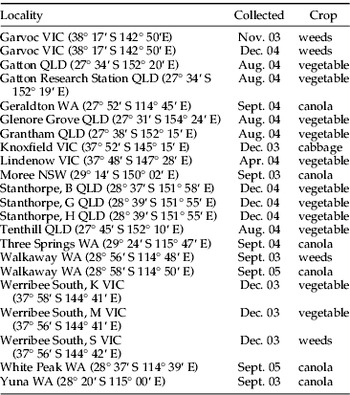
Eggs, larvae or pupae of P. xylostella were collected from 16 field sites in southern Australia, some on more than one occasion and some from closely adjacent sub-sites, from September 2003 to September 2005 (table 1). To minimize obtaining related individuals, collection was from dispersed field plants at each site where possible. Larvae were reared on seedling leaves of cabbage (Brassica oleracea var. oleracea cv. Green Coronet) at 25°C (16 h:8 h, L:D) at ambient relative humidity for one to four generations. A population (Waite) of P. xylostella that is susceptible to synthetic pyrethroid insecticides (Baker & Kovaliski, Reference Baker and Kovaliski1999) was used as a reference in each assay.
Australian samples of Plutella xylostella screened for para genotype variation.

Insecticide bioassays
Third instar larvae of P. xylostella were tested for susceptibility to permethrin using a leaf dip bioassay (after Tabashnik & Cushing, Reference Tabashnik and Cushing1987). Cabbage leaf discs of 4.5 cm diameter were dipped for five seconds in distilled water solutions of formulated insecticide (Ambush® Emulsifiable Concentrate Insecticide, Crop Care Australasia Pty Ltd, Brisbane, Australia) and hung vertically to dry in a fume hood for two hours. Control discs were dipped in distilled water. No wetting agents were used. Discs were placed into Gelman® 50 mm diameter×9 mm plastic Petri dishes. Ten larvae were placed on each disc and four replicates of seven or eight concentrations were set up for the field populations tested and for the susceptible laboratory population. Mortality was assessed after 48 h at 28°C. Larvae were considered dead if they did not move when touched with a paintbrush.
Concentration-mortality data were analysed using the probit analysis program, POLO-PC (LeOra Software) (Russell et al., Reference Russell, Robertson and Savin1977). The lethal concentration expected to cause 50% mortality (LC50) of each insecticide for each sample of P. xylostella, the 95% confidence intervals for these concentrations and the slope (+standard error) of the probit line was estimated.
Mutation assays
Extraction of genomic DNA
Genomic DNA was extracted from whole moths using CTAB-(hexadecyltrimethylammonium bromide)/phenol/chloroform, RNase, proteinase K and ethanol precipitation with 5M NaCl (based on Sambrook et al. (Reference Sambrook, Fritsch and Maniatis1989)). Each extract was used for the three separate SNP (single nucleotide polymorphism) mutation assays.
Bi-PASA assay protocol for L1014F mutation detection
To screen Australian populations of P. xylostella for the L1014F mutation, we modified the single-tube bi-PASA technique used by Kim et al. (Reference Kim, Hawthorne, Peters, Dively and Clark2005) for the Colorado potato beetle. PASA (PCR amplification of specific alleles) requires two separate PCR reactions per individual, each with primers that amplify a specific allele. Bi-PASA (bidirectional PASA: Liu et al., Reference Liu, Thorland, Heit and Sommer1997) employs a single reaction with a pair of outer primers P and Q amplifying a region containing the mutation of interest, and two allele-specific inner primers facing in opposite directions, each of which terminates with its 3′-OH end on the nucleotide position to be screened. This position is closer to one of the outer primers than the other, producing allele-specific products of different sizes. The polymerase chain reaction in 25 μl was performed using primers P (5′ ATCAC GTGGA CCGCT TCCC 3′) in exon 19 and Q (5′ TTCGG CTACT TTGTT GGTCT CCTG 3′) in exon 20, A (5′ GCGGG GCTCG TCATT GGCAA CC 3′), the forward primer specific for wild-type L1014 in exon 19, and B (5′ GCGGG CGACA ACAGC TTACC ACAAA 3′), the reverse primer specific for the kdr L1014F substitution straddling the exon 19-intron 19 junction. Numbering of exons and introns follows Sonoda et al. (Reference Sonoda, Tsukahara, Ashfaq and Tsumuki2008b). The A and B primers had short GC-clamps at their 5′ ends to control the annealing temperatures. The reaction mixture contained 2.5 μl 10× Reaction Buffer, 2.5 μl 2 mM dNTPs, 0.25 μl 10 μM of each primer, 0.5 units Taq DNA polymerase (HotMaster–Eppendorf) and 16.9 μl ddH2O. The PCR profile was initial denaturation at 95°C for 2 min, 35 cycles of 94°C for 20 s, 52°C for 20 s, 72°C for 1 min and a final extension at 72°C for 10 min. After PCR, the products were separated by electrophoresis in a 2.5% agarose gel for 1.5 h at 110 V. Primers P and Q produced a 394-bp amplicon from both alleles, A and Q produced a 233-bp fragment from the wild-type allele, and P and B generated a 207-bp fragment from the kdr-type-allele. Heterozygotes displayed all three bands. These conditions were developed after extensive optimization of primer sequences and PCR conditions, which was necessary to balance the reliable production of all three amplicons from heterozygotes. Amplicons from a subset of individuals were sequenced to validate the bi-PASA technique and confirm genotypes.
PCR-RFLP assay protocol for T929I mutation detection
To screen populations for the T929I mutation, we exploited the presence of an MboI site in the region. PCR amplification took place in a volume of 25 μl with 2 μl of genomic DNA diluted 1:4. Primers used were: SuperKDR_F1 (5′ CATGG CCGAC ACTTA ATTTA CTCAT C 3′) in exon 18b and SuperKDR_R1 (5′ CATGC AACAC TCCCA CCAA 3′) in intron 18b. These primers are specific for the region containing the T929I mutation (termed the A2 exon by Sonoda et al. (Reference Sonoda, Igaki, Ashfaq and Tsumuki2006)) and do not amplify from the corresponding region of exon 18a (A1 exon). The reaction mixture contained 2.5 μl 10× Reaction Buffer (Fisher Biotech), 2.0 μl 25 mM MgCl2, 2.5 μl 2 mM dNTPs, 0.25 μl 10 μM of each primer, 0.5 units Taq DNA polymerase (Fisher Biotech) made up to 23 μl ddH2O per sample. The PCR profile was initial denaturation at 95°C for 2 min, 35 cycles of 94°C for 20 s, 52°C for 20 s, 72°C for 1 min and a final extension at 72°C for 10 min; 5 μl of PCR product was incubated in a restriction enzyme digestion containing 0.35 μl MboI (New England Biolabs), 2 μl 10× Buffer 3, 2 μl 10× BSA and ddH2O. After digestion, the products were separated by electrophoresis in a 2.0% agarose gel for 1 h at 110 V. The allele bearing the wild-type T929 produced an uncut amplicon of 167 bp, and the mutant allele with the T929I substitution produced two restriction fragments of 66 and 101 bp. Heterozygotes displayed all three bands.
PCR-RFLP assay protocol for F1020S mutation detection
In the process of optimizing the bi-PASA method for the L1014F detection, we sequenced amplicons generated from genomic DNA with the primers SuperKDR_F1 and Q. After detection of the F1020S mutation by sequencing, we scored it using a PCR-RFLP polymorphism with StyI. The polymerase chain reaction was performed using primer pair PxSci 18F (5′ TGATC GTGTT CCGCG TGCTG TG 3′) within exon 19 and PxSci 18R (5′ GGCTT CCGCT ACTTT GTTGG TCTCC TG 3′) within exon 20. The reaction mixture contained 22.5 μl 10× Reaction Buffer (HotMaster, Eppendorf, Hamburg, Germany), 2.5 μl of 2 mM dNTPs, 0.25 μl 10μM of each primer, 0.5 units HotMaster Taq DNA polymerase (Eppendorf), 2 μl of genomic DNA diluted 1:4, and autoclaved milliQ H2O. The PCR profile was initial denaturation at 94°C for 1 min, 35 cycles of 94°C for 20 s, 60°C for 30 s, 72°C for 1 min and a final extension at 72°C for 10 min. 10 μl of PCR product was incubated in a restriction enzyme digestion containing 0.1 μl StyI (Promega), 2 μl 10× Buffer F, 0.2 μl 100× BSA and ddH2O. After digestion, the products were separated by electrophoresis in a 2.5% agarose gel for 1 h at 110 V. The allele bearing the wild-type F1020 produced an uncut amplicon of 328 bp and the mutant allele with the F1020S substitution produced two restriction fragments of 83 and 245 bp. Heterozygotes displayed all three bands.
Sequence analysis
PCR products generated from genomic DNA with the primers SuperKDR_F1 and Q using the conditions described above for L1014F were cloned into the pGEM-T Easy vector (Promega, Madison, WI, USA) and at least five clones per haplotype were sequenced on an ABI 3730 at the Australian Genome Research Facility in Melbourne. Sequences for the four haplotypes have been deposited in GenBank with the following accession numbers: w: GU797896, kdr: GU797897, skdrl: GU797898, cdr: GU797899. Coding sequences from exons 18b, 19, and 20 are shown in fig. 1b.
Population genetic analyses
Genotype scores were converted to SNP allelic frequencies by direct count and using Genepop version 4.0.10 (Raymond & Rousset, Reference Raymond and Rousset1995a). Linkage disequilibrium was assessed using LinkDos (Garrier-Géré & Dillmann, Reference Garnier-Géré and Dillmann1992). Haplotype frequencies were estimated by maximum likelihood (Lin & Zeng, Reference Lin and Zeng2006) using Hapstat version 3.0. Assessing fit to Hardy-Weinberg equilibrium (Guo & Thompson, Reference Guo and Thompson1992), assessing differentiation of haplotype frequencies among locations using an exact G tests (Raymond & Rousset, Reference Raymond and Rousset1995b), estimating F ST (Weir & Cockerham, Reference Weir and Cockerham1984) and assessing differentiation between control and permethrin survivors with an exact genotypic χ2 test (Goudet et al., Reference Goudet, Raymond, de-Meeus and Rousset1996) were also facilitated using Genepop.
Results
Genotype determinations
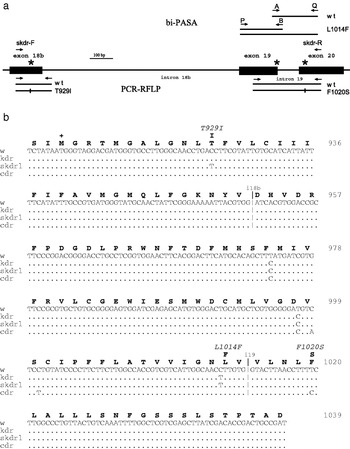
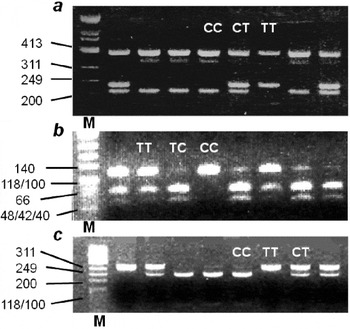
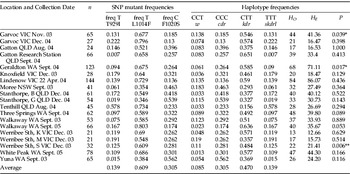
Single-nucleotide polymorphisms (SNPs) in the para sodium channel gene were scored by PCR-RFLP and bi-PASA assays (figs 1a and 2) in 1076 individuals and verified by sequencing a random sample (fig. 1b). The ‘mutant’ variants of all three SNPs were detected in all locations sampled across Australia at high frequencies, averaging 0.139 for T921I, 0.609 for L1014F and 0.305 for the new F1020S (table 2). At these frequencies, the SNP mutations were not distributed randomly with respect to each other in each of the sampled field populations since, among 1076 field-collected individuals, only ten genotypes were detected of 27 three-SNP genotypes possible under an assumption of random chromosomal association of the mutations. This strong linkage disequilibrium was confirmed between the T929I and L1014F sites, the T929I and F1020S sites and the L1014F and F1020S sites using genotypic data that takes population subdivision into account across 19 field samples (Black & Krafsur, Reference Black and Krafsur1985), with χ2(1df) values of 178.13, 122.43 and 846.66 (all P≤0.0001), respectively.
Mutations in the para sodium channel gene of Plutella xylostella. (a) Genomic region scored for mutations using PCR-RFLP and bi-PASA techniques. Asterisks mark the positions of the mutations surveyed. Primers and amplicons for bi-PASA, and restriction sites for PCR-RFLP, are indicated. (b) Nucleotide and deduced amino acid sequences of four haplotypes in the IIS4-IIS6 coding region, bounded by the primers skdr-F and skdr-R. Vertical lines denote positions of introns 18b and 19. The plus sign marks the position of the super-kdr mutation M918T in housefly.

Genotype gel assays for three para-sodium channel mutations in Plutella xylostella: (a) L1014F, (b) T929I and (c) F1020S. Scored genotypes (TT, CT or CC) are indicated for representative sample lanes and DNA size markers (φX174/Hinf1) are indicated in the M lane.

Australian samples of Plutella xylostella para SNP frequencies, and haplotype frequencies assessed for fit to Hardy-Weinberg equilibrium.

n, number genotyped; H O, observed number of heterozygotes; H E, expected number of heterozygotes;
P, probability of fit to Hardy-Weinberg proportions of four alleles (exact test of Guo & Thompson, Reference Guo and Thompson1992).
The table only includes field samples with where n>20, with mean n=56.6. * P<0.05, ** P<0.01.
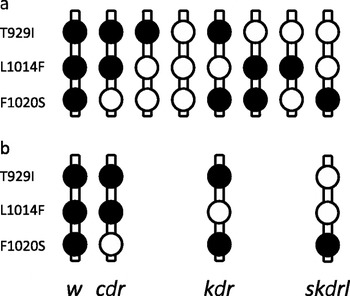
When the genotype data were used to estimate haplotype frequencies in each of the field samples, of eight possible haplotypes involving the three mutation sites (fig. 3a), only four were indicated to be present (fig. 3b). This facilitated a multiple-allele single locus interpretation, and the excellent fit of field genotype frequencies to Hardy-Weinberg equilibrium under the four-haplotype assumption (table 2) supported this approach. While we cannot exclude the possibility that one or more of the four additional haplotypes, depicted in fig. 3a, occur in Australian P. xylostella populations, if they are present, they would be at low frequency. Complete linkage association is also consistent with previous reports in Korean P. xylostella populations that only found the T921I substitution along with L1014F within a single haplotype, although L1014F may occur alone (Kwon et al., Reference Kwon, Choi, Park, Lee, Miyata, Clark and Lee2004). Thus, our survey of Australian populations of P. xylostella indicates that only the four haplotypes, which we call w, cdr, kdr and skdrl (figs 1b and 3b), are present, cdr being an acronym for crash down resistance by analogy to knock down resistance (c also representing the mutant base cytosine of this resistant haplotype). We interpret the distribution and bioassay data accordingly.
(a) Theoretical and (b) observed haplotype configurations for three para sodium channel mutations of Plutella xylostella in Australian populations (w=wildtype C-C-T; cdr=C-C-C; kdr=C-T-T; skdrl=T-T-T; these are not representations of codons but instead indicate the variant wild-type or mutant base within each of the three codons at positions 929, 1014 and 1020). Closed circles represent the susceptible variant; open circles the resistant variant.

Spatial and temporal variation
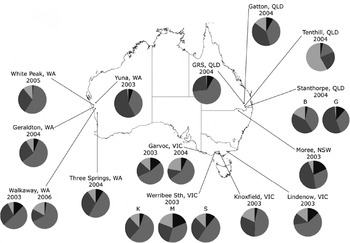
The Australian samples are widespread, being separated by distances of up to 3800 km, and were taken over three consecutive seasons. However, as indicated, some of the samples were clustered in cropping areas on opposite sides of the continent. The four haplotypes were each present in all the field populations sampled across Australia (table 2, fig. 4). The most common was the kdr haplotype at an average frequency of 0.47 and ranging between a low of 0.153 at Tenthill to a high of 0.651 at Gatton Research Station, both sites being sampled in Queensland in 2004 and being separated by only 25 km. The rarest haplotype, w, averaged a frequency of 0.085, with a range from 0.013 at White Peak in WA to 0.183 at Moree in NSW.
Variation in frequency of the four para gene haplotypes of Plutella xylostella across Australia (Haplotype Key:  , CCT (w);
 , CTT (kdr);
 , CCC (cdr);
 , TTT (skdrl))

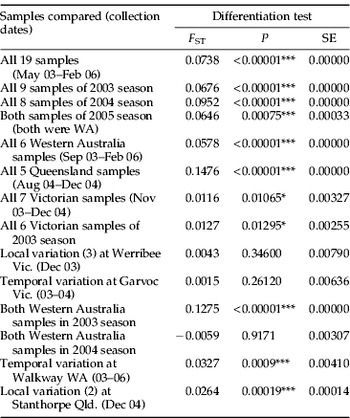
When all 19 field samples are compared, clear differentiation in haplotype frequencies occurred. Variation was measured by F ST (table 3), with an average value of 0.074 across all pair-wise sample comparisons. This is noticeably higher than the overall average F ST of 0.005 obtained for six microsatellite loci across a similar geographic set of Australian P. xylostella samples taken between 2001 and 2003 (Endersby et al., Reference Endersby, McKechnie, Ridland and Weeks2006). The average level of para haplotype differentiation was of similar magnitude and remained highly significant, even if comparisons were confined to particular regions. Thus, heterogeneity remained, though slightly reduced in magnitude, if the comparisons were confined to the cluster of six samples in close proximity in Western Australia, or was exacerbated if the comparisons were among the five sample cluster in Queensland within a single season, with average F ST reaching a high of 0.15 (table 3). However, such a high level of differentiation of clustered samples did not occur among the seven Victorian samples where the average F ST was reduced to 0.012.
Summary of spatial and temporal allelic differentiation and F ST estimates among para haplotypes of Australian P. xylostella field samples.

Contingency test probability
* P<0.05, *** P<0.001.
Strong spatial differentiation was the rule rather than the exception, and it was not accounted for by changes across seasons. Thus, the strong average level of differentiation persisted when comparisons were only between samples taken within single seasons (table 2), even within seasons within States, except for the two Western Australian samples taken in 2004 and among the six Victorian samples in 2003. No consistent pattern of differentiation was detected in space or time. Thus, whereas no differentiation was detected among three samples from adjacent growers in 2003 at Werribee in Victoria (average F ST=0.004), significant local differentiation (F ST=0.03) occurred between two adjacent sites taken from Stanthorpe in Queensland in 2004 (fig. 4, table 3). Likewise, between-season differentiation was absent in Victoria at Garvoc when the 2003 and 2004 seasons are compared (F ST=0.002), but differentiation was marked between the 2003 and 2005 seasons at Walkaway in Western Australia (F ST=0.03).
Pyrethroid resistance assays
Over a 30 month period from November 2003 to March 2006, 25 permethrin resistance leaf-dip bioassays were carried out on either field-collected individuals or on mass-reared early-laboratory-generation individuals from a geographically diverse group of populations. Each population assay involved an estimate of the level of permethrin resistance and the genotype determination of the three para SNPs, both in a sample of control individuals and of adult survivors of the permethrin treatment (at concentrations in excess of 56 ppm).
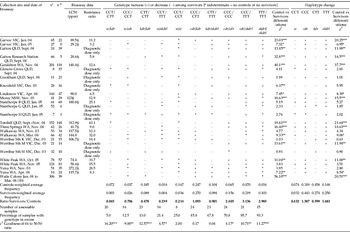
Many assays (12 of 25) showed marked and significant differentiation between the control samples and the survivors in the relative numbers of the ten genotypes (table 4), indicating differential genotype mortality following permethrin treatment. Across all assays, the pattern of excess survivors was clearly associated with three genotypes CCC/CCC, TTT/TTT and CCC/TTT, corresponding to the cdr/cdr homozygote, the skdrl/skdrl homozygote and the cdr/skdrl heterozygote, respectively. For each genotype, a ratio of its genotype frequency among survivors to its frequency in the control sample, over all trials, provides a rough measure of its relative survival under pyrethroid stress. Thus, these three genotypes had relative survival levels of 2.41, 2.99 and 3.14, respectively.
Survival performance of P. xylostella para-sodium channel genotypes and haplotypes following leaf-dip bioassay of permethrin resistance carried out between 2003 and 2006 on field-collected or early generation laboratory-reared larval instars.

n†=number of controls genotyped.
n #=number of survivors genotyped.
§ LC50 previously reported in Endersby et al., Reference Endersby, Ridland and Hoffmann2008.
ψ Contingency test probability.
* P<0.05, ** P<0.01, *** P<0.001.
While these ratios for a given genotype were highly variable across the assessable samples (mainly due to low numbers of a given genotype within samples), we would expect 50% of samples to exceed a ratio of 1.00 and 50% to be less than 1.00 if there was no differential survival following insecticide treatment. For each of these three genotypes, a significant excess of samples with a ratio greater than 1.00 occurred, indicating that they conferred a significant survival advantage (table 4). While not significantly higher, it is worth noting that the skdrl/cdr heterozygote had the highest survival ratio. Among genotypes that were particularly poor survivors were the w/kdr heterozygote (with a survival ratio of 0.05), the w/skdrl heterozygote (with a ratio of 0.24), the kdr/kdr homozygote (with a ratio of 0.48) and the w/cdr heterozygote (with a ratio of 0.71), all of these showing a significant excess of samples with a ratio less than 1.00. While the wildtype homozygote w had a low survival ratio of 0.21, it did not have a significant excess of samples with a ratio less than one, likely due to the rarity of the genotype and the resulting insensitivity of the χ2 test when fewer samples were assessable. No indication of an advantage or disadvantage under permethrin stress occurred for the remaining two genotypes, cdr/kdr (with a ratio of 1.09) and kdr skdrl (with a ratio of 0.90).
A similar analysis was carried out for each haplotype within each assay by comparing its frequency among the survivors to its frequency in the controls and asking whether it increased or decreased as a result of the insecticide (table 4). As expected from the genotype results, the cdr and skdrl alleles increased in frequency among survivors in the majority of assays at the expense of w and kdr, the differentiation being highly significant in most cases. The relative ‘fitness’ of skdrl at 1.68 is indicated to be higher than cdr with a ratio of 1.39, with kdr (at 0.60) and w (at 0.43) having reduced performance levels.
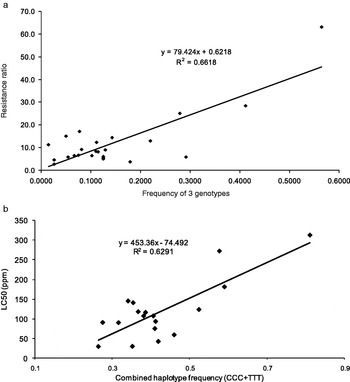
Extensive spatial and temporal variation of pyrethroid resistance of P. xylostella among field locations across Australia has recently been reported (Endersby et al., Reference Endersby, Ridland and Hoffmann2008). Does the molecular variation in the para gene help explain the resistance variation? A plot of the combined frequency of the three resistant genotypes against the permethrin resistance ratio indicates that it does (fig. 5a). A significant regression analysis indicates that ∼66% of the field variation in resistance ratio is accounted for by the observed frequency of these genotypes at each site. This association is equally accounted for if the Hardy-Weinberg expected frequency of these genotypes is used as the predictor (y=84.847x+0.9025, P<0.0001, R2=0.66) or if the LC50 measure of resistance is used instead (y=439.69x+31.523, P<0.0001, R2=0.66). Our data suggest that if the combined allelic frequency of the two ‘resistant’ alleles (cdr+skdrl) is used as the predictor, the associations are not as high, but remain highly significant, explaining ∼60% of the variation in resistance ratio (y=85.174x–18.574, P<0.001) and ∼63% of the variation in LC50 (fig. 5b). Using the individual SNP mutant frequencies separately as predictors of resistance variation is far less informative and of borderline significance.
Associations in Plutella xylostella between Australian geographic variation in permethrin resistance and genotype variation at the para gene locus. (a) observed combined frequency of the three resistant genotypes (cdr/cdr+cdr/skdrl+skdrl/skdrl) versus the resistance ratio; and (b) combined frequency of the two resistant haplotypes (cdr+skdrl) versus LC50.

Discussion
The mutations in the para voltage-gated sodium channel that confer target-site pyrethroid resistance are limited in number, but many recur independently in a variety of different insect species, including Lepidoptera (Heckel, Reference Heckel, Goldsmith and Marec2008). This pattern is caused by rigid structural constraints on the protein structure, causing a large portion of the amino acid sequence to be absolutely conserved among insects and even vertebrates, allowing very few sites to vary. The L1014F substitution, first discovered in the kdr strain of housefly, is one of these and has been found in many other resistant species. Thus, it has been of interest to examine these variable sites in additional species with resistance problems, as has occurred in many population studies. However, a focus on known mutations can lead to a bias against discovering new ones, as illustrated by our fortuitous discovery of the novel F1020S substitution. The advent of new high-throughput sequencing technologies will offer the opportunity to survey population variation in the entire gene in a less biased manner.
The phenylalanine found at position 1020 is invariant in all animal species to our knowledge (Schuler et al., Reference Schuler, Martinez-Torres, Thompson, Denholm, Devonshire, Duce and Williamson1998, fig. 4 depicts eel, ascidian, squid, jellyfish, rat and housefly) and, as such, may be a key structural element. O'Reilly et al. (Reference O'Reilly, Khambay, Williamson, Field, Wallace and Davies2006) used homology modelling of the housefly sodium channel with docking to various pyrethroid structures and predicted the pyrethroid binding site to occur between the IIS5 and IIIS6 helices. F1020 on the IIS6 helix does not appear to be a determinant of binding to pyrethroids, as it is far away from the predicted binding cavity, as is L1014. Assessment of the functional significance of the F1020S substitution will require heterologous expression, such as been performed for other substitutions.
The invariant nature of F1020 and flanking region, together with its proximity to L1014, may have paradoxically led to its being overlooked as a possible resistance site in previous surveys. This is because this region has been used as a target for the design of degenerate primers to screen for variation at L1014. Primer D3 of Martinez-Torres et al. (Reference Martinez-Torres, Devonshire and Williamson1997), which was used to amplify the L1014 region from eight previously-uncharacterized insect species, contains this site. Thus, the identity of positions 1015–1020 across these species depicted in fig. 2 of Martinez-Torres et al. (Reference Martinez-Torres, Devonshire and Williamson1997), including the invariant F at position 1020, derives not from the actual sequence of these species but from the D3 primer sequence itself. Consequently, additional sodium channel variants in other species, even quite close to known mutations, may have escaped detection.
Once mutations are identified, accurate and efficient methods must be used for population screening. Optimising assay conditions is especially important for the bi-PASA technique, in which up to three different amplicons are competing in the same PCR reaction. Kim et al. (Reference Kim, Hawthorne, Peters, Dively and Clark2005) found that a bi-PASA screen for the L1014F substitution determined the correct genotype 98% of the time, compared to sequence-validated cases. Our sequencing of gel-scored individuals, including 24 that scored initially as containing the ‘unnamed’ haplotypes of fig. 3a, found a low error rate and confirmed that the ‘unnamed’ haplotypes were absent. We estimate one incorrect SNP genotype per 181 scored SNPs, assuming our mis-scoring occurred at random across all genotypes. This is a low and acceptable level, given the magnitude of the temporal and spatial allele frequency variations detected.
The kdr mutation is recognized as an ‘old’ mutation, having been detected in Korean P. xylostella collected prior to the widespread use of pyrethroids (Kwon et al., Reference Kwon, Choi, Park, Lee, Miyata, Clark and Lee2004). It was probably selected for in populations with early use of DDT. The T921I substitution is thought to be an additional mutation that originally occurred in a copy of the gene that already harboured the kdr mutation (Sonoda et al., Reference Sonoda, Igaki and Tsumuki2008a). Our data are consistent with this interpretation since, in the ∼2700 P. xylostella genotyped in this study, we found no evidence of these two mutations occurring on different chromosomes.
The F1020S substitution, on the other hand, occurs in field populations independently of kdr and skdrl, only being found in the cdr haplotype in the absence of the L1014F and T921I substitutions. Thus, it appears as if the F1020S mutation has arisen on a wild-type sequence of the gene, likely in recent times and possibly within Australia (unless it was present, but undetected, in other non-Australian studies due to primer design issues mentioned previously). It was not observed by Sonoda et al. (Reference Sonoda, Tsukahara, Ashfaq and Tsumuki2008b) who looked thoroughly for mutations throughout the gene in P. xylostella from Japan.
Records of P. xylostella in Australia date from 1882 (Linnean Society of NSW, 1884; Tryon, Reference Tryon1889) and microsatellite and mtDNA data suggest that it is relatively isolated from SE Asian, African and Korean populations, that it has reduced variability, is genetically homogeneous and that it experienced a founder effect in recent times (Endersby et al., Reference Endersby, McKechnie, Ridland and Weeks2006; Saw et al., Reference Saw, Endersby and McKechnie2006). The L1014F and T921I mutations must have been present in the founding populations at low frequencies. The F1020S substitution may have been overlooked elsewhere or may be confined to Australian P. xylostella.
The genotype and haplotype survival patterns from the resistance bioassays strongly suggest that Australian P. xylostella populations harbour two alleles of the para gene that confer pyrethroid resistance, the skdrl allele and the cdr allele, that give rise to three resistant genotypes, the corresponding two homozygotes and individuals that are heterozygous for this pair of alleles. In general, excellent agreement of genotype frequencies in field samples, and in first laboratory-generation mass-reared individuals (data not shown), to Hardy-Weinberg expected frequencies suggest that there are no marked fitness costs (viability costs) to individuals bearing the resistance alleles, a point previously made about the P. xylostella kdr and skdrl haplotypes in Korean populations (Kwon et al., Reference Kwon, Choi, Park, Lee, Miyata, Clark and Lee2004).
Selection for single-gene insecticide resistance is usually thought of in terms of dominance or recessive gene-substitution models. However, the patterns of genotype-resistance association among Australian P. xylostella suggest the possibility that a heterozygous advantage model is also appropriate. While not statistically significantly so, the survival ratio of the cdr/skdrl heterozygote was the highest of any genotype in our data set and suggests that it is at an advantage under pyrethroid stress. The mechanistic basis of any such heterosis is unknown. A heterozygous advantage fitness regime would help maintain both resistance alleles in a population that is repeatedly exposed to pyrethroid spraying, especially if there is a fitness cost (reproductive or subtle viability cost) associated with either homozygote.
Both of the resistance alleles are widespread in Australian field samples, their combined frequency falling between 25% and 59% (fig. 4, table 2). This has allowed a high resistance level to be attained by different means in different Australian populations, the most resistant sample (LC50=330 ppm) having come from Tenthill in Queensland where the skdrl haplotype is at particularly high frequency (fig. 4). Contrast this to the relatively high level of resistance at Yuna (LC50=272 ppm) more than 2500 km away in Western Australia where the cdr allele is at very high frequency, and skdrl is almost absent. This is not a function of distance apart, however, since Stanthorpe B, quite close by to Tenthill in Queensland, with high resistance (LC50=181 ppm) has a high frequency of both resistance alleles, particularly cdr, in contrast to Tenthill. Local patterns of insecticide use, in type and intensity, may be responsible for such close-by spatial disparity of resistance allele frequencies. This pattern contrasts with the generally low level of population structure seen in the analysis of microsatellite and mtDNA markers across Australia.
Another main mechanism of resistance to insecticides found in P. xylostella is the enhanced action of cytochrome P450 oxidases (Sun, Reference Sun and Talekar1992), but this has not been studied in detail in Australian populations. The kdr type resistance is unaffected by synergists (Soderlund & Knipple, Reference Soderlund and Knipple2003); therefore, any synergisable pyrethroid resistance identified in P. xylostella should be investigated further in case a P450 mechanism is acting.
Some of the LC50 data reported here were included in a recent spatial and temporal analysis of a much larger data set on pyrethroid resistance variation across Australia over an 11 year period (Endersby et al., Reference Endersby, Ridland and Hoffmann2008). In that study, differences in the incidence of resistance among local populations were often stable over several years and local selection brought on by local patterns of insecticide use were postulated to be factors responsible for the spatial resistance heterogeneity. Our current data on spatial allelic variation in a major resistance gene are consistent with this idea. So, despite the known long-distance dispersal and colonisation behaviour of this species, in Australia (Endersby et al., Reference Endersby, McKechnie, Ridland and Weeks2006; Saw et al., Reference Saw, Endersby and McKechnie2006) and elsewhere in the world (Chapman et al., Reference Chapman, Reynolds, Smith, Riley, Pedgley and Woiwood2002; Honda, Reference Honda and Talekar1992), that effectively homogenizes genetic marker frequencies at ‘neutral’ loci, local contemporary selection maintains spatial allelic differentiation at a locus that has a major effect on an adaptive trait. In fact, several studies now interpret the heterogeneity in spatial variances between loci, as is the case here for microsatellite loci and the para gene variation, to be a signature of selection (Avise, Reference Avise2004; and see Lewontin, Reference Lewontin1974).
Finally, the capability to test for pyrethroid resistance may be valuable for the horticultural and grain industries, for a number of reasons: (i) to identify a resistance mechanism early in an outbreak, allowing for more informed treatment decisions; (ii) to confirm that resistance rather than defective insecticide contributed to spray failure; (iii) to help monitor change in resistance level over time, allowing for general advice to the industry; and (iv) to help to identify that new resistance mechanisms have arisen, thus adding to our understanding of resistance evolution and improving prospects for control. Once these are identified, simple and inexpensive SNP assays targeted to the most common resistance mutations, such as those used here, provide the most flexible way to track their variation in space and time.
Acknowledgements
Thanks to the Department of Agriculture, Western Australia and Queensland Department of Primary Industries for contributing some P. xylostella for this study. Thanks to Philip Batterham for use of CESAR Melbourne facilities in the latter part of this study. The study was funded by an Australian Research Council Strategic Partnership with Industry Research & Training Grant, Department of Primary Industries Victoria (Industry Partner), the Grains Research and Development Corporation, CESAR-a Special Research Centre of the Australian Research Council, Biotechnology and Biological Sciences Research Council (BBSRC) and the Max-Planck Gesellschaft.